The Editions' Mailbag
pp. 28-29 · Read in the full issue
That Palm Is A
Small-time Freak
Jim Shortall, PlM’s staff corre spondent in Suva (at present he is in Auckland), shoots across a note to us right on the heels of that photograph of the forked coconut palm, which we published on page 49 of the February issue. He draws our attention to some earlier PIM correspondence on the subject of forked coconut palms, which makes it pretty clear that they may be rare, but they are not unique.
And just to prove it, right on the heels of Jim Shortall’s note, comes one from Mr. B. Mennis, of Rabaul, who says there is at least one other coconut fork palm in the Territory —this one about 100 miles south east of Port Moresby, on the South Coast of Papua. Mr. Mennis noticed it when he was surveying that area for the Administration recently, but “did not obtain a photograph of it, thinking, in my ignorance, that it was not an uncommon occurrence.”
Anyhow, it seems that back in 1937, PIM published a number of examples of forked palms.
One photo, published in October, 1937, was of a palm branching into three, about 10 feet above ground level, and with a healthy supply of nuts at the head of each branch.
It was then growing on BP’s Fanning Island plantation and the photo was sent in by the late Ellen
Leembruggen.
But the three-trunked palm was thoroughly put to shame when J. D.
McComish sent in a photo of a seven-trunked palm, at that time growing in front of the Adminis tration offices at Avarua, Rarotonga.
The Rarotonga palm was different in that all seven trunks commenced at ground level from a single nut.
Photographer McComish was told that the nut, a freak with seven sprouts, had been sent in from one S? e P uter Co 9k Islands as a gift to the then Resident Commissioner, who had planted it.
McComish doubted that there could be such a nut and discussed the matter later with the late Dr.
Gemt p. Wilder, botanist attached to the Bishop Museum of Honolulu, who examined the growing palm very closely. Wilder told McComish he was prepared to accept the statement that these seven trunks had indeed grown from a single nut.
He personally had seen one other coconut with four sprouts and several with two or three sprouts. f rom the appearance of of pron £ ed Palm, a photo p/M- hl S h appeared in February, 1938, would estimate it to have en planted at least 15 years be
f<pre the photo was taken, and sibly a good deal longer. It the Fanning Island palm—ma ke in existence, though the j tonga sample may have beer rooted in the development scl of recent years. That part: sample could be unique am such, is a genuine botanical curi And some years ago, PIM published a photo of another of coconut freak. The trunk curved over to re-enter the gi in the form of an arch, and then decided to resume its ve growth after apparently taking at this point.
He Says The Nakanai
Were Hanged
Mr. A. C. Eldred, of Wau, Guinea, won’t agree with fc District Officer Ted Taylor th£ the Nakanai murderers had death sentences commuted to imprisonment. He says at least of them, if not more, were ha in Rabaul in 1927.
The story Mr. Eldred refers tc on page 15 of the February i and told how the late Errol p in his autobiography, had appar used the Nakanai murders as basis for a fictitious story g
some hangings in Madang—han*
which Flynn says he himself nessed.
Mr. Eldred says he was fore in the Public Works Departmei Rabaul at the time of the Nak murders and it had been his to build the scaffold for the hi ings. He says he had been instru to attend the function to see tha scaffold worked, “but did not the actual drops”. Mr. Eldred mentions that it was his job to ] the coffins made for the four E peans murdered by the Nakan PIM was not published in 19 it did not come on the scene i three years later—so we can’t up our files for a report on matter. But we have heard Nakanai story before, of course, our recollection is that it happt the way Ted Taylor says it did, that nobody was hanged.
But there are several people can think of who will know the tails, and we’ll let the experts f it out.
Tahiti History In A
Scots Church Yard
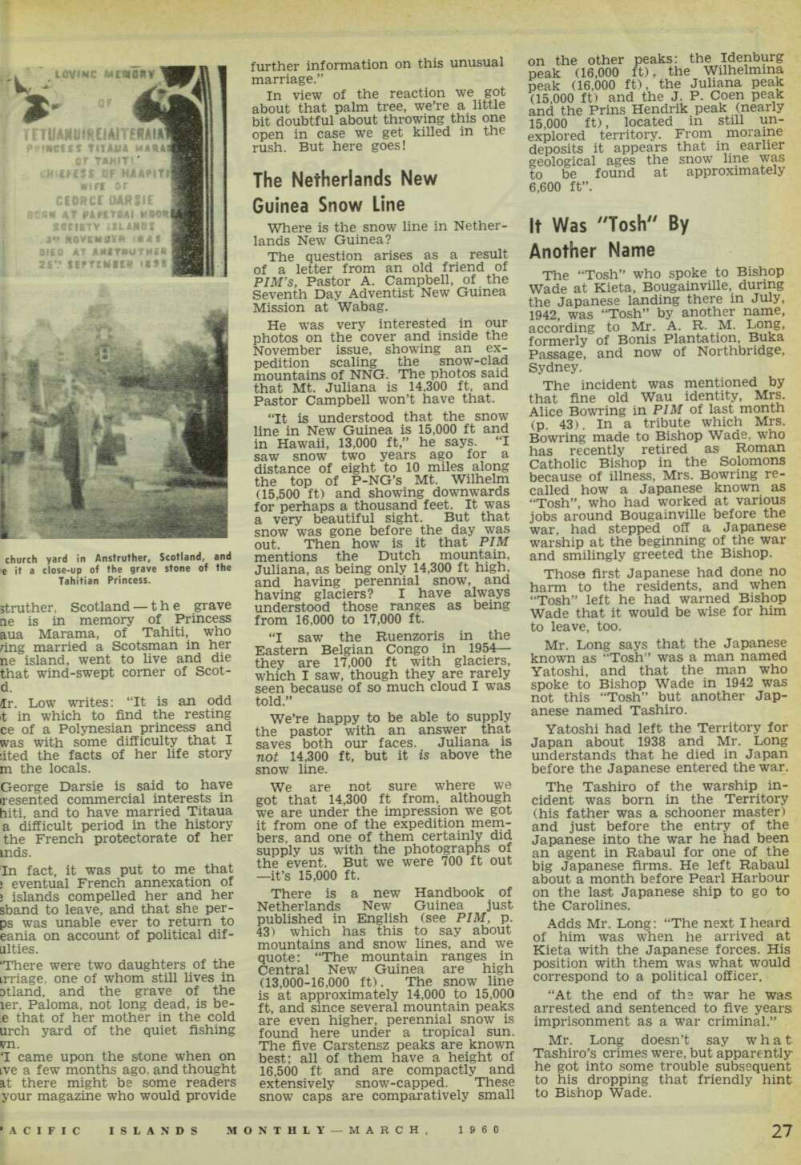
The photographs of an romance on next page come f] Mr. W. R. M. Low, of Honiara, the British Solomons. They si a grave yard and grave stone
struther, Scotland the grave ne is in memory of Princess aua Marama, of Tahiti, who ring married a Scotsman in her ne island, went to live and die that wind-swept comer of Scot d.
HLv. Low writes; “It is an odd it in which to find the resting ce of a Polynesian princess and was with some difficulty that I sited the facts of her life story m the locals.
George Darsie is said to have iresented commercial interests in hiti, and to have married Titaua a difficult period in the history the French protectorate of her tnds.
In fact, it was put to me that ; eventual French annexation of * islands compelled her and her sband to leave, and that she per ps was unable ever to return to eania on account of political dif alties. ‘There were two daughters of the irriage, one of whom still lives in Dtland, and the grave of the ler, Paloma, not long dead, is be •e that of her mother in the cold arch yard of the quiet fishing vn.
T came upon the stone when on tve a few months ago, and thought at there might be some readers your magazine who would provide
further information on this unusual marriage.”
In view of the reaction we got about that palm tree, we’re a little bit doubtful about throwing this one open in case we get killed in the rush. But here goes!
The Netherlands New
Guinea Snow Line
Where is the snow line in Nether lands New Guinea?
The question arises as a result of a letter from an old friend of PlM’s, Pastor A. Campbell, of the Seventh Day Adventist New Guinea Mission at Wabag.
He was very interested in our photos on the cover and inside the November issue, showing an ex pedition scaling the snow-clad mountains of NNG. The photos said that Mt. Juliana is 14.300 ft, and Pastor Campbell won’t have that.
“It is understood that the snow line in New Guinea is 15,000 ft and in Hawaii, 13,000 ft,” he says. “I saw snow two years ago for a distance of eight to 10 miles along the top of P-NG’s Mt. Wilhelm (15,500 ft) and showing downwards for perhaps a thousand feet. It was a very beautiful sight. But that snow was gone before the day was out. Then how is it that PIM mentions the Dutch mountain, Juliana, as being only 14,300 ft high, and having perennial snow, and having glaciers? I have always understood those ranges as being from 16,000 to 17,000 ft.
“I saw the Ruenzoris in the Eastern Belgian Congo in 1954 they are 17,000 ft with glaciers, which I saw, though they are rarely seen because of so much cloud I was told.”
We’re happy to be able to supply the pastor with an answer that saves both our faces. Juliana is not 14,300 ft, but it is above the snow line.
We are not sure where we got that 14,300 ft from, although we are under the impression we got it from one of the expedition mem bers, and one of them certainly did supply us with the photographs of the event. But we were 700 ft out —it’s 15,000 ft.
There is a new Handbook of Netherlands New Guinea just published in English (see PIM, p. 43) which has this to say about mountains and snow lines, and we quote: “The mountain ranges in Central New Guinea are high (13,000-16,000 ft). The snow line is at approximately 14,000 to 15,000 ft, and since several mountain peaks are even higher, perennial snow is found here under a tropical sun.
The five Carstensz peaks are known best: all of them have a height of 16,500 ft and are compactly and extensively snow-capped. These snow caps are comparatively small
on the other peaks: the Idenburg peak (16,000 ft), the Wilhelmma peak (16,000 ft), the Juliana peak (15,000 ft) and the J. P. Coen peak and the Prins Hendrik peak (nearly 15,000 ft), located in still un explored territory. From moraine deposits it appears that in earlier geological ages the snow line was to be found at approximately 6,600 ft”.
It Was "Tosh" By
Another Name
The “Tosh” who spoke to Bishop Wade at Kieta, Bougainville, during the Japanese landing there in July, 1942, was “Tosh” by another name, according to Mr. A. R. M. Long, formerly of Bonis Plantation, Buka Passage, and now of Northbridge, Sydney.
The incident was mentioned by that fine old Wau identity, Mrs.
Alice Bowring in PIM of last month (p. 43). In a tribute which Mrs.
Bowring made to Bishop Wade, who has recently retired as Roman Catholic Bishop in the Solomons because of illness, Mrs. Bowring re called how a Japanese known as “Tosh”, who had worked at various jobs around Bougainville before the war, had stepped off a Japanese warship at the beginning of the war and smilingly greeted the Bishop.
Those first Japanese had done no harm to the residents, and when “Tosh” left he had warned Bishop Wade that it would be wise for him to leave, too.
Mr. Long says that the Japanese known as “Tosh” was a man named Yatoshi, and that the man who spoke to Bishop Wade in 1942 was not this “Tosh” but another Jap anese named Tashiro.
Yatoshi had left the Territory for Japan about 1938 and Mr. Long understands that he died in Japan before the Japanese entered the war.
The Tashiro of the warship in cident was born in the Territory (his father was a schooner master) and just before the entry of the Japanese into the war he had been an agent in Rabaul for one of the big Japanese firms. He left Rabaul about a month before Pearl Harbour on the last Japanese ship to go to the Carolines.
Adds Mr. Long; “The next I heard of him was when he arrived at Kieta with the Japanese forces. His position with them was what would correspond to a political officer.
“At the end of the war he was arrested and sentenced to five years imprisonment as a war criminal.”
Mr. Long doesn’t say what Tashiro’s crimes were, but apparently he got into some trouble subsequent to his dropping that friendly hint to Bishop Wade.
church yard in Anstruther, Scotland, and [?]e it a close-up of the grave stone of the Tahitian Princess.