Pacific Shipping And Cruising Yachts
pp. 103-117 · Read in the full issue
One of the fruits of the Cold War is the secrecy that surrounds the tremendous developments in electronic naviga tion which have taken place in post war years but which are still restricted to military usage.
J|OST of these developments (I have been directed towards air navigation, but it seems irtain that in the forseeable iture sea navigation will have the id of radio-equipped space rockets ipable of providing information ifficient for an immediate navi itional fix under any conditions ; weather.
A similar application is at present sing used by the US Army Mapping ervice for fixing the positions of jrtain Pacific islands and reefs ithin several hundred feet. This being done by accurately tim ig the overhead passage of the merican space rocket Vauguard-1 hich was launced on March 17, )58, and is estimated to remain i orbit from 200 to 1,000 years.
Its radio gear is powered by sun ght, which means that the gear perates for at least 70 per cent, f each circuit. The transmitter is n approximately 108 Mc/s and is ius only tunable on a special very igh frequency radio receiver.
It approaches within 405 statute files of the earth at its nearest oint. Its exact point overhead can e calculated with great accuracy nd it will continue to aid the map lakers as long as its radio functions. • TOUCH AND GO: Captain and rew were still aboard despite heavy
seas which had been pounding the 8,397-ton Japanese freighter Naga saki Maru between the time that she went ashore on Helen Reef, north of Dutch New Guinea, and mid-January. Owned by the Sawayama Steamship Co., of Kobe, and under charter to Osaka Shosen Kaisha, which operates a regular service from Japan to New Zea land via Hongkong, she went ashore while southbound on December 5.
Cargo was jettisoned from No.’s 1, 2 and 3 holds at the beginning of January in a refloating attempt which apparently failed, with the aid of the salvage ship Chitose Maru, which had been working in the New Guinea area. A typhoon passing further to the north during the first half of January caused rough seas and the ship was reported to be pounding heavily as salvage attempts continued. • AT COLLEGE: The Shimonoseki College of Fisheries training ship Koyo Maru (no connection with the larger tuna mothership Koyo Maru which operated near Fiji last year) was in Auckland in January.
The 1,215-ton vessel, launched in 1958, was on her second off-shore cruise with 49 students aboard.
Aged about 20, the students were in their fourth year of the five year university course. During the four months at sea they were re ceiving practical training in navi gation, trawling, longlining, and oceanography. On return to Japan they will do another year ashore at the university before gradua tion.
Some will then take jobs as key men with fishing companies ashore, while others will go to motherships or to ordinary merchant ships as cadet officers. After a year at sea these latter will sit for their Third Mate’s certificate.
The course costs each boy, or his parents, about £5OO, so the boys are mainly from reasonably well-to-do families, many with no seafaring background.
Koyo Maru is not engaged in commercial fishing.
The vessel has a well-equipped laboratory and her hydrographic sounding gear included the usual big winch with 5,000 metres of sounding wire on one drum and 2,000 metres of trawling wire on another. Constant seawater tempera ture readings are available on a
meter in the laboratory to any depth down to 300 metres.
In addition to the main elec tronic echo sounder for depths up to 10,000 metres, the ship carried a small portable echo sounder for use in one or other of the two big launches. Equipment for lowering by sounding wire included a bathythermograph, a current meter, and a sampling “bottle”. Bridge and radio room are equipped with every modern navigational aid.
The students are housed in six berth cabins located round the big lecture hall and recreation room, which also contains a TV receiver.
Koyo Maru is one of eight vessels operated by the Ministry of Agri culture and Fisheries, but there are many other similar training vessels
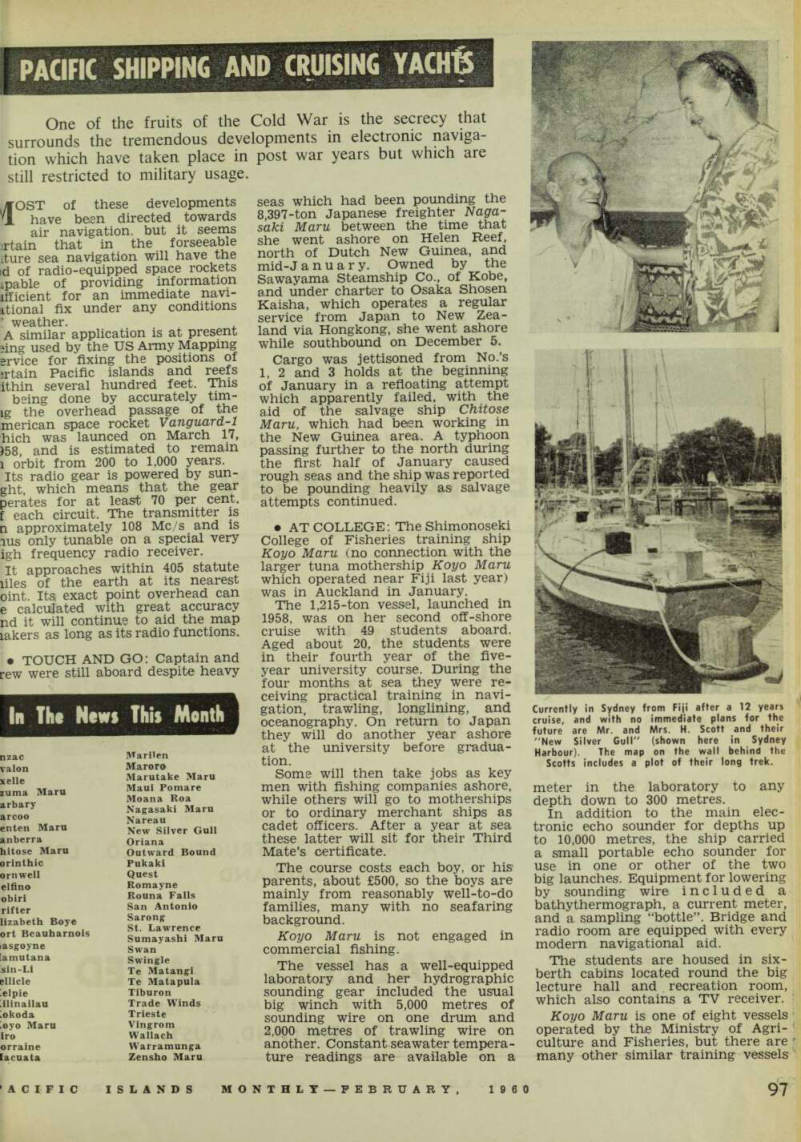
Currently in Sydney from Fiji after a 12 years cruise, and with no immediate plans for the future are Mr. and Mrs. H. Scott and their "New Silver Gull" (shown here in Sydney Harbour). The map on the wall behind the Scotts includes a plot of their long trek.
•erated by the Ministry of Trans lation, the Ministry of Educa jn. and the various Prefectural •vernments, some having more iphasis on practical fishing, and me dealing with younger boys of wer standard, or teaching only ivigation.
Koyo Maru was to proceed home rect from Auckland but next year ie will cruise to Chile and will ,11 at Papeete or possibly Suva. • UNUSUAL JOB. The Maroro ruise and Charter Service ketch aroro, based at Suva, was off on lother unusual job in January, a ,dio “ham” expedition to the Dkelau Islands, north of Samoa.
The ketch cleared Suva for Apia id north on December 29, with ew Mexico ham Dr. H. W. :eredith, his wife, Fiji ham Peter lexander, of Vatukoula, and Mrs. , Akins aboard, to give the world’s ims an opportunity to earn a card ith the call-sign ZM6AP-Portable i its face. There are no home own hams in the Tokelau atolls.
Operations were from Nuku mo, and the party established con ,ct with over 3,000 hams in 65 luntries during their week’s stay.
Maroro returned to Suva on Jan iry 17. Later. Dr and Mrs. Meredith ft Fiji for New Zealand.
• Wind Go, Water Come:
here should not be any surprise • mystery connected with the high ides” associated with a hurricane, it invariably there is much specu ,tion by the man on the water ont when this phenomena is jserved.
When some billions of tons weight I air is removed from one place i another during the passage of hurricane, it seems fairly clear lat the sea is going to be forced ito that low pressure zone and is ling to pile up in a dome “above ta -level” —as an Irishman might iy- That is what happened in Fiji i January when the hurricanes assed well to the south. Seamen
can reasonably expect unusual “sets” of current, flowing more or less with the wind, at such times, perhaps far from the hurricane
centre. In the same way excep tional anticyclones result in an out ward flow of seawater.
Such sets due to air pressure dif ference may be greater or less than the sets due to the wind on the sea surface, and can probably account for a good many strandings, though this factor seems to be one which is not always given very deep con sideration at marine inquiries.
E & O E: The New Zealand Meteorological Service has recently issued an 8-page pamphlet entitled Meteorology of the South Pacific, which is available for the asking from its Port Meteorological Officers.
It gives an outline of normal seasonal weather movements and it
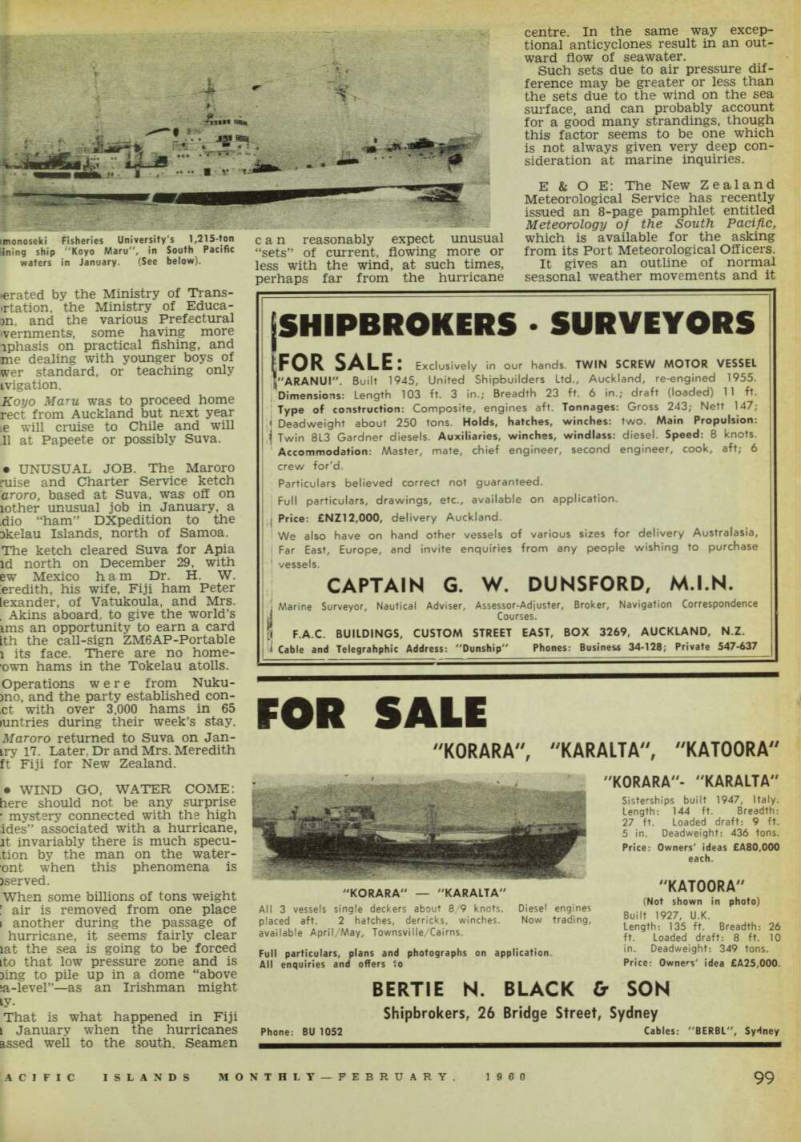
[?]monoseki Fisheries University's 1,215-ton [?]ining ship "Koyo Maru", in South Pacific waters in January. (See below).
V °Nz
tions with the exception of Midcasting stations. It might have rn made more useful had it also iinHpd all weather broadcasts, Sliding those from broadcasting if inns in the Islands areas, too. rS&IaV controls almost all of
brTdts I to thSoSSteSd from'the
b Antarctic to the Equator, but W here—except in PlM’s usual nual summary —is there pubtied information of the many bather broadcasts useful to shiple in the tropical portion of this ge area.
What is wanted is a regularly reied pamphlet covering all broad -sts from French Polynesia west- ,rd to the Australian coast and w Guinea for the whole area ith of the Line. Still wanted, too, more consideration for the yachts- ;n, of which there are many, in e way of a voice broadcast of ;ather conditions throughout the nole tropical area, transmitted on *h frequencies and receivable by ssels anywhere in the area.
• Where Did It Come From?:
le master of the British liner rinthic reported on arrival at ickland early in January that this ip bound from Panama, had ssed through 900 miles of what peared to be floating pumice, the ne ending about 150 miles from ickland.
Whether the pumice had come Dm some undersea volcano in that neral area, or whether it had been rried down from the New ebrides area, where there had been Icanic activity as mentioned last onth, by the recent hurricanes, ay never be known.
• Pass The Opener: The
>ttles are still drifting by. Latest r our record is a beer bottle
picked up on the beach 10 miles south of Hokitika on the West Coast of the South Island of New Zealand on January 3 by a gentle man with the name of Breeze. In lieu of beer there was a note dated 14/4/56, the name Hans van Goverg, Vanberg Place, Cape Town, and the friendly inquiry, “How vas you?”
• Man Overboard; The Nor
wegian freighter Vingrom, under charter to British Phosphate Com missioners, reported on arrival at Lyttleton, in January, that galley boy Tore Hansen, aged 17, known to be aboard when the vessel sailed from Nauru on December 31, was missing next morning.
O Ship Missing: A Hydro
PAC message to all ships in January requested information concerning the Japanese fishing vessel Benten Maru No. 13, 84 tons, call-sign JQEM, missing since she last re ported by radio on December 31 at position 32.28 N, 165.40 E.
• In For Their Chop: For
delaying their annual holidays and making a special voyage from Auckland to the Chatham Is. with school-children, in January, the officers and crew of NZGS Maui Pomare shared a present of 15 carcases of prime lamb, received from the happy parents. The ship arrived back from her week’s voyage and paid off on January 2, and was scheduled to sail for the Cooks on her first 1960 voyage on January 21. What she will be doing in 1961 no one can say, but her successor, the new MoaTia Roa should be on the job well before then.
• Something Old, Some
THING NEW: Agence Reuter of Noumea is reported to have dis posed of the 203-ton wooden vessel Lorraine —ex English fishing vessel Maid of Pinto, purchased from
Malta in 1954—and is now in terested in a somewhat larger vessel.
Purchaser of Lorraine was un known to PIM late in January.
• Still Looking: Mr. Jack
Thurston, of New Guinea, on a combined vacation and ship hunt, looked over one or two vessels in New Zealand waters in January but is believed not to have made any purchase as yet.
• Learning Dutch: Nether
lands New Guinea appears to be far more advanced than most other South Pacific territories in the matter of training navigators and marine engineers. Arrang ments have now been made for a number of Australian New Guinea students to attend the Hollandia Nautical School for a year’s course. The Aus tralian Government, or New Gu nea authorities, foot the bill. The boys receive a uniform, accommodation, rations, instructions, and pocket money at the rate of £l6/5/ per annum. Of the first group of boys, six are to be trained as seamen and six as engineers.
• They’Re Shuddering:
Whenever the big news starts to break somewhere in the Pacific Islands the world’s news agencies invariably turn on a display of extraordinary geographic ignorance.
As soon as the Russian rocket tests were announced in January, Fiji Times began to be bombarded with news agency queries on how
Papua-New Guinea students are to attend the Hollandia Nautical School, NNG, for a year's course. This arrangement is part of the closer liaison be tween the two Terri tories. Here are some NNG students on the job. (See story this page).
Captain Hugh Williams and seaman Kaipo Makimare, of Aitutaki, survey Auckland from the focsle-head of "Dobiri", Cook Islands trader, which was in Auckland in January. (See p. 105).
people in Fiji were feeling about all. They were apparently quite iware of the fact that the target a was almost twice as far (1,500 es) from Fiji as from Hawaii 0 miles). New Zealand news iers did not publish the exact ation of the test area. The Fiji nes did, but in a very garbled m, apparently as received from ;rseas, though this could be ted out to make sense. ?here was less sense, however, in agency report from Fiji which d, “Russian ships can expect to d only a few small ships operated Gilbert and Ellice Is. traders when »y arrive at their Pacific idezvous. . .” This will surely be tvs in the Gilberts. About the ly vessels they might find would Japanese tuna longliners.
> What’S Going On Up
lERE?: One of the few GEIC ssels that does go somewhere near 5 Russian rocket area from time time —though well to the south it—is the Suva-built 126-ton tch Te Matapula, and if reports jeived in the outside world in nuary were any indication she d just come to an unhappy end.
First she was in trouble at iristmas Island when, on No mber 19, a Royal Navy 45-ft rbour tender attached to the J’A Fort Beauharnois, knocked a le 2 ft x 1 ft in her side 3 ft ove the waterline. The Navy tched her up and she headed ,ck for Tarawa. Word was re ived in Suva late December that e had apparently there caught e and was considered a total loss.
Built in Suva in 1953, Te Mata ila was originally to go into the & E Is. trade for the Colony holesale Society, but was taken er by Government in 1955. She is powered by a 204-hp Ruston ornsby diesel.
To replace her, Captain G. ouglas, Tarawa’s marine superin ndent, in Fiji on his way back the Gilberts after leave in UK, immissioned a Suva marine sur
veyor to report on the old BP ketch Macuata, withdrawn from service several years ago and, at end of January, anchored in Walu Bay.
Experts considered that about £6,000 would need to be spent on Macuata to make her serviceable, in addition to her reported for-sale price of between £4,500 and £5,000.
Another vessel that the G & E authorities looked at as a replace ment, was Trade Winds, ex Aoniu, 128 tons gross, formerly of Tonga.
She was offered for sale recently by an Auckland shipbroker.
Earlier, on October 30, the Gilberts Government’s vessel Nareau, 180 tons, suffered some slight engine room damage by fire and water at the conclusion of her annual refit in Suva. The fire delayed the vessel’s departure by five days. • GOING DOWN: Dr. Jacques Piccard, of the famous Swiss scientist family, and US Navy Lieutenant Commander Donald Walsh, on Jan uary 23, made a world record ocean descent to a depth of 37,800 ft. (more than seven miles) in the Challenger Deep of the Marianas Trench, north of the Palau and Caroline Islands.
They sat for half an hour on the bottom and reported seeing living and moving objects when the lights were turned on. Until this dive, the Marianas Trench was thought to be only 35,000 feet deep, which was based on measurements by the Russians in 1957.
It took the bathyscaph Trieste almost five hours to descend and a little over three hours to return to the surface. There was a pressure of 16,883 lbs a square inch against the craft’s hull on the bottom, and temperatures were near freezing.
The men lost voice contact with the surface about half-way down but it was re-established when they hit bottom and maintained until about mid-way up.
The Trieste had been in that area for some time. It made a record dive to 18,600 ft on November 15.
Yacht "Romayne", at Auckland recently. The crew from left: Ann Reiner, Caroline Kinloch, Hans Reiner, skipper owner Stuart Riddell, George Miller, Michael Kinloch. Absent: Emily Shepard who was shortly to be Mrs. Riddell.
a dive on January 7 a depth of (30 ft was reached, with Piccard Walsh aboard. . he Trieste was designed by tne -ards, father and son, and after value had been demonstrated :dives in the Mediterranean the Navy bought it and engaged Dr.
'3Erd.
Ihe Piccards, in early January, ie insisting that Jacques was to i one of the two men to man it an it attempted to reach the in-mile depth. The Americans e insisting that it be an all .erican affair, but the Piccards Tie dive means that man has ,ched a depth in the sea greater ,n the height of the tallest untain—29,ooo ft Everest.
I For “Baa” Read “Moo”:
wording to a Suva report the £ter of the lamb \inev Delfino d in December, when the ship s northbound from Sydney for n Diego with its third cargo of nbs, that on returning to Aus- L lia the ship would transfer to => cattle trade from Darwin to isbane for a number of voyages inversion from sheep to cattle mid obviously involve a lot oi irk as the pens were designed for eep It was not clear whether this >ant that American and Aus ilian resistance to the live lamb port trade had proved too much id that the ship was being forced but a later report from Cali mia said that at least three other ssels were being fitted out there enter the live lamb trade for her interests, which did not sug st that it had been killed.
• New Naval Liaison
FFICER: Since the Fiji RNVR as decommissioned last year there is been no Naval Liaison Officer L Suva to handle the affairs of siting naval craft, fleet tankers, ,c., which call from time to time, i January it was announced that new appointment had been made -Lieutenant J. H. Gale, formerly of RNVR, and a resident of Suva.
• Rock-And-Roll Is Out:
/hen the Cook Islands trader lobin sails from Auckland in larch following refit, this 19ear-old l?.dy will have abandoned Dck-and-roll and adopted a more Bdate step—at least that is what wner-master Hugh Williams ex acts. The vessel is being fitted with 0-inch bilge keels to slow down ter lively motion.
Dohiri, ex Total, built of wood by I. Mercier, of Noumea, in 1941, aust be one of the very few New 3aledonia-built ships to trade in ither waters. She is unusually >eamy, 22 ft, for her length of 82i t and has unusually low head •oom in her accommodation, but ;he is a handy ship for the Cooks vhere shallow draft is desirable. Her
layout gives a measure of comfort to deck passengers.
• Money Down The Drain:
For years there has been talk of building a reasonably sheltered Rarotonga harbour capable of handling the local small craft— vessels of, say, up to 12 ft draught— and several detailed investigations have been made, but that is about as far as things have gone. One reason is lack of unity between the four local shipowners.
There is no shipowners’ federation which can bring united pressure on the Government for improvements.
Several years ago the Director of Public Works in the Cooks worked
out a scheme for Avarua harbour which gave promise <pf meeting re ouirements at an estimated cost ol about £20,000. The scheme was okayed by the Minister on a visit to Rarotonga, subject to its being okayed by a senior engineer from New Zealand. The latter gentleman vetoed it and produced an £BO,OOO scheme which the government would not finance.
Since then a considerable sum of money has been spent at both Avarua and the nearby Avatm har bour on futilely scooping sand away from the berth area and from the Union Co.’s lighter launching ramp, only to see the slight de pressions so made filled with silt
ain after each rain storm. So long local shipping can make do with ■; present situation there is un jely to be any improvement.
Jause of the silting at the main irbour of Avarua is a stream feed ijr into it. To anyone who has seen large river diverted in its course th the aid of a row of fallen Cows, wired together, or a few v stone embankments, the problem diverting this stream and per ps altering the situation sub intially, does not appear msur mntable. At least it might be >rth a trial, as little money would involved.
• Regulations Tighter In
)LOMONS: The British Solomons
arine Department has recently
en reminding local shipowners,
suns, and engineer-mechanics
at the Shipping Regulations 1957, lich came into force on January 1, 59, require a survey to be rried out on all local vessels, id also require these personnel to »tain a certificate of competency. ) date some leeway has been lowed, but few applications for irveys or certificates have been ceived A Government statement id that it has not been desired place harsh restrictions on ship mers or boats’ crews, but a arine Licensing Officer and Marine irveyors have been appointed and is felt that the time has now ime for action —so, gentlemen, ndly form a queue and toe the le!
• All Over The Place: If
ariners start reporting unusual >mpass deviation off Ouaco, New aledonia, with nothing to account ir it, they can blame the old eighter San Antonio which, bound om New Zealand and Noumea for ipan with a full cargo of scrap ent up on the reef there on Jan iry 7, 1957, after losing her pro filer and drifting ashore.
Recently, Mr. Les Ellis, of Auck md, on a scrap hunting expedi on, had a look at what remained I San Antonio and admitted that le wasn’t a business proposition, he is well broken up, with her ,000 tons of scrap, plus her own ull plates, scattered over a wide
reef area by heavy sea since the stranding. Nothing shprt of a heli copter and a magnet will ever collect those pieces.
• Single, Not Twin: Writing
from Brixham, England, Mr. S.
Briant, formerly an engineer with the Australian Directorate of Ship ping in New Guinea, points out that the vessel Kokoda (PIM, October, 1959. p 144) now named Liro, is single screw, not twin, as stated there—and he should know, for she was said to have the best-kept engine-room of the government fleet when he was chief in her. He was later chief in Matarani operat ing from Samarai.
• One In, One Out: After
three years in reserve, the RAN frigate Barcoo has been recom missioned and will make an oceano graphic survey of section of the South Pacific, commencing at Lord Howe Island, this month. At the same time as Barcoo rejoined the Navy, the destroyer Warramunga moored beside her at Garden Island, was paid off and went into reserve.
Warramunga, 17 years old, took part in 16 troop landing operations in the Pacific in World War II with out receiving one serious hit.
• Un Sea Conference:
Geneva will be the site of the second United Nations Conference on the Law of the Sea, from March 17 to April 14. Invitations have been sent to 103 governments, maritime organisations and commissions. The two main questions left unsettled at the first Conference, in 1958, will be dealt with, namely, the related problems of the width of the terri torial sea and the breadth of zones in which coastal countries may exercise exclusive fishing rights out side their territorial waters.
Of the four conventions adopted at the 1958 conference, one (Con vention on the High Seas) has been signed by 48 nations and ratified by one country, Afghanistan. Conven tion on the Continental Shelf has been signed by 46 countries; Con vention on the Territorial Sea and the Contiguous Zone by 44 countries; and Convention on Fishing and Conservation of the Living Resources
of the High Seas by 37 countries.
Twenty-two ratifications are re quired before any convention be comes enforceable. • LAE BUSY: In the lull between big vessels, the small ships have taken over Lae Wharf, and the place is a hive of activity these days (wrote our Lae correspondent in January).
MV Elisabeth Boye, now operat ing a regular service from Sydney, Port Moresby, Rabaul, Lae, Bris bane, left during a recent week end, loaded with timber, plywood and peanuts, and will return with general Islands cargo. She is a European-built ship, especially for the timber trade, and is under charter to the Karlander Line, whose agent in P-NG is New Guinea Goldfields Ltd, themselves shipping a considerable quantity of timber and plywood.
• Pacific Pennant: All
vessels of the Orient and Pacific Lines now fly the new house pennant of the joint companies.
The flag is divided into four seg ments by a blue cross. At top left, on white background, Orient Line’s crown is superimposed on the P & O sun-sea symbol in red, yellow and blue; top right, blue; bottom left, yellow; bottom right, white.
O & P Lines Pacific operations commenced in January. 1959, and now link Australia, NZ, Fiji and Hawaii with North America; North America with the Far East (Japan Hongkong, Philippines); the Far East with Australia—thus forming
Here is all that now remains of the old freighter "San Antonio" on the reef off Ouaco, New Caledonia. She is not a business pro position as scrap. (See story this page).
Photo: L. Ellis
HURRICANE DID IT. This is all that could be seen of the auxiliary ketch "Avalon", 80 tons, following the big New Hebrides hurricane of December. The "Avalon", without an engine, had been beached on Iririki Island with the bottom out of it for some time, and owner Captain Brett Hilder had been asked to move it, but couldn't. The vessel was originally the "Taipan", and he had bought it for its teak. Anyhow, after the blow the "Avalon" was found in 60 ft. of water. Later, the Australian Army blew it up because it was in the way, and that was the end of that!
a great Pacific triangle whic] traversed both clockwise and 2 clockwise.
One of the Line’s two new su liners, Canberra (45,000 tons, O), will be launched in UK March 1 by Dame Pattie Men wife of Australia’s Prime Mini The other, Oriana (40,000 t Orient Co.), was launched last vember by Princess Alexandra. I will carry more than ; passengers at 27i knots. They enter the service in late 1960 early 1961.
• Nz Frigate To Visit P-]
HMNZS Pukaki, which has occasion shown the flag in Cen Pacific, will call at Port More P-NG, April 24-26, on her way t from Hongkong to Auckland.
The following RAN ships will : visit the Territory during the 1 couple of months: Swan (trair frigate), Port Moresby, March 12 Gasgoyne (frigate on oceanograi survey), pt. Moresby, March 29 Tobruk (destroyer), Rabaul, I 14-16, Manus, May 17-20, Lae J 21-23, Pt. Moresby May 25- Anzac (destroyer), Rabaul » 14-16, Manus May 17-20, Saim May 22-24, Port Moresby May 25
• Chinese Ship Adrift- F(
day or two in early January, P-NG Administration assisted ir sea and air search for a miss Nationalist Chinese fishing vei Hsin-Li. The 100 ft wooden st with 19 aboard, was reported to drifting towards Wuvulu and / Islands, 120 miles NNW frc Wewak.
The Administration trawl Rouna Falls was sent out; a D air-sea rescue aircraft took off a search from Wewak; a arrangements were made for 1 privately-owned St. Lawrence, th near Ninigo Group, to divert to t area. The Netherlands NG Gover ment sent out a Cessna plane on square search.
On January 12, a radio messai relayed through Manila, advis that the Hsin-Li had been repair at sea and was safe. The sear was then called off,
• Stranded Japs Rescue!
When the 95 tons fishing vesj Sumayashi Maru went aground \
The new pennant of the 0 & P line, to be seen in the Pacific.
3eef off Fead Islands, New Guinea, December 31, 25 Japanese were tanded for a week They we re :cued by Bougainville Co s Kil :’ilau, which was diverted to =guria (or Home) Is., and taken to ibaul. The Japanese were later :en aboard Azuma Maru (200 tons ling boat) which came down r.m the Carolines to collect them.
Captain Toshio Mizushima said \mayashi struck the reef at 1 a.m. :d became a total wreck. She was second Japanese fishing vessel t there —Marutake Maru, No. 14, a aground on the Feads reef on member 1, 1955. Seven Japanese ssels have hit NG reefs in recent ars, six of them being beyond Ivage.
• Hollandia’S New Wharf:
new, modern jetty for ships up 12,000 tons will be ready next onth at Hollandia, Netherlands »w Guinea. Facilities will include 2,500 sq. yds. storage building.
Modernisation plans are under iy (or being considered) for the irbours of Bia k, Manokwari, jrong, Gudang, Arang, Fakfak, irmi and Kaimana, NNG.
• She’Ll Look Cool: Colours
losen for Moana Roa, 2,750 tons otorship now being built in UK ► replace the NZ Government’s aui Pomare on the Cook Is. run, :e pale green hull, dark green mnd the waterline, and white pperworks. Her funnel will provide contrast —signal red divided by horizonal black band. Inside jlours will be eau-de-nil, ivory and rimrose, while passengers’ lounge id dining saloon will be panelled ith pale wood.
• Lighthouse Ships: Two
nail motor vessels. Swingle and Tallach, which service lighthouses, ghts and other navigational aids to lipping in Papua-New Guinea and 'orres Strait, are nearly the end f their useful life, Australian Min ster for Shipping and Transport, enator S. Paltridge, said recently hat they and the three Cape ships York, Leeuwin, and Otway), which ttend Australian lights, will be re laced in a £2,500,000 replacement irogramme. • NOW, IF YOU HAD A TUNA JO AT!: The American fish cannery ,t Pago Pago has recently been saying the two Japanese corn sanies supplying them with fish, ;310 per metric ton for the top ;rade albacore. The 158-ton Zensho \laru No. 18, fishing near New Zealand last winter, landed some :argo worth $27,000 —a record land ng for Pago Pago. The Japanese jovernment controls the amount of :una which it permits its vessels to ieliver to foreign canneries and the Pago Pago cannery quota has been set at 12,000 tons a year, but there is a possibility that this will be in creased this year.
The quota for delivery to PaUi kulo, New Hebrides is currently 3,600 tons. Of the 12,688 tons of fish landed at Pago Pago in 1958 8 964 tons was albacore, 2,150 tons was yellowfin, and 476 tons was bigeye tuna. These totals were reached in 268 actual trips by a total of 42 longliners averaging 50 to 150 tons gross in size each.
Up to the end of September, 1959, the landings at Pago Pago last year were 7,642 tons of albacore, 1,715 of yellowfin, 372 of bigeye, and two tons of skipjack.
News of Cruising Yachts
• DRIFTER, 30-ft Wellington yacht, which left Rarotonga with owner John Moore aboard last August 16 for “Gisborne
or possibly Wellington”, and which was the object of an air search in the second week in October, is still missing as far as “PIM” can discover. Search and Rescue Organisation has no information of the yacht’s eventual arrival anywhere up to late January. Moore was born, or lived as an infant, at Rarotonga during World War I when his father served there as a government doctor. He sailed for Canada from Wellington last Winter, in tending to call first at Mangareva, but en route blew out some sails so diverted to Rarotonga from where, after some days, he decided to return to Wellington until 1960.
The October air search was initiated when the British freighter CORNWALL, while between Auckland and Wellington, intercepted a garbled distress call which included the word “drift” in some form.
No other station intercepted the message, and it seems to be well established that DRIFTER had no transmitter capable of sending morse on 500 kc/s where the message was intercepted, so there is
.(thins to link this message, the origin which was never discovered, with WIFTER—except that DRIFTER was ited as overdue. • QUEST is the name of the 25-ft 20-ft x 7V 2 -ft 24-year-old sloop which nrlos Paiva Toledo (third name omitted i past reports) purchased in Auckland •cently. The canoe-stern triple-skinned •aft was built by P. Vos to a Harrison intler design, and has a Kermath petrol [axiliary. Carlos, who arrived in Auckland iith Hilary Chiswell in ZONDA 111 in I’ctober, 1956, has lately married a New lealand girl. They may head for deep ; ater later, but not this year. • HAMUTANA, of Auckland, an 88-ft teel launch, built by Hamilton, NZ, ngineer A. W. Gallagher sailed for risbane on Christmas Day. The itinerary if this craft is not known. The launch u very well fitted out, can sleep 12, and 5 powered with a pair of 150 hp diesels yhich can drive her at 12 knots. Weigh og 28 tons, the launch was transported mile for launching in the Waikato River i 0 miles from the sea in September, 1958.
Ihe has since cruised South Island waters. • KELPIE ex HOPEFUL, 65-ft x 59-ft 15-ft x 10-ft Bermudan schooner of Newport, Cal., arrived at Papeete on November 29 via the Marquesas where five veeks were spent. With owner George E. dinney and three sons, Ernest, Joseph, ind Owen, lan McLeod, and Peter Sstabrook. The 31-year-old Marine-built racht will not be coming further west but irill head back home via French Polynesian and Honolulu. • TIBURON, of Santa Barbara, Cal., with Ed. and Ruth Vessey, arrived at Papeete, December 10, and will remain In French Polynesian waters for four or five months. Leaving home December 20. 1958, this 40-ft x x llMs-ft x 714-ft ketch has called at numerous Central American ports, nine islands and 14 anchorages in the Galapagos, and also in the Marquesas and Tuamotus. There are no firm future plans. • ROMAYNE, of Vancouver, at Auck land, was advertised for sale there in January. She is a 53-ft deckline x 14-ft
X 8-ft ketch with Albion Albatross diesel auxiliary. • BARBARY, which cruised to Fiji from the United States some years ago, was there sold to Captain D. K. Matheson, of Auckland, and now owned by Mr. John Robinson. was dismasted near Little Barrier Island, NZ, on January 7, but the 38-ft ketch reached port safely. • AXELLE which the Frost brothers of London sailed to New Zealand via the Pacific in 1951 and sold at Whangarei.
NZ, was blown ashore 18 miles from Whangarei during the Christmas holidays but was not considered a total loss. This yacht, now owned by J. Brown, was the source of some excitement at Papeete on August 2, 1951, when she was alleged to have sailed without clearance, was pursued by the pilot launch, overtaken and escorted back to port, and the owners fined. • TE MATANGI, of Los Angeles, for a while believed to be in trouble, arrived at Auckland, December 23. Source of a small-craft R/T distress call heard at Whangarei was never established and is thought to have been a hoax. Its contents were garbled. • MARILEN, 6094-ft Los Angeles ketch, while bound from Suva to Papeete via Atiu, lost both her masts 100 miles west of Papeete early December when a chain olate fitting parted in a fresh breeze under all sail. The boat was otherwise un damaged and the rigging was saved, and the yacht made Papeete under motor and jury rig. Howard Gee and his two sons and Peter Chick are remaining in Papeete awaiting the arrival of new spars from the US, but Mrs. Gee and small son Gregory have flown home. • SARONG, of Sydney, on the latter part of a circumnavigation, arrived at Papeete, January 8, from Panama. • JLLLICLE’s successor, name still un known, which was believed to have sailed for NZ from the UK in mid-1959, is so far unreported west of Panama. This yacht was similar to JELLICLE which Lieutenant-Commander Michael Balles sailed to Auckland and sold in 1955. This time he was to have a crew of three aboard the 25-foot Folkboat. • OUTWARD BOUND, with the Caldwell family aboard, was at Aden on January 6, when John Caldwell dropped a note to “PIM”. From Cocos (Nov. PIM”, p. Ill), they had a quiet trip to lonely Durgo Garcia atoll in mid-Indian Ocean; but their next leg to Seychelles was through a cyclone that blew a solid 90 knots.
“We liked the Seychelles greatly”, writes Caldwell, “finding the scenery as remark able as any we had seen in the South Pacific. Mahe, the main island, is called the Pearl of the Indian Ocean (memories of Papeete, Pearl of the Pacific).
“Our trip up to Aden was veering due to headwinds, and 800 miles of beating to windward. The Middle East in transition is very exciting and colourful —reminds me of China (Shanghai) in 1945; the same policies that lost her stick out like a sore thumb here. We attack the Red Sea in February and will be in Rome for the Olympic Games; then to England, on to America and, finally, the Pacific.”
• A Better Bargain: Mr. Serge
Tetzner, purchaser of the ex-RNZAF crash-boat mentioned in December, says that his purchase was something more of a bargain than we there reported. He paid a mere £5O for the vessel, and there is every indication that she can be repaired and put back into service. No. 276 is now hauled out at Lami, near Suva.