Territories Talk-Talk
pp. 31-35 · Read in the full issue


By Tolala
If the self-glorification of being a nasty piece of work fas Errol Flynn’s objective in My Wicked, Wicked Ways, then e has certainly succeeded, judging from a serialised edition of he book, dealing with his youth and the time he spent in New juinea and the East. My copy came from the US.
B narration by no means en hances the opinion of him I have held these many years; although must give him credit for a lin decency in camouflaging (to ixtent) the identities of his con its in the lists of Lust; though ome of the older residents some easily identifiable, le book, no doubt, will receive , critical reviews, which is ;tly what Flynn wanted in order tep up the sales. No doubt there be big sales, despite its lack of ary merit, and its bravado and s mishandling of the truth, it modern ethics being what ' are the reading public will rush Ith their ears back —more’s the —and, insofar as the section ing with the rake’s progress in Guinea is concerned, will obtain iry cock-eyed impression of con ms there in the late ’Twenties.
That Old
German Flag
In December Talk-Talk I com mented on a statement in the Times Courier about an old German Im perial flag, which “some people reckoned was the old Neu Guinea Kompagnie house-flag.
The other day I turned up an old letter from Captain Haug, who was skipper of the Company’s Siar back in 1908. He writes: “Do you remember the old flag of the NGC? I still have a small one, which I flew on my gig when I paid an official visit. . . . Per haps you remember we called the flag Der Hund mit dem Blutigen Knochen (The Dog with the Bloody Bone). In the left upper part schwarz-wsiss-rot (black, white, red) and in the white part something like a bear or a tiger, or a dog, with something in his paw that looked like a bone.’’
That should settle the argument.
That Itinerant
Canoeist
The adventures of young “Tarzan”
Michael Fomenko which are being treated very kindly by the Press and public as opposed to the more realistic attitude of Govern ment officials generally, reminds me of a somewhat similar egotistical escapist who arrived in Rabaul in the early Forties, or thereabouts.
He was a Czecho-Slovakian and had paddled his canoe from the Philippines (I think it was), touch ing at various TNG villages on the mainland and being acclaimed by the native people, whom he con tacted, as a god coming out of the sea.
Quite innocently he sparked off a couple of cargo cult demonstrations around Aitape way and later on down in Bougainville. TNG official dom treated him —more or less — with ignore but when he reached the BSIP they took a dim view of his mode of transport and cut short his voyaging by shipping him out to Australia. I forget what eventually happened to him; he probably wrote
a book, but otherwise accomplished nothing particularly useful.
Aspects of these “intrepid ad venturers”, which should not be overlooked in Islands areas, are: • The reaction of the native people to such odd-bod Europeans arriving “out of the blue”; • The need for the enforcement of safety precautions; otherwise • Expensive search parties, which have to come out of the public purse.
Undoubtedly coves like Fomenko are imbued with endurance and stamina and, therefore, arouse ad miration and have their fans —so do pole-sitters and marathon dancers. They contribute nothing more towards general knowledge; they receive a lot of cheap publicity which boosts their one-time deflated ego then usually disappear into the Nowhere from whence they came; though in late years they might have a short life-span on TV, or, if they are of the female species and with the right measurements, a try-out in a night-club.
FOOTNOTE: As for the two youths who stowed away in the Qantas Electra at Mascot and landed at Moresby, to top-off a bright party at Bellevue Hill, they were indeed lucky their prank did not land them in the boob for a long stretch. (One wonders: If the party had been at Surry Hills. . .
Oh, well, never mind!) What’s the moral difference between stealing a
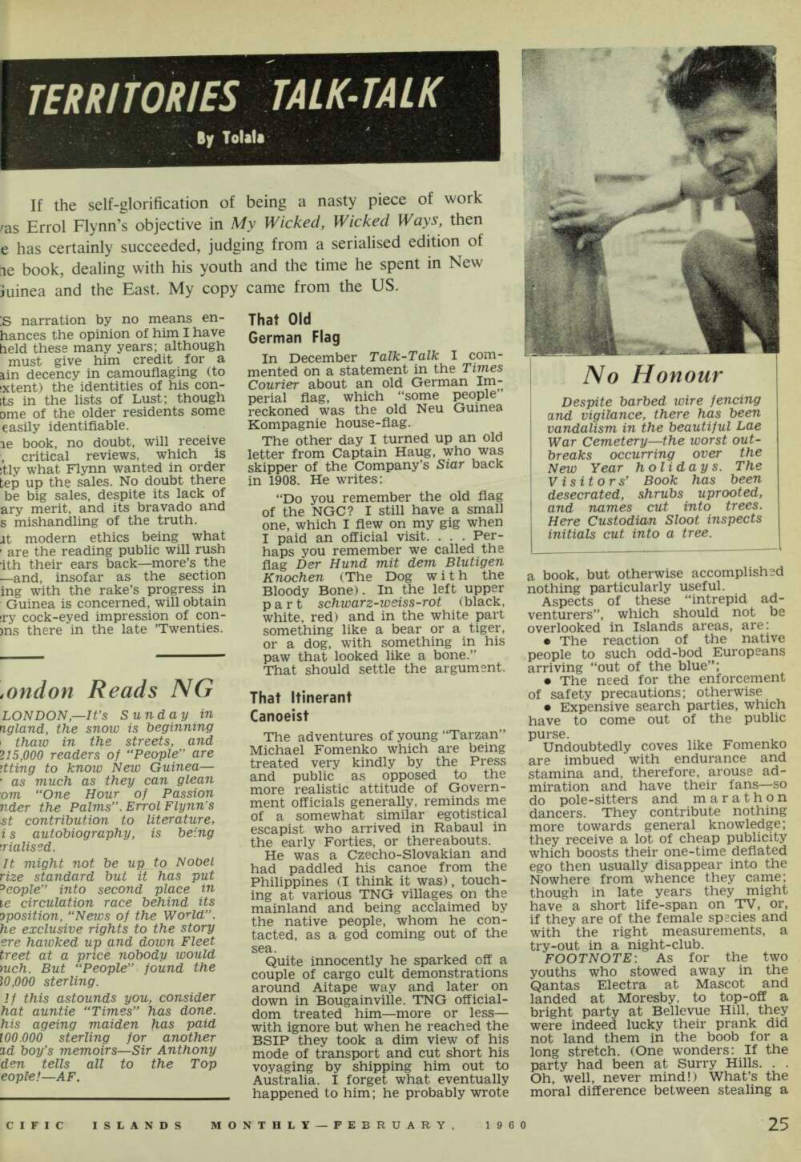
No Honour
Despite barbed wire fencing and vigilance, there has been vandalism in the beautiful Lae War Cemetery—the worst out breaks occurring over the New Year holiday s. The Visitors’ Book has been desecrated, shrubs uprooted, and names cut into trees.
Here Custodian Sloot inspects initials cut into a tree.
Hrip from an air company, snitching a gold watch from a lery shop? . . . And someone have been put “on the spot” areless checking of passengers. do the two “adventurers” feel ; that?
'chologists will probably claim isuch behaviour—canoeists and itch-hikers—indicates potential anding research workers and fore should be encouraged.
'he ■ Foot 6 out oTp NG-in S aS f Admhiis-
re^evel—
ng AffoiJc o^duc S atio r n W Health r e Affairs, Education, neaitn, sulture and Police Departments, !ix-weeks’ course at the Summer bute of Linguistics at Kainantu.
After the course the trainees will be posted to an area with a language group for a period of four years, A n Administration spokesman said that “shorter term postings had proved unsatisfactory in establish jng a close link between the two peoples”. How true!
And what a pity such a policy had not been introduced nearly 40 years ago. How many misunder standings would have been avoided?
And how much closer would the Gov ernment officials have approached (What* Col-oner say in the -cent Death to language difficulties and inex nar!onpe(t rsee n 451. penence. .. . Lt) P It needs now a juggling of leave rosters to enable officials from a
district to return to that same dis trict in which they have succeeded in making close contact and then everyone should be happy. The native most of all. If there is any thing that is anathema to the native is the constant change of the in dividual who is their “boss”. Unless, of course, he be a nasty type; then he shouldn’t be there at all.
In time, with the working of such a system, it will obviate the necessity of that dubious individual, the in terpreter who, on more than one occasion has been suspect to an in vestigating officer. But he couldn’t do anything about it on account of his ignorance of the language.
When that time comes in P-NG then life should be made easier for all.
When Teddy
Got The Bird Jack West is well on the beam ( PIM, Jan. Editors’ Mailbag). If anyone knew the Madang-Aitape coast in the early ’Twenties it was Jack. But the punch-line of the Teddy Phibbs’ story is that he was Chief Collector of Customs, and the one man responsible in seeing that Birds of Paradise did not get out of the country! Yes, there was certainly a flutter in the Customs dove-cots over that incident and Teddy never really lived it down. Fortunately, he was a man who could take it.
There was another BOP incident in 1921 when the senior Exproboard inspector broke the eleventh Com mandment and was discovered in the gentle art of attempting bird smuggling on the same coast, but the vessel, in this instance, I think, was the old Kekere with pioneer Peter Hansen at the helm. The in spector was fined £lOO and lost a good job.
Incidentally, most of the planta tions along the Madang-Aitape coast (other than those belonging to the NGG) were planted from proceeds of BOP’s sales during the German days. That trade will be revived one of these days.
That "Moresby"
Voyage
A. P. Lyons’ trip with Captain Bayldon (mentioned in the same “Mailbag”) gives an idea of what you used to get for your money in the old days; in mileage, if not amenities.
The mention of Penduffryn planta tion on Guadalcanal, with the two odd-bods, Darbyshire and Harding will awaken memories in some of the real old-timers.
D & H could never bear to see a ship pass their place without call ing in. It was usual for them to put a shot across the bows of any disobedient skipper—a shot from th«ir small “recruiting cannon”, which was commonly used in those days by recruiters on Malaita Island.
heir home was luxuriously fitted marathon carousals; a well keel bar, billiard table &pd >le guest chambers. Little wonder t later they went bung and BP : over the estate, and changed name to Berande. ; was here that Jack London red on his Snark voyage and e gathered material for his book, lenture. Jack was accompanied a glamorous secretary (a habit hors seem to have acquired these nv years); whom (I think) he ir married. It was the perfect losphere for Jack, men BP took over Jim Campbell gntioned by me last month in pukpuk story) was manager for mile and was succeeded by Phil jlley.
Correction
)nly a small matter certainly, but t to keep the record straight I mid have described the mono i (mentioned in “TT” last month) Fred Archer’s place as being on > northern end of Jame Island, st in case someone goes looking it—or someone hops in to correct
blicity for
ucation
[ don’t remember reading so much out the needs for education—on g juvenile level —as I have dur r the past six months; both in istralia and P-NG. Education ecutives have been plugging away the Press about the urgent needs r more teachers (and, naturally, Dre finance), more schools, changes curricula and systems.
Education in P-NG appears to ive a good Press. Local sheets as ill as southern papers (not omit ig PIM, by any means) are put ng the spot-light on what has
been accomplished, what is being done and what the Department hopes to do. Good luck to Director Roscoe, who is undoubtedly a be liever in Good Public Relations.
But . . . readers should not be under the misapprehension that education of the primitive started in NG only in the Post-War II years.
Turning the pages of an old copy of The Rabaul Times, dated De cember 24, 1941, I came across an interesting story by none other than journalist Norman Bartlett, who had made a visit to the Rabaul district and published his story in the Australasian of August 23, 1941 Amongst the schools he visited was the Government school at Nodup, where J. H. L. Waterhouse was in charge. Bartlett’s description of the system and the high standard achieved by the pupils was glowing He thought their knowledge of pure English might have been taught par r o t-fashion, but Waterhouse soon disillusioned him by seeking synonyms from the various pupils for the words used. Amongst the pupils evincing a high standard of efficiency was one, Walaka (the same Towalaka, who is now a member of the Rabaul Council), who knew all the answers without faltering.
Bartlett writes; “When war began there were 2,290 village mission schools and 5 government schools. . . A young Government official gave me the most intelligent criticism of New Guinea education.
“ ‘We are training a few of them to do white men’s work for low wages’, he said. ‘What we should do is start in the villages and give them an all-round agri cultural, hygienic and vernacular education which is related to their local conditions, social organisa tions, and traditional ideas. Most
of them are doomed by circum stances to be village agriculturists; our educational system should be designed to make them better agriculturists, better natives and more integrated human beings.
And this, we are assured now, is exactly what is happening. Lets hope that in our enthusiasm to educate we do not divest the in dividual of his New Guinean identity altogether. he Forgotten AEI I am the last one to desire plaques and memorial stones for every act of bravery or sacrifice made for one’s country; but I do think the Silent Service should do something about perpetuating the memory of Australia’s first sub marine, the AEI and the 35 officers and men who disappeared some where out of Rabaul harbour on September 14, 1914. A plaque on the Memorial Gates of Elizabeth Park, perhaps? Its sister ship—AE2—was sunk a few days after the landing at Gallipoli, fortunately without loss of life.
So Long, Robbie Passed on to his long rest on January 21 was Robert Vernon Robertson, and probably one of the best-known identities among New Guineaites in Sydney. For years “Robbie” was a sick man but, tenaci ously, kept going; invariably en gaged on some commission for Islands folk temporarily in Sydney: Seats for a theatre, a taxation clear ance, a passage on a plane; Robbie was the one man capable of per forming miracles, of ironing out troubles and overcoming the tangle of red tape. He will be sadly missed.
Peace For
Poppy Forsyth
After an illness lasting for years, bed-ridden and unable to enjoy the life she loved so well, Mrs. Madge (“Poppy”) Forsyth passed away in a private hospital at Mosman on January 28. There was no better known or well-loved woman in Rabaul pre-war days than “Poppy”.
A nursing sister in War I, she re tained to the last those sterling qualities developed by that gallant band of workers. Memories of her kind actions, generous gifts and willing help will always remain valued treasures amongst her friends. ☆ Mr. Brian Edwin Jinks, who graduated as a P-NG Patrol Officer from the Australian School of Pacific Administration recently, was the winner of the 1959 R. W.
Robson prize for law and he shared with Mr. Alexis Bishaw. of Northern Territory, the R. W. Robson prize for general proficiency.
As Tv
Sees It
It's election day at Maprik, in the Sepik district of New Guinea, and ADO Arthur Carey, the local native registrar and a voter all gather at the table in the village of Waigakum on the first polling day for the election of a Native Local Government Coun cil. This scene was photographed by a film unit of the Department of the Interior, headed by producer R. Maslyn Williams, and was part of a series of six half hourly documentaries on New Guinea, shown re cently in Sydney on ABC television. They were well received.
Photo: Lew Priday.