The Editors' Mailbag
pp. 28-29 · Read in the full issue
That Old Ship
Was The "Brunner"
Everything comes to him who waits, especially if he is sitting in a PIM editorial chair. Way back in July last year the PIM Shipping Section told about the missionary from Abemama in the Gilberts, who had found an anchor in the wreck of an old steamer, sunk in 1915, and put it to better use for the mission ship Fetu Ho. The name of the wreck was not mentioned.
In September, in this column, Captain Brett Hilder, who has seen the wreck, suggested it might have been the old BP vessel Tambo, which was wrecked when entering Abemama in 1919. But he wasn’t sure. Then came silence.
The other day we received a friendly note from an old PIM reader in the Gilberts, giving what appears to be the good oil.
The wreck, says the informant, was the On Chong steamer Brunner (although he is not sure of the spelling) 300 to 400 tons, which went aground on a clear night towards the end of 1914, when bound from Tarawa to Tabiteuea.
There was a big celebration aboard possibly a Christmas or New Year Party—when the ship struck, near the north-west passage The ship was unloaded to the main land but couldn’t be refloated and was soon broken to pieces.
The Tambo, says this reader, was wrecked a few months earlier—in July .P r AT Jgust, 1914 (not 1919), ar ?° the boiler, bow and stern are still visible near the south-west passage—useful marks for mariners. 4-u^ 10 resu lt of all this wrecking was that 1915 was a bad year for the Gilbertese—for copra was stock piled with no ships to take it to Tarawa.
last Of The Old
Labour Traders
«f An< ? J while we are on this subject oj °l d wrecks, Capt. Ted Clay, Torres Strait Pilot Ser dlops a note on th e loss of the Borough Belle on the Bellona reefs in 1893—mentioned by “Suner cargo” in his history of old BP skippers . {PIM October, p. 83). r ? i?7^ pt v r . clay recalls that Borough ( Ca Pt- John Williams) was cvHoJJp °k reefs by a tropical oyc i°uC’ but having struck the reef was thrown right over into com- M yel £ c ? ln l water, thus allow lnl» lu° boa ts to be launched.
Ibaats > although they
had lost sight of each other, made Lh fe aroSBl ng of the Coral Sea and made landfall within a few
miles of each other. In the B boat was Capt. Williams’ son, who was thus reunited wit] father. The landfall was nc from the town of Macka Queensland, which had for years been the home por Borough Belle —then operated recruiting vessel in the Queen labour trade, by Messrs. Paxtoi Co.
She left Mackay on Octob* 1890, on her last recruiting v under the command of William T. Wawn (the Ac November 10, 1885, had decreed after December 31, 1890, no li to introduce Islanders woul( granted).
The Borough Belle returnet Islanders, including six wome: the New Hebrides and Solomons on that voyage arrived back with only 25 recruits and four women—an successful final recruiting trip, ship was paid off in April, thus completing her service ir black labour trade. But as we seen, she never lasted long that!
Why Shouldn't Mr. Boyd
Have a Cannon, Too?
A reader and occasional tributor, A. J. Sheat, of A land, wonders out loud whc Britain’s former Colonial Secre Mr. Alan Lennox-Boyd, is goir call in at Auckland during current wanderings in the v South Seas. (See p. 63).
Mr. Lennox-Boyd is repon bent on finding out, among c things, whether it was true s( body ate his great uncle, Benjj Boyd, in the Solomons in 1851.
Mr. Sheat reminds us th£ cannon salvaged from the v of Boyd’s schooner, the Wane is now in the Auckland Musi probably in a store room, and drawings made by John Web of the Wanderer, are also in Museum, adorning the walls, has previously published ph graphs of some of these skeh one of which shows the bur of a Guadalcanal village follow Boyd’s death.
Mr. Sheat suggests that Museum people might even lik give the former Colonial Secre that cannon if he asks for it. at least some copies of the picti We don’t know about that, we rather suspect all the publ; about Mr. Boyd’s reported intc in Uncle Ben started probably ( a comment which he just happe to drop lightheartedly in hearing of some London repor and that he never meant the tl to create the interest it has.
Mr. Boyd would know better t
; people the details of the life death of Uncle Ben—he collects i. And it is not long ago since received a request from ion, on his behalf, for copies of of May and July, 1957, and 1, 1958—a1l issues dealing with iamin Boyd and his exploits, iding that last unfortunate one. of the accounts was by corres lent A. J. Sheat. was as a result of this London est that PIM began to look i the then Secretary of State the Colonies in a new and awe ired light. Here was a man l a real sympathy for the ;h Pacific, for when your great e is eaten by a cannibal you surely claim that the Islands in your marrow.
i Latest On
istwatching
hen we were writing to Com ider Eric Feldt over that tribute is to the late Commander Long ich appears on p. 41) we asked about progress on the American ion of his book, The Coast chers. It has recently been pro jd by Ballantine Books of New k in its first paperback edition first Australian edition has been Electors’ piece for a number of •s now, and is out of print). tie paperback edition, with a jtacular cover and a foreword by teral MacArthur, is a stream d version of the original, but ically the same book, and still food, if not better,in our opinion.
Commander Feldt says there were to be about 200,000 copies printed, with a right to market in the British Empire, but he had not heard if the publishers had taken this option up.
He adds, “I have no idea how it is selling and do not expect to hear till after September, when the publishers make up their return.
Probably I should get on their back and ask them about it, but I’m too lazy.”
We never heard before that he’s lazy, but this time he can afford to sit back and wait!
Apparently though, the American paperback is being marketed else where, because PIM staff have seen copies’ for sale in Sydney.
Incidentally, there is one thing readers of the page 41 tribute will no doubt notice. In the introduc tion. which is ours, we refer to “Coastwatchers”, although Eric Feldt’s version, which we didn t touch is, “Coast Watchers”.
He should know how to spell it, but PIM in the last year or two has made it into one word, and will continue to thus treat it, because it is now part of the language. And we notice, despite Eric Feldt’s own spelling in PIM, that the text of his American paperback makes it as one word, and with a capital, too.
And a final word about Coast watching: We hear that Mr. Walter Brooksbank, former Civil Assistant to Commander Long, is publishing an illustrated article on the Coast watchers’ Memorial Light at Madang in the March issue of the Aus tralian National Travel Association’s magazine, Walkabout.
What Is The Sound Of
One Hand Clapping?
Mr. G. W. L. Townsend, now of Queensland, drops a note to point out that the United Nations’ move to establish UN Information Centres in or near Trust Territories, (re ported by us in December and Jan uary) was raised in the Fourth Committee of the General Assembly, and not by the Trusteeship Coun cil Thanks Mr. Townsend says he agrees with us that the capacity of the New Guinea natives to absorb the con cepts of the United Nations is still very limited —but from there on in, we’re not sure whether he is on our side or not.
He says. “Are there not others besides natives in the Territory who must be anxious for information concerning the world organisation of which Australia was a founding member, on councils and committees of which Australian delegates serve with distinction?
“The United Nations information material which goes to the Terri tory is supplied direct from New York by the UN Department of Public Information in response to
a resolution of the Trusteeship Council of 1947.
“With some knowledge of the sub ject, it is my own view that with the material now received, which can be supplemented from New York and the UN centre in Sydney if desired, a UN centre in the Terri tory is entirely uncalled for. How ever, what is the use of any in formation material unless it is dis seminated?”
Departmental Store in
The Shipping Business
Our correspondent, “Supercargo”, recalls in this recent letter a hit of smallships history that few Islanders now remember: Having noticed recently that Hordern Bros, have merged with Anthony Hordern & Sons Ltd., I wondered if any of your readers re member when Hordern Bros, ran the only regular service from Sydney to Norfolk Island via Lord Howe.
I think it was 1894 when they started running the schooner Alice May about 60-70 tons, under the command of Captain Champion.
Many old Norfolk Islanders travelled by her, such as the Quintals, Buffetts, Dignams and others.
The Sydney Morning Herald of July 17, 1896, reports: “Messrs.
Hordern Bros.’ schooner, Alice May. last night arrived from Norfolk Island.
“The owners of the Alice May take nearly the whole of the pro duce from the Islanders and find a market. The whale oil is put up in tuns of 250 gallons each, in which form it passes at once into the hands of the consumer.
“As an article of export, whale oil is almost sure of a market in London and the Continent, while there is a possibility of trade with America. The local demand is alone sufficient to consume a very large quantity, while the supply is with out doubt more than equal to de mands when whalers are provided with the necessary means of catch ing their sport.
“In the present instance Messrs.
Hordern Bros, have the best appli ances for securing the monsters of the deep, and they look forward with pleasurable expectation to a rapid export trade”.
I do not know what happened to the Alice May, but the May Howard schooner, of 64 tons under the com mand of Captain William Champion, sailed from Sydney for Norfolk Island on March 30, 1897. The passengers were Mr. and Mrs.
Anderson with four children, Mr.
J. B. Tressider and Mr. R. Rose.
The ship’s agents were Hordern Bros.
This may be of interest to some of your more elderly readers.
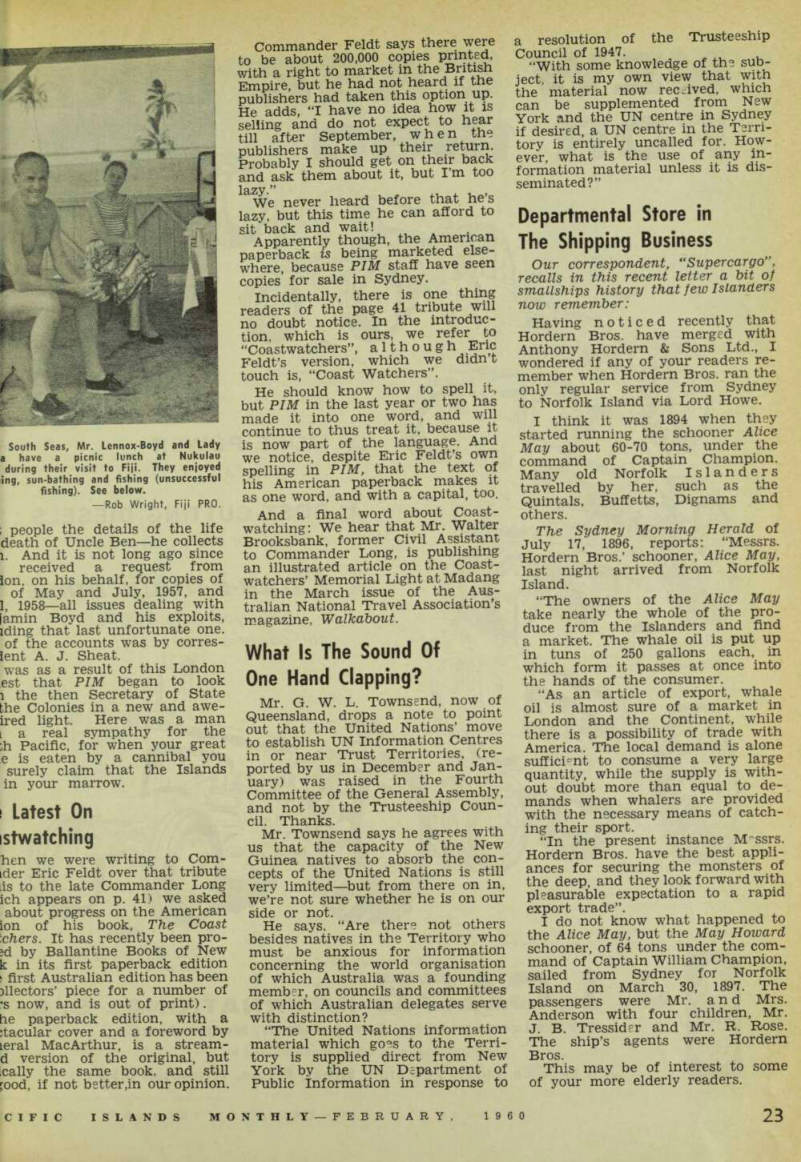
South Seas, Mr. Lennox-Boyd and Lady a have a picnic lunch at Nukulau during their visit to Fiji. They enjoyed [?] ing, sun-bathing and fishing (unsuccessful fishing). See below. —Rob Wright, Fiji PRO.