James Anthony
p. 20 · Read in the full issue
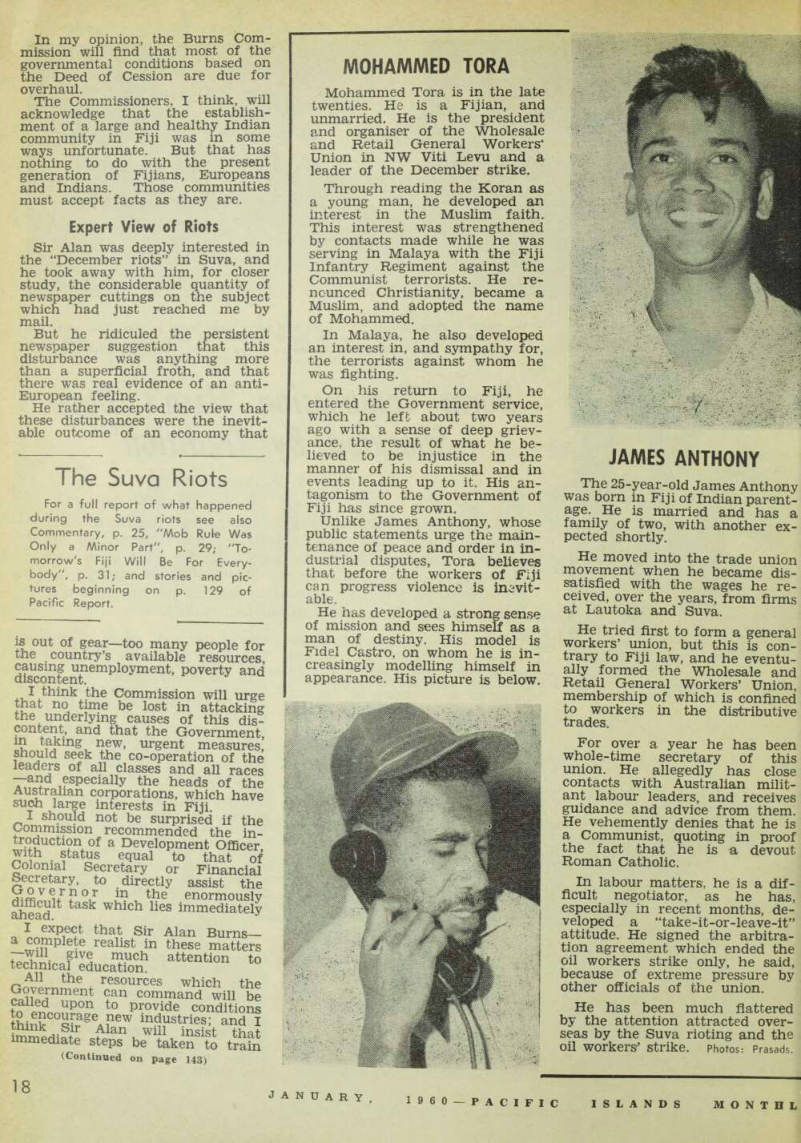
Mohammed Tora
Mohammed Tora is in the late twenties. He is a Fijian, and unmarried. He is the president and organiser of the Wholesale and Retail General Workers 4 Union in NW Viti Levu and a leader of the December strike.
Through reading the Koran as a young man, he developed an interest in the Muslim faith.
This interest was strengthened by contacts made while he was serving in Malaya with the Fiji Infantry Regiment against the Communist terrorists. He re nounced Christianity, became a Muslim, and adopted the name of Mohammed.
In Malaya, he also developed an interest in, and sympathy for, the terrorists against whom he was fighting.
On his return to Fiji, he entered the Government service, which he left about two years ago with a sense of deep griev ance, the result of what he be lieved to be injustice in the manner of his dismissal and in events leading up to it. His an tagonism to the Government of Fiji has since grown.
Unlike James Anthony, whose public statements urge the main tenance of peace and order in in dustrial disputes, Tora believes that before the workers of Fiji can progress violence is inevit able.
He has developed a strong sense of mission and sees himself as a man of destiny. His model is Fidel Castro, on whom he is in creasingly modelling himself in appearance. His picture is below.
The 25-year-old James Anthony was born in Fiji of Indian parent age. He is married and has a family of two, with another ex pected shortly.
He moved into the trade union movement when he became dis satisfied with the wages he re ceived, over the years, from firms at Lautoka and Suva.
He tried first to form a general workers’ union, but this is con trary to Fiji law, and he eventu ally formed the Wholesale and Retail General Workers’ Union, membership of which is confined to workers in the distributive trades.
For over a year he has been whole-time secretary of this union. He allegedly has close contacts with Australian milit ant labour leaders, and receives guidance and advice from them.
He vehemently denies that he is a Communist, quoting in proof the fact that he is a devout Roman Catholic.
In labour matters, he is a dif ficult negotiator, as he has, especially in recent months, de veloped a “take-it-or-leave-it” attitude. He signed the arbitra tion agreement which ended the oil workers strike only, he said, because of extreme pressure by other officials of the union.
He has been much flattered by the attention attracted over seas by the Suva rioting and the oil workers 1 ’ strike, photos: Prasads.