Shackled By Tradition'
pp. 19-145 · Read in the full issue
Burns Commission 'Hasn't Been Shackled By Tradition'
From R. W. Robson LONDON, January 2.
Fiji history definitely will be made when the Burns Com mission’s report is released, shortly, by the Governor of Fiji.
I spent a couple of hours this week with Sir Alan Burns and, although of course I was given no indication of the Commis sion’s findings, I got the impression that the job has been done in a most thorough, conscientious and realistic way.
1 THINK it will be found that the three experienced, highly-skilled men who made that inquiry in Fiji in the last half of 1959 have refused to be shackled by ancient
viewpoints and sacred traditions; and have dealt with the facts as they exist today.
In so many words, the Burns Commission was asked to advise the Fiji Government on the steps to be taken to allow the rapidly growing population to feed itself, and enjoy the highest standard of living commensurate with the resources of the country. The Commissioners have tried to do just that.
When the Deed of Cession was signed, in 1874, there was no dominant industry—as sugar is today—and there was not one Indian in the archipelago. Today, the Colony’s economy revolves around sugar; and the 185,000 Indians outnumber the Fijians by at least 20,000.
"Completely Realistic"
It may be expected that the recommendations of a completely realistic Burns Commission will try to fit today’s inescapable social and economic facts (not enough avail able land and not enough estab lished industries to adequately support the growing population) to political conditions that are based rather too much upon sentiment and tradition. (Over)
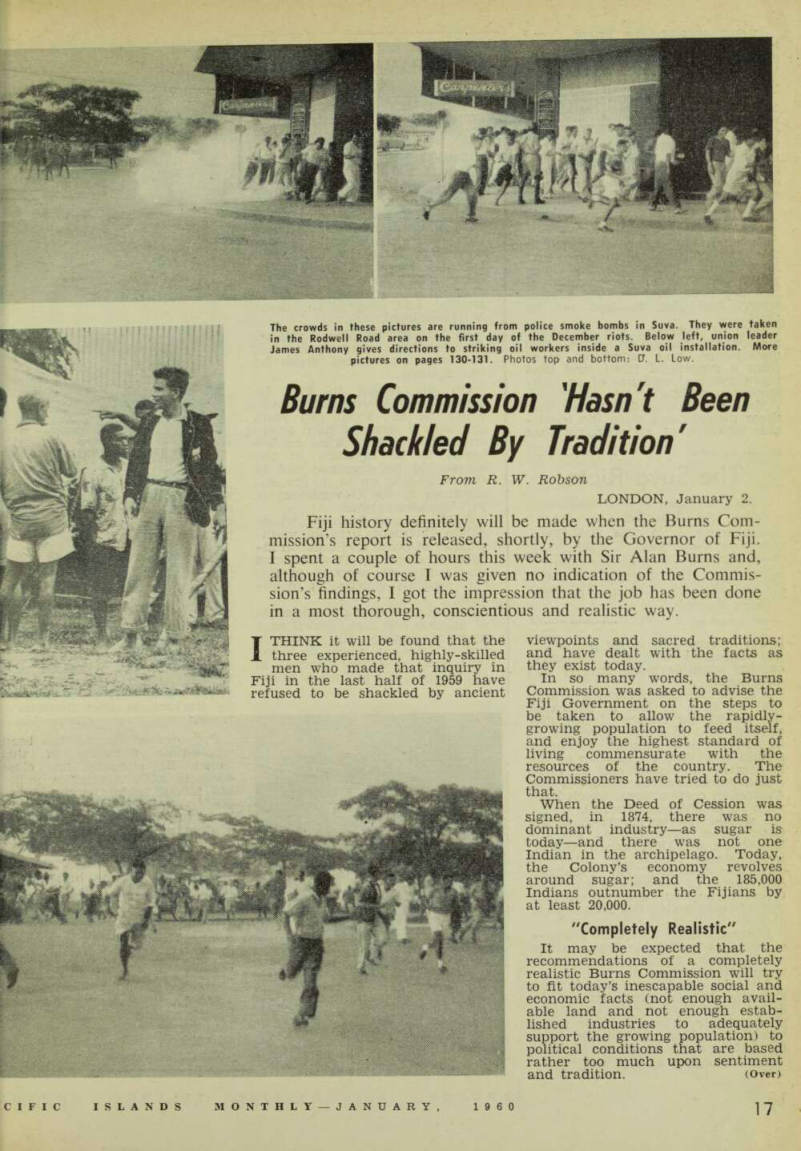
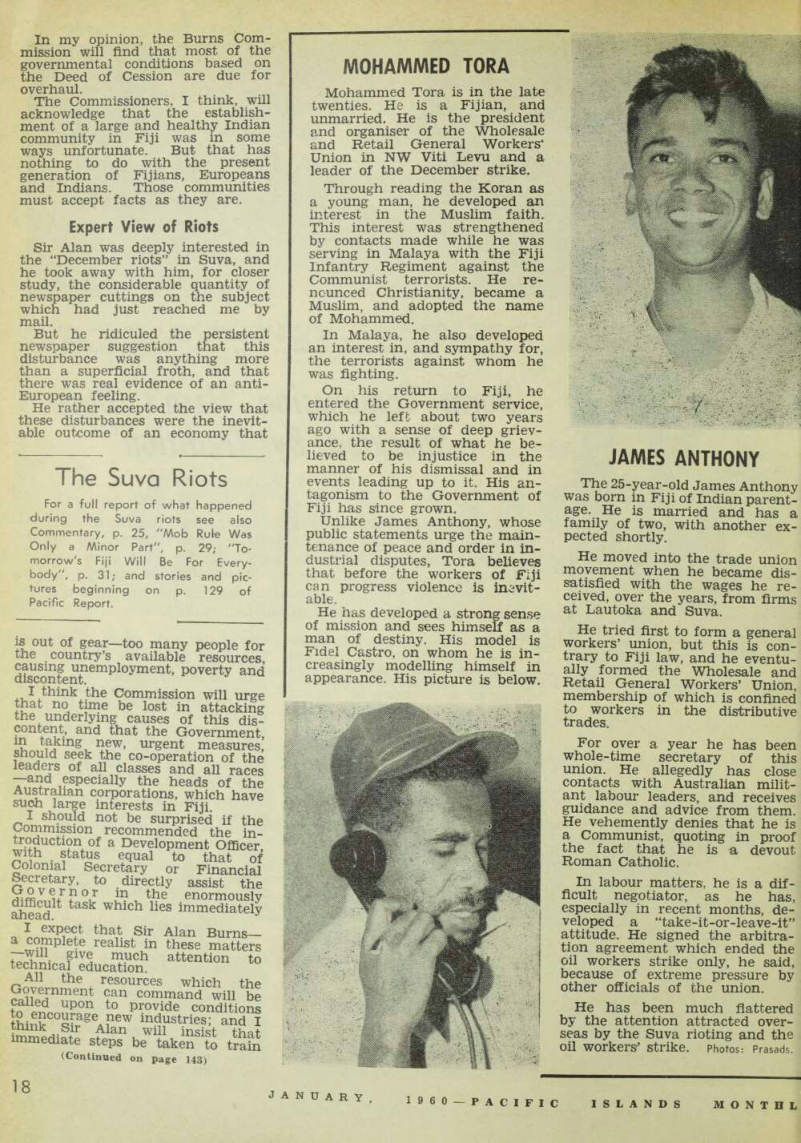
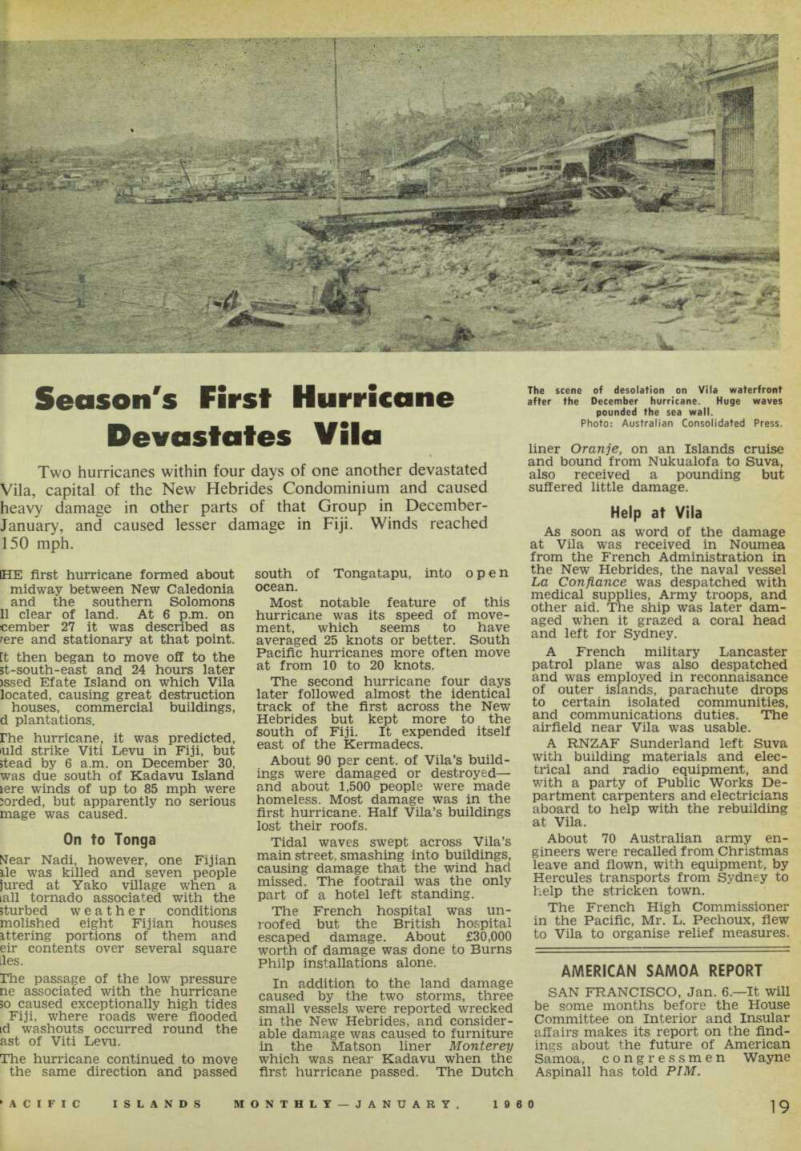
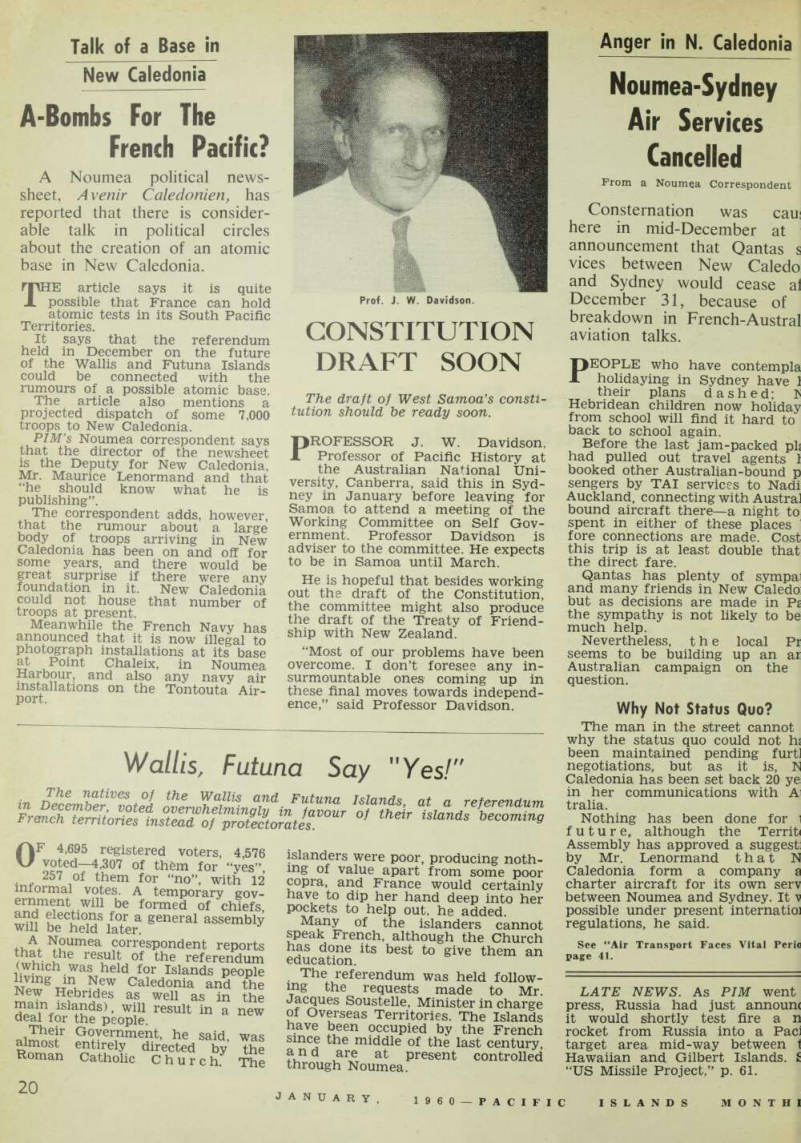
The crowds in these pictures are running from police smoke bombs in Suva. They were taken in the Rodwell Road area on the first day of the December riots. Below left, union leader James Anthony gives directions to striking oil workers inside a Suva oil installation. More pictures on pages 130-131. Photos top and bottom: D. L. Low.
In my opinion, the Burns Com mission will find that most of the governmental conditions based on the Deed of Cession are due for overhaul.
The Commissioners, I think, will acknowledge that the establish ment of a large and healthy Indian community in Fiji was in some ways unfortunate. But that has nothing to do with the present generation of Fijians, Europeans and Indians. Those communities must accept facts as they are.
Expert View of Riots
Sir Alan was deeply interested in the “December riots” in Suva, and he took away with him, for closer study, the considerable quantity of newspaper cuttings on the subject which had just reached me by mail.
But he ridiculed the persistent newspaper suggestion that this disturbance was anything more than a superficial froth, and that there was real evidence of an anti- European feeling.
He rather accepted the view that these disturbances were the inevit able outcome of an economy that
is out of gear—too many people for the country’s available resources, causing unemployment, poverty and discontent.
I think the Commission will urge that no time be lost in attacking the underlying causes of this dis content, and that the Government, m taking new, urgent measures, should seek the co-operation of the leaders of all classes and all races —and especially the heads of the Australian corporations, which have such large interests in Fiji.
I should not be surprised if the commission recommended the in troduction of a Development Officer, riin • i tat o S equal to that of Colonial Secretary or Financial Secretary, to directly assist the V UP°i r enormously
aheadlt lies immediately
I expect that Sir Alan Burns— S?? 11316 - 6 realist in these matters P V S n }. uch attention to technical education.
All the resources which the Government can command will be to conditions to encourage new industries; and I think Sir Alan will insist that immediate steps be takeS to trafn
(Continued on page 143)
technicians for the staffing of such industries.
I was impressed by the fact that Sir Alan, in conversation, warmly praised the achievements of the Colonial Sugar Refining Company, in co-operating with Fiji’s Depart ment of Education in encouraging new techniques in agriculture and animal husbandry.
British Governmental Connection I did not get the impression that the Report will urge any marked changes in the governmental system. I think the Commissioners probably are afraid of the complications inherent in racial distinctions and common rolls.
Probably—for the present, any way—the Colony will be urged to carry on with the present form of government, leaving to an ex ceptionally strong and experienced man, in the person of the Governor (if such can be found, of course!) the job of getting the real co operation of the racial leaders and the corporation heads in the heavy task of shaping a socio-economic road along which Fiji may travel in security and reasonable content ment.