Season's First Hurricane
p. 21 · Read in the full issue
Devastates Vila
Two hurricanes within four days of one another devastated Vila, capital of the New Hebrides Condominium and caused heavy damage in other parts of that Group in December- January, and caused lesser damage in Fiji. Winds reached 150 mph.
(HE first hurricane formed about midway between New Caledonia and the southern Solomons 11 clear of land. At 6 p.m. on cember 27 it was described as rere and stationary at that point.
Ct then began to move off to the st-south-east and 24 hours later >ssed Efate Island on which Vila located, causing great destruction houses, commercial buildings, d plantations, rhe hurricane, it was predicted, iuld strike Viti Levu in Fiji, but >tead by 6 a.m. on December 30, was due south of Kadavu Island lere winds of up to 85 mph were jorded, but apparently no serious mage was caused.
On to Tonga Near Nadi, however, one Fijian lie was killed and seven people jured at Yako village when a iall tornado associated with the sturbed weather conditions molished eight Fijian houses ittering portions of them and eir contents over several square ties.
The passage of the low pressure ne associated with the hurricane so caused exceptionally high tides Fiji, where roads were flooded id washouts occurred round the ast of Viti Levu.
The hurricane continued to move the same direction and passed
south of Tongatapu, into open ocean.
Most notable feature of this hurricane was its speed of move ment, which seems to have averaged 25 knots or better. South Pacific hurricanes more often move at from 10 to 20 knots.
The second hurricane four days later followed almost the identical track of the first across the New Hebrides but kept more to the south of Fiji. It expended itself east of the Kermadecs.
About 90 per cent, of Vila’s build ings were damaged or destroyed— and about 1,500 people were made homeless. Most damage was in the first hurricane. Half Vila’s buildings lost their roofs.
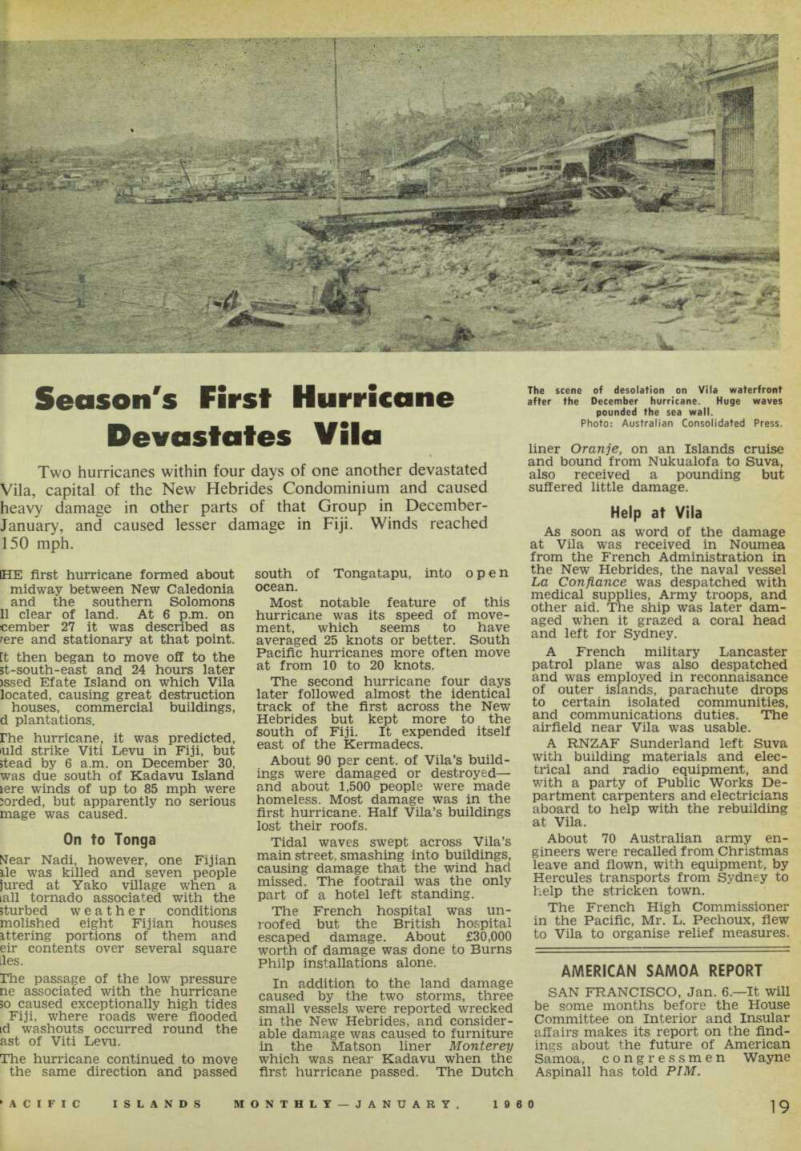
Tidal waves swept across Vila’s main street, smashing into buildings, causing damage that the wind had missed. The footrail was the only part of a hotel left standing.
The French hospital was un roofed but the British hospital escaped damage. About £30,000 worth of damage was done to Burns Philp installations alone.
In addition to the land damage caused by the two storms, three small vessels were reported wrecked in the New Hebrides, and consider able damage was caused to furniture in the Matson liner Monterey which was near Kadavu when the first hurricane passed. The Dutch
liner Oranje, on an Islands cruise and bound from Nukualofa to Suva, also received a pounding but suffered little damage.
Help at Vila As soon as word of the damage at Vila was received in Noumea from the French Administration in the New Hebrides, the naval vessel La Confiance was despatched with medical supplies, Army troops, and other aid. The ship was later dam aged when it grazed a coral head and left for Sydney.
A French military Lancaster patrol plane was also despatched and was employed in reconnaisance of outer islands, parachute drops to certain isolated communities, and communications duties. The airfield near Vila was usable.
A RNZAF Sunderland left Suva with building materials and elec trical and radio equipment, and with a party of Public Works De partment carpenters and electricians aboard to help with the rebuilding at Vila.
About 70 Australian army en gineers were recalled from Christmas leave and flown, with equipment, by Hercules transports from Sydney to help the stricken town.
The French High Commissioner in the Pacific, Mr. L. Pechoux, flew to Vila to organise relief measures.
The scene of desolation on Vila waterfront after the December hurricane. Huge waves pounded the sea wall.
Photo: Australian Consolidated Press.