Yank In Honiara
pp. 85-99 · Read in the full issue
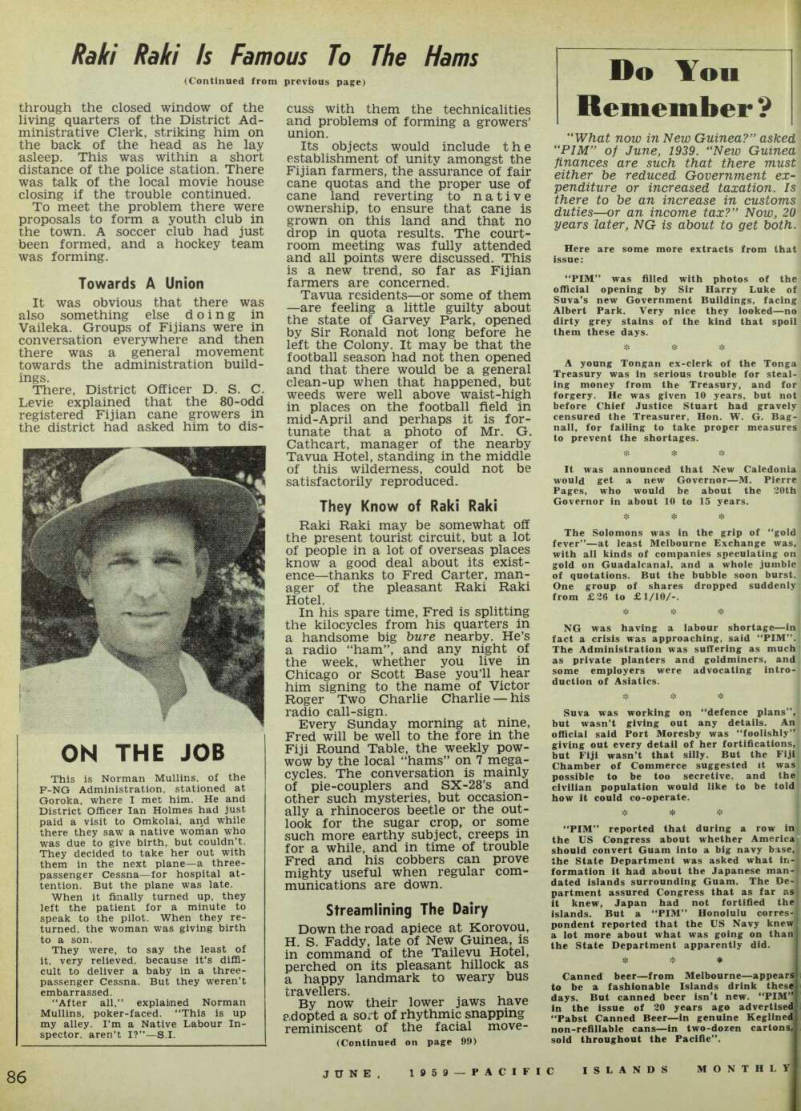
MR. ALVIN J. BLUM, well-known businessman of Honiara, in the Solomons, was born in New Jersey, USA in 1912. He spent 10 years in the Southern States, as a commercial traveller, mostly at the now famous town of Little Rock, Arkansas.
When war broke out he joined the American Army and became a Sergeant in the Medical Corps, serv ing four years in the Pacific cam paigns. This took him to New Zealand, New Caledonia, Santo, Guadalcanal, Finschhafen, Manus, and Hollandia, and to Takloban and Manila in the Philippines.
After the war he married Gertrude Gewertz, of New York, and when their daughter Keithie was born at Little Rock they moved to New Zealand and entered the “Rag Trade”.
In 1953, the Blum family set out on a tour to Ceylon, India, Pakistan and Israel, being interested in the traditional religions of those countries. The next move was to Honiara, where the family arrived on March 1, 1954, in the “Malaita”.
During the past five years they have established a laundry and dry-clean ing service, a bakery and a general store. They also make aerated waters and are about to establish a small oil mill to extract oil from peanuts or copra for local con sumption.
The firm of Blum has taken Mr. & Mrs. John Mills as partners, and is extending its activities to Auki. on Malaita Island, where they are erecting a picture theatre and a general store.
The Blums and the Mills are members of the Baha’i World Faith, and it was partly on this account that Mr. & Mrs. Blum were in May on a visit to Australia and Fiji.
Mr. Blum is a member of the Honiara Town Council and the Public Health Committee. In all his activities he has had the untiring assistance of his wife. — BRETT
Hilder.
through the closed window of the living quarters of the District Ad ministrative Clerk, striking him on the back of the head as he lay asleep. This was within a short distance of the police station. There was talk of the local movie house closing if the trouble continued.
To meet the problem there were proposals to form a youth club in the town. A soccer club had just been formed, and a hockey team was forming.
Towards A Union
It was obvious that there was also something else doing in Vaileka. Groups of Fijians were in conversation everywhere and then there was a general movement towards the administration build ings.
There, District Officer D. S. C.
Levie explained that the 80-odd registered Fijian cane growers in the district had asked him to dis
cuss with them the technicalities and problems of forming a growers’ union.
Its objects would include the establishment of unity amongst the Fijian farmers, the assurance of fair cane quotas and the proper use of cane land reverting to native ownership, to ensure that cane is grown on this land and that no drop in quota results. The court room meeting was fully attended and all points were discussed. This is a new trend, so far as Fijian farmers are concerned.
Tavua residents —or some of them —are feeling a little guilty about the state of Garvey Park, opened by Sir Ronald not long before he left the Colony. It may be that the football season had not then opened and that there would be a general clean-up when that happened, but weeds were well above waist-high in places on the football field in mid-April and perhaps it is for tunate that a photo of Mr. G.
Cathcart, manager of the nearby Tavua Hotel, standing in the middle of this wilderness, could not be satisfactorily reproduced.
They Know of Raki Raki
Raki Raki may be somewhat off the present tourist circuit, but a lot of people in a lot of overseas places know a good deal about its exist ence—thanks to Fred Carter, man ager of the pleasant Raki Raki Hotel.
In his spare time, Fred is splitting the kilocycles from his quarters in a handsome big bure nearby. He’s a radio “ham”, and any night of the week, whether you live in Chicago or Scott Base you’ll hear him signing to the name of Victor Roger Two Charlie Charlie his radio call-sign.
Every Sunday morning at nine, Fred will be well to the fore in the Fiji Round Table, the weekly pow wow by the local “hams” on 7 mega cycles. The conversation is mainly of pie-couplers and SX-28’s and other such mysteries, but occasion ally a rhinoceros beetle or the out look for the sugar crop, or some such more earthy subject, creeps in for a while, and in time of trouble Fred and his cobbers can prove mighty useful when regular com munications are down.
Streamlining The Dairy
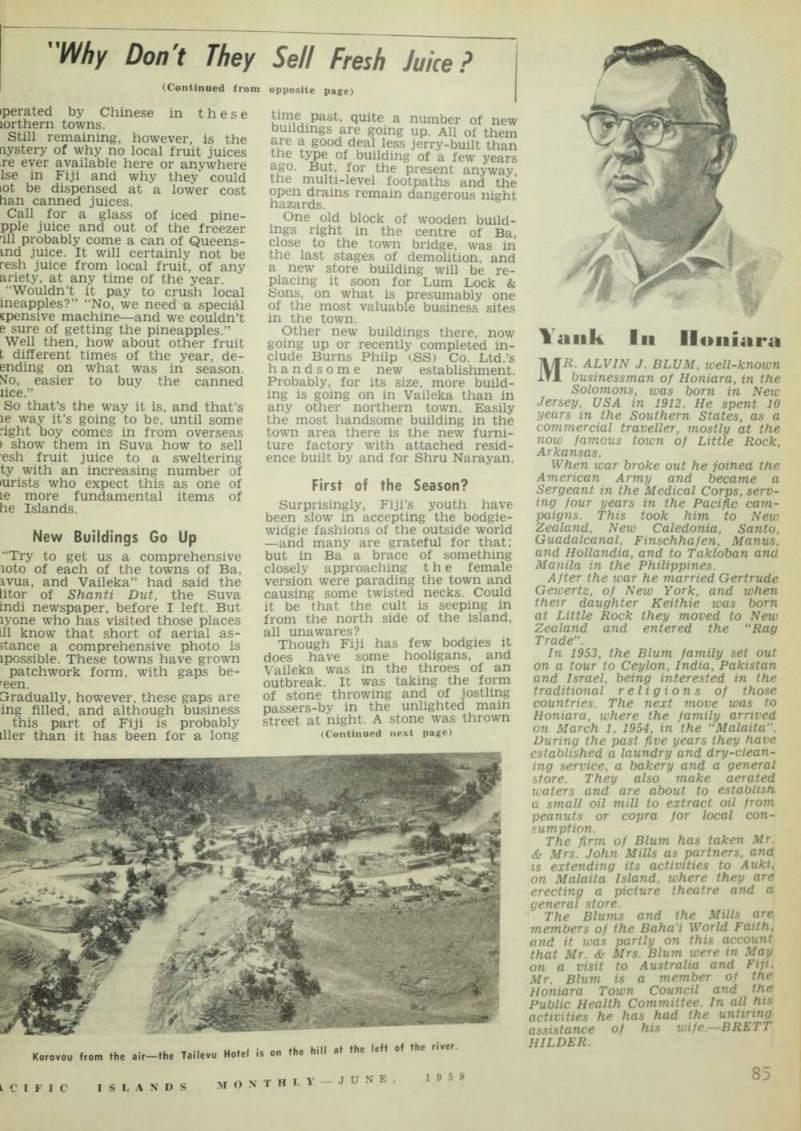
Down the road apiece at Korovou, H. S. Faddy, late of New Guinea, is in command of the Tailevu Hotel, perched on its pleasant hillock as a happy landmark to weary bus travellers.
By now their lower jaws have adopted a sort of rhythmic snapping reminiscent of the facial move
(Continued on page 99)
its of a freshly gaffed salmon, to the pot-hole jumping of the on the long run south and the mce of refreshment stops en e. Thus the Tailevu pub is more i welcome for a half-hour break, f the sandwiches and beer, ager Faddy talks of local affairs. ie big news is Mr. Tom ward’s streamlined cow bails, the new Tamavua milk factory ;h will soon start the homo sation of milk supplied by the V farmers in this area for dis ition in Suva. rtain machinery was expected ome to hand from overseas in for the Rewa Co-operative y Co. to start up this new plant uly. This will be a major de iment in Suva’s progress, te company’s dairy factory at a, which has operated for many 3, is being dismantled and part ie equipment transferred to the site which is near Suva. The inder is offered for sale. Fiji •rted about £lBO,OOO worth of ed milk in 1957, the last year which statistics are available,
riu?m t ? e *f! r ! sent aims at re ducmg that amount by exoandino the l° cal dairying lndLtry P d g But, returning to Mr tr, m Gat ward's streamlined cowbails with covered yard. Something like 150 cows are being milked by hand as is the case with many Fiji dairy farms, though some haVe machines
By The Way
snm?iv re ii S public electric power IpJPcJJL III ! thls area > but in New Zealand long before electricity had their own motor milking plants. However, hand milking has the virtue of providing employment, and costs may bl comparable with machines in Fiji Winding over the hill-country south towards Nausori many Fijian
women, stooped with huge loads of tlcks on their backs moved to the edge and swung their loads in tn ttrTJi h fh the K roadwa y so as not bus - standin g stooped they were suggestive of aircraft revving up their motors at the end of the strip prior to take off. Invariably they faced outward from the roadway.
Along this stretch, 50 miles out from Suva, was one of Fiji’s prettiest sights. Big African tulip trees over hang the road, their tops a blaze 01 orange-coloured flowers, which were also falling thickly on the roadway to give the kind of display seen more often in the travel fold ers than in nature. But that’s one of the many pleasant surprises of the Slipped Disc Route.