Off The Badly Beaten Track: From Nadi To Suva
pp. 84-85 · Read in the full issue
Via The Slipped Disc Route
From J. P. Short All
“Everyone” travels from Nadi to Suva via the Queen’s Road the south coast road via the tourist resorts accord ing to the tourist people. But a few still travel, for good reason or bad, the King’s Road via Raki Raki, though it might at present be better named the Slipped Disc Route.
There are people who pit themselves against mountain peaks or deep limestone caves, but the same kind of stamina—in shorter bursts— is called for in an Indian bus on the road to Raki Raki, where the dust comes in choking clouds and the sweat flows freely, and a certain memory of a neighbour’s curried lunch or well garlicked dinner rends the air. This is not top-class tourist stuff, but it’s all experience, and after all, don’t tourists want something different?
THERE is no one more obstinate to change than the designer of the Fiji bus. The wooden straight-backed seats close-spaced, the canvas side screens let down to flap loosely when it rains, are still there, as they were 20 years ago.
But at least the main-line buses now run to timetable, supervised by the police, and at least there appears to be some check on mechanical condition There is progress, too, in the signals system. Where before you shouted for a stop, there, is now a bicycle bell mounted on the roof near the driver, with a nylon fishing cord extending aft above the centre alleyway. The bell is usually of the double type which rotates when rung. Bathing beauties are painted on either dome.
And More Progress; The larger varieties of live-stock are now generally confined to a screenedoff luggage compartment at the rear and not accepted as equals in the passenger section, though the odd sack of produce is persona grata there, depending on the particular driver’s ideas on the subject.
In short, the Fiji bus—always
Indian operated—has made some progress this century. The engine and chassis are generally stronger and better fitted to climbing the corrugations and pot-holes on the King’s Highway—but whether the frail-looking CSR bridges have progressed with the size and weight of the buses is a moot point. It is always a tense moment when a heavily laden bus falls from the crest of the last corrugation onto the patchwork decking of one of these bridges, T l D| n r rftn “ "
After two poor years, it is very evident that this year’s sugar cane crop is a bumper one all along this north coast. The road is a narrow channel cutting through the dense cane fields which stand eight and nine feet high—blocking the view and the breeze on the flat areas, At intervals in this sea of cane, and with no visible reason for their existence, shabby Indian stores stand at the roadside, The bike bell jangles, the bathing beauties do a loop, and the bus grinds to a halt to unload some Indian farmer or his wife, and as
the bus takes off again the late passenger disappears up some narrow, stifling lane through the cane crop to an almost hidden farm house. The bus makes a sudder side-slip onto another cane-railway bridge, then resumes its course parallel with the railway through the waving sea of cane.
In this area progress across streams is almost always by courtesj of The Company. Just now there is little rail traffic, but when the mills start up the cane trains will take priority.
Worry In The Ricefields
Though the sugar crop seems at its best right through this ares from Nadi to Raki Raki, all is not well with the rice crop which pro vides a part of the staple diet, j Wherever the cane fields pause to give way to rice the Indian farmers riding the buses broke into animated conversation as they scanned the rice plantings. Many areas of yellow, dying rice stalks were evident amongst the greem and in a few places damage was extensive. In Lautoka the District Agricultural Officer, Mr. Norman Williams, said that after a lull since about 1952, “Rice Yellow”—as the pest is loosely called —reappeared in the North-West last May and at present is increasing in that area.
Liquid Refreshment
As everywhere in the tropics? beer is always an acceptable topic of conversation—and a touchy one at Ba, where it costs 1/2 per 8 ok glass to those who drink it acrosi the bar of the only hotel. That’s; why business is brisk at the clubi where they sell it at 9d per glassj?
But everyone still sneaks in for: one across the bar now and againjt A feature of the non-alcoholi© liquid refreshment situation in ref cent years has been the appearance of clean, well-run iced-drink bad
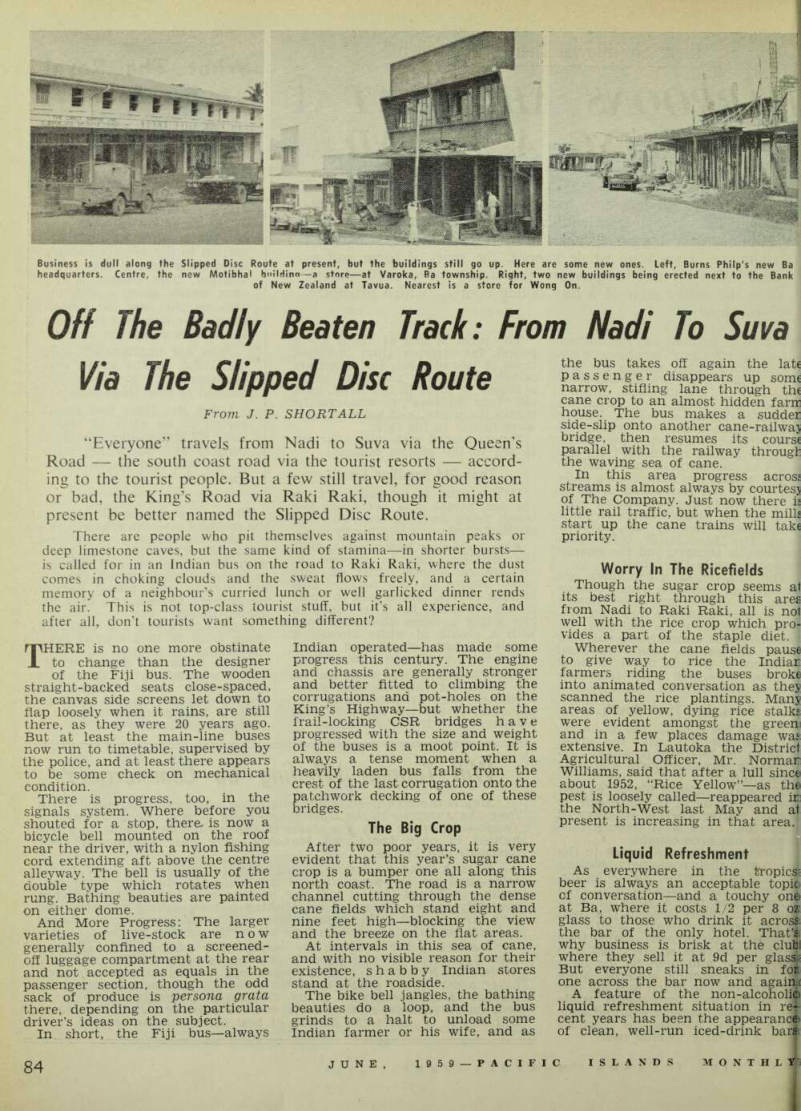
Business is dull along the Slipped Disc Route at present, but the buildings still go up. Here are some new ones. Left, Burns Philp's new Ba headquarters. Centre, the new Motibhal buildin g—a store—at Varoka, Ba township. Right, two new buildings being erected next to the Bank of New Zealand at Tavua. Nearest is a store for Wong On.
Shlrn to^ns CWneSe ta theSe Still remaining, however, is the nystery of why no local fruit juices re ever available here or anywhere Ise in Fiji and why they could ton el juices a * C ° St Call for a glass of iced pineppie juice and out of the freezer ill probably come a can of Queensmd juice. It will certainly not be resh juice from local fruit, of any time of the year - Wouldn t it pay to crush local ineapples?” “No, we need-a special icpensive machine—and we couldn’t e sure of getting the pineapples.’’
Well then, how about other fruit t different times of the year, deending on what was in season. easier to buy the canned lice.”
So that’s the way it is, and that’s le way it’s going to be, until some right boy comes in from overseas » show them in Suva how to sell esh fruit juice to a sweltering ty with an increasing number of lurists who expect this as one of le more fundamental items of he Islands ii..,. d.-sus,.-, ii n
New Buildings Go Up
“Try to get us a comprehensive loto of each of the towns of Ba, avua, and Vaileka” had said the litor of Shanti Dut, the Suva indi newspaper, before I left. But lyone who has visited those places ill know that short of aerial asstance a comprehensive photo is ipossible. These towns have grown patchwork form, with gaps bereen.
Gradually, however, these gaps are ing filled, and although business this part of Fiji is probably iller than it has been for a long
LTdiSgf SHn
are a glod deal less the type of building 3 of a few years ago. But, for the present Tnvwav the multi-level footpaths and the halards^ 8 dangerous ni^ht One old block of wooden build ings right in the centre of Ba close to the town bridge was in the last stages of demolition, and a new store building will be re placing it soon for Lum Lock & Sons, on what is presumably one of the most valuable business sites in the town.
Other new buildings there, now going up or recently completed in elude Burns Philp (SS) Co. Ltd.’s handsome new establishment, Probably, for its size, more build ing is going on in Vaileka than in any other northern town. Easily the most handsome building in the town area there is the new furni ture factory with attached resid ence built by and for Shru Narayan.
First of the Season? . . . , Surprisingly, Fiji’s youth have been slow in accepting the bodgie widgie fashions of the outside world a nd many are grat eful for that; but in Ba a brace of something closely approaching the female version were parading the town and causing some twisted necks. Could it be that the cult is seeping in from the north side of the island, all unawares?
Though Fiji has few bodgies it does have some hooligans, and Vaileka was in the throes of an outbreak. It was taking the form of stone throwing and of jostling passers-by in the unhghted mam street at night. A stone was thrown (Continued next page)
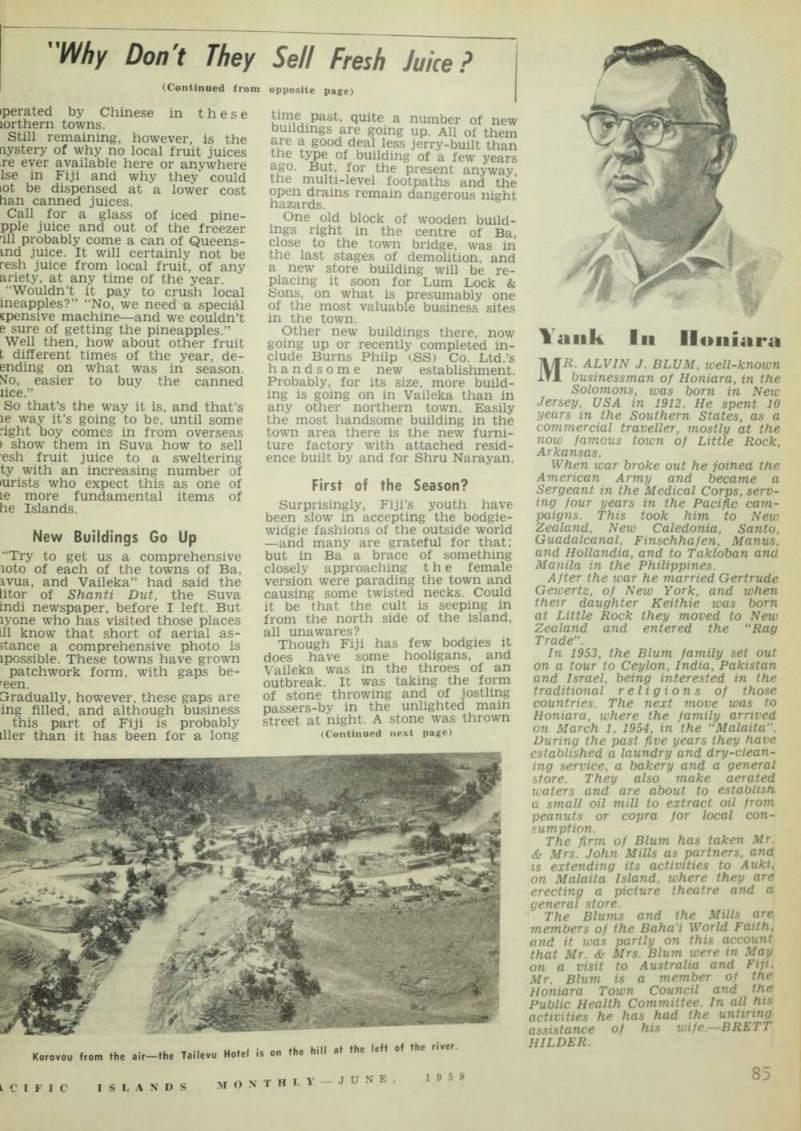
Korovou from the air—the Tailevu Hotel is on the hill at the left of the river.