[?]hey Want Improved Land ,
pp. 53-59 · Read in the full issue


What The South Pacific Conference Decided [?]hey Want Improved Land , And Better Organised Tourism
When the 65 delegates and advisers, from 18 non-self ;oveming Pacific territories and the independent Kingdom of fonga, finished having their say at the Fourth South Pacific conference in Rabaul in May, the South Pacific Commission net to officially hear the details.
was merely an official act, be cause the Commissioners had been present in Rabaul through the fortnight’s conference any , and knew very well how things t. All of them agreed: “It was best conference yet”—or, to use more colourful expression of ’erence chairman and Senior tralian Commissioner, J. R. igan, “the finest flower of the imission’s achievements.” le SPC meeting—its nineteenth ion —surveyed the resolutions of conference, and decided what m, if any, it would take on them. how far-reaching this action be, will depend as usual on how perative the member govern ts are in the three years to the - conference. lese are the main resolutions forward by the Fourth Confer ; during its fortnight-long sit , together with the comments e by the Commission after ying them at its own meeting.
The Resolutions
The conference thought it was ood idea for the Commission rain selected assistant medical ers in public health work, and ght the SPC ought to do Some s' about getting the scheme :ing right away. ie SPC replied that it had idy worked out a project for a ling course in preventative icine and was now getting the ms Governments to comment t. The results should be ready the SPC to discuss further at 10th session in October.
The conference thanked the for its fisheries and plant in action work and the “energetic” it had tackled the rhinoceros e problem, and suggested it up its support for the coconut trch station which is studying lut growing under atoll condi e SPC said it would make ler plans for all these projects ctober. The work on the rhino e had opened up “promising bilities”, but it was now obvious
a. i a that the SPC had to work to a Pl an over a number of years before the beetle could be brought under control. • The conference thought there was need of special training for co-operative personnel; that where co-operatives were well-established there were now possibilities of extending them to small-scale secondary industries if capital could be provided (by Government loans, perhaps); and that there was need for training indigenous people in business methods “because private
enterprise plays an important part m their progress.”
Co-operatives
The SPC said that following its meeting on co-operatives in Port Moresby last year it had decided to help co-operatives in many ways— by providing local training courses and material and helping co operatives’ officers to travel. But it would also, now, prepare a paper on how capital could be provided to extend co-operatives, and bring the paper to the attention of the gov ernments. The SPC had men avail able to advise governments on the training of indigenous people in business methods. • The conference was critical of the fact that some delegates weren’t sent the introductory papers to the agenda items in time to study them properly, and said this “prejudiced” the effectiveness of discussion. It added that, in future, papers should be put in simpler language.
The SPC had a watertight excuse.
It blamed the situation on the lack of co-operation from some of the governments. It said the rule of the conference laid down that gov ernments should supply the SPC with the papers in time for it to cir culate them at least eight months in advance. The agenda for this conference had been circulated 12
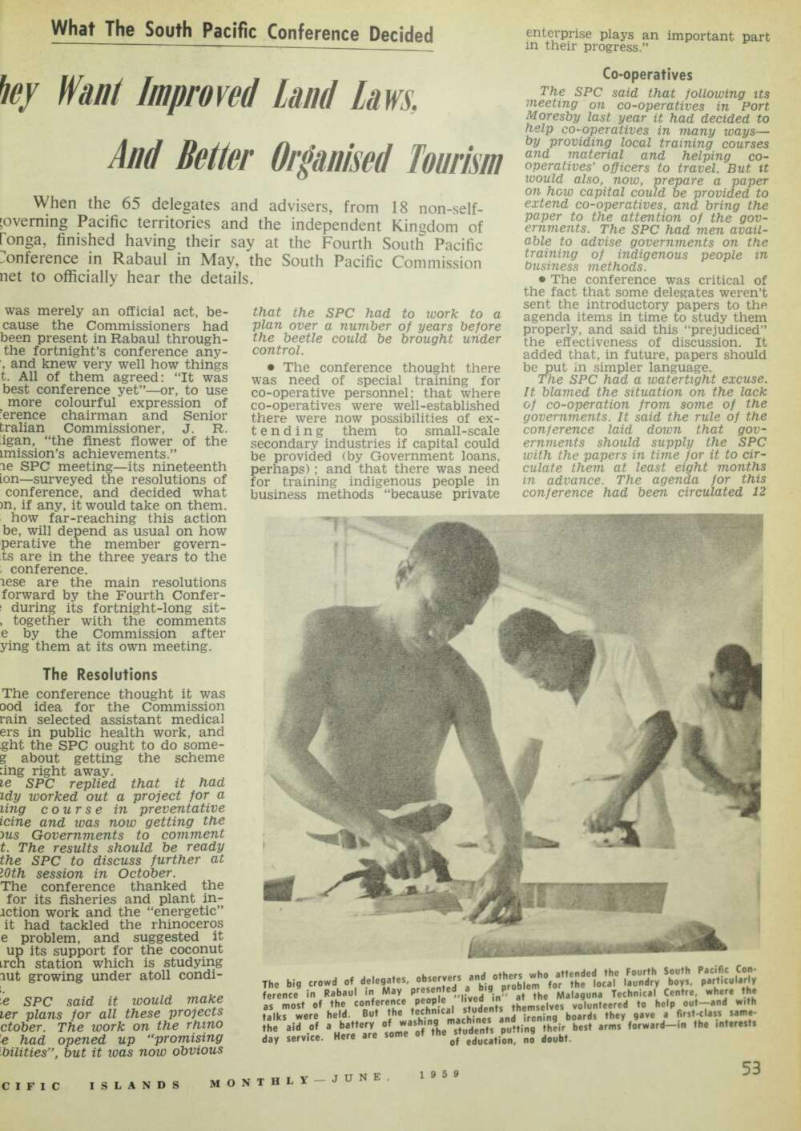
The big crowd of delegates, observer and others who aţtended the Fourt South Pcific Conference in Rabaul in May presented a big problem for the local laundry boys, particularly as most of the comference people "lived in" at the Malguna Technical CEntre, where the talke were held. But the technical students themselves volunteered to help out-and with the aid of a battery of washing machines and ironing boards they gave a first-class same day service. Here are some of the students putting their best arms forward-interests of education, nodoubt.
mths in advance, with a request 1 papers, but some had not turned until three weeks before the con ence.
I he SPC had nothing to say about i conference’s request for simpler iguage, which is a pity. Here is a nple sentence from the intro jtory paper on land tenure, pre 'ed by the P-NG delegation: iras (1) and (2) above describe efly the position of large bodies people throughout the tropics, or to the impact of external terns of administration bringing v concepts of law and social re onships, and to the impact of the hange economies from the out s world that have either accom lied or preceded these adminis tions.” l whole paper written in this le, as this one was, can be hard ng. 1 There should be prepared a ies of graded readers with a ific setting, for all primary school groups, the conference said. ’he SPC thought this a good idea I will examine it with member ernments. It said that meanwhile Pacific Reader suitable for the 15 age group (recommended by Third Conference) was now well 'anced and that this could well part of the series.
The conference said it “re :ted” the limitations imposed on SPC by its restricted budget, asked that the contributions ;he governments be increased; it 1 stressed the value of more and •e personal visits to territories by 2 officers.
More Finance Perhaps? he SPC said this view about the 1 budget would be sent to the ernments.
Tiat it did not say, but discussed fficially at its, meeting, was that •e could soon be a review of gov nent contributions. The Ameri -5 are anxious to make a larger ;ribution. At present America ddes 12i per cent, of the budget i percentages are: Australia, 30 cent.; Netherlands, NZ, UK, 15 cent each; France and America per cent). [See page 20]. le American contribution was down before America intro >d the US Trust Territories into SPC. When the SPC was first ffished, the only American terri connected with it was East oa. A review of percentages Id naturally concern all govern ts, and presumably involve some ;ical wrangling.
The conference made a whole ss of resolutions involving land lems—a paper on which was most important matter dis
cussed during the fortnight. The debate on it at times became almost political. The conference recognised that one of the big dangers of traditional land tenure systems in an altering society was that they could hinder the advancement of natives attempting to become pro gressive, or independent of the herd.
These are the resolutions: (a) that where changes are necessary, they
must come from the community itself, and should only be instituted after full investigation of the community’s views; (b) that to facilitate the progression of unskilled labourers to the stage of skilled labourers, and to facilitate the acceptance of these necessary changes, higher level education should be in stituted: such education can be pro moted through the establishment of agricultural schools, experimental stations and extension services; (c) that governments should establish a land and genealogical registry system and provide the machinery to deal with cases where communities are will ing to exchange their traditional form of tenure for a modem system, accom panied by an equitable redistribution
of land to permit progressive methods of farming; d) that where appreciable, every effort should be made by governments to provide for the settlement of progres sive farmers on individually owned holdings outside the traditional system of tenure. Governments should take into account the availability of land suitable for specialised agriculture, in cluding tree crop farming, having re gard to the effects of population pres sure in various areas; e) that where traditional forms of land tenure provide for the purchase or exchange of land amongst indigenous people, provision should be made for the recognition of such purchases or exchanges in the laws of the country concerned and their legal registration; f) that where planting of perennial cash crops is to take place on land owned according to traditional tenure, active extension work should be carried out in both the technical and social fields to ensure that the crops are planted in the best way.
The Conference further recommends ?) that the Commission undertake a study of land tenure systems in the Pacific area and other parts of the world and make full information available to governments and invite them to con sider sending experienced, indigenous, territorial representatives to selected territories to study the position on the spot with a view to helping them to reach solutions to their own problems, and that the Commission facilitate inter-territorial visits for the purpose of gathering information insofar as territories will ask for them.
The SPC agreed that modifications f land tenure systems might be ssential in some cases, and will get
he Secretary-General to consult
overnments on the conference reso ■itions and report back to the SPC.
Pacific Tourism
• The conference decided that ie advantages of Pacific tourism sually outweighed the disadvant ages, and suggested establishment of irritorial tourist offices: exchange f information between territories nd the organisation of joint travel mrs; establishment of catering :hools; and the consideration of iws to protect territories from ime of the disadvantages of tour m—such as danger to customs, arts
nd crafts and property.
The SPC will pass this on, and nil ask governments how it can elp. • The conference said it wanted jrritories to establish, increase or nprove broadcasting services and ive more emphasis to the use of le vernacular. Broadcasting was 'owing in importance in the Pacific.
The SPC agreed, and said it was Iready doing something to help, nth the circulation of recorded ilks and Pacific music.
South Pacific Games
• The conference listed a number I points which it thought should 3 considered in selecting and train ig leaders in aided self-help pro rammes, and suggested the com lission should prepare a booklet
giving details of successful schemes elsewhere.
The SPC said it would try to do something about the booklet. • The SPC should investigate the chances of organising an inter territory sports tournament every three years, said the conference. It would be a kind of South Pacific Olympic Games.
The SPC will look into this, and also the question of finance — vihether the tournaments could be financed by sports bodies in the Island administrations, or even by the SPC. • The conference pointed out that evolution towards industrial isation was inevitable in the South Pacific, and that this affected exist ing social structures and meant that some natives would have a problem
to adapt themselves. It recom mended that governments encourage new industries while at the same time recognising the problems. Sub sistence economies should not be overlooked, but developed by new methods. The conference added that governments could do something ta pool their resources and establish ad vanced schools to train natives in modern industry—as the Central Medical School was training them in medicine.
The SPC did not buy into any of this, it said these matters were ones for the governments, although the SPC would continue to look for ways to help. • The conference wasn’t very happy about the fact that resolu tions touching on infant and maternal welfare problems, moved at the Third Conference, had not
, Tf ;en acted upon by governments. It id it still wanted a ciDinparative iluation of the various infant and aternal welfare programmes m ie Pacific Islands.
The SPC requested the Secretary iTte* prepare a plan for this General to V . f tQ govern . evalua request for com mens ww a project. menis, una y