Tirst Talanoa Was Produced By A Bishop,
p. 31 · Read in the full issue
Ours Is Not The irsf by 66 Years
Tirst Talanoa Was Produced By A Bishop, A Priest And A Bricklayer
• When “PlM’s” Vakatawa was looking for a name for his Fiji column, € chose “Talanoa”, for its meaning of “gathering together to talk or spread \e news”. But “PlM’s” was not the first “Talanoa”, in the newspaper sense: 'he distinction goes to the Marist Mission press in Fiji, which for 60 years reduced a monthly paper “A Talanoa” which was distributed amongst
ijians.
I7TTH a wit which one might fr expect from a man with an Irish name and French ationality, Father Patrick O’Reilly, le French Pacific’s most enterpris ig literary researcher and writer, ills something of the early print ig efforts of the Marist Mission in iji. And more particularly he tells I the Loreto Press, whose main )b was producing A Talanoa, from uly, 1892, until 1954, when it seems ) have gone out of existence. ; Whenever he has been wandering round the Pacific in the past 10 ears, this French O’Reilly has Elected mission publications, but it r as not until mid-1958 that, with ie help of Fr. Joseph Castanie, r ho was visiting Paris from Fiji 'here he has worked since 1903, e produced the small bibliography f the Catholic Mission publications i full. ( Imprints of the Fiji btholic Mission Including the oreto Press) .
The Marists established themselves i Fiji in 1844, but their first book
in Fijian did not appear until 1864, and then it was published in Syd ney—a sort of combination prayer book, catechism, hymnal, church history and the Gospel of St.
Matthew.
The Bishop's £5O Printing Press
It was Fiji’s first Roman Catholic Bishop, the Marist Julien Vidal, who was appointed in 1887, who set up the first printing-shop.
At a later stage, Bishop Vidal had an extra cross to bear, in the shape of the ebullient Father Rougier but in the meantime, the Bishop got on with establishing his press, first at Levuka, and finally at Loreto, some miles away on the island of Ovalau. , One of the reasons why the Bishop wanted a press, was to pub lish A Talanoa; and the reason for A Talanoa was to counter-attack against the Methodists and their Ai tuku-tuku vakalotu. . .
What kind of a press the mission printers had in the early years is
lost in the mists of history, but in 1892 the Suva Times (“faltering visibly”, says Fr. O’Reilly) merged with the Fiji Times. The Suva Times equipment became surplus to re quirements, and Bishop Vidal pur chased it, triumphantly, for £5O, complete with numerous sets of type.
A Talanoa, No. 1, Vol. 1, emerged soon after.
Father Marion was entrusted with the printing and editing of Talanoa, and in this task he was helped greatly by the versatile Brother Xavier, who went to the mission as a bricklayer but seemed to have no trouble whatever in changing his craft to typography.
In the early years of this century, Brother Xavier was transferred to the Rewa, where Father Rougier was in charge. With the Brother’s help, Fr. Rougier set up in opposi tion to Loreto, and on his printing press produced a Fijian dictionary and other works—including a book of Fijian myths, of which “pagan stories” the other missionaries dis approved.
“They appeared without the im primatur of his Bishop,” says Fr.
O’Reilly. “Bishop Vidal was too in telligent a man to take this whim seriously, but nevertheless, Fr.
Rougier’s press ceased to work.” (It was, in fact, sent to Loreto).
The mission printing is no longer done at Loreto—a much more modern printing shop was set up in Suva a few years ago, and with the move from Ovalau, A Talanoa appears to have folded up, too.
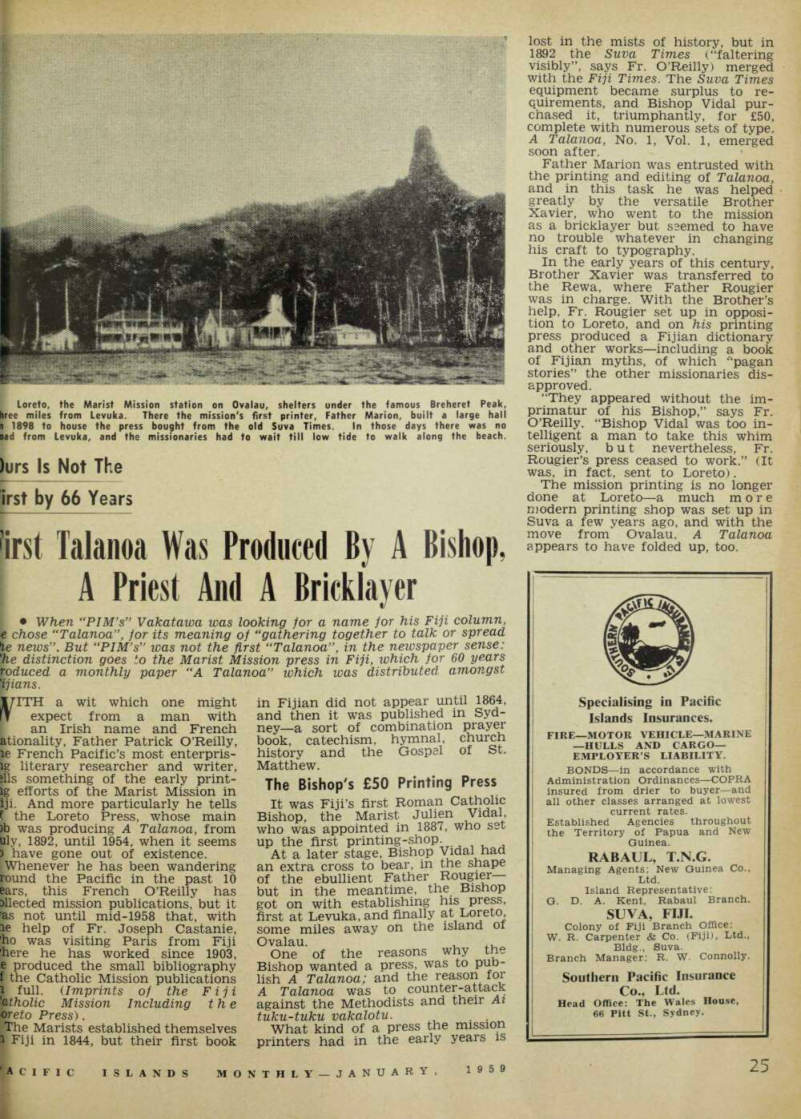
Loreto, the Marist Mission station on Ovalau, shelters under the famous Breheret Peak, hree miles from Levuka. There the mission's first printer, Father Marion, built a large hall [?] 1898 to house the press bought from the old Suva Times. In those days there was no oad from Levuka, and the missionaries had to wait till low tide to walk along the beach.