fiji talanoa
pp. 29-30 · Read in the full issue
Vakatawa Talks Of This And That
The new brewery at Suva is producing a draught beer which Fiji drinkers have pronounced “a very nice drop”—to such an extent that even customary spirit drinkers can be found down ing the local draught with enthusiasm. Another aspect of the new state of affairs is that methylated spirit sales are said to
have slumped.
MELBOURNE beer has always been a favourite in Fiji and the Suva brewed draught is of 1 type and quality which expert asters with whom Melbourne nemories linger say are very much ikin to those of their home towh
product.
\ There were a few dispensing roubles to begin with, through lack )f barmen skilled in the art of [rawing beer from the keg (or drum, )r firkin, or kilderkin, if you want ;o be all technical). i Fiji has had no draught beer for 1 long time —not since Sydney (rewers cut off the supply because, hey said, they found shipping costly md difficult. A few of the older rijian bar boys are still in service, mt most of them have been suc jeeded by younger men, used only p dispensing by or from the bottle. ? The local draught is to be fol owed by bottled beer in the New fear and great stacks of bottles are waiting at the brewery at Suva, fans are apparently out of the [uestion, on economic grounds, for I long time to come, i The local brew has brought the price of beer down and if the Gov srnment’s financial worries had not breed them to increase the excise [ate the reduction in price would lave been considerably greater. As t is, Suva drinkers who were paying 71 for an eight-ounce glass are now fetting their beer for lid in hotels md lOd. in most clubs. ! Outside Suva, the price is gener ally 1/-, although the licensee of the 3ot Springs Hotel, Mr. Robbie jepper, caused some comment when ie said that he would sell draught it Savusavu for lOd. after taking t the 100 miles or so by sea from Suva. • The spate of drunkenness, of Irtiich there were such dire pro phecies, has not followed the open -50 for beer-drinking by non-Euro peans and the coming of the local >rew. If anything, there seems to H: a greater degree of responsibility
and less obvious drunkenness than before .
One man wrote to the Fiji Times to say that since the draught beer had been available the local store keeper hadn’t been able to sell any methylated spirits.
GPH Offered
As Going Concern
The Government of Fiji has called for tenders for the Grand Pacific Hotel as a going concern. A lease is offered for 99 years.
The hotel has come into Govern ment hands as a result of a 40-year old agreement with the Union Steamship Company of New Zea land.
The company built the hotel as a staging point for passengers in the various Pacific shipping services at about the time of the First World War. The Government leased the hotel site for 1/- a year, and under took to take over the place “at current valuation” in 1959 if the company decided it wanted to move cut of the hotel business in Fiji.
Now the company has decided it does want to move out.
In the past 40 years, the GPH has become one of the world’s best known hotel names, but, despite the expenditure of a lot of money on furnishings and on kitchen equip ment, the hotel has, with the passage of time, fallen somewhat behind the requirements of a first-class hotel by modern standards.
The magnificent situation, the broad verandahs, the fine view, the pleasant grounds and the spacious and airy lounge are gx'eat assets, but there are few rooms with private baths or showers and the public bar is an integral (and inevitably sometimes a noisy) part of the hotel.
So the Government has promised preference to tenderers who are “prepared to modernise and extend the hotel within the next five years”.
Fiji’s Days
Of Reckoning
The Budget session of the Legis lative Council in December aroused much more than ordinary interest in Fiji.
The revelation that the Colony had been living beyond its income
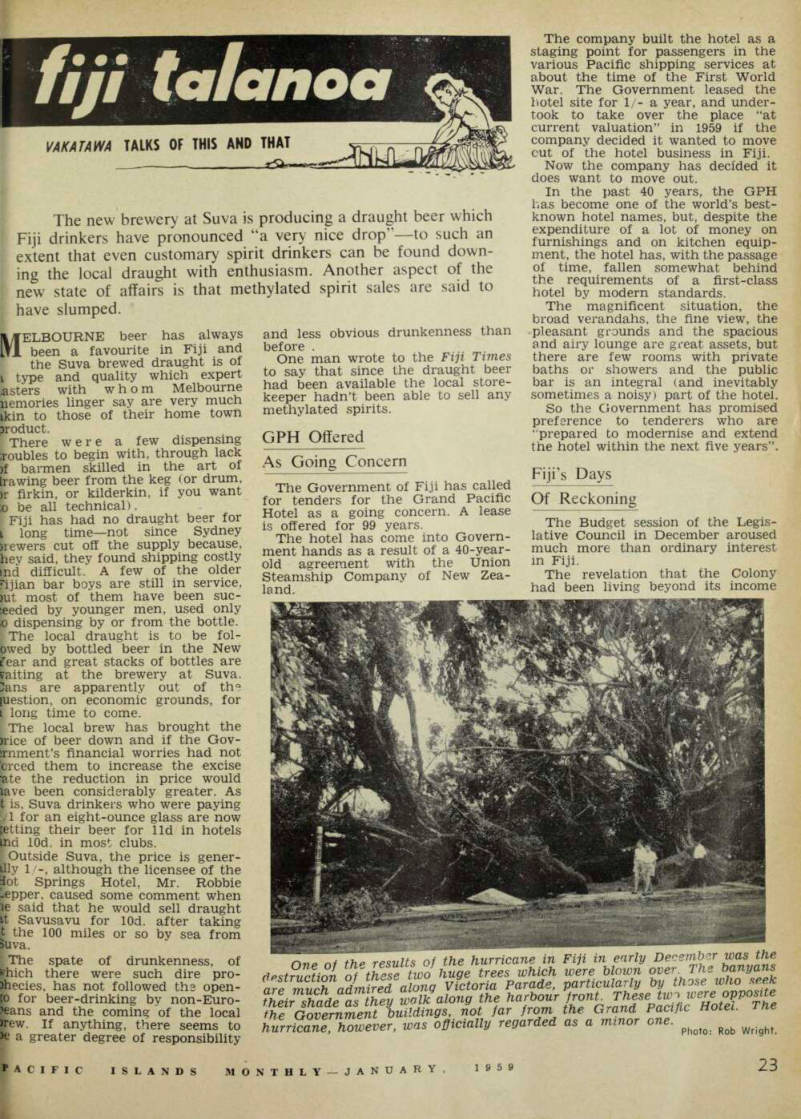
One of the results of the hurricane in Fiji in early December was the destruction of these two huge trees which were blown over The banyans are much admired along Victoria Parade, particuly by tose who sek their shade as they walk along the harbour front. These two were opposite the Government buildings, not far from the Grand Pacific Hotel. The hurricane, however, was officially regarded as a minor one.
Pohto : Rob Wright.
and that a day of reckoning had arrived, should not have been a sur prise to anyone who had been study ing trends of trade and production, but it obviously was not only a sur prise but a positive shock to nearly everybody.
Some of the unofficial members of the Legislative Council admitted freely that, as far as spending was concerned, they must accept their share of blame for agreeing to ex penditure which required the approval of the council’s finance committee.
Others were less frank. They “hadn’t been told” —an attitude which is rather more typical of the politician than the responsible rep resentative of the people. (Yes, Fiji has them, too).
Out of the welter of comment and controversy about the Colony’s finances generally, there emerged a fairly clear feeling that leave and passage privileges for the civil ser vice have got out of hand and are now on too generous a scale and are more than the Colony can afford.
Some of the arguments ran: “If senior officers got six months’ leave every three years (or four, depend ing on salary) and another two months are added for travelling time to the United Kingdom, continuity of policy is impossible and the cost of maintaining a staff and a quarter (or thereabouts) when added to the cost of passages half-way round the world and back, creates a burden too great to be borne by a country the size of Fiji.
“It is reasonable to send officers whose homes are in England back to England every now and then, but why should local people and those recruited in Australia or New Zea land also go to England at Fiji’s expense?
“Anyhow, is it really necessary to leave a healthy country like Fiji every three years or so?”
It’s the Leave Not
the Work that Counts
But there was another side, and some of the arguments ran:
“The leave and passage conditio now in operation were among t: things that attracted many office to the Fiji service. If the privileg are interfered with, the Colony w lose these men, and will not be aM to replace them.
“To withdraw terms of emplcc ment accepted in good faith tantamount to breach of contrac: “Fiji is the better for the maii tenance of health and broadenLi of outlook which comes fro periodical overseas visits by sent civil servants to temperate zoc countries.
“The Government is not the on employer to recognise this. Con mercial houses offer comparaH leave conditions to attract staff a:j to keep them contented a j efficient.”
On the question of English lea tnere was a certain amount of ca fused thinking.
There were those who argued tH local recruiting would save Unitt Kingdom passages. But the moj vehement advocates of this point; view were those whose voices s heard with equal fervour again “discrimination”.
You Can’t Have
“Discrimination”
The equal-privileges-for- equ sb jobs principle now in force, is a i suit of this “non-diseriminatioo policy which is a matter of delibers' practice in Fiji.
If two men work side by sid earn the same salary, and do cok parable work and one gets eig months’ leave as opposed to tt other’s six because the first mn was born in the United Kingdol and the second in Fiji or New Zel land or Australia, odd frictions as ill-will develop.
They did develop in the past as so the present system of eqvc privileges for equal posts grew.
The periods of leave and earning service and the place wher leave can be taken and the passs? grants made, are graduated acconc ing to salary. The homeland of race or the place of recruitmer of the officer holding the post a not considered for leave purpose?
It’s a fine idea, equality of oppiq tunity and privilege, but if you hi listened in to discussions in H round about Budget session tini you would have realised that tilth are one or two practical problem that are not in the book of theoio (Fiji shouldn’t despair. With ft British Empire — pardon, Comment wealth —ever shrinking, and fern* jobs for existing Colonial Serves personnel, maybe we can yet lcn\ forward to the day when the ;obd< more important than the lean privileges. Already there are j. more potential Colonial Governor than there are Governorships ava ou able for them.—Ed. " PIM”).