Papua’s Cutch Enterprise Offered
pp. 33-35 · Read in the full issue

The Correspondence Course that Failed
Papua’s Cutch Enterprise Offered Where Is, As Is
• Another Papuan industry that at one time was believed to promise great things—not the least of which was that the Gulf natives were to have a means of earning money—has, like the poetical Arab, quietly folded its tent and stolen away. At the end of 1958, tenders closed for the Aird Hills cutch factory r in toto, or for individual items of equipment. And that appears to be the end of cutch manu facture in Papua.
THE parent of the New Guinea Borneo Mangrove Company, operated in Borneo for many years, producing cutch, a tanning extract made from mangrove bark.
It was then found that supplies of mangroves were giving out in Borneo and it was proposed, about seven years ago, to set up a similar [establishment at Aird Hills in the Gulf District of Papua. Mangroves are one of the things with which the Gulf country is plentifully en dowed. [ Establishing this factory was likened to setting up a small sugar anill and the difficulties encountered in the swamp lands of the Gulf fcoast were considerable.
However, the problems weren’t all ■ones of terrain. Although the com pany may have been efficient enough back in Borneo, the history of the cutch industry ps it turned out in Papua, makes it clear that all the cutch experts stayed right at the home-base, and the unfortunate Papuan factory was permitted to struggle along as best it could, in ithe charge of people who, through no fault of their own, scarcely knew khat cutch looked like.
It seemed to be done out of a Do-It-Yourself Manual, or trial and error. When the first experimental batches were turned out, samples ;were sent abroad and months went by before reports on them came back.
The bark itself was supplied to the factory by local natives who had formed co-operative societies for that particular purpose.
The 18 Months' Option By about mid-1956, when the factory seemed that it might be getting to the point of turning out acceptable cutch in commercial quantities, financial difficulties were encountered and shortly afterward an Australian financial company, Mainguard, took it over and worked it with an option to purchase for a [reported £50,000, which was probably about one-quarter of what had [already been put into the venture.
But, in December, 1957, the Main guard company withdrew, without exercising its option. The NGBM
then came back into the picture. A skeleton staff was retained at the factory and a conference was held in Port Moresby with representatives of the company and its sundry creditors.
It was decided to carry on—repair and remodel the factory (which appears to have been equipped with obsolete and used material from Borneo in the first place), to try to obtain more capital and to find new markets.
Whole or in 136 Parts Evidently this attempt failed, and the company finally went into voluntary liquidation, the plant was shut down and all personnel, except a caretaker, withdrawn. Tenders for the whole establishment, or for 136 individual lots that made up the establishment, closed, in November, 1958.
The notes that follow some of the mechanical items—such as “parts missing”; “never assembled”, “un serviceable”, “gear stripped”, “less motor” —seem to give an indication of the state of confusion that at-
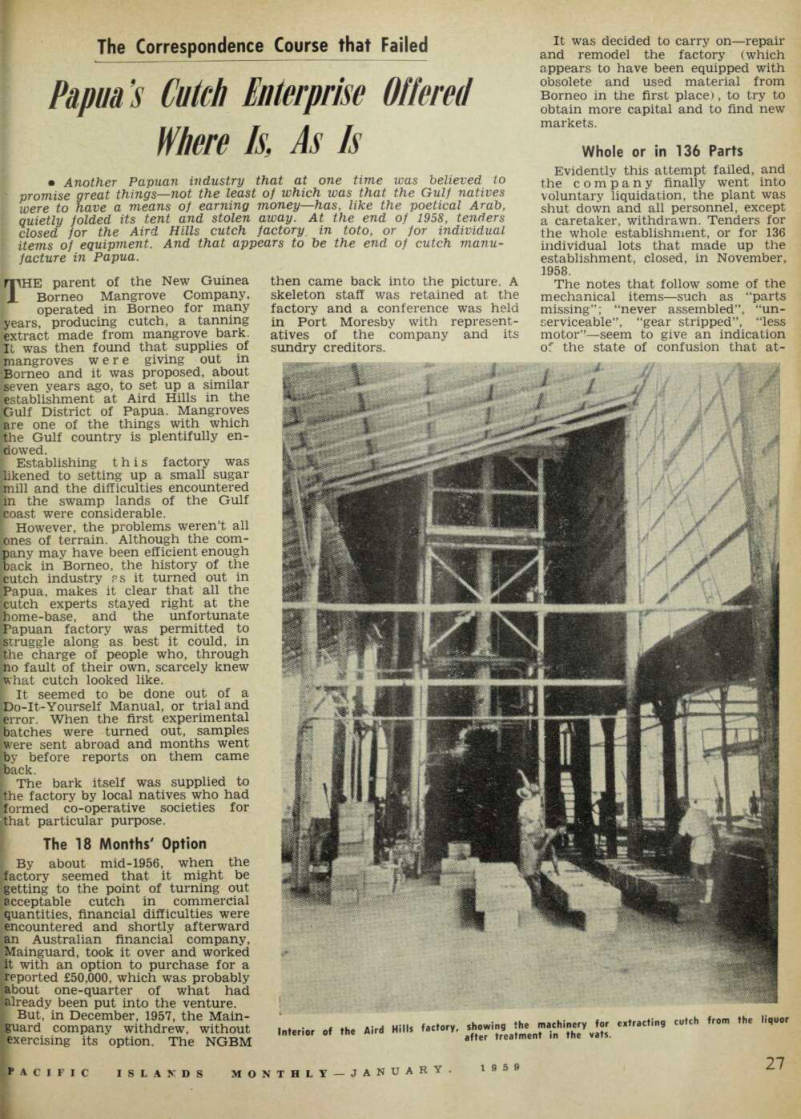
Interior o. the Aird Hills fectory,showing the machinery for extracting cutch from the liquor aftrer treatment in the vats.
nded this apparently promising
(idustry from its inception. ’Those left lamenting when the .iterprise closed up finally included ite local native co-operatives which id organised to collect the bark, part from prospective petroleum induction, there is no scope for a i,sh income for these Gulf natives, id the mangrove bark business speared as a god-send.
When Mainguard took over in 56, it seemed for a time that some :.ing might yet come of the enter ise. In 1956-57, cutch valued at er £B,OOO was exported but this is a flash in the pan. In 1957-58, which there was production for Jy six months, exports were down £5OO.
The Broken Beer-Bottle Look
Most of the trouble appeared to that no one in the factory had a jar idea of what constituted good ality cutch. So-called experts in Istralia kept asking for lower and ver moisture content, and it was t until the end that the men who »re at Aird Hills trying to hieve this, were informed that for I Eastern market low moisture atent was not as important as pearance (it had to be dark and fessy “like a broken beer bottle”).
Shipments were sent to America d although apparently acceptable, ist buyers there were already hmitted to suppliers in South lerica.
Vs stated in an article in PIM March, 1957, it seemed for a while it there might be a profitable jrket for liquid cutch (the stage !ore evaporation) right in the
fritory.
Australasian Petroleum Company preached the company for lid cutch in drums to run into lir drills while boring, to facil te the removal of spoil and mud. rmally, they imported a prepara a called Murtan for this. &rge shipments of cutch were iplied, but it appears to have been satisfactory—which was not sur ging as the production staff at id Hills was never informed of tt requirements. And, although y requested it be done, none of m ever was sent to the drill sites make an investigation on the Tie CSIRO showed a great in ist in the cutch undertaking and *ked for years to perfect from it due for bonding plywood. They ieved that it would mean that n the cheapest plywood could be £rproofed with the aid of this e, at low cost.
Quantities of the glue were sent ; Commonwealth New Guinea Ibers at Bulolo for large-scale crimental production—but so far the men back in Aird Hills were cerned, that was the end of the tter.
And so ends a seven years’ fiasco, in which thousands of pounds of shareholders’ money went down the drain, the natives of the area lost their reason for Co-operating, and the men who actually were trying to make the cutch were frustrated at every turn.
Having spent so much on erect ing the premises, it might have been imagined that the hiring of an ex pert cutch-maker would be logical; instead, the whole thing seems to have been based on some crazy idea of Learning How by Correspondence.
Whatever may have been the problems, and they were consider able, the impression remains that know-how and enterprise might have saved the day.
New Airways for E. Samoa
A new company called Samoan Airlines has just announced that:— It will in April next begin building a 5-storey hotel of 150 rooms, on 10 acres, beside Pago Pago Harbour, in Eastern Samoa; It will inaugurate next month a regular air service between Pago Pago and Apia (Western Samoa)—a distance of some 90 miles, now serviced by large launches.
It will inaugurate later—if the demand is there—a weekly air service between Honolulu, Tahiti, Pago Pago, Tonga, Nadi and New Caledonia.
Announcements to this effect were made early in January by Mr. Lawrence M.
Coleman, president of Samoan Airlines.
Several announcements about new hotels and new air services in Fiji and Polynesia generally have been made in recent years; but few of these plans have taken shape.