Tonga Has Pacific's Most
pp. 71-73 · Read in the full issue

EVERYTHING'S ON THE UP AND UP IN TONGA
Enterprising Native Leader
From a Staff Correspondent Tonga’s new Treaty of Friendship and Protection with Britain, signed in August, gives the independent kingdom of Tonga the ordering of its own financial affairs.
rHIS means that Prince Tungi, Heir Apparent and Premier, is now free to make his own de cisions—subject to the Queen and ;h e Cabinet regarding finance.
Which means that Tungi can do as le pleases—for everyone in Tonga, :rom the Queen to the meanest labourer, holds the hard-working irince in great esteem, and most are certain that whatever he does will le for the good of the kingdom.
Prince Tungi never rests. If he s not in Holland buying ships, he s in America selling the Kingdom’s copra. He has a dozen bright plans 'or the establishment of new in iustries, to supplement the earri ngs of copra and bananas.
And—perhaps because he realises ;hat his happy, laughing Tongans, )f whom there are now 60,000, can tot endure too much hard, monoton es work—he is always studying and iuying machines.
I wandered into the Government Printing Office—and I was astonished to see there a couple of ■he newest Heidelberg presses, and
* shining new Intertype; and other
fiodern machines. Another Inter
type is on the way, and next year Tonga is to have a weekly news paper.
And why not? These people are almost all literate in Tongan, and a great many in English; and noth ing will assist their social progress more than the printed word,
legularly published.
I found the streets of the towns all hard-surfaced (they used to be of grass), the big ships tying up to concrete wharves, a very large new produce store being erected by Tongans in Nukualofa, a fine new hospital in Vavau, all staffed by Tongans—the director of Health took his medical degree at NZ s Otago University.
For Better Agriculture
A young European went solemnly down to the wharf-side at Vavau, sitting in a cart drawn by a small, modern tractor. I discovered that he was Mr. T. W. Canter-Visscher, a Dutch-New Zealander in charge
of the agricultural experiment
station, two miles out in the bush, from Vavau. The budget is slim and tight, there are no taxis —so Mr.
and Mrs. Canter-Visscher come in on the tractor, every week or two, for supplies and mail>Five miles an hour.
Out there, I saw the Tungi policy in full operation. It seeks an ex tension of food products and an im provement in quality; and so in various stages of controlled growth I saw bananas, cabbages, tomatoes, coconuts, cocoa and —t his most significant—vanilla.
Here is a pool of modern agri cultural implements—and any land owner in the district may hire them at a very low rate.
The cocoa trees —young plants from Samoa —were poorly, and disease-stricken. This is not cooca country.
But the vanilla vines are flourish ing, and the experimentalists think they can produce a bean as good as Tahiti’s. If they can, here is a very suitable new industry for the Tongan farmer.
Coconuts grow all ' over these Vavau islands, and the output of copra should be greater. But they mostly grow out of unchecked bush —the nuts fall and are lost.
The well-fed Tongan landholders are too indifferent to money to bother clearing the bush and turn ing the nuts into copra. Pests thereby are encouraged. Rats are a great nuisance.
Young Canter-Visscher, over a year, carried out an experiment, with some 200 coconut palms. Some he banded with metal, to keep the rats from climbing the trunks; some he left in their natural condition.
He discovered that, among the trees in the 20-40 years age-group, there
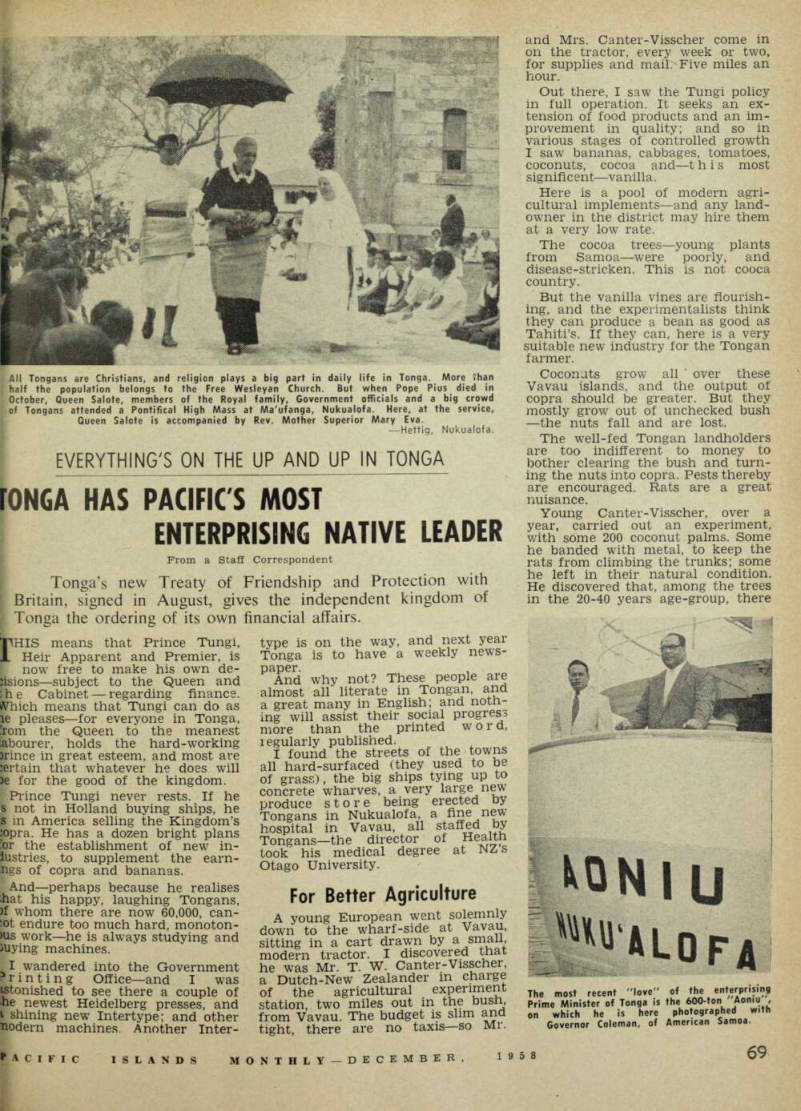
All Tongans are Christians, and religion plays a big part in daily life in Tonga. More than half the population belongs to the Free Wesleyan Church. But when Pope Pius died in October, Queen Salote, members of the Royal family. Government officials and a big crowd of Tongans attended a Pontifical High Mass at Ma'ufanga, Nukualofa. Here, at the service, Queen Salote is accompanied by Rev. Mother Superior Mary Eva. —Hettig, Nukualofa.
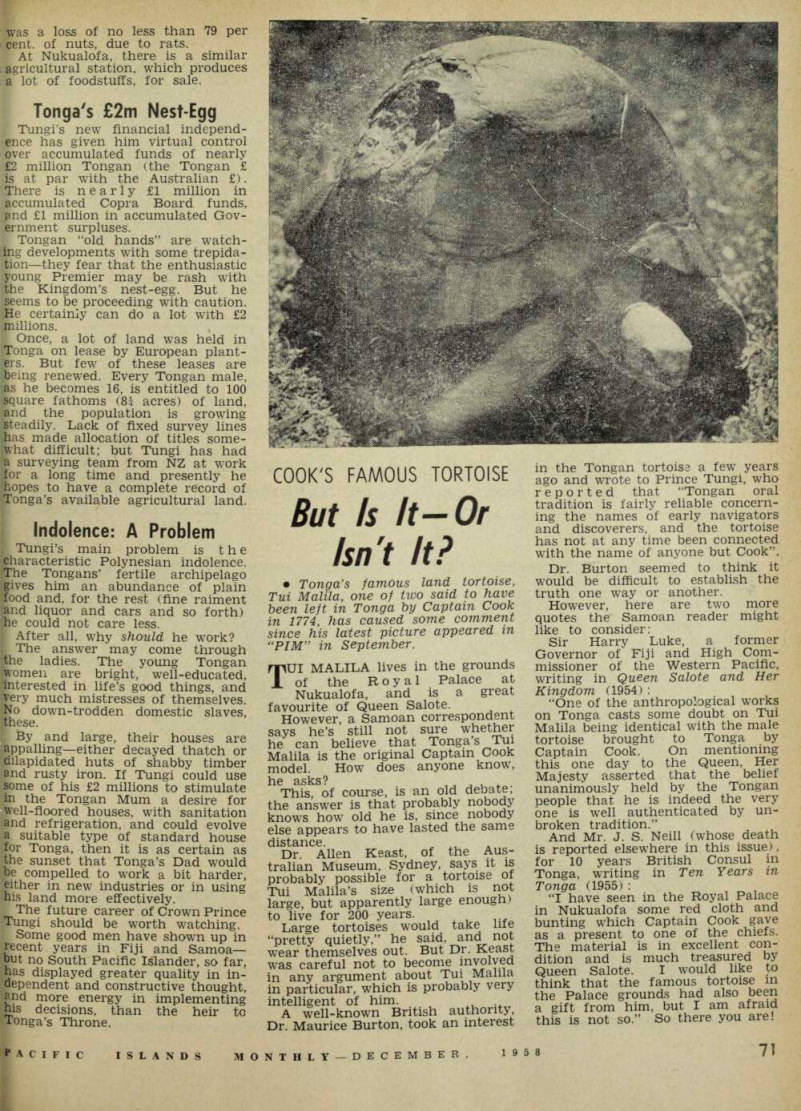
The most recent "love" of the enterprising Prime Minister of Tonga is the 600-ton "Aoniu", on which he is here photographed with Governor Coleman, of American Samoa.
was a loss of no less than 79 per i cent, of nuts, due to rats.
At Nukualofa, there- is a similar i agricultural station, which produces a lot of foodstuffs, for sale.
Tonga's £2m Nest-Egg
f Tungi’s new financial independ ence has given him virtual control over accumulated funds of nearly £2 million Tongan (the Tongan £ is at par with the Australian £).
There is nearly £1 million in accumulated Copra Board funds, £l million in accumulated Gov ernment surpluses.
Tongan “old hands” are watch ing developments with some trepida tion—they fear that the enthusiastic young Premier may be rash with the Kingdom’s nest-egg. But he .seems to be proceeding with caution.
He certainly can do a lot with £2 [millions.
Once, a lot of land was held in Tonga on lease by European plant ers. But few of these leases are being renewed. Every Tongan male, as he becomes 16, is entitled to 100 square fathoms (84 acres) of land, and the population is growing steadily. Lack of fixed survey lines has made allocation of titles some what difficult; but Tungi has had a surveying team from NZ at work for a long time and presently he hopes to have a complete record of Tonga’s available agricultural land.
Indolence: A Problem
' Tungi’s main problem is the characteristic Polynesian indolence.
The Tongans’ fertile archipelago gives him an abundance of plain food and, for the rest (fine raiment and liquor and cars and so forth) he could not care less.
I After all, why should he work? r The answer may come through the ladies. The young Tongan women are bright, well-educated, interested in life’s good things, and -very much mistresses of themselves.
No down-trodden domestic slaves, these. > By and large, their houses are appalling—either decayed thatch or dilapidated huts of shabby timber and rusty iron. If Tungi could use some of his £2 millions to stimulate in the Tongan Mum a desire for well-floored houses, with sanitation and refrigeration, and could evolve a suitable type of standard house for Tonga, then it is as certain as the sunset that Tonga’s Dad would be compelled to work a bit harder, either in new industries or in using his land more effectively.
The future career of Crown Prince Tungi should be worth watching.
Some good men have shown up in recent years in Fiji and Samoa— but no South Pacific Islander, so far, has displayed greater quality in in dependent and constructive thought, and more energy in implementing his decisions, than the heir to Tonga’s Throne.