Polio Fight In
p. 69 · Read in the full issue
[?] Quarantined [?]n Niue
The Islands
By a Staff Writer
When the Tofua called at Niue, i her November round, on No
rn her 12, the following things
ippened:
• Neither passengers nor crew jre allowed ashore. • Ten passengers (including two ung women and two young ildren), who were booked to ue, were placed in a big cargo at, and towed ashore by a launch r hich stayed out at the end of a ig rope). They were not allowed ar the people ashore and were ten away to a closely-guarded arantine camp, where they were remain for 21 days. • The 40 casual labourers from ue, who worked the cargo from ip to shore, were similarly taken r ay under guard, and put into e same quarantine camp for 21 ys. ‘Ooh,” said an imaginative New aland girl, leaning over the rail d watching the passengers’ parture, and fixing her eyes on B two gaily-dressed lasses in the at, “they’re going to be stuck - that quarantine camp with 46 ;n for three weeks. Gosh!”
But no one is blaming the thorities. This polio epidemic is ung a pretty grim toll in these ands. ?iji has had hundreds of cases, d the thing—despite pre itions—has spread through Tonga the past month or two. When
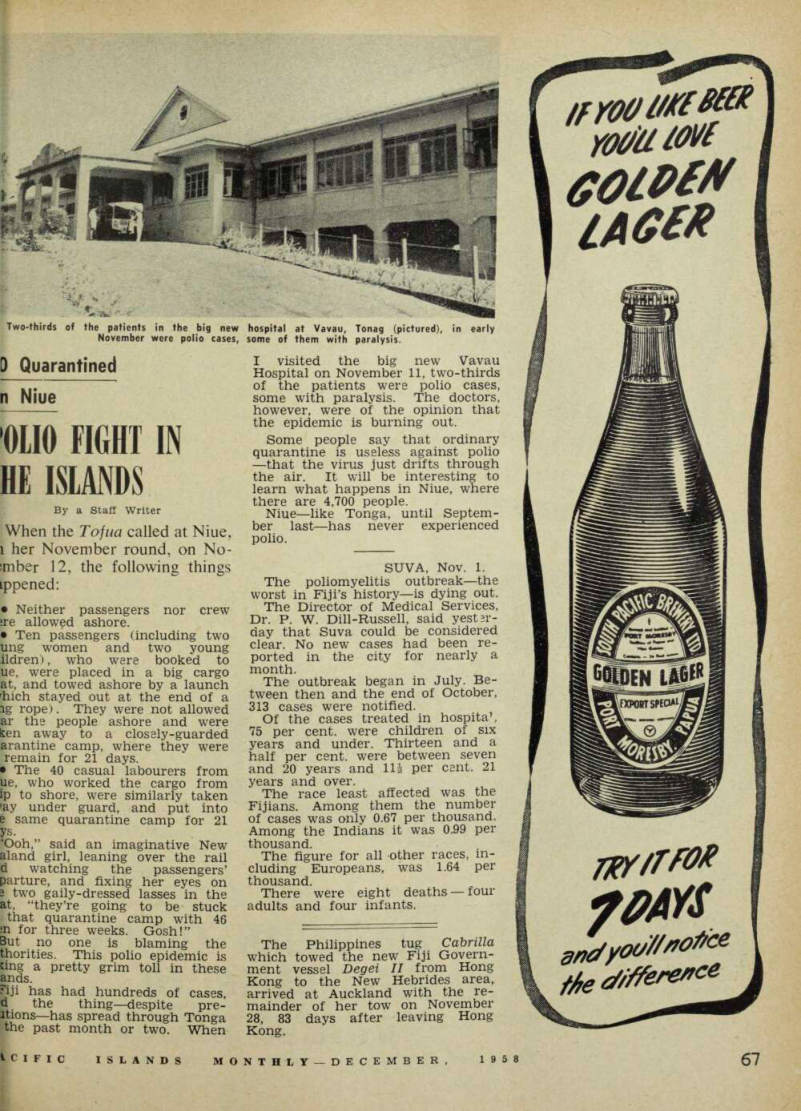
I visited the big new Vavau Hospital on November 11, two-thirds of the patients were polio cases, some with paralysis. The doctors, however, were of the opinion that the epidemic is burning out.
Some people say that ordinary quarantine is useless against polio —that the virus just drifts through the air. It will be interesting to learn what happens in Niue, where there are 4,700 people.
Niue —like Tonga, until Septem ber last —has never experienced polio.
Suva, Nov. 1.
The poliomyelitis outbreak —the worst in Fiji’s history—is dying out.
The Director of Medical Services, Dr. P. W. Dill-Russell, said yestsr day that Suva could be considered clear. No new cases had been re ported in the city for nearly a month.
The outbreak began in July. Be tween then and the end of October, 313 cases were notified.
Of the cases treated in hospita 1 , 75 per cent, were children of six years and under. Thirteen and a half per cent, were between seven and 20 years and Hi per cent. 21 years and over.
The race least affected was the Fijians. Among them the number of cases was only 0.67 per thousand.
Among the Indians it was 0.99 per thousand.
The figure for all other races, in cluding Europeans, was 1.64 per thousand.
There were eight deaths four adults and four infants.
The Philippines tug Cahrilla which towed the new Fiji Govern ment vessel Degei II from Hong Kong to the New Hebrides area, arrived at Auckland with the re mainder of her tow on November 28, 83 days after leaving Hong Kong.
Two-thirds of the patients in the big new hospital at Vavau, Tonag (pictured), in early November were polio cases, some of them with paralysis.