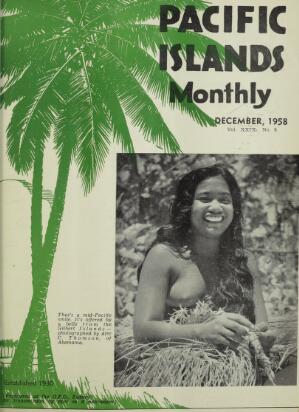
Islands
Pacific
Monthly
December, 1958
Vol. XXIX. No. 5
I Established 1930
pr ansmi?si(m%y*%ost a^a^newspaper
That’s a mid-Pacific smile. It’s offered by a belle from the Gilbert Islands photographed by Alec C. Thomson, of Abemama.
Advertisements & other items, pp. 2-6 (4 items)
Boac
EAST
'HtST
THIS WAY'S BEST!
8 flights weekly around the world
Circle the globe with the sun or travel round the other way—B.O.A.C.-QANTAS is the best way to go.
Offering a choice of eight weekly flights, the 8.0.A.C.-QANTAS round-the-world route via Australia enables you to fly directly between San Francisco and New York without changing airlines. Experienced travellers will appreciate what it means in terms of convenience, comfort, cuisine and service to fly all the way by intercontinental airliners operating to international standards.
See your 8.0.A.C.-QANTAS travel agent.
BOAC
THE WORLD-WIDE AIRLINE
with QAN
J82.84.58A
STOVES
MADE IN ENGLAND
These two Coleman Stoves are of the one burner kerosene type and are available in both silent and roarer models. Their dimensions are height 8! inches, diameter 81 inches, approximate weight 2| lb. Both models have the same outstanding features.
Model No. 532 E
SILENT TYPE
1. Full-Size Fount with Filler Plug of wing type. 2. Air release on side of Filler Plug. 3. Heavy Brass pressure-tested Tanks. 4. Fount and Burner firmly soldered together. 5. European-type pump. 6. Grate and Grate Supports detachable to reduce shipping space. 7. Spare parts interchangeable with simitar European Stoves.
Representatives for the Pacific Islands yi 531 E
TYPE
Model No.
ROARER
22 YOUNG ST.,
SYDNEY
ROBERT GILLESPIE Pty. Ltd.
Phone: BU 2221 Cables “Robergiir
ROBERT GILLESPIE (N.G.) LTD.
Lae, Madang, Rabaul, Port Moresby
PEARCE & CO. LTD.,
Suva for Fiji Islands
INVEST IN SUCCESS...
Ami let your money earn more in this
yuaran teed in vestmen t
Link with the great success of Sydney’s Big Ford Dealer— Broadway Motors and profit by investing in a' virile company and share in Australia’s growing demand for Zephyr, Customline, Fordomatic, Utilities, vans and other products in the popular Ford range.
BrOADWA VMntifiA,
PAYS YOU..
Your money earns MORE more than three times savings bank interest at 10 p.c. for 3 years (or 9 p.c. for 2 years, 8 p.c. for 1 year) Plan.
ONE OF THE VALUABLE PROPERTIES
OWNED BY BROADWAY MOTORS
t per annum mmm & V' 9 sc* c» a* ft® s*. o" o" s * cat' 008 V.o V’a" 9' v' 9\ OtV> eI
SYDNEY'S BIG FORD DEALER
There are now over 2,400,000 vehicles registered in Australia plus nearly 250,000 vehicles sold each year. Broadway Motors, a major Ford Dealer, command a large and constantly expanding part of this industry. More new vehicles sales, more used vehicle sales, more service and parts replacement, more hire purchase, assure even greater consolidation in the future. You too now have the opportunity to share in this growing prosperity and profit by having an interest in this expanding Company.
Broadway Motors Holdings Ltd., 184-200 Broadway, Sydney.
Please forward without obligation on my part full dela;’ of how my money can earn 10 p.c. for 3 years under you; Term Deposit Plan.
NAME
ADDRESSS
P.I.M.
m. 2Ai
imperial
makers of Canned Meats, Fresh Meats, Smallgoods, Pre-Wrapped Meats, Bacon and Hams fjrrai® ro ray the best wishes for a
AND A
W. ANGLISS & Co. (Aust.) Pty. Ltd.
RIVERSTONE MEAT CO. PTY. LTD. REDBANK MEAT WORKS PTY. LTD.
"Imperial" House, 255-257 George Street, Sydney. N S W. 154-206 Stanley Street, South Brisbane, Queensland. m
SLICED
dshrooms » *AU«t c amp
PIEf"
SL!CED
Mushrooms
IN SAOCt
New- Quinea JUm
Passenger and Cargo Liners:
M.S. "SINKIANG"
M.S. "SHANSI"
M.S. "SOOCHOW"
S.S. "PAKHOI"
Regular services between Australia, Papua New Guinea and Solomon Islands. ■ JAPAN, SHANGHAI, HONGKONG TO NEW GUINEA AND FIJI Regular Service with the Motorships: "CHENGTU" "CHUNKING" "CHEFOO"
Japan, Shanghai, Hongkong, Borneo, Madang, Kavieng, Rabaul, Lae, Samarai, Port Moresby, New Hebrides, Fiji, Sydney, Melbourne, Adelaide. (Returning from Australia to Japan direct).
For further details please apply to agents or refer to the weekly advertisements in the “South Pacific Post”.
THE CHINA NAVIGATION CO. LTD.
(A British Company incorporated within the United Kingdom)
AGENTS:
PAPU "SteVmshlps' ? . S Tra<lin9 Co ' Ud -' Por ’ MorKb V- Samarai ■ Cables, NEW Cable' M^ol^te-. Wa,S ° n (NG) Ud - Laa - “ aba "9- « abaa '- New Guinea Co. Ltd., Kavieng. Cable: "Camohe".
FIJI: Morris Hedstrom Ltd., Suva. Cable: "Deuba".
EW Sa^ E o R * P C E aVIe: CO 'Xompt $ oirs ra Francai da ! HebridM ' Vila ' NEW "Ba“a L nde“ N ' A! E,ablissamen,s Ba " a "<le, Noumea. Cable, BRISBANE: Wills, Gilchrist & Sanderson Pty. Ltd., 400 Queen Street.
Cable: "Wilgilsand".
MELBOURNE: John Sanderson (Shipping) Pty. Ltd., 11l William Street.
Cable: "Syndicate".
ADELAIDE: George Wills & Co. Ltd., 33 Gilbert Place. Cable: "Willsandco".
JAPAN: Butterfield & Swire (Japan) Ltd,, Tokyo, Yokohama, Osaka, Kobe. Cable: "Swire".
EASTERN MANAGERS; Butterfield & Swire, Hongkong. Cable: "Swire".
SWIRE & YUILL PTY. LTD. 4 . XZ-SS&ZrZ™
1
ACIFIC ISLANDS MONTHLY DECEMBER, 1958
2
DECEMBER, 1958 PACIFIC ISLANDS MONTH LJ
4
DECEMBER. 1958 PACIFIC ISLANDS MONTH!
People
Prince John (better known as Prince Tu’ipelehake), second son of the Queen of Tonga, with his charming wife and their children, left Nukualofa by the November Tofua, en route to New Zealand and Australia, on a lengthy holiday.
Prince John was formerly Governor of Vavau, and was received there with much ceremony when the Tofua called. ♦ * * Mr. R. Sanders, formerly of the Fiji Administrative Service, who has been Government Secretary in Tonga in recent years, has left Tonga on overseas leave, and it is presumed he will return to the Fiji service. He has been succeeded in the Government Secretaryship in Tonga by Mr. W. W. A. Miller, from Fiji, who formerly saw a good deal of service in the Gilbert and Ellice Islands Colony.
Mrs. Mary Croudace, former well known resident of Western Samoa, who has been living in New York for several years, is returning soon to Apia, to take charge of the Casino Hotel there. Mrs. Buckle,
Charming Miss Marina Norbert, receptionist at the Australian Consulate office in Noumea, will marry M. Jacques Laplagne, teacher of English at the College La Perouse, Noumea, in Decem ber. Miss Norbert, of Adelaide, where she attended the Adelaide High School, won a year's New Caledonian Government scholarship to Noumea, and did so well at her studies that the Government extended the scholarship for a further year.
Photo: Fred Dunn.
who has been the hardworkii manageress there for the last t\ years, Is returning to New Zealan " * Most of Apia’s leading citizs] were among the 800 persons who, ( November 13, saw Rosita Co< married to George Fepuleai, secoi son of the well-known family Nofoali’i, Western Samoa.
Both are popular members of tl younger Apia community and, f( . marriage, the Cathol Cathedral was decorated with ma and tapas. Father E. McVicar o ficiated; Mr. Charles Hellesk gave the bride away; Messrs. Sai Atoa and Fred Samson we] groomsmen. The full capacity < Tivoli Theatre and Catholic Ch was needed for the reception.
Archdeacon C. W. Whonsbon Aston left Apia in November afte many years as Anglican Chaplai and a period of devoted work whic culminated in the recent dedica tion of the beautiful new Churc: of All Saints, He was farewelle: at a number of functions, amom them a party at Vailima wher the High Commissioner (Mr. G. F Powles) paid tribute to his work Now, as Dean Whonsbon-Aston he has taken charge of Anglica, Chuch affairs at Levuka, Fiji.
Photographed after their marriage in Po[?] Moresby in November—Mr. J. Gayton and h[?] bride, the former Miss Connie Watts. T[?] ceremony took place at the Church of England —Papuan Print
Mr. L. Fepuleai, now settled in Christchurch NZ, his fiancee Miss H. Magon, and Mu Anthony Palepoi, manager of Sina Plantation were among those aboard "Tofua" bound fo Apia in November.
Photo: J. P. Shortal
Well-known planter and business man, Mr. Harry W. Moors, has re turned to Samoa from a flying visit to the United States. He met members of his family and numer ous former residents of Western Samoa, amongst them Mrs. Mary Croudace, of New York, John and Lou Kruse of Boulder City, and former Administrator Sir Alfred Turnbull and Lady Turnbull at Stanford, Connecticut.
Mr. A. D. Leys was re-elected Mayor of Suva for another term in early November; also re-elected for another term was the Deputy Mayor, Mr. C. A. Stinson.
In Auckland in November were; Mr. J. M.
Finnegan (left), who operates an importing and jewellery manufacturing business at Rarotonga; Mr. David Graham, lately Union Steam Ship Co. manager at Rarotonga, who will now take up a similar position at Apia; and Mr. lan A. Forbes, government printer in the Cooks, on vacation.
Photo: J. P. Shortall.
A marriage of special interest in Port Moresby in November was between Mr. N. Johnston and Miss Nancy Ure, at the Ela Church. Miss Ure is the daughter of the Rev. D. E. and Mrs. Ure, well-known mission leaders in Papua. —Papuan Prints.
Mrs. Nancy Phelan, whose amu ing and interesting book, AU Holiday, was reviewed in the PI in November, has recently returni to Sydney after a year abroad—ii eluding five months in Turke Yugoslavia and Greece. SI travelled by bus, boat or donkey ai stayed anywhere it happened to si —from luxury hotel to Turki! farmhouse. In fact, it sounds lil a real Nancy Phelan “do”—and nc she intends to write a book abo it. If it is up to the standard Atoll Holiday, there is a treat store for her fans.
At Trinty School Chapel, Sydne on November 10, Miss Jennifl Pritchard, only daughter of Mr. ai Mrs. Guy Pritchard, of East Lino field and Popondetta, Papua, m married to Mr. Robert Alan Cai, of “Wilga” Station, Hillston, NS T A reception for 85 guests was he afterwards.
Mr. W. P. Dobbin, District EducD tion Officer, Morobe, New Guinw and Mrs. Dobbin, have been
Mr. and Mrs. S. Talagi, Toke, and Brenda turned to Niue from New Zealand by [?]
November "Tofua". Mr. Talagi, a governm[?]
dentist at Niue, had been undergoing a months' course at Wellington.
Photo: J. P. Shortall.
Mr. F. Unasa, of Auckland's Samoan color went home to Apia on vacation aboard "Tofoa" in November. He is employed Hellaby and Co.
Photo: J. P. Shortall.
leave at Surfers’ Paradise, Queens land. When they return to the Territory in early January, their daughter Bridget, who has been do ing a teachers’ training course in Sydney (and at will return with them. ♦ * * At an investiture at Government House, Port Moresby, on November 26, the following Territorians re ceived honours bestowed upon them in the Queen’s Honours Lists, earlier this year: H. L. R. Niall, District Commissioner, Morobe, who received the insignia of the CBE; Matron Alice Thorburn, Senior Matron in P-NG’s Nursing Service, who re ceived the OBE; Stanley Hinton Christian, Principal of the Malaria Control School, which he established at Minj, who received the MBE; and Frank George Hoeter, of the P-NG Police Force, received the MBE (Military Division) in recognition of his work with the PNGVR since 1951. He holds the rank of captain.
Superintendent Ron Clammer arrived in Brisbane from Rabaul, NG, in November on pre-retirement leave. He said he might build or buy a seaside house at Caloundra, north of Brisbane. ♦ ♦ * The Rev. E. Walter, who has been for some years with the Lutheran Evangelical Mission in Lorengau, Manus, New Guinea, sailed for Germany from Sydney in early De cember.
Captain H. C. S. Slinn, who in November was appointed to command the 28,000-ton P. and 0. liner "Himalaya", which recently has gone into Pacific service in addition to the UK- Australia run. Gloucester-born Captain Slinn, 56, served in 21 P. and 0. ships before this appointment. His wife is an Australian, and they live in NSW.
Mr. H. T. Kienzle, well-know planter of Mamba Estate, Yodd Valley, Papua, has been plannin for years to erect a memorial to th Papuans who formed the Carrie lines on the Kokoda Trail durin the war. As part of this plan, re cently two bronze plaques were com pleted by a Melbourne sculptor. Th memorial will be built of local stor at Kokoda. Mr. Kienzle won th MBE for his own work on th Kokoda Trail. As a Captain 1 ANGAU, he was in charge of nativ carriers and responsible for keepin the line of communication opei across the Owen Stanleys.
The George Medal, given only f<’l outstanding gallantry, has awarded to Mrs. Edith Gladf Collins, of Suva, Fiji, widow of M/ David Collins (a well-known admin istrative officer, who was drowns last year at Kadavu). A Fijian mas last May, entered a house whee Mrs. Collins and her four childrn were sleeping, and attacked hrl Fijian house-girl with an axe. Mil Collins tried to stop the man, am was very severely wounded, am then she seized him again when I attacked her children, and ww again injured. The house-girl ww, killed and the Fijian was afto; wards tried and sentenced to death The Chief Justice, when hearing t:j case, warmly praised Mrs. Colliri courage. * * * Back in Brisbane on 1e a w Tonga’s leading churchman, R<tf R. A. Woodgate, did a good piece s publicity work for the Kingdom, di> scribing its 56,000 people as “amo:o the happiest in the world”.
Mr. and Mrs. A. P. Preuss and children [?] turned home to Apia by the "Tofua"
November after leave in New Zealand. M Preuss is well known to Apia movie theat[?] patrons.
Photo: J. P. Shortall.
Dr. D. W. Beckett, medical super intendent at the Pacific’s well-known Makogai leper settlement, Fiji, went to Tokyo in November to attend conferences on leprosy, including a world congress on the disease. * * * Mr. G. L. Tuita, Governor of Vavau, accompanied by his family, travelled to Auckland in November and will be there on vacation for several months.
With traditional Fijian ceremonies, followed by the presentation of a yaqona bowl commanding officer of the Fiji Military Forces, Colonel G. P. Sanders, was farewelled in Suva in November. He is retiring bo New Zealand.
Colonel Sanders’ successor is Colonel R. W. Foubister, 48, of the Royal New Zealand Signals, who has been Chief of Staff of the Northern Military District, NZ.
Mr. and Mrs. R. D. Moore travelled to Raro tonga in the November "Maui Pomare". Mr.
Moore takes the post of Deputy Court Registrar there.
Photo: J. P. Shortall.
Among the guests at a gathering of the Poly nesian Association in Sydney in November were Angeline Yager and Ronnie Sharkey, both of Norfolk Island. —Tele-Photos.
Meanwhile Lieu t.-Col. R. A.
Tinker who served with the Fiji Military Forces from 1949-53 and commanded the Fiji First Battalion in Malaya for part of that time, has been appointed Chief-of-Staff, Southern Military District of New Zealand. * * * Cameraman F. Vail and director S. Toogood, of International Film Productions Ltd., were in Tahiti in November shooting travel-film material in colour for use mainly in America. The pair travelled on to New Zealand per Monterey. * * * Rear-Admiral J. M. Villiers, NZ Chief of the Naval Staff, visited Fiji in November, and inspected the Fiji Royal Naval Volunteer Re serve, which was established in 1955 He reported good progress.
Japanese publishers have shown-, an interest in Elsie K. MortonVi Crusoes of Sunday Island— which ii a history of the Bell family of thtr Kermadecs, published a year oo two ago. There is likely to be s Japanese edition. * » * Dr. Emilio Pampana, director oo WHO’s Malaria Eradication Division* is to retire after 11 years in thd organisation. New director will bd Dr. Carlos A. Alvarado, of Argenn tina, former Director-General oo Health for North Argentina.
Mr. and Mrs. Brian Orchard—the bride wa[?] formerly Miss Jenny Ferries —after their marriage at the Lutheran Church, Lae, NG.
Photo: Otto Brabant
A party of 17 Sixth Form New Zealand students, aged between 17 and 19 years, comprising four boys and 13 girls, and accompanied by one master and one mistress, will leave Auckland by TAI on December 22 on a visit to the homes of students in New Caledonia. * * * Mr. Paul Coloun, garage pro prietor of Luganville, New Hebrides, recently successfully salvaged a 60-ft workboat which was wrecked in the Banks Group a year or so ago.
Mr. J. W. Gregory, OBE, who travelled on MV Citos from Honiara in November, intended to go on to the New Hebrides, but became ill in Sydney and has now returned to London.
He is an expert on Customs laws, has been in Honiara, BSIP, for about 41 months, revising Customs laws and Tariff, and advising on re organisation of the Colony’s Customs Department. (See p. 17).
He retired in 1947, has since that time been attached to the Colonial Office, London, and has spent most of his time in his capacity as Customs expert in British Guiana, the West Indies and other British tropical possessions. * * * Captain L. Killman, master of the MV Citos, entertained 30 guests in cluding High Commissioner Sir John Gutch and Lady Gutch, when the vessel was in Honiara. BSIP, in November. The guests enjoyed the Swedish Smorgesbord, and the Aquavit that went with it. * * * Mr. K. Dalrymple-Hay was in hospital in Honiara in November for a brief spell, but has now re turned to directing his many busi ness ventures, including his new hotel, which recently has been completed. Interiors of lounges and bar are in native decor.
Among the passengers homeward bound for the Cook Islands in the "Maui Pomare" in Novem ber were: Mr. N. Turua and Maria; Mrs. A.
Mitchell and Andrea; and Mr. Harry Napa.
Photo: J. P. Shortall.
Advertisements & other items, pp. 7-17 (3 items)
With Foaming Detergent
Stay at Manly! JENBER LODGE PRIVATE HOTEL 56 Osborne Road, Manly, Sydney, N.S.W. Phone: XU 1962 Harbour View Gracious Living Tariff From:
B. & B. £B/8/-
D.B. & B. £ll/11/- Proprietors: Mr. and Mrs.
Ken Marlay, late New Guinea. 18
I#
JSE
LITTU
S *?2™ PASTE
f OAMINC
DETER
The Smooth Paste Cleanser
NOW
WITH FOAMING DETERGENT
Removes most stubborn stains with ONE wipe Does not scratch • No waste — it's paste The NEW GUMPTION cleans Hies, cutlery, walls, baths, pots and pans, refrigerators, sinks, etc. It cleans your car like new.
Obtainable all stores
TALLERMAN & Co. Pty. Ltd.
AGENTS;
60-62 York Street, Sydney, Australia Cable: "FRESHET", Sydney. phone: 8X3411
a vP % % tv
The Best Protection
—for YOUR Savings
The Commonwealth Savings Bank offers you the best protection for your savings right throughout the Islands.
No matter where you go, you will find an office of the Bank.
There are branches at the following Port Moresby Rabaul Bulolo Goroka Kavieng Lae Madang Wewak Norfolk Island Honiara In addition, 64 agencies operate throughout PapuantZ 6 ag ?" cies in Solomon Islands, and at Fanning Island, Norfolk Island, Lord Howe Island, Nauru, and at Vila and Santo (New Hebrides).
Sa°vincs y ßant aVin f b . ank . n l eds ’ use the Commonwealth STS SdT.t ,ou bt *‘
COMMONWEALTH
BANK
Guaranteed by the Commonwealth Government of Australia 5879.84
rprr
Concentrated Germicide
f*recr, Us /
Ce ,mr r i* T #7
{Clot
Sp o Se S/ Cae^rp o 0 ° V 5 //Vi' r r eo er c
PICCANINNY
Australia's
Best Selling
GERM
KILLER
now comes to you! // Fresh as a new day Piccaninny’s new disinfectant brings ‘Hospital-clean’ protection to your home. Every time you clean use Piccaninny Pic-a-lyptus. Australia’s most popular germ-killer, is now available to you in the large economy priced bottle.
Powerful, safe and fragrant.
AT ALL ISLAND STORES
Made by Piccaninny Manufacturing Company, Manly, N.S.W., Australia.
PIC-A-LYPTUS ... a disinfectant and deodorant
A COMPLETE
IN EVERY
A 0
BOTTLE!
0 O' □ o M Igt y# 0 r o U
DON’T SAY GIN
. SAY
THE INTERNATIONAL
FAVOURITE
39C9
Organised and Directed for the Comfort
and Pleasure of
TRA VELLERS IN FIJI
Lautoka Hotel,
LAUTOKA
30 Bedrooms and Suites Bo Hotel, BA 15 Bedrooms and Suites Nadi Hotel,
NADI
16 Bedrooms and Suites Raki Raki Hotel,
RAKI RAKI
15 Bedrooms and Suites
Sigatoko Hotel,
SIGATOKA
12 Bedrooms and Suites Tavua Hotel,
TAVUA
9 Bedrooms
BEACHCOMBER HOTEL
Deuba, South Coast Attractively Situated—Only One Hour’s Drive from Suva Opened on December 1
NEW CLUB HOTEL, SUVA
Modern and Luxurious Centrally Situated—Overlooking Suva Harbour 18 Air-Conditioned Rooms and Suites
KOROLEVU HOTEL
On Southwest Coast of Viti Levu Most Famous Pleasure Resort in The South Seas 26 Separate Bures (Modernly- Equipped Suites) Under the Palm Trees Facing the Lagoon Luxurious Central Dining Rooms, Lounges, Ballroom, Etc.
All Equipped in Modern Fashion . . . All Licensed to Sell the Best Brands of Liquor . . .Any Kind of Transport (Private Hire Cars, Special Tourist Coaches, Taxis) Can Be Arranged. . ■ ' ' - ' : ;■) For a Leisurely Tropical Holiday, or an Islands Tour, under the Most Pleasant Conditions, Consult —
NORTHERN HOTELS LIMITED
SUVA OR LAUTOKA, FIJI—OR
WHITES TRAVEL SERVICE HUNTS TRAVEL SERVICE
Sydney—Fiji—New Zealand Suva, Fiji
On all forms of
Insurance
you will be
well served by
Harvey Trinder
Has anyone really checked over your insurances of late really brought them upto-date or have they just been renewed from year to year 11 they haven’t we’ll be happy to check them and prepare a quotation for you.
It’s a service without obligation.
HARVEY TRINDER
Insurance Brokers
MUSGRAVE STREET, PORT MORESBY
Box 104 P.O. Port Moresby. Phone 2373 Agents PORT MORESBY & SAMARAI . Steamships Trading Co. Ltd, LAE & WAU New Guinea Goldfields Ltd.
RABAUL .. .. a. Hopper. BULOLO .. A. McKinlay.
HONIARA, 8.5.1. P MADANG
E. V. Lawson. c. W. b. Rock.
Insurances at Lloyd's and Companies
la
PARKE-DAVIS
CAMOQUIN
Effective Single Dose Treatment for
MALARIA
SPECIALLY FLAVOURED TABLETS AVAILABLE FOR
CHILDREN
SUPPRESSIVE DOSE—
For Adults: 3 tablets to be taken as a single dose once weekly, or 1 tablet three times weekly.
For Children: 1-2 years, one INFANT FORMULA TABLET once weekly or half-tablet twice weekly. 3-5 years, two INFANT FORMULA TABLETS once weekly or one INFANT FORMULA TABLET twice weekly.
TREATMENT DOSE—
For Adults: 3 tablets taken as a single dose. A second dose of 3 tablets may be given in from 24-72 hours if fever has not subsided completely.
For Children: 1-2 years, one INFANT FORMULA TABLET as a single dose. 3-5 years, two INFANT FORMULA TABLETS as a single dose.
IMPORTANT: —CAMOQUIN should be taken immediately after or during a full meal.
Obtainable from all chemists and suppliers of
PARKE-DAVIS products
PARKE, DAVIS Cr CO., LTD., SYDNEY
21 (hunky squares
rich satisfying flavour
nso smooth .. . creamy
LK ft OA» These are just a few of the many reasons why you’ll like Cadbury’s Dairy Milk Chocolate. Take a deep bite of Cadbury’s Dairy Milk Chocolate. Mmm . . . it’s so smooth ... so creamy ... so satisfying. There’s wonderful eating enjoyment in each of the 21 thick, chunky squares. Nourishing, too; there’s a glass and a half of pure, fresh, full-cream milk in every i lb. Buy a block today.
Cadbury’s Dairy Milk Chocolate
MO2B/HF/9
u
EVEREADY'
BRAND
batteries
HAVE LONGER LIFE
GIVE BRIGHTER LIGHT . . .
1. 20% more power 2. Metal sealed for your protection! 3. Recover power between uses 4. Protective rolled top 5. Built for tropical conditions Anywhere . . . when it’s dark, you need an “Eveready” Flashlight powered with dependable “Eveready” “Nine Lives” Batteries. Always insist on “EVEREADY” Brand Batteries . . . they’re backed by over 50 years of research.
EVEREADY
"Eveready" "Nine Lives" with the Cat Symbol are the registered trade marks of the Eveready Company, a division of Union Carbide Australia Limited.
EB3R
NOW ... a range off
DAVID BROWN
900 SERIES
DIESEL TRACTORS
9 9
FROM
o
(FREE ON WHARF, SYDNEY)
5 GREAT MODELS
all covered with exclusive 12 months' warranty... tailored to your individual farming needs priced, planned and engineered with you in view i
MAKE YOUR CHOKE, BUT CHOOSE
DAVID BROWN
Please write for full information on the David Brown ’‘9oo" Series Tractor Range to:
DAVID BROWN (A'ASIA) PROPRIETARY LTD.
Cnr. Derby and Wetherill Streets, Lidcombe, N.S.W.
NAME.
ADDRESS...
PIM
D 827.86
S Distributed in AUSTRALIA,
NEW ZEALAND and the following PACIFIC ISLANDS: Australian Territories: Papua. Norfolk Island. Cocos Island.
Aust. Trust Territories: New Guinea.
Nauru. tritish Crown Colonies: Fiji. Gilbert and Ellice. kritish Protectorate: Solomon Islands.
British Protected State; Tonga.
I.Z. Territories: Cook Islands. Niue.
I.Z. Trust Territory: Western Samoa.
Tench Territories: New Caledonia.
French Polynesia.
Anglo - French Condominium: New Hebrides. 1.5. Territories: Eastern Samoa. Hawaii. 1.5. Trust Territory: Micronesia (Caroline, Marshall and Mariana).
Dutch Territory; West New Guinea.
Publisher:
R. W. ROBSON. .
Editors;
JUDY TUDOR STUART INDER
Manager;
SELWYN HUGHES.
ELEPHONES: General Business, Editorial, Advertising, Subscriptions:
MA 9197-8, MA 7101, MA 4369,
MAI 395.
G.P.O. BOX 3408, SYDNEY.
Registered Address for Telegrams, Radiograms, and Cables: "Pacpub", Sydney.
SUBSCRIPTION RATES:
n Australia and N.Z. and Australian, N.Z., and British Pacific Islands .. £1 4 0 lew Caledonia, Tahiti . . . £1 7 0 Jsewhere $3.50 U.S. or . £1 10 0
BRANCH OFFICE, PAPUA-
NEW GUINEA
'acific Publications (New Guinea) Ltd., heatre Building, Fourth St., LAE, New Guinea. Tel.: Lae 2577. l Miss Pat Robertson, Manager.
BRANCH OFFICE IN FIJI:
iji Times Building,. Gordon St., Suva.
Tel.: 4043.
REPRESENTATIVE IN N.Z.:
?J. D. Whitcombe, P.O. Box 5179, Auckland. Tel.: 42.384.
REPRESENTATIVE IN U.K.:
. T. Wallis, 13 Rood Lane, London, ; E.C.3. Tel.: Mincing Lane 8633.
MELBOURNE OFFICE: Newspaper House, ■47 Collins St., Melbourne, Victoria.
Tel.: 63.7053.
IGENTS; All main trading firms and I stores in the Pacific Islands.
fUI TIMES AGENCY IN AUSTRALIA
Jote: Pacific Publications Pty. Ltc echmpress House, 29 Alberta Si •ydney (Telephone MA 9197-8), is tl Australian Agent for THE FIJI TIME of Suva, Fiji.
8
DECEMBER, 1958 PACIFIC ISLANDS MONTH LJ
14
DECEMBER. 1958 PACIFIC ISLANDS MONTHLJ
Content s:
PEOPLE: Personal Para graphs Of Islands’ Interest 5 Fiji Gets Some New Taxes, And The Solomons May Be Hit Again 17 How Safe Are Samoan Land Titles? 18 Record London Copra Prices 19 Patrol Visits Shangri-la Plane Crash 19 The lan Crouch —Yet Another Sea Mystery? 20 The Urgency Of. W. Samoa’s Three-Year Plan .. .. 21 Nobody Rides The Hibiscus Highway 21 Threat Of A Fiji Sugar Strike 22
HOME BASE: Sydneysider
Reports 22 Progress Comes To Suva With A Bang 23
Commentary: The Pub
lisher And The Editors Look At Pacific Affairs 25 Silver Jubilee Of The Dis covery Of The NG High lands 27 The Editors’ Mailbag .. .. 29
Territories Talk
TALK: With Tolala .. .. 31 Report On W. Sa m o a’s Birth Pangs 37 The Story Behind The Dis covery Of Puri 43 Big Nadi Project Behind Schedule 45
Fiji Tala N O A, With
Vakatawa 47 Imaginative Approach To Pacific Trade 53 It’s A Do-It-Yourself Stamp Issue 57
Is It Santo, Santos Or Luganville? 57 Pacific Must Prepare For A Tourist Invasion 59 They’re Searching For Native Music 63 The “First Newspaper In The World” 65 The Polio Fight Continues .. 67 Tonga Has Pacific’s Most Enterprising Leader .. 69 Cook’s Famous Tortoise—But Is It? 71 Captain E. W. Harness Re tires .. .. .. 73 Some More Memories Of Humphrey Berkeley .. .. 77
Magazine Section;
Tropicalities, 81; Crossquiz, 82; They Built Their Own Brewery, 82; Descendants Of A Tyrant King, 83; Man Who Cleaned Up Steven son’s Tomb, 84; Gold Dust A-plenty, 85; Manam Is Home To Them, 86; Do You Remember? 87; Fiji’s Diwali Festival, 87; Book Reviews 83 The Month’s News Of Ships And Yachts 103
Pacific Report; Round
up Of Pacific News And Pictures (Index p. 17) .. 117
Obituaries: Mr. Henry W.
Kinney; Mr. J. S. Neill; Mr. William Alfred Smith, Mr. James Yamton; Mr.
V. Rule; Mr. W. Johnson .. 151 Sports Review 153 Shipping And Airways Time tables 155 Commerce And Produce .. 165
Advertisements & other items, pp. 17-18 (3 items)
A Product of Pacific Publications Pty. Ltd., Technipress
House, 29 Alberta Street, Sydney. (29 Alberta Street is 10 yards from the intersection of Goulburn Street and Wentworth Avenue.)
16
DECEMBER, 1958 PACIFIC ISLANDS MONTHL
Trinity Grammar School
SUMMER HILL and STRATHFIELD, NEW SOUTH WALES A Church of England Boarding and Day School for Boys SENIOR SCHOOL BUILDING AT SUMMER KILL, N.S.W.
Trinity Grammar School is a day and boarding school for boys. The School is in three establishments; the Sub-Primary and Preparatory Schools at Strathfield, and the Senior School at Summer Hill. Boys may proceed through the three Schools from Kindergarten to Leaving Certificate and Matriculation Honours.
The School has admirable facilities for recreation and games. There are tennis courts, four playing fields and two swimming pools.
A number of Scholarships ranging in value from about £l3O to £2BO a year is awarded annually.
A year ago the War Memorial Chapel was opened. It is regarded as one of the finest of School Chapels.
Headmaster: J. WILSON HOGG, (OXON.)
Are Imposed
"The Colony Is In For Some Belt Tightening"
Fiji Yells As New Taxes Are Imposed
From a Staff Writer
Suva, Nov. 26
The middle classes of Fiji are in an exceedingly bad temper. In places, there are signs of a mild revolt.
THE Legislative Council met in financial session last week; and a brand-new Governor (Sir Kenneth Maddocks) and equally brand-new Finance Secretary (Mr.
E. R. Bevington) submitted a Budget for 1959 which places new taxes, sstimated at about £250,000, squarely upon this mixed community of 150,000 people.
The gap between revenue (over 16 millions) and expenditure has )een discernible in the last year or ;wo, and the Colony has noted with increasing uneasiness that it tends ;o grow.
A Fiscal Committee, early this fear, recommended various admin strative economies; and the trad ng community has been pointing irgently to the need for more pro iuction and exports, to take care of •apidly-shrinking overseas balances.
Nonetheless, it came as a shock to earn that it was proposed to im pose new taxes to raise— £ ncreased personal income tax (the companies escape) from 1/- to 1/3 in £ 50,000 idditional duty on petrol of 3d per gallon 00,000 ncreased port and customs service tax from 6d to 9d 166,000 ncreased import duty on beer and increase in excise duty for new brewery 50,000 ligher duties on cosmetics and ; films 9,000 Half of the new taxes falls directly •n the high-salaried group and the raders; the remainder is spread through the port and customs harge) over the whole community.
Although expected, no one likes t. There are signs of bitter protest -even of a kind of revolt.
Committee "On Strike"
Yesterday, the Select Committee all the Unofficial Members, plus finance Secretary) on the Budget fas on strike.
So far, the Government sternly ays, “No comment”; but it is gener lly known that the Unofficial Mem •ers stuck their toes in and flatly efused to proceed with the Budget mtil the Government told them low, and to what extent, it had im 'lemented the cuts in administrative xpenditure sought by the Council -iter the Fiscal Committee had re iorted.
Yesterday, there seemed a com plete deadlock. Today, probably Government and Select Committee will compromise somehow, and get on with a Budget that, however un palatable, is inevitable.
Citizens' Protest
The other “revolt” is a thing of different complexion. Messrs. H. N.
Murray, S. A. Tetzner, J. P. Bayly and R. S. Kay—all well-known businessmen of Suva—have called a public meeting, in the Town Hall tonight, to protest against the in creases in taxes and duties. (Continued on page 149)
There will be fiery talk, which in evitably will swing around to forth right criticism of the administrative policies of the Government, in their relation to development and pro duction.
That line of criticism, of course, is justified by the facts —but the convenors of the meeting are just as blameworthy as the Government for the present situation. Their pro tests and criticism are ten years late.
As leading business administrators they must have seen this situation developing at least a decade ago when increasing population began to get gravely out of adjustment with productive capacity.
Instead of joining with all Fiji’s communities to demand revision of Fiji’s Constitution and administra tion, to take care of rapidly chang ing conditions, they remained silent and complacent, and enjoyed the good times of the post-war years, it is a little late for yelling—but yelling is still most necessary. Any thing to awaken the British Colonial Office to the seriousness of the situation!
This loss of productive wealth, this (so far) mild recession, this increase in taxation and “postpone ment of public works” (for the Gov ernor has announced substantial cuts in capital expenditure) are due primarily to internal maladjust ments as between population growth and land usage; but they have been hastened and accentuated by drought and hurricane damage, For example, Fiji has not nearly
ifilled the quota of banana exports iDermitted by New Zealand; and copra production is down so far that a, few coasters, customarily carry ing copra from Fiji’s ports to Fiji’s crushers are lying idle.
Defenders of the Government in cist that all these fiscal troubles ire due to droughts and hurricanes, rather than failure in administrative long-distance planning.
No one could really separate the causes. What does seem fairly cer tain is that Fiji is in for a long term )f belt-tightening, with social and political troubles developing.
Cost of Public Service
Naturally, the beach commenta tors are after the “cost of the public service”, with teeth bared. ; Every man has a set of figures ready, to ask why these public servants should enjoy these emolu ments and privileges, while the ion-official classes are taking it in the neck.
The true figures are hard to come )y. But it does seem that, taking ill governmental instrumentalities nto account, there are about 5,000 mblic servants; and there is no ioubt that their triennial leave and ravelling allowances, despite recent nits, still are extremely generous, lompared with what are given non pfficial workers.
I have a full set of Government Ecounts beside me—but it is im jossible actually to separate out the spsts referred to.
Every public servant whether Britisher, Australian, New Zealander )r local-born—is entitled to three nonths’ leave and travelling time o Britain every three years, and he cost of this in provision of relief, passages for the official and his wife md family, is enormous. There is in annual item in the Budget of Jetween £BO,OOO and £lOO,OOO for the Payment of these fares, alone. Other Posts can only be guessed at.
Then there are pensions. Every mblic servant retires soon after 50, >n a generous pension; and some the pension, representing the proportion of his service years given o Fiji, is a charge on Fiji. Someone old me that this is an annual cost 'f about £300,000.
However Fiji is governed, there Oust be annual leave, pensions, etc., or a trained public service; but the peach commentators—very much on ue job as this is written—insist hat the provision for these things ould be a little nearer the realities stablished in similar services here >y the big corporations.
After all, this is a pleasant, ualaria-free, healthy country, where ■mropeans live a very long time, he climate and conditions are lUite comparable with Northern 'ISW or Queensland: and there are 10 special privileges there for civil ervants. then (say the critics) treat iji as if it were in the swamps of he Ganges, or in Darkest Africa?
Pacific Report
Turn to these inside pages
for more highlights of the
month’s news: Samoan Fono In Slow Motion—ll 7; New Interest In Walpole Is.
Guano—ll 7; Another New TEAL Route—ll 9; Expert Will Assess Coconut Research —121; They’re Leaving W. Samoa—l2s.
New Governors For French Poly nesia—l2s; UN Missions For Nauru, NG, Samoa —126; No Action Over Goilala Reports; Tahiti Airport A Stage Further; P-NG Credit Scheme Starts—l 27; New Patrols For Dutch NG —129; New Caledonia To Go To Polls; Hollandia’s Hospital—l3l.
Grand Pacific Hotel Goes To Govt. —135; Flag Of Convenience Ships In Trouble —135; Nino Culotta Back—l 37; Prince Tungi Sells His Bananas; Drink Beer, Beat Bore dom—l 39.
Cook Is. First Assembly Sits—l4l; Leahy Damages Claim For Hear ing; BSIP Wharf ies’ Strike; Hurricane Hits Fiji; Latest On Warangoi Land —143.
Navuneram Report Six Months After—l4s; Indonesian Immi grants Aren’t Happy—l4s; Men Off In Nickel Slumn: Another Union Ship Laid Up—l 47.
Overtaxed, Underprivileged
And Now The Poor Old Solomons Overtaxed, Underprivileged Yet They May Be Hit Again!
Although private enterprise in the British Solomon Islands Protectorate is already overtaxed and under-privileged, the indications are that it is due for another tax slug.
RESIDENTS were interested in the recent visit there of a Mr.
J. Gregory who has been en gaged on redrafting Customs legis lation and tariffs. They had nothing
personal against Mr. Gregory, but they were, of course, aware that any changes in taxes of any kind were scarcely likely to be for their benefit.
It is rumoured that one of the measures Mr. Gregory was organis ing is the introduction of the so called “Bermuda” system of import duty, which has operated in Fiji for a considerable time.
The Bermudan system gets its name from the fact that it was in Bermuda that some inspired tax gatherer had the happy notion of assessing import duty on the c.i.f. value of goods, and not the f.o.b. cost, as in most countries (such as Australia, New Guinea, etc.), The Fiji government has, for years, been collecting duty on the freight and other costs involved in getting goods to their destination.
If goods are sent in by parcels post, the value of the stamps is added to the value of the goods, and the duty is calculated on that. This has meant a great deal more in Gov ernment coffers; agitation to have basis of calculation revert to the (Over)
Mr. Gregory smiles as he leaves Honiara, on MV "Citos" for Sydney and the New Hebrides, in November. But residents of the Solomons do not know whether to smile yet or not.
old f.o.b. system has got nowhere, where.
Mr. Gregory left the Solomons in the Citos in November. He expected to go on to Vila, to do a job for the people of the New Hebrides, but became ill and returned to London.
The Solomons are already bur dened by income taxation, a higher general rate of import duty than Papua-New Guinea, and export duties on all commodities.
Income Tax for New Guinea Residents of Papua-New Guinea (which is the only major Pacific Island territory not already taxed on income) are steeling themselves for the introduction of direct taxa tion there —probably in 1959.
The Planters’ Association of New Guinea has concerned itself with the probability, and it believes that the rate will be something like 47in the £ for company taxation and half the Australian scale for per sonal exertion.
The Association, as a body, does not object to income taxation, be lieving that if imposed fairly it would be the most equitable way of raising revenue. It does believe, however, that if income tax is im posed, modification or removal of import and export duties should follow.
But it can get no reassurance on this point.
The planting community takes the view that it has been bearing the lion’s share of taxation in the Territory, mostly through copra ex port tax. There is now, too, an ex port duty on cocoa, which they feel is “an iniquitous tax on a young industry”.
There is an export duty on rub ber, also, although this has not contributed to revenue to anything like the same degree as copra.
Planters (and others) regard ex port taxes on primary products as sectional taxation —and in 1957 these duties contributed £568,950 to P-NG revenue.
Elsewhere it's Income Tax Plus In view of the hopes of P-NG residents, it is interesting to see how residents of other Territories have fared.
Before World War 11, few of the Pacific territories had income taxa tion After the war, with new de mands for new kinds of amenities and social services, and with a new conception of what should be done for native welfare, governments everywhere had to find new field! for raising revenue.
Most of them have turned to in come taxation—Papua-New Guinea ir ?S the notable exception; but that did not mean that they quit more traditional fields of revenue raising. uc fF^j. n r nin eS , between JF2.000.000 to £F2,500,000 from import duty ner yeai. (Papua-New Guinea raised
(Continued on page 152)
£A1,868,014 from import duties in 1957 and £586,950 from export duty.) Fiji has no export duty. But it has, of course, income taxation of up to 6 3 in the £. Rates of import duty in Fiji are generally slightly higher in P-NG for British goods, and for foreign goods very much higher.
P-NG has a general import duty of 15 per cent, (with no preference
for British goods) with tariffs 25 per cent, and 33J per cent, “luxury” goods, no duty at all foods, and very low duties clothing, household goods etc.
Taxes in Samoa, Solomons
Western Samoa has income 1 ranging from 1/- to 8/- in the: import duties with a general r of 25 per cent, for British and per cent, for foreign goods; fo and clothing are dutiable.
There are export taxes on all * ports—lo per cent, on copra, 1/case on bananas, 10 per cent, cocoa increased by .01 per cent, every £1 per ton in excess of £:: per ton.
The Solomon Islands (even wit out the proposed new Bermu tax) has a considerably higher ii port duty than P-NG, particulas for non-British goods. Export dut cover all commodities includi copra, with a duty of 15 per ce Income tax begins at £2Ol i annum with a tax of 1/3 in the rising by 12 one-thousandths of for every £1 increase in taxable come. After an annual taxable come of £1,500, there is a surtax} from 1/3 to 10/- in the £.
There are numerous deductionr a statuary one of £2OO, others wife, children, education, supers' nuation payments etc. A single me on £1,050 per annum pays £89.5 c income tax. A married man £1,170 per year, £64/6/4; a mam man with a wife and two childn on £1,536 per year pays £lO2/0 All these are facts P-NG resides should bear in mind before assuo ing that the introduction of a m tax will necessarily mean t abandoning of another.
How Safe Are
Land Titles
In W.Samoa?
From a Staff Writer in Apia One of the first and most difficult matters to be brought before the UNO Trusteeship Mission in Western Samoa next
April is that of land ownership
by Europeans and part-Euro
peans.
IT cannot be dealt with too soon.
Recent pronouncements by some classes of Samoans have aroused deepest anxiety among European and part-European planters es pecially those who hold freeholds — and this has resulted in a percep tible movement of capital out of the country. Individuals and firms have been quietly shifting their money— wherever it could be freed —to Fiji, New Zealand and Australia.
Too many blind and silly Samoans, nursing a strong anti- European bias, have been allowed to broadcast their cock-eyed eco nomic theories.
They have, for example, been watching developments in Indo nesia.
“If the Indonesians can throw out the Dutch and part-Dutch”, said one Samoan, publicly, “why cannot we throw out the Europeans and part-Europeans, and regain possession of these lands for the Samoans?”
No one can explain to these hot heads that there is, ideologically,
a world of difference between tl set-up in Indonesia now, and t! set-up in Samoa.
One of the oldest planters Samoa has just pointed out th the Samoans who talk like th have got no legal justification wha ever.
No Justification
In 1891 there was a Three-Powe Land Commission which ve thoroughly examined all then e isting land titles and claims to lai titles, and was drastic in throwi:. out all claims which could not fairly established.
The titles which survived that ii quiry were accepted international as sound titles; and when Germaj took over Samoa, a little later, ti Commission’s decisions about la;j ownership were the basis of h: administration.
“Only a revolution could destn those land titles”, said the o planter, “and if there is one thii certain, it is that no revolution w be permitted in this country.
“Let the Samoans have thu head, if they want self-governm© —but there are some things whii they must accept as fundament —the safety of life, the maintes ance of order, and the safety property which has been propels and legally acquired.”
Residents in Santo, New Hebridb have been paying as much as per truck of fresh water during® recent period of drought.
GARLANDS. That's not exactly a look of joy being worn by the NZ Minister for Island Territories, Mr. Jock Mathi son, but perhaps the scent of the flowers is overpowering. He received the lei on his arrival at Rarotonga in November to open the Cook Islands' first Legislative Assembly.
GARLANDS AGAIN. These are for the Earl and Countess of Elgin who visited Hawaii in November to lend to the Bishop Museum a royal cloak presented to their family by Kalaniopuu, who was high chief of Hawaii at the time of Captain Cook's visit In 1788. The cloak has been put on public display.
An Hawaiian Airlines' secretary, Miss Katherine Clegg, formerly of London, presents the garlands.
Advertisements & other items, p. 20 (1 item)
18
DECEMBER, 1958 PACIFIC ISLANDS MONTHL.
Record In November
It's Money in the Bank for Planters
London Copra Prices Reach Record In November
Pacific planters who were depressed to see the UK Min istry of Food copra contract finish at the end of 1957, could not have anticipated the fantastic prices—higher than during the post-war boom—reached at the end of 1958. In spite of modest returns obtained at the beginning of the year for their product, it seems certain now that they will finish this year much better off than in 1957.
rHE average London c.i.f. price for Philippines copra (on which is based final price in such places s Papua and New Guinea) was Stg.9o/7/6—a gain of £Stg.ll/17/6 ver the previous month. Highest rice for the month was reached n November 17, when copra was Stg.9s/6/6, c.i.f., London. (During le period when Pacific copra price r as limited by the MOF contract, hilippines copra on the “free” ondon market was never more lan £Stg.Bo per ton c.i.f.) In the last week in November, )pra being delivered to the krpenter mill in Suva, by Fiji lanters, was bringing £FBO for >p grade. This is the first and nal price, so far as these purchases re concerned, of course.
At the same time, Papua-New uinea planters were still being paid t the rate of £AS3 for top grade— hich means that they certainly are ©ring up treasure in heaven and hen the final pay-out, based on le average c.i.f. London price of 3tg.90/7/6, comes there will be sub antial increases in planters’ bank dances. (£Stg.9o is equal to about Ml 2; but deductions of about £AIS ill have to be made for freight and
her charges.)
The Territory as a whole will mefit also, in increased collections - export duty. This will boost fall g Administration revenu e— though it is unlikely to stay the reasury hand if it has already sen decided to introduce income xation in 1959. The official view is ore likely to be that “the planters ■n afford it.”
Shipping Mishaps Helped
The spectacular rise in copra 'ices over the month was caused r the continuing low supplies from iilippines and Indonesia, plus two ipping mishaps. In his monthly fcular to planters, Mr. lan cDonald, chairman of the P-NG >pra Marketing Board reported: “Quantities of copra available for ffopean consumers, already around to 20 per cent, below that of 3t year, were further weakened inng November, as a result of
additional purchases being made by Philippine desiccators, and thus the market reacted spectacularly to two misadventures with copra ships out of Manila.
“One, carrying 8 000 tons of rnnra ran aground on Bancoran'Reef/n^ar o^her*’ caran h*? to discharge part of her cargo before being refloated;
and another collided with a sub merged wreck necessitating a re turn to dry dock in Manila.
“Dealers and consumers, with near contracts to meet, thus had to move quickly, and on short supplies the market naturally reacted with a sudden upward price.”
Future Outlook
Although it is not expected that the supply position will improve much before April 1959, the high price of copra and coconut oil in evitably must send consumers look ing for cheaper alternatives.
While copra and coconut oil (up to £Stg.l34 per ton c.i.f. London for the latter) soared during No vember, other oils kept at steadier levels.
Peak price for soyabean oil was £Stg.34 per ton; ground-nut oil, £Stg.63; whale oil, £Stg.76, and tallow £Stg.B3 per ton.
Nonetheless, taking all facts into consideration, it seems reasonable to expect that good prices for copra will be maintained for at least the first half of 1959. (Over)
An agreement between Unilevers and the BSI Copra Board has been reached for the disposal of 12,000 tons of copra to Unilevers in 1959.
Total production within the Pro tectorate is .estimated to be in the vicinity of 20,000 tons for 1959.
Levers Pacific Plantations Pty. Ltd., with approval of both Copra Board and Australian authorities, will ship 5,000 tons to Australia, leaving a balance for disposal on the open market mainly to Japanese in terests.
The Copra Board has also an nounced that a new contract has been concluded with the Bank Line whereby the freight rate ex Solomon Islands ports to United Kingdom and Western European ports has been reduced by 110/- Sterling to 160 - Sterling per ton.
The new rate will operate from January 1, 1959, for one year, and will then again be reviewed.
He's 'Pete ' Of Shangri-la
From PIM’S Hollandia Correspondent In May, 1945, a party of US Army personnel went for a sight-seeing tour in a C 47 over the mountains inland from Hollandia in Netherlands New Guinea—and there crashed in the unknown Baliem Valley. Twenty-one died and three survived —including WAC Corporal Margaret Hastings. The survivors were got out six weeks later by a glider operation, after being cared for by valley natives. The valley was left untouched for some years until a Mission station was established. In April, 1955, tragedy struck again when a Short Sealand Mission plane crashed on its way to the valley, killing Canadian pilot Al Lewis. More than 12 months later, in December, 1956, the first Administration post in the valley was established, but patrolling has been hard and dangerous because the valley natives are always warring among themselves. But in October, patrols went out to look at both these air crashes for the first time. They found bones scattered about the C 47 crash, and buried them after patrol leader Gonsalves had said a prayer. But they found none of the crosses that had been dropped from the air as a tribute to the victims during the rescue. The patrol also met a village leader, named "Pete" by Corporal Hastings, who had helped the survivors. "Pete", seen above talking to the October patrol, remembered. Two US Army men, from Honolulu, are now in Hollandia waiting to visit the C 47 officially, but they will have to wait until the patrol returns from the Sealand crash, no report of which is yet in.
Advertisements & other items, p. 21 (1 item)
19
ACIFIC ISLANDS MONTHLY DECEMBER, 1958
Rival Copra
Babassu Oil Could Rival Copra
people outside of Brazil know 1 anything of Babassu Palms, although it is obvious that if the extraction of oil from them could be as highly organised as the copra-milling industry, the latter would have to look to its laurels.
This interesting item appeared in the copra market report issued by Chairman lan McDonald, of the P-NG Copra Marketing Board, in early November: An interesting side-light on the oil market this month is a reported sale of 1,500 tons of Babassu oil from Brazil—the first for years.
Babassu palms grow only in cer tain areas of Brazil, where they flourish in a wild condition, and the oil is a direct competitor of coconut oil.
The potential output is enormous, but there have b,een two major hindrances to production;—(a) the shortage of labour for collecting the nuts; and (b), the lack of adequate mechanical means of cracking the extremely hard and thick shells containing the kernels.
In addition, transport facilities are inadequate in most of the pro ducing areas.
Production, in terms of oil, has been around 40.000 tons annually tt ol eternal consumption’, but the United States and Brazillian Governments have been studying the possibilities of an expansion in output.
It is understood also, that a US firm has already commenced extrac tmn of this oil by modern methods in North Brazil.
What Happened
Yet Another Sea Mystery!
What Happened To The lan Crouch?
The mystery disappearance
of the three-masted schooner
lan Crouch, on a delivery voy
age from Hongkong to South
Australia, has been confused
rather than clarified by the
“positive identification” of the
vessel a few miles south of
Rabaul on November 7, and the
finding of pieces of wreckage on
New Ireland and elsewhere.
r[E 500 gross tons steel vessel was built in Hongkong for M. B. Crouch and Co., of Adelaide, which operates small vessels in the Australian coastal trade. Captain Norman Berry and 12 Australian seamen were flown to Hongkong to man her for her de livery voyage, and the vessel left there, bound Port Adelaide via Manila and Rabaul, on September 26.
Nothing has been heard of her since.
In early November some anxiety for the safety was already being felt —she had been expected in Port Adelaide by the end of Oc tober,
Sighting Reported
About November 7, a Qantas airline pilot reported that he had sighted a vessel that “could be lan Crouch” off the south coast of New Britain. At the same time, the skipper of the local NG vessel Nereus, also sighted a vessel in that same area that, he said, could answer the description of the schooner.
Photographs of lan Crouch were sent to Port Moresby and on to Rabaul, where the local skipper “positively identified” the vessel he sighted on November 7, as the same shown in the photographs.
At this stage, November 27, full air operations were put into action; RAAF Lincoln bombers from Townsville combed thousands of square miles around New Britain, between New' Britain and Milne Bay, and between there and the Australian coast, along routes that the vessel might have been ex pected to take.
At the same time, regular air services operating in all these areas were alerted to keep a look out, and so also was local shipping.
Oil drums, an old dinghy and a Carley float, found on New Ireland and other islands, were later proved not to be from lan Crouch.
The air search was called off the end of November.
What Vessel Was It?
If it was the lan Crouch sight on November 7, why did the ves< not answer radio calls? Or if h radio were broken down, why o she not signal the Nereus, if s were in distress? If the Nere sighted lan Crouch, it is likely tli the big schooner also sight Nereus.
If it were not the lan Crow which was sighted, then what ves was it? Three-masted, 500 toe steel schooners are not so comm around New Britain waters tl there should be a great deal of co fusion on this score, and a skip’( of a local vessel should be in: good position to know any stram to regular coastal shipping roui
Pirates or Typhoons?
In spite of the alleged sightix of lan Crouch off New Brits; many Australian and Islaj shipping men are now convinr that the schooner never read: New Guinea waters and that was overtaken by disaster shoe after leaving Hongkong .
The disaster might have been natural one —such as a typhOD or a man-made one such pirates, many of whom still m operational headquarters in Hod kong and the lesser Philipp islands. The vessel might even Iff become involved in Chinese C<C munist activities of some k?J What the Owners Think The owners made a statement early December to the effect t they still believed the vessel wov turn up.
They could be right. No one see; to know the route she was to tf or how long she would be on i way; or whether she would use 1 auxiliary engine, or both. ‘ ‘'Commentary”, page 25).
Bringing The Islands To The World.
—Sooner or later you'll see where this trio have been. They're a NZ National Film Unit team, who have been filming the Islands, and recently arrived back in Wellington. From left: Mr. G.
Pomfret-Brown, sound engineer; Mr. R.
Bowie, director; Mr. Don Oakley, cameraman. Photo: J. P. Shortall.
Advertisements & other items, p. 22 (1 item)
BSIP's 1959 Plans
20
DECEMBER, 1958 PACIFIC ISLANDS MONT
BSIP's 1959 Plans (Continued from previous page)
Urgency Of West Samoa’s
Too Much Talk —Too Little Done Urgency Of West Samoa’s Three Year Plan
By a Staff Writer
The three-year economic development plan which the West Samoa Assembly was slowly and wordily debating late in November—to the manifest annoyance of the High Commis sioner and the exasperation of the author of the plan, Mr. E.
F. Paul—has two chief objectives:
mo make early provision for J. Sa m o a’s population (now 100,000, and growing fast).
And to simplify governmental procedures when, as is expected, Samoa within the next three years, changes over to substantial self government, with less dependence on New Zealand.
The plan is simple and ap parently workable, and is easily summarised thus: Approximately 17,800 acres of suitable land, divided among five districts, is to be closely examined, and its agricultural value assessed, and made available to new culti vators in blocks of about 25 acres.
Feeder roads are to be put in from existing main roads; agricul tural officers are to assist in plant ing and re-planting projects, and in demonstrating new methods and the uses of fertilisers.
Early Financial Help
The new cultivators are to be selected with care, and rentals and tenures are to be arranged for their encouragement. There must be some preliminary financial help.
The whole settlement scheme to be directly under the supervision of the Minister for Lands.
As preliminaries, there must be land surveys, adoption of a stan dard lease agreement, inspections by engineers, study of water supply problems, provision of schools and hospitals.
It is planned to deal with the lands of four districts in 1959, of one district in 1960 and of another in 1961.
The plan provides that a fully staffed Agriculture Department, with experimental and demonstra tion stations available for all dis tricts, should take a large part in the settlement of agriculturalists in the six districts.
The four staple crops envisaged at this stage are copra, cocoa, coffee and bananas.
A section of the plan gives much attention to communications es pecially the construction of feeder roads (new developmental main roads must wait until more funds are available) and the construction
„ of deep-water ports for the direct loading of ships. (At present, all big ships lie off and are loaded and unloaded by lighters).
Finally, there is evidence of careful thought in regard to secondary industries, to give employment to surplus population after all available land is occupied and working.
Industries considered worth investigation include desiccated coconut, copra crushing, coir processing, use of coconut shells, extraction of banana oil, commercial alcohol from bananas, banana chips, banana flour, processing and canning of Samoan coffee, taro flour,
commercial fishing for local food and the Pago Pago cannery, pro motion of native handicrafts for supply of overseas markets.
Mr. Paul has calculated that £55,000 (£25,000 from profits of Trust Estates and £30,000 from copra Stabilisation Fund) is avail able for the implementation of this three-years plan. But a huge amount of preliminary work has yet to be done if the plan is to be brought into operation in 1959.
Mr. Paul has done a monumental job in compiling this plan. He probably got much help from Di rector of Agriculture Parham —that experienced and knowledgeable man who grew up in Fiji and whom the Fiji Government, by sheer in ertia, lost to Western Samoa.
Polio In The Bsi
The Pacific’s polio outbreak (see page 67) had spread to isolated Ren nell Island, in the British Solomons, in November.
Renneil has no outside radio con tacts and sees few ships. But the Seventh Day Adventist mission ship “Vinaritokae” recently visited the island and reported back to Honiara that 50 people appeared to be suffer ing from polio and there had been five deaths.
Medical aid was hurriedly sent on the Government vessel "Bina” on November 18.
Hibiscus Highway: It's All Dressed Up
But There's No One To Go
By a Special Writer in Fiji
The “Hibiscus Highway”, well made and graded, goes out from the Savusavu trading centre and port area, 40 miles eastwards into some of the most attractive agricultural country in Vanua Levu.
THE road was opened in July. It should be a channel for strong developmental enterprise. This drive through a beautiful island should be a tourist’s “must”. The road cost at least £105,000.
A census taken in November showed that an average of 11 cars per day use the road and they mostly are Public Works vehicles engaged on maintenance. The others are trucks which bring, by road, the coastal copra which formerly travelled by sea.
Savusavu has built a deep-water wharf to accommodate big overseas shins and is providing one of th“ safest’ ports “n the South Seas.
The bis firms have built fine new stores g There is a good modem hotel There is an air-strip, and daily' air service with Suva. The Indian traders are coming in. .
With the Hibiscus Highway giving access to a huge area of good, unused land, and with the com-
pletion of the road link with the vast sugar area of Labasa, over the range, expected next year. Savu savu is throbbing with hope and enterprise, .
Could Challenge Lautoka
With its port and its roads and its f er tn e hinterland, Savusavu could challenge Lautoka for the Fiji’s second city. It should already have a growing stream of tourists.
But now it is learned that none of the countless acres opened up by the Highway have been mapped and classified as Native Land Trust Reserves, or delineated for use in any other way. No one knows when an over-all plan of land usage will be brought into operation. That is typical of Fiji’s top planning.
Meanwhile, Savusavu is living on its own fat—and 11 non-productive vehicles solemnly traverse the Hi biscus Highway each day.
Threat Of A Sugar
Uncertainty In The North-West
Threat Of A Sugar Strike In Fiji
A degree of resentment that was close to blazing fury was to be seen in Suva and Lautoka during the November 29 week-end, when it be came known that the Lakshman- O’Neil trade-union hierarchy planned a sugar strike for De cember 2.
THE indignation of Government officials, directors of industry and the more responsible sections of people can be understood when it is remembered — • Because of drought and hurri canes, there have been serious de creases in the production of copra and bananas. • Decreased exports are reflected in serious shrinkage in overseas funds, which in turn is causing diminution of imports, fall-off in trade and a minor recession. • Reduction in governmental revenues had resulted in the an nouncement only the previous week of sharp increases in certain taxes. • The one thing that is temper ing the financial troubles of the Colony is the hope of a continued good sugar crop and a continuance of a guaranteed sugar market.
Any dislocation of cane crushing would reduce the quantity of sugar exports, and add further to Fiji’s financial troubles.
Last year, the then Lakshman led sugar workers made certain demands, backed by a strike or strikes; and when settlement was effected a solemn agreement was entered into between the parties, part of which was an undertaking not to strike for a time.
Mr. Lakshman's Boast Some weeks ago, Mr. Lakshman boasted that there would be another strike before Christmas. The reason for the threat was not clear—it appeared that Mr. Lakshman con sidered he was not being taken suf ficiently into the confidence of the Government and the CSR Co. in planning the administrative and industrial activities of the country Wages were settled by last year’s agreement. It does not appear that workers have any new grievance.
The announcement of the strike was greeted by such a burst of in dignation by all classes that, by Sunday, Mr. Lakshman appeared to be making a virtue of necessity and had stated privately that there will be no strike”.
But the state of uncertainty re mained and will remain while Mr.
Lakshman tries to find his particular level in the public life of Fiji Mr. Lakshman is the problem child of the Northwest.
Home Base
By Sydneysider
Sydney is the huh of the South Pacific, and its news is your news. Here are some of the things that made Nov.-Dee. headlines.
Among some peoples in this State privileged to read Cyril Pearl’s Wild Men of Sydney, will be politicians: Three copies exist in the Parliamentary Library.
The appearance of this book is believed to be the reason for the rush Defamation Bill which has caused the biggest political odour in recent years. Its “defamation of the dead” clause will make it possible for a person to sue if he considers that one of his ancestors has been de famed.
Rightly or wrongly, Press Baron Ezra Norton, of Truth and Daily Mirror group, is blamed for bringing pressure to bear on State politicians to have the Bill rushed through. Part of Pearl’s book tells a story of Norton’s father, John.
The NSW Bill is based on a piece of Queensland legislation, in force in that State since the good old days, when to say, “Your father was a lag,” was the surest way to buying a fight. * * * Readers of Sydney’s Sunday Telegraph, their appetites whetted by much publicity in and out of State Parliament, were bitterly disappointed when the promised serialisation of Wild Men of Sydney did not eventuate. After looking feverishly through the issue of November 30, for the first instalment, they were not comforted to find, in a small box, the information that on legal advice the Tele had decided not to publish the book. It was one way, anyway, of bringing home to readers what the Defamation Bill means. * * * It seems that Warwick has little luck as a King-Maker. The Fairfax Sydney Morning Herald's campaign for Labour, in the re cent Federal elections, was no more successful than an earlier attempt in the late war years.
The Menzies’ Liberal govern ment romped home with an in creased majority. Say the cynics, the only thing needed now to clinch the defeat of the State Labour government at the next election (probably April), is for The Sydney Morning Herald to espouse its cause. * * * With change-over to buses in George Street at the beginning of December, there are now no trams operating in the city
proper. The result has been a speed-up of traffic (which has pleased the motorists) ; but an intensification of hell for users of public transport. Buses do not lift as many passengers as trams, so crowds pile up at bus stops.
Inside the buses there are seats only for the minority, and the rest are bumped and jolted to a pulverised mass. The type of bus is wrong (say the critics, and those who have used London’s double-deckers will agree). They are single-deckers, with auto matically closing doors which produce, for six months of the year, conditions similar to a turkish bath. And, invested with a little brief authority, the drivers refuse to open-up until they reach the exact spot. There is no hopping off and on at will, as in the old trams.
The change-over from trams to buses may be good for the public purse; it is devastating to the public temper. * * *
Archbishop: The Rt. Rev.
H. R. Gough, Suffragan Bishop of Barking, England, has been invited by the Sydney Diocesan Synod to become Anglican Arch bishop of Sydney, in succession to the late Dr. H. W. K. Mowll. * * * MERRY XMAS: As seasonal spending spree gets under way— screaming kids under foot, bad tempered mums, perspiring Santa Clauses mopping their beards in Sydney summer heat—retailers are gleefully anticipating no less than £73,000,000 changing hands.
Who said Recession? * * *
High Cost Of Living:
Every Australian man, woman and child spends £4O per annum on beer and cigarettes. That works out at 9 per cent, of the national income—but what we lose on the roundabouts we make up for otherwise. Education, for instance, comes cheap: Only 6 per cent, of the national income. * * * SPORT: Jack Kramer, US pro moter of professional tennis, said in a TV interview that he had made offers to Australian Davis Cup hopes Ashley Cooper and Mai Anderson. Lew Hoad, who appeared on TV with Kramer, said he had made £A61,410 in the two years since he turned pro.
Advertisements & other items, p. 24 (1 item)
22
DECEMBER, 1958 PACIFIC ISLANDS MONTHLII
Hotel And A Modernised Newspaper
Progress Comes to Suva with a Bang THEY'VE GOT A NEW BREWERY, A NEW
The inauguration of three new enterprises in Suva at the end of November and early in December indicated the progress being made in Fiji, in spite of a minor recession. Thev are: ° J
r[E installation by Fiji Times and Herald Ltd. of a modern, flatbed Cossar rotary press, which will will print Fiji Times (morning daily) and Shanti Dut (Indian weekly). • The opening of the new and very modern Club Hotel, at the corner of Victoria Parade and Gordon Street. • The opening of the new brewery in the Walu Bay area, jointly owned and operated by W. R. Carpenter and Carlton United (Melbourne) interests.
Each event was marked by a formal reception, attended by the leaders of all the Fiji communities.
New Newspaper Press Since Fiji Times and Herald Ltd was bought in 1956 by Sydney in terests in which Pacific Publications Ltd. is dominant, the printing and publishing business has been re organised, re-staffed and re-equipped, so that the Colony now is receiv ing modern newspaper and printing service.
The circulation of Fiji Times grew so fast after 1956 that the very old newspaper press could not cope with it, and sales were held down to 4,000 daily until the new Cossar could be ordered from England, de livered and installed.
Now, the new press produces in 60 to 90 minutes what previously was done, inefficiently, in 12 or 14 hours.
Similarly, Shanti Dut, using Hindi type, was printed under the old system in a series of operations ex tending over days. Under the new conditions the full issue of a 16page newspaper is delivered in less than 80 minutes.
Other machines recently intro iuced include a teletype for over seas news, facilities for quickly re producing news photographs, and much new and modern plant for
newspaper and commercial printing.
The new Club Hotel represents, in modified form, the first two floors of the large luxurious South Seas Hotel which Morris Hedstrom Ltd. planned to build in 1952-53, at a cost of around £250,000. The earthquake, plus rocketing costs of such building, caused that plan to be abandoned, and the partly-erected first storey lay derelict for years.
The company finally decided to complete the ground and first floors, and the Ragg interests (who operate a chain of modern hotels as Northern Hotels Ltd.), agreed to lease and operate the building as the Club Hotel (the name of the old hotel which once occupied this sits) On the ground floor, finished in most modern fashion, are lounges, dining-room, reception rooms and large public and private bars. On the first floor are 18 single and double bedroom suites, with every modern amenity, including airconditioning. Many of the rooms look out over the harbour and coastline Tariff ranges from four to
six guineas per room per night.
Mr. Max Lovell, a well known Northern Hotels executive, is the manager. The official opening was on December 1.
Fiji Brews Its Own Beer The new brewery—long a project of Mr. W. Grainger Johnson, Car penters’ managing director in Fiji— was formerly opened on December 8, but highly-skilled technicians had been building up the brew for several weeks. The many Fiji beer experts pronounced it “excellent”.
It is now being marketed all over Fiji.
The new brewery block at Walu Bay is among the Colony’s most modern industrial premises.
Both building and brewery opera tions were carried out under the expert direction of Carlton United Brewery managers. The new estab lishment at Walu Bay employs
approximately 25 P e °Pte, and the probable cost is over £lOO,OOO.
It is anticipated that, if the price is not too high, the brewery history of Papua and New Guinea will he repeated. There, the iMal biews— especially the draft— -quickly re placed large quantities of imported beer.
The system of liquor permits, im posed for years upon Indians ana Fijians, was abolished some time ago—all races may drink beer in licensed bars without restriction, There is still somo restriction on the, sale of spirits. There has been no increase in drunkenness—on tne contrary, the bars now seem more orderly than before.
The new, luxurious Club Hotel, containing 18 air-conditioned rooms, at the corner of Victoria Parade and Gordon Street, Suva, Fiji, which was officially opened on December 1. This photograph was taken from the water-front. The western section (left of picture) looks out over Victoria Parade, onto the harbour; the main entrance is in the right-hand section, facing Gordon Street. —Stinsons.
Wasn't Theirs
Cook Islanders relaxed in November. The Navy owned up that the mystery submarine seen in the area on October 12, the day IGY scientists observed the eclipse, was not “Theirs”, but “Ours”. It was HMS “Aurochs”, bound from Sydney to Papeete.
Advertisements & other items, p. 26 (2 items)
24
DECEMBER, 1958 PACIFIC ISLANDS MONTHL
Morris Hedstrom Limited
Head Office: SUVA, FIJI :: Established 1868
General Merchants, Importers and Exporters,
Shipowners, Plantation Owners,
Commission and Insurance Agents
SERVICE IN THE SOUTH PACIFIC ISLANDS
Through our Large Establishments in Suva and our Numerous Branches, we distribute a wide and comprehensive range of General Merchandise and provide almost every kind of service. Our departments and associated businesses include:
DRAPERY
MOTOR SALES
AND SERVICE
TOBACCO
TIMBER AND
BUILDING
GROCERY
CONFECTIONERY
HARDWARE
ELECTRICAL
LIQUORS
DRUGS
SEA AND AIR TRAVEL SERVICE
TtwoughouJ, Fiji, Samoa and_ Tonga
There is a Branch or Agent of Morris Hedstrom Limited in every Town in the Three Territories.
We are Sole Agents in these Territories for British Drug Houses Ltd.
"Chula" Copra Dryers.
Electrolux Ltd.
General Electric Co. Ltd.
Goodyear Tyre and Rubber Co.
B. A. Hjorth & Co. {Primus Products).
Imperial Chemical Industries Ltd.
Matson Navigation Company.
Max Factor and Co. Inc.
Pacific Islands Transport Line.
Ransomes Sims & Jefferies Ltd.
Vacuum Oil Co. Pty., Ltd.
Yorkshire Copper Works Ltd.
Morris Hedstrom Limited are LLOYD'S AGENTS in Fiji and Samoa.
IN AUSTRALIA:
MORRIS HEDSTROM (AUST.) PTY. LTD.
IN GREAT BRITAIN:
MORRIS HEDSTROM LIMITED,
"Wales House", 27 O'Connell Street, SYDNEY Barclay's Bank Buildings, 73 Cheapside, LONDON, E.C.2
Commentary
In New Guinea —New
Taxes for Old?
RESIDENTS of Papua-New Guinea feel that the imposition of in come taxation cannot be very much longer delayed—most of them are prepared for it in 1959 —so the $64 question is not so much “if” and “when”, as “how much”, and —even more important—what re lief can they expect in other direc tions when income tax comes in?
If the experience of residents of other Pacific Territories can be re garded as a guide (see article, page 17, this issue) they would be de luding themselves if they believed that they would emerge from any income tax deal better off.
Governments, world over, are re luctant to quit any taxation field once having entered it, even when they have invented another tax that should logically take the place of an old one.
There are only two alternative reasons why the Administration would enter the income-tax field in Papua-New Guinea: (1) That they expect to raise more revenue. (2) That they really believe what the planters have been telling them all these years—that is, that export taxes on primary industries are sectional taxation and unjust.
If they enter the field of income taxation only because of (2), and only to recoup the revenue—to wit, about £500,000 per annum—that they would lose on export duty, then in come tax probably would be a good thing, and certainly quite altruistic of the Administration which would be committed to setting up a whole lot of expensive and complicated tax-gathering machinery merely to ensure that all members of the com munity contributed to that £500,000, and not just the planters.
There is no real reason to suppose the Administration (or the Aus tralian Government) cares enough about planters to do this, so we must accept the fact that the only yalid reason that the Administration would introduce income taxation would be because of (1) —that is, that they want more revenue.
The revenue would have to pay for the cost of setting up and main
taining a tax-gathering organisa
tion and it would have to make a handsome profit besides. To make mis dream come true, Territorians ire just going to have to contribute i bit more in cold cash.
The planter won’t escape either, M course; he may not have to con tribute so much in export duty on ms copra, rubber or cocoa (although ie cannot be sure of this, either), jut he certainly is going to have *> pay his income tax.
No one who has not done busi ness outside the tax-free heaven of Papua-New Guinea can have any conception of the nightmare of con ducting an enterprise under the Aus tralian taxation set-up. For a be ginning, every business is going to need more clerical staff to cope with the added accounting, recording and form-filling that must be done.
Secondly, his business will no longer be his own. What goes on in his establishment will also be the business of the Taxation Com missioner. That is only the begin ning; there are other problems.
On the Administration side there will be plenty of troubles in a mixed community where European, Asians and natives are in business.
The year 1959 seems a propitious one for the introduction of income tax to the Territory, The Liberal Government has just gone back for another three-year term, and so can turn its thoughts from the big problems (such as licking Dr. Evatt) to the smaller ones (such as ad ministering P-NG).
In addition, the big oil companies have announced their intention of staying in the Territory for a while longer. One of the supposed reasons for not introducing income taxation last year was the belief that it might administer the coup de grace to the hesitating oil companies.
Finally, the fact that the oil companies are staying for the time being, has put heart into other business in the Territory and so, with phenomenally high prices for copra, this could therefore be con sidered a very good time to intro duce a new tax slug. ☆ ☆ ☆
The lan Crouch —
Another Lesson
HHHE disappearance of the Hong .L kong-built schooner lan Crouch, on her delivery voyage to Port Adelaide, has come too soon on the tail of the unexplained Mela nesian disaster of last July, for anyone’s comfort —and it was in evitable that it should give the wild boys of Sydney Sunday journalism a field-day on the last date in November.
Four years ago, when the Joyita started the recent crop of sea mysteries, th£ disappearance of passengers and crew was laid to the credit of the Japanese. For the present series, however, the Japs are out, and the torch has been passed to the Russians, “Red Subs clue to missing ships”, said the Sunday Telegraph. And went on: “There is strong evidence that another ship was destroyed by a
submarine in the Pacific this year.
This was the 300-ton Melanesian which disappeared near the Solo mon Islands. Experts ruled out the possibility that she may have been destroyed by a tidal wave or by an underwater eruption”.
Experts meaning the members of the formal commission of in quiry, two of whom had been taken to Honiara at considerable expense —also ruled out the possibility that she had been sunk by a submarine —Red, White or Blue. But to have said that would have spoiled Sun day for interested Sydneysiders.
But having ruled out the possi bilities of sea monsters, wicked Japanese, Red Submarines, the supernatural, and Flying Saucers with little Green Men, we are still left with a great big question mark: What does happen to these small ships? How can they disappear from regular shipping lanes, with out so much as an SOS message?
The answer probably lies in the fact that in small-ships operation, even without the unnatural hazards of the present time —Red subs and Flying Saucers —there are still suf ficient natural ones to provide that long chain of circumstance that occasionally ends in disaster.
Engines fail, and in small vessels it then is only a matter of time before the radio fails, also. Radio transmitters also fail of their own accord, and in any event, the radio officer usually has other duties and certainly does not stand a 24-hour watch. If it is a matter of panic stations, he may not be able to get to his transmitter in time.
Since the Joyita mystery, the regulations that govern the opera tions of small ships have been tightened up considerably in many South Pacific territories; but until such times as the movements of small vessels are controlled as rigidly as the movements of com mercial aircraft, there will always be room for disaster —and doubt.
The case of the lan Crouch is very much in point. She was, it is stated, equipped with radio trans mitters and receivers. She was, it is also stated, scheduled to call in the Philippines and New Britain on her way to Port Adelaide —no doubt for bunkers, water, etc.
She certainly did not call at Rabaul, and presumably she did not call at Manila. It might have been thought that the owners would know the proposed route of the vessel, and that she would report to them from time to time. She obviously did not, and this was accepted as normal. The owners did not become concerned until the vessel was over due in Port Adelaide —five weeks after she had left Hongkong. Even in early December, the owners be lieved she would still turn up.
If anything did happen to the ship it could have occurred anywhere between Adelaide and China.
If the Master had been compelled to file something equivalent to a
"‘flight plan”, before he left Hong kong, the area where he struck his trouble could have been pin-pointed much closer than that; search and rescue operations then would have been that much simpler.
Something fantastic may have happened to the lan Crouch — although the chances are that it was just one of those hazards of the sea. But if it has to be fantastic, then it is more likely to have occurred in the North Pacific —where there are Chinese pirates, and a war on between the two varieties of Chinese —than in the South Pacific where we know some of Their submarines are occasionally sighted, but where we have abso lutely no proof that They sink small ships or castaway their passengers and crew. ☆ it ☆
What Could Follow the
Australian Election
THE Territories of the South Pacific Islands could be directly affected in two ways by the resounding victory of the Menzies Government in the Australian general election: • In a wide re-shuffle of the Australian Cabinet, Mr. Paul Hasluck could be given new in structions and a different policy to follow as Minister for Territories. • Australia could show more initiative, and more drive, in bring ing about a re-alignment of the administrative responsibilities of the six nations primarily responsible for the government of the 16 Colonies and Territories of the South Pacific (now associated, for consultation only, in the South Pacific Com mission) .
We soon should know about the first. So far as the second is concerned, we only can await the slow grinding of the mills of the Canberra gods.
Throughout Papua and New Guinea, Mr. Hasluck is held in respect, because of his ability, and because no other Australian Minister for Territories has shown anything like his interest and activity in relation to Territory affairs.
But—where any sentiment is ex pressed—he is disliked by both official and unofficial classes because of his temperamental inability to delegate the more important tasks of administration to other and competent people.
The stubbornness—amounting to fanaticism—with which he insists that all major decisions shall be made by himself or by Canberra bureaucrats has partially crippled the New Guinea Administration chiefs, tended to demoralise the public service rank and file, and
rendered the Legislative Council practically useless as an instru ment of government.
Much has been accomplished in P-NG—but it has been mostly by weight of money, rather than by Administration team-work. So much more could have been done if the eagerness and skill of the public officials, and the practical know how of the unofficials had been harnessed, by wise Ministerial guid ance, to the tens of millions which Australia has made available, as a free gift, since 1950.
Every major Territory and Colony of the South Pacific today is seek ing help and/or guidance—especially Australian and Dutch New Guinea, the Solomons, the New Hebrides, Fiji, Western Samoa.
A general revision of constitutional powers and practices, and a con sideration of the possibility of closer relations between these Territories, are needed; and Australia, as the chief country of the South Pacific, should give a lead.
It may well be that our friendly neighbours in New Caledonia and French Oceania where recent political events clearly show a need for policy re-orientations—would be glad to join in.
Probably, of all the Ministers in office today, none is better qualified to plan and speak, in relation to South Pacific affairs generally, than Mr. R. G. Casey, Australia’s Minister for External Affairs. Aus tralian policy, directed and shaped by Messrs. Menzies and Casey, could establish a new era in South Pacific international affairs. ☆ ☆ ☆
Could Land Hunger Be
Satisfied in Solomons?
TROUBLES based on the owner ship and availability of land are boiling up in all the Territories in the South Pacific. Some could be serious, very soon.
There are three main factors. The
chief one is the recovery and steac growth of the indigenous populatior especially in the Polynesian ar part-Polynesian communities. (For years ago, every population was d< dining.) Another is a natural d< mand for land made by the Asia races which have settled in tl Islands —especially the Indians i Fiji. The third is the large-sca alienation of land bought by in migrant Europeans from the natu owners around the turn of tl century.
Various recent incidents point 1 a worsening problem.
The virile Micronesian peop have over-populated the Gilbe Islands atolls, and new lands ai being sought for them. Only a fe weeks ago, Gilbertese who had bee transplanted to the Phoenix Islam atolls —without success —were move on again to the western Solomon!
Surveys show that Fiji’s availab land, suitable in soil and locatio is not greatly in excess of the for« seeable needs of the growing Fijia population. Meanwhile, the ir dustrious Indian community of Fi. now in excess of 175,000, are insis; ing that, if they are to experient orderly growth and developmer the Indian people must have land.
There were some sharp exchange in Samoa last month, over lar matters. The Samoan population now 100,000, and growing fast. TB new Legislative Assembly, with ne powers, is taking a lively interest ; land ownership. A section of tM Samoan members argue that certa:, classes of lands which long ago we:: alienated from native ownershj should go back to the districts an villages. The High Commission* has reminded them that preser land dispositions were fixed by 8 international commission after e:: haustive inquiry and “should coi tinue to be fully respected”.
But European and part-Europes interests in Samoa, whose land righr now are regarded as threaten© want a more definite reassuram than that; and some very stror representations have been made the High Commissioner and to tK NZ Government.
In Tonga, as land leases held I Europeans expire, they are practically every case not renewed! the lands return to occupation T the Tongan population, which steadily increasing.
This problem of land availabilii. is general.
But it is not seen in the Briti.i Solomon Islands—the largest arcld pelago, next to New Guinea, in tld South Pacific, and one of the mo fertile. There are only 100,000 peopj there, and room for many million* If there was a greater degree union between these various Terr'; tories, there would be room in tld Solomons for all the peoples of the South Pacific, for i long time to come.
Will Go
Where The Duke
A more detailed itinerary for the Duke of Edinburgh’s visit to the BSI was announced at Honiara in Novem ber. Prince Philip, aboard the “Britannia”, is expected to spend the day at Gizo on Wednesday, March 18.
He will go to Honiara the next day and leave Honiara early on the Fri day for Auki, Malaita Island, where he will spend the rest of the day. He will then go to Gracioza Bay, in the Santa Cruz group, and leave the BSI on Sunday. March 22, for the Gilbert and Ellice Colony.
Advertisements & other items, p. 28 (1 item)
26
DECEMBER. 1958 PACIFIC ISLANDS MONTHL
First War Delayed Discovery
It's Their Silver Jubilee Year First War Delayed Discovery Of The N. Guinea Highlands
Based Partly on Material Supplied
by the Rev. Dr. R. M. Wiltgen, SVD
It is now 25 years since Roman Catholic missionaries of the Divine Word Order started to work amongst the natives of the New Guinea Highlands, and it was planned that the Silver Jubilee would be celebrated at Mt. Hagen on November 1, in the presence of distinguished visitors including the Apostolic Delegate, the Most Rev. Romolo Carboni, from Sydney.
lOWEVER, the death of Pope Pius XII, altered the plans and the celebrations will now take iace at a later date.
Even before 1933, missionaries and hers were interested in finding out hat lay behind the Bismarck ange, although it was left for achael and Dan Leahy, who were rospecting for gold, and Jim Taylor, i Administration business, to metrate as far as Mt. Hagen in lat year, and incidentally, to dis- >ver some hundreds of thousands : natives.
The first European to see the ighlands was undoubtedly Captain ermann Detzner, of the German dministrative service, who took to ie bush in the Morobe District hen the Australians landed at abaul in 1914. In his efforts to sach neutral Dutch Territory, he andered for four years in the area e now call the New Guinea High- -nds, and the book he wrote after ie war (and never translated from
the German) makes it clear that he got as far west as Mt. Hagen, But even before this, the Ger mans were thinking of what lay over range and were planning an expedition, - u Germans May Have Found Them Except for World War I, the Highland peoples may have been discovered 20 years earlier than they were by the English-German air borne expedition planned in Berlin in 1913, when the Territory was still a German possession.
Graetz, an African explorer, was to use a non-rigid airship called the Parseval and, in the course of several years was to examine, from the air, every inch of land, He was to begin in the spring of 1914, but the war and Germany’s consequent loss of the Territory prevented the plan from ever being carried out.
In 1930, Father Franz Kirschbaum, famous Sepik missionary and
anthropologist, planned to cross the Bismarck Mountain Range from the upper reaches of the Sepik River and to return to the coast via the Ramu River.
But when he asked for a guard of 50 native police and a patrol officer to accompany him, the
Somewhere between 1914-18, a German official is credited with being the first European to have looked upon Mt. Hagen; and even before that, the Ger mans were planning an air borne expedition to the area.
But so far as Australian New Guinea is concerned, this year is the Silver Jubilee of the un locking of the door to the rich Highlands by the Leahy brothers and Jim Taylor, with hard upon their heels, the pioneering missionaries.
Administrator of the Territory re fused permission and so Fr.
Kirschbaum decided against the ex pedition.
In 1931, Father Albert Aufinger, and Brother Anton Baas set out for the Bismarck Mountains from Harip, going up the Ramu River, but sick ness and lack of supplies forced them to turn back.
In June of 1932, Father Alfons Schaefer, and Brother Anton re ceived orders from the Most Rev.
Francis Wolf, then Bishop of Alexishafen, to make an expedition to the Bismarck Mountains. They set out 14 days later, reached the Bismarck Mountains, but did not cross them.
First Contact With Chimbus
At Guyebi, however, they had their first contact with the Arava, a name given by the Ivam people there to others in their area who came from the Chimbu and Wahgi
"Peace!" shouted ADO Jim Taylor, [?]n a coastal dialect, to these Wahgi [?]atives when, a short time before, they [?]ad set eyes for the first time on a white man. But they had looked at Taylor suspiciously, spears poised—and hen bolted. Taylor followed them, [?]nd as they stopped, menacing, he ad [?]anced alone, his arms wide in a [?]esture of friendship. Soon they broke into smiles. First contacts had been made. This photograph was taken in 933 during the Leahys' and Taylor's uccessful first penetration of the NG lighlands.
valleys on the other side of the Bismarck Mountain Range. The Arava told the missionaries about a large river (the Wahgi) and a large valley filled with many people.
In September of 1932, and again in February of 1933, Father Schaefer and Brother Anton reconnoitred the Guyebi area, and finally crossed the Bismarck Mountains via the Mondia pass on November 9, 1933, along with Father Anthony Cranssen.
They were the first white men to reach this section of the densely populated Chimbu Valley. Brother Anton planted a huge cross atop Mount Kunambau.
By November 15 all three missionaries had pentrated to the Wahgi Valley and got their first panoramic view of this vast new mission field, which quickly over shadowed coastal missions in im portance. Missionaries were soon ; assigned to the new area.
Returning to the coast, the small band of missionaries learned that the Leahy brothers and Jim Taylor had discovered and explored the Wahgi Valley six months earlier, entering it by another route.
By then the Leahys had invited their friend, Father William Ross, to come into the Waghi Valley and set up a mission. Father Ross, with Father Alfons Schaefer, who died a short while ago, became the best known missionaries in the area. Fr.
Schaefer was stationed at Mingendi for 25 years; and Fr. Ross has been at Mt. Hagen for the same period.
In the early days of the High lands Mission two missionary lives were lost because the missionaries were not yet familiar with the ways of these easily excitable warriors.
They were Father Karl Morsch heuser, who was killed on December 16, 1934, by an arrow through the mouth and another through the lungs; and Brother Eugene Frank, an American, who was pierced by eight arrows on January 7. 1935, and died from his wounds on January 28.
It was the deaths of these missionaries which led directly to the closing of the New Guinea Highlands for about 13 years. A special “dispensation” allowed the Leahys to work a gold lease they had near Mt. Hagen, but the Central Highlands (as they were then called) were officially uncontrolled territory until some years after the Pacific War.
Advertisements & other items, pp. 29-30 (3 items)
27
ACIFIC ISLANDS MONTHLY DECEMBER, 1958
28
DECEMBER, 1958 PACIFIC ISLANDS MONTHLJ
Own Your Own Car
Invest in
EOC
Assets exceed £50,000,000 The longest-established hire-purchase company in Australia Registered First Mortgage
DEBENTURE STOCK
Capital and interest are free of exchange to residents of Papua and I\ew Guinea.
AUSTRALIAN GUARANTEE
Corporation Limited
c/o E. A. James & Co., Port Moresby; c/o M. W. Fishwiclc, Mango Avenue, Rabaul.
Sydney • Melbourne • Brisbane • Adelaide • Perth • Hobart A.G.C. operate in New Guinea and Papua as A.G.C. (Pacific) Ltd.
6 to 10 years 7%
4 years ... 6Vi%
3 years .. ... 6%
2 years ... 5V2%
Short Term Stock from 3 months at 3y% Application Forms and Prospectus from • A.G.C. (Pacific) Ltd. • Your Stockbroker. • The Bank of New South Wales.
PIA
Make YOUR Holiday a Happy One
OWN YOUR OWN CAR
Buy it fr us!
Each of these selected cars is covered by a written 30-day GUARANTEE-each is mechanically perfect-your costs will be considerably lower than normal hiring rates-and there is no restriction on your enjoyment
Sell it back to us!
SAVE MONEY
Buy one of our guaranteed cars.
Drive anywhere you like.
Drive your own holiday car.
• Use our SPECIAL HOLIDAY PLAN-
NORMAN G. BOOTH
When your holiday is over
BOOTHS will buy it back /’
it will cost LESS for that fascinating Holidayv
p T Y. LTD.
(Metropolitan HOLDEN DEALERS ot Mosmon)
USED CAR DIVISION
259 PACIFIC HIGHWAY, NORTH
PHONES
XB 8049 XB 9232
SYDNEY
The Manager, NORMAN G. BOOTH PTY. LTD., 259 Pacific Highway, NORTH SYDNEY.
Without obligation, please send me free particulars ot your
SPECIAL HOLIDAY PLAN
NAME
ADDRESS
Stop Press
Whatever plans Tonga or the Chatham Islands may have for producing the first newspaper in the world, the morning daily “Fiji Times” scooped them on November 27 when it carried for the first time this banner: “The First Daily Newspaper Published In The World Each Day ” (See page 65.)
The Editors' Mailbag
Convicts and Missionaries
Off the Papuan Coast
The death of Mr. Wally Maidment, of Daru, Papua (October PIM, p. 27) recalls for an elderly reader, Mr. A. Minshull, now of North Queensland, some events at the turn of the century, Mr. Minshull also had some in teresting things to say about the early days of the LMS in Papua.
His mother was a schoolteacher on Saibai —an island that belongs to Queensland but is only three miles from the coast of Papua.
During his schooldays he was once invited by the Rev. Mr, Dauncey to make a two months tour of LMS mission stations in the mission’s vessel Niue. Mr. Maidment was in Daru at this time and had opened a store there with Mr. Luff.
While the family was on Saibai, the Minshulls were the first to learn of the murder of the Rev.
James Chalmers and his companion, Tomkins, by Goaribari natives.
The native skipper of the Niue, v/ho had seen it all happen, called in at Saibai and Minshull’s father sent him on to Thursday Island as quickly as possible.
Less welcome visitors than the missionaries on Saibai, were escaped convicts from the New Caledonian penal colony. They had stolen the Governor’s whale boat, and got as far as the remotest of the Torres Strait Islands somehow without mishap.
“My sister, who spoke French, advised them not to go near Thurs day Island or they would be arrested,” writes Minshull. “What became of them we never learned.”
A Tudor Did
Not Sleep There
One of the letters this month was directed to Editor Tudor, and caused considerable mirth, although the incident referred to was not regarded as funny at the time that it happened.
The letter was from Mrs. Marie Hendrick, who with her husband Bill, is now managing hotels for the Northern Hotels chain in Fiji. At the time of the incident aforesaid, they were managing a hotel in Port Moresby (Moresbyites will remember them in the 1954-56 period, and would probably like to know that they have now been in Fiji for a couple of years, with a recent three months break in the USA and Canada, looking over the hotel business there).
Mrs. Hendrick recalls herself to la Tudor by saying: “I shall never forget the night Blank Blank dis turbed the peace a bit and you were so upset about it yet so sweet to me . . .”
Tudor remembers the night very well, although Mrs. Hendrick is wrong on two points: It wasn’t that particular Blank who disturbed the peace on that occasion (although knowing him, we are sure he is quite capable of it); and Tudor wasn’t sweet to anyone that night.
The Blank who created the dis turbance was a very drunk Patrol- Officer and his half-dozen friends who moved their party up to the top lounge (off which all the bed rooms open) when the bar closed below. About 2 a.m., Tudor created quite a disturbance of her own, by screaming around the establish ment in her night shirt, bashing on doors, looking for the manage ment. She finally located the Hendricks, in an apartment down stairs and demanded that they come out at once and restore peace.
This they did. They dispersed the party and persuaded the Patrol- Officer to return to his room.
But that wasn’t the end of it.
Those were the days when not only were you expected to share rooms, but when things got really willing, a mattress was put on the floor between the two beds. The Patrol- Officer had a mattress on the floor and he spent the rest of the night either trying to erect the mosquito net that was part of the equipment or becoming entangled in it—and the racket went on, and on.
One of his room mates was the Rev. F. G. Lewis, then a Mission member of Legco. Throughout the fracas, he lay calmly in bed and read a book. This, Tudor thought at the time, to be remarkably poor spirited of him, but on reflection afterwards decided that it was not only Christian fortitude on his part, but the result of long years in the country: If things had been let be for only half an hour more, the whole party would have collapsed into drunken stupor, and peace would have been restored.
Tudor returned to bed and spent the rest of the night seething and writing imaginary articles, with flamboyant headings like, “The Night-Life of Moresby”: or A Tudor did NOT Sleep Here”. She never has had to stay at that pub since—but only because kind friends have rescued her. And she has never written that article, either, because she is always scared that some day she might have to go back and stay there.
Advertisements & other items, p. 32 (1 item)
A new addition ...
S \ m
. the powerful 3" ‘ICIL Magnum’
With up to 20 yards greater effective killing range, this cartridge is ideal for ducks, foxes, kangaroos and wild dogs. Star crimped, lacquered and loaded with 1% ozs. of shot, in sizes 2, 4 and 6, ‘ICIL Magnum’ is specifically designed for guns with 3” chambers.
Another ICI service to the shooter the 3" ‘ICIL Magnum adds that extra power to the already comprehensive range of AM6303
ICI
SPORTING CARTRIDGES
Manufactured in Australia for Australian conditions by IMPERIAL CHEMICAL INDUSTRIES OF AUSTRALIA AND NEW ZEALAND LIMITED
Territories Talk-Talk
By Tolala
Sorcery and the P-NG native used to be more or less synonymous. An impression fostered by fiction-writers choosing a new Guinea setting.
IN recent months the Press has given liberal publicity to two incidents arising in Moresby, which have been dubbed “sorcery”.
One case concerned the dislike of relatives to allowing a woman patient to remain in hospital; the other regarding the refusal for an autopsy on a man accidentally killed. Subsequent investigations ex ploded the sorcery idea.
There was no mention made in the southern Press of the influence of modern missionaries upon present day actions of the native.
Some of these missioners are widely known for their refusal to accept orthodox medical treatment, and it is reasonably possible that the Iresent “sorcery” charges may be laid at their door.
Operation
Sorcery
And talking of goblins, gremlins and extraordinary phenomena re minds me of the time, about the middle Thirties, when there was an Inusual outcrop of Malira, tam barans and the like in the Duke )f York Group, not far distant from fcabaul. fSo much so in fact that John Walstab, Superintendent of Police at Rabaul, decided to make a per lonal investigation and get to the bottom of the whole business. spent about a week in the group inquring and quietly making svery effort to debunk the sorcery idea amongst the some-what Tightened folk; even walking over mnbu ground which, he was told, would occasion extensive tropical ilcers to any trespasser, f In due course he returned to fcabaul, satisfied with his mission and assured there would be no mrther cases. A few days after his arrival home a tropical ulcer broke rut on one of his legs and, despite ■he best of medical treatment, re used to heal. He was laid up for weeks.
No I’m not inferring anything at all. But that’s the way it was!
louses and
rheir Cost
see where the Ack-Ack (Dr. ninther) has asked for plans from he Public Works Dept, for houses ostmg no more than £1,200 each or workers in the Auxiliary Di
vision of the P-NG Public Service.
Dr. G. is reported to have said that officers (presumably of the PWD) were finding it difficult to “plan houses within the price limit”.
What’s the matter, anyway, with the good old semi-native house? By far cooler than most of the modern-designed fibre structures.
It seems we try to get away as far as possible from anything re sembling New Guinea when cater ing for the transition of the local
indigine.
Glancing recently at some photos of PWD houses in and around Moresby, they appeared more suit able to be erected in the select and exclusive suburbs of Sydney than for tropical domiciles, and the price? A mere £6000! Everything imported.
It just doesn’t make sense to me, unless (a) the Administration has so much money it doesn’t know what to do with it; or (b) a high level directive calls for nothing but the most expensive materials to boost Australian industries.
The Date Line
So the UN hardy annual comes up again. When will there be in dependence for New Guinea. Echo answers: When?
And, naturally, with increased demands for higher wages, in nuendoes concerning the Mau Mau policy and the general attitude in some areas regarding the payment of taxes, to say nothing of the ar rogant attitude of some indigines towards those who are busily lift ing them out of the trough of ig norance, the Soviet-cum-satellites reckon the NG natives have reached the stage to shoulder their own responsibilities. How wrong they are.
It could be farcical, were it not so tragic, to hear some of the pint sized members of UNO delivering advice on how we should run NG; when their own countries are seeth ing with social and political un rest and their people dying of disease and malnutrition.
I can foresee no change in the future tactics of these urgers for
VISITOR AND FRIENDS. The new Superior-General of the Missionaries of the Divine Word, Rev.
John Schuette, SVD, of Rome, was in Wewak for the opening of the big new Christ the King Cathedral (see PIM, November). Hare ha takas an interest in two rather camera-shy converts.
Photo: Father John Gehberger.
NG independence, who hope to whittle away Australia’s prestige and later entice a national New Guinea into their own fold.
And, if oil begins to flow, this will intensify their energies to wards acquisitiveness.
But a hand to our delegate, Mr.
Kelly, for his firm stand and lucid explanations during the debate.
Lop-Sided
Education In an issue following the “Sor cery” reports a P-NG newspaper deals with the matter from an edi torial angle in a most logical and common-sense manner, emphasising the ignorance of Europeans gen erally to the native way of life; pointing out that this ignorance can only be overcome by the Euro pean learning something about the native.
“It should be a great deal easier for Europeans to learn the rudi ments of native thinking than it is for the Hanuabadan to learn about European ways”, the editorial concludes.
But how many Europeans are prepared to do this? A few mis sionaries, intent on fully under standing the native mentality, in order to better equip themselves to evangelise the heathen; here and there an isolated planter or trader as an alternative to working tor toise-shell or “counting his but tons”; and an occasional govern ment official who has the personal urge to continue with practical anthropology after the theory he has assimilated at ASOPA at Mos nan.
If whites would only realise how juickly the P-NG native responds :o any show of sincere interest in heir lores, customs, taboos, lin guistics and the like I feel sure ;here would be a greater tendency m the part of the European to Jducate himself in the native way )f life, and thus gain some know edge of the people amongst whom le is living, as well as creating a greater degree of tolerance and sympathy between the two races.
/lore Experts
“The P-NG Administration may set expert advice on all Territory abour matters”, reads a news )aper heading of early November, ind Mr. H. A. Bland, Secretary of he Dept, of Labour and National Service, is reported as saying that in officer of his department might )e sent along to do the job.
Mr. Bland has been interviewing ‘as many people as possible” to get heir views on “how soon the native )eople will be able to accept re sponsibility and how rapidly they :an be trained”.
This analysis of public opinion las been sparked off apparently by lissatisfaction expressed by native Jublic servants concerning their salaries.
So now P-NG is to have some experts whose knowledge of Aus tralian complex labour conditions will be the yard-stick deciding the requirements of conditions in the Territory.
I can think of no more inappro priate manner of trying to solve the present problem for undoubtedly there is a problem, and a big one at that.
But the stereotyped system of passing the buck whenever a knotty question arises, to a panel of “ex perts” is not going to lead the politicians, or Canberra bureau crats, out of the wood, where they have lost themselves despite the warnings of old-time residents and officials with local knowledge.
A committee of Legislative Councillors, evenly balanced with representatives of all sections would be far more practical, more realistic and give greater satisfac tion to all those who are involved.
Territory problems should be solved by Territorians themselves, not by imported unimaginative de partmental officials who live and
have their being within the con fines of sub-sections and para graphs of this and that Act.
What's in A Name?
One naturally assumes that the names given to their drilling sites by the APC have local geographi cal significance.
No doubt it’s merely coincidental that the now famous (and, we hope, to become more famous) Puri well only requires its name duplicated to become the well-known Papuan word for “sorcery”.
While the Kuru hole reminds one of the mis-named “Laughing Death” disease which is playing havoc with the Fore people in the Eastern Highlands.
Perhaps philologists could work out an answer. Let’s hope it’s a portent for good.
Discipline on the
High Seas
The article “Undisciplined Native Crews” ( PIM, Nov. p. 71) shows
a truly sad state of affairs, but a danger which has given master of Islands shipping headaches for many a year—even in pre-War days. An old mangrove skipper once remarked when the vagaries of boats crews were being discussed: “I sign on all my crew on the ship’s articles, then they have to do what I say—or else”.
And his schooner was a pleasure to see and a joy on which to travel.
The crew took a pride in their work, their appearance and were as happy as Larry.
I don’t know how it is now, but presumably Ship’s Articles are as sacrosanct as ever; although one can see the day when the Articles may be policed by a member of the Auxiliary Division.
Safety at sea is something we shouldn’t footle about with.
The Legco
Farce
PIM publisher Robson’s concise summing-up of the atmosphere of the P-NG Legco (PIM, Nov. p. 83) once again puts the remote control machine on the spot, and his final remark on the members “For all the help they are in administration, however, they might as well stay at home”, puts the position in a nut shell.
The same nutshell it has been in ever since the Gilbertian assembly
has been set up, whether in Papua or TNG.
It is not a chamber of legisla tion; merely a Chamber of Ven tilation in which the People’s Rep resentatives have an opportunity of hurling a few legitimate brick bats at the complacent heads of the Administration, who agilely dodge behind the wall of indif ference erected at Canberra.
The placid disregard of proce dure in disallowing the prescribed time for the consideration of bills by unofficial members is such a long-established custom in Terri torial Councils that it has now been accepted as a modus operandi.
Well do I remember one instance in the old TNG Legco when the Shipping Bill was introduced in the Thirties. It was un fait accompli before it ever reached the Chamber. It was a bill with far reaching effects, but was merely referred to as “a machinery measure”, that delightful camou flage that covers up a multitude of legislature.
One of these days the Unofficial Members may be able to think up some tactic which may out-Darwin their NT opposites.
It would seem that direct action is about the only successful method of solving problems these days.
Sticky Fingers
Registrar of Co-operatives, G.
Morris continues to pull no punches when reporting on native co operatives, and it would seem that the gentle art of tickling the till still prevails, though the members do not attach the same stigma to embezzlement as do most Euro peans, according to Mr. Morris, who reported in November that some “£20,000 worth of goods had been stolen, embezzled or taken unlawfully on credit”.
That, apparently, is the true co operative spirit!
And to think that in our own civilisation some hundred and fifty years ago penal servitude was doled out if one stole a loaf of bread . . . Yes; Time marches on.
PACIFIC MERMAID: And of course mermaids have tails. It's Lorraine Baldock, of Port Moresby—in the prize-winning costume she wore at a children's Fancy Dress Ball at Boroko in November. —Papuan Prints.
Greetings
There is no more appropriate message to voice at this time of year than that given 1958 years ago: “Peace on Earth; Goodwill toward men.”
A simple greeting conveying the desires of all the people everywhere.
A Happy Christmas and a Peaceful and Contented New Year to you all.
Advertisements & other items, pp. 33-38 (5 items)
31
" A C I F I C ISLANDS MONTHLY DECEMBER, 1958
32
DECEMBER, 1958 PACIFIC ISLANDS MONTHL
FlfXI
I
WALES
•U TRUST
Trustees:—Perpetual Trustee Company (Limited)
offers you: —
@ A safe investment • Spread of investment ® A satisfactory income • Specialized management ® Prospects of capital growth • Easy realization of your investment • A share in Australia’s growing industries Application forms may be obtained from your local Branch of the Bank of New South Wales who will be happy to forward your application and remit the necessary funds on your behalf to The Wales Unit Investment Pty. Ltd., or send for FREE descriptive brochure by completing coupon.
THE WALES UNIT INVESTMENT
—— pty. ltd.
A WHOLLY OWNED SUBSIDIARY OF THE BANK OF NEW SOUTH WALES The Wales Unit Investment Pty. Ltd. 66 Pitt Street, Sydney. lease send me, posi free and without obligation, the First Wales Flexible Trust booklet. name Miss
PLEASE USE BLOCK LETTERS
address
TP4/SBO4D
All over the world Smart people —
START the day right
with a Kiwi Shine
/ From New York to Timbuctoo— From Birmingham to Hawaii — From London to Papua Smart people start the day right with a Kiwi Shine.
Kiwi puts a gleam on your shoes that lasts all day. They’re well worn, but they’ve worn well, thanks to
KIWI
Pistols, Revolvers
Rifles & Shotguns Ammunition & Accessories (Licenses required for Handguns)
HANDGUN REPAIRS BY EXPERIENCED
LICENSED PISTOLSAAITHS
Australia’s Finest Service for Firearms and Equipment
P. G. MORTON FIREARMS
Box No. 28, P. 0., Port Kemblo, N.S.W., Aust.
FREE LIST. Write today for Free List and your requirements.
the WORLD'S DEADLIEST
INSECT KILLER
»Ot(ie TRESSmrm
lor everything
except the pest it kills
HOSPITALS
USE KAN-KIL
f i'7 No fly, mosquito or other insect pest can survive Kan-Kil! It’s so easy to kill all insect pests in your home—just spray the rooms for 3 seconds with the Colgate Aerosol Press-button Kan. The penetrating mist of pleasant Kan-Kil floats about the rooms for hours, killing every insect that flies through it. Buy Kan-Kil in 12 oz. or 6 oz. Press-button Kans.
Bit Ki I ugatL^
LIQUID SUPER KAN-KIL is also
available for use with spray gun —in 10 oz. Kans and giant, economy 20 oz. Kans. Buy Kan- Kil to-day.
antly P£m
n s At
IST Pft£SS THE eunOH :
inoes UB cocKioAcm
IJ. OTHER INSECT Mt!,
t 1444
FOR SALE
- 1
25 K.V.A. SOUTHERN CROSS, 415/240
volt, 3 phase, 1,000 R.P.M., electric start, B.G.C. diesel plant. Running time has not exceeded 800 hours.
Price: £685/-/-, f.0.b., Sydney
BRAYBON BROS. PTY. LTD
27-33 Washington St., Sydney, Aust.
Cable: "Braybonian", Sydney. Phone: MA 6853.
McILRATH'S
Australia's Leading Grocery and Provision Merchants for over Fifty Years IS £xte nd the Reason S CfreetinyS to readers of thi dfourna / and att JJancL residents, an dtkan k for their generous Support for over 37 years. em McILRATH'S WILL CONTINUE TO MAINTAIN THE HIGH STANDARD OF SERVICE December . 1958
THINKING
SYDNEY?
want a Holden the minute you arrive?
Tee it up with Doug! He'll reserve a smart, soundly reconditioned Holden, (at the right price!) deliver it on the dot! You keep it for the duration. Then, holiday over, Doug will handle re-sale if you wish. This saves having to resell in a hurry. Handy isn't it!
And it's just part of his special Sales Service for friends from N.G. and the Islands.
Pick up a pen and write to
DOUG ELP
N SD E
STO
I Freshwater Garage, Harbord, N.S.W.
33
'ACIFIC ISLANDS MONTHLY DECEMBER, 1958
34
DECEMBER, 1958 PACIFIC ISLANDS MONTH]!
Samoa Is Rearing To Go—But
A REPORT ON WEST SAMOA'S BIRTH PANGS
Samoa Is Rearing To Go—But There Could Be Danger Ahead
The infant nation of Western Samoa is being born into a self governing world. It is strong and well-shaped, and a lusty squawker.
But I think it has too many mid-wives.
Most are skilled enough, and very sincere; but some features of this birth have them puzzled. They do not realise, for example, that the birth is premature.
They are good people; but too many of them are guided by tradition rather than knowledge, and they talk too much.
This is likely to be a very self-willed child, and he will need wise and careful training, early—otherwise he is likely to be a great worry to his parents (Mr. UNO and Mrs. NZ ).
The strongest and most knowledgeable mid-wife, nominally the leader, remains somewhat in the background, silent and very observant. This person—Eugene F. Paul, well-equipped and capable —could do so much at this critical time; but is not getting full support and co-operation.
If parents and mid-wives are wise—which they are not —they will leave the immediate care of the infant as far as possible in the hands of Eugene F. Paul. Otherwise, the infant is likely to suffer dreadfully from stomach-cramps and growing-pains.
From R. W. Robson, in Apia These views fairly sum up my impressions, after several days of listening to official openings of schools and colleges, beach arguments about the governing and feeding of 100,000 virile people, yards of conflicting statistics on production and export, and the incredible, interminable oratory of the Fono.
Consider the following:
UNDER the driving-force of New Zealand-produced Director of Education, K. R. Lambie, Samoa has bounded from the part-literacy of the depressing Mau and World War II periods, to almost complete literacy in Samoan and simple English.
A school now is available for every village child; a technical training school or excellent secondary schools (including the new agri cultural college at Avele, near Vailima) are functioning, to help on the best products of the village schools. Lambie’s achievement is epochal.
A combination of health services, mass education and calculated local government nursing by Trustee ship administrators has produced a people that is “rearing to go” in nationalist self-government.
But the process has gone too far and too fast. The self-government promised for 1960 is interpreted by most of the Samoans as complete independence—for which, socially and economically, they are not ready.
The Samoan natural increase is Phenomenal—l am told it is well over 40 per thousand per annum.
At the same time, the standard of living has risen, and is rising.
The well-meaning NZ planners have not taken these factors
sufficiently into account in calculat ing national production and national minimum requirements.
There is, immediately ahead, a period of severe re-adjustment, which could produce some political howling and grave social unrest.
The call is for strong, wise and patient leadership—and, in this respect, one is not impressed with what one sees in the top ranks of the full-blooded Samoan leaders.
"Good Material"
There is good, promising material, however, in the secondary Samoan ranks —men like Papalii Poumou, District Officer in charge of Savaii, for example, should be in the Government, instead of in routine administration, taking orders from Government.
Samoan planners and policy makers are Samoa’s most urgent need; and a decade or two of patient training are needed to pro duce them.
Meanwhile, whatever self governing talent is available to Samoa lies in the part-European community, of 6,500 people, where there are two or three outstanding men.
Eugene Paul —Samoan-born and having about one-eighth Samoan blood, self-made and owner of a wide variety of business establish ments in Apia, quiet-spoken, well read and apparently a terrific worker —looks like the country’s natural leader. He is at present the Territory’s chief Minister (virtually Premier).
I listened while the Fono debated an economic plan to meet the Territory’s present and future needs—Paul’s “Development Plan”, appearing sound and constructive, upon which he obviously had spent much thought and labour.
Too Much Talk
Paul formally moved for quicker and more practical consideration of his plan; the Commissioner himself begged the Fono to spend less time on oratory and to get on with the really serious issues which confront the Territory. But (I heard this myself) the Fono turned down Paul’s motion, and ignored the High Commissioner.
The majority of the Samoan members are reasonable, patriotic men who, apart from their traditional preoccupation with “oratory”, will respond to the drive of sound leadership.
But the whole governmental system seems smothered under formulae and the time-wasting procedures of “council” approach, and men who—like Eugene Paul— really can govern do not get a chance Whoever or whatever decided to give Samoa self-government in 1960 should have been cupelled to listen in on that Fono in November —especially to the members speeches on the problems of
Mr. Eugene Paul.
feeding, housing, reading, educating and giving adequate medical care to a nation of 100,000 which does not realise that, if anything better than a bare subsistence economy is to be achieved, there must be far more hard work.
The worst thing in Samoa today is disunity among the part- Europeans.
With self-government, the country must look, for some years, to the few Europeans and the 6,500 part- Europeans for governmental talent; but the latter seem to be torn by squabbling and petty jealousies.
One faction follows Paul; another, the Nelson family.
It is sheer tragedy, at a time like this—it tends to throw the country into the hands of the trouble-makers.
Trouble Makers
The trouble-makers in Samoa are represented by a small group, in a corner of the Fono, who seem never to lose an opportunity of snarling and sneering at the Papalagi —the Papalagi, in this case, including both the dwindling few scores of full-blooded Europeans, and the steadily increasing thou sands of part-Europeans.
It is the sort of unimpressive, somewhat entertaining little group which one finds politically clowning m all Parliaments; but, in this particular Fono, it is more than a nuisance, because it gives leader ship and encouragement to a large and growing section of young Samoans who are drifting into a kmd of political hooliganism, directed against the Papalagi.
Anti-European Feeling
Under wise, strong government this Bodgie-rlike cult would be negligible. Under the kind of government that present conditions are likely to produce, this Fono group, plus the political hooliganism it encourages, could become a national danger.
Already, there have been un pleasant incidents.
A Samoan politician got into an excited state in the Apia Club; and in the course of a violent argument, made statements which were considered very offensive to Europeans and part-Europeans.
They indicated his belief that, when the country becomes self-governing, the Papalagi will be summarily deported, irrespective of rights of citizenship and property.
Similar sentiments are said to have been attributed to a very high Samoan chief.
There have been several cases of assaults on Europeans by Samoan hoodlums.
When NZ Islands Minister J.
Mathison came through Samoa on October 31, he was interviewed on this subject by a delegation representing Planters’ Association, Chamber of Commerce and Re
turned Servicemen. All insisted that they have fundamental rights in Samoa.
The Minister said he would discuss the matter with the NZ Cabinet.
A little later, High Commissioner Powles went on the air and urgently appealed for unity between Samoans and Europeans (which includes part-Europeans) during the difficult period immediately ahead.
He said that when Samoa becomes self-governing, only persons of Samoan citizenship will be entitled to vote; and the Fono of Faipule, in Apia in 1956, had defined citizenship and privileges as follow: Any person will be a citizen of Western Samoa, if he was born there, or if one of his parents was born there.
A person may become a citizen of Western Samoa by naturalisation—that is (Continued)
The Samoan Assembly meets in this very large Fono House specially erected and equipped for the purpose at Malinu'u Point, near Apia.
ifter long residence and under certain other conditions.
The principle of citizenship by birth ipplies to all persons born after self fovernment.
No person can be a citizen of two ;ountries at the same time. People of oreign nationality will have to choose vhether they will take up Western Samoa dtizenship or not.
Only two main differences between Europeans and Samoans should be pre erved—namely electoral rights and land loldings.
It has been agreed that Europeans hould continue to enjoy universal suffrage .s at present, while Samoans continue to ote on the Matai basis. Samoan land rill continue to be held according to the raditions and customs of the Samoan •eople and will be protected from sale: ut all lawfully constituted leases and itles to freehold land held by Europeans dll continue to be respected. This (Mr. owles pointed out in his address) is the lew of the New Zealand Government and resumably also that of the Trusteeship ouncil.
Trust Mission in April
There is mounting interest here i the Mission from the Trusteeship iouncil of the United Nations, r hich is expected to arrive in April, 959. It is supposed that the lission will give shape to the self overment promised by New ealand in I 960; but if it is wise ; will put the brakes hard upon lis headlong dive towards “in ependence”.
It is noted that the terms of Jference under which the Mission ill work promise no self-govern lent. The Mission simply is asked
) fully investigate and report upon
ie condition of Western Samoa, ith particular regard to the way i which New Zealand has carried at the task placed upon her by the N Charter to prepare Samoa for Jlf-government, and to make any deemed necessary.
The members of the Mission will be Mr. Arthur Lall, Indian diplomat (chairman); Sir Andrew Cohen, United Kingdom; Mr. Loutfi, of the United Arab Republic; M. Kosciusko Morizet, France.
The Mission will go first to New Zealand.
Money is Scared, and Leaving
It is known that certain big financial interests, alarmed by political trends in Western Samoa, and the ugly temper being shown by a section of Samoans, have been taking steps for months to with draw their investments from the Territory.
Some even talk of “another Mau period”.
This could not come at a worse time. Samoa needs more and not less investment funds, if it is to avoid serious economic trouble under the new regime.
In men and money, New Zealand has given much of incalculable value to the task of producing a new nation in Samoa. Now it is in danger of undoing all the good by releasing upon the world a spoiled and pampered brat.
Foundations for a sound future for Samoan youth will be laid in the next few vital years.
Advertisements & other items, pp. 40-42 (2 items)
38
DECEMBER, 1958 PACIFIC ISLANDS MONTHLIf
Problem?
Have you a
Pest or Plantation
m Look to Shell for the solution to your plantation problem. Whatever agricultural or horticultural pest plagues your crops there’s a Shell agricultural or horticultural Chemical to control it. See your nearest Burns Philp Branch to-day for supplies or contact Mr. D. O’Neil, Shell Chemicals representative, at Burns Philp. Port Moresby.
DIELDRIN CONCENTRATE 15%
Control pests of Coffee, Cocoa. Ants, vegetable pests (including Bean Fly, Cabbage Moth, Tomato Looper) cutworms, army worms, white grubs.
Banana pests.
Household pests, termites and timber borer, leaf eating pests of garden plants.
ALDRIN 2i%, DIELDRIN H% DUSTS For use where dusting is preferred to spraying, e.g. Dusting of cocoa seeds for protecting against ants, ant weevil control on Kau Kau plants. Cocoa capsid control.
Control of scale pests in Orchards.
Vegetable and crop spray.
For sealing wounds and pruning cuts on coffee/cocoa trees and budding and grafting.
SHELL WHITESPRAY
SHELL DDT EMULSION (25%)
SHELL GRATING MASTICS
SHELL WEEDKILLER 'Q'
TEEPOL
For control of harder to kill weeds.
A Shell detergent for general cleaning.
SHELL
AGRICULTURAL
CHEMICALS
Shell Chemical
(AUSTRALIA) PTY. LTD. (Inc. in Vic.)
Melbourne • Sydney • Brisbane • Adelaide • Perth . Hobart An Associate of The Shell Co. of Aust. and registered user of its Trade Marks.
SUPPLIES OF SHELL CHEMICALS CAN BE OBTAINED FROM YOUR NEAREST BURNS PHILP (NEW GUINEA) LTD. BRANCHH
f.
/OTHER
r FAMOUS
FOUNTAIN
PRODUCTS
% 'MA m
Lasted
won by
Rich, Red Fountain Brand Tomato Sauce is vacuum sealed to retain its freshness of flavour.
FOUNTAIN
SELF-RAISING FLOUR
The high prize-winning standard set at last year's Royal Easter Show is maintained in special triple-sealed-for-thetropics 2-lb. packets and in 2-lb. and 7-lb. tins.
Try this Prize winning Recipe for Scones: 3 cups Fountain Self-Raising Flour 1 teaspoon of salt 1 teaspoon of butter pint of milk Sift flour three times with salt added. Rub in butter with fingertips. Mix with a knife. Knead well and bake for 15 minutes in a moderate oven.
FOUNTAIN
W. C. Douglass Limited, Foveaux St., Sydney, Australia Vitamin-filled Fountain Brand Tomato Juice, served chilled, is a delicious, thirstquenching drink.
Energetic in the
tropics ?
OF COURSE •
What a wonderful difference daily ‘AKTA-VITE’ makes to the whole family ! And it costs so little !
Delicious ‘AKTA-VITE* contains the vitamins you need for bounding health —A, B l} C, D —with calcium and phosphorus for sturdy growth. Chocolate and malt flavoured, ‘AKTA-VITE’ can be taken in hot or cold milk, on fruits, desserts and ice-cream, in sandwiches or straight from the jar. ‘AKTA-VITE’ makes life in the tropics a daily joy.
Made by Nicholas Pty. Ltd., Melbourne, Australia. \
AEIS/2048 1
Q&ba
o S m i ■ m
TRADE MARK
i
you Me &/
How refreshing to sit at ease with a glass of sparkling cool K.B. Lager . . . truly "lager as you like it" . . . truly the favourite of men and women
everywhere!
Tooth's
Lagei
IREWED AND BOTTLED BY TOOTH & CO. LIMITED
KB.IHB.HF
Bank of Samoa Displaces
Bank of New Zealand
Late in November, the Legis lative Assembly of Western Samoa had not yet approved the new Samoa Bank Bill; but it was ex pected that the measure would go through—probably after consider able oratory and the expression of some anti-Papalagi sentiment.
The new bank will displace the Apia Branch of the Bank of New Zealand. It will be owned, to the extent of 55 per cent, (three di rectors) by the New Zealand Gov ernment, and 45 per cent, (two directors) by the Government of Samoa.
The Bank, as now conducted by the Bank of NZ, has a European staff of 14, and two Samoan mes sengers; and it is expected that they will retain their posts when the change in ownership takes place in April, 1959.
The Apia Branch of the Bank of NZ was established in 1915, after New Zealand troops occupied German Samoa; and it has en joyed a monopoly of the Terri tory’s banking business ever since.
Advertisements & other items, pp. 43-44 (3 items)
41
ACIFIC ISLANDS MONTHLY DECEMBER, 1958
Fay-Gardiner
FREE and post free!
AUSTRALIA'S LARGEST SHOE CATALOGUE
Offering a big range of styles in Men's, Women's and Children's Shoes. Good value at low prices.
Send for your copy now to —
FAY-GARDINER
BOX 4048, G.P.0., SYDNEY, AUST.
name
m m (f.
I
CORN
D
auamtdee o/Gua&fy
SALISBURY" canned meats, SPECIALLY PACKED tor the PACIFIC ISLANDS are the popular choice, ALWAYS.
CORNED BEEF
CORNED MUTTON
MEATREAT
SHEEP TONGUES
OX TONGUES
MIDGET (Cocktail) SAUSAGES
SANDWICH PASTES
SAUSAGES AND TOM ATI
STEAK & KIDNEY PUDDId
LAMB & GREEN PEAS
DRIPPING AND LARD
Also "WESTFIELD" Brand
CORNED BEEF
KEGGED MEATS
CORNED MUTTON
DRIPPING AND LARD
WESTFIELD FREEZING CO. LTD.
Postal Address: Private Bag, C.P.0., Auckland, N.Z.
Cable Address: Filalora, Auckland.
42
DECEMBER, 1958 PACIFIC ISLANDS MONTH It
There May 'Be A Bigger Oilfield At
Papuan Oil Strike Could Have Come 20 years Ago There May 'Be A Bigger Oilfield At Puri Than Anyone Now Believes'
By G. A. V. Stanley
The general area around the head of the Gulf of Papua is one which, for many years, has attracted the attention of world geologists. Oil seepages were first discovered in 1910 on the Vailala River, about 20 miles from its mouth, and also downstream.
SOME drilling was done during the First World War under the direction of Dr. Arthur Wade (who enjoyed the title of Director Df Commonwealth Oilfields) but with very little success.
After the war the Australian Government consulted the British Government in the matter of the search for oil in Papua and the Vfandated Territory of New Guinea.
Between 1920 and 1923, a team of British geologists from the Anglo- Persian Oil Company carried out geological surveys in a number of Dlaces in both Territories.
One party consisting of William Vlclntosh Gray and John Bouchier, napped out the Era River in Papua reaching points about three niles to the south of Puri. Had hey gone on up-stream for a few nore miles, they would have found he mouth of Puri Creek—and if hey had been lucky enough to go ip the creek for about four ol ive miles, they must inevitably
have found the Puri anti-cline.
However, the discoverer of that structure—and the only true dis coverer of it—is a geologist named Samuel Warren Carey, who from about 1934 onwards, worked for Oil Search Ltd. and from 1938 until late in 1942, worked for Australa sian Petroleum Co. Ltd. At present he is a Professor of Geology in the University of Tasmania at Hobart.
The Discoverer
Professor Carey was lucky enough, in 1937, to be working with his other companions in a creek that runs into a tributory of the Era River. Following a small western tributary of the creek, a peculiar, unaccountable noise was heard in the bush near the head waters.
When this noise was investigated it proved to be caused by very considerable quantities of gas bub bling up through mud at the bot tom of a crater-shaped depression about 30 feet in diameter, and about 10 or 15 feet deep.
An iridescent scum of oil was coming to the surface with the gas —which was accompanied by some water and very soon Carey and his companions found other signs of oil in creeks nearby.
Puri Reeks of Oil
Pushing on to the westward, the party discovered the head of Puri Creek and found for the first time Puri limestone, which in many places reeks of oil, and through the cracks and crevices of which, in many places, gas issued. (Puri is 7 deg. 6 minutes south latitude and 145 deg. east longitude—or in layman’s language 220 air-miles from Port Moresby and 45 miles airline from the sea at the head of the Gulf of Papua. The Puri anti-cline is a mile or so to the southeast of Mount Saisau).
Carey immediately grasped the significance of his discovery but since his chief, the geologist in charge, Mr. J. N. Montgomery, was in Australia at the time, Carey telegraphed to Oil Search Ltd. recommending that Puri anti-cline be drilled as soon as possible.
The flow of 1,000 barrels of oil from Puri well in early November was big news in Papua. One man, Mr. G. A.
V. STANLEY, a retired APC geologist now living in Port Moresby, has been closely interested in the Puri area since 1937 when it was first discovered. He tells here a fascinating story of the events that led up to that discovery and of the reasons why, time and again, drilling was put off until 20 years had elapsed.
At the time I was geologist in charge of Oil Search Ltd. in the Mandated Territory, and with Mr.
Montgomery, who was in charge of Papua, I was in Australia for the purpose of conferring with the late Sir Herbert Gepp who had been commissioned by the Australian Government to investigate the whole field of oil prosperity in Australia and in its territories.
Attracting UK and US Interest Carey’s telegram came at the very moment when the conference was being held. The managing di rector of Oil Search Ltd., the late E. L. Walter, was delighted, but Mr. Montgomery cautiously per sisted that at least six months must elapse to allow more detailed in vestigations and geological map ping before he would be prepared to endorse a drilling recommenda tion. And with that caution I think
helicopters are an important link in the diffi cult country surrounding Papua's new Puri well.
Mr. G. A. V. Staniey.
everyone would be in agreement.
Soon after, unfortunately, the managing director of Oil Search Ltd., Mr. Walter, died and the new managing director, Mr. E. F.
Griffen, 'together with the chief geologist, an American, Mr. D.
Dale Condit, visited England and America with the intention of try ing to attract British or American capital and technical knowledge to come to the assistance of Oil Search which then appeared to have two immediate drilling pros pects: One at Puri in Papua and the other in the Sepik District, south of the Torricelli Mountains behind Aitape.
Eventually, British Petroleum and Stanvac combined to form
Australasian Petroleum Company, with Oil Search Ltd., a one-third partner, and the staff of Oil Search Ltd. transferred, almost to a man, to the new management.
Very soon after the amalgama tion, British Petroleum geophysicists carried out siesmic arc-shooting at the eastern end of the Puri anti cline and succeeded very clearly defining the direction of hade of the axial plane.
The decision to drill, however, was deferred owing to the fact that extensive aerial photographic sur veys had been carried out and these disclosed structures which appeared to be bigger than Puri and probably more accessible.
One after the other these other
sites were drilled, while Puri al ways got pushed to the end of th queue.
After the war Carey did not re join the APC but took a job i.
Tasmania which eventually led t his being appointed Professor c Geology in the University then
Puri Would Come Good
But he has always kept ver. closely in touch with Papua, geology. In a personal letter in re cent months he deplored the fac that APC should be withdrawin from Papua; he still had, he sai« considerable hopes that Puri woul eventually come good.
In 1951, British Petroleui pressed strongly that Puri be drills and I was sent there, accompanie by Mr. David Swenson and Mr. 11 G. O’Halloran to make a more de tailed geological survey.
We spent four months there be tween September and the end o the year, 1951; and in 1952 at dil ferent times, two British Petroleui geologists Martin Strong and laU C. A. E. O’Brien, visited Puri.
Since that year British Petro leum continued to press for drill ing at Puri, but the difficulties ai ways were with the other Big Par’ ner which did not agree to inr mediate drilling of the whole < Puri; and it was feared that the. might withdraw from the counti; without a hole being drilled the;j at all.
I retired from APC at the en of July 1954, and so I was sitting o the sidelines when Puri eventuall was drilled.
Living in Port Moresby and r tained as consultant for APC, was able to know a great deal what went on behind the scene; but I must say that even I w\ disappointed, although not necee sarily discouraged, when the neg? tive results of the first drilling Puri were obtained.
As is so often the case, the u:x derground picture is more compll than the geologist on the surfas had foreseen.
Nonetheless, the complexities cfo not necessarily mean that t!f chances of finding oil at Puri hir lessened; just as good a case com have been made out that tf chances were enhanced.
It was a distinct blow to all us when the technical staff Vacuum announced early this yes that they would withdraw fro search in Papua. And, when afti a conference in London in Juu British Petroleum announced thl they would follow suit, it seerm inevitable that the search for in Papua would, as far as AEi were concerned, come to an end.
But that persistent group in H in London, which had all along tf lieved in Puri, urged strongly ora more that the whole of the am be tested —or even that the fi:fl well which had seemingly prowc less negative be retested.
It was this last throw of the dice, i the retesting of Puri No. 1, that ventually produced the dramatic esults of early November.
Gas and condensate, so-called, egan to come into the hole in suf icient quantities to be burnt con inously at the end of a line tretching some hundreds of yards rom the rig. And then, very ramatically at 5 a.m. one day, tie noise of burning gas and con ensate altered note suddenly, and ; was found that the well was pro ucing greenish-brown crude oil.
Waited 21 Years Some of us had waited 21 years )r that moment.
I was at Mt. Hagen when the ews came that Puri was produc ig oil at the rate of 1,000 barrels day.
After all that time it seemed in redible. I had recently been in etherlands New Guinea where the itire oilfield produces only 5,000 irrels a day. Puri was doing better lan some of those wells.
Since that first exciting nejws, uri, of course, has begun to pro (ice water as well as oil. Opinions iner as to the significance of this, it I do not necessarily think it a iscouraging sign.
Many more holes must be drilled ; Puri—the future can be decided ily by the drill.
I believe that there is an oil field iere-and further, that it is likely > be a much larger oil field than Jople connected with the industry 3w envisage.
Advertisements & other items, pp. 45-46 (3 items)
43
ACIFIC ISLANDS MONTHLY DECEMBER, 1958
44
DECEMBER. 1958 PACIFIC ISLANDS MONTH II
Christmas
Such a gay, exciting present— that will give them so much pleasure! A Sparklets Syphon provides fresh, sparkling sodawater for everyone ‘shorts’ for the grown-ups, sparkling drinks for the youngsters... for Christmas Day and for years of happy days to come! m So quick and easy Just fill the Syphon with water, screw on a Sparklets Bulb and the Syphon is ready for use it’s as easy as that, and so economical.
There are two models HOSTMASTER attractive and colourful, in a choice of Dove Grey, Old Gold, Ruby or Emerald, De Luxe STREAMLINE in gleaming chrome, relieved by red, black or green trimming.
SEE SPARKLETS SYPHONS AT ALL GOOD STORES
THE
SPARKLETS LIMITED TOTTENHAM. N. 17
SYPHON
ENGLAND
Strikes—And Rain
Problems Of The Jet Age
Strikes—And Rain Put Nadi Project Behind Schedule
From a Staff Writer in Fiji
Nadi, Nov. 7.
• Today, the rain is pouring iown and, what with mud and a lasty industrial strike, the outlook it the Nadi International Airport s exceedingly dismal.
EVER since the South Pacific nations united in the task of preparing Nadi for the fast ;oming jet airliners, there has been rouble.
The New Zealand authorities and he contractors —in whose hands lie esponsibility for the vast enlarge nent and strengthening plan— lave done their share in getting the leld ready for the jets reasonably arly in 1959, but the luck is run ling against them.
First hold-up was the London
ment eQui P" ment and material lay there in Britain for weeks, while a small army of European, Fijian and Indian workers—for whom scores the h °pfrfi Vh V 6 be6n erecte £ around the uraent l( ioh Were assembled for me urgent job.
No sooner was the dock strike over—some of the stuff is not here yet—than the rains came—sent by Providence in overwhelming measure, to make up for the months of drought. Anyone who has seen what rain and vehicular traffic does to roads in Northwest Fiji need not be told what rain and bulldozers have done to the airport works.
And now—this week—the workers
°L bave been on strike-something to do with the dismissal of a counle of unruly labourers. They have had no legitimate grievance this hold up is based on the fact that there is in Northwest Fiji an Especially restless and dangerous type of Red agitators, who are known be be in constant communication with the Australian Communists, They were responsible for the last sugar-industry strikes (which are likely to recur, when it suits the Red bosses) and it is known that they have been assiduously cultivating the airport labourers.
The airport men were out for two days.
Meanwhile, the Nadi programme is well behind schedule.
Advertisements & other items, pp. 47-48 (3 items)
45
CIFIC ISLANDS MONTHLY DECEMBER, 1958
Thanks To Glaxo Baby Food
I’M A HEALTHY CHILD
Glaxo milk-food gave me the right start to a healthy, happy childhood.
It's pure, nourishing and easily digested. There's no check to baby's steady progress with Glaxo.
PERFECT MILK-FOOD FOR BABIES
full cream »| H fI C ° MICT StCONO FOOD FO« ,N '**
4 t ON UiNSMINi GLAXO AND
° U CRf AM MILK FOOD t$ WlC***
INAICHCO WITH
Glaxo Laboratories (N.Z.) Ltd,, Palmerston North, N.Z,
JOHNSON’S WAX 1958 ADVERTISING
PROMISES BIG PROFITS FOR YOU!
★ 7 HALF-PAGE COLOUR ADS. IN WOMAN'S DAY ★ TV —JOHNSON’S WAX PLAYHOUSE, WED., 8.30, TCN, HSV s*
ipHNSO
, WAX
• lf» S. C. JOHNSON & SON PTY. LTD., ROSEBERY, N.S.W.
The World's Largest Makers of Wax Polishes
SJ6O
WANTED
MARSDEN
AIRSTRIP MATTING
ANY QUANTITY
MUST BE IN GOOD CONDITION
CARR SHIPPING & TRADING Co. Pty. Ltd. 67 Castlereagh Street, Sydney. BW 1838 Telegrams—“CAßßSHlP”, Sydney
46
DECEMBER, 1958 PACIFIC ISLANDS MONTH K
fiji talanoa
Vakatawa Talks Of This And That
Although it seems likely that more than one anopheles mosquito is needed to introduce malaria to a new field (other wise Australia would long ago have succumbed), Fiji has recently had an object lesson on how easily insect pests can be introduced in this age of air travel.
It/fR. G. F. BURNETT, who is in L? 1 charge of filariasis research in Fiji, told the Suva Rotary Club •ecently how a new and viciously jiting mosquito crept past the guards it Nadi, in spite of the insecticide vhich is sprayed into the aircraft >n arrival.
It arrived (or so it is supposed) iboard an aircraft from Australia »r New Caledonia. It escaped the f umes of the insecticide (because lobody pretends that these are 100 >er cent, effective, but the general dea is that 90 per cent, is better han no line of defence at all).
Even then all would have been veil if it had not been for special :ircumstances because mosquitoes ie e d congenial surroundings in vhich to survive and control teams it Nadi Airport are on the alert o deny them such surroundings.
A CSR Company flood gate had rot out of order and quite a lot •f land near the airport had be ome sodden and flooded.
The intruder welcomed this home rom-home, flourished, bred and
spread and in less than a year was savagely biting people in Suva on the other side of Viti Levu, 100 miles away.
Unpleasant as it was, it was not a disease-carrying mosquito. But it might have been.
It might—and could—have been anopheles, and the way would then have been opened for the curse of malaria to descend on now free Fiji.
Species of mosquito already in Fiji do carry dengue and filanasis.
Dengue appears in epidemic form every ten years or so, but there are a good many doses of individual illness in between that bear a strik ing resemblance to the disease that is well called “break-back fever”.
Bare-Belts for
Fijian Villages
The most important mosquito borne disease in Fiji is filariasis, which can, after repeated doses, cause the swelling of limbs known as elephantiasis.
A determined war on filariasis has been waged for 15 years or more, with quite a lot of success.
It is conducted by a special branch of the Medical Department, but in its earlier days the principal figure was a layman, the late David W. Amos.
Amos was for years an insurance company manager at Suva. In the early war years he retired and as his contribution to the war effort he threw himself with immense en thusiasm into the work of fighting the menace of the mosquito, a menace grown potentially greater because of the number of military aircraft flying in and out of Fiji.
He soon developed a special in terest in filariasis and studied in particular the life cycle of one of its vectors, or carriers, aedes pseudoscutellaris.
He found that after a blood meal this mosquito flew to the nearest low bush and rested for some days while the filariasis worms grew in its body, ready to be injected into the blood stream of the person next bitten. (Over)
M r and Mrs. Joe Campbell, of Levuka and [?]uva, returned home recently after a holiday [?] Europe and the United Kingdom. Here, they are photographed in Sydney. —Tele-Photos.
He found also that the well-fed, aedes pseudoscutellaris could not fly much more than about 50 yards.
It then dawned on him that if there were no low bushes less than, say, a hundred yards from dwelling houses, the mosquito would have nowhere to rest during the filarial development process and the chain of infection would be broken.
With zeal he threw himself into a colony-wide campaign to persuade Fijians to clear a belt of 100 to 150 yards wide round every village.
Villages which responded well were praised in Fijian broadcasts. Those who remained indifferent were re buked. A , Teams of assistants travelled about the group, preaching the gospel of land clearing as a weapon in the fight against filariasis.
A spectacular reduction in the number of cases of the disease fol lowed, and it continues wherever the Amos plan is still followed.
Fiji Has Financial
Difficulty (Not Crisis)
The new Governor (Sir Kenneth Maddocks) and the new Financial Secretary (Mr. E. R. Bevington) arrived in Fiji just in time to walk into the boiling over of a pot of financial trouble.
The Colony’s plight was summed up by the Financial Secretary at the opening of the Budget Session of the Legislative Council. He said that 1958 would end with a deficit and that the reserves were almost exhausted.
The 1959 budget would have to be framed to make revenue meet expenditure, and to replenish some of the reserves. This would mean another quarter of a million pounds from somewhere.
So —3d more on income tax; 3d more per gallon on petrol, an extra 3d in the £ on the Port and Customs Service Tax (which is imposed on all imports—even duty free) and 6d a bottle on beer.
The beer tax blow will be softened to the consumer by the lower cost of the beer from the Suva brewery.
But instead of a substantial drop in the price of local beer —or draught beer anyhow—the consu mer will be paying about the same as he has been doing for imported beer.
The financial difficulty (not crisis, official circles insist) has produced the usual crawling-out-from-under by politicians.
Some of the Unofficial Members of Legislative Council have beeen talking loudly about waste of Gov ernment money in the past, con veniently forgetting that the Un official Members sitting in Finance Committee, month by month, have to approve expenditure.
One of the troubles is that the public knows nothing of what goes on at these secret meetings of the
Finance Committee, so it is always possible for members to respond to criticism with, “If only I could tell you what I said or how I voted”.
Lakshman Denounces
Budget, and Other Things
B. D. Lakshman’s struggle to get into the public eye continues.
He was elected to the Lautoka Town Council last month and spent a busy week trying to persuade his fellow councillors that he would be a very good mayor.
They remained singularly un moved and Mr. Keith Marlow was duly elected unopposed.
But Mr. Lakshman was not going to remain unheard. At the next meeting he challenged that portion of the minutes which referred to Mr. Marlow as a JP. The full mantle of office of a Justice of the Peace, Mr, Lakshman said, did not descend on the shoulders of a mayor until he had taken the necessary oath.
Mr, Marlow had not yet been sworn in.
Mr. Marlow promptly cut short this valuable contribution by the new councillor to the civic welfare of Lautoka. He moved that the letters JP be struck out of the minutes.
The Deputy-Mayor, Mr. Ingleton. seconded the motion, which was solemnly carried and the council was then able to get on to other matters which rate-payers probably consider rather more important.
When the Budget, with its new taxation, was introduced, a new organisation came suddenly into be ing at Lautoka. It was an “All Parties Congress”, with one of Mr.
Lakshman’s close associates, Mr. J.
C. O’Niel, as president and Mr.
Lakshman himself as not just secre tary but Secretary-General.
A memorandum to the Colonial Secretary was written, denouncing the Budget, and this was des patched, with a copy of a long speach delivered by Mr. Lakshman at Lautoka several weeks before.
The letter did not go direct to the Colonial Secretary, however. It was done up in a parcel, with simi lar letters, and sent to the editor
, of the Fiji Times with a note from Mr. Lakshman asking the editor to . take his own copy and deliver the rest, including one to the Secretary of State to the Colonies in Lon don, to the addressees.
The reply of the newspaper— which seems to have little admira tion for Mr. Lakshman and his works was discourteous and ap parently unprintable.
London’s Big
Sensation
During the month, the editor of the Fiji Times was warned that a radiophone call was coming in from New York. Then, this was cancelled, and soon there arrived a full-rate radiogram of about 300 words, signed by the “Foreign Editor” of one of London’s biggest dailies.
The Fiji Times editor was given the cabin number of a woman pas senger on the liner Orcades, due in Suva the next day. It was explained that she was a woman councillor in a large industrial city in England; and it was thought that she had run away with a medical man, also well-known in the city. This was de scribed as a “big sensation” in Britain.
The Fiji editor was asked to find cut whether the doctor was aboard with the lady; to interview her and report exactly on her attitude and conduct, as disclosed by herself and her fellow passengers. It was ex plained that she was likely to be “unco-operative”; but that the Suva journalist was not to be dis couraged on that account.
The Fiji Times editor was asked to acknowledge receipt of the mes sage. The Fiji Times did so, in one simple sentence; “We are not in terested in gutter journalism.”
Attractive Mrs. Ann Griffin, popular social secretary of the Polynesian Association of Sydney, recently spent a long holiday in her home town of Suva. She is photographed back in Sydney with the Association president, Mr.
Leonard Moran. —Tele-Photos.
Advertisements & other items, pp. 49-52 (1 item)
Earn
9°/o
PER ANNUM
INTEREST WITH SAFETY
Why Take Less?
INVEST IN A GOOD SAFE
HIRE PURCHASE COMPANY
ISSUE OF
£50,000
REGISTERED FIXED DEPOSIT NOTES
1. Your money earns interest from the day of investment. Your interest rate is a fixed rate, not a variable dividend. You have a regular income, your interest is paid quarterly. 2. Your capital repaid in full at maturity, no market fluctuations, as with shares, to lower the value of your investment. Your money always remains intact. < 3. Your interest is paid quarterly direct into your local account or into your account in Australia, as required by you. 4. "Fixed Deposits" have first preference over all share capital. 5. Bank references can be directed to our Australian Bankers A. & N. Z. Bank Ltd., Windsor Branch, Victoria, Australia. 6. A safe and conservative investment.
Deal With A Company Established Many, Many Years
OUR INTEGRITY
IS YOUR PROTECTION
WESTERN ACCEPTANCE
HOLDINGS LIMITED
Hire Purchase Financiers “Western House” 162 Greville St., Prahran, Victoria Please send me without obligation particulars of your issue.
NAME
ADDRESS
31 KVA Windpower Units produced for operation either as autonomous generators or suitable for connection to existing networks Windpower Generators from 7—250 KVA designed and manufactured as required
DOWSETT HOLDINGS LIMITED
18 QUEEN STREET MAYFAII
LONDON W.,
Telephone: Mayfair 8511 (8 line's
TALUNGTON
STAMFORD, LINGS.
Telephone: Market Deeping 2301 (10 lines).
As* mm a*.
View of the Ranges from the Goroka Hotel For a cool, exhilarating holiday visit the Eastern Highlands of New Guinea.
Goroka Hotel offers all those amenities that will make your stay a happy one.
The cuisine is excellent and the tariff moderate.
Qoroka
Under the management of Tom Abberton.
TELEPHONE: GOROKA 18. CABLES: “MORTEL”
Bookings may also be made by writing P.O. Box 91, Port Moresby A Unit of Morobe Hotels
You can qualify for
a big future through
Merchants, Bankers and business organisations are always seeking the fully qualified man. YOU can be that man successful prosperous, with a bright future simply by studying at home in your spare time. The Hemingway Robertson Institute will gladly assist you in your ambition. Since 1897, H.R.I. has been preparing ambitious men and women for all business positions. Our tuition is simple, practical and modern and up-to-the-minute with the latest, thus ensuring success. 4 ncler 88.8t.8. Vou Make So Experiment -Please send me informative literature FREE!
Mvntingtvutj Kohvrison insitiisi* • :ame
® interested in I 22 Consulting Accountants ... Professional Tutors m Address Age I 126 BANK HOUSE - BANK PLACE - MELBOURNE g ■ ■ m Offices all Capital Cities, Nen'castle and Launceston H ->p - ■ in 9 tra» n
Career
tul cess
bovers
P'P Sue \on Sect 6 pa®
o*an<*
n\ar» c ' V\nq
(kcoov
Ban Nccovi Ran c^ ca ntn® Co^ pra \\on
0 O V® T
o'*® org a Loca aV'° . nq Oa'H Poo SecvJ T ' re*P aVvons an Got {\or farm \ar\®s
des\
\ha n S® cT f gra SnO' \nP a*®
VV®eP
rc'a dame fcoO
Comm®
Pun dene® P'P o® sS an* \ a a\®^ Ro*'
Sa\e sro
V^n d^® re \roan
SeW'ng
r \\s\n9 VAav an
Tick®'
Cov» rse pva® p.e^a So^9°° n®* 5 Con TS ® Bos' Wian d\s'n9 cYs pan SoP\ e pA® rC SPo*® ar n®** Rus' \\on s\ra e m® a 9
GO M c* m&m 6
nmm
COUMBtm
m
FOR
Wi \7i Made % £ 4SL *A by Sole Agents Tat ham Ltd.
Collins Street Melbourne Australia.
Public Emissary on a Private Matter
The Northern New Hebrides main centre of Luganville—Santo, call it what you will—“desperately needs a public convenience’, ac cording to a business man who arrived south from there in November.
HE said that many local residents had asked him to do what he could to give the matter pub-
licity.
“In fact I was appointed a sort of special public convenience emissary to tell PIM all about it”, he said T Luganville and the surrounding
area now has a fair population, and when families come to town for shopping, or to attend the movies in the evening, the situation at f the emissary-is “ab nr ai J? fast &lp >~ )r ,2^ l c^lir W a P health menace .
The Condominium Government says that no funds are available for the job at present.
Advertisements & other items, pp. 53-54 (3 items)
51
THLY DECEMBER, 1958
ACIFIC ISLANDS MON
Fishing
MONOFIL
NYLON
LINE
(with SILICONE) *AW
WATER RESISTANT EXTRA STRENGTH
A High Quality Line at Low Prices!
POUND FOR POUND . . . BEST BY FAR!
Your enquiries would be appreciated either to us direct or through your usual buying channels.
SAMPLES AVAILABLE
OVERSEAS INDENTS PTY. LTD.
Manufacturers, Agents and Importers Whyte-Hall House, 29a Oxford Street, Sydney, Australia Phone: MA 7887 phone: MA 7853
S ic cXV W® *
NILE
AERO UNDERWEAR
52
DECEMBER, 1958 PACIFIC ISLANDS MONTHL
An Imaginative Approach To
COCONUT CHIPS, TROPICAL LIQUEURS AND SNAILS IN BRINE
Pacific Trade Roosting
The writer of this article, “PlM’s” Auckland correspondent, has a few revolutionary ideas —such as shipping hack those snails to the Japs as a food delicacy—hut there is much in what he says. No day ever passes when “PlM’s” Sydney office has not at least one inquiry from someone interested in the commercial possibilities of the Islands. Authoriative information, readily available in the form suggested, would he a godsend to many—and providing it would not cut across the sacred function of the South Pacific Commission as an “advisory body only”.
By J. P. Shortall
Since the South Pacific Com mission was formed it has been
instrumental in carrying out
many agricultural, crop, and
fisheries surveys, mostly with a
view to investigating the possi
bility of establishing primary in
dustries in new areas so that all the local eggs are not in one— or two—baskets.
THE results of these surveys have been published in the form of Technical Papers.
I This is all very well; but what about a really useful survey of possible industries based on exist ing resources, including the market outlook for such produce? This seems to be something that is very badly needed, and the SPC appears to be well placed for carrying out such a survey.
There are, in the Islands, and outside the Islands, a great many people with some capital and plenty of enterprise, who are looking for profitable outlets in the form of small industries. What they lack is some guidance as to industrial pos sibilities in the Islands.
A great deal of time and money can be wasted at present by such an investor in slowly gathering factual information.
What first is wanted is a survey of possible industries, and an ex
planation of whether and why they are feasible, or not.
Americans Love Coconut-Chips For example, can anyone say with authority that a profitable little coconut-chip industry is out of the question?
Huge quantities of potato chips are eaten in Australia. Large quantities of coconut-chips are eaten in America. Why should Australians not eat coconut-chips if they are properly presented?
What about other markets—in America or elsewhere. And where in the Islands would it be practical to establish such an industry? What would it require in electricity, water,
and labour resources; how long can coconut chips be safely stored in the tropics after roasting; what regulations exist in nearby market ing countries which might have an important bearing on landed costs, etc.?
Such a survey might make a start by dealing thoroughly with the better known industries. One of these would be the possibility existing for small local copra-crushing mills.
The process may or may not require large quantities of water, steam, or electricity. These considerations could be the immediate deciding factors.
For example, at first sight there would seem to be many sound reasons for establishing a small mill in the Northern Cooks, or perhaps in the Gilberts, but some of the above-m enti o n e d considerations might rule such an industry out.
Or again, those particular require ments might all be met in the New Hebrides, but there might be no labour, where plenty of the right kind of labour might exist in the Cooks. And even if this industry were feasible, can the investor be sure that no government agreement at present exists whereby all the local copra is promised to some out
side organisation?
Miss Out, Perhaps
For an individual investor to set out to gather all this information piecemeal, the outlook is so dis heartening at present that he is apt to abandon all idea of investment after the first flush of enthusiasm, and in doing so perhaps miss out on a worthwhile venture.
Among the industries that could be listed for investigation of tech
nical requirements, suggested
locations, and market outlooks would be the following: Fruit peel; canned, dried and quick-frozen fruits; jams, pickles, and chutneys; peanut butter; coconut syrup; liqueurs made from tropical fruits; perfumes, meat tenderisers made from papain (a derivative of the pawpaw 01 papaya); “instant” coffee; pottery, cocoa in consumer form; salt PJ°" duction; shell button and wooden button manufacturing; plastic in dustries; canned soups, canned mushrooms: cut flowers. .
As well as these more obvious possibilities there may be others a
If there is one thing the South Pacific has plenty of, it's coconuts. And why not a coco nut chip business, indeed?
If the writer's suggestion about exporting New Guinea's giant Japanese snails pays off, there shouldn't be any lack of variety. New Guinea snails come in all sizes, from the trial size on the right, to large economy sizes (in the middle), and the giant size—6 in.—on the left. They are ranged along a 15 in. measure.
',ood deal less obvious. Shipping con nections are improving throughout [he Pacific and new markets are opening up.
Japanese Love Snails There may be many commodities ihat the Islands could produce from existing materials which would have 10 sale at all in the traditional narkets, but might have consider able sale, say, in Eastern markets.
The SPC might very profitably make - close investigation of such markets.
As an extreme example of pos ibilities under this heading, we night consider an item in November *IM where it was reported that ;iant snails are still a major and :ostly pest in New Britain, where hey have become established in nillions.
Remembering that these snails eere deliberately introduced to this sland as a war-time item of diet »y the Japanese, is it not just pos ible that they could be sold pro bably in that country now—perhaps hipped in brine, in casks, or in some •ther acceptable way?
Has anyone investigated this pos ibility? And if these giant snails lave no present commercial value, perhaps there are other, small 'arieties that do have. Plenty of xpensive cans of French-type snails toss the counters of Sydney lelicatessens and they have been mported all the way from Europe.
Perhaps there are other equally sxotic foodstuffs at present avail tble, or which could be very easily troduced in the Islands and which pould have a ready market in the East.
Hongkong still has its millionaires .s well as its refugees, and Aus tralia's population no longer con ists solely of people who eat dinkum Aussie” food.
How the SPC Could Help The survey of markets is a pecialised work, calling for access o many obscure trade journals rtiich are largely unknown to the lewcomer and certainly not avail -ble over the counter of many book ellers.
The SPC, on behalf of its member :overnments, who are keen to en ourage new industries, could be of :reat assistance by establishing a eally good market advisory service.
The market situation is constantly hanging. What may not be com petitive last year may be highly profitable this year, but unless and until there is such an advisory ser ice there is no encouragement or prewarning to take advantage of
ikely openings.
This particularly applies to land •wners in the Islands who would Perhaps be fully prepared and able o take advantage of market open ings in diversified catch-crops. - Suppose, for example, that ginger
roots are normally supplied to New Zealand mainly from Fiji, At present, should it be evident that the crop was going to fail due, say, to hooding, the farmers in perhaps the Cook Islands who might be ready ,mAwSS breech are pprtnSTv {? n oar ? bou JL ? r to get a crop in to meet the situation profitably.
To give such warning and advice would be the function of this advisory service. It would be given not through the individual governments or administrations or their agricultural departments (who for their own good reasons often oppose such diversifxcation) but in the form of a
regularly circulated published bulletin; perhaps even in the exist ing SPC Quarterly Bulletin, though a monthly bulletin would seem to be called for, to fully meet the situation.
A reliable service of this kind mi ght provide a very real contribu tion to the economy of the South pacific A salt industry will start near Port Moresby soon, as a native co operative. P-NG imports 1,000 tons of salt a year at present, but it’s hoped in 10 years local production will account for all of it. Production will be by solar evaporation.
Advertisements & other items, pp. 56-58 (4 items)
54
DECEMBER, 1958 PACIFIC ISLANDS MONTHL
Taikoo Dockyard, Hong Kong
t t*Tn
SHIP AND ENGINE
BUILDERS AND REPAIRERS
(DOXFORD AND SULZER LICENCEES)
SALVAGE OPERATORS
Above: M.V.
"HERVAR", one of two motor cargo vessels built for Messrs.
Bruusgaard Kiosterud, Drammes, Norway.
Left: M.V.
"TARAWERA", all
refrigerated motor vessel built for the Union Steam Ship Co. of New Zealand Ltd. m m m
Ski
Right: "LUNG SHAN", one of the two bunkering vessels built to the order of Shell Tankers Ltd. For use in Hong Kong supplying fuel and lubricating oils to ships at harbour moorings.
AUSTRALIA:
SWIRE & YUILL RTY. LTD
6 Bridge Street,
SYDNEY
General Representatives:
NEW ZEALAND:
C. W. F. HAMILTON & CO., LTD.
Lunns Road, Middleton,
CHRISTCHURCH
BE SURE OF THE BEST!
PP / S*
p'\ -iV.
Hsm' :t
WHITE
ROSE
D, L Perfect 3Lur
WHITE ROSE FLOUR MILLING
CO. PTY. LTD.
Ultimo, Sydney, N.S.W. BA 4027 Cables; “WHITEROSE”, Sydney.
1
isi
for service
GENERAL MERCHANTS PLANTATION PROPRIETORS
SHIP OWNERS
Direct Exporters of Cocoa, Coffee, Trocas and green Snail Shell to world
Agents for
The China Navigation Co. Ltd.
New Guinea Australia Line Distributors of Chrysler Cars, Dodge Trucks Humber and Hillman Cars Commer Trucks Willys Jeeps, Trucks V.B.W. Tools Coventry-Victor Engines Bentall Coffee Machinery British Ropes Ltd.
Pental Soaps G.E.C. Refrigerators markets The Hong Kong New Guinea Line Lombard Insurance Co. Ltd.
Union Assurance Society Ltd.
Charles Hope Refrigerators Primus Appliances Erres Radios Vaughan Radio-Telephones Sherwin-Williams Paints Robbialac Paints Killrust Paints Lodge Spark Plugs Nordex Hardboard Panelyte Ushers Green Stripe Scotch Whisky
COLYER WATSON (A) LTD.
RABAUL, MADANG, GOROKA, LAE
Associated with COLYER WATSON PTY. LTD., Sydney, COLYER WATSON & CO. LTD, Wellington, Melbourne, Brisbane, Fremantle Auckland, Christchurch
SMASH/**, COL
jm AS PRO
At the
first sniffle
or feeling of
heavy head
do this ...
2.
Take 2 or 3 ‘aspro’ tablets
immediately.
Repeat the dose every three hours.
Before going to sleep take your 2 or 3 ‘aspro’ tablets with a hot, stimulating drink. aspro acts quickly. It breaks up the cold and ‘flu symptoms, clears that heavy head, relieves you of all trace of trouble and discomfort. The important thing is to have ‘aspro’ handy and get in early. Then keep on taking ‘aspro’ as long as the symptoms remain. This way you’ll save yourself days
k of misery.
FOR SORE THROAT
Mix two aspro’ tablets in half a glass of water, gargle then swallow. The tiny ‘aspro’ particles adhere to the lining of the throat and soothe away the soreness. m m
55
1 ACIFIC ISLANDS MONTHLY DECEMBER, 1958
56
DECEMBER, 1958 PACIFIC ISLANDS MONTHL
It's A Do-It-Yourself Stamp Issue
Norfolk Island people are going to get the opportunity of designing their own postage stamps. But if any of their designs are accepted they will have to be content with little else but the kudos.
The Norfolk Island Administration announced the scheme in late November. The announcement said Norfolk planned on a new stamp issue, possibly consisting of nine denominations, in 1959. Exact details had yet to be decided.
However, residents were invited to submit designs or ideas —in the form of their own photographs, or sketches and drawings, or detailed written descriptions. Designs had to go to the Administrator by Christmas Eve.
A prize of £5 “and a copy of the die proofs of the issue” will be awarded to anyone who submits a design or idea that is used.
No doubt there will be plenty of takers —for it will be in the way of an honour to have designed your own stamps.
Although £5 these days will hardly pay for the supply and processing of photographs used in the design.
or Luganville?
The Big Hebrides Mix-up Do You Say Santo, Santos
• Walk into any RNZAF or United States Ex-Servicemen’s Club and ask any likely-looking World War II vintage ex-serviceman to place his finger on Luganville on a chart of the South-West Pacific, and you’ll almost certainly draw a blank.
BUT ask the same man to point out “Santos” and he will im mediately indicate the Segond Channel area of south-east Espiritu Santo Island in the northern New Hebrides. Yet officially there is no such place as Santos.
This is just one of the problems that pop up each time, as now, that a new edition of the Pacific Islands Year Book is being prepared.
Prior to World War 11, the few people who had occasion to talk about the island of Espiritu Santo naturally called it Santo for short.
On Espiritu Santo’s south-east coast, on the shores of the Segond Channel—which is formed by the small islands of Malo and Aore close off-shore—was a small settlement known as Luganville, administrative centre for this area.
During the Pacific war, the Americans arrived in great force, to set up a huge complex of bases all about the Segond Channel area.
There are several places called Santos with an “s” —in the Americas, and this seems to be the only sound explanation of why they attached this letter to a general name for this whole military city, of which Luganville became merely an insignificant suburb or sub division.
When the war ended, the word Luganville was virtually forgotten— but unfortunately it hadn’t just changed its name to Santos.
The trouble now is that no two people agree as to just what is meant by Santo or Santos. Is it the island? Is it Luganville? Is it the new wharf area? Or is it the gen eral Segond Channel area just as it was in military days? And is Luganville merely a part of this new Santos?
Most residents still call it Santo.
So do Islands merchants, shipping companies and airline operators.
Maybe the only sound test of whether there is a township called Santo/Santos, or a placed called Luganville is The International List of Telegraph Offices, published by the International Telegraphic Union’s Berne headquarters, and constantly kept up-to-date by them. It is an essential document in every tele graph office in the world —and what it says, goes! It lists Luganville, but not Santos, New Hebrides.
However* the word Santos (or Santo) is becoming so firmly en trenched in actual usage that some thing will have to be done about it on an official level before many more years.
In places like Sydney where tele graph officials are familiar with the Luganville-Santos mix-up, there is not much difficulty, but in more distant places many people know of no other name than Santos (or Santo) for this settlement, and an
increasing telegraphic problem will
develop overseas.
It would be interesting to know for whom Luganville was named — and just at what point the original pre-war Luganville existed —if it did at all.
The present town was virtually non-existent before the war. The Segond Channel was an area of French-o wn e d plantations and nothing more. The present town straggles for miles along the main road (Yank built) and the only people to benefit from that are the Tonkinese taxi owners.
Advertisements & other items, pp. 59-60 (1 item)
Minna
Bronchitis
If you cough, wheeze, can’t breathe or sleep well due to Asthma, Catarrh or Bronchitis attacks, get MENDACO from your chemist or store today.
MENDACO works through the blood and bronchial tubes to dissolve and remove offending phlegm congestion. Then your cough Is curbed, you can breathe freely, sleep like a baby, and regain natural energy. Satisfaction or money back Is guaranteed. Save this notice.
when Kidneys
Moo Often
Are you embarrassed and bothered by too frequent elimination during the day and night? These symptoms, as well as Bladder Irritation, Backache, Swollen Ankles, Leg Pains, Nervousness, Dizziness, Lumbago, Interrupted Sleep, Circles Under the Eyes and a generally rundown feeling, are usually due to germ-caused kidney and bladder troubles. The very first dose of Cystex, the scientifically compounded medicine, goes right to work overcoming these troubles in 3 ways. 1. Quickly kills germs causing troubles. 2. Gets rid of poisonous acids. 3. Strengthens and reinvigorates the kidneys and bladder. Get Cystex from your chemist to-day under the guarantee of comolete satisfaction or money back
FOOT ITCH
Helped IstDay
Do your feet itch so badly that they nearly drive you crazy? Does the skin crack and peel? Are there blisters between your toes and on the soles of your feet? If you suffer from these foot troubles the real cause is a germ or fungus which you must kill to get rid of the trouble. Fortunately it is at last possible to end these foot troubles, Tinea and stubborn cases of Eczema, Ringworm, etc., with an American Hospital Discovery called Nixoderm. Nixoderm stops the itch in 7 minutes, kills germs and fungus and in 24 hours the skin begins to heal clear and smooth. Get Nixoderm from your chemist to-day under positive guarantee to return your money if not satisfied.
because
its VACUUM PACKED
i'M ■' 9 O- 5 *m w o IA % H AW
g tH
STRE
N *e f \HE ; / VACUUM PACKED, your Capstan fine cut Tobacco is always fresh in the new Vacuum Sealed Tin.
TO OPEN, TWIST A COIN. The patented sealed lid is easily opened by merely inserting a coin and twisting.
CAPSTAN
FLAKE FINE CUT & NAVY CUT—FRAGRANT VIRGINIA
TOBACCO
Pacific Will Have To Meet The
Shipping Lines Are Making £28-Million Tourist Gamble Pacific Will Have To Meet The Biggest Tourist Influx Ever
By Stuart Inder
Anybody who doubts that the Pacific tourist industry is now ripe for opening up in a big way, might be interested to learn that a British shipping combine is betting £2B million that this will happen in the next two years.
THAT’S what it’s going to cost the P & O Group, which includes the Orient Line, to build the 40,000-ton Oriana, and the 45,000-ton Canberra.
The two new ships, able to travel at about 28 knots, and carrying 2,000 passengers each, will go into the Pacific service in the next two years.
This service is being extended to form a great triangle, taking in both North and South Pacific; and its ships will operate under the name of the recently formed Orient and Pacific Lines, which is an in tegration of P & O and Orient Line services, and specially designed to handle this big new Pacific passenger trade.
The new services will involve eight passenger ships, worth about £65,000,000, including such luxury ships as the 28,000 Himalaya (which has already begun Pacific service), the 30,000-ton Arcadia, the 24,000ton Chusan, in addition to the two big ships now building.
They Need Passengers
These ships are dependent on passengers. [ The two new ships will be de pendent virtually on Pacific passeng ers. They will, like the others, operate other runs, mainly UK to
Australia, but the Canberra and the Oriana will not be able to exist on the UK run alone.
Yet at the present rate of Pacific
passenger bookings, they wouldn’t be able to pay there, either. There would need to be an additional 20,000 passengers a year to and from the US West Coast, across the North and South Pacific, to make it a worthwhile proposition.
In short, Americans and Can adians would have to “discover” the Pacific, as they discovered Europe after the war. And they would need to spend their dollars as freely in getting there. Since all these new tourists would not choose to travel by ship, there would have to a greater number of tourists av*n-
Pacific tourist amenities are getting better all the time, but most still retain their own brand of Pacific charm. At left are some of the latest bures (native-style housing) just opened for guests at the Korolevu Beach Hotel, Fiji.
They are luxuriously appointed. At right is the view up the beach from the bures.
Netherlands New Guinea, once off the beaten track, is getting increased numbers of visitors.
There is plenty to do —such as water skiing on Lake Sentam, near Hollandia. -KVR Photo
able than the ships themselves would need, so an additional 20,000 tourists overall would be conservative.
Now all this is of vital interest to the Pacific Islands.
In the first place it is clear that the gentlemen who sit in the board rooms of the big shipping interests have deliberately chosen to speculate on the Pacific as a big new tourist attraction.
A Shrewd Gamble a >nrewc bambie While certainly the shipping business is a speculative one, because so many important decisions have to be taken in advance, nobody speculates in millions unless they have a pretty shrewd idea that they are going to be proved right.
Secondly, having once taken the decision, as the P & O Group has, the speculator would have to do everything possible to make it pay off, by intensifying, or even de liberately creating, demand for Pacific travel.
And that is just what is happen ing now.
In the last few months there has been launched the beginnings of a “sell the Pacific” publicity cam paign of vast magnitude. It will grow in intensity in the next couple of years, and involve every kind of agency and publicity tie-up. It has to be Big Time, because it’s playing for millions.
Not only P & O, but other trans port services, will come in on it— and have in fact started.
The Pacific Islands have hard, begun to be aware of what is hap pening, for the intensive publicil is designed for America, Canac and Europe where the passenge: will come from.
The beginnings of the campaig are only now being laid in Austral! which will be used as a key-stor of the Pacific travel plans.
Top Men Lead Drive
Top P & O Group executives, be ginning with the Deputy Chairma;, Sir Donald Anderson, who starte the publicity ball rolling in Nej York in February (and later visite Australia) are putting a great de;; of personal time and energy int the drive at this early stage.
One of the P & O Managin Directors, Mr. A. J. Crichton, air a General Manager, Mr. C. V) Aston, were in Australia in No vember.
This job at the Australian end hs been one of public relations at thr stage (they also have an Australian public relations firm working be< hind the scenes) because the Autj tralian side involves some peculia. problems not encountered else; where.
It is not that Australians muu be made Pacific travel consciouL for the Group is under no illusion that the money that will make thf ships pay will come not from Ausj tralia but from the American enn But Australia has long been awan of the P & O Group because of i i vital passenger and freight linMj to the UK, and the Group for mam years has been quietly rankling s the treatment it gets at the hanoi of Australian public opinion, whio universally regards all big shippim companies, of whatever flag, a monopolies of robber barons suck: ing the blood of the workers.
But the Group has been uni versally unsuccessful in getting Icross to the Australian man-in he-street the news that the Group [which owns 360 ships throughout he world) makes a much smaller profit on shareholders’ funds than he average company; that British Ddustry as a whole made an average of about 19 per cent, on hareholders’ funds compared with ess than 9 per cent, for shipping is a whole; that the most profitable ype of major business in Australia “ecently showed a profit of 34 per sent., another basic industry showed !0 per cent., compared with the f & O figure of 8 per cent.; that ts Australian services do not give is profitable a return as the Group joes as a whole; and that while Australians are always calling for reight rates to be reduced, London hareholders are always demanding o know why they can’t get a )etter return for their money.
Delicate Job
This is a somewhat delicate public elations job which the Group still las on its hands in Australia, uthough it is tackling it gamely hd with surprising honesty.
The main point of interest for acific Islanders is that, however hat particular problem may turn •ut (for many other considerations Resides the immediate Pacific travel »ian are involved in it), the Islands ire going to benefit in a thousand by the vast tourist influx vinch is now, inevitably, on its way.
There is a warm welcome waiting for Pacific tourists everywhere. In fact, the hospitality in Noumea, New Caledonia, seemed to weigh this fellow down.
Photo: Fred Dunn.
Outer Islands May
Get a Chance
The beautiful islands of Vanua Levu and Ovalau, Fiji, for too long off the tourist tracks (see “PIM”, October, p. 55) may shortly get the rights due to them.
The Fiji Visitors’ Bureau in November decided to ask the shipping companies to send tourist vessels to Savusavu and Levuka. It appointed a delega tion to take the matter up..
Commercial bodies at both places are supporting the scheme.
The tourists would not be dis appointed. There is plenty of interest on both islands, includ ing the 44-mile Hibiscus High way on Vanua Levu, which winds through some of Fiji’s prettiest country.
Advertisements & other items, p. 62 (2 items)
60
DECEMBER, 1958 PACIFIC ISLANDS MONTHL
Inquiries Are Invited
Concerning the Distribution and
Sale of All Types of
Merchandise in the
Pacific Islands
IVE AUSTRALIAN^ FOR
MILLERS LTD., Fiji
8.5.1. TRADING CORPORATION
G. & E.I.C. WHOLESALE SOCIETY, Tarawa.
MAX HALECK, Pago Pago, American Samoa.
Original Invoices Supplied. Quotations on Request. ☆
Morris Hedstrom (Aust.) Pty. Ltd.
ISLAND MERCHANTS
Wales House, 27 O'Connell St., Sydney Box No. 2512, G.P.0., Sydney. Cable Address: “MORSTROM”, Sydney.
BANKERS: BANK OF NEW ZEALAND, SYDNEY.
Noumea As A Regular
Port Of Call
From Fred Dunn, in Noumea Area vice-president of the Matson Lines, Mr. T. E. Rowe, with Mr. O’Brien, traffic man ager from Sydney, have been visiting here to see the pos sibilities for making New Caledonia a regular port of call for their ships, “Mariposa” and “Monterey”.
They have made a detailed study of tourist attractions, including those on the Isle of Pines. They were very impressed with the latter.
“It’s just what the tourists want,” said Mr. Rowe.
However, a difficulty there is that the plane, a Heron, is limited to 14 passengers.
The proposed call at Noumea would be made on the return voyage to the US, with Auckland omitted.
But mooring would have to be arranged, as the ships couldn’t berth. This is now being investigated, and a plan will be submitted to Matson within a month.
Matson Hotels in 1959 are co operating with Orient and Pacific Lines to provide 39-day excursion trips from Sydney to Honolulu at reduced rates. Passengers will travel by O & P and stay at Matson’s Honolulu hotels.
Advertisements & other items, pp. 63-64 (3 items)
61
ACIFIC ISLANDS MONTHLY DECEMBER, 1958
Fciaw 1 '
oRa
LYSAGHT
makes new
rainwater
tanks last
/ears
!ong er
Ordering new galvanized rainwater tanks?
Then order a Lysaght TECT-A-TANK unit at the same time! Hangs inside the tank . . . releases crystals with the first filling which deposit a thin anticorrosive film on the inside walls. Cannot harm or affect the water in any way. Never needs replacing. Costs only a few shillings. All plumbers and hardware >ode enquiries: JOHN LYSAGHT (AUSTRALIA) PTY. LTD.
Offices at Sydney, Melbourne, Brisbane, Adelaide, Fremantle.
CHATEAU TANUNDA
BRANDY
Refreshing
Invigorating
and
Healthful
too . . .
The ideal social drink at all times . . . with soda, minerals or "on the rocks"
Seppelts Wines are available from all retail stores throughout the Pacific Islands Wholesale supplies through B. Seppelt & Sons Ltd., Box 163, G.P.0., Sydney mm 1
eauTj
RA
♦©SPECIAL
PELT
mr
62
DECEMBER. 1958 PACIFIC ISLANDS MONTHL
They're Looking For
A Recording of Weird New Guinea Noises They're Looking For More Music From The South Pacific
A small Australian recording
company is looking for primi
tive music of the South Pacific. r:E company, Wattle Recordings, of Sydney, has just released a long-playing record of New Guinea music, and hopes to follow it up with recordings from other areas—if it can get hold of the raw material.
“We hope people will release material to us. We already have had some offers,” said Mr. Edgar Waters in Sydney in November.
Mr. Waters and Mr. Peter Hamilton are Wattle Recordings, which is a small-time company that has so far specialised in Australian ballads and folk songs.
It operates from a dilapidated building in Cathedral Street, one of Sydney’s old residential areas that the city’s spread is now turning over to commerce.
73 Samples
Music of New Guinea plays for about 40 minutes and sells in Sydney for 57/6.
It comprises 73 examples from 14 areas of NG —the Huon Peninsula to the Maclay Coast, Madang to Ma,nam Island, the Sepik River, Wewak to Dutch NG, the Huon Gulf to North Morobe, South-East Morobe, the NG Highlands, Vitiaz and Dampier Straits, the North Coast of New Britain, the Tolai area, the Gazelle Peninsula and the South Coast, the Bougainville area (including the Tasmans) and the
Admiralty group.
The examples include a wide variety of songs and noises—none of them likely to interest the hit paraders, but of value to music specialists, or to anybody interested in owning some genuine New Lrumea native noises.
The samples include “pig killing aiusic ’; a solo death chant sung tor a corpse being mummified over a fire of burning coral and green leaves; music made by tubes of hour-glass shaped lengths of wood
hemg dashed rhythmically end-on
P°°l water—to represent he bark of a crocodile; a Kukukuku jiribesman strumming the string of his great fighting bow, and chanty ° del Call fr ° m the Wah^
But there are many more ex amples of equal fascination, if perhaps a little tuneless by normal standards.
A Bamboo Zither The musical instruments used include drums, various kinds of flutes, panpipes, bamboo rattles, a Jew’s harp made from bamboo, and a bamboo zither.
A printed introduction accom panies the recording, explaining the sound tracks and giving notes on methods. It is a valuable addition.
Responsible for most of the tapes used in the recording is Mr. Ray Sheridan, who now lives in Rabaul,
but who is probably better known in the New Guinea music field through his association a few years ago with the Australian Broadcasting Com mission. He did several popular recorded features on NG music.
But some of the recordings used were taken by an Administration MO, Dr. W. E, Smythe.
All the tapes have been collected slowly over the last few years.
Mr. Sheridan is now working to collect NG instrumental music for recording—which should be a good seller if it turns out like some of the native instrumental recordings that are now eagerly being bought by tourists in parts of Polynesia.
Advertisements & other items, pp. 65-66 (2 items)
Economy
demands
that rubber
producers
use
Faster production reduces costs.
HUTTENBACH
RUBBER
MACHINERY
with the Huttenbach I.H.S.
Sheeter, (above). Moderate Speed and hand-driven sheeters also available.
Continuous and non-continuous sheeters, running on frictionless ballbearings, and incorporating the special arcuated rolls, give thinner, tougher sheet rubber. Creping Batteries of first-class design and workmanship give superior c epe rubber at less cost and are available with direct drive, backshaft drive or individual drive Dryers for crepe or sheet rubber give higher grade results in less time and with less expense.
TYNESIDE FOUNDRY & ENGINEERING CO. LTD.
SKINNERBURN ROAD, NEWCASTLE UPON TYNE, 4, ENGLAND Agents: Papua: The B.N.G. Trading Co. Ltd., Port Moresby.
New Guinea: Burns Philp (New Guinea) Ltd., Port Moresby, Rabaul.
Lae, Madang and Kavieng.
Fiji, Samoa, Tonga: Morris Hedstrom Ltd., Suva, Fiji.
Solomon Islands: Mendana Enterprises Pty. Ltd., P.O. Box 73, Honiara.
Chula Copra Dryers give higher grade products and greatly reduce labour costs
A. H. BUNTING LTD.
SAMARA! and POPONDETTA
huntings
LAE and GOROKA
WHOLESALE AND RETAIL MERCHANTS SHIPOWNERS IMPORTERS AND EXPORTERS , PLANTERS SHIPPING , CUSTOMS , /4WD INSURANCE AGENTS
SAMARAI & POPONDETTA
LAE
Vacuum Oil Co. Pty. Ltd.
South British Insurance Co.
National Mutual Life Association.
Webley & Scott Ltd.
Ekco Radio.
Davison Paints Ltd., N.S.W.
South British Ins. Co.
Ekco Radio.
Webley & Scott Ltd.
Davison Paints Ltd.
GOROKA
Vacuum Oil Co. Pty.
Mandated Air Lines.
South British Ins. Co.
Ekco Radio.
Webley & Scott Ltd.
Ltd.
Agents: BUNTINGS BISCUITS LTD. rabaul
t
fULL CREAM
POWDERED
MILK
SPRAY dried Produce of Australia
TOORALAC
Tooralac quality milk products are made from pure, fresh, pasteurised dairy milk. For flavour, nourishment and creamy richness use Tooralac milk products.
Also manufacturers and distributors of
FRESH and TINNED BUTTER
Manufactured by:
BRITISH UNITED
DAIRIES PTY. LTD.
33-35 King Street, Melbourne, Australia Cable Address: “Handbury”
Your enquiries would be appreciated either to us direct or through our export representatives for the Pacific Islands:
DEMKA AGENCIES Pa. Limited
2-12 Carrington Street, Sydney, Australia
64
DECEMBER, 1958 PACIFIC ISLANDS MONTH LI
Perhaps They'll
First Newspaper
In The World
Perhaps They'll Print It In The Chathams!
• The possibility of Tonga being ible to put “The First Newspaper n the World” on the mast-head )/ a newspaper, if one should be published there, was discussed in i “PIM” article in August ip. 35).
BUT someone seems, however, to have overlooked the possibility that even Tonga, in 175 degrees (Vest longitude but keeping the time md date of East longitude—l 2 lours and 20 minutes ahead of Greenwich —might also be scooped.
The Chatham Islands east of tfew Zealand, in 176 J degrees West ongitude, keep standard time of .2 hours and 45 minutes ahead of Greenwich, so their morning paper :ould well be sold out before the fcngan “Morning Surprise” reaches he hands of its readers!
ILike Tonga, the Chathams at (resent are served only by a ;yclostyled daily news-sheet, and ;he possibility of anything more mpressive appearing amongst that wpulation of 500 seems slight, Ddeed.
The point made here is that tonga, often thought to be ahead if all other places in Standard hme, is not so.
Three Different Times [Chathams standard time of 12 tours and 45 minutes ahead of Ireenwich was established by a Statute Admendments Bill passed ►y the New Zealand parliament in )ctober, 1956, and the law came nto force on January 1, 1957. *For some years prior to that, no ess than three different time tandards were being kept in -those slands and it was to finally traighten out this confusion that he law was brought in. .The confusion of times came _bout through the alteration of Jew Zealand Standard Time during vorld War 11, from Hi hours to 2 hours ahead of Greenwich.
Back in the 1930’s New Zealand [ad its first taste of daylight saving fine, thanks to an MP named udey.
In the first summer the clocks fcre advanced a full hour. This aised such a howl from the arming community that in uccessive years, clocks were ad anced only half an hour. When far came it was decided to main am daylight saving time through ut the year, mainly to save toctricity in the evenings by getting veryone off to bed half an hour arher.
The population became so used
to this alteration—and it was so convient from an international communications point of view—that Standard Time was legally altered to 12 hours in advance of Greenwich and daylight saving tune abolished.
Meanwhile, in the Chathams, most people ignored Mr. Sidey and the later compromise, keeping right on with what their time had k£ en j 01 * a long time—4s minutes ahead of New Zealand time, or 12 hours and 15 minutes ahead of Greenwich—which tallied fairly well with the true solar time, except that for convenience, the New Zealand date was, and still is, mamtained.
However, when New Zealand Standard Time was legally altered to 12 hours in advance of Greenwich
some of the Islanders objected and refused to alter their clocks from 12 hours and 15 minutes ahead of Greenwich.
Some complied with the law and altered to 12 hours and 45 minutes ahead, and another group, finding the whole thing beyond them, set their clocks at the new New Zealand Standard Time of 12 hours, pointing out that as far as the Chatham Islands were concerned it was optional anyway, Whether it was so or not, the option ceased on January 1, 1957 and, unless there is some obscure Soviet territory in the Bering Strait area with clocks still further ad vanced, the Chathams undoubtedly hold the distinction of being the most Advanced Islands in the
World.-
J. P. Shortall.
Advertisements & other items, pp. 67-68 (2 items)
65
ACIFIC ISLANDS MONTHLY DECEMBER. 1958
Millers Limited
G.P.O. Box 296, Suva—Cables: “LUMBA”, Suva
SHIPWRIGHTS AND SAILMAKERS
ENGINEERS AND BOILERMAKERS
MOTOR DEALERS AND MECHANICS
HARDWARE MERCHANTS
JOINERY AND FURNITURE MANUFACTURERS
TIMBER MERCHANTS
BUILDING CONTRACTORS
PLUMBERS
No job is too big nor too small for
A KEEN PRICE AND FIRST-CLASS WORKMANSHIP
GUARANTEED
Sole Distributors for: —
Suva and Lautoka
Fiji.
us to tackle Firestone Tyres Vesta Batteries Vauxhall Cars Bedford Trucks Chevrolet Cars Rover Cars Land Rovers Frigidaire Refrigerators Johnson Outboard Motors Allis Chalmers Tractors Priestman Excavators Gallon Graders Broomwade Compressors Ruston & Hornsby Engines Hoover Appliances B.A.L.M. Paints G.E.C. Radios S.K.F. Ball Bearings
JUST ONE BRUSHING WITH
Colgate
Dental Cream
s*
while it CLEANS
YOUR TEETH
CLEANS
YOUR
BREATH
wm Your very first brushing with Colgate’s each morning removes up to 85% of the bacteria that cause bad breath! Yes, scientific tests prove that Colgate Dental Cream stops bad breath instantly in 7 out of 10 cases that originate in the mouth! When you brush your teeth with Colgate Dental Cream, you can and clean they are.
Scientific tests over a 2-year period show a startling reduction in tooth decay for those who brushed their teeth with Colgate’s right after eating! In fact, X-rays showed no new cavities whatever for almost 2 out of 3 people.
GET THE FAMILY ECONOMY SIZE
AND SAVE!
§ >'v|
STOPS
TOOTH DECAY
BEST
KEEPS CHILDREN'S TEETH HEALTHY
Scientific tests showed that the Colgate way of brushing teeth right after eating stopped decay for more people than ever before reported in all dentifrice history.
Your teeth are whiter—brighter—and you are assured of round-the-clock protection against decay-causing enzymes.
COLGATE DENTAL CREAM IS AUSTRALIA’S LARGEST - AMERICA’S LARGEST THE WORLD’S LARGEST SELLING DENTAL CREAM
Polio Fight In
[?] Quarantined [?]n Niue
The Islands
By a Staff Writer
When the Tofua called at Niue, i her November round, on No
rn her 12, the following things
ippened:
• Neither passengers nor crew jre allowed ashore. • Ten passengers (including two ung women and two young ildren), who were booked to ue, were placed in a big cargo at, and towed ashore by a launch r hich stayed out at the end of a ig rope). They were not allowed ar the people ashore and were ten away to a closely-guarded arantine camp, where they were remain for 21 days. • The 40 casual labourers from ue, who worked the cargo from ip to shore, were similarly taken r ay under guard, and put into e same quarantine camp for 21 ys. ‘Ooh,” said an imaginative New aland girl, leaning over the rail d watching the passengers’ parture, and fixing her eyes on B two gaily-dressed lasses in the at, “they’re going to be stuck - that quarantine camp with 46 ;n for three weeks. Gosh!”
But no one is blaming the thorities. This polio epidemic is ung a pretty grim toll in these ands. ?iji has had hundreds of cases, d the thing—despite pre itions—has spread through Tonga the past month or two. When
I visited the big new Vavau Hospital on November 11, two-thirds of the patients were polio cases, some with paralysis. The doctors, however, were of the opinion that the epidemic is burning out.
Some people say that ordinary quarantine is useless against polio —that the virus just drifts through the air. It will be interesting to learn what happens in Niue, where there are 4,700 people.
Niue —like Tonga, until Septem ber last —has never experienced polio.
Suva, Nov. 1.
The poliomyelitis outbreak —the worst in Fiji’s history—is dying out.
The Director of Medical Services, Dr. P. W. Dill-Russell, said yestsr day that Suva could be considered clear. No new cases had been re ported in the city for nearly a month.
The outbreak began in July. Be tween then and the end of October, 313 cases were notified.
Of the cases treated in hospita 1 , 75 per cent, were children of six years and under. Thirteen and a half per cent, were between seven and 20 years and Hi per cent. 21 years and over.
The race least affected was the Fijians. Among them the number of cases was only 0.67 per thousand.
Among the Indians it was 0.99 per thousand.
The figure for all other races, in cluding Europeans, was 1.64 per thousand.
There were eight deaths four adults and four infants.
The Philippines tug Cahrilla which towed the new Fiji Govern ment vessel Degei II from Hong Kong to the New Hebrides area, arrived at Auckland with the re mainder of her tow on November 28, 83 days after leaving Hong Kong.
Two-thirds of the patients in the big new hospital at Vavau, Tonag (pictured), in early November were polio cases, some of them with paralysis.
Advertisements & other items, pp. 69-70 (3 items)
67
1 c I F I C ISLANDS MONTHLY DECEMBER, 1958
Ifyooufimcr
YOOUIM
eoipw
CAGSR
GOLDEN LA6LR
rwirrot
WAYS
nnt/yo a ' ,, ' K>/K * fa difference
mm® » Bfc oo- -
thth
COIOUB
Designed specially for the outside
Tested and Used
Du!ux Hi-Gloss House Paint is the hardest-wearing, longest-lasting paint you will ever use. It resists tropical sun and rain . . . flows on easily and smoothly . . . retains its rich colour and gloss for years and years. •Ml
% COTTON WASTE
STOCKINETTE <
% INDUSTRIAL CLEANING CLOTHS
& BEDDING MATERIALS
Quality raw materi improved techniques . the modern equipmem a large factory comh to make AUSTRAL COTTON products first choice of Austra industry. When you quire Cotton Wai Stockinette, Industl Cleaning Cloths and holstery & Bede Materials, always spe;
AUSTRALIAN COTTI
Service is prompt efficient. i
LIMITEP
AUSTRALIAN COTTON
MANUFACTURING CO. LTD.
90 O'Riordan Street, Alexandria, N.S.W.
68
DECEMBER, 1958 PACIFIC ISLANDS MONTH
Tonga Has Pacific's Most
EVERYTHING'S ON THE UP AND UP IN TONGA
Enterprising Native Leader
From a Staff Correspondent Tonga’s new Treaty of Friendship and Protection with Britain, signed in August, gives the independent kingdom of Tonga the ordering of its own financial affairs.
rHIS means that Prince Tungi, Heir Apparent and Premier, is now free to make his own de cisions—subject to the Queen and ;h e Cabinet regarding finance.
Which means that Tungi can do as le pleases—for everyone in Tonga, :rom the Queen to the meanest labourer, holds the hard-working irince in great esteem, and most are certain that whatever he does will le for the good of the kingdom.
Prince Tungi never rests. If he s not in Holland buying ships, he s in America selling the Kingdom’s copra. He has a dozen bright plans 'or the establishment of new in iustries, to supplement the earri ngs of copra and bananas.
And—perhaps because he realises ;hat his happy, laughing Tongans, )f whom there are now 60,000, can tot endure too much hard, monoton es work—he is always studying and iuying machines.
I wandered into the Government Printing Office—and I was astonished to see there a couple of ■he newest Heidelberg presses, and
* shining new Intertype; and other
fiodern machines. Another Inter
type is on the way, and next year Tonga is to have a weekly news paper.
And why not? These people are almost all literate in Tongan, and a great many in English; and noth ing will assist their social progress more than the printed word,
legularly published.
I found the streets of the towns all hard-surfaced (they used to be of grass), the big ships tying up to concrete wharves, a very large new produce store being erected by Tongans in Nukualofa, a fine new hospital in Vavau, all staffed by Tongans—the director of Health took his medical degree at NZ s Otago University.
For Better Agriculture
A young European went solemnly down to the wharf-side at Vavau, sitting in a cart drawn by a small, modern tractor. I discovered that he was Mr. T. W. Canter-Visscher, a Dutch-New Zealander in charge
of the agricultural experiment
station, two miles out in the bush, from Vavau. The budget is slim and tight, there are no taxis —so Mr.
and Mrs. Canter-Visscher come in on the tractor, every week or two, for supplies and mail>Five miles an hour.
Out there, I saw the Tungi policy in full operation. It seeks an ex tension of food products and an im provement in quality; and so in various stages of controlled growth I saw bananas, cabbages, tomatoes, coconuts, cocoa and —t his most significant—vanilla.
Here is a pool of modern agri cultural implements—and any land owner in the district may hire them at a very low rate.
The cocoa trees —young plants from Samoa —were poorly, and disease-stricken. This is not cooca country.
But the vanilla vines are flourish ing, and the experimentalists think they can produce a bean as good as Tahiti’s. If they can, here is a very suitable new industry for the Tongan farmer.
Coconuts grow all ' over these Vavau islands, and the output of copra should be greater. But they mostly grow out of unchecked bush —the nuts fall and are lost.
The well-fed Tongan landholders are too indifferent to money to bother clearing the bush and turn ing the nuts into copra. Pests thereby are encouraged. Rats are a great nuisance.
Young Canter-Visscher, over a year, carried out an experiment, with some 200 coconut palms. Some he banded with metal, to keep the rats from climbing the trunks; some he left in their natural condition.
He discovered that, among the trees in the 20-40 years age-group, there
All Tongans are Christians, and religion plays a big part in daily life in Tonga. More than half the population belongs to the Free Wesleyan Church. But when Pope Pius died in October, Queen Salote, members of the Royal family. Government officials and a big crowd of Tongans attended a Pontifical High Mass at Ma'ufanga, Nukualofa. Here, at the service, Queen Salote is accompanied by Rev. Mother Superior Mary Eva. —Hettig, Nukualofa.
The most recent "love" of the enterprising Prime Minister of Tonga is the 600-ton "Aoniu", on which he is here photographed with Governor Coleman, of American Samoa.
was a loss of no less than 79 per i cent, of nuts, due to rats.
At Nukualofa, there- is a similar i agricultural station, which produces a lot of foodstuffs, for sale.
Tonga's £2m Nest-Egg
f Tungi’s new financial independ ence has given him virtual control over accumulated funds of nearly £2 million Tongan (the Tongan £ is at par with the Australian £).
There is nearly £1 million in accumulated Copra Board funds, £l million in accumulated Gov ernment surpluses.
Tongan “old hands” are watch ing developments with some trepida tion—they fear that the enthusiastic young Premier may be rash with the Kingdom’s nest-egg. But he .seems to be proceeding with caution.
He certainly can do a lot with £2 [millions.
Once, a lot of land was held in Tonga on lease by European plant ers. But few of these leases are being renewed. Every Tongan male, as he becomes 16, is entitled to 100 square fathoms (84 acres) of land, and the population is growing steadily. Lack of fixed survey lines has made allocation of titles some what difficult; but Tungi has had a surveying team from NZ at work for a long time and presently he hopes to have a complete record of Tonga’s available agricultural land.
Indolence: A Problem
' Tungi’s main problem is the characteristic Polynesian indolence.
The Tongans’ fertile archipelago gives him an abundance of plain food and, for the rest (fine raiment and liquor and cars and so forth) he could not care less.
I After all, why should he work? r The answer may come through the ladies. The young Tongan women are bright, well-educated, interested in life’s good things, and -very much mistresses of themselves.
No down-trodden domestic slaves, these. > By and large, their houses are appalling—either decayed thatch or dilapidated huts of shabby timber and rusty iron. If Tungi could use some of his £2 millions to stimulate in the Tongan Mum a desire for well-floored houses, with sanitation and refrigeration, and could evolve a suitable type of standard house for Tonga, then it is as certain as the sunset that Tonga’s Dad would be compelled to work a bit harder, either in new industries or in using his land more effectively.
The future career of Crown Prince Tungi should be worth watching.
Some good men have shown up in recent years in Fiji and Samoa— but no South Pacific Islander, so far, has displayed greater quality in in dependent and constructive thought, and more energy in implementing his decisions, than the heir to Tonga’s Throne.
Advertisements & other items, p. 72 (2 items)
70
DECEMBER, 1958 PACIFIC ISLANDS MONTH II
Amalgamated Wireless (Australasia) Limited
simple; efficient
/ i i 1/ i / \ mm i
ON LAND
The A.W.A. Teleradio 5A breaks down the barrier of isolation in outback areas. In the remote islands of the Pacific, or in the many undeveloped areas of the world, the 5A can be an invaluable help.
AT SEA
Small ships engaged in any trade can benefit by fitting the A.W.A. 5A radiotelephone. There is a widespread network of shore stations available for speech communications. Trained operators are not required.
The Teleradio 5A uses the most modern valves and desfgn features to provide simplicity of operation and
efficiency.
Further information gladly given
SIMPLICITY
Only six controls, no technical skill required.
COMPLETE
SERVICE
A.W.A. provides a complete equipment ready for connecting to the battery. Full details given on aerials.
BATTERY POWER
The 5A works on a 12 Volt battery. Only 3.2 Amps, drain when re- RECEPTION ceiving. High - performance receiver tunes over a SIZE useful portion of the In one attractively fini- short-wave band, to shed case, 9" x 16" provide general enterx 20". tainment.
Manufactured and Guaranteed by
AMALGAMATED WIRELESS (AUSTRALASIA) LIMITED
47 YORK STREET, SYDNEY
ES 27-57
But Is It-Or
Cook's Famous Tortoise
But Is It-Or Isn't It?
• Tonga’s famous land tortoise, Tui Malila, one of two said to have been left in Tonga by Captain Cook in 1774, has caused some comment since his latest picture appeared in “PIM” in September.
TUI MALILA lives in the grounds of the Royal Palace at Nukualofa, and is a great favourite of Queen Salote.
However, a Samoan correspondent says he’s still not sure whether he can believe that Tonga’s Tui Malila is the original Captain Cook model. How does anyone know, h.O asks 9 This, of course, is an old debate; the answer is that probably nobody knows how old he is, since nobody else appears to have lasted the same distance.
Dr. Allen Keast, of the Aus tralian Museum, Sydney, says it is probably possible for a tortoise of Tui Malila’s size (which is not large, but apparently large enough) to live for 200 years.
Large tortoises would take life “pretty quietly,” he said, and not wear themselves out. But Dr. Keast was careful not to become involved in any argument about Tui Malila in particular, which is probably very intelligent of him.
A well-known British authority, Dr. Maurice Burton, took an interest
in the Tongan tortoise a few years ago and wrote to Prince Tungi, who reported that “Tongan oral tradition is fairly reliable concern ing the names of early navigators and discoverers, and the tortoise has not at any time been connected with the name of anyone but Cook”.
Dr. Burton seemed to think it would be difficult to establish the truth one way or another.
However, here are two more quotes the Samoan reader might like to consider; Sir Harry Luke, a former Governor of Fiji and High Com missioner of the Western Pacific, writing in Queen Salote and Her Kingdom (1954) : “One of the anthropological works on Tonga casts some doubt on Tui Malila being identical with the male tortoise brought to Tonga by Captain Cook. On mentioning this one day to the Queen, Her Majesty asserted that the belief unanimously held by the Tongan people that he is indeed the very one is well authenticated by un broken tradition.”
And Mr. J. S. Neill (whose death is reported elsewhere in this issue), for 10 years British Consul in Tonga, writing in Ten Years in Tonga (1955) ; “I have seen in the Royal Palace in Nukualofa some red cloth and bunting which Captain Cook gave as a present to one of the chiefs.
The material is in excellent con dition and is much treasured by Queen Salote. I would like to think that the famous tortoise in the Palace grounds had also been a gift from him, but I am afraid this is not so.” So there you are!
Advertisements & other items, p. 74 (2 items)
72
DECEMBER, 1958 PACIFIC ISLANDS MONTHL
Buyers Of Islands' Produce
Exporters catering to South Pacific Areas with branch offices Fiji and New Guinea
THE CRACKER BISCUIT
exactly right in sixe, shape and crispness for perfect savoury servings Made by DAVID WEBSTER & SONS PTY. LTD., Annerley Rd., Sth. Brisbane. Phone: J 1253.
5,000 Ships
Captain E. W. Harness
Retires From Fiji
He's Piloted 5,000 Ships
• Captain Edward Harness re tired at the end of October after 14 years as Suva’s harbour master —and a lifetime in the Islands.
CAPTAIN HARNESS, was born in Suva in 1908, and educated at the Suva Boys’ Grammar School. At 16 he got a job in the post office for a year, and then joined the Colonial Service as cadet-midshipman, serving in the HMCS Pioneer.
This vessel was the Governor’s yacht, and also served as a light house tender, and made visits to the Gilberts and Solomons.
In 1929 Ted passed for second mate in Auckland, and returned to the Pioneer as second officer. In 1932 he passed for first mate, also in Auckland, and as there was no vacancy in the service he decided to get some experience in merchant ships.
He sailed first in the schooner Lei Viti, which had been BP’s Motau, and the following year joined BP’s Malake, as second mate under Captain Donovan. In June, 1935, he rejoined the Colonial Service as chief officer of the Nimanoa at Ocean Island, and while there he married Miss Betty Leask, who had been born in Suva.
Pacific Activity
In 1937 there was a lot of activity in the Central Pacific about establishment of air-bases on the deserted atolls. There was rivalry and disputed sovereignty between the USA and Britain.
An early British move was to send the Nimanoa to erect notices
of British ownership on the deserted islands of the Phoenix Group, which was transferred to th 3 Gilbert and Ellice Islands Colony.
The next step was to settle some 500 Gilbertese on the islands of Sydney, Hull and Gardner, while two other Phoenix Islands, Canton and Enderbury, became a British- American Condominium for joint use as air bases.
Gardner Island had no coconuts on it, though plenty of other trees, so they had to be planted, as part of the Phoenix Island Settlement Plan.
Ted got his Master’s Certificate in Sydney in 1938, and was given command of the Nimanoa in 1939,
trading around the Gilbert and Ellice Islands, the Phoenix Group and sometimes to Suva. He took a full load of coconuts from Vaitupu in the Ellice Group to Gardner Island, filling the whole ship’s holds, decks and spare cabins.
In 1941 he evacuated the Euro pean women and children from Tarawa to Beru, where they trans ferred to John Williams V.
The Nimanoa arrived at Tarawa three days after Pearl Harbour, and next morning the atoll was raided by Japanese marines.
They blew up the Nimanoa and put all the launches and small boats out of commission and then left.
They paid another visit a fortnight
Captain Harness —as Brett Milder sees him.
later, but this did not hold up the preparations Ted and his com panions were making to escape.
Tne party left on February 25 in a lifeboat towed by a launch.
They travelled by night from island to island until they got to the rendezvous at Nonouti. Here they were met by the Degei under Captain Webster from Fiji. They successfully evaded the daily aerial reconnaissance from the Jap bases in the Marshalls.
Piloted Minelayers
At Suva, Captain Harness was given the work of piloting American minelayers in Fijian waters. It was then that he became assistant harbour master.
In 1942 he was sent to Pearl Harbour with other shipmasters from the Gilberts—Heyen, Forbes, Page and Tschaun —to advise and assist in the attacks being planned by US forces. After six weeks in Hawaii the two task forces set out for the Gilberts, and finally re fuelled off Arorae.
They made simultaneous dawn attacks on Tarawa and Makin on November 2. Ted was in the Makin assault with Gerry Heyen.
Afterwards he returned to Suva, where he took over the duties of harbour master in 1944.
This has not been an armchair job.
He has piloted 5,000 ships of all sizes without accident.
Ted has also served as president of the Marine Board, chief surveyor of wooden hulls, and as a member of the Lighthouse and Beaconing Committee.
His hobbies have been sailing, fishing and bowls, and during his leave in 1953 he took BP’s MV Vasu around the Gilberts and Phoenix Islands to see for himself how the settlers were faring.
During his leave in 1956 he delivered BP’s Ratanui from Auck land to Suva, arriving back in Auckland six days later. He then went off to England with his wife and daughter Linda, leaving his two sons, Kenneth and Tony, behind.
"Melanesian" Inquiry
This year, a Commission of Inquiry into the loss of the Melanesian was set up in the Solomons, headed by the Senior Magistrate in Fiji, Mr. M. J.
Saunders. The other Commissioners were Ernie Palmer, of the Solomons, and Ted Harness.
The inquiry lasted nine days, and although valuable recommendations were made by the Commission, they were unable to determine the actual cause of the ship’s loss.
After this Ted was back in Suva -m time to pilot the Southern Cross into the harbour, for she carried the newly appointed Governor of
Fiji.
This was his final job before re tirement at the end of October.
He plans to settle in Auckland,
and may, if his feet get too itchy, visit Fiji each year to pilot overseas ships during the sugar season.
Although Ted has spent 50 years in the Islands he isn’t ready for a wheel-chair yet. He is sure to pop up in the Islands again before
long.-
Captain Brett Milder.
Advertisements & other items, pp. 75-76 (2 items)
more economically
FlyTox Aerosol
Insect Killer
kills more insects
more economically
With FlyTox Aerosol Insect Killer you simply press the button for only a few seconds and enough deadly FlyTox mist is released to kill all the flies in the room; and because FlyTox Aerosol Insect Killer is stronger, less spray kills more insects.
FlyTox keeps on killing long after you've finished spraying. For the . utmost in economy from FlyTox Aerosol Insect Killer, use it according to the instructions on the container.
■ :: 0? ■ ■ ■ mmse
THC
J-s Treat c ***,'-<fs j
MONT BLANC
MILK PRODUCTS
Yours For Quality Flavour and Value
Pasture fresh Products from one of Australia’s
most modern Milk Food Producers.
MONT BLANC and JERSEY COW Sweetened Condensed MILK.
Prepared from pure, creamy cow’s milk, keeps its wonderful flavour right to the bottom of the can.
MONT BLANC Evaporated unsweetened MILK.
It s richer, creamier and retains all its smooth, farmfresh flavour right to the last drop.
SWEETENED condensed MILK in TUBES.
Stops waste. Just the thing for picnics, boating, camping. Keeps for a long period, stays fresh.
TONGALA MILK PRODUCTS LIMITED
MELBOURNE AUSTRALIA
MONT BLANC. Natural pure whole MILK.
Use straight from the can. Sterilised for added purity and long lasting qualities.
MONT BLANC CHOCREAM.
A delicious blend of milk and chocolate that may be used for iced drinks or as a topping for Ice Cream or desserts.
MONT BLANC Reduced Cream.
It’s rich—it’s pure—it’s wholesome—Serve it straigh from its flavour-saving gold-lined can.
Associate of BERNESE ALPS MILK CO. f
SWITZERLAND
TMB/240
74
DECEMBER, 1958 PACIFIC ISLANDS M O N T H L ’
A Fijian Industry
Was Still-Born
Tapioca grows well in Fiji; and, by a simple milling process, there can be obtained from this tapioca a quality of starch which is in demand by confectionery manu facturers.
Knowing this, Mr. C. N. Francis
induced a firm of confectionery makers in New Zealand to give Fijian tapioca growers a 5-tons trial order —he thought that thereby he might introduce a small but valu able industry.
The New Zealand company after wards reported that the experiment was a “wash-out”. The tapioca has to be so well milled that the starch is high-grade; but the shipment from Fiji was so badly treated in that respect that 'it had to be milled all over again.
The company appealed to Fiji for better milling. The machinery re quired for the process would not have cost more than £lOO. The people concerned would not provide the machinery. The industry died practically before it was born.
Advertisements & other items, pp. 77-78 (1 item)
with equal easel
THE
Cuts fine lawn and jungle
• Automatic Height Adjustor
• Foldaway Handle • Safety Ring Guard • 3.6 H.P. Victa Engine Obtainable from: UVA MOTORS LTD., Suva, Lautoka. iLAND PRODUCTS LTD., Port Moresby.
EW GUINEA CO. LTD., Rabaul, Madang, Lae, Kavieng, Kokopo.
GROVE
eesiww&s
lit
w T m
iUTO
W. H. GROVE
& SONS LTD.
Established 1896.
P.O. BOX 490, AUCKLAND,
NEW ZEALAND.
ISLAND
MERCHANTS
REPRESENTING
MANUFACTURERS
THROUGHOUT THE
PACIFIC ISLANDS
In Fiji as:
W. H. GROVE & SONS
(FIJI) LTD.
Bank of New South Wales Chambers, Suva, Fiji.
Office and Sample Room
\ A* s
the
GILLESPIES
Gillespie’s Anchor Floor Is milled from selected high quality Australian wheats and is entoleted for purity. Its consistent high quality has made it the best-known, most asked-for brand of flour In the Islands. (Entoletion Is a special new purifying process which reduces the risk of insect infection).
NCHOR
FLOUR
GILLESPIE BROS. PTY. LTD., ANCHOR FLOUR MILLS, SYDNEY Cable Address: Gillespie, Sydney. G. 1.97
Humphrey Berkeley
A Lovable Man of Wiles and Stratagems Fiji’s Memories of
The article in August PIM tell ing the story of the lively events
surrounding the relationship of
Father Rougier, Humphrey Ber
keley and the Griegs of Washing
, ton and Fanning Islands, has
brought in some old memories and interesting reminiscences from people who knew them, or knew others involved in the events. r[REE of these people, whose comments are published here, are Miss Laura A. Cooper, of Savusavu, Fiji; Mr. Rob Wright, of Suva, who is the Fiji PRO photo grapher; and Mr. K. P. Wright (no relation), of Lomani, Quirindi, NSW—formerly a well-known Fiji resident.
Miss Laura Cooper is 75 years old, and judging by her letter, she is a very healthy and very alert old lady.
She is a notable personality of Old Fiji. Her mother, born Alice Charlotte Smithyman, and her uncle, Frederick Charles Smithy man, were the first white children born in Fiji—on the lower Rewa, in 1860 and 1863, respectively.
Their father, John Bailey Smithy man, and mother (the latter daughter of Major Merill, of the British Army) came from England to the Rewa, to grow cotton, in 1859.
Alice Smithyman married Walter Stonehaven Cooper, a planter and storekeeper, of Savusavu about 1880, and there have been Coopers in Vanua Levu ever since.
Met Them All Miss Cooper writes : The article you wrote in the August PIM, based on notes given you by the late Walter Gors, was very interesting to me—l met all these people here over 50 years ago.
Mr. Gors was Burns Philp’s first manager, when they took over from Robbie Kaad.
Father Rougier came to see my father in Savusavu. He was there to inspect the Savu Reka Reka Roman Catholic Station. He had charming manners and was re markably good-looking.
Mr. Humphrey Berkeley also called in on us in Savasavu. He came in one morning, after spend ing a night, on his way to Labasa,
at Nelice, with the then SM, the late Frank Spence. I think they had had a strenuous evening.
Mother offered him some break fast.
“No, thank you,” said Mr.
Berkeley, “but could I have some fresh eggs?”
“Of course,” said mother —and I was sent off to the fowl yard, and for a drinking-glass.
He broke one egg after another into the glass, and swallowed them raw, like that —not even “a wee drappie” to take away the taste of the raw eggs.
Buried at Sea I was living in Suva in 1912, and in July or August of that year Humphrey Berkeley died in Suva, and was buried at sea. It was said that his burial was arranged that way because the Punjabis were after his body, to chop up—l don’t know what for.
The body was brought from the hospital to the English Church.
From there it was taken aboard a big cutter —and she went out through the passage to the open sea. It was one of those rainy days, and we could not see how far she went out.
My brother Percy then was em ployed by old De Francur, the undertaker; and he told me that a considerable amount of lead was put into the coffin, at Berkeley’s feet —so the bottom of the sea outside Suva Harbour was apprently his last resting-place.
I remember that Father Rougier bought a big cutter built by Mr.
Alexander S. Barrack, at Savusavu Bay. It was about 18 tons, and was called Tui Na Kama. She left Fiji for Fanning Island, in charge of Captain Gibbs. I do not know what became of them.
I remember that Mr. Gors was in Levuka before he joined Burns Philp, and that his place in Levuka
Humphrey Berkeley.
was taken by Mr. W. R. (afterwards Sir Walter) Carpenter.
Brother Was Writer Mr. Rob Wright writes: I am reminded that one of Humphrey Berkeley’s sons grew up with my older brothers. His name was Reginald Berkeley and, after leaving Fiji, he became a writer.
One of his books was, I believe, called French Leave, and this was the subject of an early British movie. I think it was also a stage play.
In the early 30’s, Reginald went to Hollywood as a screen writer.
While I was in that city—l think it was 1934—1 attempted to get in touch with him at the Writer’s Club. Instead, I met the late Sir Aubrey Smith, filmdom’s Grand Old Man, who informed me that Reginald had died of an illness a week or two before.
"Loveable Man"
Mr. K. P. Wright, of NSW, writes: I was much interested in your article describing the relationship between Father Rougier and Mr.
Humphrey Berkeley, of Suva, prior to the acquisition by Rougier of his Coconut Empire. The writer said that he did not know what had happened to Berkeley.
Humphrey Berkeley’s end was as dramatic as his career, as set out by the writer; and it must have been about the beginning of World War I, in 1914.
At that time there were a con siderable number of Indians in Fiji who wished to return to India, but could not secure passages.
So our friend, Humphrey Berkeley, promised to provide a ship; and he collected a consider able amount of money from Indians to “charter” a vessel. The ship, however, for all sorts of reasons, never materialised. There was a great deal of ill-feeling and the Indians naturally wanted their money back.
At this juncture, Humphrey died in Suva; and a special dispensation was obtained from the Colonial Secretary, permitting his body to be buried at sea. The Indians were said to have theatened to desecrate the grave, had he been buried in the cemetery. His body definitely was committed to the ocean, just outside the Suva Passage.
Berkeley had a delightful per sonality and was a very well-known man.
Interesting incidents of his career were described for me about 50 years ago by another well-known Suva identity of those times, Mr.
Edgar Powell, of Lami Plantation.
Mr. Powell, after making a big impression on Fiji between about 1900 and 1920, died in Sydney, a broken man, in the late ’Twenties.
At one time, according to Powell, Berkeley was defending an Indian, who was accused of murder. The judge was summing up to the jury
(or assessors) at the conclusion of the evidence, and Berkeley realilsed that things looked very bad for the prisoner. He left the court for a moment, and arranged to have a note brought in to him just as the Judge (probably Sir Charles Major) concluded his remarks.
This was done and Berkeley, holding the note, jumped to his feet and asked permission to say a few words before the jury’s retirement, as his client’s life depended on it.
What he said was: “Gentlemen, His Honour has painted a dark picture of the prisoner’s conduct— but all pictures, like other things, have two sides. I ask you to turn this picture around, and look at the back of it. Gentlemen, there is nothing behind it!” The prisoner was acquitted! Only Berkeley’s social standing and popularity saved him from being struck off the rolls.
On other occasion, he was defending some Indians, or natives, before Mr. Spence, the Magistrate
at Navua. He realised he had no case, so he resorted to subterfuge.
He requested an adjournment, ex plaining that it would be some time before he was able to collect his “evidence” and appear in court again. “Therefore, would your Worship grant me three weeks’ adjournment?”
This was granted. When the case was again called, Berkeley rose to his feet and said: Your worship, I ask you to dismiss this case”.
“What are your grounds, Mr.
Berkeley?” asked the Magistrate.
“My grounds, your worship,” said Berkeley, “‘Are that you had no authority to grant a three weeks’ adjournment. You should have re called the case at the end of 10 days.” That was the end of that.
My times (both three weeks and 10 days) may be wrong; but that was the way in which he tricked the Court.
That was Humphrey Berkeley: a most likeable man, but full of wiles and stratagems.
Advertisements & other items, pp. 79-82 (2 items)
DiandsMadeYoung
Specialising in Pacific
Islands Insurances.
FIRE—MOTOR VEHICLE—MARINE
—HULLS AND CARGO-
EMPLOYER’S LIABILITY.
BONDS —in accordance with Administration Ordinances—COPßA insured from drier to buyer—and all other classes arranged at lowest current rates.
Established Agencies throughout the Territory of Papua and New Guinea.
RABAUL, T.N.G.
Managing Agents: New Guinea Co., Ltd.
Island Representative; G. D. A. Kent, Rabaul Branch.
SUVA, FIJI.
Colony of Fiji Branch Office: W. R. Carpenter & Co. (Fiji). Ltd., Bldg., Suva.
Branch Manager: R. W. Connolly.
Southern Pacific Insurance
Co., Ltd.
Head Office; The Wales House, 66 Pitt St., Sydney.
DiandsMadeYoung
Vigour Renewed
WITHOUT OPERATION
If you feel old before your time or suffer from nerves, brain and physical weakness, you will find new happiness and health in an American medical discovery which restores youthful vim and vigour quicker than gland operation. It is a simple home treatment in tablet form, discovered by an American doctor. Absolutely harmless and easy to take, but the newest and most powerful invlgorator known to science. It acts directly on your glands, nerves and vital organs, builds new, pure blood, and works so fast that you can see and feel new body power and vigour in 24 to 48 hours. Because of its natural action on glands and nerves, your power and memory often improve amazingly.
And this amazing new gland and vigour restorer, called Vi- Stim, has been tested and proved by thousands in America, and is now available at all chemists here. Get Vl-Stim from your chemist to-day. Put it to the test. See the big improvement In 24 hours. Take the full bottle under the guarantee that it must make you full of vim, vigour and energy, and feel 10 to 20 years younger, or money back. money dack. .
Vi-Stim
To restore I Vim and
L Vigour
RIGHT DOWN
TO THE
LAST
MELLOW DROP
AMBB-FP
Mattel)
preait)
ftisti m rfan)
BLENDED SCOTCH WHISKY
Distributed by: AUSTRALIAN, MERCANTILE, LAND & FINANCE CO. LTD.
(INC. IN ENGLAND 1863)
SYDNEY • MELBOURNE • BRISBANE
POWER & GAS INCREASES
YOU
WONT AFFECT
WITH YOUR .
n h
Kerosine-operated
BATH HEATER
Challenger now shows greater savings than •ver, giving three to four steaming hot baths or numerous showers from one quart of kerosine—pay as you go end cut out big quarterly bills.
Slim, attractive appearance, corrosion-proof copper construction . . . heavily nickel-plated.
No priming—no pumping.
Easy to Instal and suitable for tank or mam pressure. Complete with nine feet of flue and cowl.
From Local Stores or Island Traders.
Distributed by
EVERYDAY PRODUCTS PTY. LTD.
105-107 Reserve Rd., Artarmon, Sydney.
'Phone: JF 2014.
FAR
r'r- ;
FREIGHT
TARPAULINS
i
* REG’D.
* ii
AVIATION
MARINE
ATHLETIC FIELDS
I
INDUSTRY
Farm . . . Industry . . . Marine . . . whatever your covering job, you may be sure Genuine Warden Proof Duck will give you the best protection, year after year, at the lowest cost.
Genuine Warden Proof Duck is weather-conditioned against sun, rain and mildew and is guaranteed fully waterproof, rotproof and colourfast. So see your usual canvas goods supplier and he will advise the type of cover best suited to your need.
But, to be sure of long life protection specify Genuine WARDEN Proof Duck.
It’s branded
WARDEN
on the selvedge! [reg'd] Manufactured by
BRADFORD COTTON MILLS LTD.
414 Collins Street, Melb., Vic. Parramatta Road, Camperdown, N.S.W.
78
DECEMBER, 1958 PACIFIC ISLANDS MONTHL
tropicalities
Pacific Islands Monthly
Magazine Section
Australian Whisky Mystery
in New Guinea WHAT becomes of the Australian whisky that is going into New Guinea? Some of the Bainings planters want to know.
In the six months up to Sep tember last, about 300 cases of Australia’s best non-Scottish brew entered through the port of Rabaul; and yet the Europeans around there are staunch drinkers of Scotch —or say they are. There are three explanations.
One is that the Chinese com munity is developing a taste for whisky, and is prepared to accept the Australian brands. Another is that people drink Australian in the privacy of their own homes, and keep the real Scotch for esteemed visitors. The third —and more likely—explanation is that the whisky is used in a foul mixture with methylated spirits, and doled out by racketeers to certain sophisticated native communities.
This kind of racketeering has been so marked lately that a close check is now being kept over the distribution of methylated spirits.
The Labours of Sisyphus SOME half-dozen experienced officials are engaged in what seems to be the endless job of defining native land areas in New Gruinea, and recommending the issue of titles to what appear to oe the rightful native owners.
It might be called a Sisyphusian task. (Sisyphus was the wicked lad :n mythology, who was condemned to the eternal punishment of rolling i stone up a hill, only to see it constantly roll back again).
Examination of rival native land claims takes the officials back into the practices of matriarchal clans, family traditions, even into the side-effects of sorcery. The men cn the job need great patience, combined with a knowledge of native ways and native mentality.
Fiji Thoughts on New
Britain Wharves HAVING a drink one night at Labasa, Fiji, with J. D. Steven son, Fiji Public Works Depart ment district engineer on Vanua bevu, the talk got around to wharf Building.
Jack had built many, but the one he remembered best was the war time one he had put in at Jacquinot Bay, New Britain. Jack, in those days, was Lieut, (later Captain) with 2 Platoon, 17 Field Regt., Royal Australian Engineers, and they had been told to put down a wharf in a hurry.
“And it went down in a real hurry,” remembered Jack. “She was 362 ft long, with some piles 90 ft —we started her on December 28, 1944, and the first ship came along side on February 15, 1945. That’s 48 days.
“We had blokes cutting the piles at Waterfall Bay, 20 miles away— and I’ve often wondered since then whether that wharf is still there.
It wouldn’t surprise me.”
So not long ago, I dropped a per sonal note to Michael Cockburn, who is a patrol officer in that area, to ask him if he could help Jack Stevenson be surprised.
He reports: “No doubt his wharf was built at Palmalmal, as there
were a lot of wharves there. How ever, none of them is now standing.
Presumably they weren’t built to last, and the borers got in, and also the dry rot.
“The Army also built a lot of bridges in the bay, but none of them is standing, and as a matter of fact you would never know there had ever been any in some places except that you can see the abutments.
“An exception is the airstrip, which we recently got into service again. No major work was required on the surface.”
Mike Cockburn adds a footnote for Stevenson’s benefit: “Ask him if he knew Harry Bode, who was here with an RAE unit. Harry now owns Wunung Plantation in the Bay.”—Sl.
Advice to Tourists
A Correspondent In Apia
sends along this note: “I was sitting on the verandah the other day with a book on my knee, when a party of tourists from the Tofua went by. They were loaded to the plimsolls with baskets and mats, and how they ever get them on to the ship’s launch I don’t know. One fellow had the biggest basket I’ve ever seen—about the size of one of Ali Baba’s jars. He could have climbed into it out of sight.
“Anyhow, when they had finally
CHRISTMAS PRESENT. Sub-Inspector Bill Curtis, of the Royal P-NG Constabulary, bagged this 13-ft crocodile with his first shot as it was swimming offshore in front of the Hotel Cecil, Lae, early this year. A correspondent sent PIM this photograph soon after, but it became lost somewhere between IM's editorial office and the blockmakers. It turned up again only recently—and the Tropicalities editor then had the problem of deciding if the Dicture was too stale to print. He decided it wasn't. "Shooting your first croco dile" he insisted, "is like shooting your first Shrdlu Surp. Your friends have to see it to believe it" So here it is, presented as a kind of Christmas present, if you like, for Sub-Inspector Curtis.
struggled by I picked up the book again, a very interesting copy of Dineen’s Commercial Directory and Tourists’ Guide to the South Pacific Islands, 1903 edition, and the very next paragraph I read said this: ‘Our advice to tourists is to restrain their propensity to purchase many curios, or to pluck too eagerly botanical specimens on first landing.
If you collect too eagerly at first you will overcrowd yourself, and probably throw away much of your earlier collections. There is no stint here, and by waiting for a little experience, which soon comes, a better and more choice collection will be made, and labour will not be wasted.’
“They should paste that on the noticeboard of all Islands’ tourist vessels!”
Associate Member
WE handful of Europeans gathered at Aitape, NG, in the early Twenties found we were all of Scots descent. So over a few noggins one day we decided on forming a branch of the Caledonian Society.
Aitape then was perhaps the most isolated outpost of the old Man dated Territory and there were not a lot of us. I think there were the ADO, a patrol officer, a medical assistant, Charlie Beckett, the wire less man, Wally Hook, Dusty Millar and just one or two others. Any how, the point was that a count of glasses showed we were one short of a quorum.
But that was fixed after a few more noggins. We went out and got in the Chinese storekeeper, who after a solemn christening was care fully entered in the books as McNing King.— Morobe.
Advertisements & other items, p. 84 (1 item)
Tropic Topic
Soekarno says he won’t use force He’ll get NGee without a fight, So why’s he buying guns and bombs — For fun on cracker night?
Tui
Crossquiz
(Solution on page 95)
Across
I.—Who commanded the "Nautilus" in Jules Verne's "20,000 Leagues Under the Sea"? 8. —From what substance are bees' cells made? 9. —What is the title of the officer of State who is responsible for matter of high ceremonial, such as coronations? 10. —Who was the most outstanding orator and statesman of Queen Victoria's reign? 12. Who was the Greek goddess of Peace? 13. —What is the Latin word for "I"? 14. —Who was the authoress of "Mv Cousin Rachel"?.
19.—What feminine name is the same as that of an Indian coin? 20.—Who wrote "The Green Hat"? 21 .—What creature breathes through gills in its early existence and later through lungs? 22.—1 n what village did Stanley find Livingstone? 23.—1 n medieval times, what name was given by the Crusaders to all non-Christians?
Down
I.—Who emerged from World War II as the most decorated bomber pilot in the 2.-What is regarded as the finest ex ample of Greek architecture that exists? 3.—What is the name given in the
Apocalypse to be the final battlefield between the powers of good and evil? 4. —What country is famous for its magnifi cent fiords? 5. —Of what territory on the Persian Gulf is Hofuf the capital? 6. —What bird is credited with sagacity? 7. —Which important gas was first isolated by Joseph Priestly? 11. —What is the name of the American playwright who wrote "Anna Christi"? 15. —What is maize called in South Africa? 16. —What planet did the great astronomer Herschel discover? 17. —Which (ead'ng French impressionist be gan earning his living painting on porcelain? 18. —What statue is in the centre of Picca dilly Circus? 19. —What was the surname of Shirley Temple's first husband?
So They Built
The Answer Was No So They Built Their Own Brewery
My friend Joe Bourke, o
Morobe, was spelling in For
Moresby, and in reminiscen
mood. We had been discussin
the price of beer.
“TT was three or four years afte J. the war, and there was a bee famine on,” he said. “Shockim prices—they were charging us 6/' a bottle, in some places.”
“Out at Nadzab airfield then were 2,500 little oxygen tanks, that had been dumped out of Liberate aircraft after the war, and no om wanted them. I bought them chean “They were in good condition and light, and each will carry abou 71 gallons of beer. So I got a; idea. I’d beat that bottled racke by bringing up little tanks of beer “I went and saw Eddie Frame for space on the BP ships. ‘Yes= he said. ‘We can provide the space on condition that you make some cc the beer available to our pubs.’
“Good. I took a plane for Sydney and saw Yeomans. He liked thr idea, too, and he introduced me tt the head of one of the Sydnes breweries. He turned me down, fla'j “I tried other Australian breweries—a unanimous ‘No’.
“And that was when we decideo in 1950, to build our own brewen in the Territory—that was thr beginning of the South Pacific Brewery.
Cooking Pots
“I still had those oxygen tanks: They were oblong, and could bd readily cut into two. I offered then to the Administration as first-clas cooking pots for boy-lines.
“The Administration was inn terested, and inspected the cookingg pots. ‘But they won’t stand upq compained the officials. (Each enr of each tank was rounded).
“I said, ‘But that is really a:c advantage—it means that whe.e they are not in use they will rob over on their sides, and cannoj collect water for mosquito larvaee And I showed them how, with couple of fitted sticks, the potn could be made to stand up firmlh when in use.
“The Administration bought thrf cooking-pots for £2 each, and thee were well worth it, for that purposes I had bought them originally fin 2/- each, but I had to cut and ffi and transport them.
“Still, I made a good profit. I[ helped to finance the South Pacififi
Brewery plan.”-
Rwr.
Tyrant King
Descendants of a Tyrant King
Two stories of the Gilberts, by R. W. Robson, in May and June “PlM’s” {“How Trader Murdock’s Grandson Became King”, and “How the Head got into Hogshead ”) reminded Rob Wright, Fiji Public relations Office photographer, that he had visited Abemama in 1944 and had taken some photographs of the descendants of Tem Binoka.
AS the May and June stories explained, Tern Binoka (spelled Timbinoka in the PIM version) was the tyrant king of Abemama in the last 20 or so years of the I9th century. He is reputed to have had 40 wives and 20 concubines but nonetheless, failed to father a son, and Tern Binoka’s line was carried on through a niece, Nei Rita, who was still living when Rob was in the Gilberts.
Also still living, according to Rob Wright, were two wives of Tern Binoka —although the old king must have been dead then at least 40 years.
Tern Binoka’s “prime minister” was a blown-away Scot called George Murdoch. Murdoch married a Gilbertess woman and they had a daughter, Agnes, who was sent to America to school.
When she returned, Murdoch married her off to Tokatake, the son of Nei Rita. They had a son, Tekenaiti, and apparently other children.
It seems that Tekenaiti became
King of Abemama late in World War 11, but there seems to be some doubt as to whether he retained the title. He married the daughter of Captain Jimmy Smith, another famous trader of the Gilberts.
During the latter part of Tern Binoka’s reign, Robert Louis Stevenson stayed for a while in the Gilberts and Tern Binoka built him a series of houses which he called “Equator Town”. One of RLS’s friends on the island was Te Kop (properly Te Kapu) whom the writer described as the “loveliest animal on Abemama”.
Rob Wright took a picture of Te Kop, then a very old man, sitting on the coral block that marked the site of Equator Town.
Rob said to the old man: “Stevenson said that when you were young you were the handsomest man on Abemama. I can see from looking at you now that it must have been true”.
“Yes,” said Te Kop, gravely. “It was true.”
These are the descendants, and one of the contemporaries, of Tem Binoka, tyrant King of Abemama, as Rob Wright's camera saw them in 1944. Above left, Tem Tekenaiti and his sister (children of Agnes Murdoch) stand beside the tomb of Tem Binoka, who was their great-grand-uncle. Right, Te Kop sits on the stone that marked the site of Stevenson's Equator Town. R.L.S. thought Te Kop the 'handsomest man on Abemama", and Te Kop concurred. Below, is Nei Rita, niece of Tem Binoka, through whom the chiefly title descended to Agnes Murdoch's son.
Up Stevenson’s Tomb
The Man Who Cleaned Up Stevenson’s Tomb
It was a bright morning in February, 1906, when young Australian journalist W. Farmer Whyte visited the tomb on Mount Vaea where Robert Louis Stevenson’s body had been placed 12 years before.
r 1 get to it he passed by “Vailima”, then known as “Villa Vailima” and in the hands of a wealthy German gentleman named Kunst, who had paid about £2,000 for it.
He passed the cottage where Joe Strong had lived, and then followed a little winding track from the back of the house, across a rustic bridge, and began the final climb. And what a climb!
“Three times I stopped and told myself this could not be the way to Stevenson’s grave,” he wrote later. But it was. And when eventually he got to the top he was even more disappointed.
The tomb and the surrounding area were uncared for, dir t v dreadful. ‘‘The utter neglect of the place pained me. ‘Nobody cares’ seemed written all over it,” wrote Whyte painting a forlorn picture in detail’
The tomb had almost been reclaimed by the scrub.
Postscript
But Whyte was a lover of Steven son. He was not there for a story He wanted to do something that would make the pilgrimage worth while for others.
And soon he was able to add a postscript to his report: “Lovers of Stevenson will learn with pleasure that his grave is no longer the uncared-for spot that it S,f en I first Visited it and that the path up Vaea has been re made, so the ascent may be made
with comparative ease.
“For this they have to thank Dr.
Schultz, who was Acting Governor during Dr. Solf’s absence in Ger many. in discussing Stevenson, I was led to deplore the fact that there was no proper pathway to his resting-place, and that the grave itself lay utterly neglected, and to my surprise—for it will be re
membered that the novelist in 1 Footnote To History wrote soi hard things about the Germans Dr. Schultz at once stated he woi have the matter attended to.
“A few days after the convers tion the Acting Governor wrote me as follows: ‘I regret very mu the bad condition in which y found the road leading to the bur ground of Mr. Stevenson, knowi well the great esteem people of nationalities acquainted with t author’s life and literary wc maintain towards the deceased.
Not Aware Of It
“I was not aware of this negle and had the necessary repairs in mediately attended to: I will tai measures that the road is kept permanent good condition.’
“Shortly afterwards, in compai with the British Vice-Consul, ft Thomas Trood, I paid another vii to Vaea. The pathway up t: mountain had been made afres and the forest had been cleared t some distance on either side. Wh before had been a tedious aj fatiguing climb was now a pleasui And on arriving at the top we fouj that the little plateau had b© carefully cleared and weeded.
“This graceful act on the part Dr. Schultz will be appreciated lovers of Stevenson the world ove although it is a sad thing that should be left to Germany to pn serve from neglect and obscur;the grave of a man who is recco nised as one of the finest maste. of the English language.”
In Apia in September this y© the West Samoa Legislative sembly passed legislation providii for the maintenance of an acre sm rounding the summit of Mt. Vae and 118 acres adjoining it as scenic reserve, “to be kept in a sty; befitting the memory of RLS”.
And in Canberra, on Novembf 16, the death was reported journalist W. Farmer Whyte, still harness at the age of 79.
Since R. L. Stevenson [?] buried here in 1894 there h[?] been occasional complaints t[?] the memorial was not kept attractive as it might be. the first man to draw attent to this state of affairs was Farmer Whyte, and the action he got is recalled h[?] after 50 years.
Thoughts at Christmas
Christmas
Here, in the smoke of the city, These are the things I dream: Of island luggers heating north, And little ketches setting forth To sail the southern seas; Of spray blown salt against my face, And cocoa palms, like ragged lace Against a velvet sky.
The curve of reef beyond the bay, And mission bells on Christmas Day; Gay parrots screaming in the trees, Rainbow fish in opal seas; And, laughing, on the golden sand, Brown children running hand in hand . . .
These are the things I dream in vain> And long to know just once again.
—Marjorie Court Mclaughlin.
Victoria, Australia.
Advertisements & other items, p. 86 (1 item)
84
DECEMBER. 1958 PACIFIC ISLANDS MONTH LJ
Champagne-With-Stout And
Gold Dust A-Plenty
Christmas Eve On The Goldfields
It was Christmas Eve in Salamaua, New Guinea’s new goldfields port, a quarter-century ago. Rain had fallen steadily since morning. The coastal mountains were blanketed in dreary mists.
SQUELCHING slowly out of the jungle, across Samoa Bay, came a line of tired, dirty men—a dozen native carriers and two very wet, very unshaven Europeans.
They had spent five days walking out from Koranga—Bo miles, as the track twisted—and they looked like it.
But they brightened when they saw the Allen Innes pub. It was a hurried structure of corrugated iron and asbestos sheets and rough timber—but it had white beds and bright lights and it was all the civilisation they had seen in twelve tough months. Beyond Salamaua were clean passenger ships and Sydney Town.
A man could get a bit of the Christmas spirit in the Salamaua Hotel, They licked their lips, and got another knot of hurry out of the weary carriers.
Within the hour, Joe and Mick had found accommodation for themselves and their “line"; had rooted a couple of fairly clean
shirts out of their battered bags; and now, with smiles instead ot whiskers across their hard young faces, they entered the Allen Innes They carried a couple of small, very heavy sacks. They calculated they had enough gold dust there to celebrate Christmas—with plenty over for “South”.
A Respectful Bow Four or five men were at one end of the bar, talking with great animation with the square-faced bar-man. No one took much notice of Joe and Mick—but Joe and Mick were not hurt. They were busy reading the labels of the bottles on the shelves. , , . , . „ There was a sudden swishing sound. A long glass tumbler came sliding along the bar from the other end, rose up on its side and made a respectful bow, and settled down flatly in front of Mick. Mick glared at it in ast I ?, nl 1 f “Well, what d’you know! he said.
While he and Joe stared at the tumbler, there came again the swishing noise. A second tumbler came sliding rapidly along the bar, halted in front of Joe, and bowed.
“Jesus, Mick!" cried the thoroughly startled Joe “Wot’s got into ’urn?" He seized the tumbler, and examined its bottom.
“Good day, gentlemen," said the bar-man. “What’s it going to be?
He had followed the tumblers along the bar.
The two miners examined the solemn bar-man suspiciously; looked again at the peripatetic tumblers; and then named their liquor.
Thus they began their Christmas party—and thus they met Bill Cameron, once a famous juggler
Satamaua, NG, is a ghost town now. It never recovered from the Pacific war. But 25 years ago it was the busy frontier town for the Morobe goldfields—well able to turn on the Christmas spirit, as this story tells.
"Bill" Cameron, as he is today. His juggling tricks once stirred the miners at the Salamaua Hotel. He now lives in Lae.
and circus-man in Europe, and now filling in time with a hotel job while he hovered on the edge of one of the world’s richest and most inaccessible goldfields.
Bill Cameron and his tricks be jPown on the Morobe goldfield of those days. He loved to startle new arrivals with his galloping glasses.
The trick did no harm when the audience was sober, as Mick and Joe were, for the moment; blut when it happened to men who had been for some time celebrating their f ßcap . e , f f om the jungle, their faith m their own liquor storage
capacity was suddenly weakened.
Heavily endowed but exhausted gents from the goldfields, having been greeted by the frisky glasses, had been known to withdraw suddenly from bar to lonely beach, and swear off the grog for life.
Bill Cameron also was the guide, philosopher and friend of the irresponsible miners who drifted in and out of the jungle tracks, be tween Salamaua and Wau. Those were the days before medical science conquered malaria and scrub typhus—and many died miserably in that region, from blackwater and from the typhus (the source of
which they then did not know they called it “Japanese rive' fever”).
Gold Dust A-Plenty
Within an hour, Joe and Mio were well advanced on the;s Christmas party. They teamed uj with other men there.
There was gold dust a-plenty, s the company settled down to steady diet of champagne-ancb stout, as mixed by the experienceos skilled hand of Bill Cameron.
As the day advanced, more mea came in—that Christmas Eve ii Salamaua was long remembered. (Opposite page)
When the wet dusk was falling, (there arrived in the raw township a solitary European, attended only Iby a “monkey” (native boy). He had come down on one of the small I planes, which had just begun freighting between Salamaua and Wau.
He was greeted at the door of the crowded bar-room with howls of pleasure. It was Hector Wales.
He carried two tea-tins, and in each tin there was £7OO worth of gold.
With Hector in good form, the pace of the Christmas party accelerated. The champagne-stout mixture circulated freely—whenever the proceedings quietened a little, “Hec” extracted a little more gold dust from his tea-tins.
That party went on for three days—right over Christmas. Mick and Joe were submerged again and again; but they always came up for air, and they finally passed South, out of this story.
At the end of three days. Hector Wales had had it. He called for his “monkey”, packed hurriedly, and caught a small plane back to Wau and Edie Creek.
(Continued on page 101)
-1 Home on his famous Cleopatra claim, the mists cleared, and he began to wonder what had happened to the £1,400 worth of gold he had taken out for safe cutody in Salamaua. He could not remember Anything after his tenth cham
pagne-and-stout.
\ He hurried down to Wau. The weather had closed in, and no plane moved in or out for several days.
Straight for the Pub
I It was in the following week that Hector arrived in Salamaua, and headed straight for the pub. ; “Bill,” he said, his voice a little tremulous. “My gold—what became of it Did you see anything of my two tins?”
I “Yes, I got ’em here,” replied Bill, reaching in under his bar. The two tins contained all the gold brought in by Hector —less, of Bourse, the heavy cost of many, Jnany rounds of stout-and-cham pagne.
After all, it had been a Merry Christmas. * * * The Old Hands still like to tell of how Bill Cameron supplied Salamaua with its first billiard table. $ Bill saved his money, and brought in a fine table from South. It needed eight posts, or legs, of concrete, upon which it might sit, firm and level. Bill assembled the fcecessary material, and Allen Innes willingly allowed him a week-end ?clear of the bar-room job, to set the table.
I Bill started work early one Saturday. It looked like a Herculean one-man task.
The Saturday morning drinkers .presently drifted around, to watch Bill at work. To some of the more knowing ones, the concrete leg under construction did not seem right. They told Bill about it.
BIT’S reply was calculated to excite wrath. The- outcome of the argument was that critics started on another leg, to show Bill just how it should be done. x The argument spread. None could agree about billiard-table legs.
Soon five different groups of concrete experts were demonstrating
five different ways of building legs.
Before the sun sank that Satur day, the grateful Bill was putting the finishing touches on the eight table legs. They were somewhat different in shape and design, but they provided all that was needed a firm, level bed for the table.
Champagne in Concrete
The company became so in terested in Bill’s enterprise that good liquor was purchased, and at least one bottle of champagne was placed in each table-leg and cemented over.
A cotiple of days later, when the table was in position, Bill auctioned off the first games, and the bids, in 10 - and 20/- rises, provided
Bill with a fund of £l3/10/-. Then Bill used the fund to provide a long series of free drinks for the billiard players.
Bill Cameron had his ups and downs on the goldfield, but he made no fortune, and he remained in New Guinea 4 I found him in September, 1958, in an Administra tion post in Lae—and I induced him to go (most unwillingly) into the light, so I could take his photograph.
“I wonder what happed to those billiard table legs,” said an old timer, wistfully, after he had told me those stories of Bill Cameron in Salamaua.
“Salamaua was blown to pieces by the Japs, and the billiard table with it, I suppose. Too bad.”—RWR
It's Home—Whichever Way You Look At It
The 4,000 natives of Manam Island, off the coast of New Guinea near Madang, began to move back in November after having been evacuated to the mainland almost 12 months earlier, following a violent volcanic eruption. an l h LlH r S n t destr °y ed ma "V ° f their gardens and homes, is °. m^ ny area ? J But home is where heart on Manam lslanders would never be happy anywhere but aer ' al Photograph, which has been published previously in PIM, was taken many years ago by NG pilot Aubrey Koch. It shows the lower section of the Ramu R P iver
—and off the coast, actually 35 miles from the camera—a most unexpected view of Manam and its 4,000 ft. volcanic peak.
The ground in between appears much flatter than it actually is because of the height at which the photograph was taken.
It is about 20 miles from the river, at this point, to the coast, and another 15 miles from the coast to the island.
There is now an Administration resettlement scheme work ing on the island to help the natives get their activities going again. The volcano still smokes and some of the ash is warm beneath the surface.
Advertisements & other items, p. 88 (1 item)
86
DECEMBER, 1958 PACIFIC ISLANDS MONTHL
Do You Remember?
Dress fashions appear to have come full circle in twenty years.
“PIM” in December, 1938, carried advertisements for swim suits and [ ladies negligees, in styles no different from those being worn in 1958. However, that wasn’t the most important piece of intelligence in [ “PIM” of 20 years ago. Here are some of the main ones:
In Canberra, they had decided finally on the system of “unified control” of Papua and New Guinea, with one administrative capital (but not Rabaul). * * Fiji, oddly enough, appeared to be hav ing banana troubles. More Fijians were growing them than ever, but the only market was in NZ, and to a small extent Canada. Sir Harry Luke said he would like to have them exported to Australia (which had given a permit for 40,000 cases a year) but so far the Australian market bad been unprofitable. * * * Nauru was having a serious drought— the worst since 1916. Practically no rain had fallen in a year.
The old “Macdhui” left Cairns. Queens land. for Lae, NG, with Mr. Jack Too good. and 15 head of Illawarra dairy cows which Mr. Toogood expected to establish in the Markham—“a most important step in NG development,” said a correspondent.
Pacific copra planters were further de pressed at news that all nations were sending bigger whale fleets out that year, and whale oil supplies, which were help ing depress the copra market, would be even larger than ever.
HS
Mr. O. F. Nelson, former leader of the Mau. topped the poll for election of two European members of the Western Samoan Legislative Council. For the first time, the large community of European-Samoans had been given the vote. * * * Dr. H. N. Kunzru, a member of India’s Council of State, made himself very un popular following a Press interview in Honolulu in which he said Indians in Fiji were “forced to live under one of the most backward Colonial policies in the Pacific”, and their living and working conditions were “deplorable”. * « * A Tulagi (Solomons) correspondent was reporting that sporting history had been made on October 26 with the first Rugby football match in the Protectorate A Tulagi team had beaten the boots oil a team from the MV “Malaita”. * * * There were reported fears that Britain’s mid-Pacific possession, Christmas Island, might be next in line for annexation b> America, which had already got a share of Canton and Enderbury and some others. * * * Auckland yachtsman J. W. Wray, m the “Ngataki”, admitted after a search that he was unable to locate any on Suwarrow. in the Cooks. He h the search because of reports that had come to him.
Festival Of Lights
They Celebrate The
• Fiji’s big Hindu population celebrated the Festival of Diwali on November 11—the festival of many legends—the “festival of lights”.
HOMES everywhere were lit, as a representation of good over evil, light over darkness.
There were multi-coloured electric lights, alongside picturesque earthenware lamps filled with mustard or coconut oil, burning with hand-made wicks.
The lights welcomed the Goddess Lakshmi who, according to Hindu belief, refuses to enter unlit houses on Diwali night, and thus the occupants may suffer financial com plications in the following year.
This is a tradition the trading classes like to remember these days.
Spring Cleaning
There are many preparations, in addition to the lights, to encourage the Goddess of Fortune to step into the house. There is a spring-cleaning, houses are perhaps white-washed, sweets are put out, traders close their accounts and carry forward the balance into new books, visitors are welcomed.
In Fiji, as in India and other places where Hindus live, the Festival of Lights is a time of re joicing and goodwill— S. M. Mudaliar.
Advertisements & other items, p. 89 (1 item)
87
PACIFIC ISLANDS MONTH I. Y DECEMBER, 1958
The Month S New Reading
With Judy Tudor
When, in late 1941, General Alan Brooke (now Viscount Alanbrooke) was told by Mr. Churchill that he was to become Chief of the Imperial General Staff, he records in his diary that, although not a religious man, his first impulse was to kneel down and ask God for guidance and support in the task ahead.
This may be the essential difference between him and his col league—and ultimate successor—Field-Marshal the Viscount Montgomery.
Montgomery would probably claim that he was a religious man. But he never seems to have had any doubts as to which side God was on: Montgomery’s.
Montgomery’s Memoirs, every word of which he claims to have written himself (which we can believe), in lead pencil (which seems beside the point), were pub lished in November. To use a phrase he frequently employs him self: They have fairly put the cat among the pigeons.
It has been said of him that he ‘‘didn’t get on with Americans”.
The fact is, that he didn’t get on with a lot of the British, either He supplies the clue himself, in the early part of his book, when in dis cussing his schooldays, he says that his teachers complained that his English was weak; that he couldn’t write essays. He concludes, with a typical Montgomery touch; “To day I should say that my English is at least clear; people may not agree with what I say, but at least they know what I am saying”.
The Monty Cat
Among Allied Pigeons
J .i_® e T nar d Law Montgomery was the fourth in a family of nine—of whom seven are still living. His mother he describes as a domineer ing woman, and his father as a gentle saint. His father was a Vicar in London when he married, and was later, for about 11 years ?if hop o f Tasmania. The family returned to London again from Tasmania in late 1901, at ’ which stage Bernard was 14. His educa tion had been received at the hands of tutors and was sketchy he now went to schpol for the first tiW and threw himself into cricket and ment y ’ lf not lnt ° scholastic attain already decided that he wanted to be a soldier.
He went to Sandhurst and when pas , s T e d out, chose to join the 1 S a T<: ICkJ S ire Sf e o if, lts attractive hat-badge but also because he was poor and had to live on his pay. This was
an inexpensive regiment, and with it he soon went to India. The business of war had begun for Bernard Montgomery.
If he sowed a wild oat or two at this time, we hear nothing of it.
He was, so he says, never interesteo in women, social life and parties: and fell in love but once—when he was 38.
He married Mrs. Betty Carven a widow with two young sons, in July, 1927. Their son, David, was born in August, 1928. Montgomery’s' marriage was happy and lasted only 11 years; his Betty died in 19371 following some strange infection from an insect bite on the foot.
Thereafter Montgomery’s main interest in life was the business of soldiering. As he conceived it, the duty of a soldier in war was to win battles, and to win battles it was necessary to kill the enemy.
He pursued these concepts withl a singleness of purpose that is made plain in the Memoirs to the extent, of turning the delicate stomachs ofl some of his critics. He makes ofl war a blood sport, they cry im anguish: and further, that at th© time that Monty emerged into th© limelight and the headlines, th© build-up of arms and forces hadb been going on to such effect in thee Middle East that any commanden of moderate intelligence could havee led a victorious Eighth Arrays across North Africa.
The answer to that probably liesa in the hearts of the men whoo served under him, who regard himc with unswerving devotion.
Monty’s own build-up to battles was meticulously planned; particu larly so as to relationship betweeno men and commander. This wasa conditioned largely by his own ex perience in the First World War..’: He remarks that he went through ri all the war on the Western Front f and never once saw the British si Commander in Chief, neither!: French nor Haig, and only twice e did he see an Army Commander.
He tells of a Chief of Staff who,,c on the point of returning to England b after the heavy winter fighting offi 1917-18, on the Passchendaeles.
This pretty young Ellice girl from Nanumanga Island, in the Gilbert and Ellice Islands Colony, is taking her pig for a walk —according to the caption. But it does look a little as if the pig is taking HER for a walk. Mr. A. C.
Atkinson, of Tarawa, captured the scene.
front, thought he would take a look at the Passchendaele Ridge. 1 When he saw the mud and the ghastly conditions he said; “Do you mean to tell me soldiers have had to fight in that?” [ Montgomery was determined that he would never be that sort of Commander. He lived with his troops and made himself con spicuous amongst them —with his caravans or with his fancy head gear. He met, inspected, talked to thousands upon thousands of men.
The exhortation to “kill and win battles” was the culmination of this preparation, and it paid divi dends. ■ It seems too late in the day to 'say that anyone could have done as well; that he treated fighting as blood-sport. At the time, the moment was crucial enough, and Montgomery turned the tide towards Allied victory.
Across Africa in Tunisia, Mont gomery met up with General Eisenhower and, for the first time, the Americans. From that point on, in more ways than one, the real fighting began.
At the end of his book Mont gomery says: I would not class Ike as a great soldier in the true sense of the word. He might have become one if he had ever had the experience of exercising direct command of a division, corps and army . . . But he was a great Supreme Commander—a military Statesman. I know of no other person who could have welded the Allied forces into such a fine fighting machine in the way he did, and kept a balance among the many conflicting and disturb ing elements which threatened at times to wreck the ship.
The story that goes before makes this abundantly clear. Eisenhower had not, in fact, seen fighting until the American landing in North Africa.
After the Battle of Normandy had been won and the Allies were pressing on into Europe, it was shown clearly how far Eisenhower’s and Montgomery’s strategy diverged.
Montgomery was for making a break-through at one point; Eisenhower, egged on by his own ambitious generals, for an all-out effort, everywhere.
Montgomery believed that if he had had his way, the British would have been spared the last nine to 12 months of the war.
Eisenhower, however, loses nothing by Montgomery’s book—he emerges as a man of great sincerity and infinite diplomacy—two qualities which were as necessary as battle tactics and grand strategy under the circumstances of 1942-45.
Montgomery developed a great respect and affection for him and places him among the four men who most influenced his life. (The other three are his father, Sir Winston Churchill and Viscount Alanbrooke), Monty was not, however, so fortunate in his relations with other American Top Brass. It was “most distressing that the Americans do not like him”, wrote Alanbrooke.
Montgomery expounds at con-
siderable length on the subject himself—of “feelings” between the British and Americans—and adds; “Patton’s remarks from time to time did not help. When stopped by Bradley at Argentan he said L J* 1 . 6 go on to Falaise and we Wlll d nve the British back into the sea for an °ther Dunkirk .
In his time Montgomery has fought everyone: Germans, Italians, Americans, British, the Russians, the Navy, Air Force, the other Chiefs of Staff, the Prime Minister of the day, and politicians generally.
As his critics have so truly said, it would be impossible for any one man to be so right so often as he himself believes. But Montgomery was right often enough to matter, He was defeated by all of the above protagonists at one time or another, and when he was, bore no grudge, kept to his opinion but carried out orders. According to Brooke, he could take his ticking off with no ill will, “A nation needs two things to survive,” he writes at the end of his Memoirs. “A religion; and an educated elite, who are not afraid to take an independent line of thought and action and who will not merely follow the popular cry.”
These two requirements he bent to his own personal needs, i n his book he displays no particular literary talent, but he never bores. It is simply 50 years
of history, seen though the e of one remarkable man—and, he predicts in the beginni although people may not agree w, what he says, at least they kr what he is saying.
A quarter of the book is taH up with events after 1945occupation of Germany, Britai Colonial difficulties, the Russ Cold War.
(The Memoirs Of Field-Marsha
MONTGOMERY. Published by Collins, Ltd. Australian price, 43/6.)
Fiction Department
BEST of the middling to lig fiction (into which catego Doctor Zhivago, review separately, does not fit) has be supplied by two women and o man, this month. The ladies a naturally enough, more concern with the emotions; the gentlerac of the trio, an old hand at t game, with the American way life, which doesn’t give him be great cause for joy.
Any of the three novels wov make good, light, holiday readii. as absorption in all cases, guaranteed quite painless. m they are: One Helen Foley, author of Betw& the Parties, is married to an An officer, has three children and] Siamese cat.
The Siamese cat doesn’t shoe although the children and 0 Army officer do.
Stripped down to bare essentia this is the story of two stroc characters, women; and one wes one, male. William, however, weak only in his association wi the women, Rose and her cousj Nancy, to whom he is unhappe married.
Rose and William had been love, and lovers, years previous when the story opens, but for som reason which is never very feasibd had not married. William Anar married Nancy, and they all mej again in a British Army post occupied Austria.
Because Nancy has some quaiL ideas about marriage, William an Rose carry on where they had lot off, and so institute a sort of uu easy triumvirate that causes a grea deal of speculation in the smtr world of the Army post.
The plot is slim to the point non-existence but the characterisa: tion is excellent and the store written with humour and insigH? flows smoothly against the bado ground of occupied Austria. (BETWEEN THE PARTIES. Published fc Hodder and Stoughton, Ltd. Australiil price, 17/-.) Two John P. Marquand’s Life Happy Knoll, is a frolicsome trifr
hat can be consumed at a sitting. ;t is a repeat performance, having ■een published first in 1955.
According to the American Con titution, or Lincoln’s Gettysburg iddress (or perhaps both), the nursuit of happiness is the right of the American.
Tiis has led him by easy stages, o the Country Club —described as n area of bridge tables, a bar, a olf course, swimming pool, tennis ourts —and a high annual sub cription.
It is the pinnacle of suburban nd rural American society and to r belong the local unhappy busi iessmen, rising or arrived, all fter some sort of escape; and their Ives, and adult sons and daughters.
Apparently believing it to be jnerica in microcosm, Marquand roceeds to take it to pieces. The tory consists of a series of letters d the absent President who is ravelling in foreign parts to try d erase the troubles of Happy [noli Country Club from his mind, hit there is no escape—they pursue im: Everything, from the state of he finances, to feuds in the men’s Dcker room, to the desirable Ingth for ladies Bermuda shorts.
In a foreword, in a sort of Don’t •et it Happen to YOU, the author iplains the phenomenon of the Sountry Club: i“. . . Americans find in their ountry clubs escape from reality, reams of wish-fulfillment, means f avoiding the drudgery of home ife. areas for the entertainment t their children ... As each year oils round, it becomes increasingly bvious that the sort of life that nee centred around the American tome is becoming more difficult to ttain . . . There are now over ,000,000 unemployed, but is there nyone available to cook a middle lass meal, or wash a middle-class lish, iron a shirt or set a middle lass table? Their numbers de fease every year. The modest American home now has only com plicated labour saving devices to ake the place of vanished hands.
Sven our stop-gap domestic in titution, baby-sitters, are begin ling to form unions and are Hindering each other with increas es frequency. In fact, after a reek of babies, bottles, dogs and ash-washers, home often becomes • place to escape from, if possible, rtien searching for momentary lappiness.” (LIFE AT HAPPY KNOLL. Published by 7m Collins. Australian price, 13/3.)
‘hree
Most people find newspaperwomen errifying enough, anyhow—the hnericans being the only ones to lave done anything about it by ailing them Newshens and thus totting them down to size—but a emale Foreign Correspondent is ilmost too overpowering to contem )late.
But that is what E. Arnot Robertson, in Justice of the Heart, has made Louise Downes.
As Foreign Correspondent for a London daily, Louise, 26, travels constantly from Oslo to Brussels to Tobruk and back to Trondheim and all points east, west and south, getting scoops for her newspaper, Louise has looks, culture, extreme sang-froid, enterprise, and is always a perfect lady. The outfit she works for is as nasty a piece of press-baronism as you will find anywhere; the bunch of newspaper correspondents she meets on her travels, as dog-eat-doggish as they usually are. All this is credible —except that beautiful, 26-yearsold Female Foreign Correspondents are, believe us, very rare.
What isn’t credible is that, with £2O in the bank, she should give it all up to dash off to Zanzibar because she feels that an Arab political trouble-maker, who has been put into gaol, has been wrongly done-by. Cynical news paper correspondents are not given to such altruism, which makes this fiction so much stranger than fact.
Once in Zanzibar the story gets interesting—even though still slightly incredible, Says the author, in the ap propriate spot in the beginning of the book; None of the characters can be met in Zanzibar —" but only \ n several of the other 33 British protectorates and colonies ”. (Over)
[She can say that again, although he italics are ours, i- Verdict on this one is: Three izes larger, than life, but enter
lining.
[(JUSTICE OF THE HEART. Published & Wm. Collins. Australian price, 18/9.)
Russian
inigma
rO reduce Boris Pasternak’s Doctor Zhivago to a column- I sized review is a manifest im lossibility when even to read it re tires some sort of fourth dimen fcnalism. This is not so much a iovel as a tapestry, so vast in con bpt and execution, that the irdinary senses of the reader, used p the styles and forms of Western Rithorship, take time to adjust to k. [The story of Pasternak and his look have now become well known: Prepared for publication in the Joviet at the time of the so-called maw, it has been repudiated by he succeeding Re-freeze. But ilthough no Russian version has leen published, it has been trans ated into 18 languages, and in America and Europe has become a )est-seller.
At the end of October it was warded the 1958 Nobel Prize for jiterature. Pasternak first accepted he award, and the £20,000 that went ?ith it, then rejeced it.
The rejection followed his de louncement by the Soviet’s cultural lommissars who put on a series of antrums so typical of what the West has come to expect, as to be, mder the circumstances, almost un )elievable. |Why Pasternak refused the award 5 not clear. It has been suggested ; hat the Russians would have been had to see the end of him and if le . had gone to Stockholm to re vive his award they would not have permitted him to return. To prevent
this, so it is surmised, he declined the award and chose to remain.
That is as may be. He made all the usual retractions in Pravda— said that he realised, on reflection, that the award was a political measure. He had not given his per mission to have the novel published abroad. (In which event, it would be interesting to know who did arrange it, and who gets the royalties).
The novel itself perhaps illus trates better than anything, the futility of measuring Russia and Russians with our own yardsticks.
The characters are bewildering in their very numbers and the con fusion of their various names; they are fundamentally deeply religious people—yet possessed of primitive superstitions and a belief in good and ill omens.
The style of the writing is abrupt, episodic, unusual. Yet, the pattern of the story is maintained to a degree that seldom allows the reader to slacken interest.
Zhivago, like his creator, is given a cultured background. His family and associates were intellectuals whose sympathies were with the radicals. As these political elements crystallise into revolution, the in telligentsia watch fascinated — elated that a corrupt regime should end; fearful of the inevitable results as the Juggernaut gathers speed.
After two years of famine and privation in Moscow, Zhivago, his wife and child, and his wife’s father, decided to seek shelter on a former family estate in the remote Ural Mountains. This fantastic journey by train occupies a large section of the book.
The family sought only somewhere where they could grow their own food and shut the rest of the world out. But even this was denied them.
White Russian fought Red; Zhivago again meets Lara to whom he has been attracted while serving in a medical unit at the Front, and his illicit relationship with her, and what he believes to be his betrayal of the family to whom he is de voted, robs him of what peace of mind he might have achieved at this time.
His moral decline begins when he is captured by partisans and sep arated from those whom he loves.
In its usual sense, this is not a political novel. Pasternak urges neither one view nor another. He is concerned only with people, against a background of inevitable events bigger than themselves. Nonetheless, in spite of the writer’s restraint, rather than because of it, it does emerge as an indictment of the regime that has developed today, as district from the revolutionary phase with which the novel concerns it self. (DOCTOR ZHIVAGO. Published by Collins and Harvill Press, London. Aus tralian price, 26/-.)
Two Pieces
From Malaya
IN spite of the Emergency, which one might have imagined would have produced the usual crop of writing, there have been few modern books about Malaya.
And neither of the two recently received are likely to emerge into the best-seller class, although both concern that country and are con temporary.
The first is Noone of the Ulu, by Dennis Holman; and the other The Door Marked Malaya, by Oliver Crawford.
Noone should have been the better of the two, but fails to grip the imagination. Possibly this is because it becomes too complicated to follow easily. Pat Noone was an English anthropologist who worked, in the 1930’5, among the Temiar, the light skinned aboriginal tribesmen of northern Malaya.
During the war in Malaya, he fought with the Argyll and Sutherland Highlanders and when the retreat commenced, he broke away and took to the jungle.
In 1953, during the Emergency, his younger brother, Richard, was summoned by General Templar and given the task of wooing the Temiar who were supporting the Communists. Richard took on the job eagerly, as it afforded him an opportunity of finding out the fate of his brother, Pat. Possibly, this might have made a better story if Richard had written it; but a
third person enters to do that — Dennis Holman.
Holman does not make Pat Noone the sympathetic figure he might have been and probably would have done him more service by leaving out the childish letters home It is hard for anyone with Colonial prejudices to take seriously a grown man who begins his letters Dear Mummy, even if he is supposed to have grown into a legend in Malaya.
In one of these early missives, Noone wrote: “Actually I am cut ting down my meat intake. Life becomes much simpler on the sexual and emotional side if one avoids too much meat in the jungle”, if' Something must have come un stuck from that theory; the next vie hear of him is that he has married a Temiar girl, who ul timately proves his undoing. < Prejudice is not lacking from the other side, either. Somewhere along the way, the author remarks on the behaviour of the Australian soldiers arho were found, during the retreat, flumping in chairs in the lounge of a hotel with mangrove-mud still plastered all over them. [They should, of course, have been
Rearing dinner-jackets.
[(NOONE OF THE ULU. Published by Heinemann, Ltd. Australian price, 26/-.) [ The other book is a much simpler Piece of writing, being an account by Oliver Crawford, 21, who as soon as he had finished with Oxford, found himself involved in his two fears’ National Service. He was Commissioned in the Somerset Light Infantry and sent to Malaya.
I His service there was not much different to the service of similar loung officers from all parts of the Commonwealth —Fiji, Africa, UK, New Zealand and Australia— except that he was interested in everything that went on around him, kept a diary and later wrote this book from it.
I (The Door Marked Malaya. Pub-
Ished by Rupert Hart Davies. Australian price, 22/6.)
The Tolerable
Americans
HAL BORLAND obviously did not mean to, but succeeds in show ing that Americans were a great deal more tolerable before they pro gressed to the stage of the Country Club. The Amulet is a story of the Civil War, but it has a tranquility at which few novels of the period aim, much less achieve.
It is the story of Quincy Scott, 19 years old, of Denver, Colorado, who joins a group who, in 1862, try to break through to the Confederate forces in Missouri. t Mostly it is the story of the ride, and the men who undertook it, rather than of the fighting, which, anyhow, took part in the rather de
tached Missouri sector. It is also the story of Quincy, of course, and the reasons that he went—which were everytihng and nothing.
A simple but rich story of the American West and South at a time when American culture was not yet founded on gadgety and business men had not become tired. (THE AMULET. Published by Wm.
Heinemann. Ltd. Australian price, 18/9.)
For Sailors
NUMBER 38, and latest, in the Mariners’ Library series, is Arthur Ransom’s Racundra’s First Cruise —published originally about 30 years ago.
Racundra’s cruise on that occasion was made to the Baltic, and took place in 1922-23. The war referred
to, therefore, is the First World War, and the map has undergone several alterations thereabouts since.
But cruising in small yachts is virutally unaltered and amateur, armchair or even professional sailors who like to read about their hobby, will find that they get plenty of value out of this one.
(Racundra’S First Cruise. Pub
lished by Rupert Hart-Davis. Australian price, 15/6.)
Too Wild For Us
ITIHIS must be exclusiely for the t zany or fey Irish (A Wild Taste , by Harry Bewick). It doesn’t make much sense to beings of lesser calibre.
Harry (who happens to be a lady) met Patsy in a Letchworth hotel and
subsequently took her two small daughters over to live in Ireland in order that she might care for Patsy’s niece and nephew, Mary and Timmy.
What happens subsequently is all terribly Irish, and no doubt supposed to be funny.
It didn’t amuse us. Perhaps we’ve known the wrong Irishmen. (A WILD TASTE. Published by Peter Davies. Australian price, 20/-.)
For Children
IT was a god-send for Father (“who sometimes has to stand all the way home in the train and comes in tired and cross. . . With six children to bring up, it’s no wonder his suits are a bit shiny and his shoes shabby”); and no doubt mother, when Cousin Annabelle off ered to take the Lattimer children to Brighton for a holiday. ; Cousin Annabelle was a tall, bony girl with gold hair, blue eyes, freckles, and teeth “on the large side, although very white,” She was a lot of fun. [ The Sea Shell Guest House at Brighton was as extraordinary as its scatter-brained owner, Prissy
pike.
This is good fare for Tens-to-
Teenagers. Even mum might get a
laugh out of it.
I ,OFF TO THE SEA WITH ANNABELLE. [Published by Heinemann. Australian price, ■3/3.)
What's New in Paper Jackets
The Mystery Of The Blue Train:
An early model Agatha Christie, with a early model Poirot. It was first published in 1928 and now, of course, the characters would probably be travelling by Air France. However, there is a satisfy ing amount of mystery, against a back ground of Europe in a more leisured age. (Fontana, yellow-spine).
I Science And Christian Belief, By
C. A. Coulson. If you have tried to tie orthodox Christian teachings to modern science this may help you. Coulson is Professor of Applied Mathematics at Oxford University, and a churchman. He believes that science does not nullify Christian beliefs; to the contrary. (Fon- Ktana, yellow-spine).
ATOMIC ENERGY: The intelligent lay man’s guide to the nuclear age. by Egon Larsen. This small book is just what it says—a report of the first 100 years of atomic research and harnessing, skipping altogether the subject of nuclear weapons —the author hopes that mankind will f “eventually triumph over its own suicidal mania”. It has an excellent index and reference list. (Great Pan).
DARK DUET: A Peter Cheyney epic of counter espionage, with all sorts of foreign bodies flitting in and out of the pages. (Great Pan).
A POWER OF ROSES: The story is by Ruth Park—the cover and the blurb on the back by the publishers, we think. “In the shadow of Sydney’s great Bridge . . . a teeming, colourful mass of slum dwellers I: . . .” As we remember it, Ruth lived briefly in and wrote about Riley Street, Surry Hills, two hops and a jump from
where this review is being written, and where no Bridge casts a shadow. Today, this area is the favourite dwelling area of Southern European migrants who have shown the locals that even a Victorian terrace house can be turned into a thing of near-beauty. It is an area of well-dressed healthy kids and more television aerials to the square inch than anywhere else in Sydney. Notwithstanding, there are plenty of Ruth Park characters as well. (Great Pan).
NO STARS TO GUIDE, by Adrian Selig man, is an exciting war-time experience of the author who, during 1941, was one of a small Royal Navy party which was sent ot the Dardanelles to pilot five Russian ships through the Axis blockade to neutral waters. (Great Pan).
THE DEAD OF NIGHT, by Harry Car michael. Who dun it? Or was it dun?
That’s the theme of this mystery, in a house full of doings and neurotic women.
“The surprise at the end is a knock-out . . . ” said the “Daily Telegraph”. We couldn’t agree more. (Fontana, yellow spine).
How To Write English, By Hugh
Jarrett. This is not aimed at book re viewers and others of the trade—although it perhaps could do good even there— but to foreign students of English. The author is an expert in his field, and now is director of studies at Davies’ School of English, Cambridge. (Comet), TOBACCO ROAD: Erskine Caldwell’s novel of the American South and a sort of companion piece to “God’s Little Acre” which was published in a paper jacket recently. Either you like this ribald kind of writing about America’s poor whites, or it bores you. About 10,000,000 Americans like it. (Great Pan).
RIOT, by John Wyllie. Rape, murder, rioting and more murder follow when a British police officer, in momentary panic, shoots one man and wounds two others, after a procession of West Africans gets out of hand. It is what the anthro pologists call “culture clash’ . (Great Pan).
BEYOND DESIRE, by Pierre La Mure, whose first novel in English, “Moulin Rouge”, made his name. The current novel is about Mendelssohn famous as a musician, and in his time, equally famous as a lover on an international scale. Dot” fames considerably complicated his life, which might have been a much more un eventful one as son of a wealthy banking family. (Fontana, pink-spine).
ABRAHAM LINCOLN, by Herbert Agar.
Not particularly original subject matter there must be thousands of Lincoln bio graphies, but an interesting enough study of America’s secular saint, who was re garded as nothing of the sort by many of his contemporaries. (Comet).
WOMAN OF STRAW, by Catherine Arley —a newcomer to the thriller field, in that it is a translation from the German, un like most translations from this lan E« a S£it is a smooth -flowing product no doubt thanks to the translator. Excellent of its type, about a woman who ans^ e r e J a matrimonial advertisement and landedl her self with a murder she did not commit.
(Fontana, yellow-spine).
MANDARIN RED, by James Cameron, a London “News Chronicle” journalist who spent some months in R e( * . teresting both as travel mature and personal experience, and a fresh slant on the inscrutability of the East ‘/ it The most entertaining travel writing have read for a long time. (Comet).
The Case Of The One-Eyed Wit
NESS; Erie Stanley Gardner has Perry Mason in court again, defending a client whose story (as usual) won’t hold water.
The District Attorney (also as usual) almost succeeds in snatching victory. The evidence is greatly concerned with the art of spectacle making. Good ESG fare. (Great Pan).
", (Our copies from Wm. Collins (Over seas), Ltd. Australian prices: Comet, 3/6; Fontana, yellow-spine, 3/6, pink-spine, 5/-; Great Pan. 3/6.)
Mackintosh Trews
Ode To A Pair Of
During the wet winter fighting in Italy, Montgomery wrote to the War Office for a waterproof jacket and trousers. The Bishop of Southwark was at the time to visit the Eighth Army, and was entrusted with the suit.
With it went a “poem” which some wit in the W T ar Office had written. The first two verses: We’ve despatched pour la guerre, A mackintosh pair Of trousers and jacket, express; They are coming by air And are sent to you care Of the Bishop of Southwark, no less.
So wherever you go From Pescara to Po, Through mud and morasses and ditches, You undoubtedly ought To be braced by the thought That the Church has laid hands on your breeches. —From Montgomery’s “Memoirs”.
Advertisements & other items, pp. 91-92 (2 items)
Burns Philp (£.) Ltd.
GENERAL MERCHANTS, GENERAL AGENTS
SHIPPING, CUSTOMS
Known everywhere os
DISTRIBUTORS OF;
Trucks, cars, motorcycles and all automotive equipment.
Tractors, machinery fertilisers and chemicals for production and processing copra, rice, coffee, peanuts, cocoa, rubber.
Building Materials.
Tools, radios, stationary engines, motors, lighting plants.
General hardware Photographic materials, piecegoods, drapery and native trade lines.
Wines and spirits and groceries, etc., etc.
The
HEAD OFFICE:
PORT MORESBY,
BRANCHES:
Port Moresby
Somoroi Modong Kavieng Kokopo Wewak Goroka
\ Rabaul j
\ Bulolo /
\ Daru /
\ \ Wau /
Lae htK
sign of service
AGENTS FOR:
Burns Philp (South Sea) Co. Ltd.
Burns Philp (New Hebrides) Ltd.
Burns Philp Trust Co.
Ltd.
Queensland Insurance Co. Ltd.
The Shell Co. of Australia Ltd.
Lloyds of London.
AUSTRALIAN
AGENTS;
Burns, Philp & Co.
Ltd.
All Stales
LONDON AGENTS;
Burns, Philp & Co.
Ltd., London House, 35, Crutched Friars, London. E.C.3.
SAN FRANCISCO
AGENTS;
Burns-Philp Co., of San Francisco, 510 Matson Building, 215 Market Street.
San Francisco 5.
Exporters of Island Produce
COCOABEANS, COFFEEBEANS,
RUBBER AND TROCAS
PEANUTS,
SHELL
OVERSEAS TRADE ENQUIRIES
INVITED
BURNS PHILP (£.) LTD.
STAR LINES!
★ MacROBERTSON'S CONFECTIONERY
★ LEGGOS' TOMATO PRODUCTS
★ WINDOLITE PLASTIC GLASS
★ ROX GREASE GUNS
★ RICHMOND BEER
Export Agents for Pacific Islands: S. E. TATHAM & CO. PTY. LTD. 178 COLLINS STREET, MELBOURNE Cables: “Set”, Melbourne ★ Buyers and Shippers ★ Pacific Island Traders
SKgMW
of I ®*?
N«. *N(»
IMPORTED FROM LONDON, ENGLAND
★ Because of the supee quality, drinks never tas?£ thin with Gordon's Giix The secret of mastera distilling, maint a i n ee through the years, is til reason why to-day, as ever.
Gordon’s Gin sta n db supreme.
90
DECEMBER, 1958-PACIFIC ISLANDS MONTHLJ
Monty a B17
When Ike Gave Monty a B17
When Eisenhower’s Chief of Staff, Bedell Smith, visited Montgomery in the desert in early 1953, he said, jokingly, that Eisenhower would give Montgomery anything if the Eighth Army could join up with the Americans bv April 15. Montgomery promised he would—and said he would like an aeroplane for his own use.
Monty kept his promise and im mediatelv sent to Eisenhower for the aircraft. He goes on: “It arrived on April 16, a BIT (a Flying Fortress).
It made me a thoroughly mobile general. Later I got properly ticked off by Brooke ... he said that it was all a joke and that Eisenhower was furious . . . Brooke added that the RAF could have provided me with an aircraft; they certainly could —but didn’t in spite of my repeated re quests. Eisenhower produced it at once.”
Brooke, who took a dim view of it, also refers to this incident in his war diaries —but naturally dwells more on his annoyance and Eisenhower’s alleged fury than Montgomery’s convenience.
Montgomery was, nonetheless, supplied by the Americans with a plane and a crew throughout the rest of the war. —From Montgomery’s “Memoirs”.
Advertisements & other items, pp. 93-97 (4 items)
Mungo Scott Pty. Ltd
Established 1894
AUSTRALIAN
OC W unram
SYDNEY
AUSTRALIA
flour millers
SUMMER HILL, NEW SOUTH WALES
Cable & Telegraphic Address: SUPERB, Sydney
y‘T\
Holt) Cecil
«t LAC
Offers fine food, fine services and every modern facility to make your holiday a dream of tropic ease.
There is a magnificent swimming pool for your FREE use and pleasure. It's safe, too —fully filtered for your protection. r Make your reservations
NOW
Manageress:
MRS. DOROTHY M. STEWART
Tel.: Lae 2321 Cables: “MORTEL”, Lae
PIMMS
W
CUP
t No
BASE
GIN
THE
WITH
N Q 4
cup
WITH
thb *um base 4fc Available:— Hotels, Clubs & Stores
PRESBYTERIAN AND METHODIST SCHOOLS' ASSOCIATION
THORNBURGH
AND
BLACKHEATH COILEGES
CHARTERS TOWERS, NORTH QUEENSLAND
For BOYS AND GIRLS—PRIMARY-UNIVERSITY
Courses available:—ACADEMlC, COMMERCIAL, INDUSTRIAL, HOME SCIENCE.
MUSIC and ART OF SPEECH taught.
AGRICULTURAL SUBJECTS TO JUNIOR:—Farm Engineering, Tropical Agriculture.
Excellent sporting facilities, swimming pool, good climate.
First term of 1959 commences on Tuesday, February 3.
Prospectus from the Principal, G. E. Thomson, 8.C0m., or Secretary, City Mutual Bigs., 90 Queen Street, Brisbane, Queensland.
TURNERS & GROWERS LTD.
AUCTIONEERS FRUIT & PRODUCE
MERCHANTS
AUCKLAND NEW ZEALAND
WE SPECIALISE IN THE EXPORT TO THE TROPICS
OF NEW ZEALAND PRODUCE, POTATOES, ONIONS.
APPLES AND FRUITS IN SEASON
All Inquiries to our Export Organisation;
Turners Supply Company Limited
Box 1370, Auckland, N.Z.
Cables: “Tusco,” Auckland
B R
COLONIAL
N So T E -X ■MX' m se' cP
tv e
CORNED MUTW
BRONTE'' & "COLONIAL'' BRAND
SPECIALLY PACKED FOR THE PACIFIC ISLANDS
CORNED MUTTON
ROAST MUTTON
CURRIED MUTTON
CORNED BEEF
CORNED BEEF with CEREAL
MINCED BEEF LOAF
ROAST BEEF
CURRIED BEEF
Available in J2-oz., 16-oz. and 2-lb. cans.
SHEEP TONGt
OX TONGUE
Products of THE COLONIAL WHOLESALE MEAT CO. PTY. LTD.
Canning Factory:
STATE ABATTOIRS, HOMEBUSH, SYDNEY
N.S.W., AUSTRALIA
TELEPHONE: UM 8436. CABLES: "WOOLMILL," SYDNEY
93
* A C I F I C ISLANDS MONTHLY DECEMBER. 1958
94
DECEMBER. 1958 PACIFIC ISLANDS MONTH
(Crossquiz Solution From
PAGE 82)
Hyphen!
Oh, For a Missing Hyphen!
A valued critic comments that that was a nice review of Atoll Holiday (by Nancy Phelan) in October “PIM”, but it was a pity poor Nancy had to be lying on the beach drinking. . . .
In case anyone should be thinking of sueing us for this, we should like to point out that what was said was (They) “ . . had a passion for such things as lying on the beach till the small hours drinking in the moonlight What should have been said was . . till the small hours drinking-hyphen-in the moon lights (And the next sentence sorted it all out, anyhow).
Some crusty Old-Timers might think that it would make more sense if they hod been “drmfc ing comma in the moonlight .
They weren’t, of course.
There wasn’t any comma; and, alas, no hyphen either. On mature reflection we are pre pared to agree that it might have been better all round if there had been.
Advertisements & other items, pp. 98-104 (6 items)
96
DECEMBER, 1958 PACIFIC ISLANDS MONTH
Blue Ark" Essences Will Produc
& £ o 'p <o cn o
Over 60 Years Experience as
SHIP OWNERS - ISLAND MERCHANTS -
IMPORTERS & EXPORTERS
Merchandise Purchased For Clients From All Parts Of The World At Best Factory & Wholesale Prices.
Cocoa Beans, Coffee, Trocas Shell and All Island Produce Sold on World Markets At Best Prices.
Original invoices supplied—Quotations on request.
SOLE AGENTS FOR
Skandia Diesel Engines.
Archimedes Outboard Motors.
Aster Canned Fish.
El Trust Shot Guns.
Avrika Axes.
DISTRIBUTORS OF;
Trade Blankets.
Bush Knives.
Cotton Piece Goods.
Rayon Piece Goods.
Copra Sacks.
And All Trade Requirements.
New Hudson Bicycles.
Take Advantage of Our Branch Office: NELSON & ROBERTSON PTY. LIMITED, Stanley Street, South Brisbane—Cables: “Ivan,” Brisbane, or oor N.G. Representatives RABAUL TRADING CO. LIMITED, Rabaul and Lae, New Guinea—Cables: “Ivan", Rabaul; “Ivan”, Lae.
NELSON and ROBERTSON PTY. LTD.
PLANTATION HOUSE, 197 CLARENCE ST., SYDNEY. BOX 5316 G.P.O.
Cables: “Ivan”, Sydney.
Attention, Essence Users!
BLUE ARK" ESSENCES WILL PRODUC
A BETTER PRODUCT !
Established 1882 * o I -n <*/ r <9 V
Our
Unsurpassed for—
★ AERATED WATERS AND CORDIALS
★ SYRUPS
★ CONFECTIONERY
★ CAKES, BISCUITS AND PASTRY
Orders should be placed through your usual Islands' Agents.
ALFRED LAWRENCE
& COMPANY LIMITED
439 Kent Street, Sydney, Australia World-wide Suppliers of Essences and Edible Colours
PLAIN AND
SELF RAISING
FLOUR.
CUtk 4#/
ESTABLISHED 1868
Agents for Fiji, Tonga and Samoa: C. SULLIVAN (PACIFIC ISLANDS) LTD., Suva, Fiji.
The Test of Time . . .
Manufacturers for over 50 years of tough, Distributors, also, of GALVANISED IRON —plain or corrugated—NUTS and BOLTS,
ELECTRODES AND WELDING EQUIP- t
MENT—JOHN VALVES AND SAUNDERS
VALVES (SPECIALLY SUITED FOR
DIFFICULT FLUIDS.)
STEWARTS AND LLOYDS
inirrmnilTAon DTV IlkilTCH reliable ”S. & L." PIPES and FITTINGS specially made for GAS, WATER, STEAM and other purposes.
CATERPILLAR
o_'jc:
\ J when, where and the way you need it! * • • N°. you II not need mechanical service on Cat Diesel Tractors very often, but, when you do, service is close by. Give us a call, and our factory-trained serviceman will be there in short order, equipped with labour-and-money-saving tools to cut your down time to a minimum. He’ll carry the Caterpillar spare parts you need for a perfect repair job, too. And these parts have the precision fit and fitness of ones that came on your Caterpillar Diesel Tractor.
CATERPILLAR
ClUrpliiai end Cel are Registered Trademarks of Caterpillar Tractor Ca. U.SA HD425 Full information & prices from
HASTINGS DEERING
(NEW GUINEA) PTY. LIMITED
• Milford Haven Road, Lae, New Guinea Box No. 61 Telephone: Lae 2487 • Blanche Street, Rabaul, New Guinea Port Moresby, Papua Box No. 138 Telephone: Kone 4328
AIR PHOTOGRAPHS
Every city and town in New Zealand. including rural and scenic areas.
Norfolk Is., Lord Howe, Noumea, Suva, Lautoka, Nukualofa, Apia, Aitutakl, Rarotonga, Papeete, Moorea, Kermadecs, Rabaul, Port Moresby, Lae.
Size 10 by 8 inches—7/6 (N.Z.) ea., plus 1/- pack and post. Enquiries invited for colour or larger sizes.
WHITES AVIATION LTD.
P.O. Box 2040, Auckland, New Zealand.
YOUR NEXT
LEAVE
Modern up to the minute homes between Dee Why and Palm Beach available to Island Residents for Holidays.
Write for information to;
J. T. STAPLETON
PTY. LTD.,
ESTATE AGENTS,
133 PITT STREET, SYDNEY.
BL 5305, BL 1737.
or any of the Branch Offices located at Dee Why, Narrabeen. Mona Vale, Avalon or Palm Beach.
THE
YORKSHIRE
INSURANCE
CO. LTD.
(Incorporated in England)
ALL CLASSES OF
INSURANCE
Including Fi re Accident Guarantee Motor Workers Marine papua and new guinea branch James Arcade, Cuthbertson St., Port Moresby.
Manager; 0. S. Pudney.
CHIEF ISLAND REPRESENTATIVES
Port Moresby . . . E. A. James & Co.
Rabaul A S P. (Overseas) Madana ' ... Roy Macgregor Marys . ... Edgell Whiteley Ltd.
Honiara, 8.5.1. P. ■ • E. V Lawson Ltd. c uva . . Williams & Gosling Ltd.
Noumea J- Lau K n X Norfolk Island ■•• A. E- Martin Apia E - A. Coxon & Co.
■fi'm 1 C'"’ & i I P :
i % W?IS
ISlr »gSpf * 1m
-5 \ 1
mm^Mm
.SM I an m u m m m iL * a -:-.■!
I 4 H iisieiii v» - - !
H ■ : : Ballina, Richmond River , N.S.W.
lVs> k
* * * *U i . 8
-ir.jjiii
WOOD AND STEEI
SHIP BUILDING, SHIP
REPAIRS AND ALL
FORMS OF MARINE AND
GENERAL ENGINEERING
Cargo, copra, island vessels fishing boats and yachts.
Cargo winches and
windlasses, etc.
Quotations invited.
m aHHI
t ■■■-'■ s: m m : I : n —~ •>-< -j •V. "Southern Cross" built for the Melanesian Mission, 1958.
Ships slipped up to 300 tons
Owned bv:
s. G. WHITE PTY. LIMITED
WORKS:
10 Lookes Ave.. Balmain. NSW Phones: WB 2170, W 82171, WB 2119.
Diesel and General Engineers
SYDNEY
CITY OFFICE:
30 Grosvenor St., Sydney.
Phone: BU 5062.
RERG-qKANDIA
MOTOR
Full Diesel Marine Engines. Easy starting without auxiliary devices. Efficient running —low maintenance cost. 6 H.P
AVAILABLE
9/10 H P
EX STOCK
15 H P.
AT RABAUL
«, s m:: Latest type twin cylinder, 15-17 B.H.P.
Bronze propeller— shafting stern tube included with equipment —no extra charge.
See these engines at:
RABAUL TRADING CO. Rabaul, N.G.
Also full particulars from:
NELSON & ROBERTSON PTY. LTD.
Plantation House, 197 Clarence St., Sydney Cables: “Ivan”, Sydney Tel.: 8X2871 (10 lines)
AiO/\i£L shafts am /onoer service
Monel* shafts are renowned for their rugged strength, stiffness and freedom from whip. These characteristics are very important since a good, stiff shaft reduces vibration, transmits more power to propeller and thereby increases speed and efficiency. Of still greater importance is the fact that Monel retains these properties indefinitely, because Monel cannot rust and is not corroded by fresh or salt water.
That is why a Monel shaft, stronger than others when new, is still in perfect condition after years of continuous service.
Further information on Monel propeller shafting will gladly be forwarded by: WRIGHT & COMPANY PTY. LTD., 81 Clarence St., Sydney Sole Australian Distributors of Monel :: :: Phone: BXI2II (Six Lines) * Monel is a registered trade-mark covering a rich nickel alloy, mined in Canada and rolled in Great ■
CARGO VESSELS
I \ %
r.rwms.
IV.L
r-* *m *«* ,1 Photo shows the 60 feet K Class Copra Vessel, built by us for Steamships Trading Co. Ltd. of Port Moresby, here carrying 420 bags of copra on a draft of only 5 feet 6 inches These vessels and also 40 feet Army Workboats are in regular production in our ya rds.
For all types of Island vessels
BJARNE HALVORSEN LTD.
John Street North Sydney, N.S.W. Cable Address: "BERRYSBOAT", Sydney.
98
DECEMBER, 1958 PACIFIC ISLANDS MONTH LI
100
DECEMBER, 1958-PACIFIC ISLANDS MONTHL
Xmas At Salamaua
101
PACIFIC ISLANDS MONTHLY DECEMBER, 1958
Xmas At Salamaua (Continued from page 87)
102
DECEMBER, 1958 PACIFIC ISLANDS MONTHL
Pacific Shipping And Cruising Yachts
From early October to mid-November the South West Pacific had more than its share of newsy maritime incidents and one tragedy with the Japanese providing a major contribution.
FIRST there was the small Rabaul vessel Gona, under charter to a Japanese party comprising copra buyers, marine biologists, and news men, bound for Noumea and over due between Honiara and Lugan ville. Just as the panic was develop ing ashore Gona arrived. Her radio was apparently in order and the reason for lack of radio contact was not available. She had been de layed by bad weather, i About this time the Eastern Aus tralian fishermen and newspapers were having their usual Spring work-out on the subject of Japanese fishing vessels which fish the Coral Sea area at this time each year.
This was probably the same fleet of 40-odd vessels, of which Fiji saw something.
I Across the Tasman in NZ, the Japanese generated some heat, too, but of a mellower sort, from a cask of rum with Japanese markings Which came ashore and was pounced on by beach strollers. lOn October 13 an unidentified submarine was sighted by a lot of people as it motored slowly past Rarotonga, close inshore, and was lipped in some quarters as being 3ne of “Theirs”, prowling about after maintaining a watching-brief on the British bomb-test series at Christmas Island.
I Then came the search for the yacht Annette and her location on a northern Lau reef by the RNZAF on October 28. The search continued
for survivors, but ended unsuccessfifilv on November 7.
On October 24 just as Annette was reported overdue, the Japanese SinaveSef AshaiMaru-ov was it Asahi Maru, the press used the first version limned in to Suva for re- S to a damaged propeller.
Twentv-three-year-oM Captain
TakaoToSi was Enable to produce
the documents normally called for when a vessel enters a foreign port.
Pxnlanatton was that there , to touch any hadbeenno intention to touch any
cruisedrom 'j one unit'of a
T/ and
the Y matter gY was sorted out satisfactorilv But befort it was, attention haH tshiTtod to the Pago Pago vessel
rfohW
All shins were alerted to keep a lookout for this vessel, whiuh was P V a«o d aSS ?e O -eTtablis C h 0 ?d a 2r V s er iatef Sd
the interest shifted to Koyo Maru.
Koyo Maru, mothership to the Japanese tuna fleet mentioned above, which had earlier called at Suva to transfer frozen fish to a Jap anese supply ship, made a radio plea for medical supplies for a seaman with tetanus on November 4. The 7,658-ton vessel was then about 100 miles south of Kandavu.
An RNZAF Sunderland flying
boat promptly took off with Flight- Lieutenant R. S. J. Stretton at the controls and Flying Officer W. M.
Krepell navigating. The ship was located, the supplies dropped suc cessfully, and that closed that in cident. , , A more sensationally minded press, drawing the most from all these incidents in the Fiji area, might have recalled that it was this same Koyo Maru and her tuna fleet which was accused of attacking Joyita exactly three years earlier, * accusations were refuted in tSe subsequent marine inquiry oTnov. 5, a Suva boatyard, hold ing spares for the American yacht Dirigo 11, reported that this craft was also well overdue from P a P ee t®» but it was soon discovered that she had tarried at Aitutaki after a late
grtawg,
S-ord came from Nassau Island m
ie Northern Cooks that the Jap nese tuna boat Tsuru Maru No. 2 -one of the Pago Pago-based fleet -was firmly aground. The 25 crew tembers landed safely and a radio all was made for another vessel •om Pago Pago to uplift them and erhaps attempt salvage.
While this was going on, calls ent out along the Australian East oast and in New Guinea for re arts of the brand-new, 500-ton, iree-masted schooner lan Crouch, 1 days out of Hongkong on de very voyage to her owners at delaide with an Australian crew of 1 aboard. The pilot of a New Guinta ircraft reported sighting a vessel lat seemed to fit the description >uth of New Britain. (See front ages, this issue, for later news).
• Going Thataway; As The
apanese tuna fleet moved north in bvember —at least radio morse gnals indicated this —another great eet of Japanese vessels was mov ig south.
These were the Antarctic whalers, ive separate fleets cleared Japan a October 31, and the sixth and nal fleet moved off on November I. As usual, many of these vessels ould hunt sperm whales in the ■opics prior to the opening of the irictly controlled baleen whale Jason early in January. Some of lese fleets are owned by the own rs of the Koyo Maru tuna fleet lentioned above. The others are «med or operated by Nihon Marine o.
In the Antarctic they will join ae Russian, three British, and nine brwegian fleets in the annual ice to get the lion’s share of the 1,500 Blue Whale Units permitted > be taken. When the total catch Jaches that level the International foaling Commission declares the Jason closed — usually about mid larch or a little earlier.
The Blue Whale, being the largest f whales, is taken as the standard nit, smaller whales being equiv lent to several Blues, thus the »ual total of whales taken is very mch greater than 14,500. These are ie non-toothed whales; the Sperm nd other toothed varieties do not »ne under the same controls.
• The Fishing Was Good;
avia Pouai, Atiu Island (Cooks) Sherman, made a lucky catch one ay in mid-October while fishing I the south-east corner of the land. Grabbing a bottle as it Dated by, he saw that it contained , note. Extracted, it read: Mr. : E. Plunners, 36 Holmes Rd., Town, London, NWS Eng ind. Will the finder of this bottle ith note inside please return by jtet to the above address—Reward Oceanographers would wish that n Plunners and other bottle unchers would add details of prewhere and when they launched
Annette In Her Watery Grave
Mystery still surrounds the fate of Doc and Dottie Tanner, whose cruising yacht "Annette" was found sunk on Dibbles Reef, Fiji, in late October ("PIM" November, and this issue).
These unusual photographs show "Annette" as she lies 30 ft. deep on the coral bottom of Dibbles Reef. Above, she is listing about 60 degrees to starboard and the planks on that side are stove in from the waterline down. There is little damage on the port side. The cabin hatch is shown under the boom crotch (centre); the door to this was padlocked. Rudder and tiller were undamaged. In the cockpit were a canvas bucket and other articles.
Below a RNZAF skin-diver looks into the forward hatch. The photographs were taken by Rob Wright of the Fiji Public Relations Office, when he and three RNZAF skin-divers visited the wreck on Dibbles Reef at the end of October. The cover of the hatch was found about 40-ft. astern of the hull and nearby was a boarding-ladder.
leir bottles, but guess that this |e began its drift somewhere along i shipping route between Pitcairn nd Panama. To where, and for long, it might have drifted had [not been intercepted will provide Short period of interesting specu lation during the still watches of ie night for Third Mates who Ippen to read this.
Meanwhile, we’re contacting bitish Town for the missing de lls.
• Slow Boat From China:
ife in an ocean tug is not every jdy’s meat, but for seamen of the Pore days, more dollars” philosophy ’s undoubtedly the life.
The voyage of the 232-ton Manila mistered tug Cabrilla from Hong >ng towards Auckland was, for ex ample, a good money-saving run for er crew. The vessel cleared Hong [>ng September 5, with barges for uckland and Fiji Government’s tyei II in tow. [Certainly the voyage was broken ith three days at Rabaul, but it as to be very late in November Kfore she was expected at Auck md. ■Degei 11, detaching from the tow I the New Hebrides area on No anber 15, reached Suva under her wn power at noon, two days later.
The tow had been a good deal ower than at first anticipated at 16 Auckland end. Cabrilla was to
pick up two old New Zealand coasters, Rata, 974 tons, and Murray (ex Titoki), 628 tons, at Nelson, NZ, for the return run.
These Anchor Shipping & Foundry Co. veterans are coal burners and could hardly have made the distance under their own steam. This convoy may also be seen in Rabaul or some other en route Islands port, as it heads north in December-January.
Meanwhile, the 148-ton Pana manian tug Inglis is heading south with a variety of craft in tow, but not with the new BSIP vessel Coral Queen, as earlier reported. She is making her own way south.
All the vessels in both these towns are from the yard of Pacific Islands Shipbuilding Co. Ltd., and the com pany is seeking a return tow for Inglis.
• As Is, Where Is: Burns
Philp’s Kulu, one of the well known war-time-built 300-tonners, lately riding at moorings in Rabaul Harbour, is reported to be for sale.
Kulu was built in Freemantle, in 1944, and like other members of the family, is powered with twin 120hp bhp Gardners. She first went to New Guinea as one of the Shipping Board fleet.
• Tenders Called: The Fiji
Government has lost no time in calling for tenders for its 205-t9n,
composite-built, 18-year-old, maid
of-all-work Degei, now for disposal since the new vessel arrived from Hongkong. The Suva-built twin screw, muntz-metal sheathed Degei was advertised widely in October- November. Tenders close De cember 13.
• Salvage Proceeds: Salvage
of war-wrecks in Rabaul Harbour, excluding some under disputed ownership and some in inaccessible depths, has now been virtually com pleted by the Japanese organisation of Okada Gumi.
In October, the company’s salvage vessel Chitose Maru towed a barge down to Buin, Bougainville, with sheerlegs and with scrap, which is being concentrated there for load ing in an overseas ship. Most of the salvage crew are now at Buin, where further work is proceeding.
• Third Try For Ar; The
New Hebrides-b ase d, converted Brixham trawler Arthur Rogers, with the Hepworth trio and new partners Jack and Eileen Close, of England aboard, was scheduled to clear from Totara North, NZ, about November 10 on a third attempt to get back to the Islands.
As earlier reported, Arthur Rogers was twice forced back with damage from heavy weather met north ol New Zealand. With the hurricane season already here, fingers were firmly crossed for a good passage this time.
• That Man Again: That
blown-away son of the Gilbert Islands, Willie Schutz, was sighted in Honolulu late October, where hi*
[?]e Auckland motor-sailer "Manawanui" now in Polynesia. Photo: J. P. Shortall.
hip, the British MV Stylehurst, ad popped in briefly for bunkers n route for Yokohama with 10,700 ijns of sugar from Santiago, Cuba.
Stylehurst, a comparatively new hip, is one of the lucky tramps hat has managed to stay at sea espite the present tramp shipping gcession, but Second Officer Schutz sported that his ship lay for 22 ays off Miami, Florida, awaiting rrangement of the present cargo, leanwhile sea-time is piling up and H examination for Master’s ticket r likely next year,
• Quarantine To Be En
FORCED: Vessels arriving in the dok Islands from Fiji-Tonga amoa are liable to strict quaran ne at present as a result of the 3cent outbreak of polio in those jrritories, which, to mid-November, ad not invaded the Cooks. Normally, lere is no shipping connection be veen the Cooks and these other roups, but there is air connection, nd certain restrictions have been laced on passengers arriving in by lat means. « BETIO HARBOUR: Good pro fess is reported from Tarawa on le Betio small-ships harbour pro set A great deal of work has still ■be done but by early 1960 that art should be transformed. • IN THE WATER; The third I the trio of medical patrol craft lilt by the NZ Lepers’ Trust Board >r the use of religious Missions Ithe Western Pacific went down p ways at Charles Bailey & Sons ird in Auckland on November 18. his one, named Mala Twomey, goes I the Marist Mission in the Bomons, and like the others, will I delivered by Auckland yachts man Mark Anthony. Each of the Ift auxiliary ketches is understood [have cost about £22,000. They are ell-equipped for their work and lilt of the best kauri timber, metal teathed. Despite the hurricane ason, Mala Twomey was expected *go north in December.
• Wanted, Reflectors:
here may be some new land-marks ringing up round the Gilbert and Uice Islands atolls now that radar is become a part of the local ferchant marine. Both Ninikoria id Moana Raoi, the new Hongkong nit vessels, have Decca radar luipment, but the range is often nited to a maximum of 17 miles I less, due to the low-lying nature Ithese islands and the absence lany structures with good reflect £ properties.
This situation could be very greatly iproved with the erection of a w metal reflectors on poles or Uttrned coconut palms at strategic iints —to the advantage of not only i e local shipmasters but also of her vessels occasionally in those pel's, and of aircraft flying over bad.
• Old Days Recalled; There
was a reunion of retired Union Steam Ship Co. Masters and Chief Engineers aboard Matua at an Auckland wharf on November 18, the excuse for it all being the celebration of the 90th birthday anniversary of Mr. David Carter, one of the company’s most popular former managers in Fiji—he was there about World War I days.
Mr. Carter served the company for 51 years, in various offices, re tiring in 1934. In the years since he joined the Auckland office in 1883 as a boy of 15, Mr. Carter has seen some remarkable changes in
the Union Co. fleet, which once had many fine passenger vessels but now, except for the ageing Monowai, the ferry steamers, Tofua and Matua, and a few others carrying a few passengers, is almost entirely a cargo fleet. • NEW LIGHT; The Mama’o Reef, or Hakau Mama’o, in the approaches to Nukualofa, Tonga, now carries an electrically lit beacon.
Details given in a recent Nukua lofa Harbour Master’s notice are as follows: Elevation, 85 ft on a steel tower; shows white from 286 deg. through north to 204 deg., thence
I to 259 deg., thence green to 286 g. true from seaward. Character ise is a six-second flash with four lond eclipse. Clean-weather range 114 miles. This light, says the lice, used together with Malinoa id Niu’aunofo lights, will enable Isels approaching Nukualofa to lain a more accurate fix as well ■ indicate the dangerous Hakau Ima’o.
I French Flowers: The Well
bwn French naval patrol craft pe, decommissioned at Noumea me time ago when replaced by a [ger and more modern craft, now E at that port for sale—a starting Ice mentioned was £AIO,OOO. fiare started her life from an herican yard as a US Navy YMS lard Mine Sweeper), similar —but >t identical—to the Pago Pago ■ding vessel Manua Tele. Both are toden-hulled, twin-screw diesel bered vessels of the same general ©file raised foc’sle, machinery janel, and bridge midships, etc., I there is a difference in length id other dimensions. Both are »ut the same mid-1940 vintage.
We, and her sister, Lotus, based I Papeete, have been officially tmeless since they were decom issioned early 1957. The names sre transferred to the replacement ssels Petunia and Zinnia respec tely. At the same time the well membered Dumont d’Urville was rapped and replaced by La Con duce.
It is not known what equipment go with Tiare.
•Another Weather
IANNEL: In our summary of 'tee radio storm warnings and sather information for mariners
given in October PIM, we did not include one Fiji frequency which we now understand is in use. This is the Suva Post Office station’s out let VRO72 on 7360 kc/s. The weather broadcasts given at 0230/2130 GMT are apparently broadcast over this channel simultaneously with the 4445 kc/s frequency which we listed. The higher frequency should be useful for more distant vessels.
• Tsunami Warnings; Suva,
Honolulu, Rarotonga, Papeete, and some other less well-known places are not likely to quickly forget the so-called “tidal” waves which have on several occasions in recent years caused damage and excitement.
Since the one which caused heavy damage in Hawaii in 1946, a warning system has been slowly built-up in the Pacific, mainly by the US Coast and Geodetic Survey, a branch of the US Department of Commerce.
With headquarters centrally located at Honolulu and under the control of Rear-Admiral H. Arnold Karo, the warning system is now able ta advise distant areas of the likely approach of a tsunami —as these waves produced by undersea earth quakes or eruptions are correctly named. According to a recent an nouncement, Fiji, Chile, and Aus tralia have now joined the warning system.
Tsunami waves, which are rarely more than six or seven feet high on the open sea, usually move in a series at intervals of up to 20 minutes apart and at speeds of up to 600 miles per hour. Under certain geographical conditions of shore line, etc., the waves will build up to 100 feet in height on striking land, and they have caused damage as much as 2,500 miles from their point
of origin. At this distance there is about 4 I hours of warning time, but at shorter distances the interval is less and the system, to be of any use—for example, in getting ships away from wharves or out of harbour, has to operate at high speed and have an extremely efficient radio communication.
• Cruising, At A Price: De
spite reports that Ernest K. Gann’s beautiful little brigantine Albatros is for sale at London—she was ad vertised in PIM last year—adver tisements have appeared in the US calling for paying crew-men for a Mediterranean cruise to commence from Portugal next July and end in May, 1960.
The vessel, which closely re sembled the Johnson’s Yankee No. 2, will be commanded by an ex-Yankee Mate, Christopher B. Sheldon, Ph.D.
Men and women between the ages of 16 and 30, and with $3,185 each to chip in, are invited to apply to Box 948, Darien, Conn., USA—and we do not doubt that there will be a full muster by next July.
• More For Tonga Fleet;
Prince Tungi, who has been in strumental in gradually building up a modern fleet of small craft to serve Tonga’s needs, placed orders for two more vessels with the Cable- Price Corporation in Auckland in November. The first of these is a 35 ft x 10 ft x 5 ft 10 in. kauri pilot launch powered with a 65-90 bhp Leyland Ajax Amazon motor. The hull will be sheathed and the vessel will be fitted with a searchlight. She will be stationed at Nukualofa. No
"TAHOE'S" NEW CREW. From left; Denis Osment of England, Rick Rewin and Dick Corisn of Australia, Don Beer of New Zealand, and skipper Reg Blake. Not in the photo is Fred Garton of Australia. "Tahoe" was to clear Auckland for Sydney and eventually the US late in November. Photo: J. P. Shortall.
"Shiralee", 35 days out of Sydney, reached Rarotonga October 30 and departed November 4 for Honolulu, Pacific base of the new owners of this solid Australian-built double-ended ketch, Jack and Peggy Burke. This blue water couple are eastbound on their new home only because a cyclone wrote finis to their 60 ft schooner "Venturer" and a planned world circuit off the Queensland last.
name is yet fixed. She will be built at the Corporation’s W. G.
Lowe & Son yard, and delivery is for about next May.
The other vessel is a 112 ft x 22 ft x 8 h ft welded steel barge with a loaded draught of 7 ft. This will be capable of carrying 80,000 gallons in eight tanks, four for petrol and two each for diesel oil and kerosene.
The barge will not be self-propelled, but she will be fitted with steering
gear and will have a wheel-house ’midships and accommodation for three helmsmen. There will be the usual fire-fighting equipment, and two Gilbert & Barker rotary pumps, each driven by a 5 bhp Lister diesel, will be fitted for discharging the cargo through 2i-inch pipe lines.
She will have a shaped bow for easy towing, and will be used to carry bulk oil from Suva to Tonga and perhaps to Apia.
The new 500 bhp all-purpose;
Hifofua, expected from Hollani
January, will be mainly engage
towing this barge.
At present Tonga has no bull
tanks, all supplies coming in
drums. The barge will be bull; A. & G. Price Ltd. and laum from the Lowe Yard. Comple date is about next July.
• To Swell The Coffe
Fiji Government expects to n
an additional £F66,000 out of creased port charges in 1959. was part of the Colony’s recent e; to boost revenue—although it said at the time that port cha in Suva were far too cheap, ; how.
The newest slug is in additiot the Port and Customs Service: of 2s per cent, that became opers in August this year.
There have previously not port dues in Suva but now they\ be levied at 3d per ton for ves
registered outside the Colony,
2d per ton for local vessels.
Pilotage, berthing, wharfage
light dues also go up steeply, will fall most heavily on large o
seas ships.
News of Cruising Yacl
• Wanted, Some Yachts: The ]
Akarana Yacht Club of Auckland is ing: for some keen snort-minded oo yacht owners to enter their craft ini planned sixth trans-Tasman yacht scheduled for February next.
The race, to be officially known ai> Auckland-Brisbane Trans-Tasman will start from Auckland on Februa,s —if a minimum of five entries arn ceived. It is earnestly hoped sponsors however that there will be more entries than this by the closings of January 31. The entrance fee isi guineas—or about SUSI 4. The prize i highly esteemed Trans-Tasman Cupq miniature, the Rangi Cup and minis! and in addition certain trophies r will be put up by the Queensland Cnn Yacht Club of Brisbane who have • instrumental in having the race termiii there instead of further south, fl change.
Very careful safety plans are beingg pared, and a study has been main weather movements in the area ovc long period in selecting this partil starting date. So, men of the cnn fraternity, what about it? • Discovery of ANNETTE of Bonn in 20-odd feet of water on Dibbles 10 miles south of Wailangilala Light,,! on October 28, solved the mystery oo yacht’s where-abouts after she had b reported several weeks overdue on past from Apia to Suva. But an examimi of the yacht by RNZAF divers whoor located her from the air showed thasi cabin was padlocked and that shesi been at anchor.
Life belts and dinghy were later 1 —the latter on Udu Point, Vuana with an oar and a six-gallon plastic T container still in it—but there waEi sign of William B. Tanner andh. wife. It seemed that the yacht k have struck the reef, an unsucctac attempt made to kedge her off, and hi she was locked up while the ownena out in the small dinghy on an ill—ll voyage to some neighbouring islan^n
assistance; or, as the Tanners were known ito be keen divers, it may have been that the yacht was anchored off this or some jther reef further north, and the cabin locked while the owners went onto the ireef for some diving.
Perhaps the yacht then dragged, and aerhaps she was pursued in the dinghy— ,r perhaps the yacht just dragged onto he reef. Whatever the exact details, it ieems quite clear that the dinghy must jave been overturned and the Tanners Irowned.
For a while there was a scare that fanner’s 15-year-old niece, Carol Ray nond of USA, had also been aboard, but t was soon established that she had javelled in the yacht only from Papeete 0 Apia and was in fact safely home at Icarsdale, NY.
Charts recovered from ANNETTE merely :ave a last recorded position midway be ween Niuafou and Wailangilala. on Sep ember 28. Pending instructions from next if-kin there has been no move to salvage he yacht, which apparently was not very tadly damaged up to early November, my inquiry would be initiated by the Hono olu authorities, is such were considered lecessary. • DIRIGO II (see Shipping News) cached Suva from Papeete on November 1 via Aitutaki and Vavau, and owner ames Crawford indicated that he will re tain in Fiji waters through the hurri ane season, that is, until about April. • MOONFLEET, mentioned last month a for sale in Suva, is none other than Ur old friend KONA, changing hands gains. This was the 40-ft. Block Island laysail schooner of San Pedro, California, I which Paul Blackford and Bob Bouts raised Polynesia in 1950-54 and then sold Suva late 1956. f • JOPEDA, ex-LA MOUETTE, on the Bef at Ngatangiia. Rarotonga since June, 95:, is there for keeps, in the opinion John O’Donnell of MIRANDA, despite ews of salvage attempts from time to ime. David Field, one of the former pt-owners, is now in charge of the taiisphere Observatory at Rarotonga, >ving returned there from New Zealand, he 34-ft. yawl is owned by a local trader, D. C, Brown, who bought her on the eef. • MIRANDA of Auckland, which cleared Rarotonga on October 18, suffered a roken rudder when 11 days out. Tem- Orary repairs were managed and the »cht made Auckland via Great Barrier sland on November 17. Kurt Hari, of witzerland, who had joined at Papeete Igned off at Rarotonga and his place was »ken by two Cook Islanders. Also aboard: irthur J. Giddons of the US. Purchased 1 Auckland by O’Donnell two years ago, M 34-ft. gaff ketch is again for sale. • RUNDOE of Oslo, 44 ft. x 15 ft. x ft. ex-pilot boat owned by Messrs. jrunborg and Anderson, left Balboa for »e Galapagos, Marquesas, Papeete and few Zealand in mid-October. The ketch 1 on a circumnavigation voyage. • NEW SILVER GULL and the Scotts I Sydney, Australia, who have been cruis the Americas in the 44-footer for a >n? time past, were at Balboa in late •ctober and preparing to head for Poly esia on the home run. The yacht left ydney 11 years ago. and passed through Wynesia north-east bound about 1950. • TAHITI, of Honolulu, which has •yaged as far as Auckland in recent was northbound from Papeete for ome—and the auction-block—in mid •ctober. Lorrin Smith has been offered Job in Rarotonga by Walter S. Johnson, who owns the trading schooner TIARE AORI, so will be heading that way by
commercial transport soon. “Smithy” and TAHITI have been mates for a long time.
With him on the passage north was Yves Garcion, who formerly sailed as crew-man in Conny Hitchcock’s MAKAI, and Bill
Weir, Ex-Staghound, Jada. Prima
VERA, and other well-known yachts. • MARANATHA, an American - built wishbone schooner of about 50-ft., which was given to the Seventh Day Adventist Mission in French Polynesia some years ago, and was recently sold to some New Zealanders at Papeete, went ashore at Avapeihi Pass on the north-west coast of Huahine while bound for Auckland in August or September and was still on the reef two weeks later, though apparently little damaged. Arrangements were then in hand for a local government LCT to come and attempt a refloating, meanwhile all hands were living ashore with Mr.
Howard Milbrandt, ex-UTOPIA, who has built a house on a property near there.
• SKAAL, a little double-ender of about 29-ft., believed to have been built in France and shipped out to Tahiti about 10 years ago and which has since changed hands several times, will be a familiar craft to many yachtsmen who have called at Papeete in recent years. Her latest role is as an advertising medium. She now cruises the harbour when passenger ships are in port, displaying painted sails pub licising a Tahiti shirt factory. • TYPEE, with Bob and Marie Grant and Ken Mildon aboard, was reported in Papeete in mid-November, bound for the West Indies from Auckland. • UTOPIA and her crew were in trouble in Bali, Indonesia, in early November when owner-skipper Fred Peterson and his entire crew spent five days in gaol there. Peterson, a retired Wisconsin boat builder, has been cruising around the Pacific for a couple of years in the big
yacht, but this is the first adventure of ; this kind that has come his way. Reports from Singapore indicate that Mr. Peterson was not pleased about it—and with reason.
The yacht put into Bali to obtain fuel. ;and the seven men and one woman on i board were detained for five days “because I they had no permission to enter Bali”.
When they were released they were re l fused fuel and told to get going and keep away from any other Indonesian ports.
In the Java Sea, an Indonesian gunboat came alongside and smashed the UTOPIA’S dinghy. On November 7, they broadcast a message asking for any passing tanker to drop some drums of fuel—and then the petrol-driven radio gave out and they made the rest of the way to Singapore under sail. • BRILLIANT, 42 ft. Bermudian stay sail schooner owned and sailed by Mr. and Mrs. Mac Forster of Hobart, Tasmania, was in Suva, Fiji, mid-November, 11 months out from her home port. She is now on the way home, via Noumea and Lord Howe, and expects to make it by Christmas. Nine of the last 11 months have been spent in NZ waters, and the last two, cruising from Auckland to Tonga and on to Fiji. Besides the owners she carries two crew members, Les Nibbs, of Hobart, and Peter Luxmoore, of Auckland. • TE MATANGI: Probably because of the ANNETTE tragedy, friends in Hono lulu are already inquiring for the Fergu sons of TE MATANGI of whom they have not heard since they cleared that port.
Papeete-bound, in July. PIM had a letter, written about mid-September, from Papeete. (Also another letter, dated mid- October, after this was in type. They are well, and enjoying French Polynesia.) • SONCY: October 26 saw the 38-foot ketch SONCY leaving the Ala Wai Yacht Harbour, Honolulu, for a four-month South Seas cruise. On board is Skipper, Rockne Johnson and his bride. Ruby. Other crew members are Jack Ward and Tom Keck, landfall will be made in the Marquesas.
However, most of their cruising will be in the Tuamotus and Society Islands.
Johnson will record ocean temeperaturcs in the Marquesas for the US Fish and Wildlife Service. Specimens of South Sea Bora will also be collected for the Uni versity of Hawaii. • FIONA: Another new yacht at the
Ala Wai Yacht Harbour in mid-November was FIONA. Owner Joseph Sage has been converting an aviation fuel-boat for the Past year. The result is the FIONA—a neatf re d-hulled. 44-foot schooner. Mr.
Sage and his wife hope to sail to the So * th Seas next year ' H e has already had a piano installed on board. Scuttlebut around the harbour is that he intends to — S «“‘ h •« .slanders, LADY ELLEN: Around November 17 the 73-foot Tasmanian ketch, LADY
ELLEN was to leave Honolulu for New port Beach, California. Aboard are Mr.
Derek Horn, owner, and his wife Lesley; Brian Wilson, engineman; Maurice Camp ton, cook; and five crew members from Honolulu. Horn said he hopes to sell LADY ELLEN in Newport Beach, then travel on to England.
• Slocum Society Awards: The
Slocum Society, a world-wide group dedi cated to the study of various aspects of pleasure and working boats, with head quarters at 9 Eastern Avenue, Annapolis.
Maryland, USA. established a number of awards in 1956. The winners of these awards for 1957 have just been announced, and include the following which have sailed through PlM’s pages: The Slocum Award for the year’s outstanding single handed ocean passage went to Marcel Bardiaux and LES 4 VENTS, with Jean Gau and ATOM as runner-up.
The Voss Award for the outstanding two-man passage went to Armit and Loe in MARCO POLO (the yacht has sin-'e changed hands in New Zealand). Smith and erstwhile partner, Ted Grant, in TAHITI received honourable mention. The J B. Charcot Award went to Squadron- Leader D. H. Clarke and Mrs. Clarke in JOHN AND MARY but this craft has not been seen in the Pacific. This award is for the “most notable use of a working boat or a working boat fleet”. The Hak luyt Award for the most notable writing of the year dealing with boats went to Kenneth E. Slack for a learned paper on Slocum’s SPRAY published by the Society.
The Slocum Society has plans well ad vanced for trans-Atlantic single-hander yacht race to start from Cowes, England, on July 18 next and to end at New York.
Many entries have already been received. • WINDSONG IV of Melbourne, owned by J. Walker and with a crew of five others, reached Rarotonga from Papeete on November 14, bound Niue, Suva, and Auckland. This is a 42-ft ketch.
"Miranda" back at her home port of Auckland with the top of her rudder missing.
Photo: J. P. Shortall.
In The News This Month
Annette Ashai Maru Arthur Rogers Albatros Atom Agnes Brilliant Cabrilla Chitose Maru Dirigo II Begei Degei II Fiona Gona Hifofua Isobel Rose *an Crouch Jopeda John and Mary Koyo Maru Kulo lotus la Confiance lady Ellen les 4 Vents Mala Twomey Hoana Raoi
Matua Manua Tele Moonfleet Miranda Manawanui Maranatha Monique Marco Polo Ninikoria New Silver Gull Petunia Rundoe Stylehurst Soncy Skaal Spray Tahoe Tsuru Maru Tofua Tiare Tahiti Typee Te Matangi Utopia Windsong Yankee Zinnia
Monique's Lifebelt - Five Years After
Towards the end of October, a man walking along the bench at Thio, on the East Coast of New Caledonia, found a lifebelt very much the worse for wear, but still bearing the name MONIQUE. It is believed that it is from the ill-fated, 300 tons vessel of that name which disappeared over five years ago, while on a voyage from Mare Island to Noumea. With her went 126 persons— including a score of Europeans and 21 children.
Save for a few articles found several days after the ship was missing, nothing has ever turned up to help solve the mystery of her disappearance.
Although an official inquiry was held into this disaster, the findings were never made public. . , The company which operated MONIQUE, and a sister ship ROSALIE, later went into liquidation. ... , Several theories were advanced as to what fate had overtaken the vessel —and the most general one was that she had turned over in heavy weather during darkness, filled up and sank.
Advertisements & other items, pp. 106-116 (11 items)
104
DECEMBER, 1958 PACIFIC ISLANDS MONTH LI
Ferrier & Dickinson Pty. Ltd.
(Gardner «amne diesel
ENGINES
ANOTHER FINE VESSEL M.V. "MAGI"
BUILT FOR THE INSTITUTE
OF ECONOMIC SERVICES,
PAPUA
By
CAPRICORN CHARTERS
Maryborough, Q'ld.
Powered with
GARDNER MARINE
LW Series
6 CYLINDER ENGINE
72 BHP at 1200 RPM
New Rating for Heavy Duty Commercial Use: 28-42-56-70-84 B.H.P.
Available from Stock and Short Delivery.
SALES SERVICE SPARE PARTS
From , ■ «« s mm .
FERRIER & DICKINSON PTY. LTD.
SOLE AGENTS FOR PAPUA-NEW GUINEA & SOUTH WEST PACIFIC ISLANDS Herbert St., St. Leonards, N.S.W.
Telegrams: “FERREOUS”, Sydney Telephone: JF 1215
• TUGS
• PUNTS
• BARGES
• LAUNCHES
• COASTERS
• PONTOONS
• WORKBOATS
Sn*‘ l
U by
Crflf 1
One of two 150 H.P. Pusher tugs for service in N.G.
One of four Dumb Barges 60 ft. long by 20 ft. beam.
In full technical collaboration with:
THE FAIRMILE CONSTRUCTION CO. LTD.
ENGLAND
Enquiries welcomed— advice freely given.
WALKERS LIMITED
P-O. Box 211, Maryborough,
QUEENSLAND, AUST,
KOWLOON DOCKS, HONG KONG
Five building berths.
Licensees for Burmeister & Wain Diesel Engines.
Clarkson Thimble Tube Boilers.
Giibert and Ellice Islands Government vessel "Ninikoria' about to be launched, September, 1958. 5 Dry Docks (larges" 700 feet).
Hull, engine, boiler electrical repairs.
Special Surveys.
Towage Services.
Salvage.
HONG KONG & WHAMPOA DOCK CO. LTD.
NG KONG (founded 1863). Telegrams: "KOWLOONDOCKS", Hong Kongi
MARINE SPARES
Suppliers of all marine equipment, spare parts for diesels, benzine, outboards, etc., new and secondhand.
Prompt service. Marine Spares, 57 Railway Parade, Marrickville, N.S.W.
Furnished
Serviced
Suites
In Sydney
Kanimbla Hall, 19-29 Tusculum St., Potts Point, 5 minutes city, next Kings Cross, modern, 9 floors, harbour views, restaurant, S.C., furn. serviced suites with separate Lounge, Bed and Bath Rms. and Kitchenettes. Refrig., H.W., from £2/15/- dally for 2, from £3/15/for 3. Under new management.
Write or Phone: FL 4141 (9 lines); after hours. FL 4149. Telegrams: “Kanimblahall”, Sydney.
The UNITED
Insurance Co. Ltd.
(Inc. in New South Wales) m 5%
FIRE, MARINE AND ACCIDENT
INSURANCES EXPERTLY
ARRANGED
LAE, T.P.N.G.
Branch: Eighth Street, Lae.
D. B. Killeen, Manager.
PAPUA, T.P.N.G.
Chief Agents: John Stubbs & Sons (Papua) Ltd.,
PORT MORESBY.
FIJI
Branch: McGowan Building, Thomson Street, Suva.
C. H. Cornish, Manager.
A 200 TON
TWIN-SCREW COASTAL FREIGHTER
3K i
ill
■ K - Cable Add. "Dunship"
jli J
m 4
AGENTS:
AUSTRALIA & NEW
GUINEA
Henderson Trippe
Shipping (Aust.) Pty. Ltd.
76 Elizabeth St.,
Sydney
Cable Add. "Hetriship"
One of the two 180 H.P. Diesel Engines Cargo Winch This vessel can be constructed and delivered to your order within 120 days. Take advantage of today’s low steel prices to expand or replace your fleet.
Generator windlass and winches all powered by same make of diesel.
Spare parts minimised.
Generator and Service Pump Tugs, Barges, Dredges, Coasters, River Craft, Launches, Yachts, Hopper Barges,
Harbour Craft, Buoy Vessels.
PACIFIC ISLANDS SHIPBUILDING CO., LTD.
D Kowloon, HONG KONG
IMXjox 8321, Sham Shui P.Q. Cable Address: "Pacshipco"
CAPTAIN W. L. KENNEDY
(Established 1831)
SHIFBROKERS, BUSINESS & REAL ESTATE
63 Pitt Street, Sydney
’Phone: BU 3797. Cables: “CAPKEN,” Sydney.
LISTING:
DIESEL CARGO VESSEL, 912 tons dwt., built 1956, 2 large hatches, 3 winches/ derricks, engine aft, delivery Pacific. Consider £90,000 Stg. Terms.
DIESEL CARGO VESSEL, 113 ft. x 23 ft. x 8 ft. 5 in., 170 tons dwt., 2 winches/derricks, 2 large hatches, cubic capacity 8,200 cu. ft., in Survey. £22,500 Stg.
DIESEL CARGO VESSEL, 95 ft. x 22 ft., built 1947, wood, sheathed copper, 250 h.p. diesel, about 9 knots, large hatch/hold, electric winch, in Survey. £15,000. Large quantity engine spares.
CARGO KETCH. 84 ft. x 16 ft., 150 h.p. diesel, about 70 tons dwt., large hatch/hold, etc., good deck accommodation aft, in Survey. £7,500. Consider offer.
TRAWLER, 40 ft. x 13 ft., G.M. diesel, well kept, echo sounder, radio, etc. £4,750.
ATTRACTIVE DIESEL LAUNCH, 33 ft. x 10 ft. 6 in., until recently used privately for big game fishing, all hardwood construction, 30 h.p. diesel. £3,300.
WORK LAUNCH, 25 ft. x 8 ft. 6 in., launched new 12 months, 20 h.p. marine diesel, large cockpit. £1.475.
We shall be pleased to obtain independent Surveys of any craft we offer and subsequently arrange delivery either on ship’s deck or sea as desired.
Specialists in Building all Kinds of Vessels
Up to 300 feet in Length
Since the War over 270 vessels and small ships have been built for: Singapore, Thailand, B. N. Borneo, Brunei, Solomon Islands, Korea, United States of America, Malaya, Indonesia, Sarawak, Vietnam, Australia, Marshall Islands.
STOCK VESSELS (NEARING
COMPLETION) FOR SALE
2 steel cargo vessels, 320 DWT Lloyds Class. 1 steel cargo vessel, 900 B. V. Class. im ■t i ■■ ■'* 4 *3 M V "MOANA RAOI", Twin Screw Wholesale Vessel for Government of Gilbert and Ellice Islands Colony. Delivered July, 1958.
CHEOY LEE SHIPYARD
nrnnrf riITATH/C IU AIK
KOWLOON, HONG KONG
Cable Address: "CHEOYLEE", Hongkong
REPRESENTATIVE IN AUSTRALIA
F. H. Stephens (Vic.) Pty. Ltd., off 544 Flinders Street, Melbourne C.l, Victoria, Australia.
C HAMMOND
The Ultimate in Radio Communications
m
SHIP-TO-SHIP . . . SHIP-TO-SHORE
INTER-ISLAND COMMUNICATION
CRAMMONDS “CTR 14”
This transciever provides amazing results when used on coastal fishing boats and pleasure-craft. Most suited, too, for inter-island communication. It will receive and transmit up to and over 300 miles.
Operated on 12 volt D.C.
CRAMMOND “TROPIC EAGLE”
Range is unlimited with a “Tropic Eagle”. Completely tropic proofed—available in 7 valves. 240 volts, 50 cycle A.C. —6 valve Vibrator—6 valve, 1.4 volt with heavy duty batteries. Continuous coverage of short wave lengths 16 to 150 metres, also BROAD-
CAST BAND 540-1,600 Kc’s
CRAMMONDS “CTR 8”
Range of more than 500 miles. Most powerful and operates under most hazardous conditions. Twelve volt D.C. Can be supplied with 1 to 4 fixed frequencies for transmitting.
CRAMMOND “Karphone”
RADIOTELEPHONE
The ideal unit for all mobile transport. Designed for V.H.F. Systems. Can be used in 6 or 12 volt vehicles (interchangeable) models 70-80 MC/S and 100-108 MC/S bands. Also 156-160 MC/S bands.
Range approximately 20 miles. Measurements 10 in. x 10 in. x 5 in. Weight 18 lbs When it’s equipment for communication you can’t do better than rely on CRAMMOND’S experience in this field. You can RELY and DEPEND on
CRAMMOND.
FOR FULL DETAILS WRITE TO
PAPUA & NEW GUINEA AGENTS:
PACIFIC RADIO & ELECTRICAL
P.O. Box 193, Port Moresby
crammono m m St )
Q uum "^£,
CRAMMOND RADIO MNFG. CO. PTY. LTD.
103 WICKHAM ST., VALLEY,
QUEENSLAND
m
Going places ?
Your trip will be much happier if you know that every detail nas been settled in advance but there is no need to do it yourself Much time and trouble can be saved by letting the ank of New South Wales Travel Department assist you.
What the “Wales” Travel Department offers you S t v he nlJ OU -f- ;ioUrn - y is in , Australia or overseas, the "Wales’ will vations rle i' c make trans ? ort bookin gs and hotel reserpassport b. nan ce, and, for trips overseas, advise on p ssport, visa, and taxation clearance procedure.
Travel finance Wale^Travel \prl’ p°. carry m °” e 7 safely is by Bank of New South Wales travellers Cheques, which are readily accepted by all bank/ and stor P es. nC ' Pa ' bureaux > transport offices, hotels, restaurants Ho* These services are available through all branches of the
BANK OF
NEW SOUTH WALES
FIRST AND LARGEST TRADING BANK OPERATING IN AUSTRALIA.
NEW ZEALAND, FIJI, PAPUA AND NEW GUINEA
(INOOBPOBATED IN NEW BODTH WALES WITH
LIMITBD LIABILITY)
A5447a
KERR BROTHERS (or BLAXLAND CHAPMAN
LAUNCHES
Modern sleek Chapman Launches hold unchallenged supremacy for reliable and long trouble free service in all climates under all conditions. They are clinker built in 12 ft., 14 ft. and 16 ft. open and 16 ft. and 18 ft. half cabin deluxe models.
You have the choice of nine Blaxland Chapman engines to power your Chapman Launch.
Sole Pacific Distributors:
KERR BROTHERS PTY. LTD.
4 O'Connell St., Sydney
Box 3838, G.P.O. Cables: "Carefulness" Sydney
Pacific Islands Shipbuilding Co. Ltd.
Hong Kong
Backed by sound experience and early prompt delivery service to any point.
New Zealand & Pacific Islands Representative:
CAPTAIN G. W. DUNSFORD
Marine Surveyor, Nautical Adviser, Assessor-Adjuster, Broker, Navigation Correspondence Courses.
F.A.C. BUILDINGS, CUSTOM STREET
EAST, BOX 3269, AUCKLAND, N.Z.
Cable and Telegraphic Address: "Dunship PHONES: Business 34-043, Private 547-637
SPECIALISTS IN THE DESIGN
AND CONSTRUCTION OF
• Trawlers • Steel Tugs • Barges • Dredges • Coasters • Pilot and Buoy Vessels • Launches and Small Craft Zinc sprayed as desired
Cable: “Tangerine”, Sydney. • Lemonade
Creaming Soda
Kola
Raspberry
W. J. BUSH & CO. (AUST.) PTY. LTD. 129 Parramatta Rd., Five Dock, Sydney, Australia.
Also at Melbourne, Brisbane Adelaide, Perth.
For
lAdorfc/ Earned
ESSENCES
COLOURS • ESSENTIAL OILS • PERFUME COMPOUNDS
FREE TECHNICAL SERVICE
Don’t Hesitate to Write Immediately on all your Technical Problems.
Orange Grenadine Sarsaparilla Ginger Ale Islands Representatives: DEA/IKA AGENCIES PTY. LTD., 2-12 Carrington Street, Sydney.
STEAMSHIPS TRADING COMPANY
PAPUA, PORT MORESBY and SAMARAI
LT II Wholesale Cr Retail Merchants, Shipowners, Planters, Sawmillers, Slipway Proprietors, Enginee Cordial Manufacturers, Bakers and Pastrycooks, Cold Store and Ice Manufacturers, Shippii Customs and Insurance Agents.
MANAGING AGENTS for:
COCOALANDS LTD.
ACME BAKERY COMPANY
MARIBOI RUBBER LTD.
RUBBERLANDS LTD.
KEREMA RUBBER LTD.
AGENCIES:
NEW GUINEA-AUSTRALIA LINE
CHINA NAVIGATION CO. LTD.
LOLORUA RUBBER ESTATES LTD.
HARVEY TRINDER (N.G.) LTD.
SOLE DISTRIBUTORS for:
ARMSTRONG-HOLLAND PTY. LTD.
Earth Moving and Logging Equipment.
FOWLER ENGINEERING PTY. LTD.
Transportation and Material Handling Equipment.
EXPORT CORPORATION
HILLMAN, HUMBER AND SUNBEAM CARS
INTERNATIONAL HARVESTER CO. OF AUST. L"J
International Motor Trucks.
International Industrial Tractors and Equipmen McCormick-International Farm Tractors 8 Equipment.
Australian Agents:
NELSON & ROBERTSON PTY. LTD., 197 Clarence St., Sydney and Stanley St., South Brisbane
105
A C I F I C ISLANDS MONTHLY DECEMBER, 1958
106
DECEMBER, 1958 PACIFIC ISLANDS MONTH
107
ACIFIC ISLANDS MONTHLY DECEMBER, 1958
108
DECEMBER, 1958 PACIFIC ISLANDS MONTHH
109
AC I F I C ISLANDS MONTHLY DECEMBER, 1958
110
DECEMBER, 1958 PACIFIC ISLANDS MONT
111
A CIFIC ISLANDS MONTHLY DECEMBER, 1958
113
ACIFIC ISLANDS MONTHLY DECEMBER, 1958
114
DECEMBER, 1958 PACIFIC ISLANDS MONTH
They I Can't Enter There!
The Fiji Director of Medical Services (Dr. P. W. Dill-Russell) has warned owners of small craft entering Fiji waters that he will prosecute them (maximum penalty is £100) if they do not enter the Colony through recog nised Ports of Entry.
There have been several recent in stances of yachtsmen calling into the Lau Group on their way to Suva from an overseas port.
The three Ports of Entry for the Colony are Suva, Lautoka and Levuka —and if coming from a malarial port, either Suva or Lautoka. Exceptions to the regulations may be made only by special arrangement with the authorities.
Dr. Dill-Russell said: “Some owners of small craft seem to be unaware that when sailing for trade or pleasure be tween the island groups, they are just as much bound by the quarantine laws and regulations as the owners of larger vessels.
“These laws have been enacted for a purpose and not merely to give annoyance to seafaring people.
“There are some very good reasons why they should be observed: (1) Small boats can carry insects which may be carriers of human or plant diseases.
There is no reason why the malaria carrying mosquito should be introduced into Fiji, an area so far free of this pest, by small ships flouting our regu lations. Those who think that such risks are so slight as to be negligible may be interested to learn that a new
mosquito, fortunately not a vector of malaria, has been introduced into Fiji during the last 18 months.
“(2) Rats are just as likely to live on small boats as on large ships and rodents are dangerous in the spread of plague and typhus.
“(3) The crew and passengers may fall sick of some infectious disease, e.g., smallpox, poliomyelitis, etc., and if this is not detected and the sufferer or sufferers isolated, the disease may be spread to people on shore.”
Dr. Dill-Russell said that within the past few weeks two small craft were known to have called at islands in the Lau Group before being inspected and declared free from infection The excuse given was that they were sheltering from bad weather.
“While this may well be true in the one case, not only did the captain and crew of another yacht go ashore, but they invited the headmaster and schoolchildren of the island’s school to visit the ship,” Dr. Dill-Russell said.
In another case while no visitors were allowed on board the crew went ashore and mingled freely with the popula tion.
Dr. Dill-Russell said he appreciated the reason why small craft should be able to shelter in bad weather but he thought that it would be very rare that contact with the shore was neces sary. The dangers to the Colony’s health that could result from flaunting the Quarantine Regulations would not, In future, be tolerated.
Advertisements & other items, pp. 117-118 (3 items)
115
ACIFIC ISLANDS MONTHLY DECEMBER, 1958
116
DECEMBER, 1958 PACIFIC ISLANDS MONT HH
Beanstalk...
the F-A-S-T-E-S-T erected slid vim
pm IV m I r% % n •>
Far Shops- Hantes 9 Office
Siares 9 etc . i\ll chrome
finish . Said in 70 countrie
The picture on top is merely a variation the unit below. BEANSTALK can be dismount! and reassembled in a few minutes. No nuts bolts or angle bars or cross braces.
Here is a 6-tier unit measured against a cigarette packet.
Erected in a twink it will make a bay 3 feet vw and six feet high. Additional tiers can be add: to meet expanding trade. Backing sheets of wlv plastic impervious to climatic conditions bnr fresh bloom to tired or faded walls.
From 8 simple components it is possible to crei changeable displays in your windows—or coo ters —around pillars—against walls—make islh counters where the customers cannot help sees your slow moving lines.
Write for illustrated lists and prices to
C. SULLIVAN (EXPORT) PTY. LTD.
66 Pitt Street, Sydney, Australia “CHASULL”, Sydney. Phone: BL 5071
C. SULLIVAN (N.G.) LTD.,
Rabaul, New Guinea Cables: C.
SULLIVAN (P. 1.)
Suva, Fiji
LTD.
Pacific Report
The month’s round-up of news and pictures of people and events, from PIM correspondents in the South Pacific.
lamoan Fono in
How Motion
The W. Samoan Legislative issembly (Fono for short) started ts present session on October 23 ,nd is making progress. A staff cor espondent in Apia reports: TELEPHONES—The business ommunities of Port Moresby, Suva, nd Rabaul, having experienced the lorrors of manual exchanges, will ympathise with the feelings of ipia when New Zealand decided hat an automatic exchange for Lpia was unsuitable and impractic ble, and that a central battery ex iiange (manual) should be estab ihed.
The Assembly, after lengthy de late, decided to raise a loan of |7,000 to finance the new exchange, md rejected the Europeans’ plea bat the matter be deferred for pother year or two, to get evidence »n the efficiency and cost of the litomatic exchanges now working I other Islands towns. The new ex pange will provide for 600 sub- Iribers instead of 300, at present.
Lunder-Surface Friction—
bme indications of the way some fections of the Samoans are think ng, in relation to future govern ment, were given by the nature of liestions asked, and statements pade. . . Soifua, Samoan member, las heavily defeated on a motion pat Missions of all denominations pould take over all primary schools lom January 1, 1959.
Mr. G. F. Betham wanted to know Inether Government would take fcps to regulate and control the ictions and powers of Ministers who iad to deal with contracts and ■finders of a character which might Joncern the Ministers’ own private nterests. • Senior Minister E. F. Paul Samoa’s leading business man) ated curtly that laws governing lese matters already existed—and ere enforced.
{Future Of Samoa—A Far
'fiaching Economic Plan, prepared >y the Leader of Government Busi ness (Mr. Paul), came before the Assembly on November 7, and was •till under debate a week later.
Appearing before the Assembly P the 14th, on the eve of departure *> r NZ, High Commissioner G. R. • owles criticised the length of the debates on matters of secondary im portance.
Such proceedings, he said, made nuch more difficult the work of nimself and the Executive Council,
and slowed down progress towards self-government.
Introducing his plan, Mr. Paul said it had been approved by Executive Council, and now awaited Assembly approval. It covered a multiplicity of matters, under the headings of Land, Agriculture, Com munications and Secondary In dustries (with the Finance section still to come) and it was designed to re-shape, within the next three years, the economy of Samoa, so that increasing population could be pro vided for by increased production.
A huge amount of work had to be done in shaping and implement ing the plan, and he asked that the matter be treated as urgent.
But the debate, late in November, still was dragging painfully; and a motion by Mr. Paul that it be placed under time limit was fiercely opposed and defeated.
Renewed Interest in
Walpole Is. Guano
Walpole Island may again come to life if investigations now being carried out are satisfactory.
The looming exhaustion of the South Pacific’s sources of high
grade rock phosphate Nauru, Ocean, and Makatea—has resulted In a wide resurvev of all Pacific phosphate and guano deposits over the past couple of years, and the British Phosphate Commissioners indicated that they were interested in the BSIP outposts of Rennel and Bellona recently.
The 300-acre Walpole Island was shipping about 10,000 tons of low grade guano per annum in the 1920’5, then cheaper alternative supplies, shipping difficulties, and
NEW VIEW OF HOLLANDIA. The newly-built clubhouse of the Hollandia Yacht Club NNG, will be the envy of many South Pacific territories. Here it is viewed from the main deck, with the Governor's yacht, "Oranje" at a nearby wharf. Buildings seen on the hill m the background are part of the big new hospital at Hollandia, which.will be ready for use early next year (see page 131 for hospital report).
Bier problems slowed up the ex erts.
The Austral Guano Co„ of Mel ourne, arranged a contract with n Auckland importer in 1934, but lis was terminated in 1936 after tie 8,500 tons agreed upon had een supplied by the Melbourne rm which was then working the eposits.
After that, and up to February, J4O, only small shipments left the iland, and when the company ithdrew its 60-odd staff and most f its machinery in that year there r as said to be a stockpile of about ,000 tons ready for shipment and bout 100,000 tons of economically wkable deposits still untouched. 0 far as we know, no guano has een shipped since 1940.
In mid-November Mr. L. Ellis, f Auckland, flew to Noumea where e was to join representatives of gence Tsutsui, a Japanese or anisation with an office in Noumea, nd export interest in other iinerals from New Caledonia to apan. The party was to travel 1 a Noumea-based Japanese tug 50 miles south to Walpole to study tie situation.
In 1955 Captain Emile Savoie, of loumea, who is believed still to be ssociated with a group having tgnts of exploitation, made in juries in New Zealand where much f the Guano was formerly ex orted, with a view to reopening ■ie industry with his own small tups.
He found, however, that higher
grade guano from Seychelles in the Indian Ocean could be landed in New Zealand at a price below the figure which he considered it would cost to deliver Walpole supplies, so the scheme was abandoned.
Importers pointed out also, at that time, that the consumers, market gardeners, etc., were now quite un familiar with Walpole guano and that they would not readily change from a fertiliser which they knew to one which was unfamiliar.
Since then the situation has changed somewhat.
The Seychelles deposits are re ported to be nearing exhaustion— though a shipment arrived in Auckland recently, the first for some years.
If the Walpole trade with New Zealand is revived, the guano, which has to be loaded by lighters, would most probably be carried in Japanese ships on the regular run between Japan and New Zealand.
Lighters and tugs used by Japanese mineral shippers at New Caledonia would be available for this work.
Another New Route
For Teal
If they can get the travel money out of their Government, blue nosed, shivering New Zealanders will have an extra winter holiday choice next year: They will be able to fly north to Fiji, as usual; or to
Queensland’s fabulous Gold Coast, :direct—which will be new.
Tasman Empire Airways will run the special Auckland-Brisbane iservices once weekly through July, August and September as an :experiment.
If successful they may be con tinued on a round-the-year basis, with heat-affected Queenslanders cooling off in New Zealand in the isummer months. The odd thing about Queenslanders, of course, is that they are not nearly so keen on escaping from the heat as New Zealanders are from the cold —but there should be sufficient of them to make this a paying proposition.
Super DC6 airliners will be used on the service, carrying first-class and tourist passengers. The flight time will be 6i hours for the Auckland-Brisbane journey and hours on the homeward run. This will be TEAL’S fifth trans-Tasman route.
Critics Don't Like
Film of Gann's Story
I Those—if any—who have, been waiting with bated breath for the Ippearace of Hollywood’s latest advertised South Seas drama, Twilight for the Gods, may now relax. It’s a flop—according to American film reviews.
I Twilight for the Gods, whatever its artistic demerits, should, how ever, have had some special interest for some people in French Polynesia Iho met American writer Ernest K.
Gann and hi s brigantine-yacht Albatros two years ago when Gann made a quick cruise south to Tahiti to gain local colour for this film, and for a possible future book.
It was immediately following that cruise that shooting began in Hawaii, with Albatros as the schooner Cannibal, and Rock Hudson as the gin-soaked skipper, as it voyaged north from the Marquesas to Hono lulu. Also featured, as passengers or crew, are plenty of other box office favourites Leif Erickson, Ernest Truex, Cyd Chansse, Vladimir Sokoloff, Arthur Kennedy, Judith Evelyn, Wallace Ford, ana Richard Haydn. But in spite of that the reviewers are not impressed.
The film has profited nothing from the stage play, which had a short run and was a financial failure.
Principal complaint about the film is that it lacks action of the type traditionally expected of a South Seas film. , Albatros, which was advertised following the making of the film, but which was unsold, was sailed to England by Gann and made the newsreels several months ago as she sailed up the Thames. We hear that the brigantine has again been put up for sale.
Expert Will Assess
Coconut Research
The first major assessment of coconut research work will be carried out in Papua-New Guinea next year by a leading international
scientist.
The Chief of the Division of Plant Industry of the P-NG De partment of Agriculture, Mr. F. C.
Henderson, said the scientist, who has not yet been named, will start work on January 1.
The scientist will work under the auspices of the United Nations Food and Agricultural Association. His job will be to assess the coconut research work now under way in the main copra-producing countries —the Philippines, Indonesia, Malaya, Ceylon, West Africa, the West Indies and the Pacific Islands—and to provide for an ex change of scientific information.
They Plan For
Mission Extension
Seventh Day Adventist church leaders from Perth to Pitcairn, and throughout Pacific Islands terri tories were attending a South Pacific Missionary Conference, be tween November 30 and December 6, near Newcastle, NSW. They planned a four year programme of mission activity, calling for ex tension of the work in New Guinea, the New Hebrides and other Islands.
Native representatives at the conference included Elisha Goropava, of Rabaul, New Guinea; Gapi Ravu and Vave Pitu, of Papua; Solomon Tevita, of the New Hebrides; and Manase Niuafe, of Tonga. All are ordained pastors of the Adventist church.
Other problems are the staffing
[?]Orfolk Island Wedding. Mr. And Mrs.
Thillip Sims, after their marriage at St. [?]arnabas Chapel, with one of their two flower girls, Cathy Stanton. Mr. Sims is with Burns Philp, on Norfolk. The bride was Judith Virtue, of Christchurch, NZ.
of mission schools and clinics, answering the requests of hundreds of native chiefs for the establish ment of mission schools and the teaching of hygienic care of infants to reduce the high mortality rate. Mission leaders for New Guinßa and the central Pacific Islands were also to be elected at the con ference.
I Pastor F. G. Clifford, president of the Seventh Day Adventist church for Australasia and South Pacific, said before the conference started that Christian responsibility to islands peoples must “go beyond a modernising of primitive heathen
living”.
Now It's Happening
In Pairs
I On the same day in November, and at approximately the same hour, the same sort of accident happened to two well-known men in the Islands —Mr. Dave Butler, man ager of Union SS Co., in Suva, and Mr. A. M. Gurau, in Apia, Samoa, i Mr. Butler was driving fairly fast along an empty street, and had to swerve suddenly to avoid a child Chasing a cat. His front wheel went deep into an unexpected hole dug by linesmen of some kind at the edge of the grass, and his car rolled over into a muddy ditch.
Mr. Gurau was turning his car in front of Mrs. Aggie Gray’s hotel, and did not take enough lock as he "went rapidly forward.
He went right over the sea-wall into the salt water of Apia Harbour.
Both men escaped with a severe
bruising.
Mr. Butler was lucky—no one was around to give him advice. Mr.
Ourau’s adventure was witnessed by many. He came up, swimming
strongly, to be told by an old friend: “You should have been a submarine captain!”
Mr. Gurau was unperturbed. He said to another old friend (Mr.
Bartley): “Kulolo, will you please get my coat and umbrella out of there?”
It Was a Japanese
Museum Expedition
Quite a number of listeners to Pacific news broadcasts probably wondered “what cooked” when it was reported that the Rabaul-based vessel Gona— a former Canadian naval hospital tender of the Fair mile type—was overdue between Honiara and Luganville in October with a party of Japanese scientists and news-men aboard. (See also PIM October, p. 145.) Inquiry indicates that the charterers, apart from a couple of Japanese copra buyers who travelled to Honiara, consisted of a small expedition from the Osaka Muni cipal Museum of Natural History, making a collection of marine life specimens and marine photographs.
The party was headed by Mr.
Yoshitaka Tsutsui, director of the museum. Some collecting was done in the Solomons and Banks en route to Luganville—possibly accounting for some of the delay in arrival there.
The party then travelled on to Noumea by the Polynesie and was working there early November .
Mr. Tsutsui then repeated that he was awaiting a permit to make similar collections in the New Hebrides. The French had agreed but a British permit was still awaited. The expedition apparently has no connection with Inter national Geophysical Year activities.
Three well-known residents of the Polynesian islands, photographed in American Samoa in November. From left to right: Dr. Hans Thieme, Medical Officer in charge of the Apia Hospital, who was in Pago Pago attending a conference on tuberculosis; Mrs. Protheroe, widow of the late manager of Morris Hedstrom, Ltd., in Nukualofa, on her way to New Zealand; and Mr. J. B. McKinney, well known in many islands and now Officer-in-Charge of Government Transport in Pago Pago.
They're Leaving
West Samoa
More by coincidence than design, :quite a number of well-known old 'residents of Western Samoa are leaving the Territory, or are about to depart; and there have been numerous farewell functions. Those leaving include Mr. K. R. LAMBIE, Director of Education, returning to NZ after 11 years very hard work...
Mr, HARRY NEWTON, who for many years has successfully man aged the Samoan Banana Scheme...
Mr. GEORGE LEOPARD, manager of the Union SS Co. in Apia for three years, and formerly a resident in other Islands centres, now to be manager at Gisborne, NZ. . . . Mr, LES PEARSON, who built Apia’s Methodist Church, Morris Hedstrom’s premises, the A. M.
Macdonald Building, and other modern structures. . . . Mr, TERRY DUNLEAVY, editor of Samoa Bulletin for seven years, and now transfer ring to a business management in Wellington, to take care of his chil dren’s education. . . In each case, the departing wife will leave a real gap in Apia’s social life.
Telegraphic Secrecy
For Tonga
I Somewhat belatedly it would seem, the Tonga Legislative As sembly recently passed a Bill whereby the Kingdom will be brought into line with international practice in enforcing secrecy of correspondence handled by the in land and overseas telegraph system. - Apparently, prior to the intro duction of this Bill, there was no legal provision for enforcing such secrecy in Tonga.
Barramundi on
Moresby Menus
f Barramundi, regarded by Aus tralians as the best-eating tropical fish in the world, was caught in quantity by Division of Fisheries re search teams operating out of Port
Moresby recently.
It is probably too soon yet to cheer—but if these big fish can be caught regularly, not only will they help out with Moresby’s perpetual fish famine but they could be a source of income if snap-frozen and shipped south.
Burramundi appears infrequently, and at a high price, on the menus of Sydney’s best clubs, restaurants and hotels. The supply comes frozen from Northern Australian waters, and the Gulf around Normanton.
Barramundi can be any size from 10 lb to 80 lb, and unlike most tropical fish, their flesh is firm and good flavoured.
Frpnrh Parifir Mow
rruntil rdtmt mew
Governors All Round
With the departure for Paris of M. Aime Grimaid, formerly Governor of New Caledonia and High Pa^^ ISS the 61 hi top French official nosts has been com? ni r ptp Cn omcial P° sts nas been com piete> In early October, M. Pierre Anthonioz, French Resident Commissioner in the New Hebrides, left Vila by air for France, and reposting. M. Camille Bailly, has already handed over to a new Governor of French Polynesia, M. Pierre Sicaud,
who was formerly a senior official of the overseas Territories “xhfnew Governor of New
Sholo^hieltrailht'MS
n os t'h“ wirformerlv aGova-nOT f French Afrlr? * Governor There is no si g nificance in the reshuffle M. Anthonioz established some sort of record in the Hebrides.
He has been there since 1949—which is four times as long as any French official remains anywhere, The number of Governors that New Caledonia and French Polynesia have had since the end of World War II have been almost as many as the number of French Govern
ments. These gubernatorial appointments are, of course, not political.
Governments come and go, but France’s bureaucracy goes on, and allows the Empire to function.
M. Grimald had been in Noumea since March, 1956—which is slightly longer than most.
ineyve bOt Virile
Anctralisnc In AUSirananS in Honiara, TOO accents P ‘X^X C maL^n“s n she found that quite half of the Austrians” 01 ’ 6 " 11 r6SldentS W6re f in caL the Other Half should
thaTre?entfy
appeared in Granny’s column in The Sydney Morning Herald. It con cerns a young Australian journalist, female, currently in London, The journalist was talking to a model and small-part actress at a reception at the famous Savoy Hotel, “You’re an Australian?” asked the small-part actress.
“Yes,” said the journalist, “You recognised the accent quickly.” . “P h ’ but rm mad about the Aus tralian accent; it’s wonderful,” re
dlar^t's^the'lomfng
thins amons actors in Fmi.nH irs ‘° “ k Uke ty% y ° U C ° lonial ° fflCe
TAI Sandringham
Back on Job
TAl’s Sandringham flying-boc purchased from Sir Gordon Tay\j for use on the Papeete-Boraboi water sector of its Paris service,, now in operation.
The aircraft was still undergoii( a refit at Papeete when the Pa* service commenced, and local sh:x were chartered to meet the situati; for a couple of flights.
Canadian Missionaries
For Papua-New Guinea
Canadian Montfortian missionan will establish a Mission post on tt Fly River in Papua-New Guim next year.
The National Director of Pontid cal Works for Australia and tt Pacific, Monsignor R. E. Thome said in November that no site hri been decided for the Mission, buttj was expected to operate near Bose Village, almost on the Dutch NT' Guinea border.
Monsignor Thomas said in futud years, with the expansion missionary service, more overs©? workers would be called on to to Papua-New Guinea if Austrae could not meet the demand.
Chathams Get
RNZAF Service
A RNZAF Sunderland flying-boc is being converted for use as z commerial passenger carrier— the Air Force —on the Wellington Chatham Islands service as requinl by traffic demands.
Prior to TEAL disposing of all fcf its remaining Coral Route Solo! flying-boat, TEAL made commercD' flights from Wellington to tf Chathams in the summer. Most J the traffic offering is the transpoq of children to and from mainla:jBj schools, before and after the sumirn school holidays.
After TEAL disposed of its flyimi boats, NAC made flights wi 11
DC3’s to an airfield on private land many miles—and hours —over a very poor road from the main settlement.
It is now reported that the civil aviation authorities have condemned the radio navigational facilities at the Chathams, but this factor does not interfere with RNZAF opera tions.
The converted Sunderland will carry 24 passengers: two flights were likely before Christmas, and next
year flights may be more frequent than in the past.
All bookings are being handled by RNZAF Movements Section, Wellington, and not by commercial airlines.
No Legal Action on
Goilala Reports
An investigation by the P-NG Administrative into a report some months ago that children from a mission in the Goilala had been chained and suffered other punish ment ended in November.
The Administrator, Brigadier Cleland, said evidence in the report was “not sufficiently strong to warrant legal action”.
“The Administration is taking the matter up with the authority of the Mission concerned, with a view to ensuring that such practices must cease,” he added.
Brigadier Cleland said investiga tion had showed there were some grounds for allegations being made.
First reports were made by two patrol officers, who alleged that they had seen chains around necks of school children attending the mission school at Woitape.
One officer also alleged that for further punishment, children worked on roads and were locked under the priest’s house at night to stop them from running away. (See PIM, September).
Tahiti Airport:
A Stage Further
The long planned and much talked about Papeete international airport has apparently advanced one stage nearer realisation.
Mr. Collet, South Pacific regional representative for TAI (headquart ers Noumea) said in Auckland in mid-November that a contract has now been let to Compagnie des Dragagis of France, which has just completed the big new jet airfield at Hongkong.
Mr. Collet said that the con tractors will commence work at Papeete next February and that construction will take upwards of two years to complete.
The 10,000-ft strip will, of course, be capable of handling modern jet aircraft. Preliminary work has been proceeding at the site out on the reef off Faaa, beyond Hotel les Tropiques, for a long time past.
The airport will not occupy any useful land and will be located within two miles of Papeete city by making use of this broad area of shore reef, which at present is covered by shallow water.
This airport may yet be completed in time for TEAL to use with the jet-prop Electras which it hopes to put on its Hibiscus Route-Coral Route Service two years f rom ., no^: However, before that could be done the airstrips at Western Samoa and Rarotonga—if the latter is to be used—will also have to be
lengthened to the presumed mini mum of 10,000 feet.
The lay-outs of the Faleolo strip at Western Samoa and of the Nikao strip at Rarotonga permit of lengthening fairly easily, but at Aitutaki it would be necessary to build on to the reef to bring either of the two strips up to near that length. But the E-W strip, which verges on the sea at each end could probably be extended only 2,000 feet from its present 4,963 feet.
P-NG Credit Scheme
Starts Operating
Papua-New Guinea’s new credit scheme for ex-servicemen {PIM, October and November) began operating on November 6.
A credit board has been appointed to administer the scheme.
The members of the Board are Mr. H. H. Reeve (chairman), Mr.
C. L. Anthony (deputy chairman) and Mr. F. C. Henderson (all senior officers of the Administration.) A classification committee has been appointed also to consider the eligibility and suitability of applicants. The members of this committee are Mr. A. P. Newman, Mr. F. C. Henderson and Mr. C. L.
Anthony (officers of the Adminis tration) and Mr. R. F. Bunting, state president of the Papua and New Guinea Branch of the RSS & AIL A. The committee in November heard about 10 applications in Moresby, a similar number in Lae and about twice that number in Rabaul.
Eligible ex-servicemen are those who served in the Second World War and since discharge, have resided in Papua and New Guinea for at least five years prior to, but not necessarily immediately prior to, the commencement of the scheme.
Ex-servicemen with service in the Korea and Malaya operations who have certain residential qualifica tions also are eligible. The maxi mum amount of a loan granted will be £25,000. , (I .
Loans may be made to qualified eligible ex-servicemen for the pur pose of providing working capital, paying for and effecting improve ments, acquiring stock, plant and equipment, and discharging any
Mr. D. W. R. Heatley.
Mr. Donald S. Reid.
THEY CHANGED FACES. The many friends of Mr. D. W. R. Heatley, newly appointed Resident Commissioner on Niue, and Mr. Donald S. Reid, newly appointed Resident Commissioner of the Chatham Islands, must have been somewhat surprised at reading PlM's November report on their appointments. The details were correct -the faces were wrong—including PIM'S, which was red. By an unfortunate error, the blocks were transposed so that Mr. Reid's name appeared under Mr. Heatley's picture—and vice-versa. Here they are—with their own faces!
FROM FIJI. Recent visitors to the Polynesian Association in Sydney—Mr. Leslie Hong Lee member of a well-known Suva family—with Mr. Wayne Bently, of Rotuma and Fiji. -Tele-Photo.
mortgage, charge, bill of sale or ther encumbrance on the property.” l borrower must reside on and undertake full management of his uroperty.
Applications for a loan have to be übmitted within the next three rears.
Application forms for a certificate if eligibility and for a loan may be btained by writing to the Executive )fficer, Ex-servicemen’s Credit toard, Port Moresby.
Natives on New Guinea
’ublic Service Committee
jThree P-NG native public servants /ere elected to the committee of the *ort Moresby Branch of the Public Service Association in November.
It will be the first time that latives have served on this com nittee. They will make up one hird of the committee’s strength.
The three members are Mr. Toua Capena, of the Department of education; Mr. Sinaka Goava, Jepartment of Native Affairs; and to. Elliott Elijah, a Co-operative ospector with the Department of Native Affairs.
Although it is the first time that mxiliary members have served on he Port Moresby committee of the issociation some have already «rved on other branch committee.
The general secretary of the PSA, £r, W. C. O’Brien, said the elections fere a “most encouraging step or ward”.
feyerdahl Says
fe's Satisfied
Thor Heyerdahl ,the Norwegian fho set out with his Kon Tiki raft o show that the first eastern- J acific settlers came from South hnerica, not Asia, said in an inter iew in America that he had “finally” nade his point. He had proved his heory—unless something new came ip.
'Heyerdahl wants most of all to be aiown as a scientist —although the K>pularity of his Kon Tiki book (20 nillion copies in more than 50 anguages) has made this reputa ion somewhat suspect in some cientific circles.
It’s not that the book doesn’t add mything to science. It’s just that, •s anthropologist Dr. Margaret Mead >nce noted about herself, it’s diffi cult to hold down a reputation as a »pular author and as a scientist it the same time.
Most people would be on the side « the scientist-authors.
Too many “pure” scientists hide )ehind a smokescreen of confused •obbledegook because they are in capable of saying just what they uean in English. The result is that he information they have to impart s often just as difficult for their colleagues to understand as the lay nan.
Invpctlnatmn tho
mve»nydimg me
Unknown
A Netherlands Government patrol is now in the little-known area of the Casuarin coast of south-western New Guinea. It’s inhabited with head-hunters and cannibals, but it has had such little contact that no river in that area has been named.
Preliminary contacts were made last year by medical patrols, and the present patrol is an attempt at making permanent contact.
In October, a Dutch patrol vessel unloaded equipment for the party in Cook Bay, at the mouth of the Cook River, and a depot camp was set up on what a Hollandia corre-
spondent describes as “the only dry spot in an oceaa of mud and swamps.”
Meanwhile, plans are still going ahead for the private expedition into the Star Mountains area near the P-NG border, probably in April. A French fijm company has become involved with this scheme, and there have been hopeful reports in Europe that the expedition will find men 18 ft tall, and the usual tribe of women Amazons (See PIM, October).
No doubt, however, what they will find there will not be so very far removed from what an Australian patrol found in the Star and Hind enburg Ranges and along the Ok Tedi River, which goes into Dutch
erritory, during three months at ie beginning of 1955.
This patrol, led by ADO James ilent, and PO David Jacobs, with ine native police, a native medical rderly and 51 carriers, penetrated •reas not previously visited by .uropeans. They got a friendly welcome —although a friendly wel ome in the first instance is not iways an indication that the wel ome will be friendly for the second third patrol.
Natives varied in height from nort, stockily built types to fine oecimens 5 ft 7 in. tall —“among le handsomest we had seen”. Some f the natives lived in three houses ) ft from the ground.
Reported Kent of that country: [n this region there exist areas of idescribable roughness. . . it is readful country to traverse. . . bn their upper reaches, all the lajor rivers flow with incredible jriftness through huge limestone irges, the sides thousands of feet igh and marked from gigantic mdslides which have left glisten ig white scars hundreds of feet igh and wide. . . It was hair-raising aling these almost sheer faces ith only slender toe-and-finger olds and by the aid of vine ropes.”
lew Caledonia Goes
o The Polls
New Caledonia will go to the polls a December 7 to elect a new
territorial Assembly.
A Noumea correspondent reports lat the election could easily be a itter one, because of its importance ■the future of the Colony—which as recently been involved in strife ?er the de Gaulle issue, and which lay have serious economic problems K>ming because of the fall in nickel sports.
The method of voting and the umber elected —30—is unchanged *om the previous Assembly.
In late November there were fears aat there might be changes in tectoral boundaries, but these roved groundless.
There were also rumblings be ause of an announcement by the ickel Company that 250 workers ould have to be laid off. Some eople saw this as some kind of Bister election move—but it wasn’t tear just why they considered it Bister.
There was some surprise in Noumea u Sunday, November 9, when police apped cars entering the city from utlying districts and searched them >r weapons.
This was reminiscent of the June •°ting, but if the authorities ex ited any trouble (some believed lore might be trouble on Armistice tey), then it didn’t come.
Hollandia's New Hospital
Ready Soon
Hollandia’s big new £95,000 hos pital, now nearing completion, is built on the spot where three Jap anse war criminals were executed in 1945.
The site has a beautiful view overlooking Humboldt Bay (see photograph, p. 117).
The hospital will have 460 beds, half for Papuans; including labour and children’s wards. All the wards will bear the names of famous doctors.
There are also school buildings for
trainee nurses, male and female; assistant pharmacists and malarial control assistants, among other technical jobs.
Tongans Would Like
AAore for Their Copra
Representatives of the Tonga Agricultural Council from all parts of Tonga held their annual dis cussion of agricultural affairs at Nukualofa in October. Some 58 motions were dealt with, some grievances aired, and government policy in various matters fully ex plained.
Among the grievances was the
unfavourable copra pries paid to producers in Tonga in comparison ;with that in Fiji.
In reply to this, it was explained that Fiji had no 10 per cent, ex port tax on copra, and that the freight factor was much lower there, where the copra was being processed locally.
Tonga on the other hand had to pay freight, not only within the Group, but also to the overseas markets. These factors might be counterbalanced however by the advantage of free-market price variations and of sometimes favourable freights, as applied to that portion of Tonga’s exports re served for free-market sale.
It was announced that in ad dition to the geological reconnais sance survey now being made in Tonga, finance has now been set aside for a soil survey to assure the most beneficial use of the soil resources of the Kingdom.
Arrangements are being made with the New Zealand Department Df Agriculture to supply a suitable officer.
Representatives from Ha’apai and Vava’u were told that it was hoped to extend the facilities of the ag ricultural machinery pool to those areas, but that it would be neces sary for the use of such machinery there to be most carefully con trolled due to the danger of erosion 3f the soil.
Other subjects discussed included possible alternative markets over seas, especially in Suva, for Tongan diversified crops. There was the juestion of plant diseases and pests, but this was being investigated in Fiji.
'Australian Subjects"
loin NG Planters' Assn.
Members of the Planters’ Asso ciation of New Guinea have de cided by majority vote that non- Europeans may now join the As sociation. The constitution has been altered accordingly—from “A mem ber shall be a planter of European brigin”, to “A member shall be a planter of European origin or an Australian subject”.
This opens the way for Chinese planters who have become natu *alised Australians, to join the As sociation, if they wish. Natives, Jho produce about one-fifth of the territory's copra, are not usually, n the strict sense of the term, owners of plantations”.
Although the majority of Asso ciation members agreed that the ;ime had come when the Associa tion should not remain exclusively European in membership, a minority were opposed to the idea, frequently on conflicting grounds, some said that the Chinese Planters would not want to join, anyway; others that if they did hey would outnumber the Euro peans and probably want to take me show over. (Over)
*The new state of affairs should flease the Minister for Territories, vho in the past has told the Asse rtion that it did not speak for he industry as a whole, fit has been stated that Euro jean producers are responsible for ibout 28 per cent, of NG copra, Chinese producers for about 39 per ;ent., and natives 20 per cent.
I (Unless our arithmetic is at f ault, this leaves 13 per cent, un counted for; perhaps Public Ser vants make this in their spare time. ?IM —Editor.)
: iji's GPH Goes Over
Co The Government
After owning and running the 3rand Pacific Hotel, in Suva, Fiji, ! or 44 years, the Union SS Co. jtd., of New Zealand, has decided » part with the famous old hos-
Slry.
The lease expires shortly; owner ship will revert to the Fiji Govern ment; and the property probably vill be sold to the highest bidder, i About the beginning of the ;entury, the Co. acquired a lease )ver a waterside swamp. The rent vas about 1/- per annum. The Co. carried out a reclamation work of ‘-onsiderable magnitude. Thereon t built the GPH—a large, white wo-storey building of attractive colonial design, commenced in 1914 ■-bedrooms for about 40 people, uning-room and lounges for double hat number.
The GPH became known to most vorld travellers and, since 1914, ias been a sort of social focus for ’iji residents. Famous people, from witish Royalty downwards, have stayed there. From its spacious irst-floor balconies Queen Eliza |eth H and Philip greeted the Suva ; rowds, on one memorable even ts in 1954.
The GPH must have been a very good investment for the Union Co.
There has been no rent, and those canny Dunedin financiers probably wrote off the original cost many years ago.
There have been numerous re ports of a sale, in recent years.
But Union SS Co. directors showed no eagerness to sell. Apparently under the original lease, the lessee need not seek a renewal, and the Government may take over at an arranged valuation.
When the GPH was built, there was nothing in Fiji to cater for the good-class tourist traffic. The Union Co. did a service to the Colony, in thus introducing a new and valuable industry. Now, there
are new hotels and services cater ing for tourism. The next stage of the GPH life will be awaited with lively interest.
There's a Million
Dollars Left
Million Dollar Point in Segond Channel, South Santo, yielded more of its wartime scrap treasure to an Auckland firm in October, when an assorted collection of fork-lift trucks, cranes, mooring anchors, girders, and trucks, was hauled out of the sea and shipped to Japanese smelters.
A large quantity of wartime am munition stowed in huts was ex amined but left strictly alone. By the same ship a large number of American Bofors and other guns were loaded at Noumea.
Mr. Les Ellis of Auckland was in charge of loading operations. On his return there he said that huge quantities of scrap still remain in the sea off Million Dollar Point.
Flag of Convenience
Ships Inconvenienced
Waterfront workers of the world united (well, almost) and in the first days of December declared a four-day boycott of the ships that sail under the “flags of con venience” — Panama, Liberia, Hon duras and Costa Rica.
The boycott was being sponsored by the International Transport Workers’ Federation, which hoped that the move would draw the at tention of governments to “con ditions and wages” aboard the ships.
Generally, the flag of convenience
TOWN FROM TAHITI. In Sydney in November at a gathering of the Polynesian Association were Mrs. John Canning, and Mr. and Mrs. T. Goulaz —all of Papeete. — Tele-Photos.
ountries have no merchant fleet f their own, and they are in the usiness to collect the registration ees and nothing else. Because of he less stringent rules under which he vessels sail, their owners are ble to operate at considerably re uced costs. However, their crews re not shanghaied on board and f they wish to work on these ships I probably can be regarded as heir own business.
A large proportion of the tanker eet of the world is registered un er the flag of one of these ountries—and the conditions under fliich tanker crews exist are sually very good.
A number of “Convenience” ves -ls operate in the Pacific, particu tfly in the frozen meat and fruit ■ade, but just how many of them rare affected by the four days oycqtt is not known.
United States and UK unions Jpported the ban; West German, talian and other European union jts did not. Netherlands unions in 'Otterdam and Amsterdam were in *° .minds about it—one port was )r . it, the other against it. Most aian countries could not care less; apan supported it “in principle aiy ’ (with reason, considering the j£) 10nS ° n some Ja P ane se ves- Australian unionists (also as JJght be expected) were “for” the oycqtt. About four vessels were aected in Australian ports.
Costa Rica, on the eve of the ban, passed legislation cancelling all shipping licences from December 31. As this country has no mer chant fleet, that means that this flag will cease to be seen on the high seas after the end of this year; it also means that a lot of foreign-owned ships registered there, will have to find new flags to sail under.
In view of the world shipping re cession, a move of this sort was almost a certainty. The frivolous demands of post-war waterside unionists have done a lot to bring this recession about. At the same time, pre-war shipowners can take some of the blame for excessive
demands of seamen once the sea men got the whip hand.
Some of the conditions under which pre-war seamen were ex pected to sail even on British articles—were shocking.
Nino Back With
The Weird Mob
Nino Culotta, known in some quarters by his real name of John O’Grady, returned to Sydney late November, after three years in Western Samoa as Government pharmacist.
While he has been in Samoa he has become famous at home (and
[?]ORESBY WEDDING. Goroka, in the NG High [?]nds, was the honeymoon spot for Miss A. [?]b and Mr. J. Flynn after their marriage at St. John's, Port Moresby. —Papuan Prints.
i elsewhere) as author of the best \ seller, They’re a Weird Mob. He says Australians are still a weird mob, but good to come home to. ’ The great Australian accent is i music to the ears of the returning ► exile —ears that have become ac customed to the Continental vowel .sounds of Polynesians, and the strange speech of New Zealand pub lic servants.
In an article in the Sunday Tele graph he elaborates on the theme: “Not bad blokes, the Kiwis, but I their speech is not our speech and I their ways are not our ways. Nor ican a country be judged by its ex- I ported public servants, so I’ll say mo more.
“New Zealand is guiding Western I Samoa towards independence due lin another couple of years and, generally speaking, has done a I pretty good job. 1 “Samoans are not easy to guide.
They are courteous, kindly, gen erous and lovable people, but stub born as mules if anyone tries to alter their ancient customs and way of life.”
32 Jewels Missing
From Fiji's Crown
The only public servants who come right out and say nasty things about their own Governments are Auditors-General, and in November Fiji’s Director of Audit, Mr. K. A. W.
Johnson, was taking full advantage of his privilege in the matter of 32 missing pearls which were, apparently, part of the Colony’s
tangible assets.
pn November 23, Mr. Johnson said sourly that he was still waiting for an explanation of how property held by an officer in his official
capacity came to be handed over to a private person.
It seems that the Auditor in him had been bottling this up for over a year, and the whole thing stemmed from a snap test survey made in September, 1957, when 32 of the 55 pearls that Fiji had acquired when it took over some Jap expropriated property during the war, were found missing.
The entry on Security Envelope No. 3, in which they had been kept, was found to have been cancelled, the cancellation being initialled by the Registrar-G ene r a 1 as the Custodian of Enemy Property, and further endorsed by him to the effect that the pearls “had no com mercial value”.
Reported Mr. Johnson: “It was understood that with the knowledge of the Registrar-General, they had
been given away to a private per son.”
After this horrible skeleton in the cupboard of the Registrar-General’s Dept, had been bared, there must have been a swift whip-round, be cause next day the missing pearls were all present and correct.
The Auditor had them valued in dependently, and finally they were auctioned with the result that he was able to announce, triumphantly: “The net proceeds from the sale, £32/16/6, have been credited to Colony Revenue.”
Prince Tungi Has
Sold Those Bananas
When Prince Tungi of Tonga ar rived in New Zealand at the be ginning of November he spoke of arranging the sale of his country’s bananas locked out by New Zealand import restrictions to Australia.
The lock-out, or a substantial re duction of imports, was to come in to force next year.
However when Prince Tungi de parted for home three weeks later, it appeared that he might have reached an agreement by offering to have some small ships built in New Zealand (see elsewhere).
No reference was made to such a deal by Prince Tungi, but he in dicated to the press on his de parture that New Zealand will still be taking his bananas next year.
It has been agreed however, that the Tongan banana crop will be replanned to provide its main out put during the winter months so as not to coincide with Fiji-Samoa supplies.
Apart from any ship deal, Tonga has the additional talking point with New Zealand of a trade balance heavily weighted against Tonga which already purchases
Some old New Guinea hands of note were aboard the MV "Citos", southbound from NG in November. Left to right they are: Mr. and Mrs. Jack I. Allen (with their grandson Michael Wheeler); Mrs. J. Hawnt; Mr. and Mrs. "Bill" Orr. The Allens have been in the Territory since 1917, and have seven grandchildren. Mr. Allen escaped from New Britain just ahead of the Japs in 1942, and later became a Coastwatcher. After the war he built up Gilalum Plantation again—and now he has about 70,000 producing cocoa trees. Mrs.
Hawnt, of Rabaul, has been in the Territory since 1919. Her husband, E. M. Hawnt, who pre-war was NG's official photographer, was lost during the Jap occupation. Mr. Orr owns Bulolo's Golden Pines sawmilling company, and also has an interest in New Britain cocoa.
He took all of the "Citos" passengers on a trip to Bulolo during the call at Lae.
about four times the value of goods ifrom New Zealand as NZ does from Tonga.
Prince Tungi also indicated that Tonga will look into the possibilities rf the New Zealand ginger and [spice market, which his country is capable of contributing to.
Points from Cook Is.
First LEGAS Meeting
Some random points from the :first annual session of the newly formed Cook Islands Legislative (Assembly: • Territories Minister Mathison said that it would cost about £600,000 to bring the Western Samoa and Rarotonga airstrips up to the standard required for future nurcraft. • In a lengthy debate on land law reform to permit government bousing loans, the President of the Council gave the following interest ing figures on Cook Islands Maori public servant’s salary scales. Four persons only were in the over £BOO group; three in £7OO-£800; nine in E6OO-£700; 14 in £5OO-£600; 38 in £4OO-£500; 64 in £3OO-£4OO, and 78 in £260-£3OO per annum scales. • Mr. F. Bateson, European member, discussing profit and loss in various Departments, suggested I new postage stamp issue as one possible source of revenue; thought that the government printery, if properly managed, could be a profitable local industry, possibly handling work from New Zealand; considered it wrong that the censor ing of films should cost the Police Department more than it received in fees; deplored the expenditure of £3,000 per annum on the operation of Rarotonga gaol; expressed pleasure that government transport costs, £31,000 last year, were cut to £22,000 under this year’s estimates; noted that expenditure on educa tion was currently at the rate of £3O per child, and that health ex penditure was at the rate of £6/7/6 per head of population; felt that Resident Agents, Maori and Euro pean, were one class of public servant which deserved upgrading; and agreed that expenditure on Agriculture and secondary industries was the best way of increasing revenue. • A petition was received from the Executive Committee of the Cook Islands Christian Church (LMS) asking that the liquor laws be modified in such a way as to defeat the illegal liquor traffic and that a Commission be set up to study the problem. • A second petition asked that the Assembly consider the establish ment of a quota system by which the number of missionaries entering the territory bear a reasonable
relationship to the number of adherents, and suggesting that one missionary per hundred adherents would be fair. Both petitions were referred to Select Committees. • The Hon. Ngatupuna Matepi, of Mangaia, indicated that cucumbers and pumpkins may be added to tomatoes and pineapples as cash
crops from that island next year.
He said that thousands of young coffee trees were now coming on well and thousands of young coconuts have been planted as long term crops. • The Hon. Mr. Noakes, official member and head of Social Development Department, reported that the SPC had authorised the engagement of a marine biologist to conduct research in the Cooks on blacklip oysters, with a view to safeguarding and fostering the shell industry. He favoured the establishment of further local industries, especially those based on locally produced raw materials, such as the local processing of coconut oil from copra. The meal by-product was currently selling in New Zealand at £3O per ton, he said.
Mr. Noakes also suggested the possibilities of a coconut fibre industry. • Several members urged in vestigation of a fresh fish industry based on the northern group and marketing the catch in Rarotonga. • Mr. Bateson deplored the con dition of some of the Rarotonga citrus plots outside the official re planting scheme—some 30,000 trees are outside the scheme —which have been permitted to become very neglected and sources of pests which were attacking the scheme plots adjoining, • The Radio Department was having great difficulty in inducing boys leaving school to train as radio operators and technicians, never theless the Department had now managed to reduce its European staff to two persons—the superin tendent and a supervisor. All senior operators are now Maoris.
Mr. Frank Bateson, MLA, who represents the 167 European electors of the Cook Islands in the new Legislative Assembly. (See PIM, November, and story below). Mr. Bateson is managing director for the Cook Islands Trading Company and is even better known as an astronomer of note.
Photo: G. Russell.
Leahy Damages Claim
For Hearing
The hearing of a claim by Mr.
Michael J. Leahy, of Zenag, New Guinea, for £lB,OOO damages, against the New Guinea Department of Agriculture, is set down for De cember 8, in Port Moresby. Mr.
Leahy alleges neglect and incom petence on the part of certain officials of the Department, and claims that, as a result, his cattle herds in the Lower Highlands of New Guinea were so affected that the value of the herds and of his irazing properties was much re duced. Mr. Dudley Jones, Rabaul Barrister, is appearing for him; and the Chief Justice, Mr. Justice Mann, is hearing the case.
Plenty of Phosphate
A survey by the Australian Bureau of Mineral Resources of phosphate deposits on Bellona Island, BSIP, proved that there were eight million tons. But the deposits are low grade, and there are no immediate prospects of it being used commercially.
BSIP Wharfies
Go On Strike
f The MV Beaverhank was involved in a series of wharf-labourers’ strikes at Honiara and Gizo in No vember. Trouble started on No vember 17 at Honiara (a public holiday in the BSD, when a gang of 80 Malaita islanders refused to load copra on the Beaverhank un less they got a 100 per cent, increase m overtime pay. i After negotiations had failed, the gang was sacked and sent home to Malaita. A second gang returned from Gizo the next day, but it went on strike in sympathy with the previous gang, and was also sacked.
A third gang was recruited and oompleted loading on November 22.
But the Beaverhank was not out of
trouble.
it went on to Gizo to load copra there, only to have the Gizo gang go on strike shortly after starting work. There was no alternative labour, so the Beaverbank sailed with only 71 tons of an estimated 750 tons of available Gizo copra.
After these events, it was feared that the Fengning, which arrived on November 25 to load 1,000 tons of copra for Japan, would also strike trouble—but she was loaded without any delay.
Minor Hurricdne
Strikes Fiji
First hurricane of the season hit Fiji on December 2.
It had developed northwest of Fiji the previous day, then travelled across eastern Viti Levu, Nausori and Suva, went past the Lau
group and to the east, decreasing in intensity. It missed Tonga.
All Eastern Viti Levu—especially Nausori and Suva —battened down on Tuesday. The centre of the storm was over Suva late on Tuesday afternoon.
It was not a very bad hurricane.
The winds were from 80 to 100 miles per hour, and accompanied by torrential rain; but it was not nearly as severe as the hurricane experi enced in Suva in 1952.
A good deal of minor damage was done —lightly built houses were wrecked, power and telephone lines were smashed, trees uprooted, trans port services disrupted, and many thoroughfares (including Ki n g’s Road) were put out of action by heavy flooding. All shipping and most air services were suspended.
Warangoi Land—Slow
And By No Means Sure
Although the much disputed land in the Warangoi Valley of New Britain was purchased by the Papua-New Guinea Administration from the natives for non-native development, three years ago, they still have disposed of no more than seven blocks, with four more just recently put up for tender.
These 11 blocks are just a drop in the bucket of land requirements in New Britain, particularly so now that the Ex-serviceman’s Rural Credit Scheme is operating.
Under this scheme —so very beneficial in principle—the position can arise where a man who wants to take advantage of it cannot do so unless he has land, while on the other hand he cannot tender for land as he has no financial
backing. And thus is completed the vicious circle. ;Now is the time, when the scheme is beginning to operate, to throw the whole of the Warangoi land open. The Administration excuse is that it has not been completely
iirveyed yet.
iLocal residents have also had some rude remarks to make about the fact that, in the recent blocks put up for tender, natives were asked to tender for no less than three of them. Why buv the land from the natives only to give it back to them, ask the critics? It just goes to show, they say, how frightened the Administration is of
Uno.
Depends What You
Mean By Free
•Thirty-seven stowaways from Indonesia who were given last ninute asylum in Netherlands New Guinea in November brought with them some problems.
The stowaways had originally been found in Holland, where they had ?one because they had decided Holland would be a better place to live in than the South Moluccas Jnder the rule of the present In donesian Government. The South Moluccas have for years been straining to set up their own re public, free of Djakarta rule.
In Holland the stowaways received Plenty of sympathy when they pointed out that they would lose fceir freedom if sent back home.
The men, nevertheless, were put mpard the Johan van Oldenbame- Wdt, which headed for Djakarta fia Australian ports. But thanks f last-minute moves in Amster dam they were taken off the ship
in the Arafura Sea and transferred to the Dutch New Guinea survey ship, Luymes, and then landed at M ® r , au^ /r e - . .. .
At Merauke they were given a warm welcome by the authorities, put in their own camp and told they were free citizens now.
But the free citizens are not happy. Not all of them are willing to work, because they feel if they accept a job in Dutch New Guinea they won’t be able to go to Holland.
And Holland is really where they want to go. It’s the bright lights for them.
If that wasn’t enough to upset the livers of the Dutch officials, there soon followed (a) a protest from
Papuans at Merauke that the new free citizens oughtn’t anyhow to be given jobs that should be kept for Papuans, and (b) in Hollandia, Papuan leader Nicolaas Jouwe pro tested that West New Guinea should not be used as a dumping-off ground.
I
Learning ADOUT
tl_ 1 rienCii Only 17 Australian school children will make the exchange trip to Noumea this year; last year there were 30.
The students are due to arrive in Noumea by Qantas on December 10
nd will be in charge of a teacher, liss Marjorie Rose. They will re irn to Sydney on January 8.
Later, 25 students from New Zea md will spend three weeks in New
lledonia.
Special programmes have been rranged for the youngsters of both arties. They will be billeted with ovate families in New Caledonia.
den Put Off In
lickel Slump
The Nickel Company at Noumea as had to lay off 244 workers from ie smelters. Included in this num -5r are Tahitians, Wallisians, In donesians, Indo-Chinese, Italians ad a few natives.
The company has warned that if Editions on the nickel market do at improve by next April, probably »ne 400 workers in all will have to ? dismissed.
This would be a catastrophe for ew Caledonia and the new Terri >riale Assembly to be elected soon 01 have as its major problem, the tteat of widespread unemployment. - will not be easy to solve.
New Caledonia’s ecoriomy is based «nost entirely on nickel mining ad smelting. That country has
always preferred importing food to growing it, which leaves it par ticularly vulnerable in a time of crisis in the nickel industry.
There is no sign of any upward trend in the nickel market, despite earlier hopes. The International Nickel Co. has stated that for the period up to September this year, revenue had fallen from the 66 million dollars for the correspond ing period in 1957, to 30 million dollars.
It is considered that the nickel industry takes longer than any other to recover from a recession.
Enercal, the company consisting of the New Caledonian and French governments and the Nickel Com pa n y combined, which is the operating authority of the new £lO million Yate River Dam, has an nounced that there will be a huge quantity of material for sale in the near future.
Prefabricated buildings, pipes, trucks, diesel generators and many other items are included.
The retaining wall is complete but it is expected to be some time before the dam is completely filled.
Meanwhil e everything points to another season of drought in the country.
Gale force south-easterlies are drying up the country-side and in Noumea and environs the fire fighters answer calls daily to fight grass fires.
New Guinea Women
Give Two Parties
The New Guinea Women’s Club of Sydney is entertaining again this Christmas. Twice—o nee for the adults (cocktail party at 77 King Street, Sydney, on December 12); and again on the afternoon of the 15th, for the youngsters.
Most of the 150 children who will attend the party this year will be children of the children who were entertained when the club was first formed in 1941.
Providing for 150 children in these days of skyrocketing prices is no light task for a small club; but members and the executive have pitched in as usual, dressing dolls and making toys; others were donated and a great many bought— two members volunteering for this arduous task. Old friends have helped by making cash donations.
Another Union Co.
Ship laid Up
Although a Union Co. spokesman said when the company’s trans pacific freighter Wairuna was re cently laid up at Auckland, that it was not anticipated that any oi the other vessels on this service would be laid up, the announcement on November 27 that the Waikawa
is also being laid up came as no surprise.
Both are oil burning steamers built in Canada in 1944 and, quite apart from the higher costs in volved in operating New Zealand ships as compared with some other flag ships, these vessels could not compete with more modern motor vessels in fuel costs.
Waikama, formerly the Canadian Government ship Parkdale Park — Wairuna was formerly Salt Lake Park —is on Canadian Articles with Canadian crew, so naturally will be laid up at Vancouver to avoid re patriation of the crew from New Zealand.
The lay-up was to take place on completion of the December north bound voyage. The terms of pur chase from the Canadian govern ment, under pressure of Canadian maritime unions, were that this and some of the other vessels on the Union Co. trans-Pacific run were to be retained on Canadian Articles.
The cause of the lay-up of these ships is the uneconomic freight rates at present offered by tramp shipping due to the world lack of cargoes and the sharp competition for cargoes offering.
Union Co. freighters on the Pacific run depend on lumber car goes for the south-bound run, and these are currently going to foreign tramp companies, and the
[?]. D. Elphinstone, well-known ex-Territorian [?]s now disposed of his New Guinea interests [?]d has started in business in Sydney. He [?]lls cars to overseas visitors and guarantees [?]at he will buy them back again at the end their visit. He went to New Guinea in 1938 [?] a Guinea Airways pilot; after the war he [?]as first Chief Pilot for Mandated Airlines and ter manager of the company—until he started [?]anting up his Eastern Highlands coffee planta on, "Elenbarlie" in 1952. He sold "Elen [?]rlie" to a private Sydney company about two months ago.
quantities have in any case been Ifreduced by the present stringent dollar import restrictions in force in New Zealand.
Some More Fiji
Sea Drama
■ Fiji, hardly over the alarums and excursions caused by the ill fated Annette (see elsewhere) had another sea drama when a Public Works Department tug, No. 8, founded off a reef at Gau Island, east of Levuka, on November 16.
I The tug reported heavy seas on the passage from Vanua Vatu in the Lau group, but then failed to maintain radio contact with Suva.
The RNZAF began an air search.
S Fears for the safety of the nine people aboard mounted as the searching aircraft failed to report anything. The Fiji Broadcasting Commission called the tug at in tervals around the clock. People on Batiki Island, near Gau, reported having seen the tug heading towards the dreaded Reef on November 15.
T Relief came on November 18 when the auxiliary ketch Tui Vunilagi, owned by veteran Suva fisherman George Houng Lee, arrived at Suva with five of the nine people aboard.
The others were safe at Nukuloa [Village, in eastern Gau, and the tug was submerged nearby. attempt will be made to salvage
Fatal Helicopter Crash
f Pilot of a helicopter operated for the Netherlands New Guinea Petroleum Co. by World Wide Heli copters was killed in late October when the aircraft crashed near a seismic camp at Lorentz, north of the Administration post at Agats, NNg. The pilot, a Dutchman named Hulsman, was the only occupant.
Masta Ben . . .
. . . and Buka
Be Registered
Trade Marks Should Be Registered
Papua-New Guinea planters are being advised by the De partment of Agriculture to register their trade marks in Australia.
The Department made an in vestigation into the legal posi tion of Territory trademarks. It found that Australian trade and produce mark legislation covered the Territory and provides marks, PROPERLY REGISTERED with the Commonwealth Trade Marks office, with national and inter national protection.
The investigations followed the coming into force of provisions in the Cacao Industry Ordin ance, which require producers to mark their bags of processed cocoa beans.
Advertisements & other items, pp. 119-120 (3 items)
117
P ACIFIC ISLANDS MONTHLY— DECEMBER, 1958
118
DECEMBER. 1958 PACIFIC ISLANDS MONTH
rfhi OtCtoicft
• Sparkling Enamelised BUTEX * Luxurious practical REVELITE • Wonder interior matt fij resists sun and sea air. Lead- WALL ENAMEL lasts for years GAYDEC can be washed a.i tree - longer. and again.
Sole Distributing Agents: —and they’re both lead-free.
NEW GUINEA: NEW GUINEA CO. LTD. Kovieng, Rabaul, Kokopo, Madang, Li STEAMSHIPS TRADING CO. LTD. Port Moresby and Samarai.
drwC faitefa.
SINCE 1890, SUPPLIERS
AGENCIES;
To
B^in T 2 m
£ uro Pe To Sth. A lrica Ck 68
TO THE PACIFIC ISLANDS
ft *3 Associated with W. S. TAIX (Hong Kong) Co.
YEARS
Ter* o o x o From Japan > \w x ‘ Sj f %a
' THROUGH
W. S. TAIT & CO
PTY. LTD.
SYDNEY N.S.W.
To Canadian Salmon.
Japanese Textiles.
Japanese Fish, Crab & Oysters.
Dutch Herrings & Sardines.
Dutch Canned Hams & Meats.
Dutch Condensed Milk.
British Mining Hand Tools.
British Garden Tools.
Etc.
To New Hebrid', To the To New Caledonia For All Your
Requirements
W. S< TAIT & Co. Ply. ltd. t Spring Slrem Sydney, NS We Australia
Clam Shells?
Got Any Giant Clam Shells?
v Late in November, an ad vertisement appeared in an Auckland newspaper on behalf of a person seeking giant clam shells “not less than 30 inches in diameter”.
Curious as to what was behind it, PlM’s local representative phoned the number given and a rather weary American voice explained it all. They were wanted merely as decorations in a city restaurant.
No, he wasn't buying them commercially but if “PlM’s” man had any, there sure was a market for them, right there in Auckland. Yes, sir.
The newspaper readers had got the wrong end of the stick as usual, and he’d had at least 60 phone calls from persons who thought he was a seller, not a buyer. v How about the price? Well, he thought that these people would have gladly paid maybe 20/-, maybe more.
So, when the next Islands ketch is going south, why not M 2 cargo?
Advertisements & other items, pp. 121-128 (3 items)
119
ACIFIC ISLANDS MONTHLY DECEMBER, 1958
Q magic salad dressing
*lll6 family will love
Ml s
ECONOMY SALAD DRESSING
71/3 cups (1 tin) Nestles Sweetened Condensed Milk. 1 teaspoonful salt. 1/2 cup vinegar. 1 teaspoonful dry mustard.
Mix thoroughly Nestle's Sweetened Condensed Milk, salt, vinegar and mustard. Stir until mixture thickens. Allow to stand a few minutes to stiffen. This makes a delightfully different dressing. Makes l| cups.
V;.;:.-:; V ★And it's backed by the famous Nestle's name.
NESTLE'S
FULL CREAM
MILK
NM.32.12
BURNS PHILP (SOUTH SEA) CO. LTD.
Registered Office: SUVA, Fiji
Code Address: “BURNSOUTH.”
GENERAL MERCHANTS AND SHIPOWNERS
BRANCHES:
F» • •
iji:-
Suva.
Levuka.
Lautoka.
Labasa.
Savu Savu.
Samoa
Ba. Apia.
Sigatoka. Pago Pago.
Tavua.
Rotuma Island.
Taveuni.
Norfolk Island. Niue Island.
Tonga
Nukualofa.
Haapai.
Vavau.
Agents for:—
• Queensland Insurance Co. Ltd. • Burns Philp Trust Co. ltd.
Shell Company (P. 1.) Ltd.
ALSO AGENTS AND REPRESENTATIVES FOR:
• N. V. Appelton Pty. Ltd. (Naco Sunsash Louvres). • Ardath Tobacco Co. • Brush International Ltd. • A. J. Caley & Sons (Confectionery). • Dunlop Rubber Co. Ltd. • Ferguson Tractors (Exp.) Ltd. • General Motors-Holden's Ltd. • Charles Hope Ltd.-Cold Flame
Refrigerators.
• Hercules Cycle & Motor Co. Ltd. • Huntley & Palmers Ltd. (Biscuits).
Shipping, Customs
• Joseph Lucas (Exp.) Ltd.
• Massey-Ferguson (Export) Ltd.
• S. Maw Son & Sons (Surgical
Dressings).
• McAlpine Refrigeration Ltd.
• McLeay Duff & Co. (Whisky). • Mu Ila rd (Overseas) Ltd. (Radios). • O'Cedar Ltd. (Oils & Mops). • S.F. Appliances Ltd. • Slazengers (Aust.) Pty. Ltd.
• Sleepmakers Pty. Ltd.
• Standard Motor Co. • Stewarts & Lloyds (Aust.) Pty. Ltd.
and Forwarding Agents
Shipping Agents for
THE NEW ZEALAND SHIPPING CO.
LTD.
(Regular First Class, One Class and Tourist Class Passenger Services from NEW ZEALAND
PORTS to UNITED KINGDOM, via PANAMA.)
SHAW SAVILL & ALBION CO. LTD.
(Regular First Class, One Class and Tourist Class Passenger Services from NEW ZEALAND PORTS J? KINgd OM, via PANAMA: and
via AUSTRALIAN PORTS and SOUTH AFRICA.)
PORT LINE LTD.
r (( 2^ Cl ««r,£ assenger Services from NEW ZEA-
LAND PORTS TO UNITED KINGDOM via
PANAMA.)
Also INTERNATIONAL AIR TRANSPORT
QANTAS EMPIRE AIRWAYS LTD. ::
TRANSPORTS AERIENS
BLUE STAR LINE
(Regular One Class Passenger Service to UNITED
KINGDOM.)
CUNARD LINE
(General Passenger Agents for Trans-Atlantic Services, Canada and U.S.A., to and from Europe.)
COMPAGNIE DES MESSAGERIES
MARITIMES
(Regular First Class and Tourist Class Passenger Services from FRENCH OCEANIA to MAR-
SEILLES, via PANAMA.)
BANK LINE LIMITED
BRITISH INDIA STEAM NAVIGATION
CO. LTD.
ASSOCIATION REPRESENTATIVES for
TASMAN EMPIRE AIRWAYS LTD.
INTERCONTINENTAL
HIGH-FIDELITY RECORD REPRODUCTION
All you need for Hi-Fi reproduction is a good turntable and pick-up arm, a good amplifier and one, two or three good loudspeakers. Even with your old records, Hi-Fi brings out qualities previously hidden.
ROGERS
AMPLIFIER AND CONTROL UNIT
Since it was first introduced, the R.D. Junior has achieved and maintained world leadership in the medium-priced amplifier field. • Lower Frequency Response: 30-20,000 c.p.s. • Switched bass and variable treble controls. • Four record characteristics. • Independent low-pass filter.
Peak output 14 Watts.
ANY INFORMATION OR ADVICE YOU NEED. CONTACT: United Radio Distributors OR Tropical Radio, 175 Phillip Street, Sydney. Musgrave Street, Telegrams: URD Sydney. Port Moresby.
WE CAN SUPPLY YOU WITH ALL YOUR OTHER HI-FI NEEDS. TOO.
Goodmans Speakers and Cabinets.
Quad II Amplifier, Control Unit, A.M. Tuner.
Connoisseur Pick-up and Transcription Motor.
Ferrograph Tape Recorders.
W. H. GROVE & SONS LTD.
Established 1896.
Island Merchants
16-18 FANSHAWE ST., AUCKLAND
Telegraphic and Cable Address: “Grove,” Auckland. P.O. Box 490, Auckland, New Zealand Entrust your requirements to the firm with more than 60 years' practical experience in the Island trade.
REPRESENTING MANUFACTURERS
THROUGHOUT FIJI, SAMOA, TONGA, NEW HEBRIDES, NEW CALEDONIA, SOLOMON ISLANDS, SOCIETY ISLANDS, COOK ISLANDS, NIUE, PAPUA,
NEW GUINEA, ETC.
SHIPPERS OF ALL CLASSES OF NEW ZEALAND MANUFACTURES AND PRODUCTS SPECIALLY PREPARED FOR THE ISLAND TRADE WE HANDLE ALL KINDS OF ISLAND PRODUCE IN FIJI as: W. H. GROVE & SONS (FIJI) LIMITED Office and Sample Room: Bank of New South Wales Chambers, Suva, Fiji.
The Fiji Times
Established 1869 Published Every Morning Except Sunday, The Fiji Times is the only English Language Daily Newspaper in the South Pacific Islands. It is Distributed by Fiji Airways and Road Bus Services, Every Day, all over Fiji.
Details of this Effective Advertising Medium May Be Obtained at The Fiji Times’
Australian Office PACIFIC
PUBLICATIONS PTY. LTD.,
Technipress House, 29 Alberta St., Sydney, and Newspaper House, Collins St., Melbourne.
Proprietors:
FIJI TIMES AND HERALD LTD.
Gordon Sf., Suva, Fiji
QUEENSLAND
INSURANCE
CO. LTD.
(Incorporated 1886 In Australia) Assets Exceed £11,000,000 Head Office:
QUEENSLAND INSURANCE
BUILDING, 80-82 PITT STREET,
SYDNEY.
Specialists in South Sea Fire, Marine & Accident Insurance Apply to:— FlJl.—Branch Office: J. F. Drury, Manager.
Burns Philp (South Sea) Co. Ltd.
VlLA.—Burns Philp (N.H.) Ltd.
Comptoirs Francais Des Nouvelles Hebrides.
NOUMEA.—L. & W. Johnston.
NEW GUlNEA.—Manager for the Territory of Papua and New Guinea. R. D. Kennedy.
PORT MORESBY—SAMARA!—LAE
—MADANG—KAVIENG—RABAUL,
Burns Philp (New Guinea) Ltd.
Resident Officer at Rabaul: K. Johnson.
Resident Officer at Lae: D. J. Granter.
PAGO PAGO.
Burns Philp (South Sea) Co. Ltd- G. H. C. Reid & Co.
OTHER SOUTH SEA ISLANDS
Burns Philp (South Sea) Co. Ltd.
Also to any of the Company’s Offices In Australia or N.Z.
i y rsi r/ : Cs
HE'S IN PARADISE
a Paradise bula shirt
Ltd* Suva for 5- ourit ? s , for QwaKty and economy. Manufactured at the modern factory of G. B. Hari manufacture snorts 'trm.c fj l ' for e , xport thr °u9hout all the islands of the South Pacific. G. B. Hari also importers and P e J fnorW ft' den "". working trousers and khaki drill shorts under the Paradise brand, and are Assaeiaff i at compet J t,ve P ri «s) of English, Indian and Japanese textiles and Hong Kong clothing.
Associate company: G. B. Hari and Co. (India), 188 Khetwadi Back Road, Bombay 4.
if its a
BETTER RUM
you're wanting..
frigate
Overproof, underproof, in ,±>
m quarts, pints and 5 oz. flasks ,fi V/Sf/UCU JC
tßansomes
NEW 30" MASTIFF
AN OUTSTANDING HEAVY DUTY
MOTOR MOWER
For maintaining large grass( areas of from 6 to 12 acres T such as public parks andl playing fields. While theß machine Is of sturdy construction the provision of a htl£i Se ge a r renders Itf Highly manoeuvrable. Fittedl with a J.A.P. 4-stroke 412? e . ngl^e - Can be usedil trailing seat and two Sulri e r? * CUt “ ng units if requlred to give effective cutting width of 66 Inches Write for illustrated literature Distributors: Morris Hedstrom Ltd., Suva, Lautoka and Ba, Levuka, Nukualofa, Apia.
For Quality and Flavour
be sure its
2u If
Hellaby
s (r%c M£ tm
MEATS
Famous in the Pacific for over 80 years
HELLABY LTD
AUCKLAND
NEW ZEALAND
P UAKATORO
APINGA TIKAI
PISUPO LOLOLO
TELE
buiamakau
VINAKA SARA
RA
120
DECEMBER, 1958 PACIFIC ISLANDS MONTH
Growth of Pacific Biscuit Company
This photograph (by R. Lane) shows part of the premises of the Pacific Biscuit Company, Rodwell Road, Suva, which have been enlarged and altered to take care of constantly expanding business. The building photographed Is one of a row of four, extending along Rodwell Road, and the biscuit-making section now has a floor area of 12,000 square feet.
This company is a subsidiary of Hackshalls, Limited, of Sydney, whose last balance sheet showed assets totalling £ IV4 millions. The business was estab lished in Suva in 1922. Mr. Malcolm M. Brodie became manager soon after wards, and the Pacific Biscuit Co. has grown to its present dimensions during his 33 years of management. It is one of the several healthy companies through which Australian corporations now own and direct most of Fiji’s economic structure.
Advertisements & other items, p. 124 (1 item)
122
DECEMBER, 1958 PACIFIC ISLANDS MONTH II
Nauru, Samoa
UN Missions for NG, Nauru, Samoa
A United Nations mission o< representatives of Italy, Burma Belgium, and China will visit th ♦ Trust Territory of New Guinea early next year.
The mission will also visit tht Trust Territory of Nauru.
A second mission, comprisina representatives of France, India the United Arab Republic ano the United Kingdom will visi'i Western Samoa. (See page 37) (
Advertisements & other items, pp. 128-140 (11 items)
126
DECEMBER, 1958 PACIFIC ISLANDS MONTH LI
128
DECEMBER, 1958 PACIFIC ISLANDS MONTHL
GitfaupkifaS&UHJM
Buying Agents for all Pacific Territories
and Authorised Agents for
AGCO
SUPALUVRES
Windows or doors—Agco Supoluvres offer the most modern, most practical form of glazing on opening since building began.
Views are completely unspoiled by heavy woodwork. All Supaluvres models have cream baked enamel finish.
COLEMAN
LANTERNS
AND STOVES
Coleman Appliances, Lamps, Lanterns, Irons and Stoves have for many years been bringing better ways of living to people everywhere. They bring greater comfort and happiness with better light, easier and faster ironing and better cooking.
POPE
PRODUCTS
Pope products are made in the largest and most modern organisation of its kind in the Southern Hemisphere. They include: Washing Machines, Wringmaster Wringers, Refrigerators, Wimbledon Lawn Mowers and Electric Motors.
ROBERT GILLESPIE PTY. LTD.
Phone: BU 2221
22 YOUNG STREET, SYDNEY
Associate Companies Cables: “Robergiir ROBERT GILLESPIE (N.G.) LTD. ROBERT GILLESPIE (FIJI) LTD.
Lae, Madang, Rabaul, Port Moresby Victoria Parade, Suva
««jr
MARINE DIESEL ENGINES
We offer a range of Marine Diesels—l 2 to 145 H.P. 16 B.H.P. 2-cylinder. Robust, positive, 2-1 Reverse Reduction gear. Simple Automatic Hand Starting. Fresh Water Cooling. Very accessible. CAV Equipment.
Economical and easily operated. Accepted by Lloyds
& M.O.T.
This 100 per cent. Marine Diesel engine has been based on the design of the Worldfamous Handybilly petrol kerosene engine which has proved so successful over the past 20/25 years and retains all the most desirable features and characteristics. Ideal for Islands operation.
Ah '
GOOD DELIVERIES. GOOD SERVICE.
AMPLE SPARES AVAILABLE.
Type RJD2
STuarT
MARINE ENGINES
Ik—4—B BMP
Stuart Generating Sets for both marine and land operation are popular in the Pacific Islands. Quiet and vibrationless they range from 300-3,000 watts in all voltages.
THORNYCROFT (Aust.) PTY. LTD.
Box 2622, G.P.0., Sydney. FF 4224. Cables: "Thornmotor", Sydney.
beer in
handy cans
m
FOSTER’S LAGER
VICTORIA BITTER
Enjoy the convenience of beer in cans. HANDY CANS are ideal for all occasions, especially out-of-doors, because they’re light to carry, compact, and unbreakable. HANDY CANS are quick to chill, too, and retain all the world famous flavour of Foster’s Lager and Victoria Bitter. You’ll like them.
Distributed throughout the Pacific Islands by: — Burns Philp Cr Co. Ltd., W. R. Carpenter & Co. Ltd., Morris, Hedstrom Ltd., Nelson & Robertson Pty. Ltd., Steamships Trading Co. Ltd.
Now in 4 NEW exclusive flavours!
FOSTER CLARK’S CUSTARD
« BANANA
• RASPBERRY
• BUTTERSCOTCH
• CHOCOLATE
Four more flavours have joined vanilla to make Foster Clark’s Custard an exclusive family of five, Here’s the sweet you’ve always wanted. ft % °c H MORE COLOUR! MORE FLAVOUR! MORE APPETITE APPEAL!
Warnock Bros. Limited
AUCKLAND, N.Z.
Manufacturers of well known brands of Laundry Soap
"KIA ORA" AND "NATURU"
★ Obtainable from Auckland and Island Merchants
New life tor tired -hirf j
111 I u
* gives access for water,
FERTILIZER, TOP DRESSING
* activates and aerates
THE SOIL * CUTS RUNNERS
If your lawn or green suffers from thatching or wearing, the Bantam" Turf Renovator can give it new life.
Special slitting or grooving knives, fitted to cut a pattern of parallel slits, open rootbound subsoil. Lawns look untouched. Even camera cannot identify the slits.
TURF CUTTER ATTACHMENT:
Cuts out old turf by the strip and replaces it with fresh turf tailored to measure!
SOIL SHREDDING ATTACHMENT:
Mixes soil, fertilizers, etc., to fine tilth for top dressing.
I Talk over your turf renovation problems with: N.S.W. Distributors:
Dangar, Gedye & Maliock ltd.
10-14 Young Street, G.P.O. Box 509. 'Phone: BU 5095 Available mounted on 2.5-h.p. "Bantam," as illustrated, or for fitment to tractor* mounted Rotary Hoes of England. Other attachments available for cultivation or general-purpose work- Local Agents p?r'fJ.r N G cL N^ W M l ? !and »?l e . r P. rises - LAE: Century Motors. MADANG: Madang Slipways Ltd. MT. HAGEN: N. J. Camps. PORT MORESt r’acitic Island Motors. RABAUL: F. L. Kwock Cheong. SAMARA): A u ® rn 1 i/uah. \*/,.. uirui< »i*w. iviauauy liu. mi . mhulm , iv. j. I I A. H. Bunting & Co. Ltd. WAU: Wau Motors. WEWAK: J. A. Corrig
IP*^ «?■*->' - She s wise ... she fights tooth
decay and bad breath
with
the toothpaste
recommended by
8 out of 10 dentists
Yes, she's following sound advice indeed when she uses Ipana toothpaste, because Ipana contains WD 9 (sodium lauryl sulphate)—the antienzyme which destroys decay-causing bacteria better than any other. And Ipana's refreshing flavour leaves the mouth clean and breath sweet for hours.
Be wise and always use Ipana, the toothpaste recommended by 8 out of 10 dentists.
A product of Bristol-Myers . 8M.12.57
SIL ROHU, 143 ELIZABETH ST., SYDNEY —MA 3540 To our many Friends and Clients in the Islands. We invite you to consult us in your problems and wants in Shooting requirements—Rifles, Ammunition and Accessories, • Also Fishing Tackle to tackle your fishing-large or small. Queries, etc., promptly answered.
Underwater Spear Fishermen also very adequately catered for.
Mail Orders Our Speciality Write For Our Catalogue
ELECTROLUX
... the refrigerator
with a difference...
ELECTROLUX
the universal
refrigerator
for every
household need.
MODEL L5l
• A convenient full-width frozen storage section. • Trays with easy release handles for ice cubes, ice cream, frozen desserts. • Rustless food shelves with special provision for upright bottle storage. • Vitalisers to keep fruit and vegetables fresh and dewy crisp. • Glacier blue porcelain enamel lining with oven-baked enamel exterior in Cream or Polar White. • A special compartment in the door for butter or cheese . . . racks for eggs and for bottles. Chrome plated cover strips protect the front edges of these racks. • The cabinet interior is illuminated with an electric light which comes on and goes off automatically when the cabinet door is opened or shut. The light can be connected to a 6v. or 12v. battery ... to your own homelighting plant ... or to a town supply.
Nlotorless, ever-silent freezing unit has no moving parts and is guaranteed
for FIVE (5) YEARS.
See your local Electrolux agent now: NEW GUINEA CO. LTD., Rabaul, Madang, Lae, Kavieng, Kokopo. ISLAND PRODUCTS LTD., Port Moresby. 5.C.1.E., Noumea. R. C. SYMES PTY. LTD., Honiara. F. J. R. SIMMONDS, Norfolk Island
W. R. CARPENTER & CO. LTD.
THE WALES HOUSE, 27 O'CONNELL STREET, SYDNEY, NSW PHONE BL 5421
A. B. DONALD LTD.
AUCKLAND, NEW ZEALAND
Cables and T'grams.: "KINGDOM” Auckland. P.O. Box 1509.
Fruit, Grain & Produce Merchants. General Merchants. Shipowners & Island Traders
PACIFIC ISLANDS BRANCHES
General Merchants (Wholesale & Retail) & Shipowners Importers & Exporters
ETABLISSEMENTS DONALD TAHITI
QUAI DU COMMERCE, PAPEETE. Telegraphic address: "DONALD, PAPEETE"
Branches throughout the Marquesas Islands.
A. B. DONALD LTD.
RAROTONGA COOK ISLANDS
Branches throughout the Cook Islands.
ft
Qrnott's ,m
ism m * & W M
CJaftcs
AND GIFT TIN OF BISCUITS
Arnott’s famous high-quality, dark colour Xmas Cakes in 2 lb. and 3 lb. sizes and a Special Gift Tin of Biscuits are again available.
Buy also, and put aside, one of these for Easter or special occasions to come, whilst they are available over Xmas.
Order from your grocer now and avoid disappointment. 2 lb.
CAKE
SPECIAL GIFT
TIN OF BISCUITS
<r. v. 3 lb.
CAKE
X/XC/58
There is no Substitute for Quality
Only a qualified
Executor Can carry
out your wishes
Some people imagine that making a Will automatically ensures that their instructions will be carried out to the letter. Because they are concerned only with results, they fail to realise that administering Estates is a task for professional Executors, This misunderstanding leads to costly mistakes, delays, unnecessary expense and—in many cases—bitter disappointment.
If your beneficiaries—your family, charities, church institutions—are to benefit as you intend, you should appoint Burns Philp Trust Company Limited as your Executor. This precaution ensures that the Company will assume full responsibility for your affairs. Probate, taxation, finance and management will be efficiently and promptly handled by men who know their job.
“Hands That Never Leave The Wheel” will give you all the facts. This 20-page booklet is available, free, from all branches of Burns Philp (South Sea) Limited, Burns Philp (New Guinea) Limited, Burns Philp (New Hebrides) Limited, or from the Trust Company’s nearest office.
DIRECTORS: James Burns Joseph Mitchell P. T. W. Black Eric Priestley Lee MANAGER: L. S. Parker
SECRETARY: E. R. Overton, F.A.S.A.
■V the
BURNS PHILP TRUST COMPANY
LIMITED
Executor • Trustee • Attorney Head Office: 7 Bridge Street, Sydney Telegraphic Address; “BURNSTRUST”. Box 543, 0.P.0.
Also Registered Offices at Melbourne, Brisbane. Port Moresby (Panuai. and Vila (New Hebrides)
NEW
BP
Berger
Paint
m PR®
**/>* on Keeping
Ti rr □ m
LEAD-FREE
OIL PAINT
FOR THE
MAXIMUM
DURABILITY
Made from the highest quality materials, B.P. is the paint to protect and beautify outside surfaces. It is ideal for interior decoration, too! ★ Flows on so easily. ★ Ready for use. ★ Lasting popular new colours. ★ Tropic tested in Berger world laboratories.
I 9
NEW SUPER-GRADE
A plastic emulsion paint that mixes with water. Costs less than one penny per square foot. No sealer or undercoat on most surfaces. Lovely colours for every wall.
YOU'LL GET U GALLONS FOR
THE PRICE OF ONE
Take a bucket from the laundry.
Mix new Kem-tone and wafer in proportions of one gallon Kemtone to \ gallon of water; use, then wash the bucket and brushes out in water. No one will ever know they have been used.
129
* A C I F I C ISLANDS MONTHLY DECEMBER, 1958
130
DECEMBER, 1958 PACIFIC ISLANDS MONT HH
131
* c I F I c ISLANDS MONTHLY DECEMBER, 1958
134
DECEMBER, 1958 PACIFIC ISLANDS MONTHH
135
ACIFIC ISLANDS MONTHLY DECEMBER, 1958
136
DECEMBER, 1958 PACIFIC ISLANDS MONTH 1(1
137
ACIFIC ISLANDS MONTHLY DECEMBER, 1958
138
DECEMBER, 1958 PACIFIC ISLANDS MONTH!
Drink Beer And Beat Boredom
If you are a beer drinker in Papua-New Guinea there is no need to be bored. According to one local newspaper calculation, there are 12 different varieties of beer to be had (although not 12 different brands) including some bottled Japanese beer that was handed out as farewell presents by the Jap salvage teams that have quit Rabaul for Buin.
You can have beer in cans, bottles or draught. There is beer from Port Moresby and Lae, from Victoria, Queensland and NSW.
Some brands have it in several varieties—such as pilsener or lager.
One result of having all this beer laid on is that consumers are getting fussy. Drinkers who once used to just ask for beer, now ask for special kinds and brands. There are also dilettante types who experiment around and try them all out.
The great NG upsurge in beer interest is about 90 per cent, natural and 10 per cent, inspired by recent selling campaigns— newspaper advertising, pesters, free beer, and high pressure sales mansmp. The South Pacific Brewery has been running slogan com petitions to boost its sales.
How times have changed! Territorians with memories that go oacx only 12 years can remember the post-war beer drought when Australian wharfies refused to let beer be shipped to the Territory, ana when all the odd brands from Europe and the East found a ready sale—as flat as some of it was
Advertisements & other items, pp. 142-144 (3 items)
140
DECEMBER, 1958 PACIFIC ISLANDS MONTH It
Vlo^Ip
FOR MARINE
EQUIPMENT
» M
ANNOUNCING ... Now 2 designs of
the POPULAR KOPSEN WORKBOAT
Heavy Duty 22 ft.
Workboat carries 10 passengers or 2 tons cargo.
Write for full details ☆ Both powered with either 10-12 Simplex Marine Engine or 14 H.P. Renta Marine Engine.
Solidly constructed to give years of satisfactory service.
Length 22 ft. Beam 8 ft. Draught 2 ft.
C.Q.R. ANCHORS
The anchor that gives positive efficiency and is easy to handle and stow.
Sizes from 5 lb. to 140 lb. *4 KENT clear view Screens, Aldis Lamps, Winches, Ship and Yacht Logs, Ships' Clocks, Navigational Instruments, Barometers, Steering Wheels, Marine Engines, Life-saving Equipment.
Write for Catalogue and Price List
W. KOPSEN & CO. PTY. LTD.
376-382 Kent Street, Sydney. Cables—Kopsen, Sydney.
Phone: BX 6331 (11 lines)
If you buy tyres
You cannot buy BETTER QUALITY than
HARDIE
. . . the BEST TYRE tor miles.
Prices are keenly competitive and the range includes passenger, truck, tractor, grader and industrial tyres in all wanted sixes.
Write for details!
Sole distributors throughout the Pacific Islands:
KERR BROS. PTY. LTD.
4 O’CONNELL STREET, SYDNEY
P.O. Box 3838. G.P.0.. Sydney. Cable Address: •■Caretalness”.
P2I b
compliment always ,
Parker
‘sl’
For that special occasion consider the elegant Parker ‘sl’.
In its attractive
presentation box—
perhaps with a
matching Ballpoint or
Pencil—the Parker ‘sl’ is a beautiful gift and
a great compliment.
For best results in all pens use Parker Quirk.
Quink —the only ink containing penprotecting Solv-X.
Parker‘sl’
GIVEN AND USED BY FAMOUS PEOPLE
To match the ‘sl’ Pen —the Parker ‘sl' Ballpoint. The ‘sl’ Ballpoint, a perfect companion to the famous ‘sl’ Pen, writes five times longer than all ordinary ballpoints.
Its sliding cap extends and retracts the writing point.
Parker “51” Rolled Gold cap pen: 177/6d. Pencil: 103/9d. Ballpoint: 90/- Parker “51” Lustraloy cap pen : 135/- Pencil :61 /3d. Ballpoint; 55- Other Parker Pens, including the “17” De-Luxe, “17” Standard, Slimfold and Lady, 48/3d. to 88/6d. Other Parker Pencils and Ballpoints, 38/9d. to 45/-.
Distributors and Repair Service Station BROWN & DUREAU LIMITED, JAMES ARCADE, PORT MORESBY, NEW GUINEA.
142
DECEMBER, 1958 PACIFIC ISLANDS MONTH II
They've Struck Oil At Lae
A young and stalwart Swede, Captain L. Killman, master of the MV “Citos”, was responsible for adding a boost to New Guinea’s “oil fever” in November when he reported crude oil bubbling up from the Huon Gulf, near Lae.
The captain had hove to at “Sugarloaf”, Lae’s only deep anchorage outside the wharf. When the wharf was clear he weighed anchor to go alongside the wharf, and noticed the oil bubbling up from the deep.
He called the attention of his officers and one passenger to the phenomenon. And all saw the bubbling oil.
Captain Killman reported the occurrence to the local newspaper, and signed an affidavit to the effect that the oil was crude, and that it was not from the ship’s engines, and that his anchor was free of any underwater obstruction.
This was all in answer to questions fired at him by the local pessimists.
The pessimists were in operation because the area around “Sugar loaf” is known to be the war-time graveyard of many Jap ships and aircraft.
Advertisements & other items, pp. 145-146 (2 items)
Give Books
We Search the World Successfully for Rare and Out-of-print Books THE TIWI—THEIR ART, Myth and Ceremony (Charles P. Mountford). A comprehensive study by the noted anthropologist, interesting photographs. £4/6/-, postage 2/- ALEXANDER MACONOCHIE OF NORFOLK ISLAND (J. V. Barry). This account of Maconochie’s life is lucid, sympathetic and just—a fitting tribute to a man who dedicated himself to the humane administration of the treatment to convicts transported and his crusade to prison reform. Illustrated. £2/10/-, postage 1/6.
THE CROSSING OF ANTARCTICA (Sir Vivian Fuchs and Sir Edmund Hillary). This is the full story, colour plates. £l/19/3, postage 1/0- THE MEMOIRS OF FIELD-MARSHALL MONTGOMERY, charts, photographs. £2/3/6, BACK O’CAIRNS (lon Idriess). Beauty, fascination and stories of unforgetable pioneer men and women. Illustrated. £l/2/6, postage 1/6.
BOOK OF THE SEVEN SEAS (Peter Freuchen). A wonderful volume filled with stories, myths, lore and legends, history and facts. Illustrated. £l/17/3, postage 2/-.
Write for Christmas Lists
sr SS" asa?
N. H. SEWARD PTY. LTD.
457 BOURKE STREET, MELBOURNE, AUSTRALIA. MU 6129
\ ■ H I
HOMER & HERON
FOR
ACCURATE RADIO
DIRECTION FINDING
AT LOW COST
★ COMPACT ★PORTABLE * WATERPROO
★ GUARANTEED 5 YEARS ★ POSITION FINDINt
BY RADIO BEACONS & BROADCAST STATION
SELF-CONTAINED
NO POWER NEEDED
DESIGNED FOR
LIGHT AIRCRAFT & SMALL SHIPS
PRICE ON APPLICATION. Literature available giving specifications & performance data.
NATIONAL INSTRUMENT CO PTY LTD
are sole distributing agents for all states in Australia (Except Victoria)
MULLALY & BYRNE PTY. LTD.
9 QUEEN ST., MELBOURNE. Tel. MA 3631
TELEGRAMS. CABLES 'BYRNE', MELBOURNE. VICTORIA
NEW ROLLEI CAMERAS
QQ A new optical principle achieves unrivalled brightness of the focusing image
Qolleiflex T
with the new Zeiss lessor f/3.5 ■ A Multiple Format Camera 2V 4 x 2 7 4 , IV,x 1 V, and 1 /ex 2 /e with built-in 12 and 16-exposure counter mechanism • Exposure Meter optional • Favorable price.
Qolleiflex 3.5 F with coupled exposure meter Zeiss Planar or Schneider Xenotar f/3.5 ■ Automatic coupling system provides correct diaphragm at all times • Built-in exposure correction for the use of filters. R ANKE& HE I D E C K E • BRAUNSCHWEIG GERMANY
new
Qollel
144
DECEMBER, 1958 PACIFIC ISLANDS MONTH
Navuneram Report
Completed
Mr. Justice Mann, Chief Jus tice of Papua-New Guinea, who was Commissioner of the In quiry into the events that led up to the shooting of two natives by police at Navuneram village, New Britain, on August 4, has completed his report. It is now in the hands of the Minister for Territories in Can berra.
The Minister will, it is said, table the report in the House or Representatives “soon”. But it can’t be that soon. Federal Parliamentarians are still re covering from their recent elec tioneering and the House will not meet before February at earliest. r So the Navuneram fracas will be at least six months old be fore Territorians will be able to read all about it, in the official report.
Advertisements & other items, pp. 147-148 (2 items)
145
* A C I F 1 C ISLANDS MONTHLY DECEMBER, 1958
Durabestos
ff
Asbestos-cement
Building Sheets
take £’s off construction costs!
\m w
Durabestos
New Deep
Corrugated
The ideal roofing. Scientifically designed —precision made—delightfully smooth and even in appearance. Perfectly weather resistant, rust and sea air proof.
"Durabestos
MM
Flat Sheets
Write for Free, Illustrated ‘ 'Durabestos'' Catalogue.
Adaptable to all modern design trends— economical —easy to use and readily painted if desired. Specify “Durabestos" for walls, ceilings, eaves linings and gable ends. / Manufacturers of the largest range of Quality Building Materials throughout Australia.
Brisbane • Melbourne Launceston 62.D8.9
B-250 sets the pace
for every job!
Here's a tractor you can keep busy all year round—it's economical to operate and runs on low-cost diesel fuel. The B-250 is a versatile tractor —operating equipment from the belt pulley, P.T.0., drawbar, 3 pt. linkage as well as front-mounted hydraulically controlled equipment. You can operate both types of 3 pt. linkage system equipment with this tractor—you can work it in sticky and wet conditions when other tractors can't get traction—because it's got a "diff lock". The amazing 30 h.p. B-250 is a comfortable tractor to drive, safe on hillsides, easy to service and features a completely
independent built-in hydraulic system.
In all types of places doing all kinds of jobs the B-250 is proving itself the tractor that sets the pace. It is available to you from Australia through your distributor—you can be sure of service, spare parts and a choice from a big range of low-cost matched equipment. Get full details and prices now!
DISTRIBUTORS
&) % A I PAPUA AND NEW GUINEA; Steamships Trading Company Limited, Port Moresby and Samarai. Dealers; New Guinea Goldfields Ltd., Wau and Lae. Rabaul Trading Co. Ltd., Rabaul. DUTCH NEW GUINEA. H. Englebert n.v., Hollandia.
SOLOMON ISLANDS; Mr. K. H. Dal-
rymple Hay, Honiara. NEW CALEDONIA; Agence Automobile, Noumea. TAHITI; Hintze & Company, Papeete. NEW HEBRIDES; Kerr Bros. Pty. Ltd., Sydney.
FIJI: Niranjan's Service Station, Suva.
PIM 134.3 E
INTERNATIONAL HARVESTER
International Harvester Company of Australia Pty. Ltd. District Sales Offices in Capital Cities of Australia. Works: Dandenong, Geelong and Port Melbourne, Victoria.
Get A way
One That Didn’t Get A way
Dropping bottles overboard with messages corked up inside them, is a favourite sport of seafarers. But not many messages ever seem to get any where. However, we have had reports of two this month. One is mentioned in the shipping section, this issue; the other is reported by our Noumea correspondent.
He says that a young New ra'pdonian, M. Yvon Begauda, was fishing at Bai N’Go, about 25 miles from Noumea, on November 25, when he found a bottle with a note inside.
The note was somewhat the worse for wear —water had leaked into the bottle —but was decipherable. It said: “This bottle was thrown from the yacht ‘Kochab’ en route to Brisbane from Auckland. Long. 166. Lat. 30.
Crew David Beard, Phil Davies. Owner John Evans. Dated 6/5/58.”
The bottle apparently went over side when the yacht was somewhere west of Norfolk Island. It possibly had been on that New Caledonia beach some time—it was high up on sand. It was, of course, just a thousand-to-one chance that it would ever be found.
The 54-ft. UK yawl “Kochab ’ is owned by Dr. John Franklen-Evans and is well known along the usual Pacific cruising route and to PIM readers.
We have not heard of the yacht since July, when it finished second in the Sydney-Noumea race.
Anyhow, wherever “Kochab is, mis is telling her that her message got there. If the crew want the note back as a souvenir, we have it here in Sydney.
Advertisements & other items, pp. 149-152 (5 items)
147
ACI F I C ISLANDS MONTHLY DECEMBER, 1958
148
DECEMBER, 1958 PACIFIC ISLANDS MONT HH
Cummins
Diesel self-contained power units from 75-450 h.p. are available equipped to suit application requirements either in the factory or in the field.
Completely self-contained generating sets covering a range from 30 to 300 KVA can also be supplied for 240/415 V, 3 phase, 4 wire, 50 cycle operation. A wide range of accessory equipment ensures desired operational features.
Ask your nearest Cummins Diesel sales office for full details of these Cummins engines.
Diesels give you the big plus
There’s a complete
range of
CUMMINS
DIESEL
Industrial Engines
and Generator Sets
■ J
MORF
PROFIT
Sole Distributors :
CUMMINS DIESEL SALES & SERVICE
(AUSTRALIA PTY. LTD.)
SYDNEY; Ferndell SI South Granville, YU 7231. MELBOURNE: Prince's Highway, North Clayton, UJ 8601 BRISBANE: Links Avenue, Eajlf Farm, M 3191. ADELAIDE; 303 North Terrace, Adelaide, W 5861. PERTH: Norma Industrial Estate, Melville, MJ 2406.
Associated companies branches works and agencies throughout the world
i m H >E xf%, VJ
f Freshen
your
taste
Chew delicious Gum.
Helps keep your mouth cool, fM your throat moist and fresh. 7iSA
Own a Car on Your Holidays AND SAVE Broadway Motors SPECIAL ISLANDS PLAN will save you money on your holiday
transport in Australia!
Select from over 100 guaranteed cars. See more ... do more . . . pack more fun into your Australian holiday with a good used car from Sydney’s famous Broadway Motors. So simple! You select your car . . . pay cash or, if you wish, make a small down payment. If you buy on terms the monthly payments will be reduced to the absolute minimum to leave you the maximum spending money. When your holiday is finished Broadway Motors buy it back and finalise all outstanding money. This gives you the use of a good car for WAY UNDER ordinary hiring rates. What’s more, each car is covered by a written 30-day guarantee for your protection
BROADWAY MOTORS (N.S.W.) PTY. LTD,
Australia's Largest Used Car Organisation
THREE SYDNEY SHOWROOMS:
184 200 BROADWAY. MA 6666.
361-367 NEW SOUTH HEAD ROAD, DOUBLE BAY. FM 1051. 204-313 OXFORD STREET. BONDI JUNCTION. FW 7996. 1. You own the car and choose the
YOU WANT.
2. You know the exact cost and can budg
accordingly.
3. You buy a guaranteed car on a lo
deposit.
4. No mileage fees to pay. 5. Drive it ALL your holiday. 6. Broadway Motors will buy it back whr
you leave.
Sydney's BIG Ford Dealer
The Sales Manager, Broadway Motors (N.S.W.) Pty. Ltd.
Please send me free particulars of your Special Islands' Plan without obligation.
NAME
ADDRESS.
-P.I.M.
I
No other tread
looks like it...
grips like it...
wears like
it...
DUNLOP 85
% $
DUNLOP
100% FRESH
DUNLOP
Dry-charged
BATTERY
The life and guarantee do not begin until your dealer adds the acid.
Can’t get old before it’s sold.
packed
power
RUBBER
COED
that raft a h ‘‘ T ractive Tread, the active tread Shde and Z™, ber flat on the roa<3 ’ beating See niTMT ee l= SPIn ' endmg fear of skids. or ee ty ?eTa?er toLZ™ “ “ Sta ”°"
High Quality Oxfords for men and boys
DUNLOP
"WELDONS'
Sturdy, long wearing shoes with pressure welded soles that will not scuff at the toes.
Black or Tan.
Men’s sizes 5-11 Youths’ 2-4 6915 AS
Fiji Yells
149
Fiji Yells (Continued from page 17)
pacific islands monthly December, i9SS
150
DECEMBER, 1958 PACIFIC ISLANDS MONTHLJ
Deaths Of Islands People
Mr. J. S. Neill, Cmg
The death occurred in England on October 3 of Mr. J. S. Neill, CMG, who was British Consul and Agent in Tonga from 1927 to 1937.
He was educated at Trinity College, Dublin; entered the British Colonial Service in Fiji as a cadet in 1914; spent 13 years there in the Law section and acted as Attorney General. After leaving Tonga, he filled important administrative posts in the West Indies and in New foundland. He wrote a useful and interesting book, Ten Years in Tonga.
Mr. Henry W. Kinney
Mr. Henry W. Kinney, a former noted American newspaper corres pondent in the Far East, and more recently a long-time resident of Mataiea, Tahiti, died at Honolulu recently, at the age of 79 years.
Kinney married a Japanese woman while stationed in the Far East. The couple settled in Tahiti in the 1930’s and built a beautiful home there. Several years ago they disposed of the property and shifted to Honolulu.
At the time of his death Kinney was suffering from a serious illness and had been discharged from hospital uncured. A gun was found beside his body.
William Alfred Smith
Mr. William Alfred Smith, a former resident of Tonga—perhaps best remembered by many as proprietor of a Nukualofa boarding house—died at Auckland on Novem ber 17, aged 83 years. He is survived by three sons, living in Auckland.
James Yarnton
Mr. James Yarnton, for many years a trader in Tonga, and an Australian by birth, died at Auck
land on November 1, aged 84. He retired to New Zealand just before the last war - He is survived by hiS Wlfe and five children '
Mr. Vernon Rule
A large crowd attended the funeral of Mr. Vernon Rule, Papua-New Guinea Regional Director of Civil Aviation, who died in Port Moresby on November 12 after a brief illness, Mr. Rule, aged 44, left a wife and three children, He had been Civil Aviation Director in New Guinea for about three years, after joining the Com- Department of Civil
Aviation in 1947. Mr. Rule had a fine war record with the RAAF, dur ing which he flew Liberators in the Pacific.
Mr. William Johnson
Mr. William Johnson, 34, of Rabaul, an inspector with the Com monwealth Department of Works, died in November when his truck overturned on a New Ireland road, 40 miles from Kavieng. He was buried at Kavieng.
Mr. Johnson was a well-known and extremely popular New Guinea sportsman, and held in high regard for his many civic and charitable activities.
Advertisements & other items, pp. 153-154 (2 items)
tiniiiiiiuiiiiiiiiuiiiiiiiiiimmi
“ZEV”/^
BRUSHES '
Clean better, last longer. zn
BRUSHWARE
VWe by ZEVENBOCMS
Exclusive Representatives for Pacific Islands
DEMKA AGENCIES
PTY. LTD.
2-12 Carrington St., Sydney
CAINE'S STUDIOS
FOR
Kodak Films, Developing, Printing, Enlarging, Colouring, Cameras, Projectors etc. etc.
Mail Orders Solicited
CAINE'S STUDIOS
(P.O. Box 8) Suva, Fiji
tiniiiiiiuiiiiiiiiuiiiiiiiiiimmi
Tiiiiiiiiliiiiiliiliiiiiiiiiniininiinniiiiiiiiiiuiiiiiiiiiiiiu Choose and
TULLOCH
you choose the best
SHOVELS SPADES SCOOPS
11 mi ii 11111111111111111111111 n 111 1111111 ! 111111111111111 li
MACMILLAN BOOKS
HOW? WHY? WHERE? E. L. Goylard
A series of six ‘information’ books on Water, Ships, Pottery, Wool, Cotton and Silk, and Flour, written shortly and simp'y. Each book has its own separate work-book. Illustrated, 1/10 each.
HOW THE CROCODILE GOT HIS TEETH
and other stories G. N.
This fifth book in a fascinating series of animal fables contains nine stories taken from the folklore of the Pacific Islands.
Illustrated, 1/3.
PARAGON BOOKS
Each story in this series for Group Reading and Class Libraries has been written by a front rank modern writer of children’s literature.
Illustrated, 2/- each.
MACMILLAN & CO LTD St Mortin's Street, London W C 2
-J is for Timbrock
HARDBOARD
.. . the inexpensive, versatile building board. Grainless, it won’t split or splinter. Easy to saw, easy to paint. It’s flexible enough to bend around curves. TIMBROCK the only hardhoard that is always white-ant proofed.
Builders and handymen use and recommend TIMBROCK for interior linings and scores of home building projects.
Sole Export Agents for the Pacific Islands Manufactured by The Colonial Sugar Reining Co. Ltd.
Building Materials Division, Sydney DEMKA AGENCIES P'i Y -n Ml ™
CSR9I3
2-12 Carrington Street, Sydney, N.S.W.
Tax Comparison
152
Tax Comparison (Continued from page 18)
DECEMBER. 1958 PACIFIC ISLANDS MONTHL
Sports Review
Radrodro Should
Have Retired
ays Norman Baxter, in Suva TOJI heavyweight boxer, Isimeli I Radrodro, was with the Ist I Battalion in Malaya as regi aental sergeant-major, and in the oxing ring when he took time off rom hunting Communist terrorists, ie won the imposing title of Champion of the Orient”. .He should have retired with that itle when he returned to Fiji two nd a half years ago, for honours fere then thick and heavy on him.
But no—he continued professional -oxing and has steadily gone down all.
He left the Fiji Military Forces fly a few weeks ago, and in his irst professional fight since then fas knocked out by the up-and oming Sakiusa Cawa at Nausori.
Radrodro is a grand sportsman hd earlier this year captained the rugby team in Tonga. He oured New Zealand with Fijian flgby teams in 1951 and 1957.
He will admit to no particular ge, but must be well beyond the 0-mark, which is just a little bit 30 old for professional boxing. He 'lans to continue his rugby career he has played as long as apakuki Tuitavua, captain of the
1952 and 1954 teams in Australia and a member of the 1939 team in New Zealand. Apakuki gave up rugby at 41.
Editor’s Note: Radrodro, in De cember, is scheduled for a series of fights in Tonga and Fiji and to de fend his Orient title in Singapore.
So we’ll soon see if he has, in fact, “gone down hill”.
They've Revived the
Five Events
From a Honiara Correspondent THEY called it The Five Events before the war, because that is what it was.
Competitive teams —Commerce v Government—clashed annually at Tulagi in cricket, tennis, golf, snooker and swimming: winner of the majority of events to take the cup. , , ..
But the war put an end to it, and only last year, for the first time, was The Five Events revived at Honiara. , , Swimming has been dropped from the new series because there are no facilities, and athletics sub stituted.
Each team comprises 14 players, from which a cricket team and six men for the other events have to be selected, which isn’t easy.
The 1958 competition, just com pleted, was won by Commerce —3-2 (successful at tennis, cricket and golf).
And to prove it, they now, have a cup donated for old times’ sake by five original players—A. E. Palmer, R. J. Lotze, Tom Elkington, “Johno”
Johnson and Bob Firth.
A Concerted Effort
Might do it
Prom Norman Baxter, in Suva MORE and more people are taking an active part in sport in Suva, but they are finding that their main playing area, Albert Park, is becoming more than a little congested.
The population is growing rapidly, which means there is going to be a bigger demand for playing space, but no one seems to be doing much about it. A few years ago an area capable of taking eight football fields was set aside at Buckhurst Park, Laucala Bay.
Although Buckhurst Park has a fine playing field, it has one only —what could be the other seven is virgin countryside. Sports bodies say it is the responsibility of the Government or Suva City Council to lay out the grounds, and those bodies say they have no money.
If the various sports organisa tions made a concerted effort and showed they were prepared to help themselves it is more than probable that they would receive official as sistance In the meantime Albert Park becomes more and more congested.
King of the
Canvas Kissers
Prom Fred Dunn, in Noumea NOUMEA’S many boxing fans still haven’t got over their wrath following a deplorable exhibition by yet another of Aus tralia’s champions, Bob Murdoch, publicised here as Number One Australian Middleweight. This gentleman proved to be the king of canvas kissers.
He was billed to fight Mahoni, the Bombardier of Tonga. Local fans, wary of Australian champs, rolled up only in hundreds, and saw Murdoch hop into the ring and Mahoni hop into Murdoch to such good effect that the Australian be came groggy and so incapable of defending himself that the referee stopped the fight. . . before the end of the first round! .
It was about the most unremark able exhibition of the noble art ever seen here. , .
The second match was about as good. A Fijian matched with a New Caledonian was floored in the sixtn, and just reclined on his elbow while the referee counted him out.
[?]T'S ALL SMILES HERE. And with good reason, for the Port Moresby Golf Association had a [?]uccessful year, and a very good dinner and Trophy Presentation rounded it off in November. [?]t the microphone is Associates' president Mrs. Cecily Perichon, watching secretary Mrs. Ann Adler hand cups to one of the season's winners, Mrs. L. Kattern. —Papuan Prints.
Advertisements & other items, pp. 155-156 (3 items)
153
A C I F I C ISLANDS MONTHLY DECEMBER, 1 * 5 8
154
DECEMBER, 1 958 PACIFIC ISLANDS MONTH It
Australia-West Pacific Line
JC Serving Manila, Hong Kong, main Japanese and Shanghai —returning via New Guine and Island Ports. Regular sailings by Milos, Delos, Aros and Citos with general and refrigerated space available. Also special mechanical ventilation for fruit, vegetables, etc in ’tween decks. Luxurious passenger accommodation in single or two-berth cabins.
Speedy Service
to the Far East and Island Port
AUSTRALIA-WEST PACIFIC LINE
General agents,
WILH. WILHELMSEN AGENCY PTY. LTD.
66 Pitt Street, Sydney, BU 6301 51 William Street, Melbourne, MA 3031
Shipping Time-Tables
All sailings are approximate and may vary by as much as two weeks.
Sydney-Papua-N. Guinea
MV Montoro sails from Melbourne for Sydney, Brisbane, Port Moresby, Samarai, tabaul, Madang, Lae, Port Moresby :optional). Last Sydney sailing Dec. 5. (ext sailing (calling Lorengau, Lombrum additional) end Jan.
MV Malekula sails from Sydney for Bris bane, Port Moresby, Samarai, Rabaul, Yewak, Alexishafen, Madang, Lae, Sydney, (ext Sydney sailing Jan. 21.
MV Malaita sails from Sydney for Bris bane Port Moresby, Samarai, Rabaul, lavieng, Lombrum, Lorengau. Madang, ;,ae, Samarai, Sydney. Next Sydney Bali ng about Dec. 24.
MV Bulolo, modern liner, sails about <very six weeks: Sydney, Brisbane, Port 'loresby, Samarai. Lae, Madang, Lombrum. labaul. Next Sydney sailing approx, an. 13.
Details from Burns, Philp & Co. Ltd., f Bridge Street, Sydney.
MV Pak Hoi: Leaves Melbourne for 'Sydney, Brisbane, Port Moresby, Rabaul, ladang, Lae. Next Sydney sailing Dec. 12.
MV Soochow: Leaves Sydney for Bris bane, Port Moresby, Samarai. Next Sydney (tiling Jan. 6.
MV Sinkiang: Leaves Sydney for Bris ane, Honiara (BSIP), Rabaul, Kavieng, lladang and Lae. Next Sydney sailing, an 6.
MV Shansi: Leaves Melbourne for ifdney, Brisbane, Port Moresby, Samarai, -ae, Madang, Rabaul. Port Moresby, Next !tdney sailing Jan. 3.
Details from Swire and Yuill Pty., Ltd., (Bridge St., Sydney.
Sydney-Dutch N.G.
■hree weeks service by MV’s Sigli, Silin oeng, Sibigo and Sinabang carrying pas angers and cargo from E. Australian orts to Hollandia and Sorong, DNG (with !lak and/or Manokwari if inducement), hence Borneo, Bangkok, Singapore, thence ittstralia direct. Next Sydney sailings: illindoeng Dec. 19, Sibigo Jan. 6, Sigli an 31, Sinabang Feb. 24.
Details from Royal Interocean Lines. 255 fcorge st., Sydney.
Far East-S.W. Pacific-Fiji-
Australia
Calling S.W. Pacific ports on south-bound journeys only.) Chengtu: Departed Japan Nov. 15, ttngkong Nov. 21, Sandakan Nov. 28, anto (NH) Dec. 6, thence Suva, Lautoka, i'oumea. Sydney and Australian ports.
Chungking: Dep. Japan Nov. 30, Hong ong Dec. 7, thence Sandakan, Tarakan, aw Guinea ports, Suva, Lautoka, Noumea.
I'Ustralian ports.
Chefu; Dep. Japan Dec. 22, Hongkong jac. 29, thence Sandakan, Tarakan, New 'rtunea ports, Vila, Suva, thence Aus rallan ports.
The three vessels call at all four ■Mralian ports, Brisbane, Sydney, Melbourne and Adelaide, and load there '•rgo for Far East including Shanghai
Australia - New Zealand - Canada - USA Sailings of Orient and P. & O. Line Passenger Ships 1958-59
t k u
Orcades Himalaya
Orcades
Orsova
Sydney
depart Jan. 24 Mar. 18 Apl. 28 May 22
Auckland
arr/dep Jan. 27 Mar. 21 May 1 May 25
Suva
arr/dep Jan. 30 Mar. 24 May 4 May 28
Honolulu
arr/dep Feb. 4 Mar. 29 May 9 June 2
Vancouver
arr/dep Feb. 10-11 April 4 May 15 June 8
San Francisco
arr/dep Feb. 13-14 April 6-10 May 17-18 June 10-11
Los Angeles
arr/dep April 11 May 19 June 12
Honolulu
arr/dep Feb. 18 May 24 June 17
Suva
arr/dep Feb. 25 Return May 31 June 24
Auckland
arr/dep Feb. 28 Different June 3 June 27
Sydney
arrive Mar. 3 Route June 6 June 30
a call is made (if inducement) on ic southbound voyage between Japan and clongkong. [ Details from New Guinea Australia Line iSwlre and Yuill Pty. Ltd., agents), 6 bridge St., Sydney.
' The Australia-West Pacific Line motor ;Bssels Arcs, Cltos, Delos and Milos maln- Uln regular services between Australian :jrts and Japan. Northbound vessels call t Manila, Hongkong and Japan; south •ound vessels call at any or all of le following: Hongkong, Manila, Sanda jan, Rabaul, Lae. Brisbane, Sydney, jfelbourne and Adelaide, with quarterly ills at Gizo (opt. t, Honiara and Vani nro, in BSIP; and at Santo and Vila, ew Hebrides. ) Cltos; Northbound from Sydney, Dec. 20. iAros: Northbound from Sydney, Dec. 17. !Milos: Due Lae Dec. 14, Brisbane Dec. ,). Sydney Dec. 24, thence Australian irts; dep. Sydney northbound about in. 20.
I Delos: Dep. Japan Dec. 2, Hongkong ec. 10, Sandakan Dec. 13, Rabaul Dec. i, Honiara Dec. 28, Lae Jan. 2, Brisbane in. 8, Sydney Jan. 12. Dep. Sydney orthbound, Feb. 4.
I Details from Wllh. Wilhelmsen Agency ty., Ltd., 30 Pitt St., Sydney, or Islands ?ents (R. Tebb, Lae; Town Transport, ■abaul; A. Strachan. Madang. BSIP Trad iig Corp., Honiara: Messrs. D. J. Gubbay Co., Santo; Wm. Breckwoldt & Co., 11a.)
N. Zealand-Fiji-Tonga-Samoa
MV Tofua maintains a service from ittckland to Suva, Nukualofa, Vavau. lue, Pago Pago, Apia, Suva and return •'Auckland. Next sailings from Auckland: ec. 30. Jan. 27.
MV Matua maintains a service from iuckland to Lautoka, Suva, Apia, Suva, yttleton, Wellington, and return to Auck ■nd. Next sailings from Auckland: ec. 18, Jan. 15. l Details from all offices of Union Steam Up Co. of NZ.
Sydney-New Hebrides-BSI-
Bougainville, Etc.
MV Tulagl, 10 passengers, makes a round ip Norfolk Is., Vila, Santo, Honiara id BSI ports, Bougainville ports, leaving JJney about once every six weeks. Next fdney sailing, Dec. 8, Jan. 15.
Details from Burns, Philp & Co., 7 Bridge
iireet, Sydney.
Sydney-N. Caledonia-Tahiti
Vessels of Messageries Maritlmes Line.
'»lng from Marseilles, via West Indies Panama - call about every six weeks Papeete. Vila (New Hebrides). Noumea >d Sydney, and return by same route. * present on this run are the motor dps, Tahltien and Caledonlen and a 2 rtered vessel. Melanesien. Next mney sailing: Caledonlen Jan. 4, 1959, *hltien Feb. 17, Melanesien April 1.
MV Polynesie (Messageries Maritlmes) Amtains about monthly passenger sail- SS between Sydney and Noumea and ‘ e Ne w Hebrides. Next Sydney sailings: *• 12, 29. Jan. 26. gtails from Sydney agents: Messageries •ntlmes, 36 Grosvenor Street, Sydney.
Sydney-S. Africa-UK-Pacifii
Ports-Sydney
Shaw Savill’s one-class all-passe:; liner Southern Cross makes four round world voyages per year, two west-box then two east-bound, calling at 8 and Papeete every trip. Current voy\ Leaves Southampton Dec. 9, via Pans for Sydney calling at Papeete (Jan. 1 Suva (Jan. 8), Sydney (Jan. 17). ’
Sydney bound Southhampton via S*i Africa Jan. 19.
Details from agents; Shaw SavillJ Albion Co., Ltd., 8a Castlereagh St:c Sydney; Burns Philp (SS) Co., Ltd., S' Fiji; Etablissements Donald Tat Papeete, Tahiti.
N. Zealand-Cook Is.
The passenger vessel Maui Pon maintains a regular service betv Auckland and the Cook Islands.
Details on application to NZ Gov? ment Department of Island Territoo Wellington, or to any office of the Ul SS Co. of NZ Ltd.
N. America-Fiji-Hebrides, e
Pacific Islands Transport Line’s vea Thorsisle and Thorshall maintalnn regular service from Pacific Coast Nk' American ports, with sailings over 2 days. Some ports depend on can offering.
Thorshall: Dep. Seattle Dec. 2, Francisco Dec. 29, Papeete Jan. 12, RFi tonga Jan. 15, Pago Pago Jan. 20.
Jan. 22. Suva Jan. 26, Lautoka Jan.x Noumea Feb. 3, Lae Feb. 9, Pago I Feb. 18, Los Angeles Mar. 4, Francisco Mar. 6.
Thorsisle: Dep. Seattle Feb. 10, Francisco Feb. 19, Papeete Mar. 5, I Pago Mar. 10. Apia Mar. 12, Suva ! 16, Noumea Mar. 21, Pago Pago Man Los Angeles April 11, San Francisco j. 13.
Details from General Steamships poration Ltd.. 432 California St., Francisco, USA. and Island Agents.
US-Tahiti-Pago Pago-Fiji-
Australia
Matson-Oceanic Line of San Francn operates a regular five-weeks passeri: cargo service from Los Angeles withri Ventura, Alameda, Sierra and Somn Southern terminal ports vary with carti offering. Vessels call at Papeete, I Pago and Suva, depending on earn Next sailings approx., Sonoma, Brisbane, Dec. 1. Ventura arr.
Dec. 1, departing northbound, Australian ports, end Dec. Alameda, ,i Sydney, Dec. 14; dep. Australian H northbound end Dec. Sierra arr. Syyi Dec. 28, dep. Australian port end of I American Pioneer Line has eight s (Pioneer Gem, Isle, Glen, Reef, Cove, i Tide, Gulf) on Australia - Panama a Atlantic Coast service with callsel Papeete on southbound voyage. Saiia approx, every 3 weeks.
Sydney-Fiji-Vancouver
Pacific Shipowners. Ltd., of Suva ( sidiary of W. R. Carpenter & Co.) opi>q< a service three times yearly with xl 10,000 ton. 98-passenger vessel Lakei, along the above route. Accommodttx
; is entirely First Class, two-berth cabins. 7 with calls at Suva, Lautoka and Honolulu.
'Next sailing from Sydney about Jan. 15.
Details from American Trading & Ship ping Co. Pty., Ltd., 19 Bridge St., Sydney.
Sydney-(or NZ)-North
America
The cargo vessels, Waihemo and ’.Waitomo, owned and operated by the LUnion Steam Ship Co. of NZ, Ltd., main tain a monthly service across the Pacific, from Sydney to Vancouver and USA ports, via Suva, Lautoka, Nukualofa, and Apia, jas cargoes offer. Occasional calls are made jat Fanning sland. They have limited (passenger accommodation. Waihemo, cur rently northbound. Next Sydney sailing ’Waitomo approx. Dec. 31.
The Waitemata, from NZ ports, makes 3-4 trips yearly to Vancouver (via Raro itonga and Papeete).
N. America-Hawaii-Fiji-Samoa-
Tahiti-N. Zealand-Australia
Matson Line’s Mariposa and Monterey make round passenger trips from Pacific North Coast American ports to Australia, via Pacific Islands ports and New Zealand.
Monterey: Dep. Sydney Dec. 13, Auck land Dec. 16-17, Suva Dec. 20, Pago Pago Dec. 21, Honolulu Dec. 26-27, San Francisco Jan. 1-11, Los Angeles Jan. 12, Papeete Jan. 20-22, Auckland Jan. 28-29, Sydney Feb. 1-4, Auckland Feb. 7, Suva Feb. 10, Pago Pago Feb. 11, Honolulu Feb. 16-17, San Francisco Feb. 22.
Mariposa: Dep. San Francisco Dec. 13, Los Angeles Dec. 14, Papeete Dec. 22- 24. Auckland Dec. 30-31, Sydney Jan. 3-7, Auckland Jan. 10, Suva Jan. 13, Pago Pago Jan. 14, Honolulu Jan. 19-20, San Francisco Jan. 25-Feb. 4, Los Angeles Feb. 5, Papeete Feb. 13-15, Auckland Feb. 21, Sydney Feb. 24.
Details from Matson Lines, Berger House, 82 Elizabeth Street, Sydney.
United Kingdom-Australia-
Port Moresby
The Federal Steam Navigation Co., Ltd., has extended its regular quarterly UK- Australia service to Port Moresby.
The vessels sail from Liverpool via Suez to Sydney, Brisbane, Townsville, Cairns, Port Moresby.
Westmeath: Left Liverpool Oct. 1; due in Port Moresby Dec. 17.
Kildare: Dep. Liverpool Dec. 23, arr.
Port Moresby Mar. 6.
Sydney agents: Blrt and Co. Pty., Ltd., 4 Bridge St. Port Moresby agents: Burns Phllp (New Guinea). Ltd.
Advertisements & other items, pp. 157-161 (5 items)
155
A CI F I C ISLANDS MONTHLY DECEMBER, 1958
Show
EUROPE
WEST INDIES
NEW ZEALAND
AUSTRALIA AND
SOUTH AFRICA
Linking the
Pacific
Islands with
The 20,000 tons all Tourist Class liner .8. Southern Cross emphasises the modern trend in travel with the latest in amenities: Every cabin air-conditioned Two swimming pools Unencumbered sports decks Children’s play rooms and deck
Spacious lounges
Air-conditioned Dining Room Orchestra Cinema Theatre • Stabilisers A /. ■/
5.3. SOUTHERN CROSS
»~r
Show
For full particulars apply r l p hUn y T^mri—Etabn3sement3 Bl! Donald hU TahUi, IIt papeete CO C.Me' Add?e«: A Donald. ipeete.
SHAW SAVILL LINE-1858-1958-A CENTURY OF SERVICE
Fly to Europe
direct from
Biak
and
save Interested? Of course . . . especially when you travel Super Constellation by KLM, the World's First Airline. Your saving by this direct route may be up to £lBO on the round trip to London. • Your local travel agent or KLM will gladly tell you all about this moneysaving route. • KLM also provide direct services from Bialc to Manila and Tokyo as well as Bangkok and all ports en route to Europe.
KLM
80YAL DUTCH
AIRLINES
KLM ROYAL DUTCH AIRLINFS
58 MARGARET STREET, SYDNEY
at
stay
JM* *** \W Specially C ‘ al ce [copies. y p designed
ss/ -<pij^ r ‘r“
«e serva(( . l ! c°m\py oSc e y be eff - n p ac ,,,^ CaWe app^.
LONDON-SUVA
Q\RECT S£^
VIA
PANAMA
For Sailings and Further Particulars Apply To: — BETHELL, GWYN & CO. LTD., BURNS PHILP (SOUTH SEA)
138 LEADENHALL ST., CO. LTD.,
LONDON, E.C.3. SUVA, FIJI
«\v p/, c <*
BURNS PHILP (New Hebrides) LTD.
Registered Office: VILA, NEW HEBRIDES Branch office at SANTO
Exporters, Importers and General Merchants
Commission, Shipping and Customs Agents
Representatives for BURNS PHILP TRUST CO. LTD., QUEENS- LAND INSURANCE CO. LTD., and LLOYD’S OF LONDON, Agents for SOCIETE DES PETROLES SHELL DES ILES FRANCAISES DU PACIFIQUE, and numerous overseas manufacturers of all classes of merchandise.
Sydney Agents: BURNS PHILP & CO., LTD.. 7 Bridge St.
San Francisco Agents; BURNS-PHILP CO. OF SAN FRANCISCO INC., 215 Market St.
London Agents: BURNS, PHILP & CO.. LTD , 35 Crutched Friars, E.C.3.
PACIFIC ISLANDS TRANSPORT LINE
Owners: Thor Dahls Hvalfangerselskap A/S Sandefjord, Norway Motor Vessels "THORSISLE" and "THORSHALL"
Regular Freight and Passenger Service between Pacific Coast Ports of U.S.A. and Canada and
TAHITI SAMOA FIJI NEW CALEDONIA
NEW HEBRIDES - NEW GUINEA
GENERAL STEAMSHIP CORPORATION LTD.
General Agents 432 California Street, San Francisco 4 California, U.S.A.
PAPEETE —Etablissements Donald Tahiti.
SUVA—Morris Hedstrom Ltd.
PORT VILA —Comptoirs Francais des Nouvelles Hebrides.
APlA—Morris Hedstrom Ltd.
NOUMEA—Etablissements Ballande.
LAE—Burns Philp (New Guinea) Ltd.
SYDNEY—Birt & Co. (Pty.) Ltd.
me
COMU A mm
Supreme in the Skies!
■ First and finest across the Atlantic with a “pure jet” service, the BOAC Comet 4 Jetliner is the most tested airliner the world has ever known. And BOAC has more years of experience with jets than any other airline. Consider the record . . . one hundred and twenty BOAC pilots have logged a total of 15 million Comet flying miles.
In 1958 alone, BOAC Comets logged 3,700 flying hours and made some 50 more trans- Atlantic jet crossings than any other commercial jet airliner.
Now BOAC invites you to fly Comet 4 —on the incomparable “Monarch” service between New York and London.
Soon the Comet will operate on other BOAC world routes.
And remember —on the Comet or the magnificent jet-prop Britannia—it costs no more to fly by BOAC.
Information and bookings from all leading Trawl Agents , Qantas Empire Airways {BOAC General Agents for Australia).
World Leader in Jet Travel me BRITISH OVERSEAS AIRWAYS CORPORATION WITH QANTAS, TEAL, S.A.A. AND C.A.A.
A3/AU
The Pacific Islands Society
(Founded 1937) lyisitors from the Pacific Islands to (Sydney, or persons interested in Islands (affairs, are invited to communicate with i the Honorary Secretary of the above iSociety which was formed to constitute « social and cultural centre for those in the Pacific Islands. {Regular meetings and social gatherings, iflth lectures, are held at the Feminist Club Rooms, 7th Floor, 77 King St., Hjrdney, on the fourth Thursday of each month, at 8 p.m. .Address for correspondence;—
THE PACIFIC ISLANDS SOCIETY,
Box 3434, G.P.0., Sydney.
ITCHING
due to sunburn, insert bites, napkin and cosmetic rashes prickly heat, or other minor irritations.
QUICKL Y RELIEVED
WITH
* S’ M Relieve Itching- Get Caladryl from Your Chemist
156
DECEMBER, 1958 PACIFIC ISLANDS MONTHS
157
ACIFIC ISLANDS MONTHLY DECEMBER, 1958
158
DECEMBER. 1958 - PACIFIC ISLANDS MONTH I
Airways Time-Tables
Transpacific Services
1. Australia (or NZ)-Fiji-
Hawaii-N. America
(First and Tourist Class available all Services)
By Pan-American Airways
(With Super 7 Clippers, using Sleeperettes and Berths*) Sup., Tue., Thurs., Pri.: Dep. Melbourne for Sydney, Nadi, Honolulu, San Francisco or Los Angeles.
Sun., Tue.: Dep. San Francisco for Hono lulu, Nadi, Sydney and Melbourne.
Wed., Fri.: Dep. Los Angeles for Melbourne (same route). ♦ PAA Skymasters are used on a con necting service between Auckland and Nadi (see table 18); and also twice monthly between Nadi and Tafuna, American Samoa (see table 20).
By Qantas Empire Airways
(Super Constellation Service)
Northwards
Tues. and Sat.: Melbourne, Sydney, Nadi (Fiji), Honolulu, San Francisco, New York, London.
Wed.: Melbourne, Sydney, Nadi, Honolulu, San Francisco.
Fri.: Sydney, Nadi, Honolulu, San Fran cisco, Vancouver.
Sun.: Sydney, Nadi, Honolulu, San Francisco.
Southwards
Tues. and Fri.; London. New York, San Francisco. Honolulu, Nadi. Sydney, Mel bourne (Tues. service only).
Thurs.; San Francisco, Honolulu, Nadi, Sydney.
Sat.: Vancouver. San Francisco, Honolulu, Nadi, Sydney, Melbourne.
Mon.: San Francisco, Honolulu, Nadi, Sydney. (Note: International Dateline crossed be tween Nadi and Honolulu).
From December 7, Qantas Super- Constellation aircraft, under charter to TEAL from Melbourne and Auckland connect at Nadi on Sundays with Qantas northbound flights, and on Monday with southbound flights (see table 17).
TEAL Super DC6 aircraft from Auck land, NZ, connect with the Qantas north bound flights at Nadi on Tues. and Fri.; and on Sat., Mon. and Wed. at Nadi for the southbound flights.
Qantas Wed. and Fri. services ex- Sydney connect with BOAC London services at San Francisco (dep. Thurs. and Sat.).
BOAC services ex-London Tues. and Thurs. connect at San Francisco Thurs. and Sat. with southbound Qantas ser vices.
By Canadian Pacific Airlines
(With Super DC-6B Aircraft—Britannia on Vancouver-Amsterdam Service) Every Wed.: Sydney (dep 11 p.m.), Nadi, Honolulu, Vancouver, Amsterdam.
Every Fri.; Dep. Auckland 10.45 p.m. for Nadi. Honolulu, Vancouver, Amsterdam.
Every Sat.: Dep. Amsterdam at 11.15 p.m. for Vancouver (dep. 10.30 a.m. Sun.), Honolulu, Fiji and Sydney.
Every Mon.: Dep. Amsterdam at 11.15 p.m for Vancouver (dep. 10.30 am. Tues.) for Honolulu. Fiji and Auckland. (Note.
Crosses Dateline en route).
Sectional Services In
Pacific
2. Sydney-New Guinea
I Service by Qantas Empire Airways (Skymasters)
Northbound
Mon. Depart; Arrive: Sydney, 6.30 p.m Brisbane, 9.10 p.m.
Brisbane, 10.10 p.m.
Tues. a Depart: Arrive: Townsville, 1.50 a.m. i&wnsville, 2.50 a.m. Pt. Moresby, 6.35 a.m. *t. Moresby, 7.35 a.m. Lae, 9 a.m.
Tues., Fri., Sat. Depart: Arrive: Sydney, 8 p.m. Brisbane, 10.40 p.m. ■isbane, 11.45 p.m.
Wed., Sat., Sun. :i Depart: Arrive: Pt. Moresby, 6.35 a.m. 1 Moresby, 7.35 a.m. Lae, 9 a.m.
Thurs.
I Depart: Arrive: .t/dney, 8 p.m. Brisbane, 10.40 p.m. [Slsbane, 11.59 p.m.
Fri.
I Depart: Arrive: Cairns, 4.35 a.m. tjirns, 6 a.m. Pt. Moresby, 8.50 a.m. ‘t Moresby, 9.50 a.m. Lae, 1115 a.m.
Sun. (Thrift Class Service) Depart: Arrive: rfcdney, 8 p.m. Brisbane, 10.40 p.m.
Brisbane, 11.45 p.m.
Mon.
I Depart: Arrive: Pt. Moresby, 6.35 a.m.
It Moresby, 7.35 a.m. Lae. 9 a.m.
Southbound
Mon. (Thrift Class Service) I Depart: Arrive: :*e, 10.30 a.m. Pt. Moresby, 11.45 a.m. i. Moresby. 12.30 p.m. Brisbane, 7 5 p.m. ifisbane, 8.15 p.m. Sydney, 10.55 p m.
Tues.
I Depart: Arrive: ae. 10.30 a.m. Pt. Moresby, 11.45 a.m.
Moresby, 12.30 p.m. Townsville, 4.15 p.m :Vvnsville, 5 p.m. Brisbane. 8.40 p.m. ®sbane, 9.50 p.m.
Wed.
I Depart: Arrive; Sydney, 12.30 a.m.
Wed., Sun. ■ Depart: Arrive: ae. 10.30 a.m. Pt. Moresby, 11.45 a.m.
II Moresby, 12.30 p.m. Brisbane, 7.5 pm. ilrisbane, 8.15 p.m. Sydney, 10.55 p.m.
Fri.
I Depart: Arrive: ae, 12.45 p.m. Pt. Moresby, 2 p.m. 1 Moresby, 2.45 p.m. Brisbane, 9.20 p.m. iWsbane, 10.20 p.m. Sydney, 1 a.m. (Sat.) Sat.
I Depart: Arrive: ae. 10.30 a.m. Pt. Moresby, 11.45 a.m. £ Moresby, 12.30 p.m. Cairns. 320 p.m. cairns, 4.05 p.m. Brisbane, 8.40 p.m Wisbane, 9.50 p.m.
Sun. i Depart: Arrive: Sydney, 12.30 a.m.
3. P-NG Internal Services
Operated by Qantas LAE-HOLLANDIA (Dutch New Guinea)
(Dcs)
Jt - Wed. (Dec. 10; 24, Jan. 7, 21, etc,), departs Lae 11.00 a.m., calls at Madang and Wewak, and arrives at Hollandia 3.30 p.m. Every alternative Thurs. (Dec. 11, 25. Jan. 8, 22, etc.) departs Hollandia at 10 a.m., and, with calls at Wewak and Madang, arrives Lae at 3.50 p.m.
Port Moresby-Kikori-Baimuru
(DH Otter) Via Yule Island. Kerema, Baimuru, Kikori, alt. Mon., returning same day via Baimuru, Kerema, Yule Is. (Dec. 15, 29. etc.).
Port Moresby-Kikori (Dh Otter)
Via Yule Is., Baimuru: Alt. Mon., return ing same day (Dec. 8, 22, etc.).
Via Kerema. Baimuru: Alt Thurs., return ing same day (Dec. 18, 25, etc.).
Port Moresby-Daru (Dcs)
Via Baimuru: Alt. Thurs, returning same day via Balimo (Dec. 18, 25, Jan. 8, etc.).
Via Kerema, Baimuru: Alt. Weds. (Dec. 10, 24, Jan. 9, etc.) returning alt.
Fri. (Nov. 28, Dec. 12, 26, etc.).
Port Moresby-Samarai (Dh Otter)
Port Moresby, Abau, Samarai each Tues. and Sat., departing Port Moresby 7.45 a.m. On alt. Sats. extends to Esa’ala.
Alt. Sat.: Esa’ala, Samarai, Abou, Pt.
Moresby, dep Esa’ala 12.30 pm., arr.
Moresby 4.40 p.m. (Dec. 13, 27, etc.).
Tues. and alt Sat.: Dep. Samarai 11 a.m. arr. Pt. Moresby 2.40 p.m. (alt. Sat.
Dec. 20, Jan. 3, etc.).
Lae-Madang-Wewak-Manus
Kavieng-Rabaul Service
(Dcs)
Mon.: Dep. Lae 6.30 a.m., Madang arr. 7.35 a.m. Wewak. Manus, Kavieng, Rabaul, arr. 3.45 p.m.
Tues.: Dep. Rabaul 6.30 a.m., Kavieng.
Manus. Wewak, Madang, Lae, arr. 3.55 p.m.
Thurs.: Dep. Lae 6.30 a.m., Madang, Awar, Wewak, Manus, Kavieng, Rabaul, arr. 4.05 p.m.
Fri.: Dep. Rabaul 6.30 a.m. Kavieng.
Manus, Wewak, Madang, Lae, arr. 3.55 pm.
Central Highlands (Dcs)
Fri.: Lae (7.45 a.m.) to Baiyer River, calling at any of: Goroka, Nondugl, Minj, Mt. Hagen, Baiyer R., Kainantu.
Arrival back at Lae dependent on stops.
Lower Highlands
(DH Otter) Fri.; Lae (7.30 am.) to Goroka, calling at any of Nadzab, Kaiapit, Gusap, Aiyura, Rintebe, Bena Bena, Kainantu, Goroka, Arona. Arrival back at Lae depends on stops made.
Lae-Bulolo-Wau
(DH Otter) Mon.: Dep. Lae 7.30 a m., via Bulolo, arr.
Wau 8.35 a.m.
Mon.: Dep. Wau 8.55 a.m., arr. Lae (direct) 9.25 a.m.
Wed., Sat.: Dep. Lae 9 am., via Bulolo, arr. Wau 10.15 a.m.
Wed., Sat.; Dep. Wau 10.45 a.m., arr.
Lae (direct) 11.15 a.m.
Pt. Moresby-Wau-Bulolo (Dcs)
Wed., Sat.: Dep. Pt. Moresby 7.45 a.m. arr. Wau. 8.50 a.m., dep. Wau. 9.20 a.m., arr Bulolo 9.35 am.
Wed., Sat.: Dep. Bulolo 10.05 a.m., arr.
Pt. Moresby (direct) 11.15 a.m.
Madang-Goroka- Madang (Dcs)
Fri.: Dep. Madang 7.45 a.m, arr. Goroka 8.20 a.m., dep. Goroka 8.50 a.m., arr.
Madang 9.25 a.m.
Goroka-Lae (Dcs)
Sat.: Dep. Goroka 8 a.m., arr Lae 9.10 a.m.
Pt. Moresby-Mt. Hagen-Madang
(Dcs)
Mon.; Dep. Pt. Moresby 7.30 a.m.. via Goroka, Minj. arr. Mt. Hagen 11.10 am.; dep. Mt. Hagen for Madang (either direct or via airfields as re quired) 11.40 a.m.
Fri.: Dep. Pt. Moresby 9.30 a.m.. via Goroka, Minj, arr. Mt. Hagen 1.10
p.m.; dep. Mt. Hagen for Madang (direct or via airfields as required) 1.40 p.m.
Madang-Pt. Moresby (Dcs)
Mon.: Dep. Madang 7 a.m., via Mt. Hagen, MinJ and Goroka, arr. Port Moresby 11.40 a.m.
Frl.: Dep. Madang 8 a.m., via Mt. Hagen, Minj and Goroka, arr. Pt. Moresby 1.10 p.m.
New Guinea-New Britain
(Dcs)
Fri.; Depart Lae 1.30 p.m., Pinschhafen 2.20 p.m., arrive Rabaul 4.30 p.m.
Mon., Sun.; Dep. Rabaul 6.45 a.m., direct to Lae, arr. 9.25 a.m.
Mon., Sun.: Dep. Lae 11 am., Finsch hafen noon, Rabaul 2.10 p.m.
Wed.: Dep. Rabaul 6.45 a.m., Finsch hafen 9.10 a.m., arrive Lae 9.45 a.m.
Wed.: Dep. Lae 12 noon, Pinschhafen 1 pm., Rabaul arr. 3.15 p.m.
Fri.: Dep. Rabaul 6.45 a.m., Madang, Lae, arr. 11.20 a.m.
Rabaul-Buka-Rabaul (Dcs)
Alt. Thurs.: Dep. Rabaul 9 a.m., arr. Buka 10.20 a.m.; dep Buka 1.40 p.m., arr.
Rabaul 3 p.m. (Dec. 23, Jan. 6, 20).
Rabaul-Hoskins-Rabaul (Dcs)
Alt. Thur.: Dep. Rabaul 9 a.m.. via Jacquinot Bay. arr. Hoskins 10.50 a.m , dep. Hoskins 11.15 a.m., arr. Rabaul 12.20 p.m. (Dec. 16. 30, Jan. 13, etc.).
Services By Mandated Airlines
Scheduled flights with DCS Aircraft Mon : Depart Lae at 7.30 a.m. for Goroka, Madang, Wewak, Madang, Rabaul— remaining overnight. Depart Lae 7.30 а. for Goroka. Wau, Port Moresby, Wau, Goroka, Lae.
Tues.: Depart Rabaul at 6.30 a.m. for Madang. Wewak, Madang, Goroka, Lae, Wed.; Depart Lae 7 a.m. for Madang.
Wewak, Momote, Kavleng, Rabaul.
Depart Lae 7.30 a.m. for Goroka, Wau, Port Moresby. Wau, Goroka, Lae.
Optional call at Goroka on this flight.
Thurs.: Depart Rabaul 7 a.m. for Kavieng, Momote. Wewak, Madang. Goroka, Lae.
Fri.: Depart Lae at 7 am. for Madang, Wewak, Momote, Kavieng, Rabaul—re maining overnight. Depart Lae 7.30 a.m. for Goroka, Wau, Port Moresby, Wau, Goroka, Lae.
Sat.: Depart Rabaul at 7 am. for Kavieng, Momote, Wewak, Madang, Goroka, Lae.
4. Aust.-Dutch N. Guinea
Bv KLM Royal Dutch Airlines (Super Constellation Service) A weekly service between Sydney and Amsterdam with a call at Biak (DNG) and Manila (Philippines).
DC3 aircraft link Biak with Hollandia, Sorong. Merauke, Tenah Merah, Manok wari, Niemfoer, Ransiki, Genjem, and Kokonao.
5. N. Guinea-Solomons
By Qantas with DCS Aircraft Every Monday depart Lae 6 a.m.; Rabaul Buka, Munda, Yandina, Honiara (BSD. arriving 5 p.m. .
Every Tuesday depart Honiara 7 a.m..
Yandina. Munda. Buka, Rabaul, Lae, arriving 3.45 p.m.
б. Paris-Saigon-Noomea-
Auckland
By Transports Aeriens Intercontinentaux DC6B aircraft depart Paris every Thurs. for Cairo, Karachi, Saigon, Djakarta, Darwin, Noumea, Auckland. Leaves Auckland every Mon. on return.
7. Sydney-Lord Howe Is.
By Ansett Airways Pty., Ltd., with Sandringham Flying-boats Return flight usually each Tuesday and Saturday.
8. Sydney-Norfolk Is.
(By Qantas, with Skymaster) lilt. Fri. (Dec. 19, Jan. 2. 16, 30, etc.): Dep. Sydney midnight, arr. NI 6.45 a.m. Sat.; dep. NI 5.30 p.m. same day for Sydney, arr. 9.30 p.m. (Flight ex tends NI-Auckland-NI. See table 12 below).
9. Sydney-Noumea
By Qantas, with Skymasters J)ep. Sydney 7 a.m., arr. Noumea 2.15 p.m. Dep. Noumea 3.45 p.m., arr.
Sydney 9.15 p.m. Service will operate on Dec. 9, 18. 23, Jan. 8. 22.
10. New Caledonia-New
Hebrides
TAI with DCS Aircraft ue. and Sat.: Dep. Tontouta (N. Cal.) at 8 a.m., arr. Vila 10.15 a.m., dep.
Vila 10.45 a.m., arr. Santo 12 noon dep. 1.30 p.m., arr. Vila 2.15 p.m., dep 3.15 p.m., arr Tontouta 5 p.m.
11. New Caledonia-Fiji-
Wallis Is.
TAI with DCS Aircraft ep. Noumea 6 a.m. second Wed. each month (Dec. 10, Jan. 14, etc.), arr Wallis Is. (via Nadi. Fiji) at 3.15 p.m. dep. Wallis 7 a.m. second Fri. each month (Dec. 12, Jan. 16, etc.), arr.
Noumea 2.45 same day
12. Norfolk Is.-Auckland
TEAL, by Qantas (charter) • Sat. (Dec. 20, Jan. 3. 17. 31. etc ) • Return flight Norfolk (dep. 8 a.m.) Auckland (arr. 11.45 am., dep 115 fcjy Norfolk (arr. 4.15 p.m.). (See Table 8 above).
13. Auckand-Sydney
Tasman Empire Airways, with DC6 aircraft % Service: Dep. Auckland 9.30 a.m. arr. Sydney 1.15 p.m. o Fri. sun.*: Dep. Auckland 6 p.m., arr. Sydney 9.45 p.m. iU . y Service: Dep. Sydney 3 p.m. arr Auckland 9.50 p.m. a" F * L ’ P un 'j ? ep - Sydney 11.30 pm., ipfi' Auckland 6.20 a.m. following day. ight on Dec. 21 will not operate. 1
14. Christchurch-Sydney
Tasman Empire Airways, with DC6 aircraft Thurs., Fri.: Dep. Christchurch 5 Pm., arr. Sydney 8.55 p.m i rh; i T h u rs - : l . Dep - Sydney 8 a.m., arr.
'Christchurch 2.50 p.m.
Dep - Sydney 3 p.m., arr. Christ church 9.50 p.m.
15. Christchurch-Melbourne
Tasman Empire Airways, with DC6 aircraft iw,P ep - Christchurch 11.30 a.m., arr 'Melbourne 4.25 p.m.
L P e P- Melbourne 7.30 a.m., arr.
Christchurch 3.05 p.m.
16. Auckland-Melbourne
Tasman Empire Airways, with DC6 aircraft Thurs.: Dep. Auckland 8 a.m., arr. Mel bourne 12.45 p.m.
Thur.: Dep. Melbourne 2.30 p.m., arr.
Auckland 10.15 p.m.
17. Melbourne-Auckland-
Nadi (Fiji)
By Tasman Empire Airways, with Super Constellation aircraft chartered from Qantas Sun.: Dep. Melbourne 7.30 a.m., arr.
Auckland 3 p.m.. dep. Auckland 4 p.m., arr. Nadi 9 p.m. Return, mme route, following day.
Note: This service connects with Qantas Super Constellation service from Sydney to US.
18. New Zealand-Fiji
Tasman Empire Airways, with Super DCS aircraft and Qantas Super Constellations Tues., Fri., Sun.: Dep. Auckland 4 p.m., arr. Nadi 9 p.m.
Mon., Wed., Sat.: Dep. Nadi 10.30 a.m, arr. Auckland 3.30 p.m.
Sunday flights ex-Auckland, and Monday flights ex-Nadi are operated by Qantas under charter to TEAL (see above).
Pan-American Airways, with Skymasters Sun., Tues., Thurs.: Dep. Auckland 10.50 p.m., arr. Nadi 5.50 a.m.
Sun., Tues., Thurs.: Dep. Nadi, 5.30 a.m., arr. Auckland 12.50 p.m.
19. Fiji-W. Samoa
Tasman Empire Airways, with Solent Flying-boats (Service Fortnightly) Dep. Suva alt. Thurs.. 9 a.m., crosses Dateline, arrives Satapuala (Western Samoa) Wed. 1.55 p.m.
Dep. Satapuala alt. Mon. at 8 a.m., crosses Dateline, arr. Suva Tues 10.55 a.m. (Dep. Suva Dec. 11, 25, Jan. 8, 22. etc.
Additional services will also leave Suva on Dec. 18, Feb. 2.)
20. Fiji-American Samoa
Pan American Airways with DC4 aircraft Alt. Sat.: Dep. Nadi 7 a.m., arr. Tafuna 12.30 p.m. (Fri.).
Alt. Fri.: Dep. Tafuna 2.30 p.m., arr.
Nadi 8.5 p.m. (Sat.). (Note: This service crosses International Dateline—the two-way flight is actually made on the one day.) -r
21. Fiji-Tahiti
Tasman Empire Airways, with Solent Flying-boats Dep. Suva 9 a.m. alternate Thurs.. crosses International Dateline, arr. Satapuala (W. Samoa) 1.55 p.m. alternate Wed.; dep. Satapuala 2 a.m. alternate Thurs., arr. Aitutaki (Cook Is.) 7.30 a.m.; dep. Aitutaki 9.30 a.m. arr. Papeete (Tahiti) 2 p.m.
Services dep. Suva Dec. 11, 25, Jan. 8, 25, etc.
Dep. Papeete 7.30 a.m. alt. Sun., arr Aitutaki 11 a.m.; dep. Aitutaki 1 2 - 30 p.m. arr. Satapuala 5 p.m.; dep. Sata puala 8 a.m. alt. Mon., crosses Inter national Dateline, arr. Suva 10.55 a.m. alt. Tues. Services dep. Papeete Dec. 14, 28, Jan 11. 25, etc.
22. New Caledonia-Tahiti
TAI with DC6B aircraft and flying-boat Sun.: Dep. Paris for Athens, Karachi, Saigon, Djakarta, Darwin, Brisbane, Noumea. Immediate connecting flights by DC6B for Nadi, Bora Bora. Trans fer to flying-boat for flight to Papeete.
Dep. from Papeete on return flight every Wed.
23. Fiji Internal Airways
Fiji Airways, Ltd., Drover aircraft Suva-Nadi-Suva: Two flights—Mon., Tues., Wed., Thurs., Fri. Three flights— Sat. One flight—Sun.
Suva-Nadi: One flight—Wed., Fri., Sun., afternoon.
Nadl-Suva: One flight—Mon., Thurs., Sat., morning. (The three Suva-Nadi and Nadi-Suva flights are additional to the above return flights.) Suva-Labasa-Suva: Two flights—Tues., Thus., Fri. One flight—Mon., Wed., Sat., Sun.
Suva-Savu Savu-Suva; One flight—Mon., Tues., Sat., Sun.
Suva-Taveuni-Suva: One flight—Mon., Fri., Sun.
Labasa-Taveuni-Labasa: One flight—Mon., Fri., Sun.
Labasa-Savu Savu —Labasa: One flight— Tue . Thurs., Sat., Sun.
Labasa-Taveuni-Labasa: One flight—Mon., Fri.
Suva-Tavenui-Savu Savu-Suva: One flight —Wed.
Suva-Savu Savu-Taveuni-Suva: One flight —Thurs.
24. N. Caledonia-Loyalty Is.
Internal Service
Societe Caledonienne de Transports Aeriens (TRANSPAC), with Heron and Rapide aircraft.
Noumea-Mare: Tues. (dep. Noumea 2 p.m., Mare 4 p.m.) and Fri. (dep.
Noumea 8 a.m., dep Mare 10 a.m.).
Noumea-Ouvea: Wed., Fri. and Sat. (dep.
Noumea 8 a.m., dep. Ouvea 10.30 a.m.).
Noumea-Lifou: Mon., Tues., Sat. (dep.
Noumea 8 a.m., dep. Lifou 10 a.m.); Wed. (dep. Noumea 2 p.m., dep. Lifou 4 p.m.); Thurs. (dep. Noumea 11 a.m., dep. Lifou 1.15 p.m.).
Noumea-Kounie (Isle of Pines): Mon., Sat. (dep. Noumea 10.30 a.m., dep.
Kounie, noon).
Noumea-Koumac; Mon., Sat. (dep. Noumea 1 p.m., dep. Koumac 4 p.m.); Wed. (dep. Noumea 2 p.m.. dep. Koumac 5 p.m.). Note: On this flight a call will be made at Plaine des Galacs if re quired.
25. French Polynesia Inter-
Island Service
Regie Aerienne Interlnsulaire (RAI) with flying-boats Twice weekly service to the Leeward Group. „ Wed.: Papeete, Huahine, Raiatea, Bora Bora, Raiatea. Papeete.
Fri.; Papeete, Huahine, Raiatea, Bora Bora, Raiatea, Papeete.
Booking agents in Papeete: Messageries Maritlmes.
26. Micronesia
Trans Ocean Airlines Using Grumman Albatross twin-motored amphibious flying-boats, TOA operates a service throughout the Trust Territory of Micronesia on behalf of the US Govern ment. Details from Trans Ocean Airlines, Agana, Guam.
Advertisements & other items, pp. 162-166 (5 items)
of pleasure
An airline
—and the islands
m mmm i sr JC tr New Zealand is the holiday Paradise of the South Pacific. For here is a genially temperate and unspoilt land fashioned by a lavish hand for the leisurely pursuit of every sporting and scenic pleasure.
And here, too, is the domain of New Zealand National Airways Corporation, whose fieet finks 20 key cities, towns and tourist resorts, and connects with other airlines servicing many more centres.
iji
fwd
MM
ZEALAND NATIONAL AIRWAYS CORPORATION
; JTi
KINGSTRAND
Ps'aMneless Aluminium Buildings
KINGSTRAND cottage witt aluminium-framed awninoi type window. The entin home is packed in tW single case shown in tH foreground.
KINGSTRAND is Inexpensive KINGSTRAND eliminates costly columns, studs and framework; standardised building units allow for speedy erection and labour economy.
KINGSTRAND is Cool KINGSTRAND aluminium is a good reflector of the sun's rays, a poor radiator of heat—the combined effect placing it far ahead of any other cladding material for tropical use.
KINGSTRAND is Durable KINGSTRAND aluminium is termite-proof, highly resistant to corrosion, and does not require painting for external protection.
KINGSTRAND frameless construction is designed for hurricane resistance with a wind loading of 120 m.p.h.—has withstood winds of 100 m.p.h.
KINGSTRAND is Easily Erected KINGSTRAND frameless buildings can be erectee on any level foundation, and assembled in a fev hours by unskilled labour. The only tools needee are spanner and screwdriver—walls, roofing, pan titions, doors—everything is precision cut ann comes packed in one compact crate ready to ereca KINGSTRAND frameless aluminium buildings are ideal for cottages, garages, stores and other purposes. They are versatile—one unit may be erected to a variety of designs and can be dismantled and erected elsewhere with very little loss of time.
ECONO STEEL COMPANY
A Division of Tulloch Limited Concord Road, Rhodes, N.S.W. UF 1231. 140 Robinson Road, Geebung, Qld. LX 30Z
AUSTRALIAN MANUFACTURERS OF KINGSTRAND FRAMELESS BUILDINGS
Agents and Distributors for Australasia, Papua, New Guinea and South Pacific Islands: Dowsett Engineering (Australia) Pty. Limited, 12 Crescent St., Hunter's Hill, N.S.VW
Classified Advertisements
Per line, 3/-; Minimum, 4 lines.
ACCOMMODATION
YOUR Australian vacation would not be complete without visiting the Queensland Gold Coast. Excellent accommodation and sound Real Estate Investments from: R.
S. (Bob) Smith, Box 122, Tweed Heads, N.S.W., Australia.
FURNISHED FLATS, Cremorne, Sydney.
Water frontage, large, comfortable, two bedrooms, linen and cutlery, 10 minutes to city. Enquiries: Nelson & Robertson Pty. Ltd., Q.P.O. Box 5316, Sydney, Aust.
BOOKS, MAGAZINES
ALL BOOKS AND JOURNALS ON AUS-
TRALASIA AND THE PACIFIC BOUGHT
AND SOLD. Catalogues issued and sent free on application. Correspondence invited. Berkelouw. 114 King St., Sydney.
Telephone: BW 7874.
AGENTS WANTED
TRADE WITH HONG KONG. Hong Kong
Exporting House handling all Hong Kong products wish to appoint Agents in various Islands of the Pacific. Free samples supplied. Interested parties please write direct to: P.O. Box 3446, Hong Kong.
STAMPS WANTED
STAMP COLLECTOR wishes to exchange stamps of Pacific Islands and South East Asia with U.S.A., Canada. Europe. State proposed basis of exchange. H. S. Heriman, 802 Edgewood Rd.. Redwood Citv California, U.S.A.
DRIVE YOURSELF CARS
DRIVE YOURSELF CAES.—At your service in Brisbane. Lloyd-De Laurier Pty.
Ltd., Rowes Cafe Lane, Edward St., Brisbane. Queensland. Phone: FA 1091.
Enquiries invited.
CAHILL'S
DRIVE YOURSELF CARS
93 GEORGE ST., BRISBANE
B 0505—8 0506—8 4132
1958 HOLDEN SEDANS
Unlimited Insurance Cover Available.
Open Sat.-Sun. 8 a.m. to 12 noon.
AFTER HOURS, PHONE NOS.
38.1596—98.3414 91.4323 6.2476 Write or Phone for Price List.
PENFRIENDS WANTED
PENFRIENDS all over the world. 12 magazines a year free, photo printed free.
Annual fee 8/- or 10 I.R C. Send full particulars with remittance in mint comm, stamps. Sample copy “Friendship”, 2 I.R.C Morningstar Correspondence Club, P.O. Box 358, Medan, Indonesia.
FIJI—“The Crossroads of the Pacific”.
Headquarters, World’s leading Society (Est. 1933) providing world-wide correspondents interested in British Colonies and Pacific Islands study and friendly exchange of Ideas and hobbies as Philately, Conchology, etc. Write for specimen copy Club journal “Island Life” and application form, to Secretary, South Sea Island Correspondence Club, Natuvu, Fiji Is.
SERVICES
WATCH REPAIRS to all brands of watches. Send your repairs directly to the only Swiss watchmaker giving service to the Pacific Islands. Rapid service—all work guaranteed. Swiss - Clox Watch Service, 9 Garner Avenue, French’s Forest.
Sydney, Australia.
PARTNERSHIP
PARTNERSHIP OPPORTUNITY in Fiji.
Young energetic man (married preferred) required to take complete charge of our trochus and M.O.P. shell diving fleet of launches and boats including the auxiliary vessel “New Star” equipped with commercial and skin diving gear, all in new condition. Applicant must have enough experience in seamanship to obtain local Master’s Certificate and have some mechanical knowledge of small engines.
A rar chance for an ambitious man with an established business. Write for further particulars, giving your experiences to: A.
G. McCown, Pacific Pearl Shell Products (Fiji) Pearl Button Factory, Levuka, Fiji.
TRADE ENQUIRIES
C. S. & JOHNSON YOUNG CO., P.O. Box 3035. Hong Kong. Cable address: “Cisij”.
Hong Kong Manufacturers’ Representatives. Inquiries cordially solicited. Prices on application. Samples available.
FOR SALE
THREE STEAM WINCHES, also
Scottish Marine Boiler, all brand n half original cost. Full details: R. Cor’ 184 Flood St.. Leichhardt, N.S.W. Pho LM 8204.
ISLAND VESSELS under construct: 40 ft. army-type workboat, wheelho and accommodation fwd., and large a cockpit. 40 ft. raised-deck workb wheelhouse, and large hold for cs below decks. 45 ft. raised-deck workbt for cargo and personnel. Above ves are of sturdy construction, built to r specifications. Delivery at short not Specifications, price, etc., will be suppc on request. Builders: Wynne S. Bre Pty. Ltd., “Phoenix Shipyards”, Newcai.
N.S.W.
FLEETS.—IB ft. cabin carvel launch, £: 30 ft. flush-deck workboat, built 1956! h.p. diesel, beech main deck, 2-way ras etc.. £2.450. 34 ft. diesel sloop, coppe ready for sea, £2,000 Also schoon ketches, etc. Fleets, 525 Stanley Sti; South Brisbane, Queensland, Australia*
PURIFIED
WATER
World renowned KATA-
DYN DRINKING WATERS
FILTERS now in Australian Household and Industriar Units available. Contamr inated water made safe foie
drinking. No more boiling.
For descriptive leaflets write to:
RIALTO PRODUCTION!
PTY. LTD.
39 Martin Place, Sydney,, Australia
BW 1701 LU 222 S
AMERICAN DOLLARS
FOR BUTTERFLIES
From all islands in the Pacific
Any boy or girl scout, student, teacher, hobbiest or nature lover, in fact anyone on anm island in the Pacific can earn American dollars from this fascinating hobby. We woullu like to receive butterflies from any Islanders who are now collecting and know how tt send perfect butterflies. Specimens from New Guinea, Indonesia, Borneo and Malaysy especially required. Will pay for any perfect specimens received. Write for free instrucu tions, concerning collecting, packing, etc.
BUTTERFLY ART
289-297 East 98th Street, Brooklyn 12, N.Y., U.S.A.
161
ACIFIC ISLANDS MONTHLY DECEMBER, 1958
162
DECEMBER, 1958 PACIFIC ISLANDS MONTH
163
*CI F I C ISLANDS MONTHLY DECEMBER. 1958
164
DECEMBER, 1958 PACIFIC ISLANDS MONTHS
Pacific Commerce and Produce
A Fiji Tragedy:
Repayment of
M. Hedstrom Prefs.
The decision of the board of Morris Hedstrom Ltd., of Fiji (now a full member of the Car
penter group) to repay to prefer
ence shareholders the whole of
their investment (nominally,
219,206 £1 shares) is a measure
of the financial tragedy that is
Fiji’s.
THE directors propose to soften the blow to the preference shareholders —they got only 6 I per cent, per annum, but it was : gilt-edged—by offering a premium of 5/- per share (25/- altogether) on condition, of course, that the [ plan is approved at an extraord inary general meeting on January 8. Repayment of 219,206 preferences (therefore will call for £274,007, Fijian.
Blhe Company’s chairman, Mr. H. E. i Snell, in a circular, makes the Joints that the money is not needed in the business; and that the prefer ence shareholder, having back his fcvestment plus a 25 per cent, (premium, probably can find a much ■etter investment.
B Fiji’s tragedy lies in the fact that it badly needs the investment of more capital in private enter prise within the Colony; and that Iporris Hedstrom Ltd., for at least 25 years, has carried in its accounts an actual cash surplus of anything »om £500,000 to £1,000,000, either in Government and Municipal stocks, or in cash in the banks. The pref. ilhareholders were getting 6 per cent., while two or three times the total of the pref. shares was either (ping idle as unwanted capital, or earning a bare 4 to 6 per cent, in i bonds, stocks and fixed deposits. ■ The Company was quite prepared to put it into gainful employment m the Colony; but the Colony, under the cramped set-up created W the British Colonial Office and other factors, did not provide :|hannels for worthwhile invest ment in new enterprises, i, AH this was immediately clear to the Carpenter directors, when they ■Purchased all the Morris Hedstrom ■ordinaries (520,407 £1 shares) at the ** of 1955; and it is to be assumed wiat they since have looked Fiji over, in an attempt to use those Wig-accumulated surplus funds
Profitably.
As the funds presumably now will
go back to the shareholders, it may be assumed that no suitable avenues for large-scale investment are in sight in Fiji.
The sooner that Colony gets a dusting over, so that new oppor tunities for the use of private funds may be presented, the better for all concerned.
Calm on the
OH Search Front
ALTHOUGH, presumably most people got what they wanted, when the two big partners in Australasian Petroleum Company announced their intention of stay ing in oil search in Papua, there has been no wild cavorting on the Oil Search market in the month since. Price of shares on December 5 was around 9/9 —about a third of what they were for a brief, wild moment on November 4, but over 1/- more than the price when the boom burst, about November 12.
On November 11, the APC Co. made this announcement.
Puri: The series of flowing tests, the results of which have already been re ported, have now been completed without significant change in conditions. A further testing programme is now being under taken with a view to evaluating the depth of oil column penetrated by the well.
Kuru No. 3: The hole has been deepened 133 feet to 8,843 feet. Progress is being held up by a high pressure gas and water show encountered on present bottom.
The decision of the two major partners to stay in Papua has re quired some reorganisation of com pany affairs in the Territory. Re cently APC released some of its native apprentices, who were placed elsewhere by the Administration.
The helicopters operated by World Wide Air Services for APC were thought to be no longer required and WW had already begun to send them overseas. Many European em ployees of APC—field, technical and clerical —had been told that their services would shortly be ter minated. Most had arranged to leave the Territory. Many houses, owned by APC and occupied by staff, were expected to go on the market.
The Company has now had to go into reverse on all these measures.
It is expected that, as soon as possible, more wells will be sunk in the Puri area. In the meantime there has been no indication of how, or when, BP and Vacuum will pro
vide, as promised, opportunity
through Oil Search Ltd. for greater participation by the Australian nublic.
£500,000 For
P-NG Entertainment
A newly-formed New Guinea company—.
Pacific Entertainments, Ltd., registered in Fort Moresby—was asking the public for support in December.
Pacific Entertainments was making an issue of secured fixed deposit notes, offer ing 15 per cent, interest, and allowed to compound. Capital was £500,000.
Objects of the issue were “to undertake and expand all types of entertainment and associated industries throughout P NG on already procured and additional sites’’.
Directors of Pacific Entertainments in clude well-known Territorians—Messrs. W.
E. Wyatt, A. L. Hood, C. Sefton and D.
J. Levy. Auditors are E. A. James and Co., and solicitors, Norman White.
Enterprise Presses
Oil Search Claim
Since the Puri oil strike and renewal of interest in oil prospecting in New Guinea, Enterprise of New Guinea Gold and Petroleum Development has been pressing hard for a renewal of right to prospect in a 1,650 square mile area in the Upper Sepik River.
The company was incorporated in 1936 but always failed to get permission to prospect for oil until 1954 when this area —known as Permit 21—was granted to them. For some reason that has never been explained, when the permit came
up for renewal earlier this year, it was refused.
On the gold mining front the company reported in October that the new plant was satisfactorily installed on the com pany’s Morobe property. Five heads of stamps are now running satisfactory. In October, 18 oz of bullion were recovered from 20 tons of ore; seven ounces were recovered from alluvial workings. In November. 63 tons of development ore was treated for 27 oz retorted gold.
Eleven ounces were recorded from alluvial workings.
Papuan Apinaipi to
Prospect Near Puri
Papuan Apinaipi will now direct its activities to the north-western portion of its Permit 22 area. This area is in the Mena Basin area, and only about nine miles from APC Puri well.
Mines Administration Pty., Ltd., operat ing company for Papuan Apinaipi Petroleum Co. Pty., Ltd., Associated Aus tralian Oil Fields NL and Associated Freney Oil Fields NL will be directing the operations.
No Dividend for
Nl & Byron Bay Whaling
Although full quotas of whales were taken, and the price of whale oil has been moderately good, Norfolk Island and Byron Bay Whaling Company, Ltd., will not pay a dividend for the year ending October 13.
Last year the company paid 6-2/3 per cent.
Consolidated net profit—after £5,700 for income tax and £29,733 for deprecia tion—was £17,876. This was £13,717 down on last year.
Permit Sought for
Papuan Off-Shore Drilling
An American oil company which specialises in off-shore drilling, applied in November for a permit to search for oil in the Gulf of Papua.
The company is Camelot Nominees Pty., Ltd., which is backed by the big Murphy Corporation of Arkansas.
The area applied for, is 9,500 square miles, and extends from Daru in the
west to Oroi on the eastern end of the Gulf. Apart from a few islands, there is no solid land in the whole permit area sought.
Timor Oil's
Big Budget
Total expenditure of Timor Oil, Ltd., on prospecting and development, was £306,924 for the year ended June 30, 1958.
Administration expenses at £35,776 were more than twice the figure for the pre vious year.
The company’s issued capital is £1 million: they value their assets at £1.011,932.
BGD Reports
To Shareholders
At the present rate of progress of Bulolo Gold Dredging’s No. 5 dredge (the only one left in the field) there should be sufficient work for it for about three years. The annual report of the directors, presented at the annual general meeting in Vancouver, BC, on November 17, re vealed that there were 23,623,000 cubic yards of gravel in reserve, but that over 10.000.000 yards of this will be hydraulic ally mined.
The shareholders were also told of the failure of an effort to enter building con struction in Port Moresby: and the suc cess of the timber venture in Lae which has resulted in expanded sawmilling and veneer peeling, and has resulted in in creased profit contribution to BGD.
The Moresby venture was entered into to utilise lumber that would not otherwise have a ready market, but it was beset by difficulties and the excessive cost structure in the Port Moresby area caused its abandonment.
Commonwealth New Guinea Timbers, Ltd., in which BGD has a 49 per cent, interest earned $97,200 for BGD in the year under review.
During the year, in partnership with Placer Development, Ltd., and Clutha Development. Ltd., nickel exploration in Papua and New Guinea was undertaken.
Presence of nickel was revealed, but not in deposits of economic importance.
An interim dividend of 25 Canadian cents per fully paid share was declared and became payable on November 15.
NG Resources Co.
Registered in Melbourne
Registered In Melbourne on Novem 11, as a foreign company from Pap was the New Guinea Resources Prospu ing Co., Ltd. Nominal capital is £300,, This company was formed some ye ago with a 51 per cent, holding by Commonwealth Government, and 49 cent, by the British Aluminium Co., I The idea was to investigate and dev* hydro-electricity in Papua for the smc ing of alumina from northern Austraj bauxite deposits.
There has been some doubt la* whether Papuan hydro-electricity willl used for this purpose—there are sevn alternatives, including use of the Quee: land Blair Athol coalfield.
Recenty, the Commonwealth Govo ment agreed to sell its share of Resouj Prospecting Co. to Consolidated Zinc, I The transfer has not yet been made; registration of the company in Meblou may be a step in that direction.
The Stock Marke
The stock exchange index for ordin shares (at 220.66) on December 3 wasa about 4 points on the index for one mo earlier.
Most of the rise had been in the week in November, and, said the expat reflected the results of the PedEi election on November 22, which return the Menzies government with a biji majority in the House of Representati: and, for the first time, a majority in i Senate.
The prospect of stable government d the next three years encourages our oo seas friends to look favourably on a tralian investments. In the last weeHe November, there was increased buying! top shares from the East and fl London. The reduction in the UK tf rate of 4 per cent, is theoretically ! posed to interest UK long-term inves; in Australian stocks.
On the home front, the wool mas creaked along with low prices; but t’f is promise of bumper sugar and wlv crops.
Since the panic of early Novernn things have quietened in the oil man* but oil shares are still mostly up alfi rates quoted before November.
Sydney Sales Prices
Oil And Mining Shares
Fiji
Nov. 5 Dec. *.
Burns Philp ... 58/6 60/68 Burns Philp (SS) . . 47/- 45/68
C.S.R
£42/7/6 £43£: Dylup Plantations 14/3 15/-' Hackshalls 47/- 48/68' Kauri Timbers . . . 20/- 21/11 Kerema Rubber . . . 10/6 10/99 Koitaki 11/3 13/-' Lolorua 6/6 6/HV Mariboi 6/- 8/-\ Norfolk Is. Whaling 3/1 2/61 Queensland Insurance 65/- 65/—\ Rubberlands ... 5/- 5/63 Sthn. Pac. Insurance 18/- (s) 16/- Steamships Trading . 46/9 51/92\ W. R. Carpenter Hold. 15/3 16/6) x Timor Oil 7/2 6/7\
' '■” July 9. ’58 Nov. 5. ’58 Dec. 4,£ Emperor . b5/9 NQ b9,e t Loloma . . b30/b30C(
Papua-New
Gu1Nea
Bulolo . . . b35/b30/b32 A £i N.G.G. Ltd. bl/flVa s2/6 b2/:\£ Oil Search b2/6 bl5/l b9/i\€ Ent. of N.G. b7d sl/2 slUJtJ Papuan Apln b9d b4/ll b4/\> do. opt. . b6V 2 d b2/ll b2/:\S Placer Dev. b86/6 b91/6 b91.IG Sandy Creek b4d b3d b6c)9i
Advertisements & other items, pp. 167-168 (3 items)
165
PA CI F I C ISLANDS MONTHLY DECEMBER, 1958
Last Longer/^
“ZE V”C
BRUSHES
are better filled wear evenly— JL* // keep stiff and upright to the end.
E For over 80 years
HIGHEST QUALITY
BRUSHWARE
Mode ty ZEVENBOOMS Exclusive Representatives for Pacific Islands
DEMKA AGENCIES
PTY. LTD.
2-12 Carrington St., Sydney
VENTURA TRADING CO. PTY. LTD.
247 GEORGE STREET, SYDNEY
Island Merchants and Buying Agents
SOLE AGENTS FOR:
• ARMSTRONG SIDDELEY DIESEL ENGINES
• AJAX MARINE DIESEL ENGINES
• NORMAN PETROL ENGINES
• SALDANHA CANNED FISH
• V.T.C. CORNED BEEF
Distributors for all plantation, farm, trade requirements and merchandise.
Highest Prices obtained for Cocoa, Coffee, Shell and other produce handled on consignment.
Write direct to our Islands Export Manager with over 35 years experience in the Islands.
CABLES: VENTURA SYDNEY
166
DECEMBER, 1953 PACIFIC ISLANDS MONTHH
Islands Produce
(Unless otherwise stated, quotations are In Australian currency. Aust. £ equals approximately 16/- Stg., NZ, or W.
Samoa; 18/- Fiji; 20/- Tonga, Solomons & WPHC areas; 168 Pac. Frs.; SUS 2.20-2.30.)
Copra
The British Ministry of Food 9-years i Contract, which governed Copra prices in Papua and New Guinea, Fiji. Western i Samoa. Solomon Islands, and Gilbert and I Ellice Colony (and, to some extent, in Tonga and Cook Islands) expired on De cember 31. 1957; since when each Terri tory has made its own arrangements for collection and marketing of copra.
PAPUA-NEW GUINEA:—AII production Is delivered to Copra Marketing Board, controlled by Government: and the Board directs distribution and sales, and makes payments to the producers. Production goes mainly to (a) Unilever (under con tract covering 1958), (b) Australia (for local consumption) and (c) crushing-mill in Rabaul. Prices generally arranged in accordance with ruling rate in Philippines market, with premiums for hot-air dried. 1 “Tentative” Price For New Guinea ■’From Jan. 1, 1959, P-NG Copra Board announces new “Tentative Prices”, for copra delivered main ports: Hot-Air Dried, £ASS per ton; FMS. £AS4 per ton; Smoke-Dried £AS3/7/6. These prices will apply to whole period, from January 1. 1958, and thereafter. The necessary back payments will be made in December, 1958.
K FIJI:—No Government control —producers sell where they wish. Bulk of copra goes to crushing-mill in Suva, whose price on wharf, Suva, is announced each week.
On December 1, prices were, HAD,
£P76/2/6; Fmi, £F74/15/-; Fm2,
£P73/7/6. ■ WESTERN SAMOA;—Official Copra Board receives all production, and sells same and makes payments to producers, large proportion goes to Unilever, at Philippines FM grade rates, plus pre miums up to £Stg.3 per ton for hot air dried. Prices as from July 18, 1958—Hot-air dried: £Stg.sl/7/-; sun dried No. 1: £Stg.4B/17/-; No. 2:
£Stg.4s/7/-.
> TONGA:—Sales are under Government control. Part of production goes to Europe, under arrangement with Unilever con trolled by Philippines prices, and part on to open market. ■ SOLOMONS:—AII production marketed “rough official Copra Board, at prices based on Philippines market. Price de clared December: Ist grade, £A6B; 2nd grade, £A66; 3rd grade, £A62 per ton, f o b., BSIP ports. t GILBERT AND ELLlCE:—Production marketed in Europe through official Copra Board, at prices based on Philippines etc 05 ' f ess "stabilisation fund” charges, E. SAMOA;—Producers receive 4 cents lb. (SUSB9.6 or £A4O approx, per long ton).
Periodic bonus, if average proceeds exceed Govt, buying price and expenses. p NEW HEBRIDES:—On November 28 Price was 10,300 Pac. francs (£A6O/4/8) Per ton, delivered Vila/Santo. (On November 28, price was 102,000 Metrop. wanes per metric ton, c.i.f. Marseilles).
COOK ISLANDS:—LocaI price is based « £ NZ SO per ton, f.0.b.. Rarotonga, wth premium of 50/- (NZ) for top grade »un dried. Shipping, handling, shrinkage »na storage charges reduce the outer islands price to about £NZ3O per ton, oasic rate. (Negotiations for price second nail of 1958 continuing—but expected to De higher).
Other Produce
COCOA:—lslands prices are based on the rate for Ghana cocoa which, on Dec. 5, was £Stg.3l2/10/- per ton, c.i.f., London.
A large W. African crop is expected this season.
W. SAMOA:—Price quoted December 1, £S3IS, f.0.b., Apia.
P.-N.G.; December 5: £A36O, ex-wharf, Sydney, market rising.
Coffee:—P.-N.G.: Dec. 5, 3/9 To 4/5
per lb c.i.f. Sydney, was generally quoted.
Supplies continue plentiful.
Last quotes for Kenya Arabica were in late November when they were, A grade, f.a.q., £ 5tg.475; B grade, f.a.q., £Stg,4lo; C grade, f.a.q., £ 5tg.375; undergradings as low as £ Stg.32o ;■ all per ton, and c.i.f.
Australian ports.
PEANUTS:—P.-N.G,: Dec. 5: Kernels 1/8 to 1/9 into store; Virgina bunch, in shell, 1/1 nominal; hard to move. Large crops still coming from Queensland and Northern NSW. NG, in types other than Virginia bunch, hard to sell.
RUBBER: —P.-N.G. price is based on Singapore rate, which on Dec. 4, was: No. 1 RSS, spot, 82.125 Straits cents (28.51 d Aust. approx.) per lb.
VANILLA BEANS: Victor Karp, Tulk & Co., Sydney, reported on Dec. 5: New crop, c.i.f., Sydney, Tahiti White and Yellow label, processed standard packs 72/-, Green 70/-.
RICE (Australian): —Price from May 1. 1958 —P.-N.G.: Dry brown and dressed, 112 lb bags, 5 tons and over, £6l/10/per ton, f.0.w.; under 5 tons £62 per ton. Vitamised and enriched white, 112 lb bags. 5 tons and over, £6B per ton, f.0.w.; under 5 tons, £6B/10/- per ton.
Other Pac. Islands: Dry, brown, etc., £7O per ton. f.0.w., Sydney or Melbourne.
PEARL SHELL. —November quotation by independent pearlers for: Sound. £A7SO; D, £ASSO; E, £A225; EE, £AISO (in store Sydney). Manihiki, £ Stg.soo f.o.b. Rarotonga, nominal.
TROCHUS:—Supplies now plentiful but no demand: nominal £A325, ex-wharf, Sydney.
GREEN SNAlL:—Nominal price £A3SO ex-wharf, Sydney.
London and US Quotations
Copra; London December 4, Philippines in bulk $265 c.i.f. per ton, nominal.
Straits/Borneo. FMS, del. weights, c.i.f., UK/North European ports, £ Stg.93 (nominal). New York; Dec. 4, Philippines $247.5, per ton c.i.f., US Pacific Coast ports. (£1 Australian is about equal to 2.25 US Dollars.) Coconut Oil: London, Dec. 4, Ceylon in bulk, UK/North European ports. £ Stg.l3s/10/- per ton c.i.f. Straits/Borneo, £ Stg.l3s per ton.
Rubber; London, Dec. 4, RSS No. 1, spot, 23ysd Stg. per lb; Jan.-Mar., 24%d Stg. per lb; Oct. 1959, 24d Stg. per lb.
Exchange Rates
FlJl.—Through BANK OF NSW, ANZ BANK and BANK OF NZ. Australia on Fiji, basis £lOO Fiji: Buying. £Alll/2/6; Selling. £AII3. Fiji-London, basis £lOO London: B. £llO/15/-; S. £ll2. NZ-Fiji, basis £ 10P NZ: B. £lll/11/9: S. £llO/4/3.
SAMOA —Through BANK OF NZ. Aus tralia on Samoa, basis £lOO Samoa: B. £ A123/12/6; S. £124/10/9. Samoa- London, basis £lOO London: B. £99/7/6; S. £lOl/10/-. Samoa-NZ, basis £lOO NZ: B. £100: S. £lOO/10/-. Samoa-Flji. basis £lOO Samoa: B. £111; S. £llO.
NORFOLK IS.—Commonwealth Bank quotes exchange rate Australia - Norfolk Island: 5/- per £AIOO.
Papua - Ng.—Commonwealth Bank
(Pt. Moresby. Lae, Rabaul, Goroka. Bulolo, Kavieng, Malang, Wewak). BANK OF NSW (branches: Port Moresby, Lae, Bulolo, Rabaul. Madang, Samarai, Goroka; agencies: Wau, Boroko, Kokopo). ANZ BANK (Port Moresby, Lae, Rabaul) and
National Bank Of A/Asia. (Port
Moresby) quote exchange rate Australia- Papua-NG: 10/- per £AIOO.
FB. PACIFIC COLONIES.—Pacific francs most valuable of the three franc groups in French Union, are used in New Cale donia. New Hebrides, and Fr. Polynesia.
D’Escompte de Paris) in Sydney June 9, quotes: Selling, Noumea, 168 Pac. francs to £ Aust.; Papeete, 166.25 Pac. franc? to £ Aust.; 208 Pac francs to £ Stg.; 72.82 Pac. francs to US $. Selling 1,179.25 Metrop. francs to £ Stg.
Advertisements & other items, pp. 169-170 (1 item)
Fresh Fruit & Vegetables
Established 1870 Cable Address:
WEYSEAS, SYDNEY”
Place yourselves in the hands of
Specialists for your requirements
in
FRESH FRUIT & VEGETABLES
POTATOES & ONIONS
* We invite your enquiries
WEYMARK & SON (Overseas) Pty. Ltd
14-18 STEAMMILL STREET, SYDNEY, N.S.W.
m HI <c
Gl A 2 E BROO* 5
Tano*
Tanox
only paint with
silicone “101”
Tanox Super Gloss cleans itself every time it rains because it contains Silicone "101"; which gives it the smoothest, glossiest surface to which dust and dirt can't cling. Tanox keeps the weather out, too, because Silicone "101" has amazing water repellency. And Tanox lead-free colours retain their freshness and strength for years.
Approach us direct or our Representatives for the Pacific Islands.
DIMKA AGENCIES Pit, Limited
2-12 Carrington Street, Sydney, N.S.W.
Index to Advertisement
Akta-Vite ... 40
A.M.L. & F. . .78
Angliss, W. & Co. 3 Arnott, Wm. . . 136 Aspro 56 Aust. Cotton . . 68 Aust. Guarantee . 28 A. 70 Ballina Slipway . 100 BALM Paints . . 68 Bank of NSW 32, 112 Berger Paints . 138 Bethell, Gwyn . 157 Blackwood Hodge 148 Blaxland-Rae . . 113 Booth, N. G. . . 28 B. 158 Bradford Mills . 80 Braybon Bros. . . 35 Bristol Myers . . 133 British United Dairies ... 64 Broadway Motors . 2, 150 Brown, D. (A/sia.) P/L 14 Brunton & Co. . 97 Bunting, A. H. . 64 Bush, W. J. . . 114 Butterfly Supply 164 B. 89,120,137,157 Cadbury ... 12 Caine's Studios . 151 Carlton Breweries 130 Carpenter Ltd. . 134 Carr Shipping & Trading ... 44 Cecil, The Hotel . 92 Cheoy, Lee . . . 109 Colgate ... 34, 66 Colonial Meat . . 94 Colyer Watson . 56 C'wealth Bank . 6 Crammond Co. . 110 C. Co. . . . 152 Cystex 157 Dangar, G. & M. 132 Donald Ltd. . . 135 Douglass, W. Co. 39 Dowsett Engineer ing 48 Dunlop Rubber . 150 Dunsford; Capt. G. 113 Econo Steel . . 162 Eveready Co. . . 13 Elphinstone, D. . 36 Everyday Products 79 Fay-Gardner ... 41 Foster Clark . . 131 Franks & Hiedecke 144 Frigate Rum . .125 Gardner Eng. . . 104 Gilbey, W. & A. 8 Gillespie Bros. . . 76 Gillespie, R. . 1, 128 Glazebrooks Paints 168 Glaxo Lab. ... 47 Gordon's Gin . , 90 Goroka Hotel . . 49 G.P.H. (Suva) . . 156 Grove Ltd. . 76, 122 Halvorsen, B. . . 102 Hari, G. B. . . . 124 Harvey Trinder . . 10 Hastings Diesels . 98 Hellaby Ltd. . . 126 Hemingway Robert son Institute . 50 Hong Kong Dock Co 106 1.C.1 30 International Harvester ... 146 Jenber Lodge . . 5 Johnson, S. C. . 44 Kanifnbla Hall . 107
Kennedy, Capt. . ' Kerr Bros. . . . ' Kiwi Polish . . .
K.L.M
Kopsen & Co. .
Lawrence, A. . .
Lysaght, J. . . .
Macßobertson P/L Mcllrath's . .
MacMillan & Co.' Marine Spares .
Mendaco ...
Millers Ltd.
Morton P. G. .
M. H. Ltd. . 24,, Mullarly & Byrne Mungo Scott . .
Nathan & Wyeth ..
Nestles .
N. & R. . . 96,"
N.G. Aust. Line Nile Products .
N.Z.N.A.C. .
Nixoderm . . .
Northern Hotels Overseas Indents Pac. Shipbuilding Co Parker Pen Co. .
Parke Davis . 11 P. I. Line . . / ’
Piccaninny Wax Old. Insurance .
Ransomes Co.
Rohu, Si I . .
Scott & Bowne ..
Seppelt, B. & Son:r Ltd Seward Ltd. . .
Shaw Savill . .
Shell Co. . .
Sparklets Ltd. .
S.T.C. Co. . .
Stapleton, J. . .
Stewarts Lloyds .
S. P. Brewery .
Sthn. Pac. Ins .
Sullivan Ltd. 72, , Taikoo Dockyard Tait, W. S Tallerman & Co.
Tatham, S. E. .
Taubmans Ltd. . .
Thornburgh College . . .
Thornycroft Co.
Tongala Milk .
Tooth & Co. .
Trinity Grammar • School . . .
Tulloch Ltd. . . .
Turners & Growers . .
Tyneside Eng. .
United Insurance e
U.R.D
Ventura Victa Mowers .
Vi-Stim ...
Walkers Ltd. . . , Warnock Webster, D. . .
Western Accept.
Westfield Meats Weymark Pty. Ltd.bi White Rose Flouiuc Wilhelmsen, W. ..
Wills Ltd. . .
Wright & Co. . .
Wrigley's ...
Wunderlich Ltd. ..
Yorkshire Ins. .
Zevenboom, J. . .
Advertisements & other items, pp. 170-172 (2 items)
Published by PACIFIC PUBLICATIONS PTY. LTD., 29 Alberta Street, Sydney. (Telephone: MA9197). Wholly set up an( printed
printed in Australia by the Sydney and Melbourne Publishing Co. Pty, Ltd., 29 Alberta Street, Sydney.
What is a neighbour?
c \ \ Who can say? Definitions change with time. People separated by hundreds of miles of Pacific Ocean can rightfully claim to be neighbours.
Flying by TEAL you can, in a matter of hours, visit a distant friend, make an overseas business trip or send merchandise to once remote places in the South Pacific.
TEAL’S business—and pleasure —is serving the South Pacific, making near neighbours of widely separated peoples.
Enquiries or reservations your Travel Agent or nearest TEAL office
New Zealand's Airline
SERVING THE SOUTH PACIFIC
IN association with qantas and b.o.a.c.
API 6.96
dm. m
GENERAL MERCHANTS
>» 3
Capitol £2,500,000
ESTABLISHED 1914
GENERAL MERCHANTS
ond fs 3 DEC 1958
PROVIDORES
TRADE THROUGHOUT THE PACIFIC
OVER FORTY YEARS OF PACIFIC ISLANDS DEVELOPMENT AND SERVICE
WHOLESALERS AND RETAILERS
BUYERS AND EXPORTERS OF ALL KINDS
OF ISLAND PRODUCE, COPRA, COCOA,
M.O.P. SHELL, TROCAS SHELL, ETC.
AGENTS FOR AUSTRALIAN, EUROPEAN
AND AMERICAN MANUFACTURERS.
DISTRIBUTORS OF EVERY DESCRIPTION
OF MERCHANDISE.
Through our Sydney office, branches ond agents, we distribute a wide and comprehensive range of general merchandise
W. R. CARPENTER & CO. LTD
Head Office THE WALES HOUSE, 27 O'CONNELL STREET, SYDNEY, N.S.W.
Cable Address:
“CAMOHE.”
Telephone; BL 5421 Postal Address: G.P.0., Box 168, Sydney.
In London: W R. Carpenter tj Co. (London) Ltd., IB Rood Lane, London, E.C.3.
ASSOCIATED COMPANIES THROUGHOUT THE PACIFIC:
IN NEW GUINEA; IV PAPUA; IN FIJI; New Guinea Company Limited, Rabaul, Island Products Ltd., Morris Hedstrom Ltd., Suva.
Lae, Madang, Kavieng, Kokopo.
Port Moresby.
W. R. Carpenter & Co. (Fiji) Ltd., Sii?
Page scans (172)
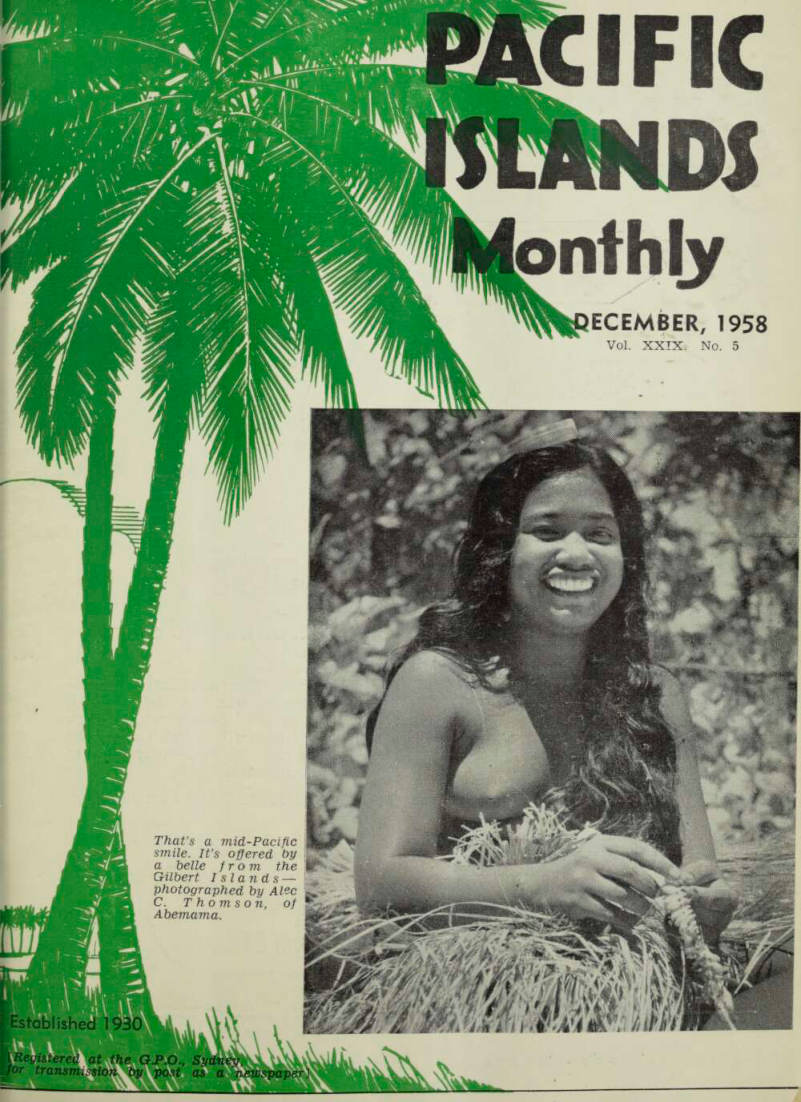 1
1 2
2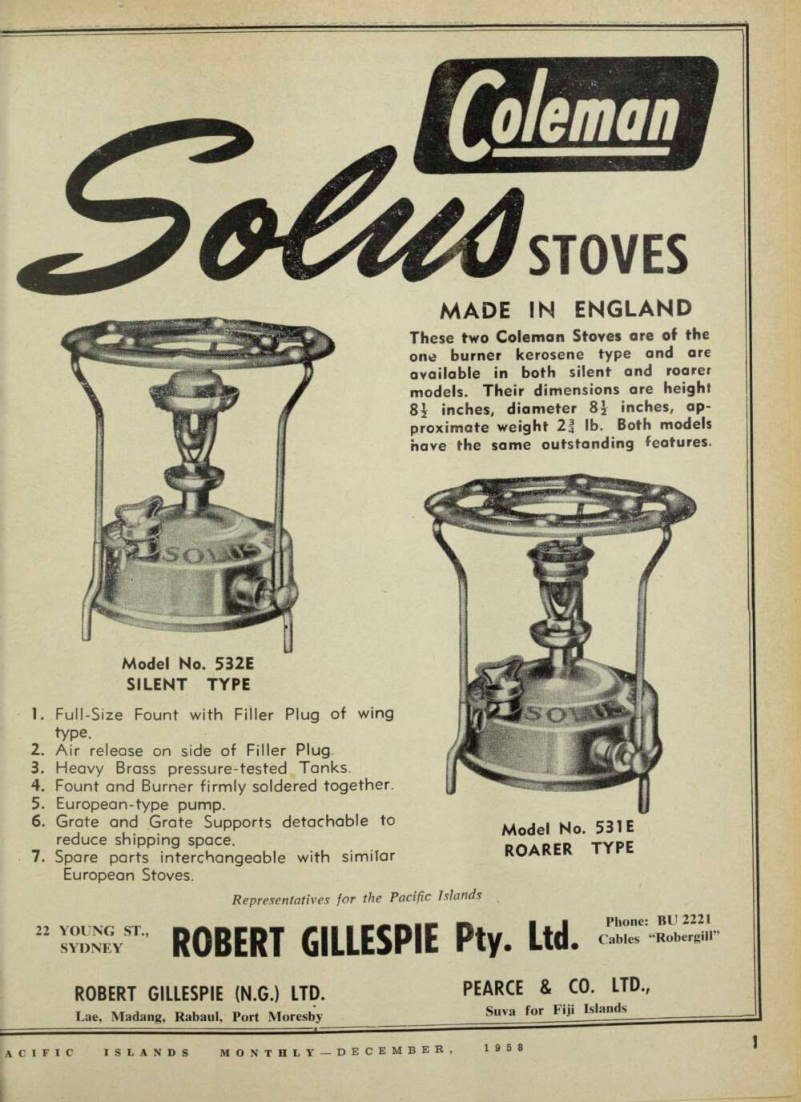 3
3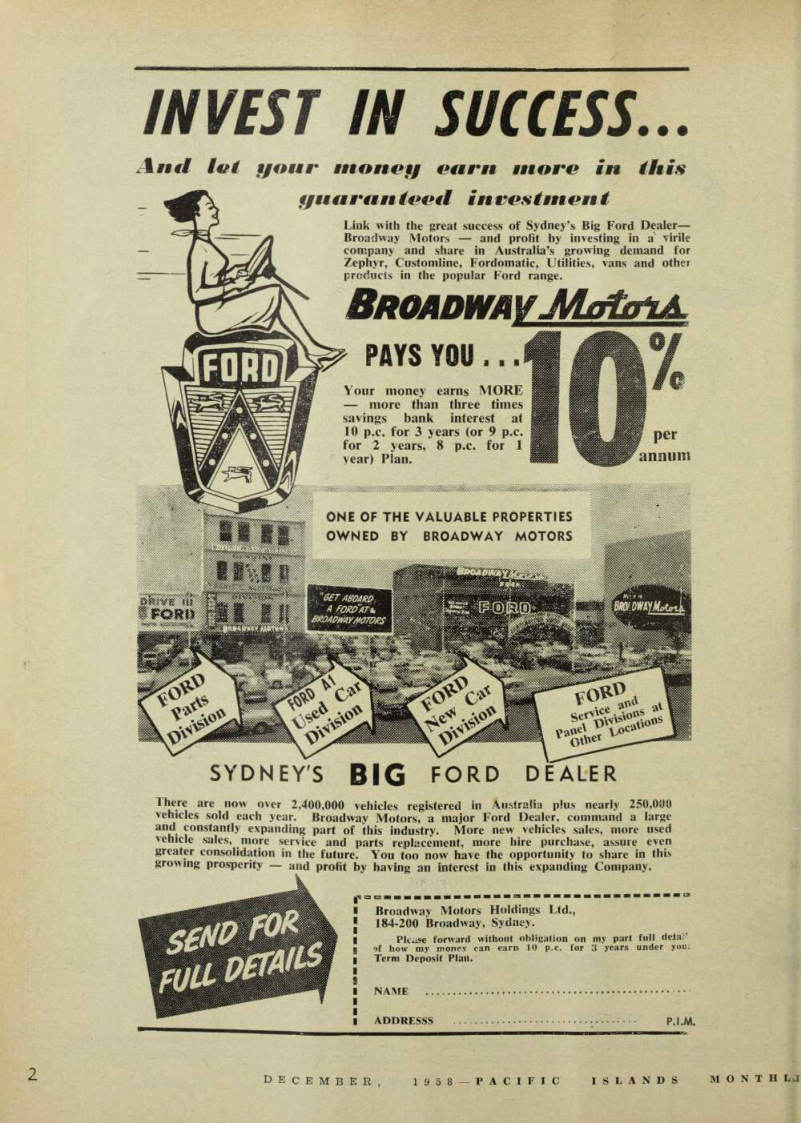 4
4 5
5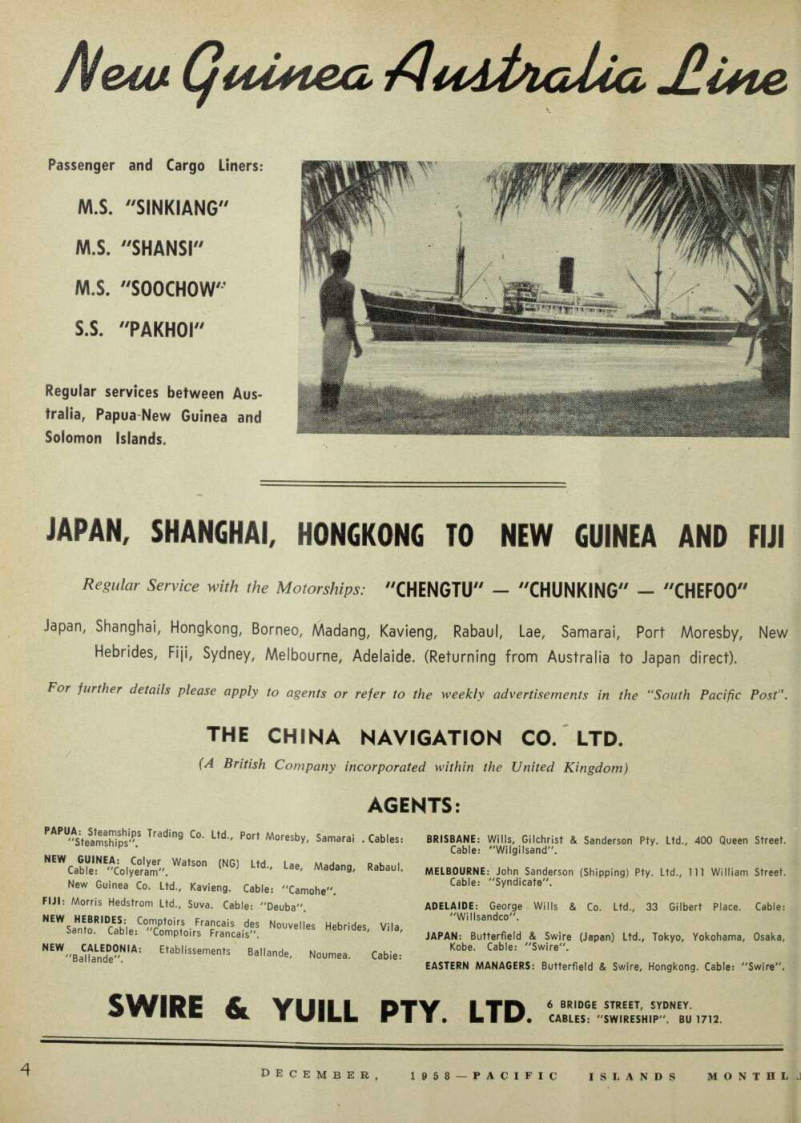 6
6 7
7 8
8 9
9 10
10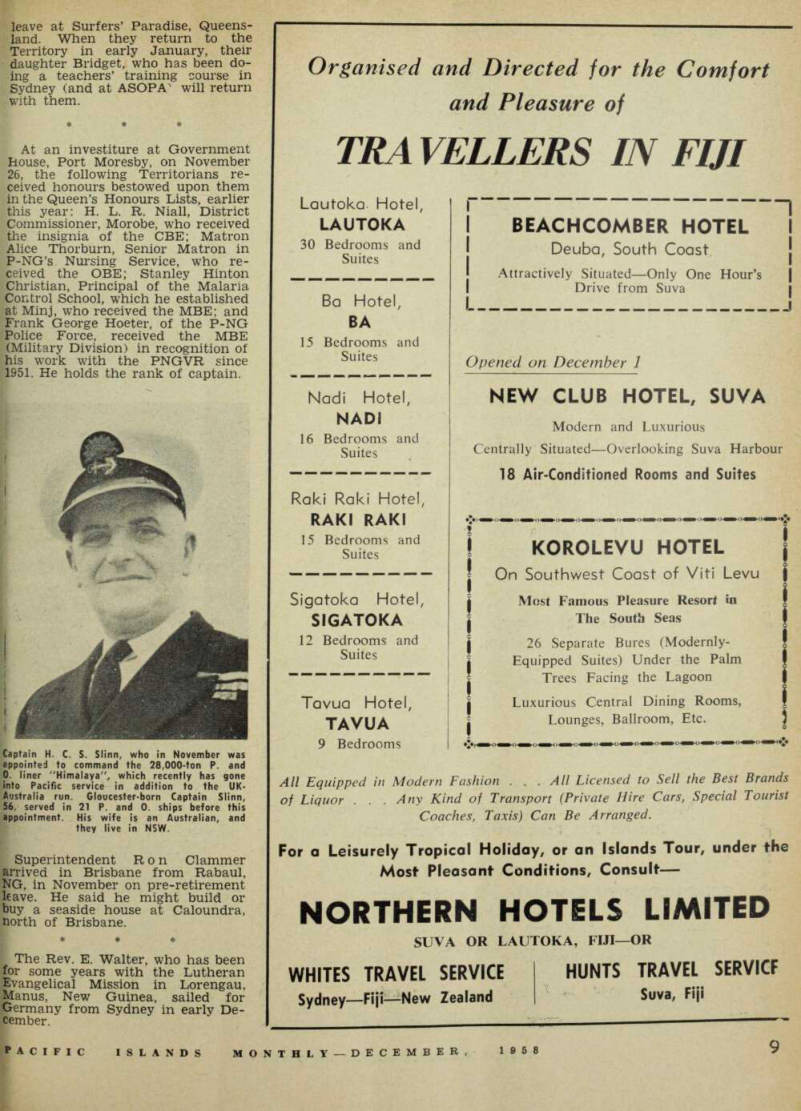 11
11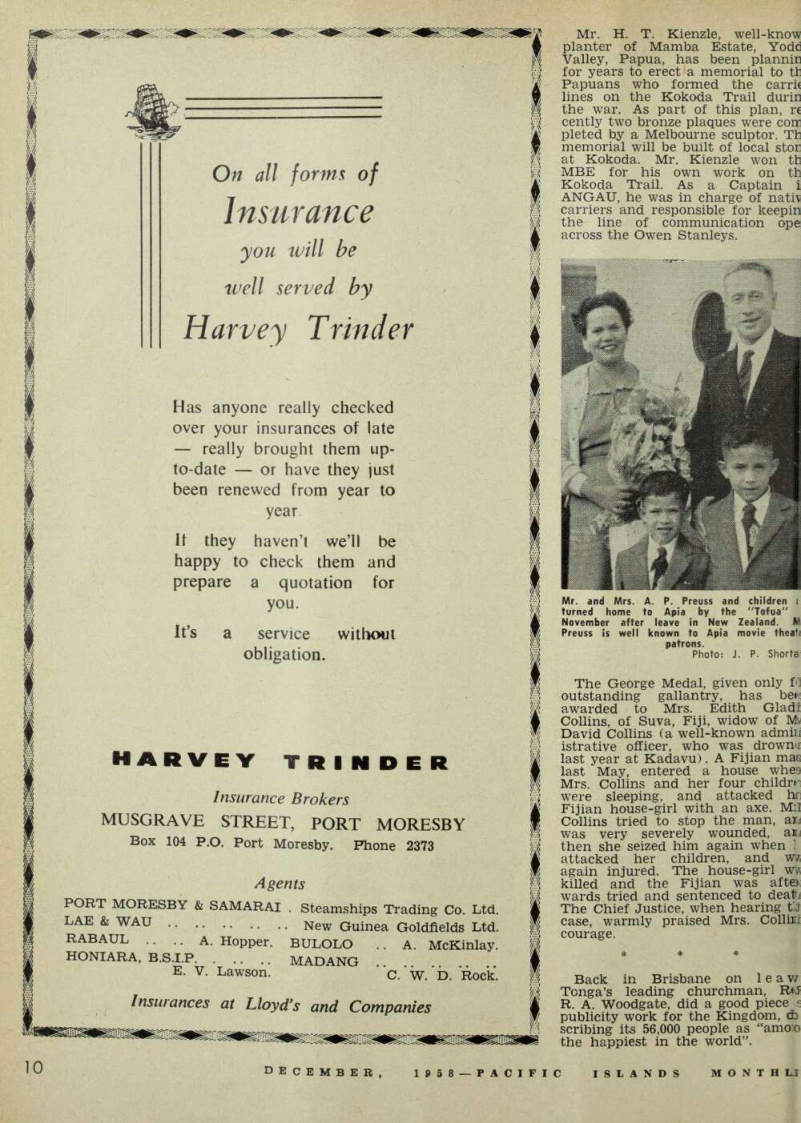 12
12 13
13 14
14 15
15 16
16 17
17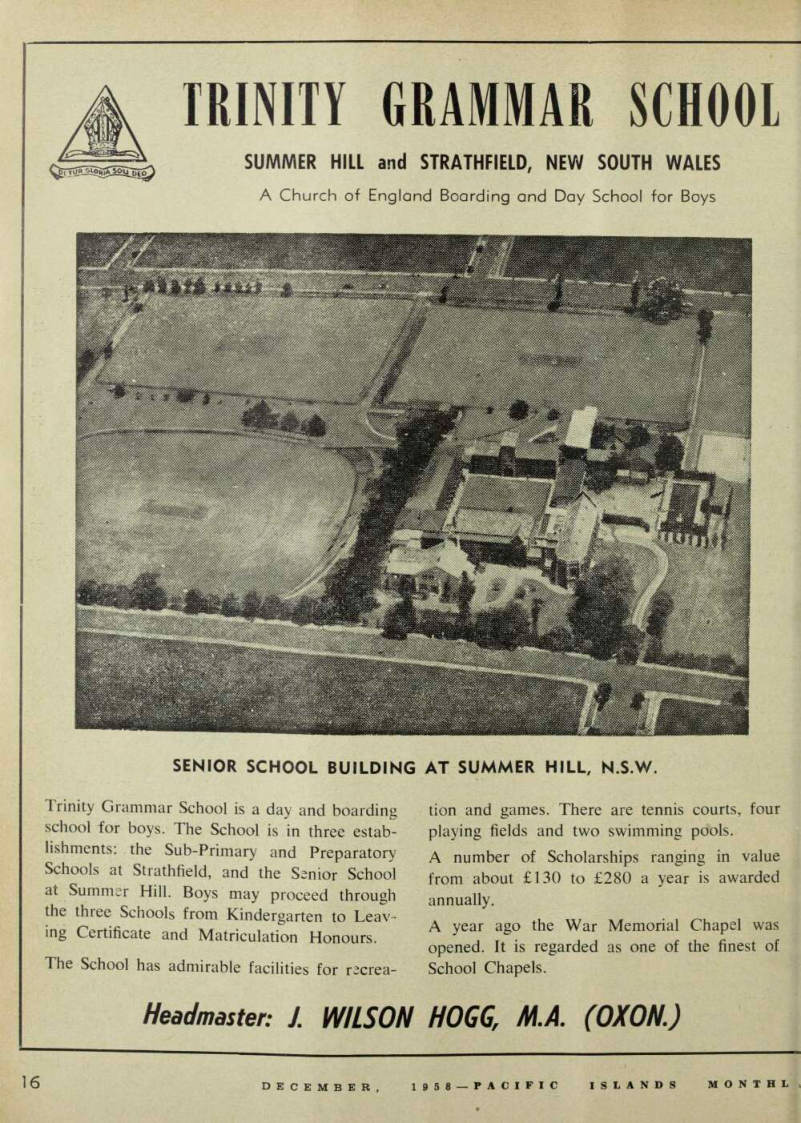 18
18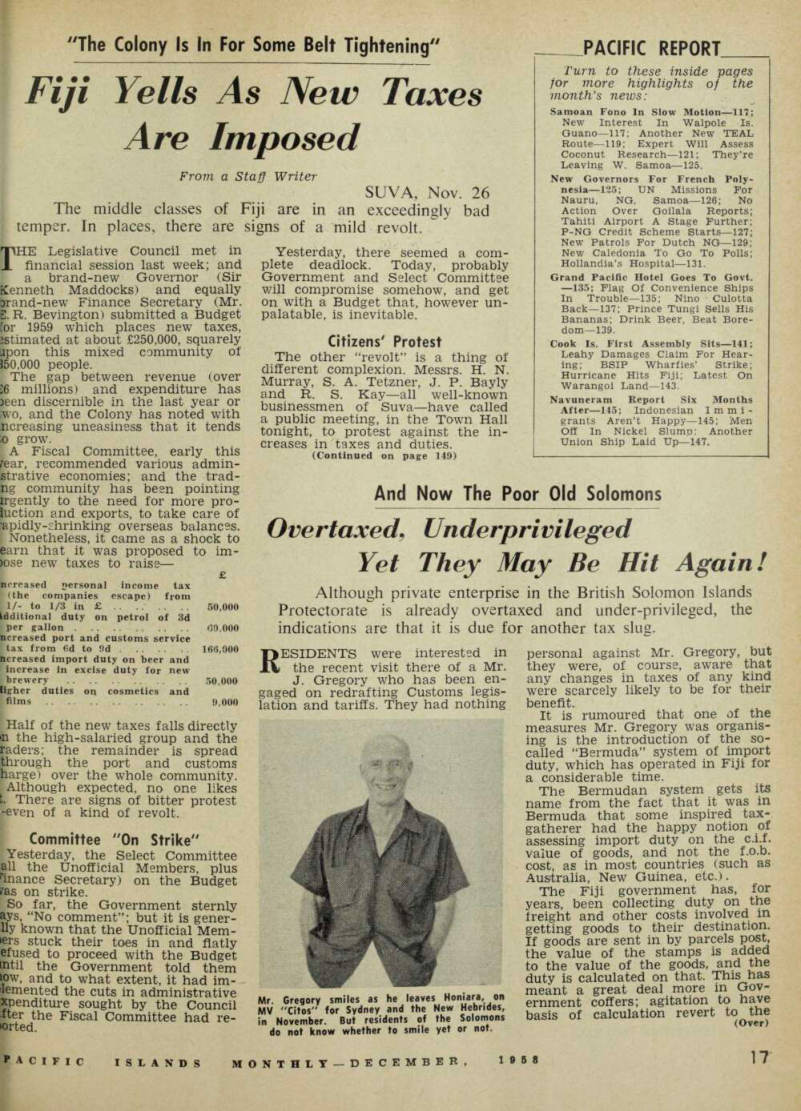 19
19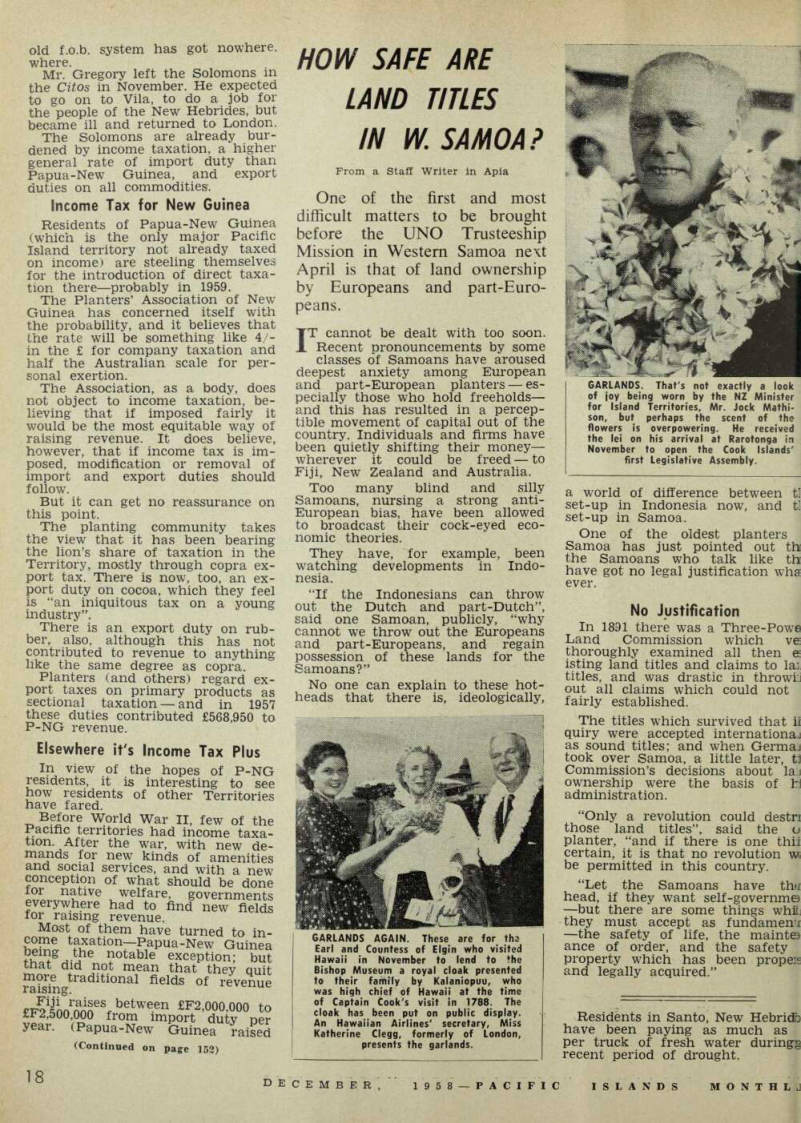 20
20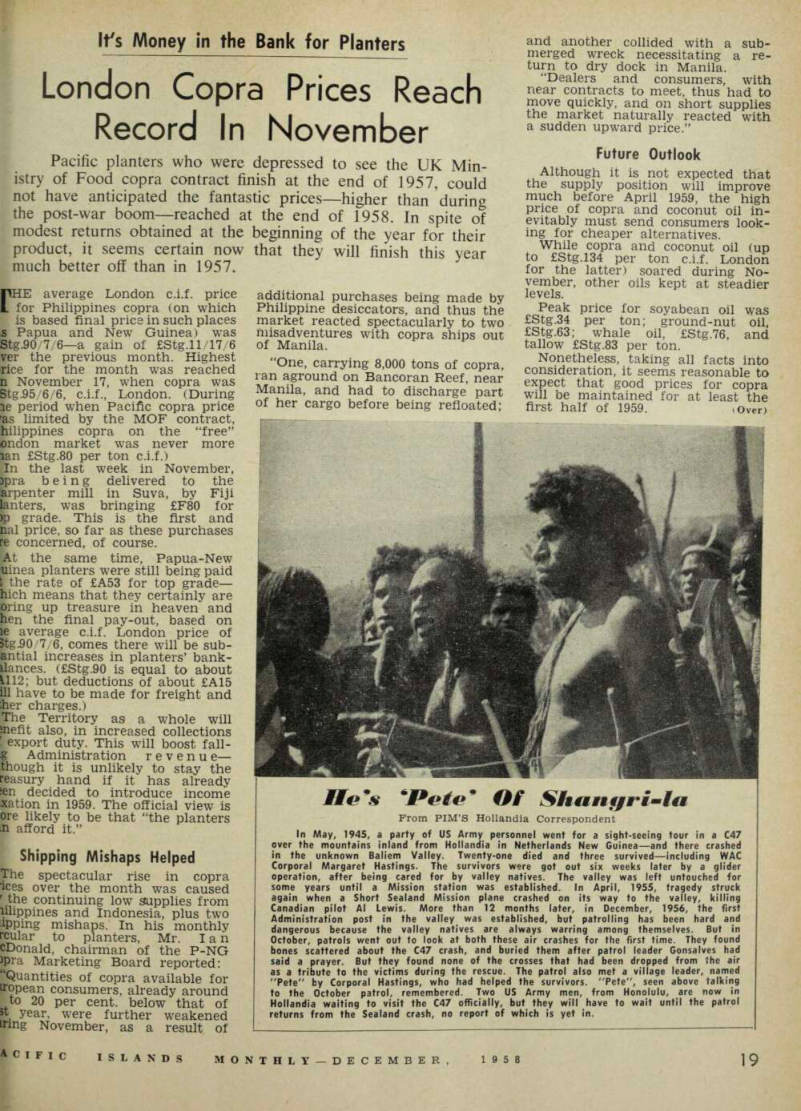 21
21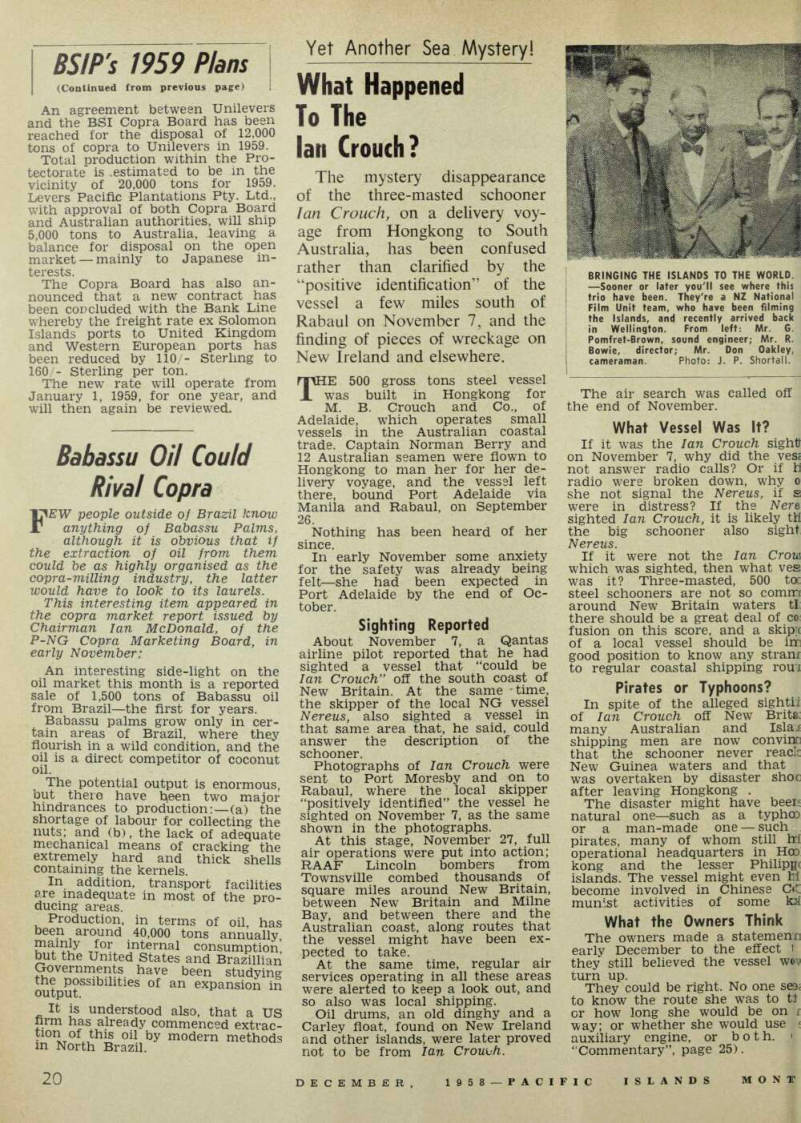 22
22 23
23 24
24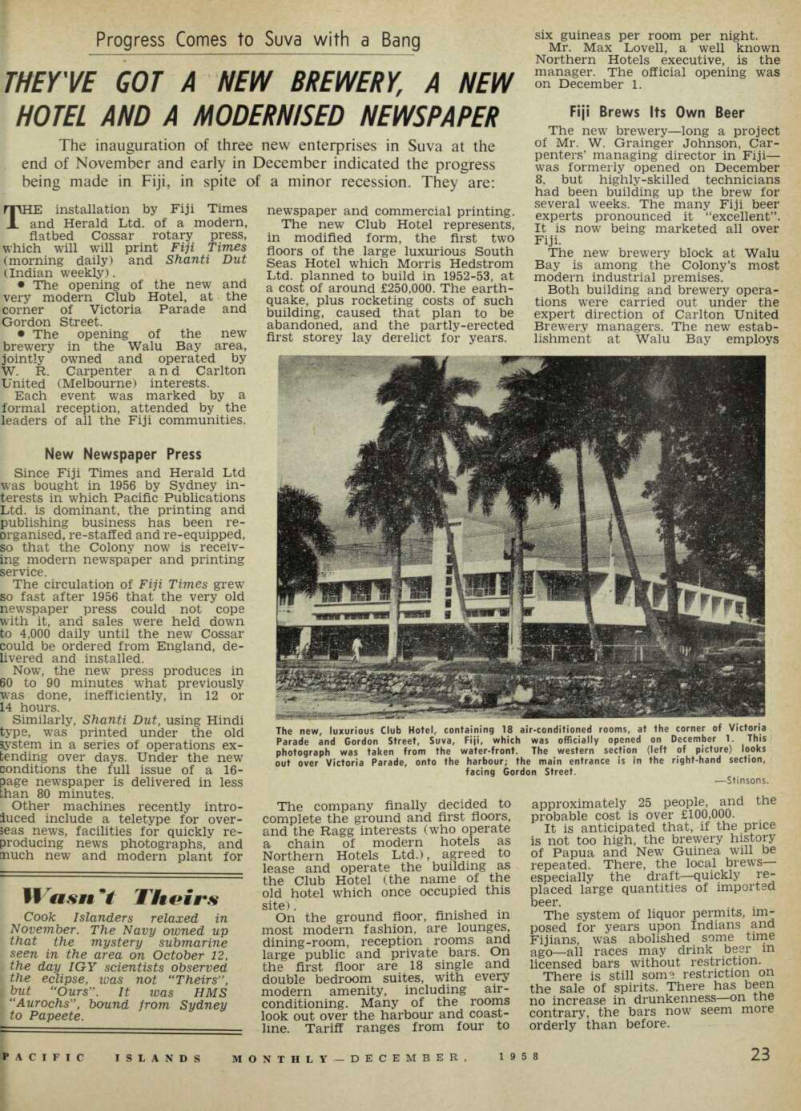 25
25 26
26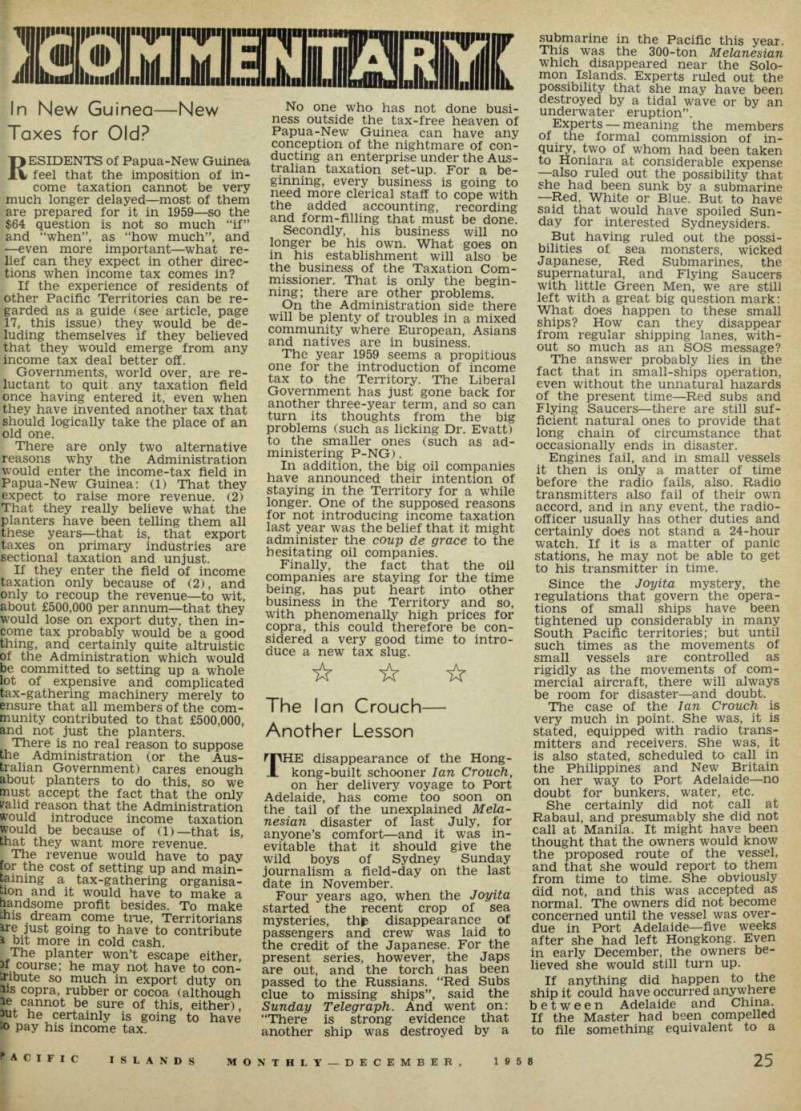 27
27 28
28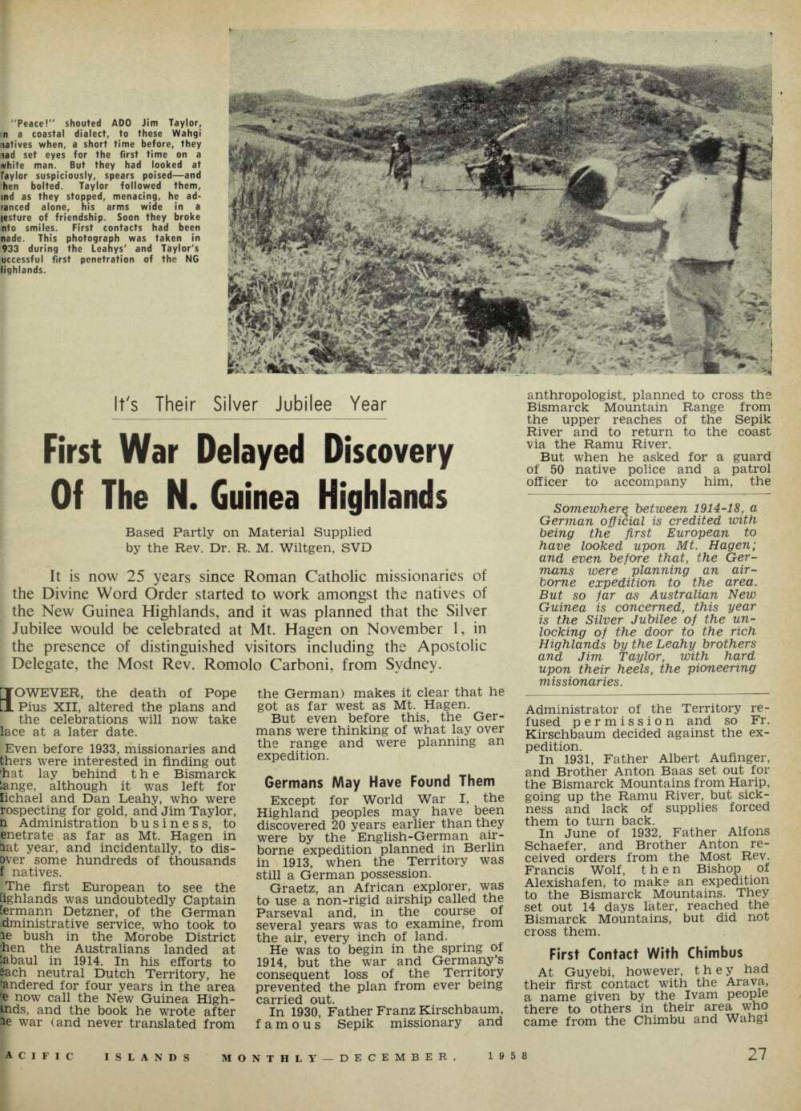 29
29 30
30 31
31 32
32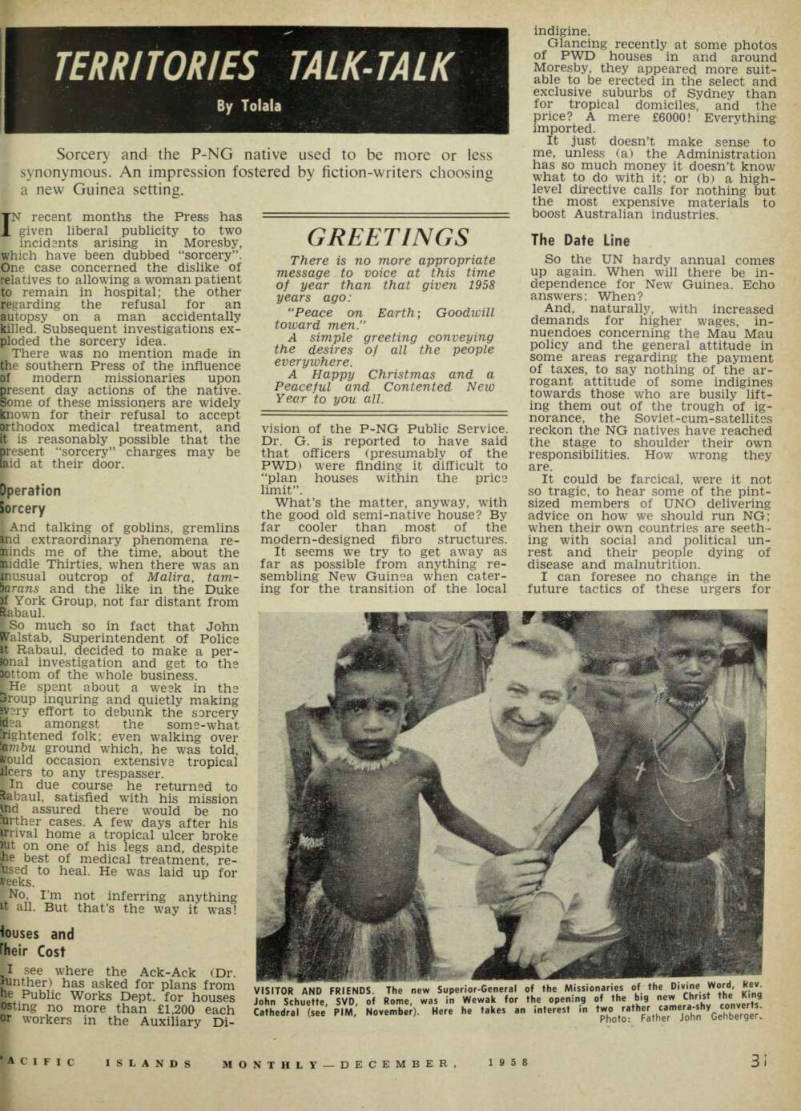 33
33 34
34 35
35 36
36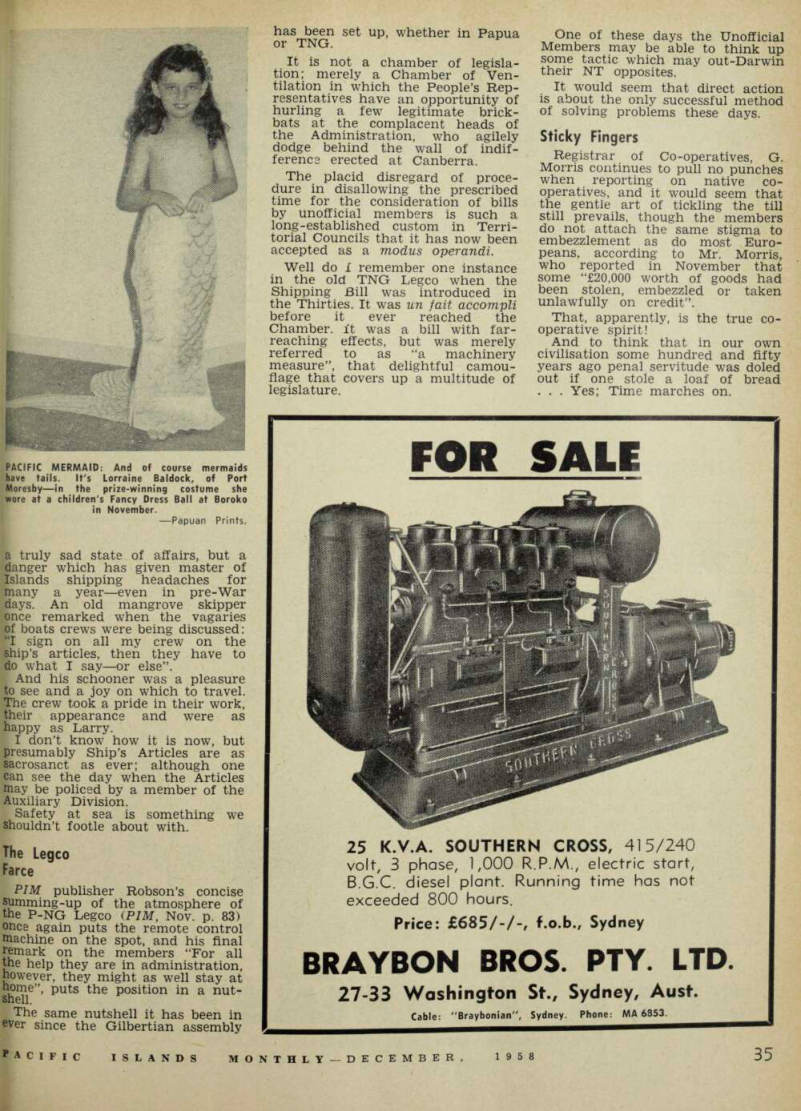 37
37 38
38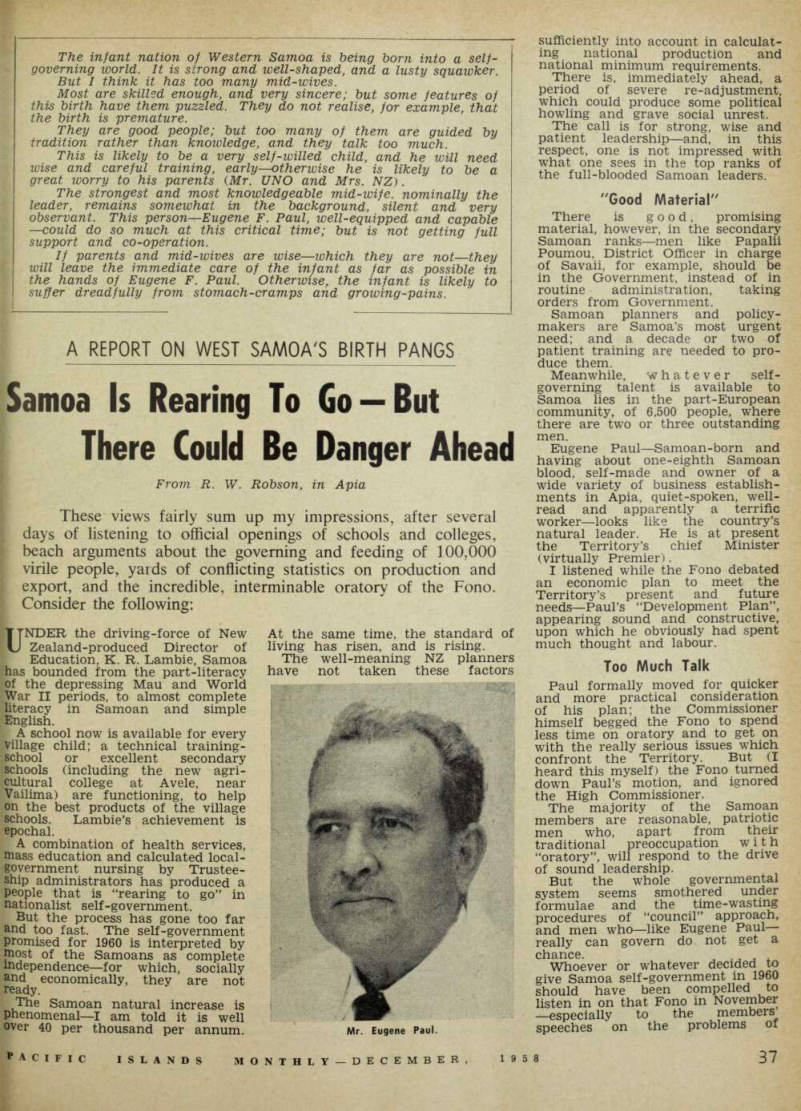 39
39 40
40 41
41 42
42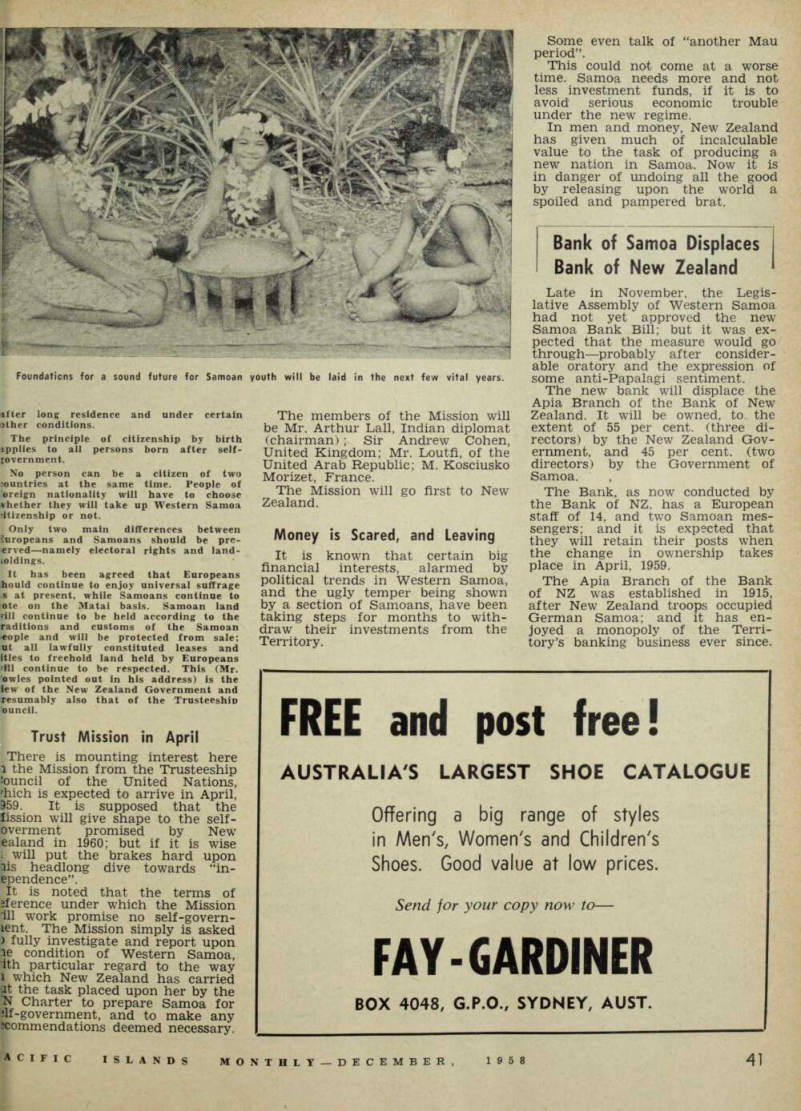 43
43 44
44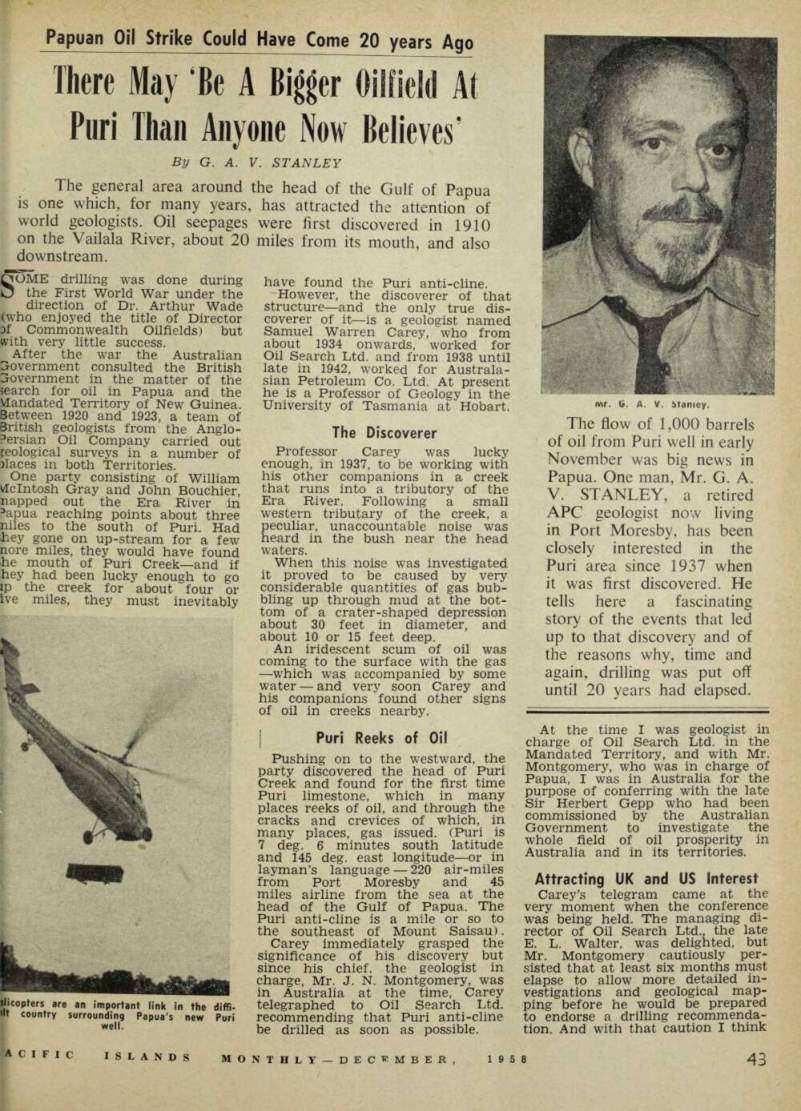 45
45 46
46 47
47 48
48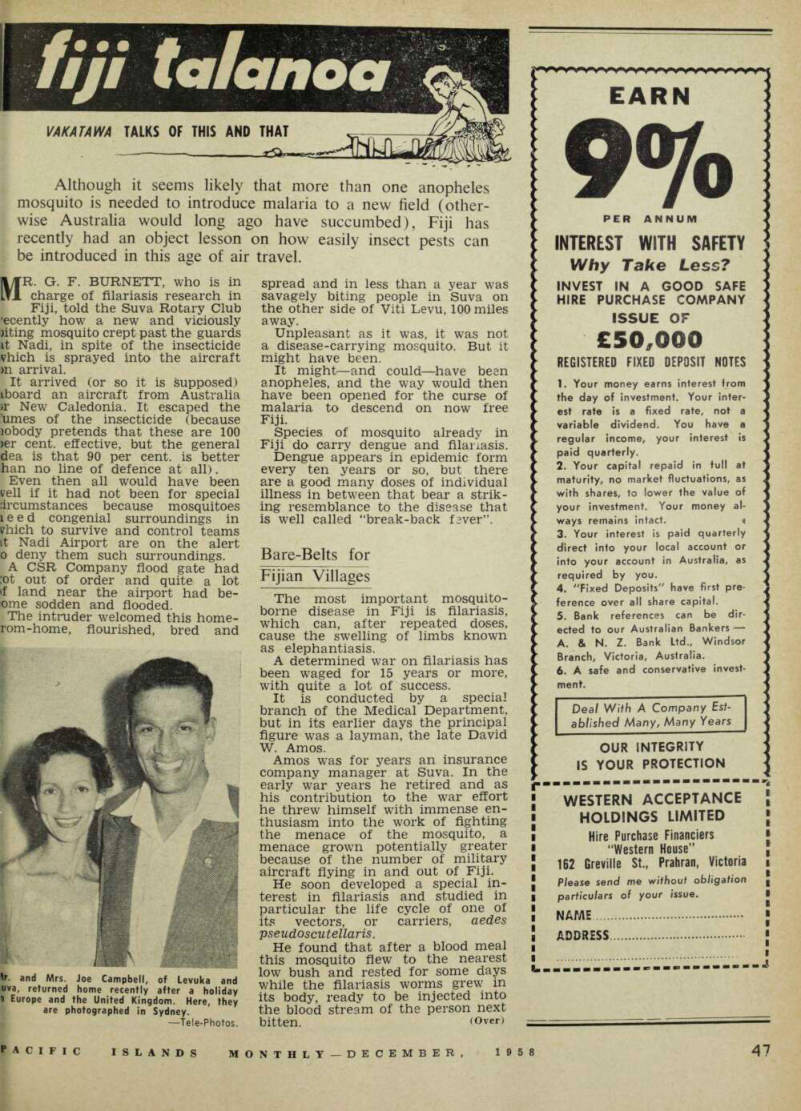 49
49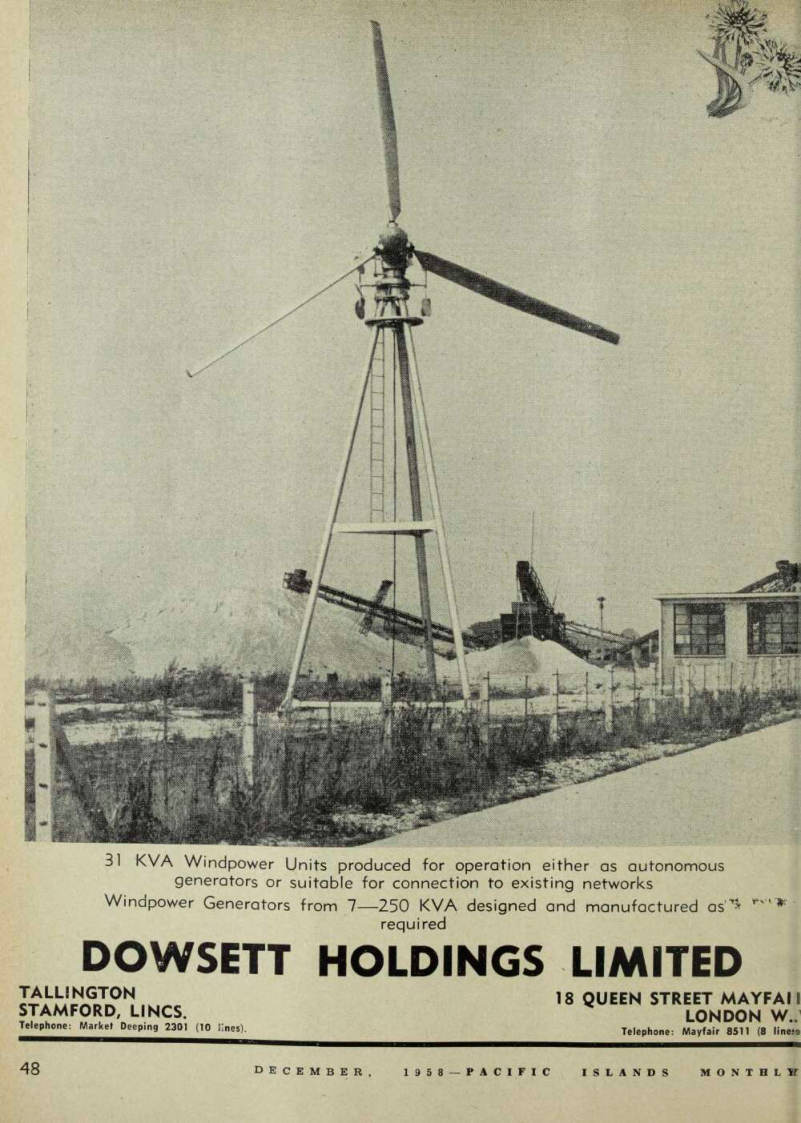 50
50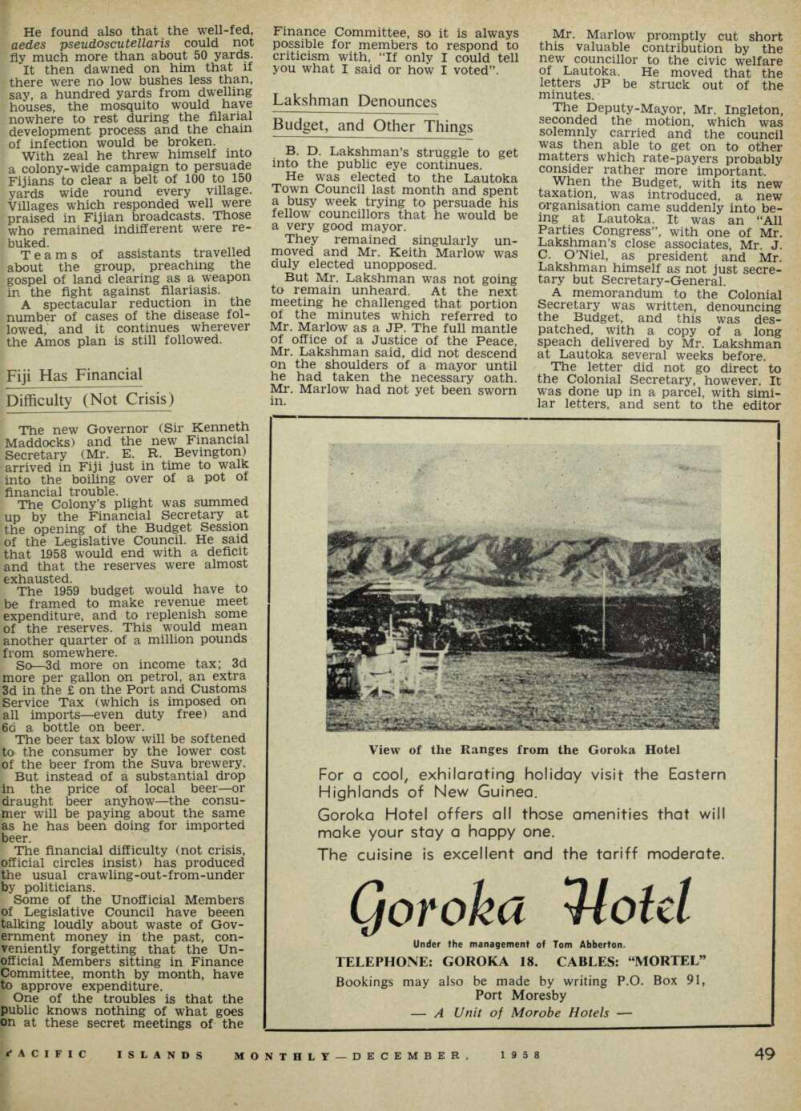 51
51 52
52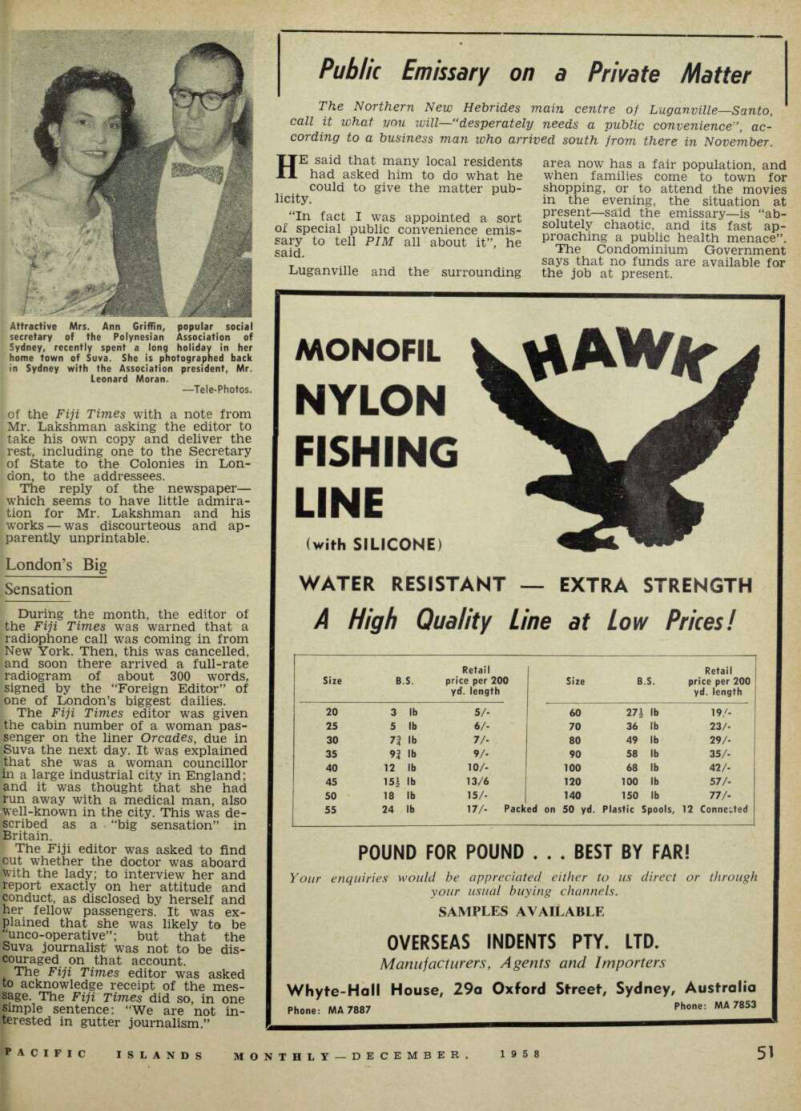 53
53 54
54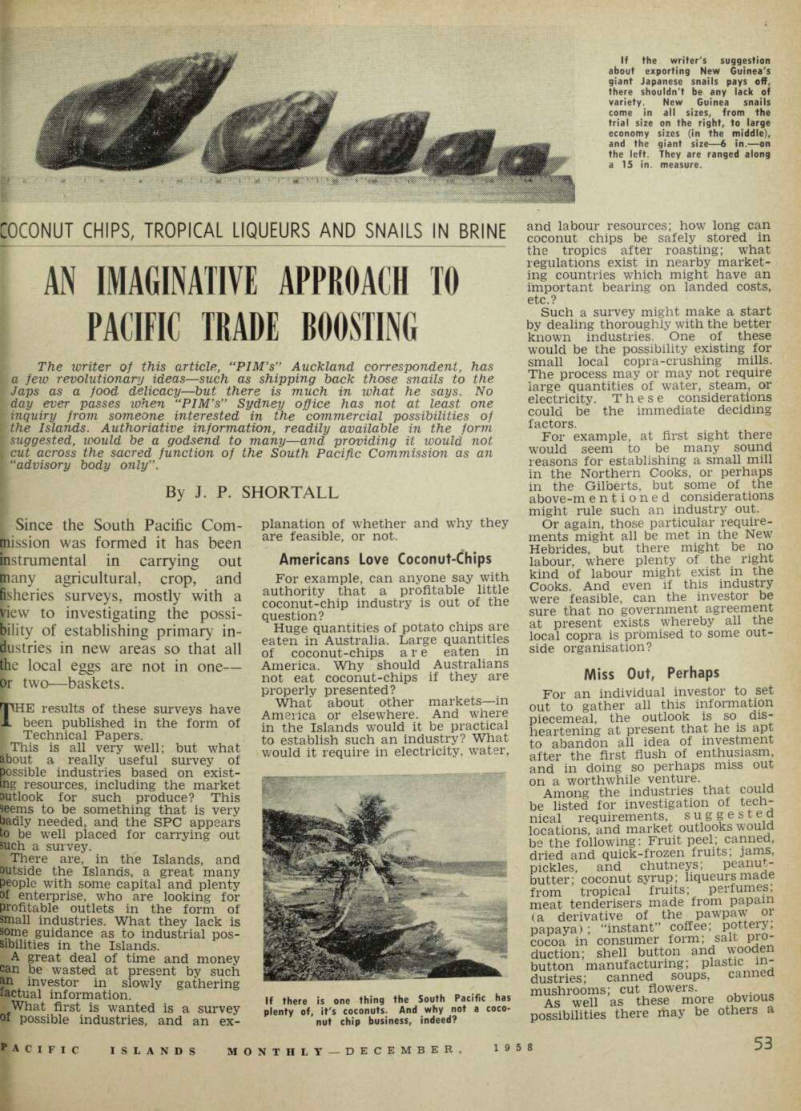 55
55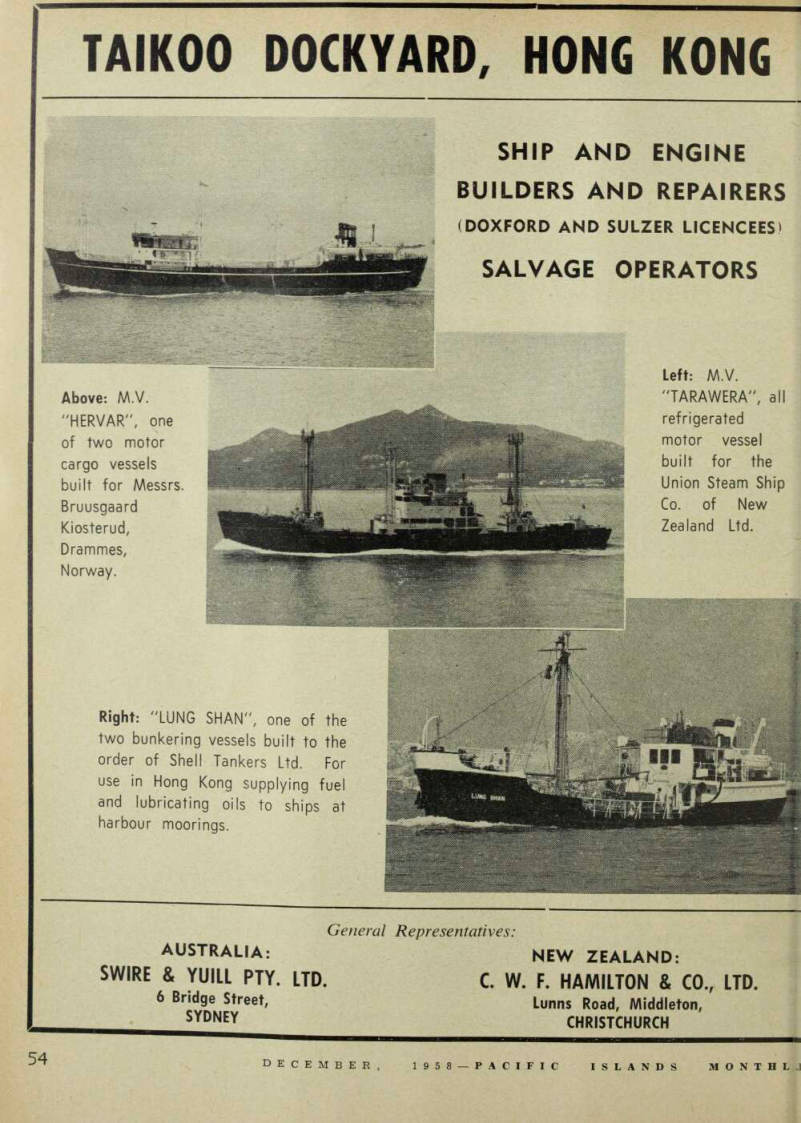 56
56 57
57 58
58 59
59 60
60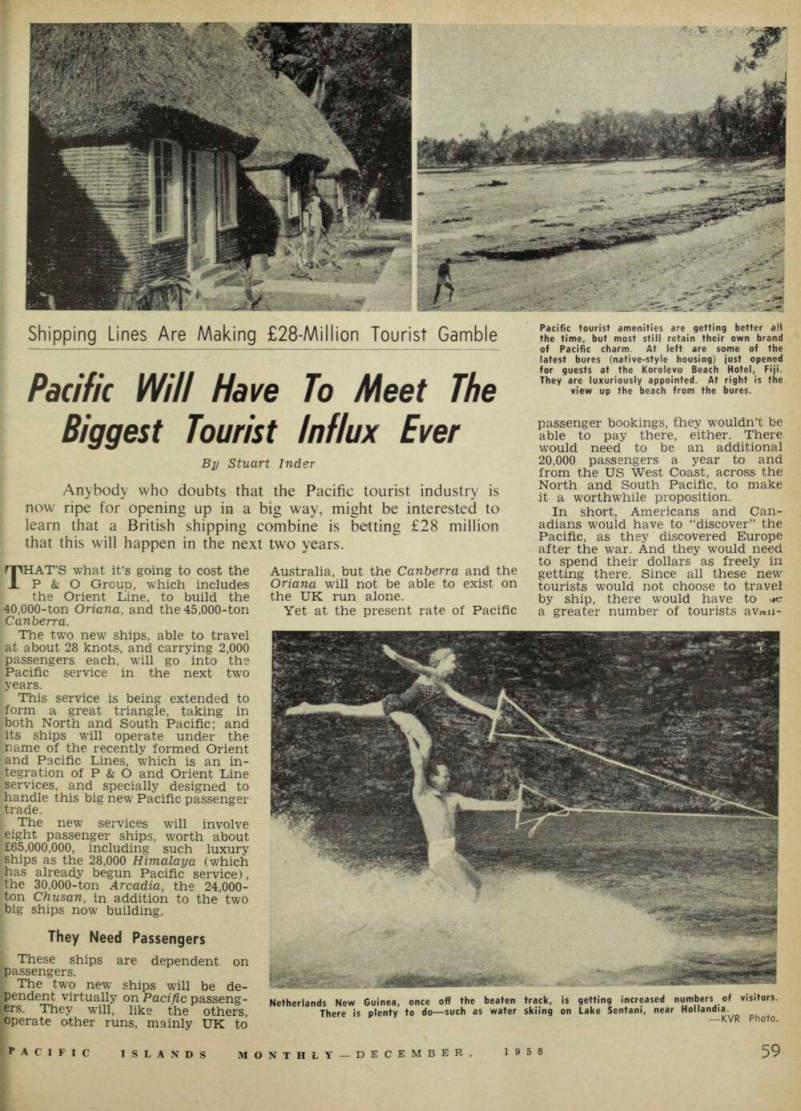 61
61 62
62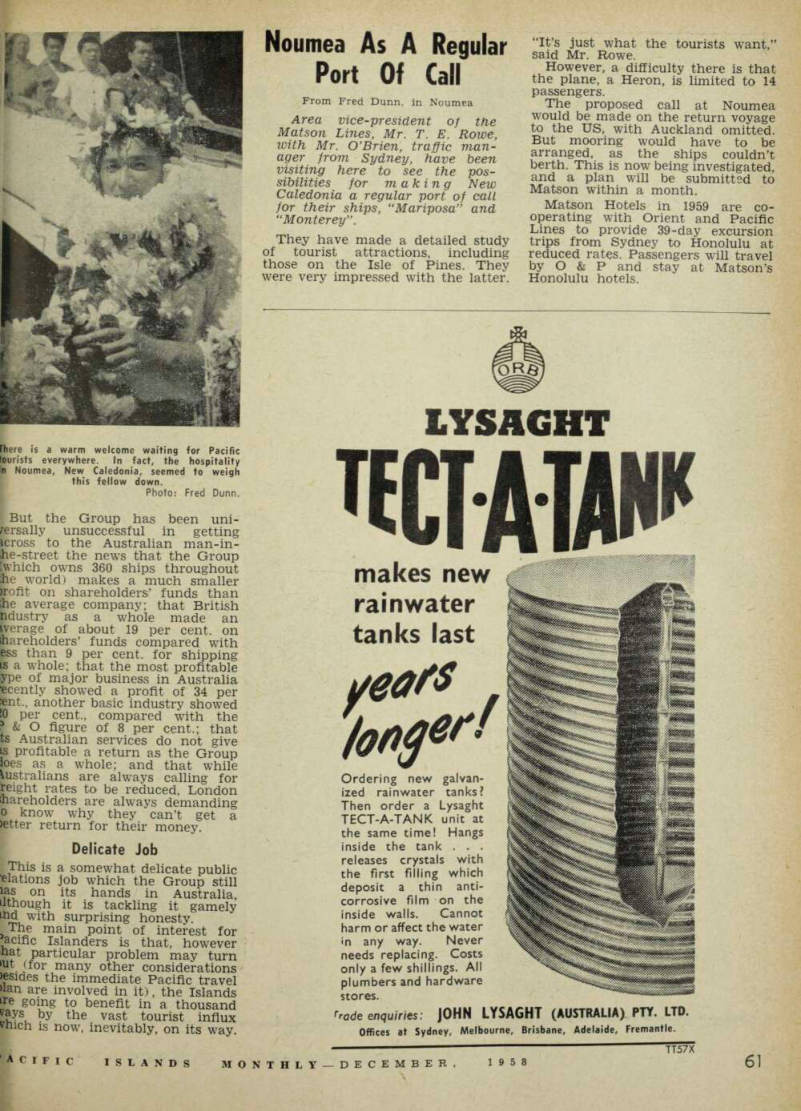 63
63 64
64 65
65 66
66 67
67 68
68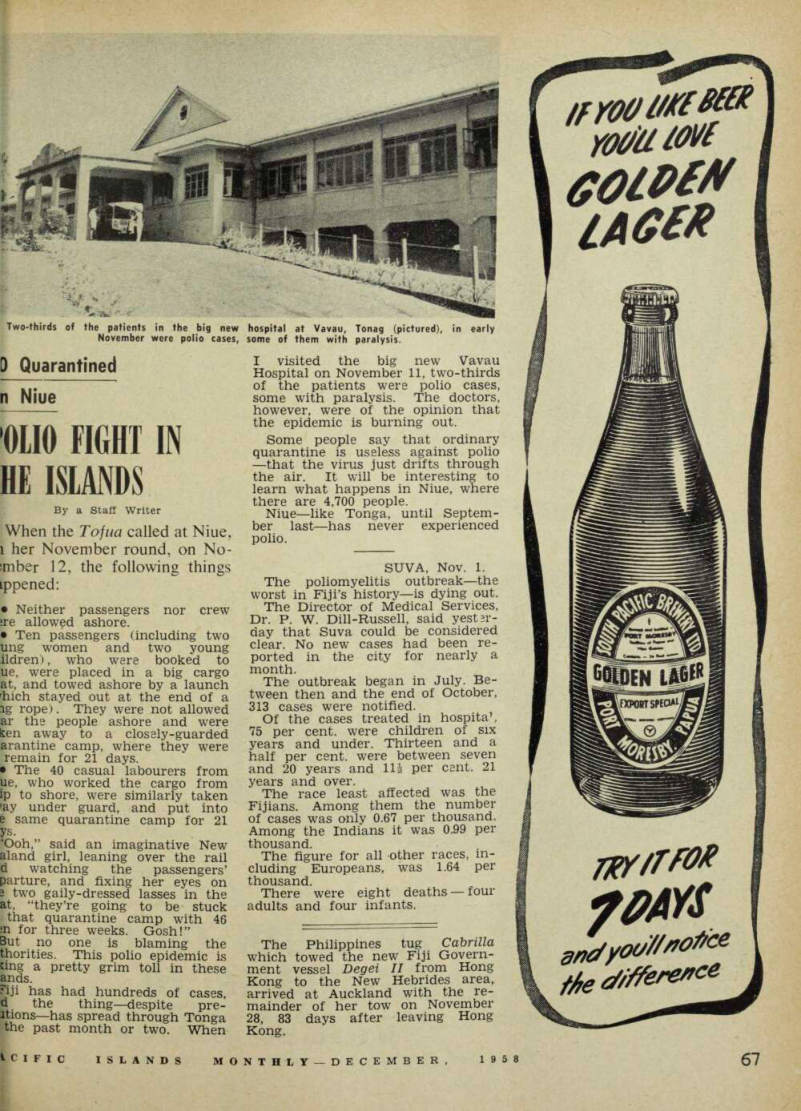 69
69 70
70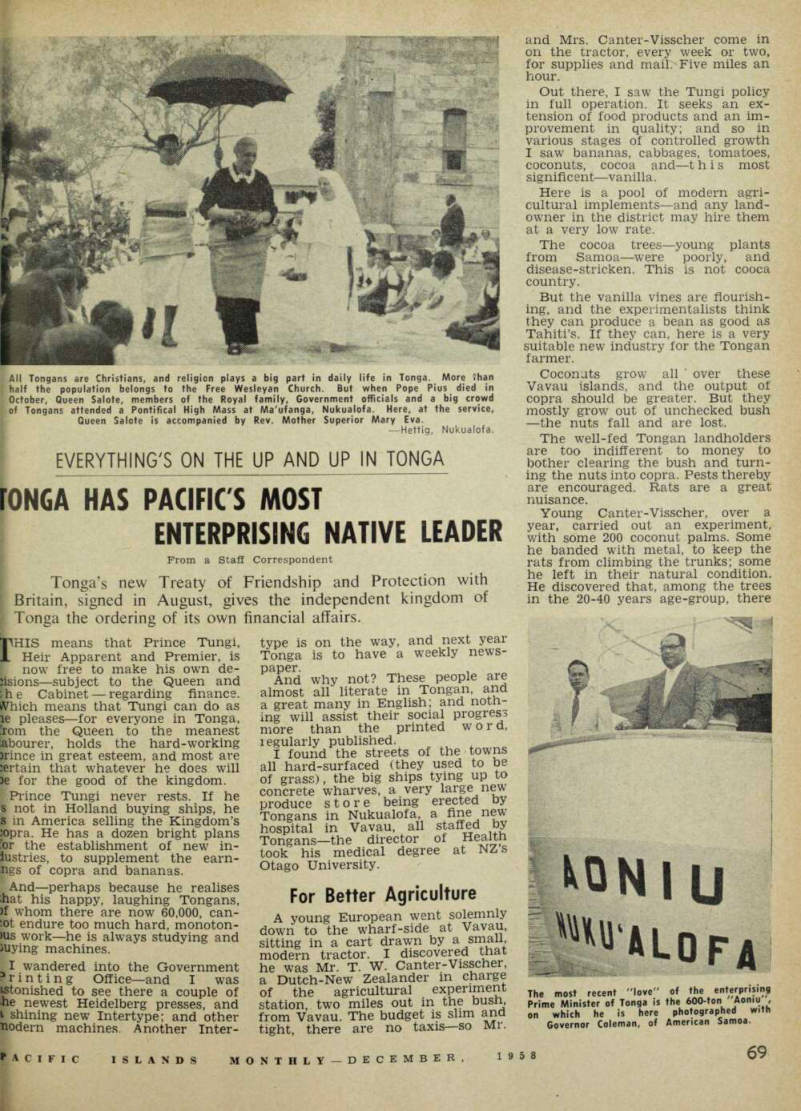 71
71 72
72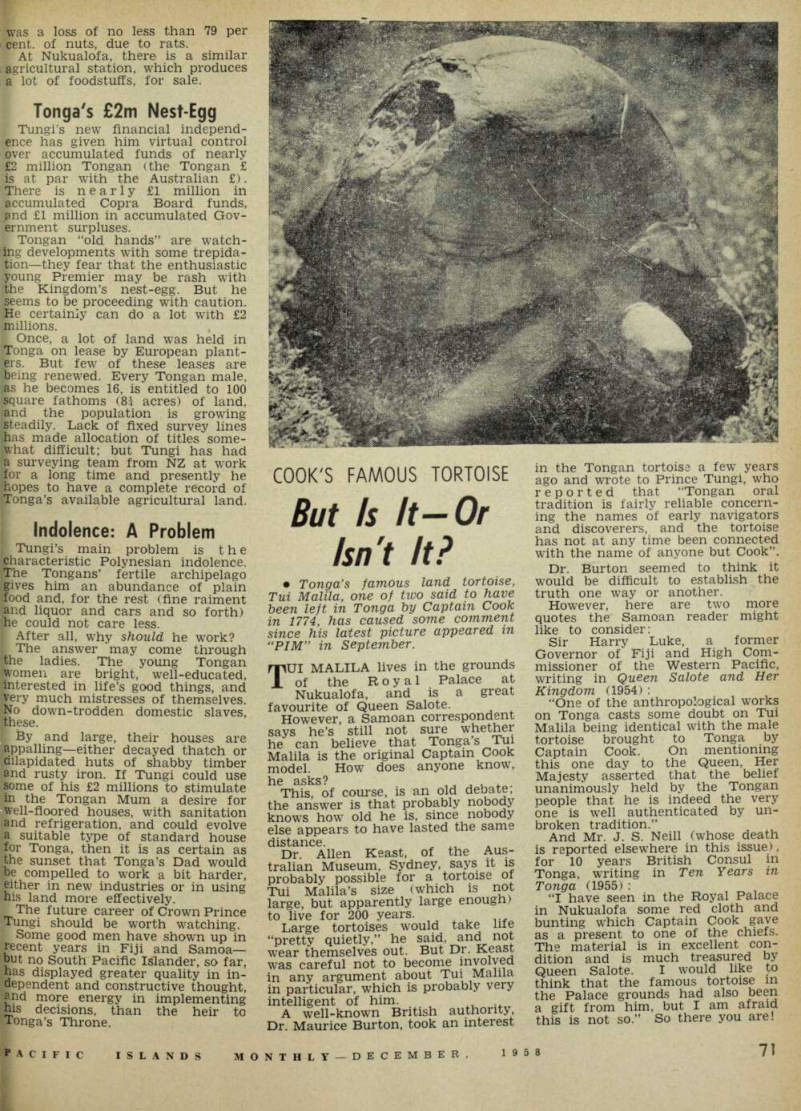 73
73 74
74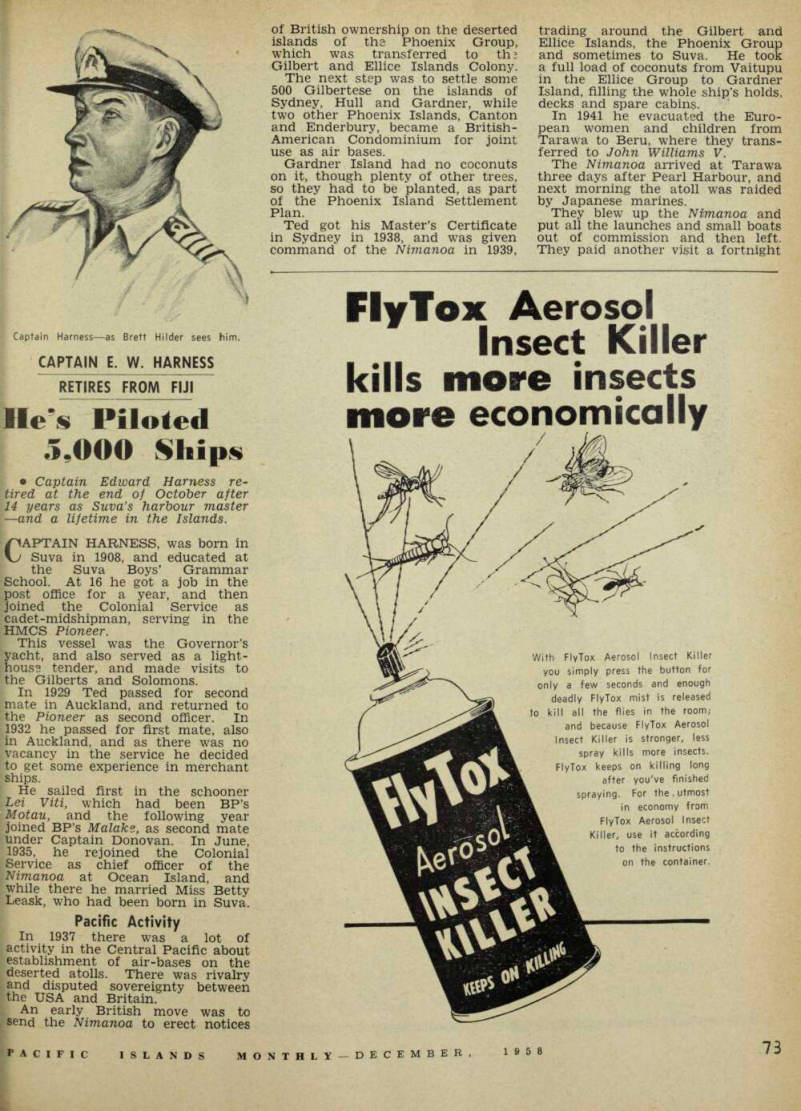 75
75 76
76 77
77 78
78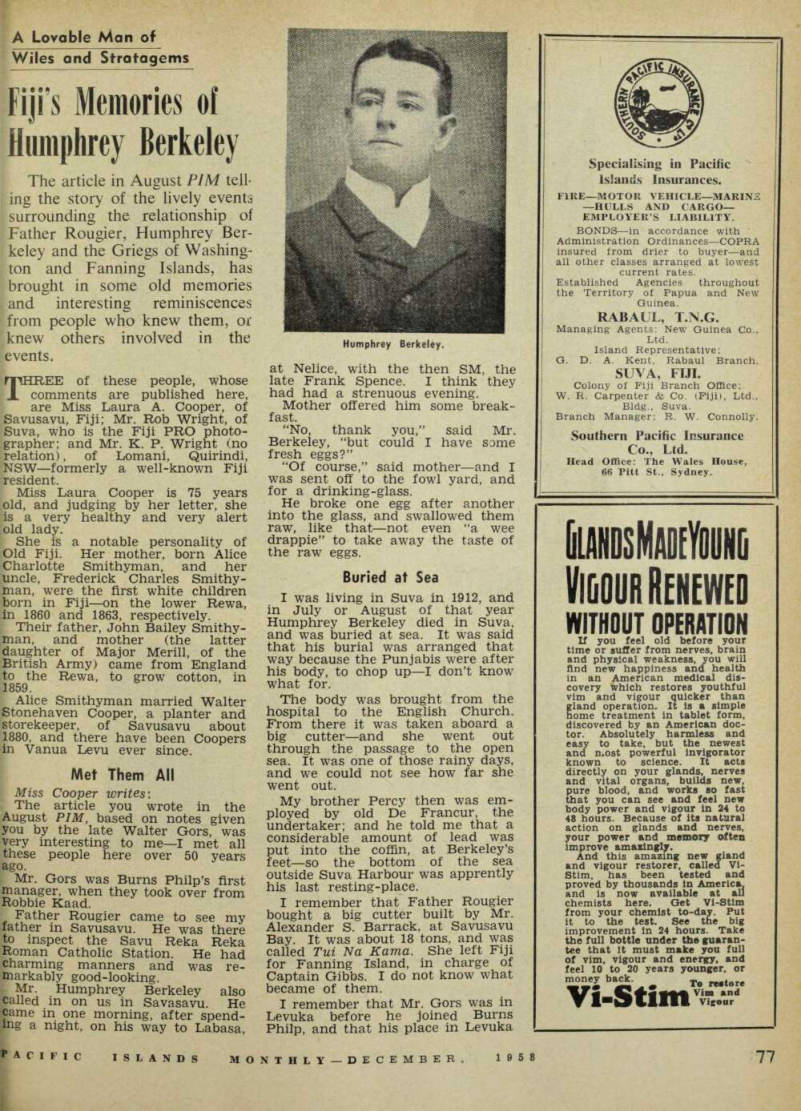 79
79 80
80 81
81 82
82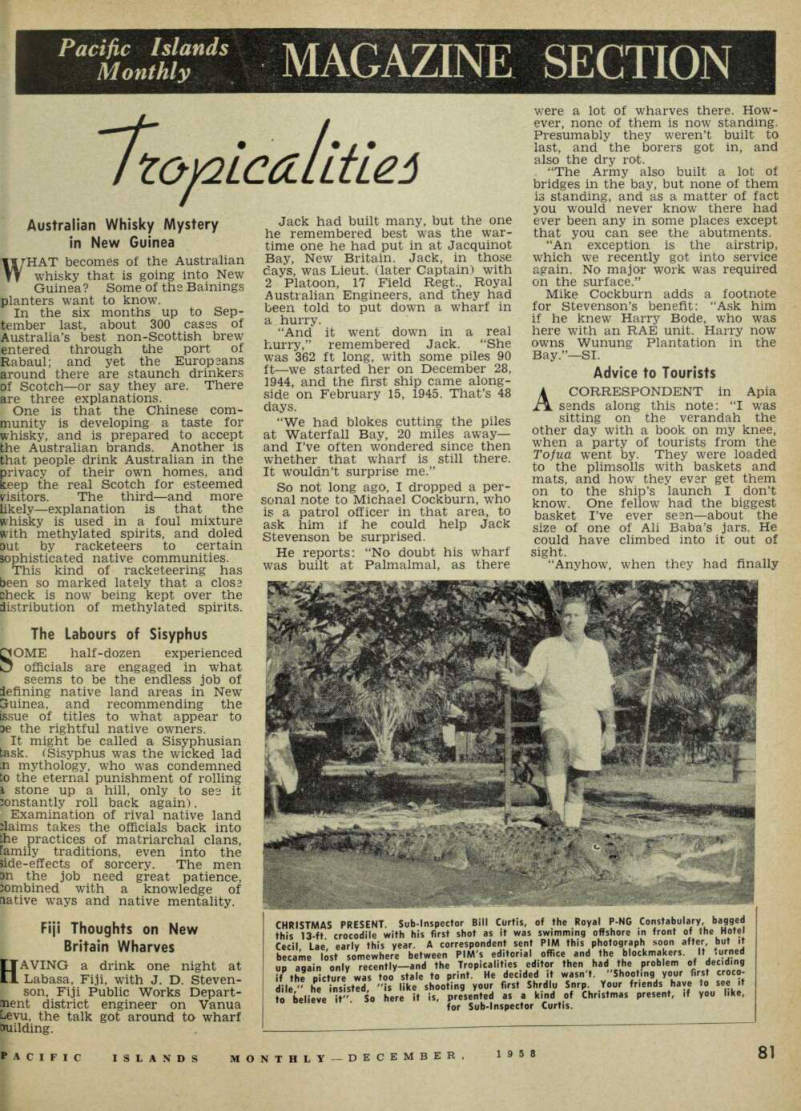 83
83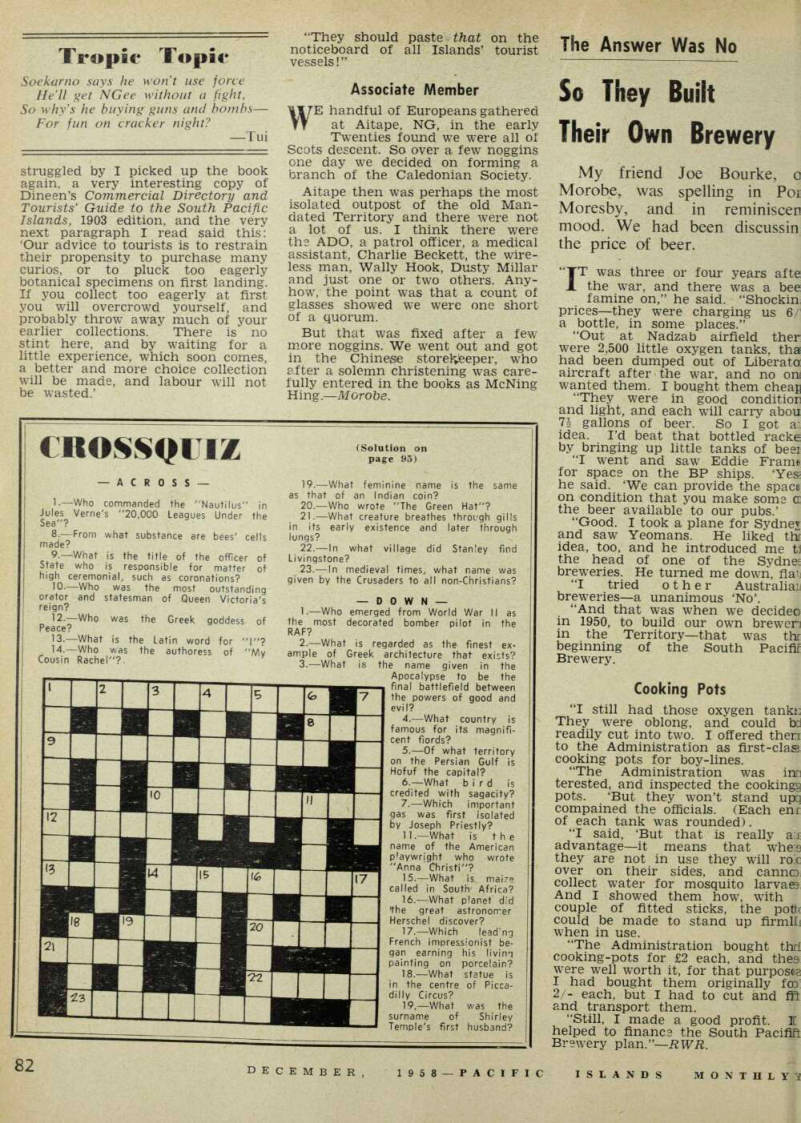 84
84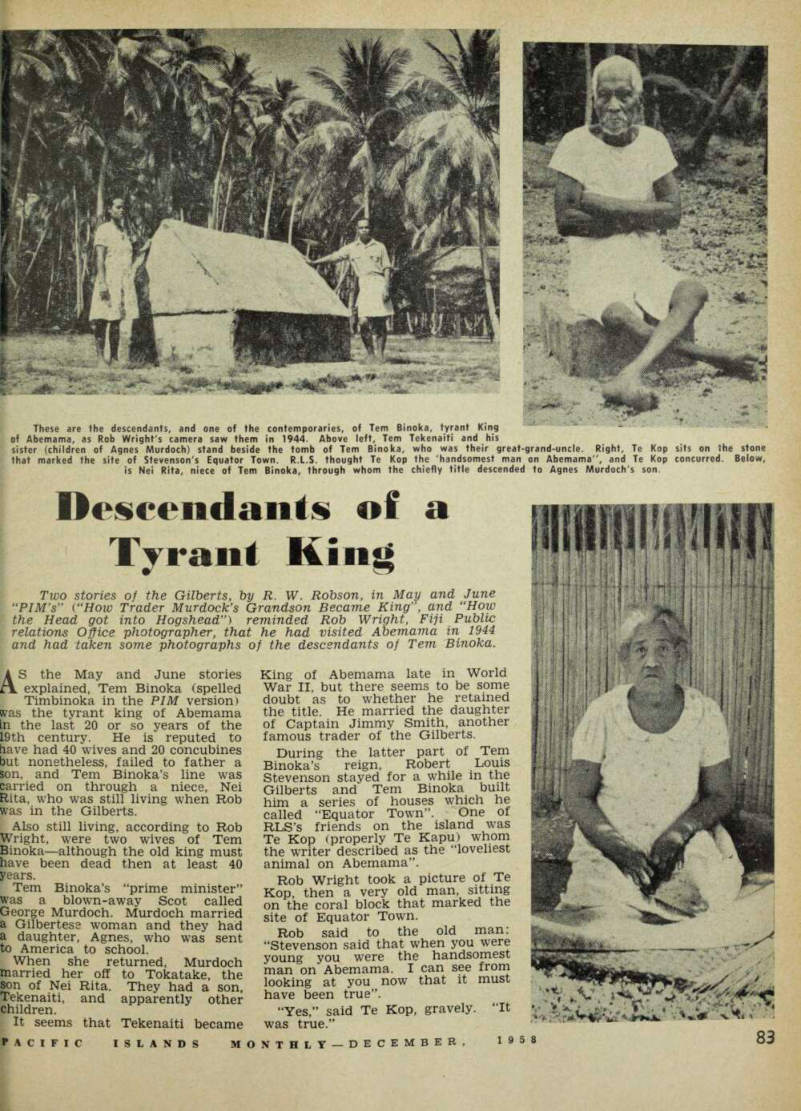 85
85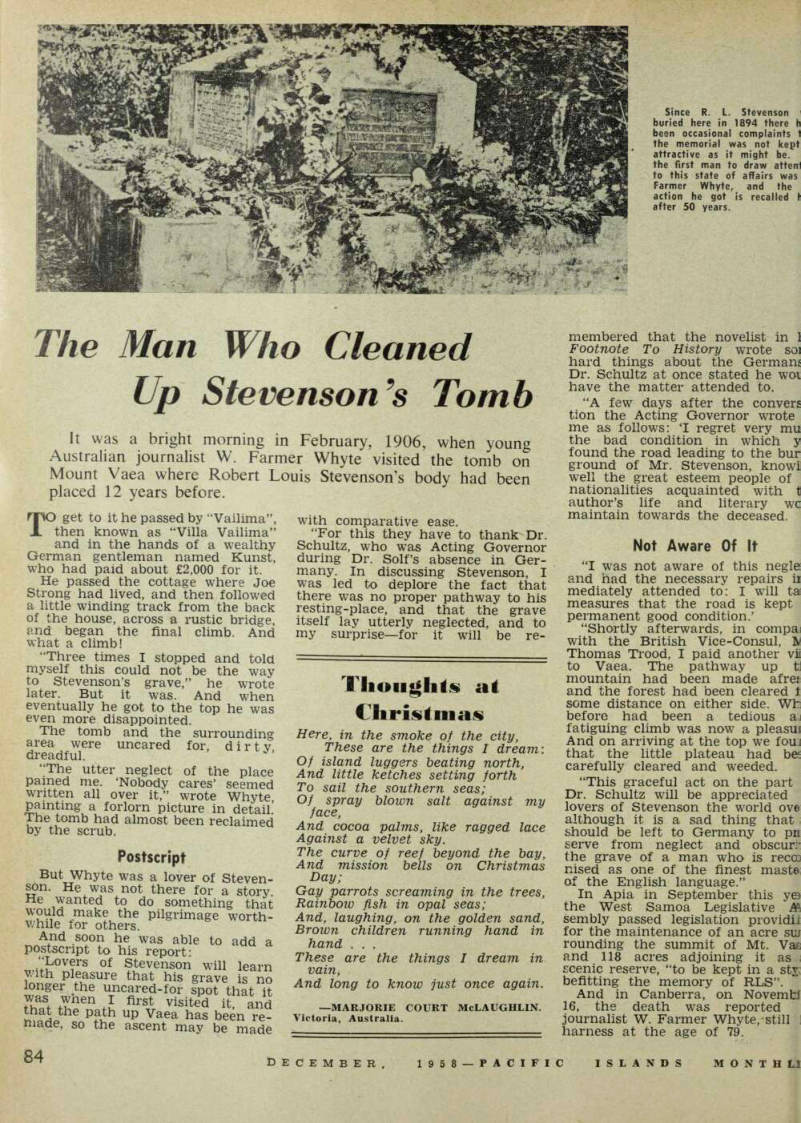 86
86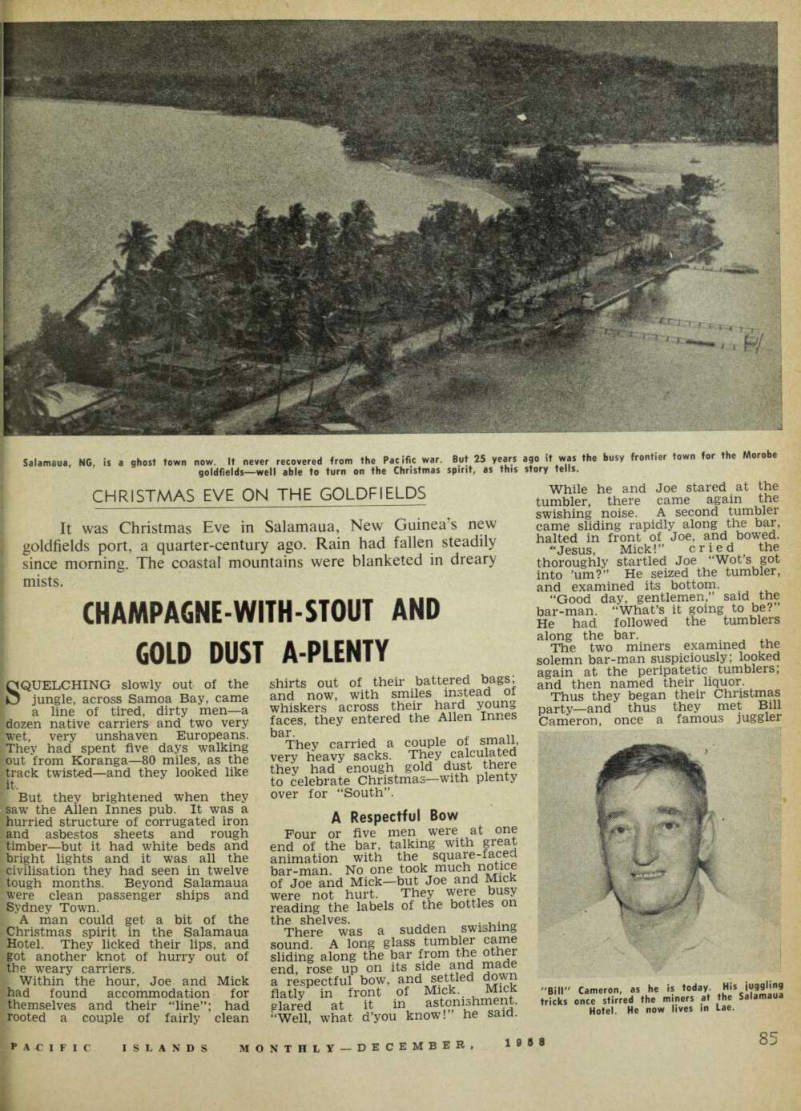 87
87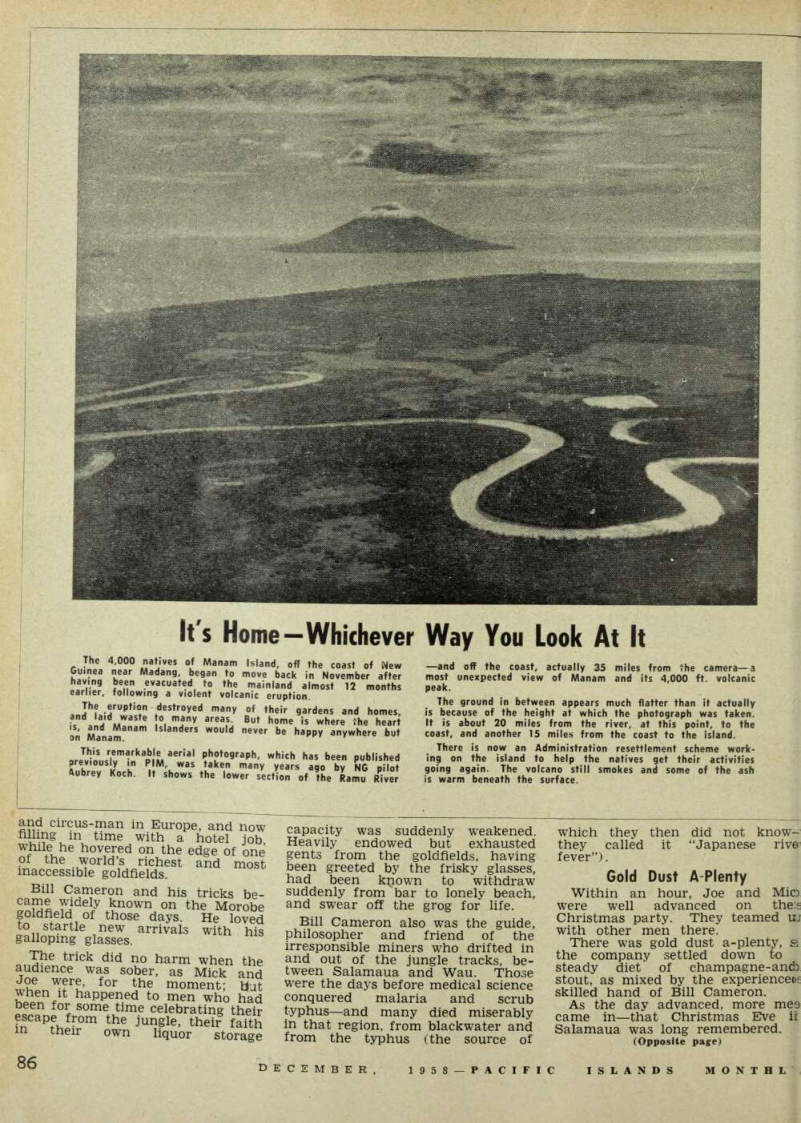 88
88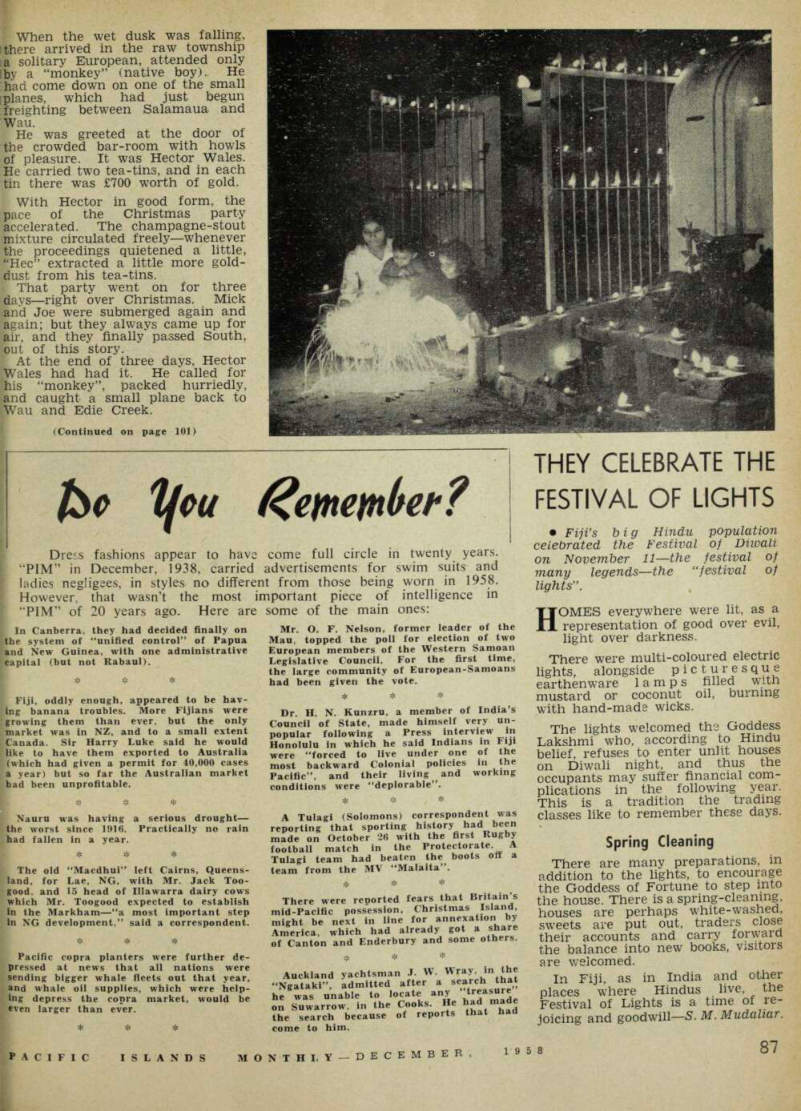 89
89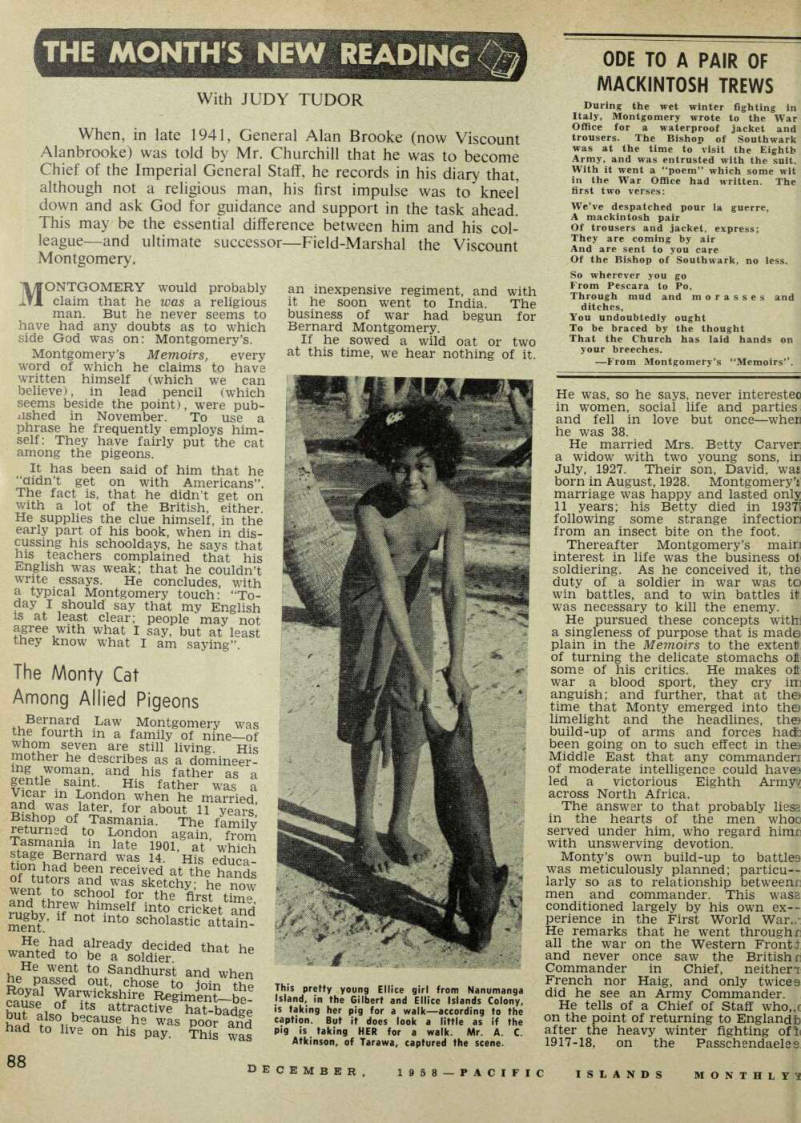 90
90 91
91 92
92 93
93 94
94 95
95 96
96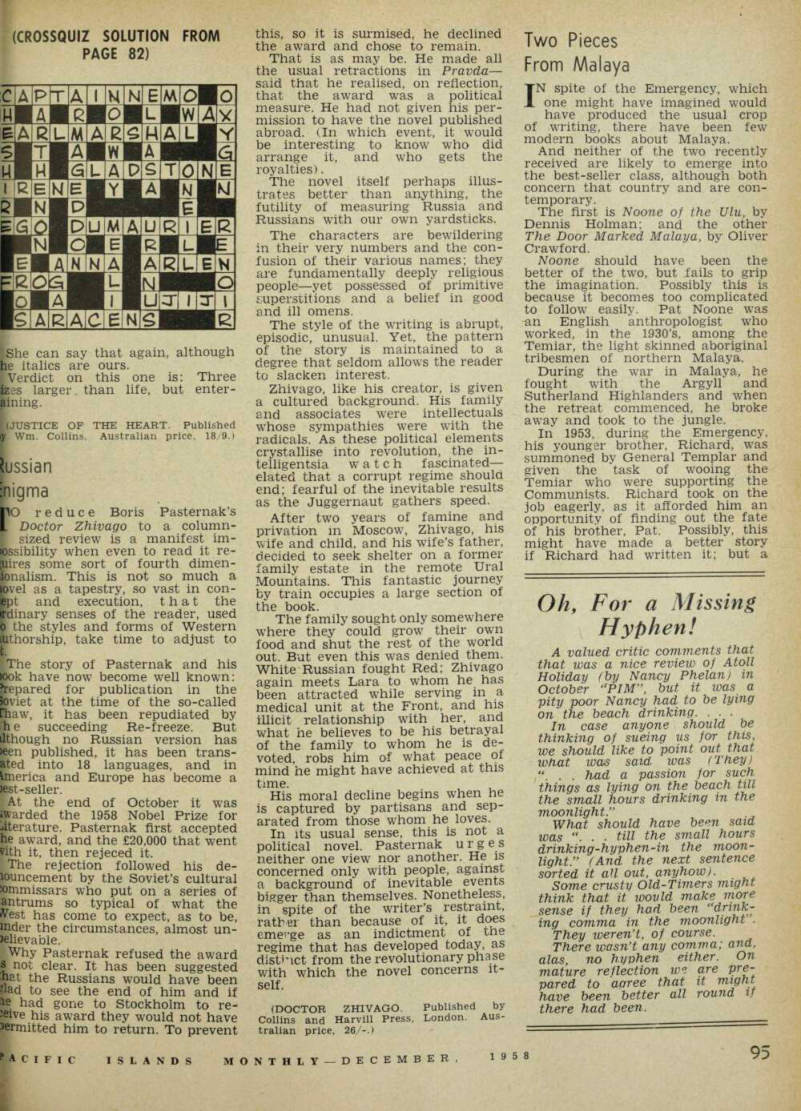 97
97 98
98 99
99 100
100 101
101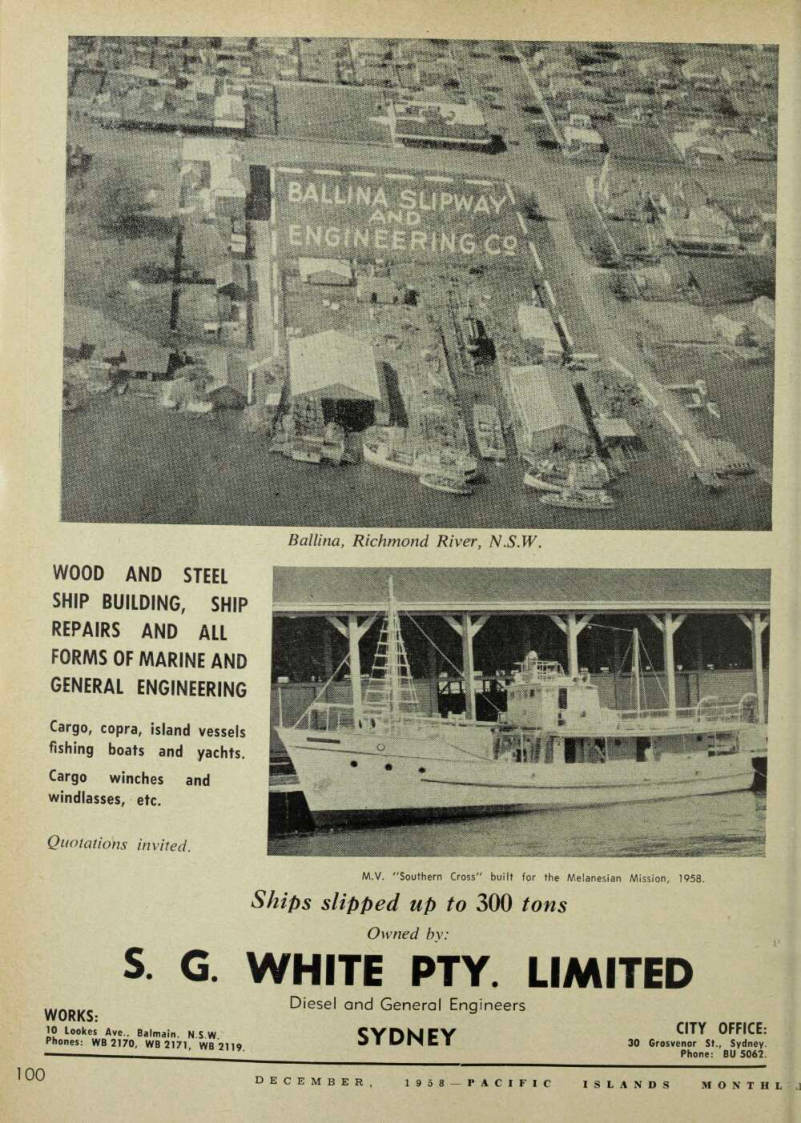 102
102 103
103 104
104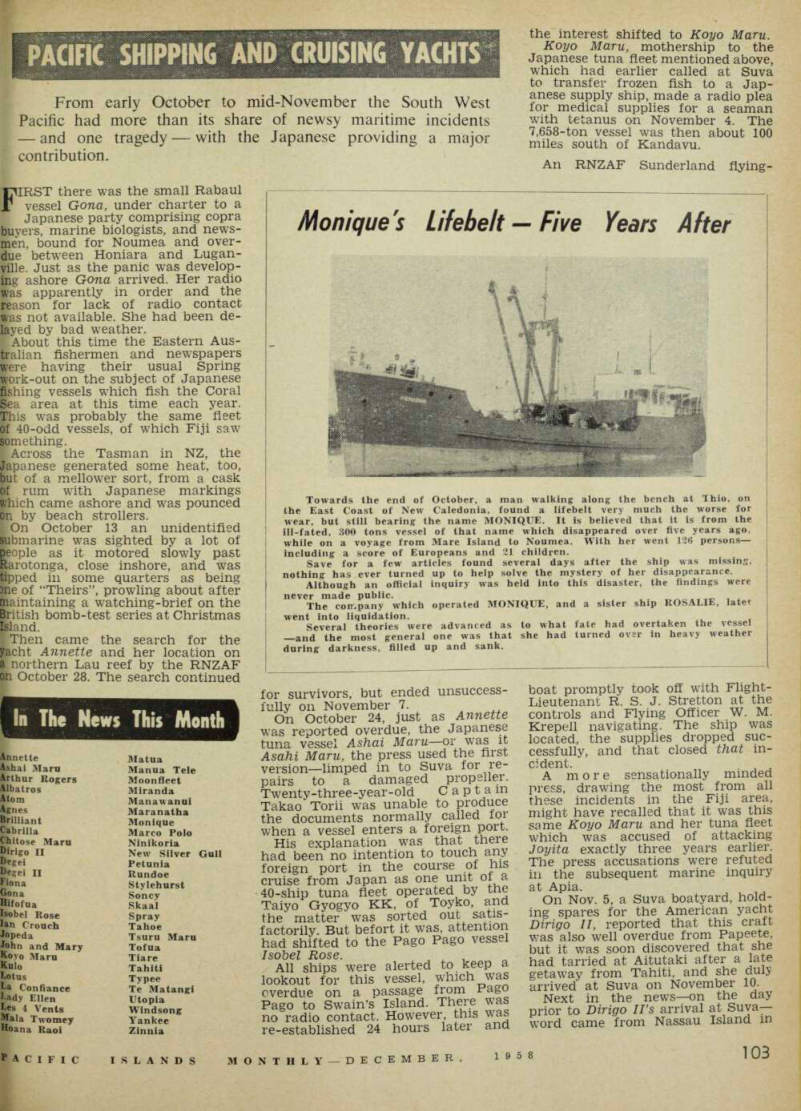 105
105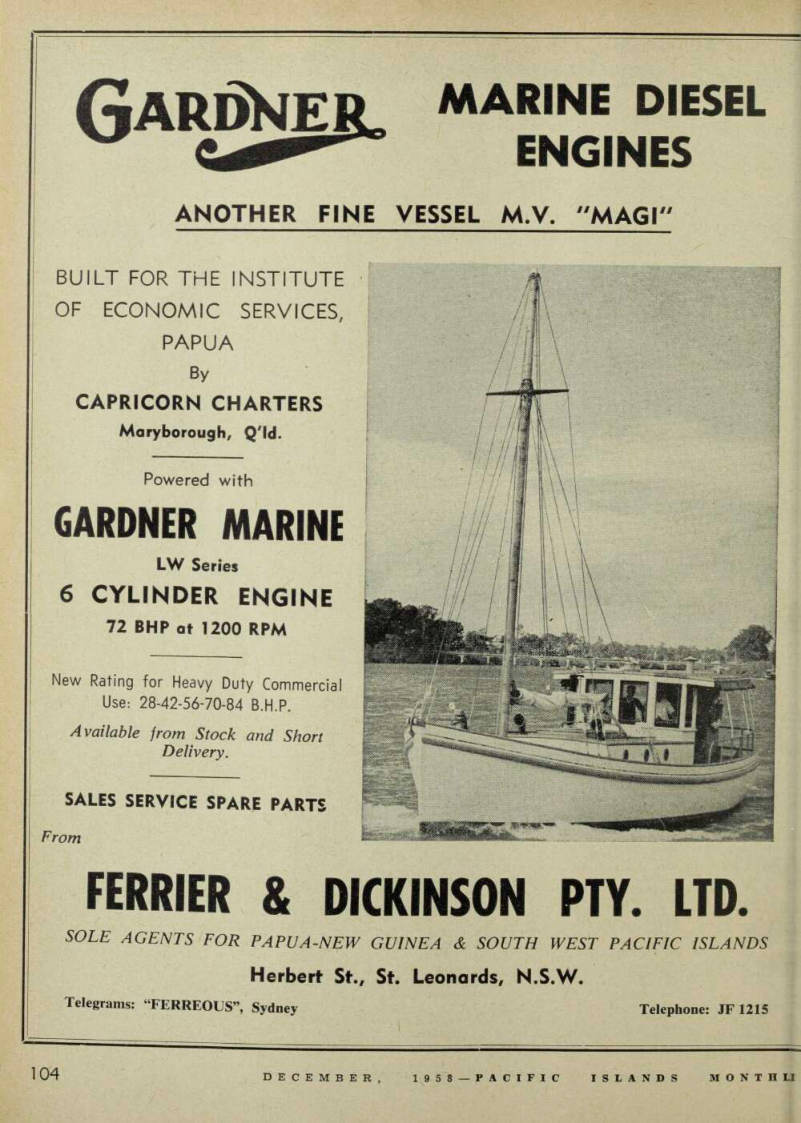 106
106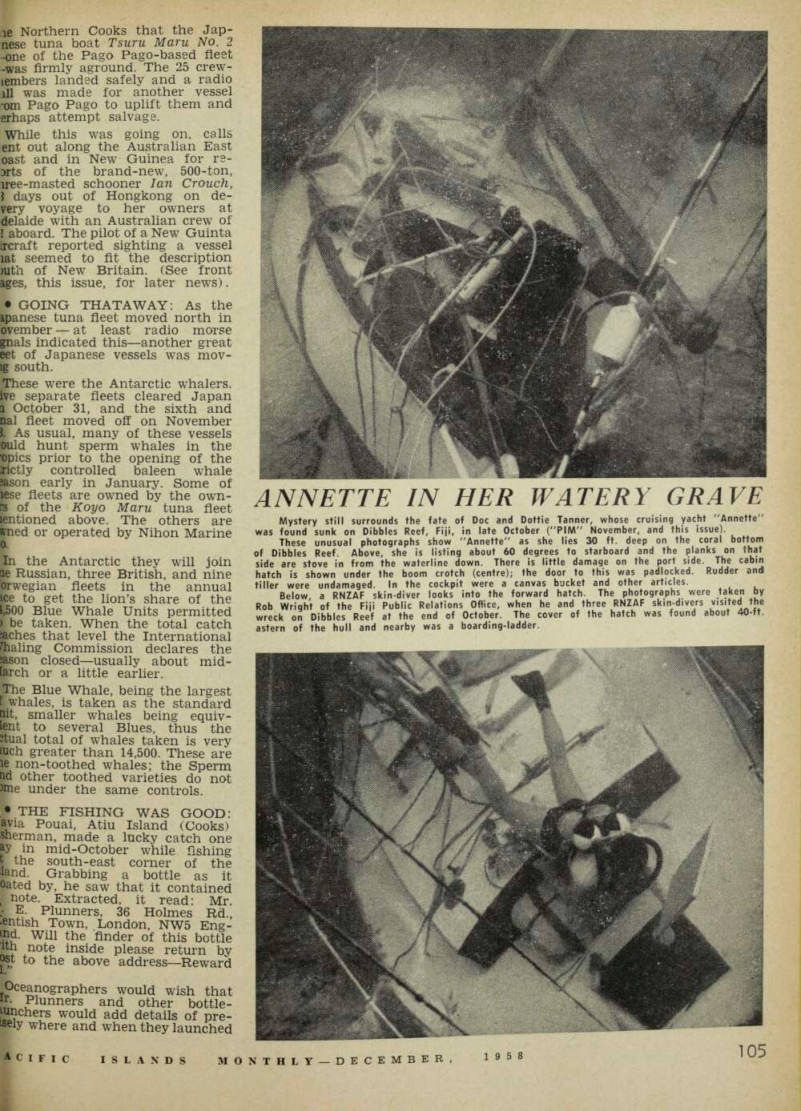 107
107 108
108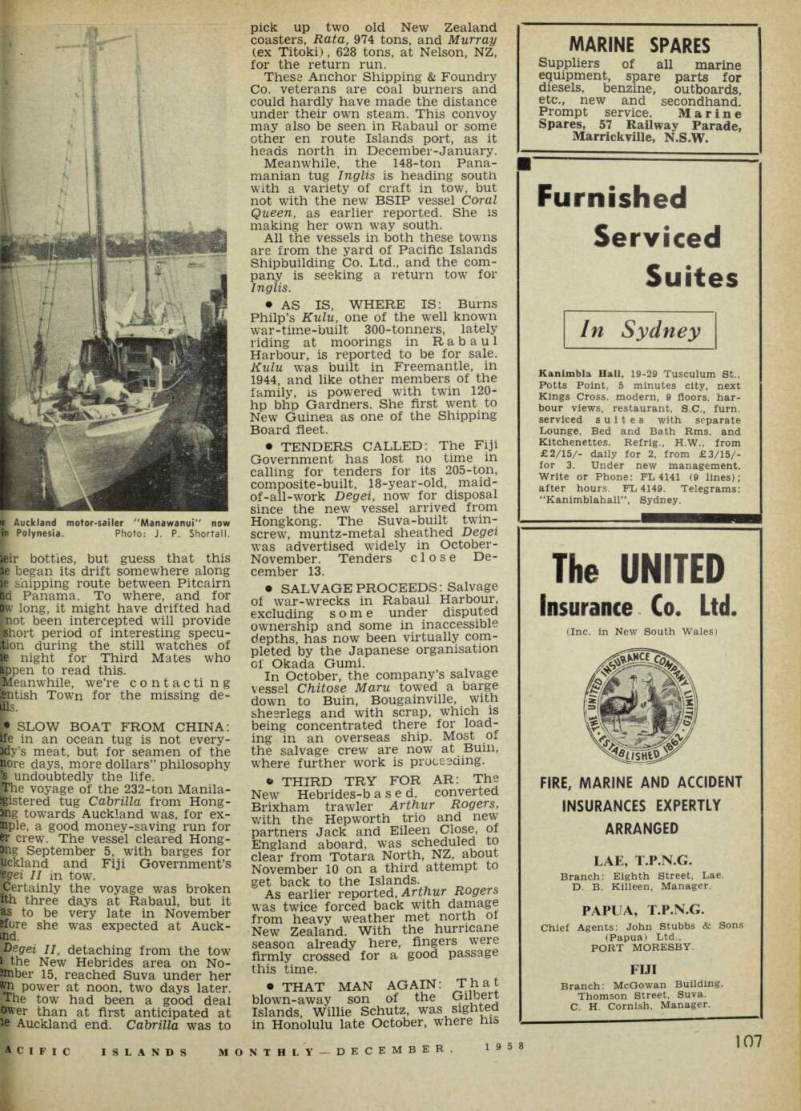 109
109 110
110 111
111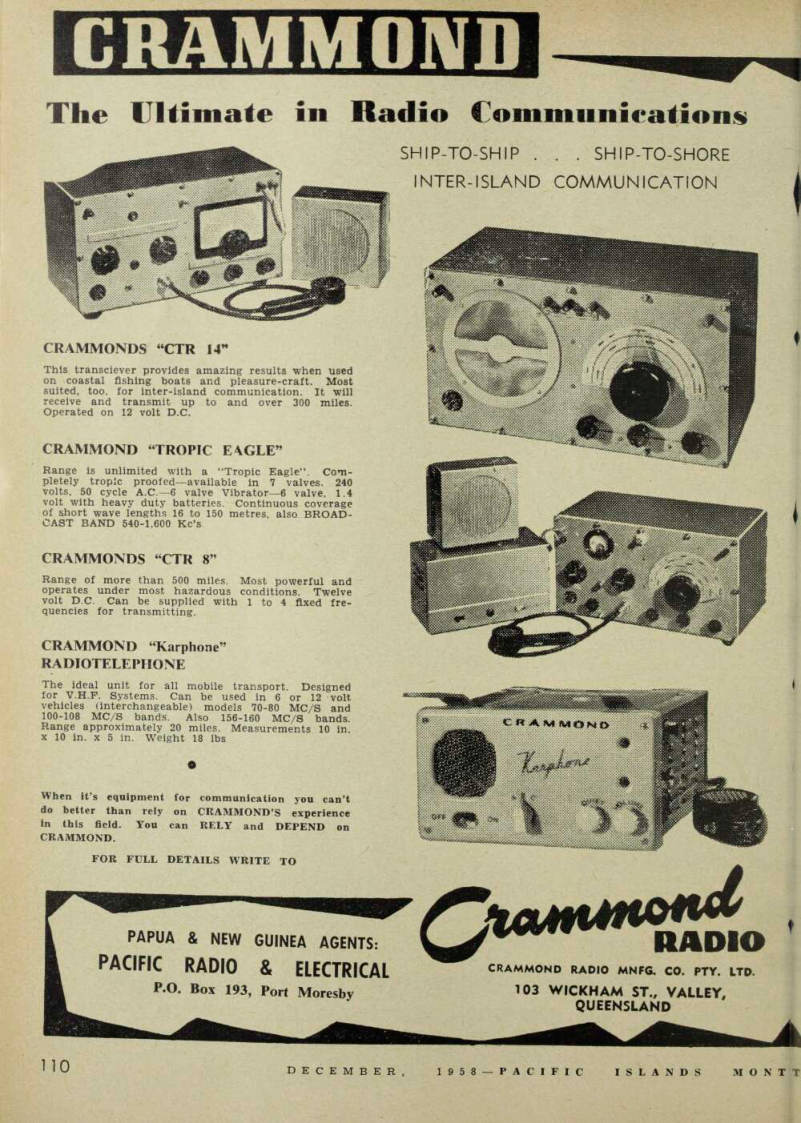 112
112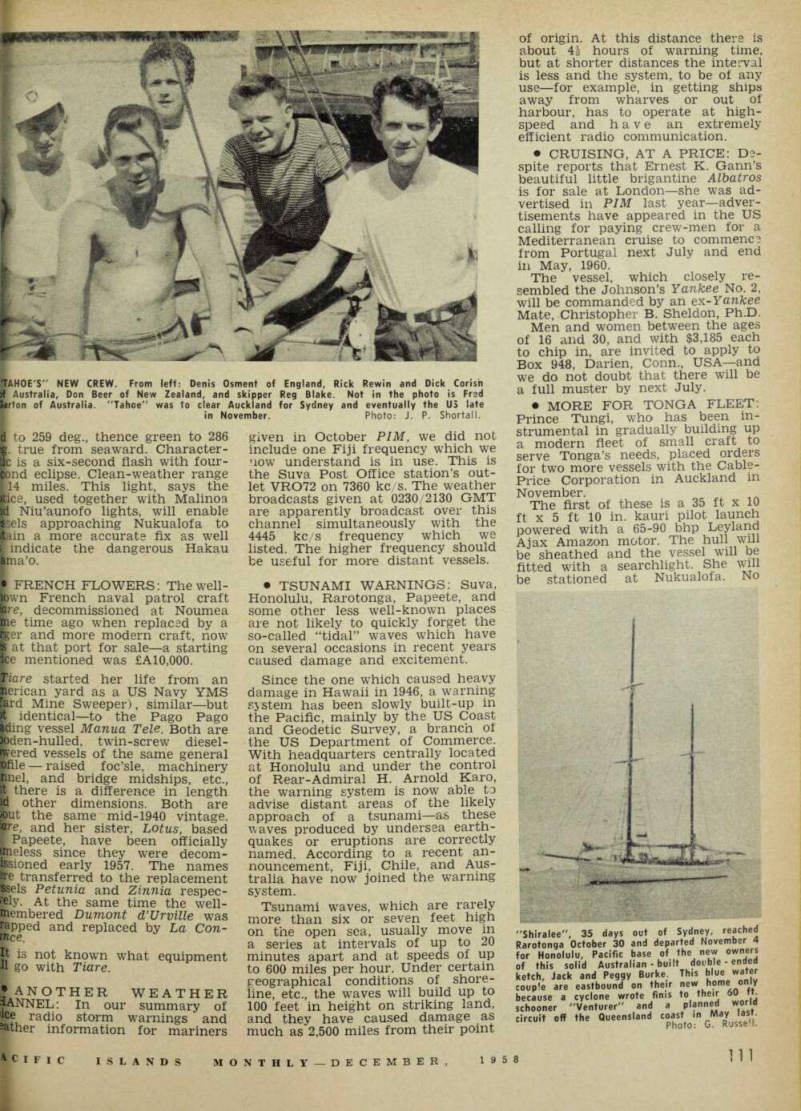 113
113 114
114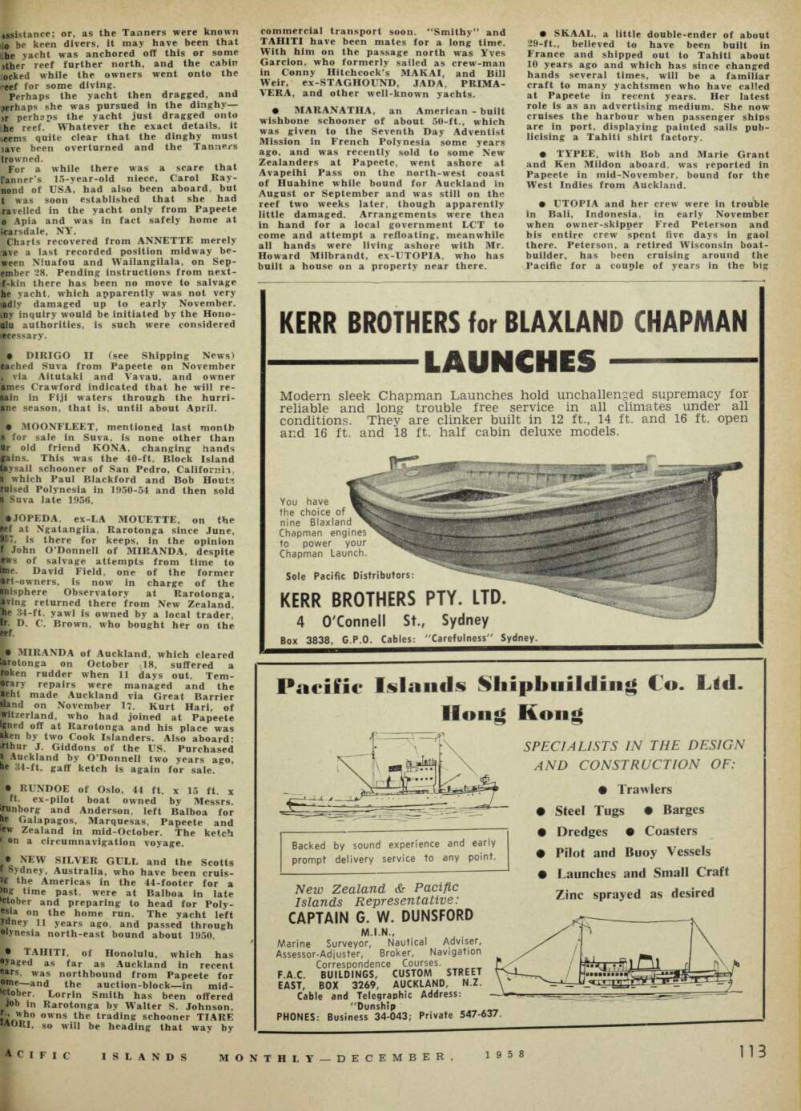 115
115 116
116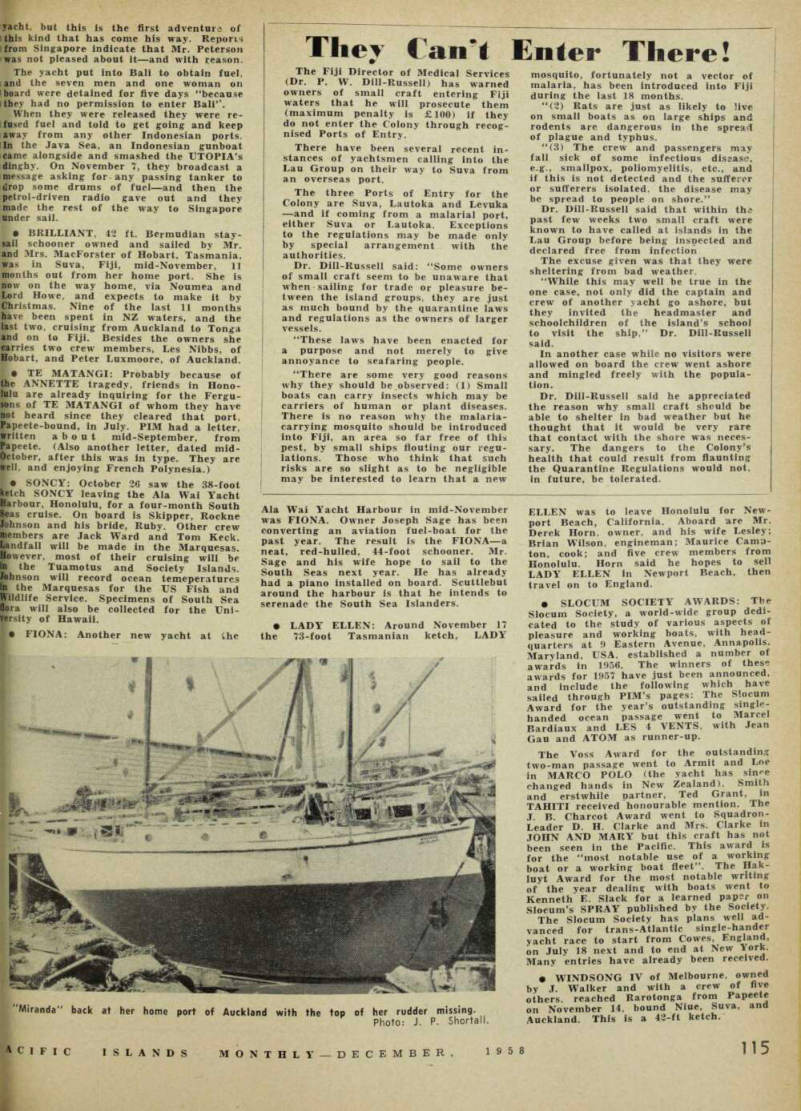 117
117 118
118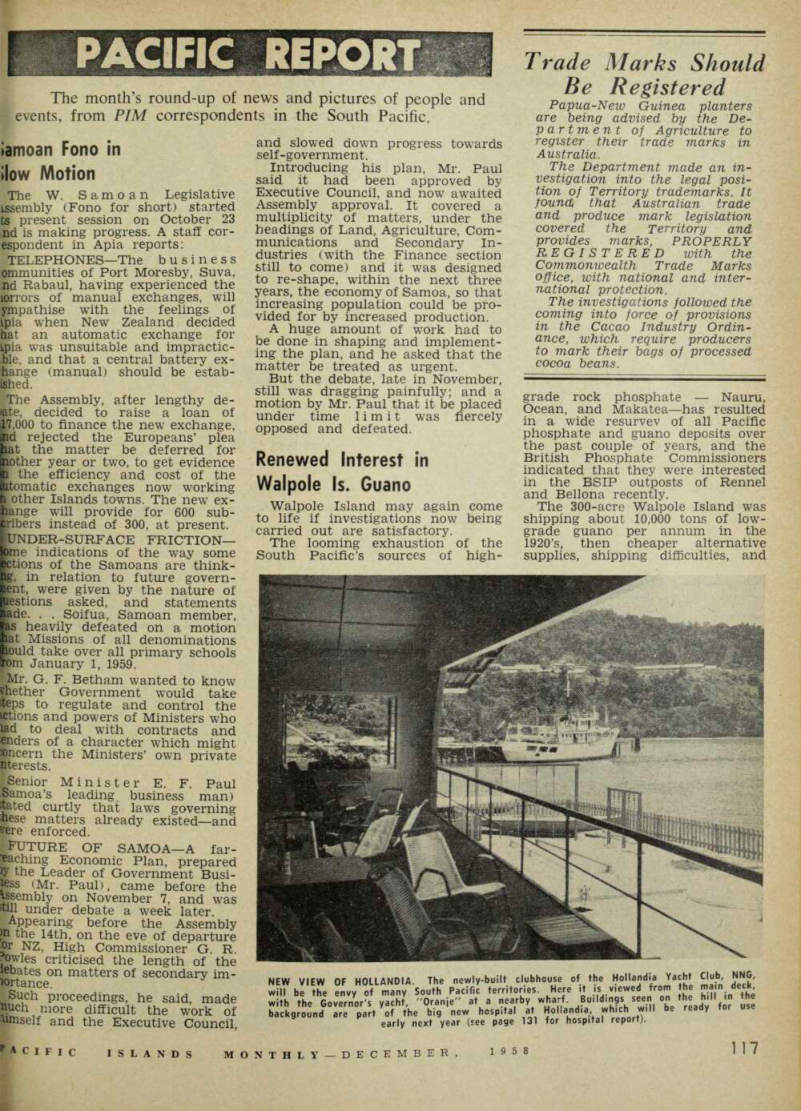 119
119 120
120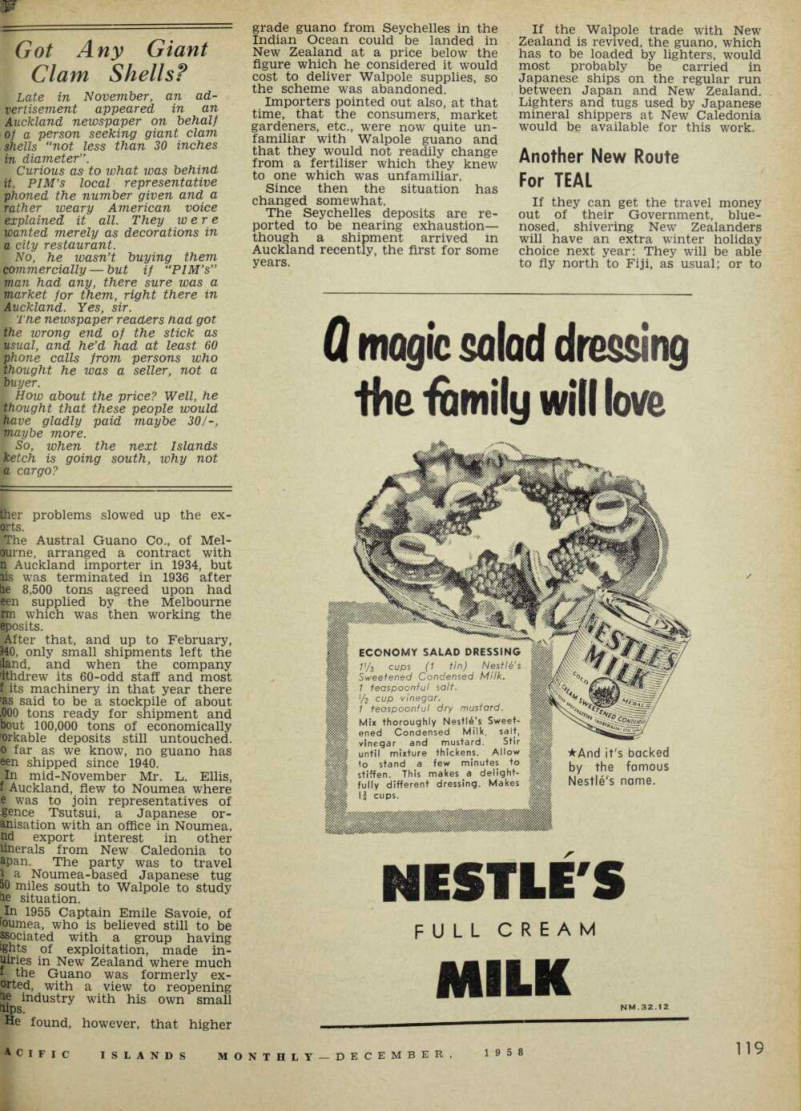 121
121 122
122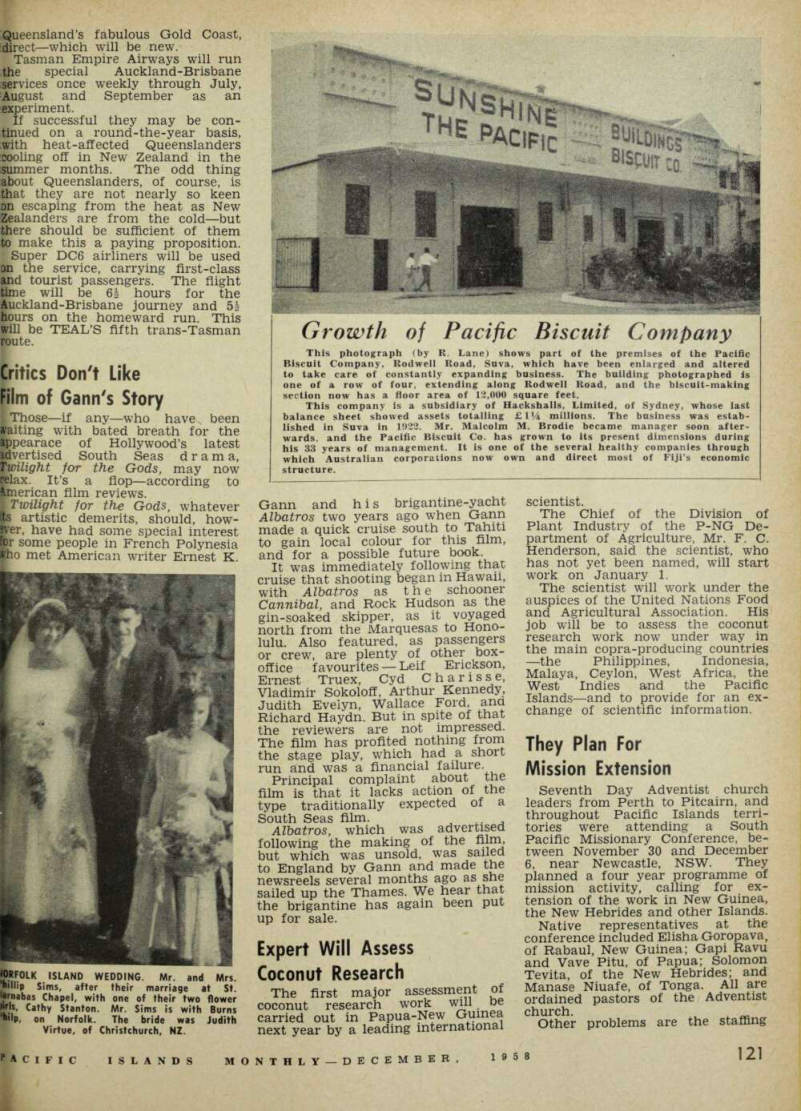 123
123 124
124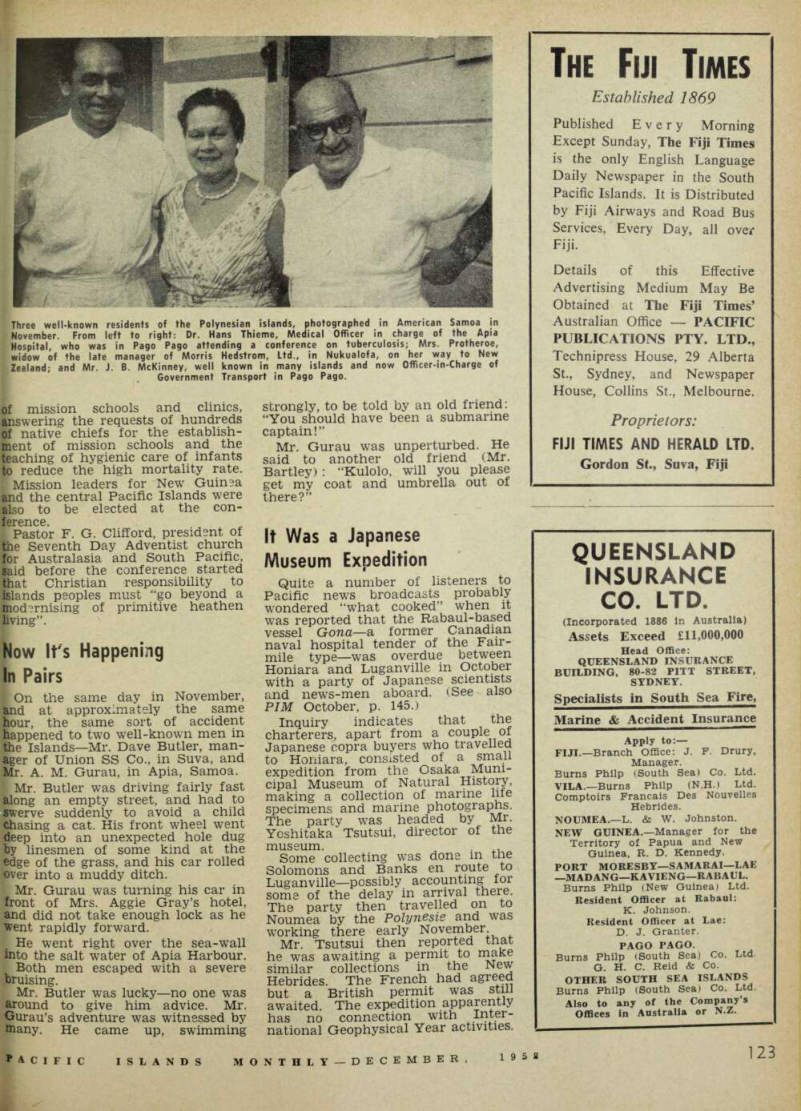 125
125 126
126 127
127 128
128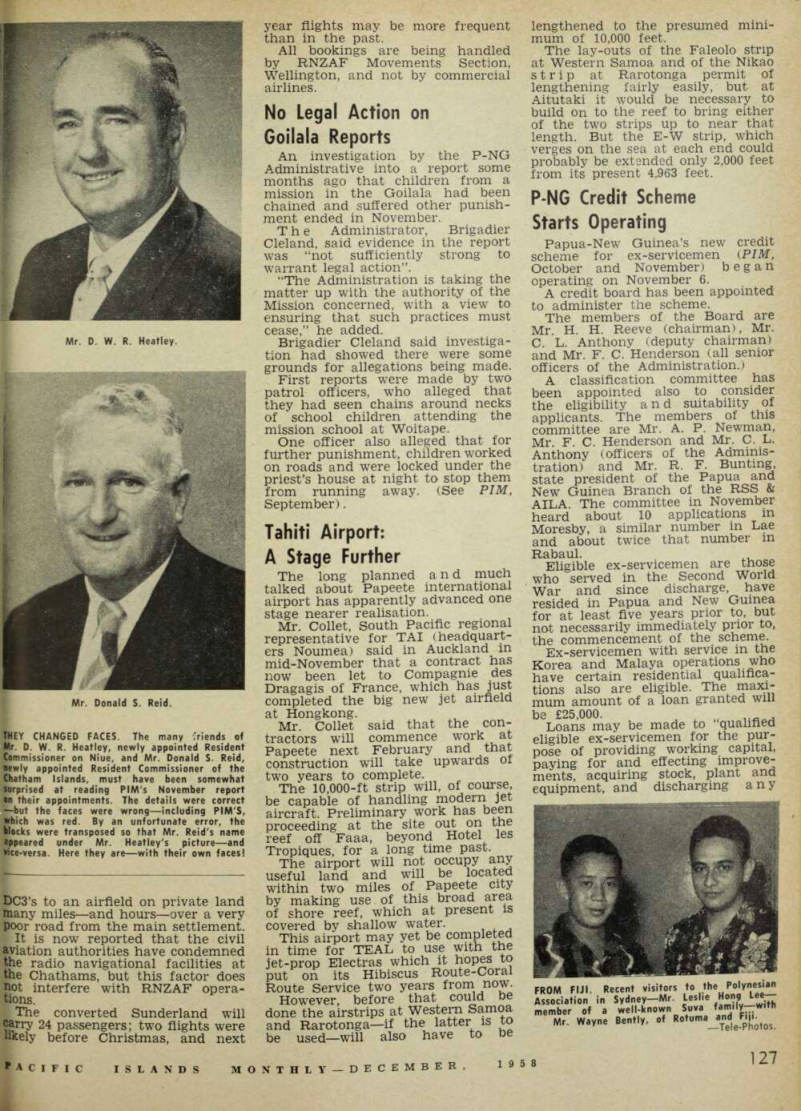 129
129 130
130 131
131 132
132 133
133 134
134 135
135 136
136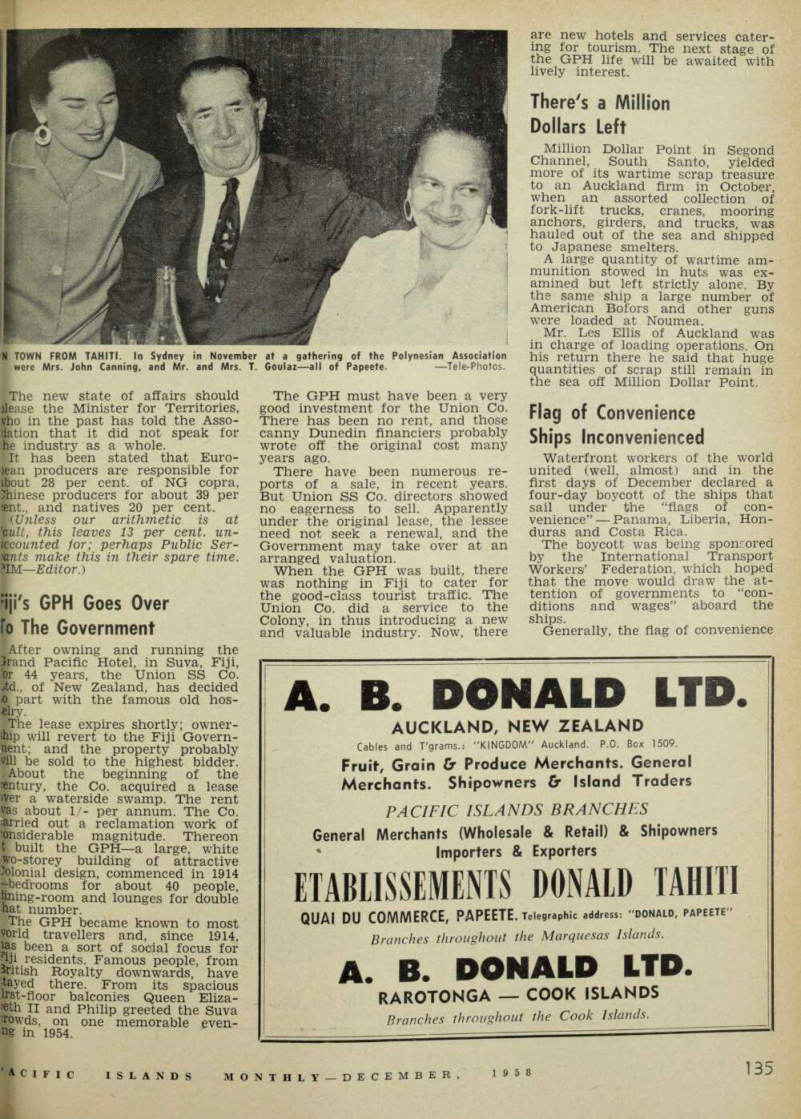 137
137 138
138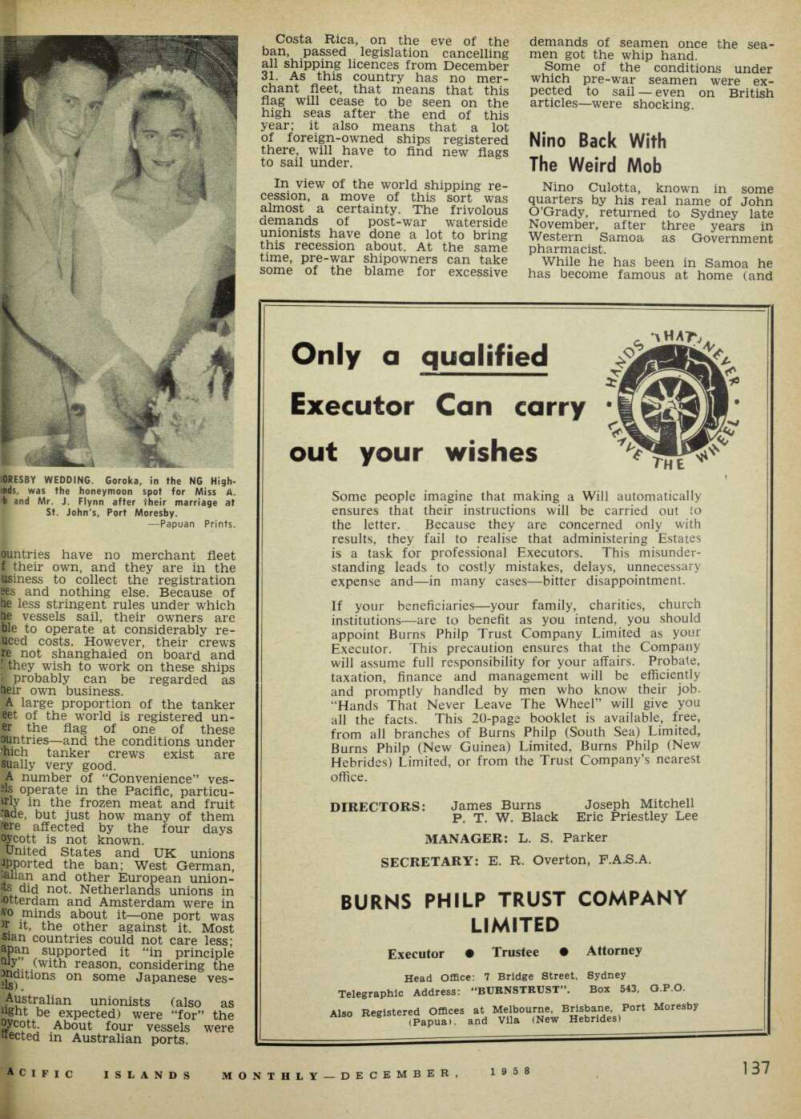 139
139 140
140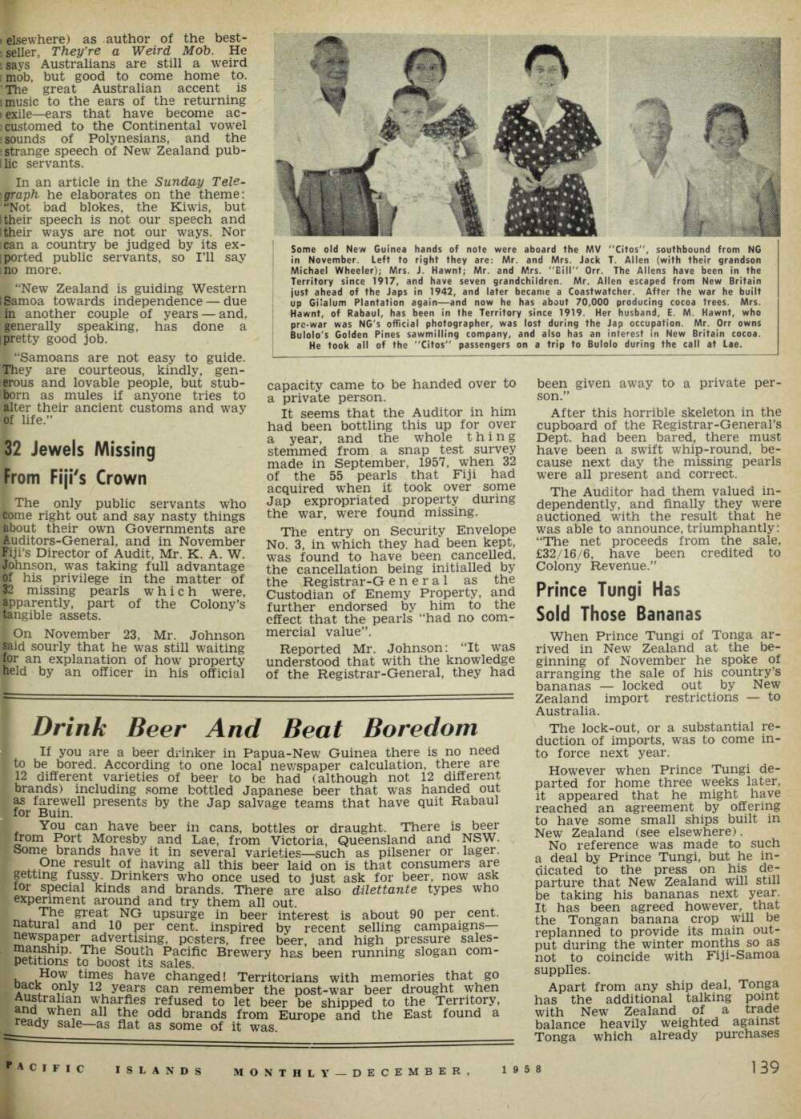 141
141 142
142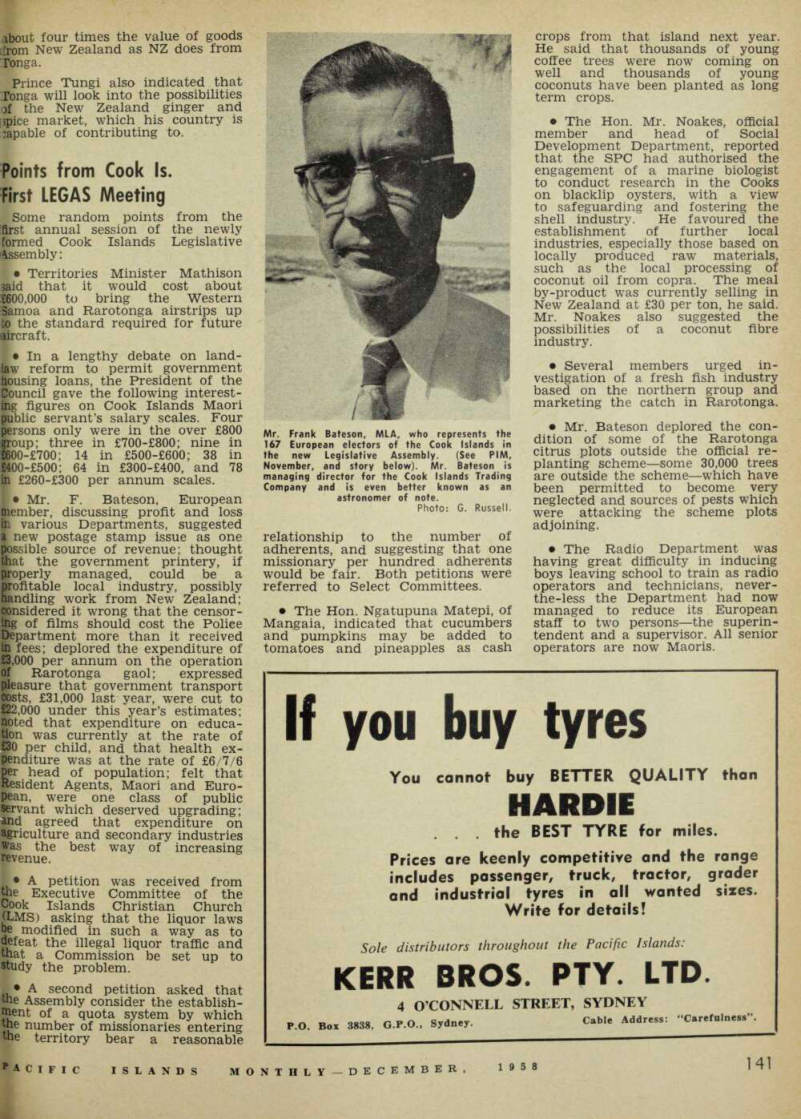 143
143 144
144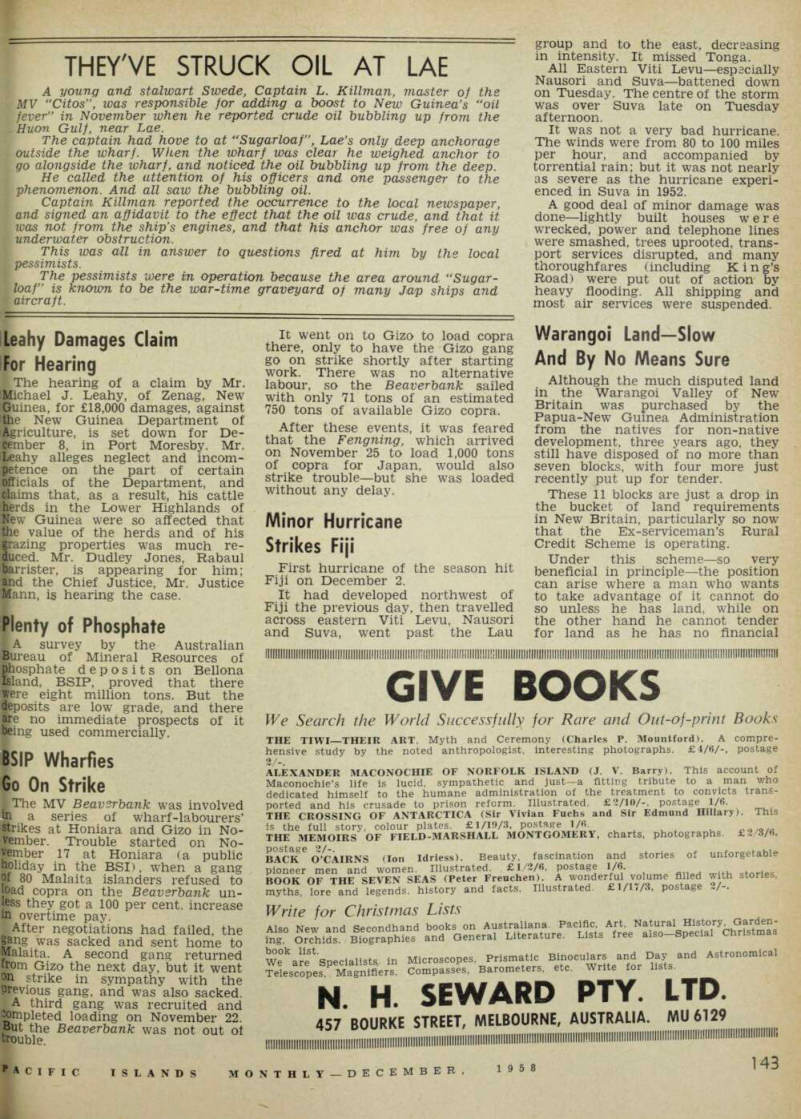 145
145 146
146 147
147 148
148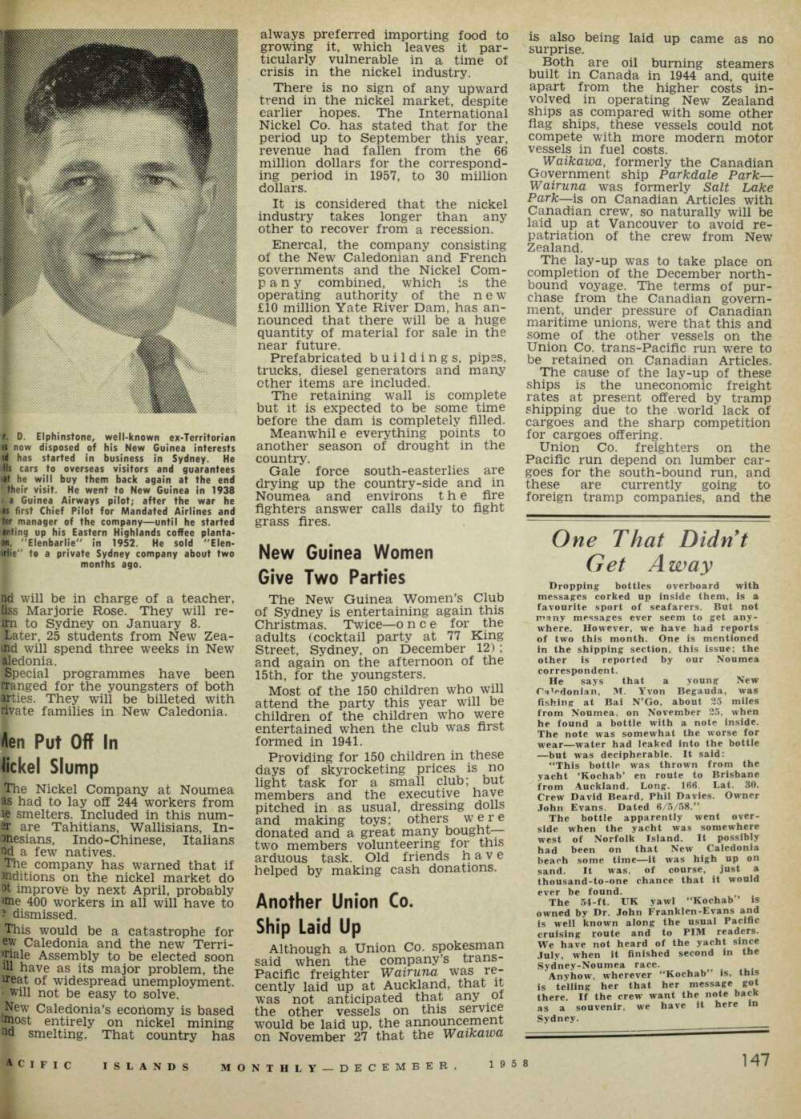 149
149 150
150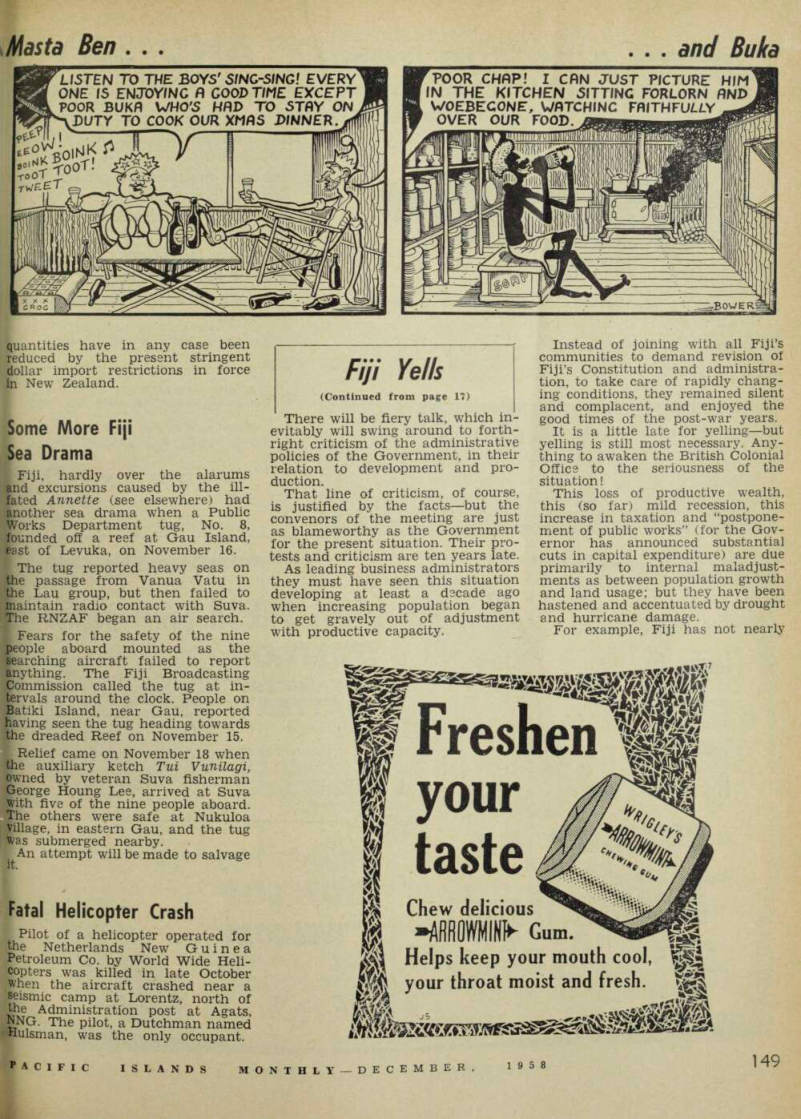 151
151 152
152 153
153 154
154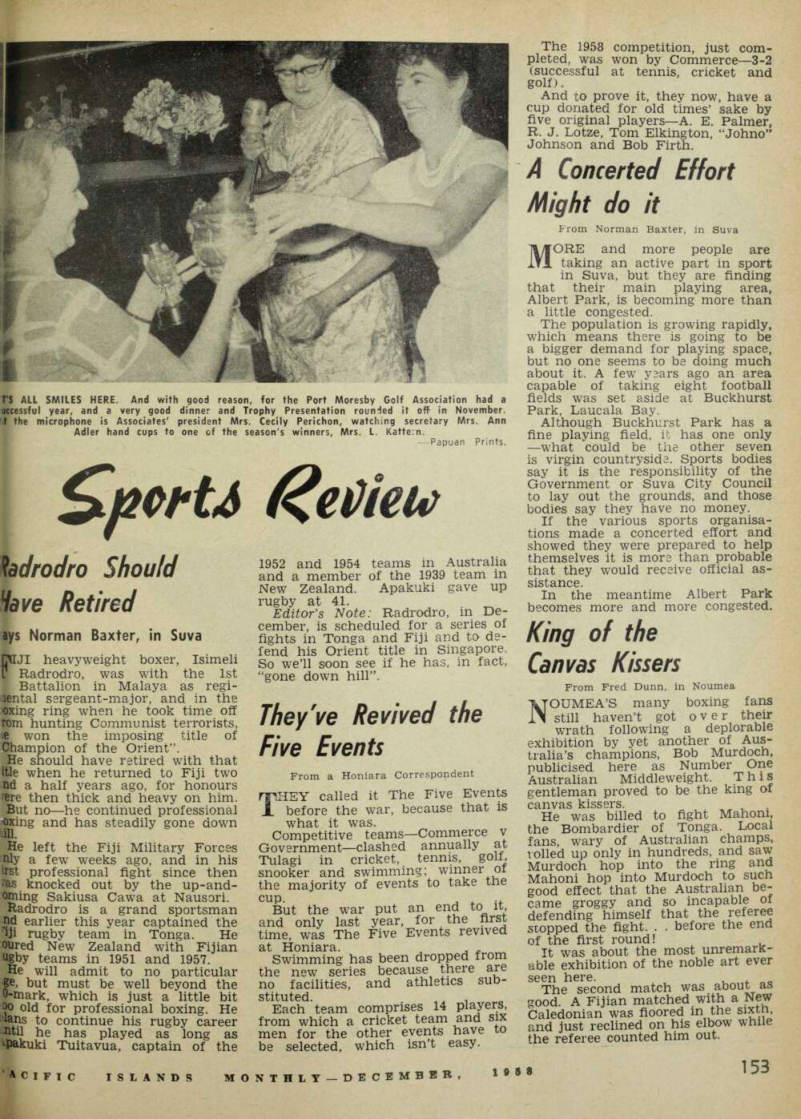 155
155 156
156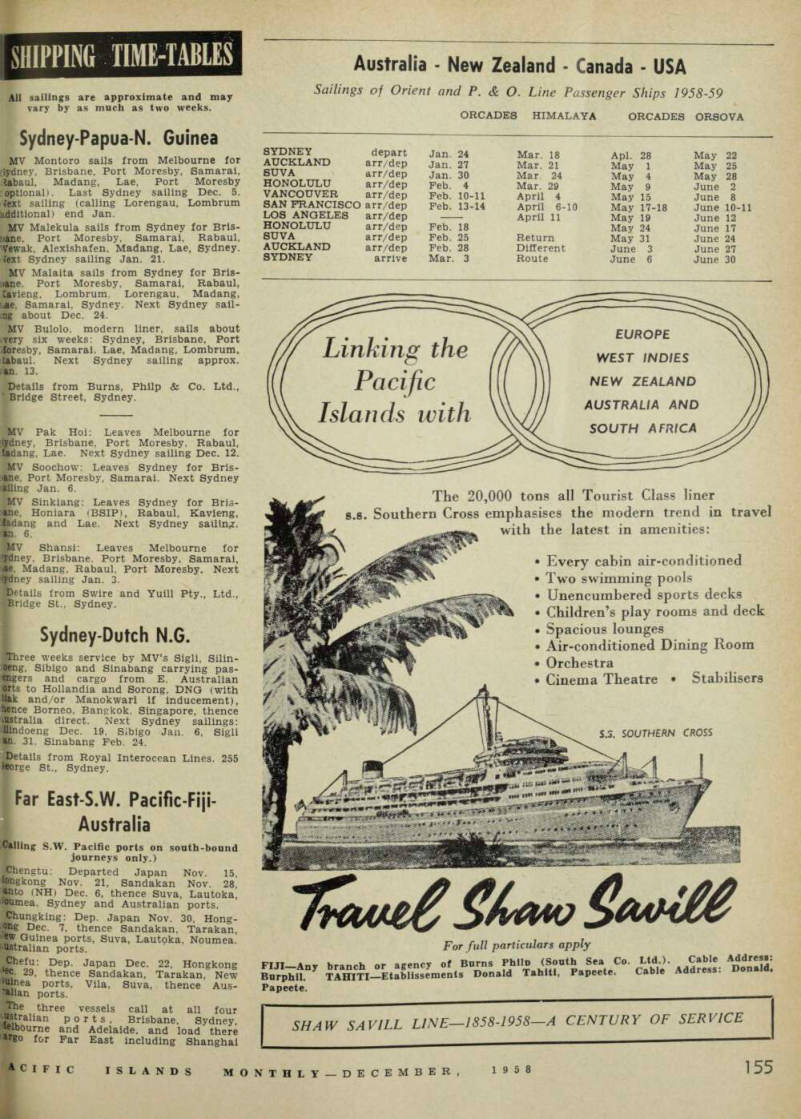 157
157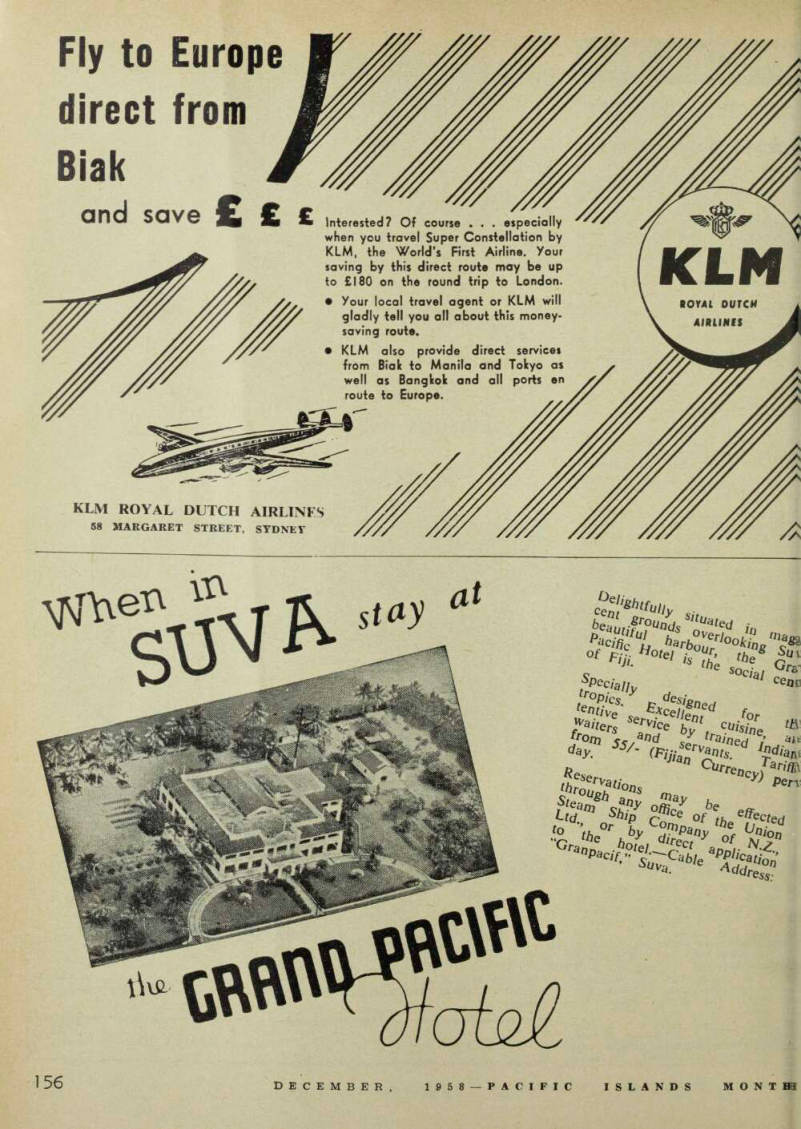 158
158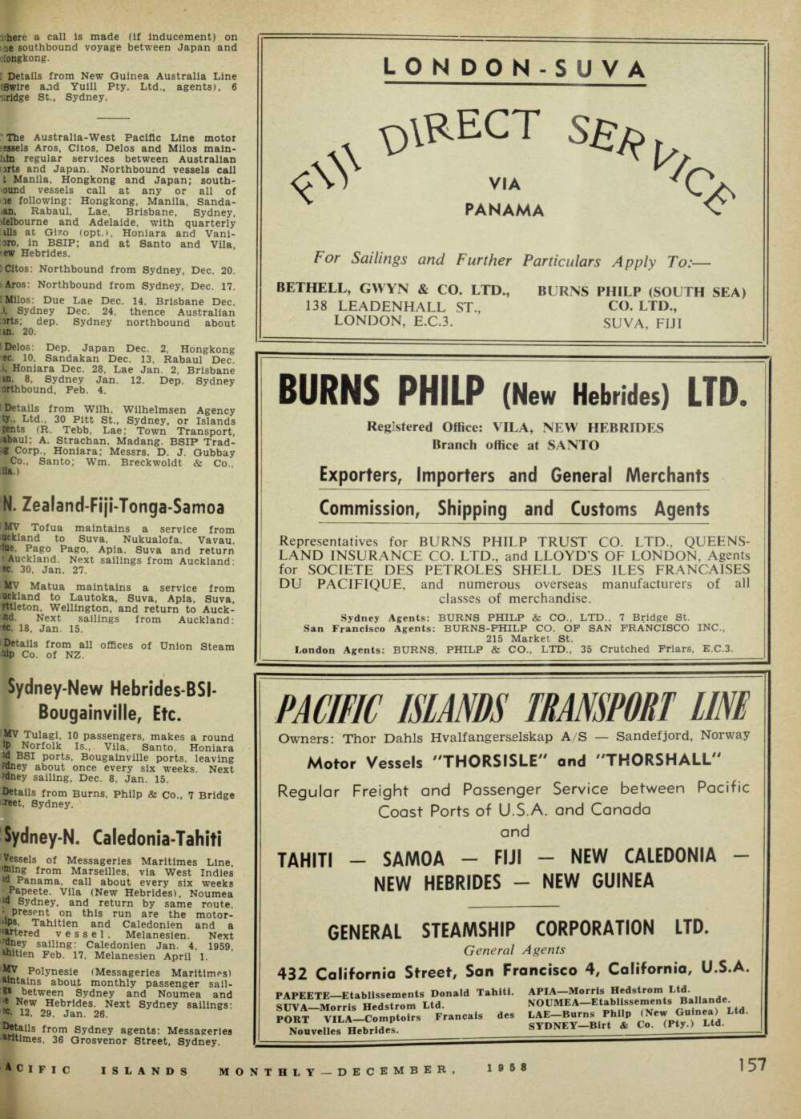 159
159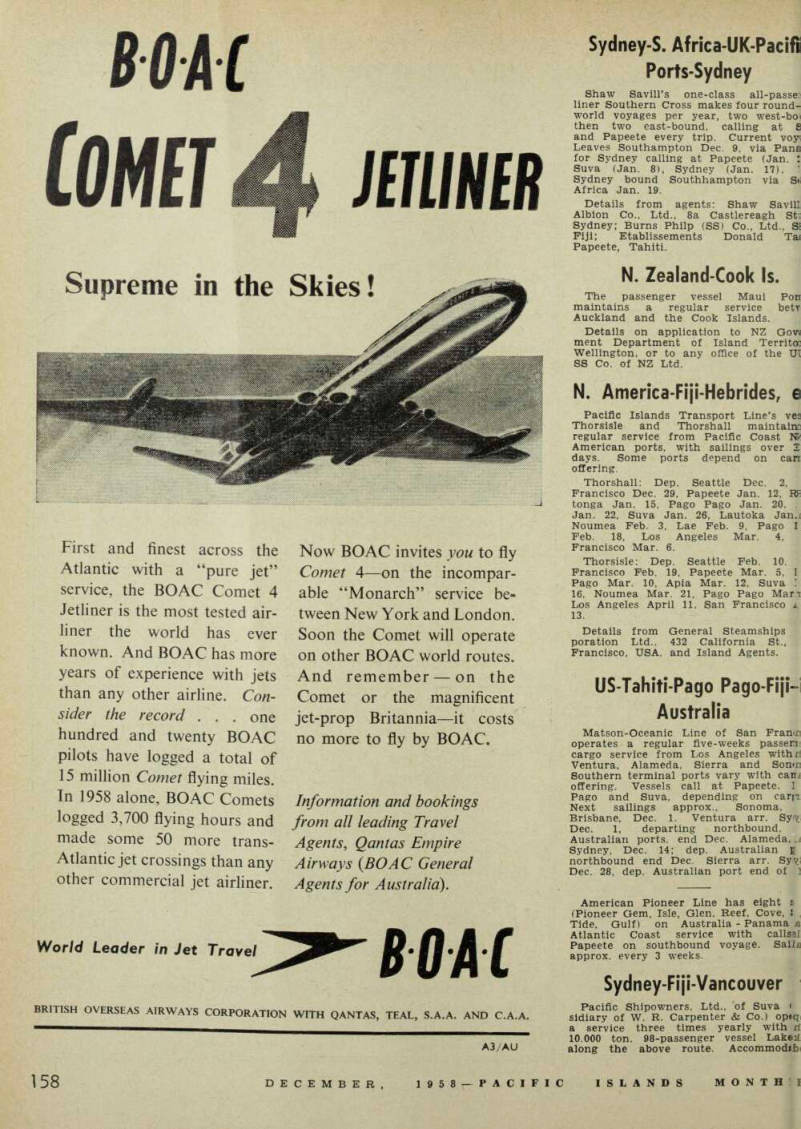 160
160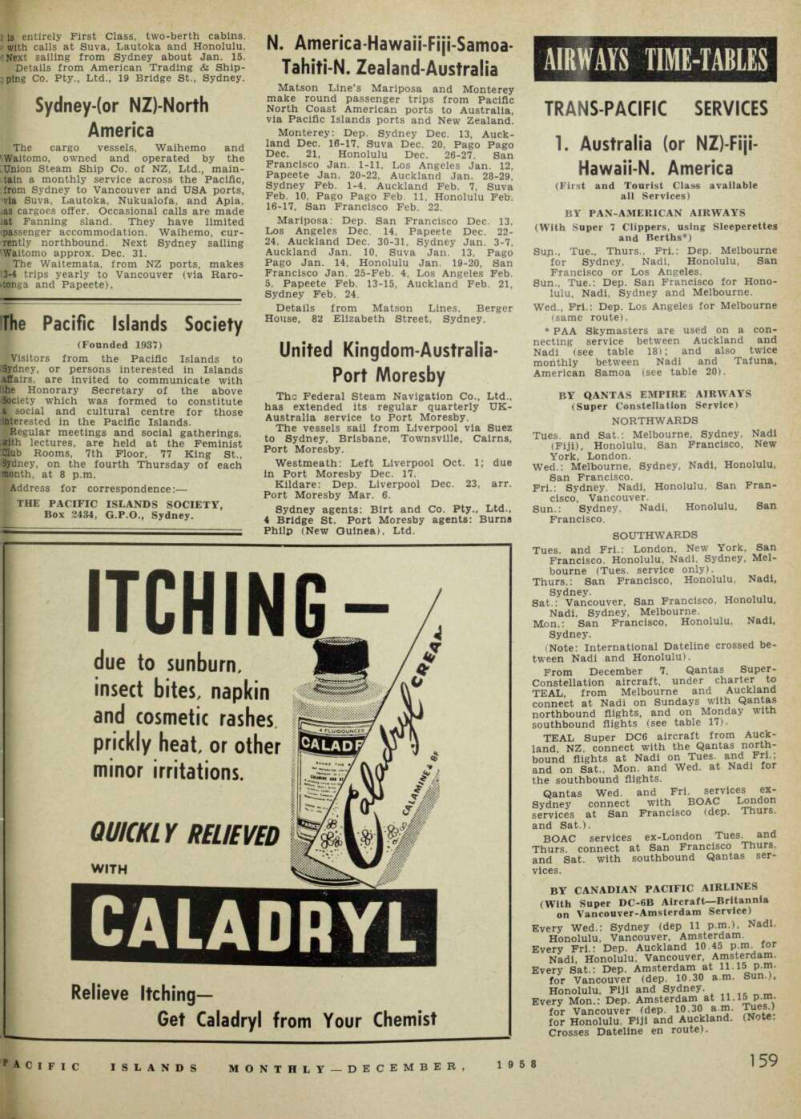 161
161 162
162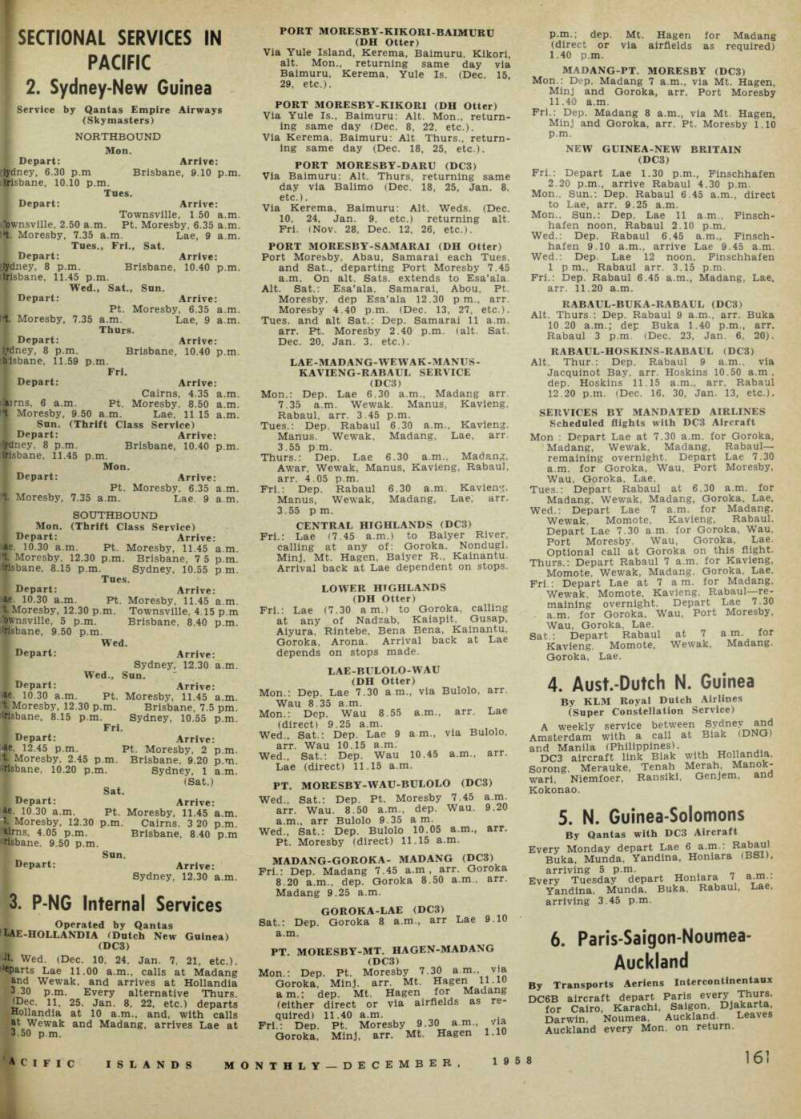 163
163 164
164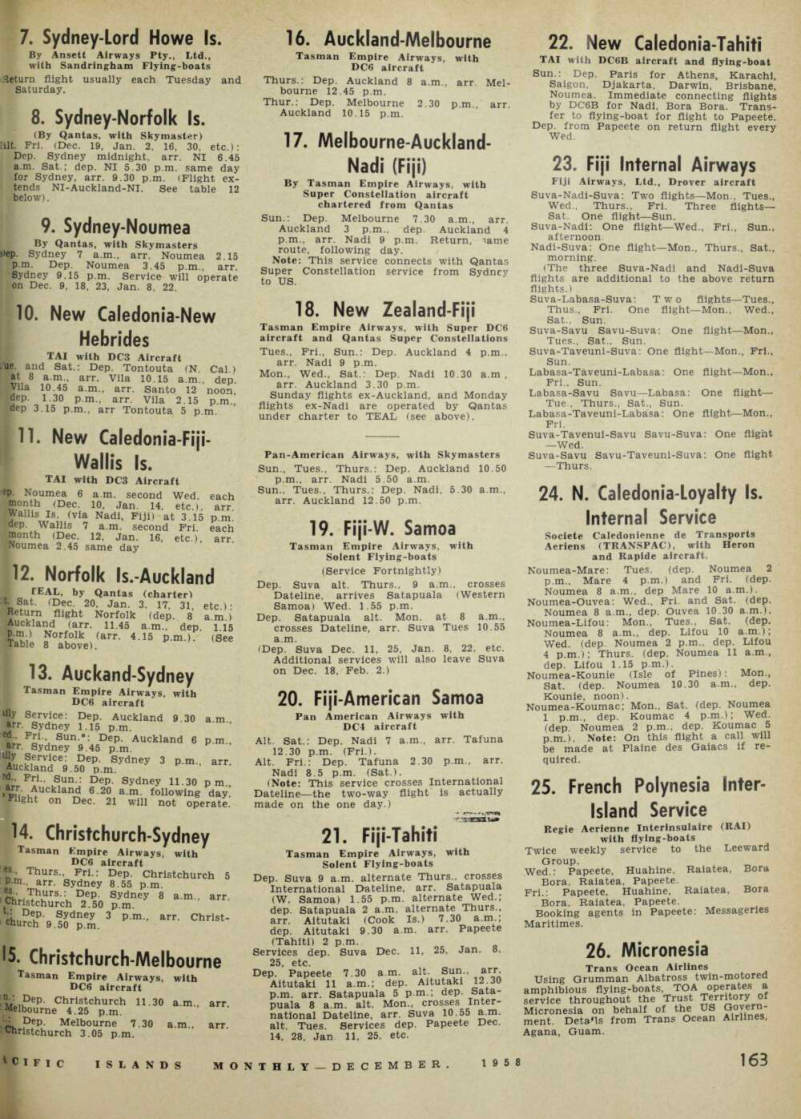 165
165 166
166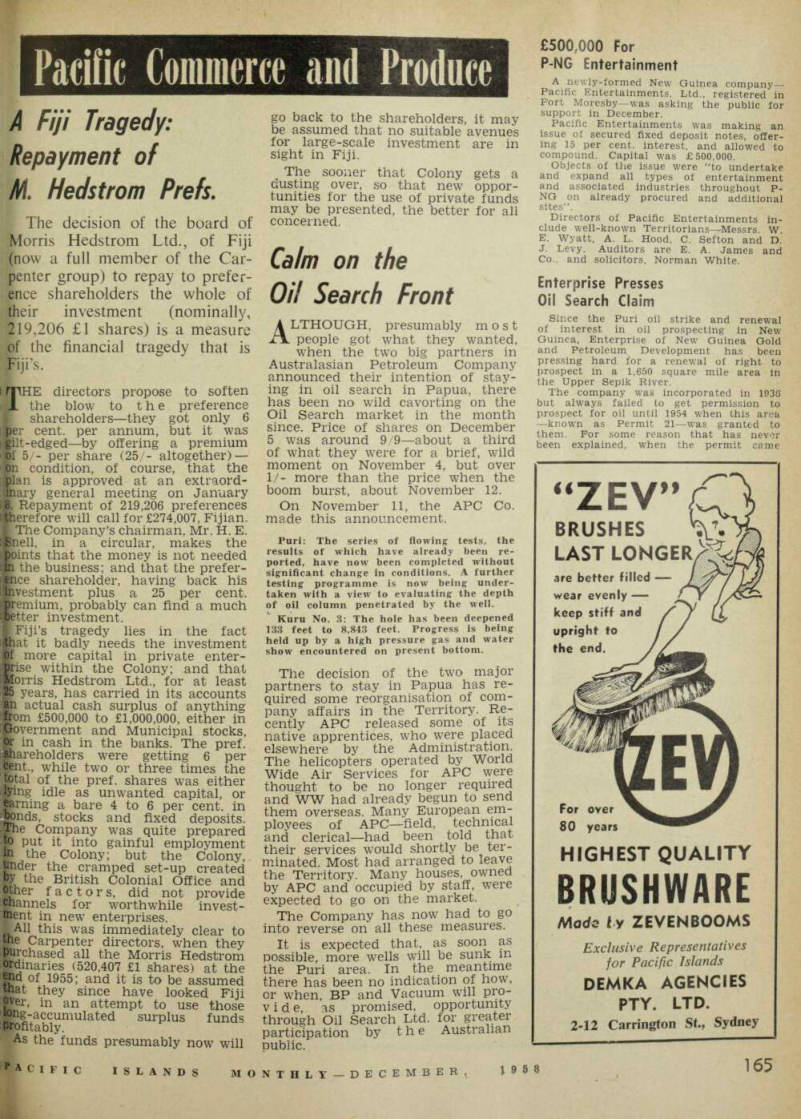 167
167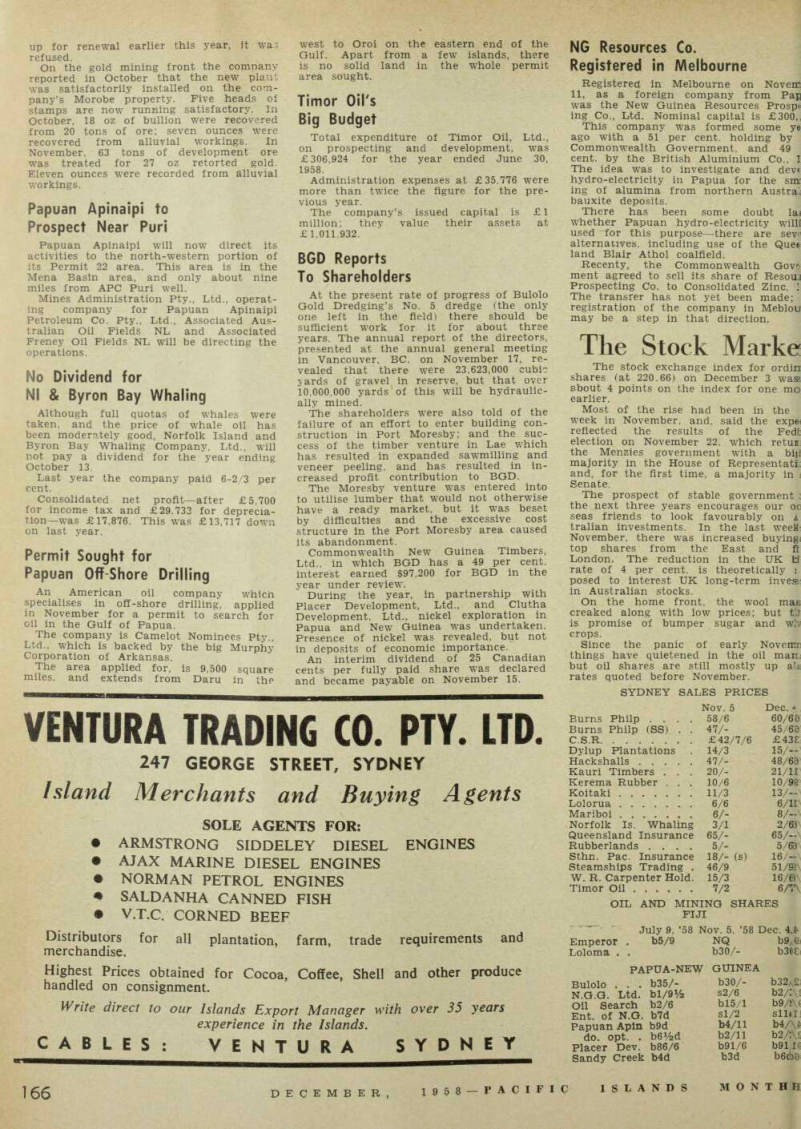 168
168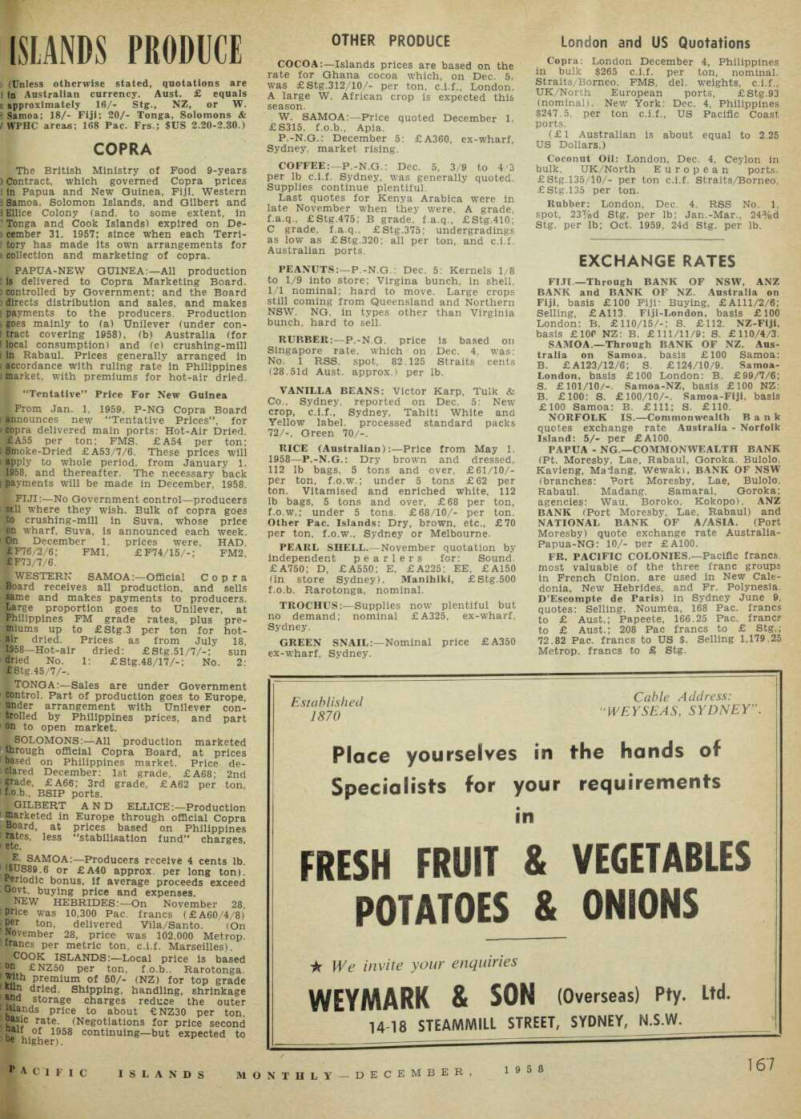 169
169 170
170 171
171 172
172