Samoa Is Rearing To Go—But
pp. 39-43 · Read in the full issue

A REPORT ON WEST SAMOA'S BIRTH PANGS
Samoa Is Rearing To Go—But There Could Be Danger Ahead
The infant nation of Western Samoa is being born into a self governing world. It is strong and well-shaped, and a lusty squawker.
But I think it has too many mid-wives.
Most are skilled enough, and very sincere; but some features of this birth have them puzzled. They do not realise, for example, that the birth is premature.
They are good people; but too many of them are guided by tradition rather than knowledge, and they talk too much.
This is likely to be a very self-willed child, and he will need wise and careful training, early—otherwise he is likely to be a great worry to his parents (Mr. UNO and Mrs. NZ ).
The strongest and most knowledgeable mid-wife, nominally the leader, remains somewhat in the background, silent and very observant. This person—Eugene F. Paul, well-equipped and capable —could do so much at this critical time; but is not getting full support and co-operation.
If parents and mid-wives are wise—which they are not —they will leave the immediate care of the infant as far as possible in the hands of Eugene F. Paul. Otherwise, the infant is likely to suffer dreadfully from stomach-cramps and growing-pains.
From R. W. Robson, in Apia These views fairly sum up my impressions, after several days of listening to official openings of schools and colleges, beach arguments about the governing and feeding of 100,000 virile people, yards of conflicting statistics on production and export, and the incredible, interminable oratory of the Fono.
Consider the following:
UNDER the driving-force of New Zealand-produced Director of Education, K. R. Lambie, Samoa has bounded from the part-literacy of the depressing Mau and World War II periods, to almost complete literacy in Samoan and simple English.
A school now is available for every village child; a technical training school or excellent secondary schools (including the new agri cultural college at Avele, near Vailima) are functioning, to help on the best products of the village schools. Lambie’s achievement is epochal.
A combination of health services, mass education and calculated local government nursing by Trustee ship administrators has produced a people that is “rearing to go” in nationalist self-government.
But the process has gone too far and too fast. The self-government promised for 1960 is interpreted by most of the Samoans as complete independence—for which, socially and economically, they are not ready.
The Samoan natural increase is Phenomenal—l am told it is well over 40 per thousand per annum.
At the same time, the standard of living has risen, and is rising.
The well-meaning NZ planners have not taken these factors
sufficiently into account in calculat ing national production and national minimum requirements.
There is, immediately ahead, a period of severe re-adjustment, which could produce some political howling and grave social unrest.
The call is for strong, wise and patient leadership—and, in this respect, one is not impressed with what one sees in the top ranks of the full-blooded Samoan leaders.
"Good Material"
There is good, promising material, however, in the secondary Samoan ranks —men like Papalii Poumou, District Officer in charge of Savaii, for example, should be in the Government, instead of in routine administration, taking orders from Government.
Samoan planners and policy makers are Samoa’s most urgent need; and a decade or two of patient training are needed to pro duce them.
Meanwhile, whatever self governing talent is available to Samoa lies in the part-European community, of 6,500 people, where there are two or three outstanding men.
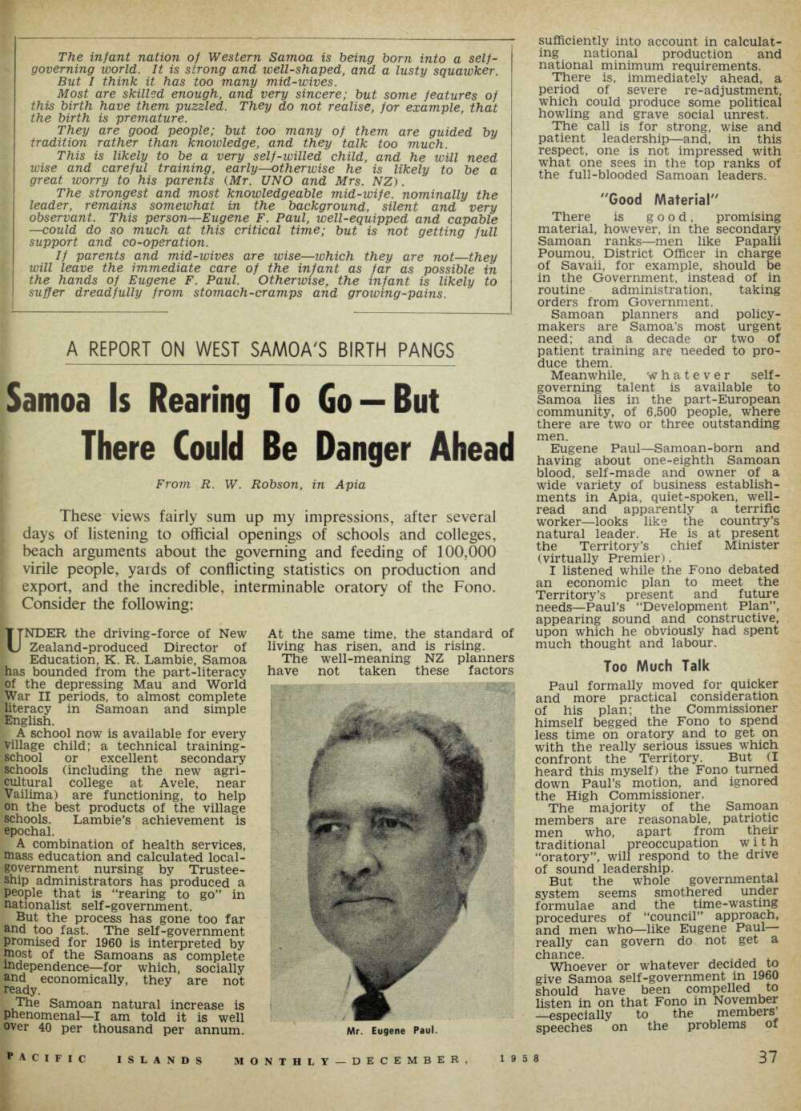
Eugene Paul —Samoan-born and having about one-eighth Samoan blood, self-made and owner of a wide variety of business establish ments in Apia, quiet-spoken, well read and apparently a terrific worker —looks like the country’s natural leader. He is at present the Territory’s chief Minister (virtually Premier).
I listened while the Fono debated an economic plan to meet the Territory’s present and future needs—Paul’s “Development Plan”, appearing sound and constructive, upon which he obviously had spent much thought and labour.
Too Much Talk
Paul formally moved for quicker and more practical consideration of his plan; the Commissioner himself begged the Fono to spend less time on oratory and to get on with the really serious issues which confront the Territory. But (I heard this myself) the Fono turned down Paul’s motion, and ignored the High Commissioner.
The majority of the Samoan members are reasonable, patriotic men who, apart from their traditional preoccupation with “oratory”, will respond to the drive of sound leadership.
But the whole governmental system seems smothered under formulae and the time-wasting procedures of “council” approach, and men who—like Eugene Paul— really can govern do not get a chance Whoever or whatever decided to give Samoa self-government in 1960 should have been cupelled to listen in on that Fono in November —especially to the members speeches on the problems of
Mr. Eugene Paul.
feeding, housing, reading, educating and giving adequate medical care to a nation of 100,000 which does not realise that, if anything better than a bare subsistence economy is to be achieved, there must be far more hard work.
The worst thing in Samoa today is disunity among the part- Europeans.
With self-government, the country must look, for some years, to the few Europeans and the 6,500 part- Europeans for governmental talent; but the latter seem to be torn by squabbling and petty jealousies.
One faction follows Paul; another, the Nelson family.
It is sheer tragedy, at a time like this—it tends to throw the country into the hands of the trouble-makers.
Trouble Makers
The trouble-makers in Samoa are represented by a small group, in a corner of the Fono, who seem never to lose an opportunity of snarling and sneering at the Papalagi —the Papalagi, in this case, including both the dwindling few scores of full-blooded Europeans, and the steadily increasing thou sands of part-Europeans.
It is the sort of unimpressive, somewhat entertaining little group which one finds politically clowning m all Parliaments; but, in this particular Fono, it is more than a nuisance, because it gives leader ship and encouragement to a large and growing section of young Samoans who are drifting into a kmd of political hooliganism, directed against the Papalagi.
Anti-European Feeling
Under wise, strong government this Bodgie-rlike cult would be negligible. Under the kind of government that present conditions are likely to produce, this Fono group, plus the political hooliganism it encourages, could become a national danger.
Already, there have been un pleasant incidents.
A Samoan politician got into an excited state in the Apia Club; and in the course of a violent argument, made statements which were considered very offensive to Europeans and part-Europeans.
They indicated his belief that, when the country becomes self-governing, the Papalagi will be summarily deported, irrespective of rights of citizenship and property.
Similar sentiments are said to have been attributed to a very high Samoan chief.
There have been several cases of assaults on Europeans by Samoan hoodlums.
When NZ Islands Minister J.
Mathison came through Samoa on October 31, he was interviewed on this subject by a delegation representing Planters’ Association, Chamber of Commerce and Re
turned Servicemen. All insisted that they have fundamental rights in Samoa.
The Minister said he would discuss the matter with the NZ Cabinet.
A little later, High Commissioner Powles went on the air and urgently appealed for unity between Samoans and Europeans (which includes part-Europeans) during the difficult period immediately ahead.
He said that when Samoa becomes self-governing, only persons of Samoan citizenship will be entitled to vote; and the Fono of Faipule, in Apia in 1956, had defined citizenship and privileges as follow: Any person will be a citizen of Western Samoa, if he was born there, or if one of his parents was born there.
A person may become a citizen of Western Samoa by naturalisation—that is (Continued)
The Samoan Assembly meets in this very large Fono House specially erected and equipped for the purpose at Malinu'u Point, near Apia.
ifter long residence and under certain other conditions.
The principle of citizenship by birth ipplies to all persons born after self fovernment.
No person can be a citizen of two ;ountries at the same time. People of oreign nationality will have to choose vhether they will take up Western Samoa dtizenship or not.
Only two main differences between Europeans and Samoans should be pre erved—namely electoral rights and land loldings.
It has been agreed that Europeans hould continue to enjoy universal suffrage .s at present, while Samoans continue to ote on the Matai basis. Samoan land rill continue to be held according to the raditions and customs of the Samoan •eople and will be protected from sale: ut all lawfully constituted leases and itles to freehold land held by Europeans dll continue to be respected. This (Mr. owles pointed out in his address) is the lew of the New Zealand Government and resumably also that of the Trusteeship ouncil.
Trust Mission in April
There is mounting interest here i the Mission from the Trusteeship iouncil of the United Nations, r hich is expected to arrive in April, 959. It is supposed that the lission will give shape to the self overment promised by New ealand in I 960; but if it is wise ; will put the brakes hard upon lis headlong dive towards “in ependence”.
It is noted that the terms of Jference under which the Mission ill work promise no self-govern lent. The Mission simply is asked
) fully investigate and report upon
ie condition of Western Samoa, ith particular regard to the way i which New Zealand has carried at the task placed upon her by the N Charter to prepare Samoa for Jlf-government, and to make any deemed necessary.
The members of the Mission will be Mr. Arthur Lall, Indian diplomat (chairman); Sir Andrew Cohen, United Kingdom; Mr. Loutfi, of the United Arab Republic; M. Kosciusko Morizet, France.
The Mission will go first to New Zealand.
Money is Scared, and Leaving
It is known that certain big financial interests, alarmed by political trends in Western Samoa, and the ugly temper being shown by a section of Samoans, have been taking steps for months to with draw their investments from the Territory.
Some even talk of “another Mau period”.
This could not come at a worse time. Samoa needs more and not less investment funds, if it is to avoid serious economic trouble under the new regime.
In men and money, New Zealand has given much of incalculable value to the task of producing a new nation in Samoa. Now it is in danger of undoing all the good by releasing upon the world a spoiled and pampered brat.
Foundations for a sound future for Samoan youth will be laid in the next few vital years.