Territories Talk-Talk
pp. 33-37 · Read in the full issue

By Tolala
Sorcery and the P-NG native used to be more or less synonymous. An impression fostered by fiction-writers choosing a new Guinea setting.
IN recent months the Press has given liberal publicity to two incidents arising in Moresby, which have been dubbed “sorcery”.
One case concerned the dislike of relatives to allowing a woman patient to remain in hospital; the other regarding the refusal for an autopsy on a man accidentally killed. Subsequent investigations ex ploded the sorcery idea.
There was no mention made in the southern Press of the influence of modern missionaries upon present day actions of the native.
Some of these missioners are widely known for their refusal to accept orthodox medical treatment, and it is reasonably possible that the Iresent “sorcery” charges may be laid at their door.
Operation
Sorcery
And talking of goblins, gremlins and extraordinary phenomena re minds me of the time, about the middle Thirties, when there was an Inusual outcrop of Malira, tam barans and the like in the Duke )f York Group, not far distant from fcabaul. fSo much so in fact that John Walstab, Superintendent of Police at Rabaul, decided to make a per lonal investigation and get to the bottom of the whole business. spent about a week in the group inquring and quietly making svery effort to debunk the sorcery idea amongst the some-what Tightened folk; even walking over mnbu ground which, he was told, would occasion extensive tropical ilcers to any trespasser, f In due course he returned to fcabaul, satisfied with his mission and assured there would be no mrther cases. A few days after his arrival home a tropical ulcer broke rut on one of his legs and, despite ■he best of medical treatment, re used to heal. He was laid up for weeks.
No I’m not inferring anything at all. But that’s the way it was!
louses and
rheir Cost
see where the Ack-Ack (Dr. ninther) has asked for plans from he Public Works Dept, for houses ostmg no more than £1,200 each or workers in the Auxiliary Di
vision of the P-NG Public Service.
Dr. G. is reported to have said that officers (presumably of the PWD) were finding it difficult to “plan houses within the price limit”.
What’s the matter, anyway, with the good old semi-native house? By far cooler than most of the modern-designed fibre structures.
It seems we try to get away as far as possible from anything re sembling New Guinea when cater ing for the transition of the local
indigine.
Glancing recently at some photos of PWD houses in and around Moresby, they appeared more suit able to be erected in the select and exclusive suburbs of Sydney than for tropical domiciles, and the price? A mere £6000! Everything imported.
It just doesn’t make sense to me, unless (a) the Administration has so much money it doesn’t know what to do with it; or (b) a high level directive calls for nothing but the most expensive materials to boost Australian industries.
The Date Line
So the UN hardy annual comes up again. When will there be in dependence for New Guinea. Echo answers: When?
And, naturally, with increased demands for higher wages, in nuendoes concerning the Mau Mau policy and the general attitude in some areas regarding the payment of taxes, to say nothing of the ar rogant attitude of some indigines towards those who are busily lift ing them out of the trough of ig norance, the Soviet-cum-satellites reckon the NG natives have reached the stage to shoulder their own responsibilities. How wrong they are.
It could be farcical, were it not so tragic, to hear some of the pint sized members of UNO delivering advice on how we should run NG; when their own countries are seeth ing with social and political un rest and their people dying of disease and malnutrition.
I can foresee no change in the future tactics of these urgers for
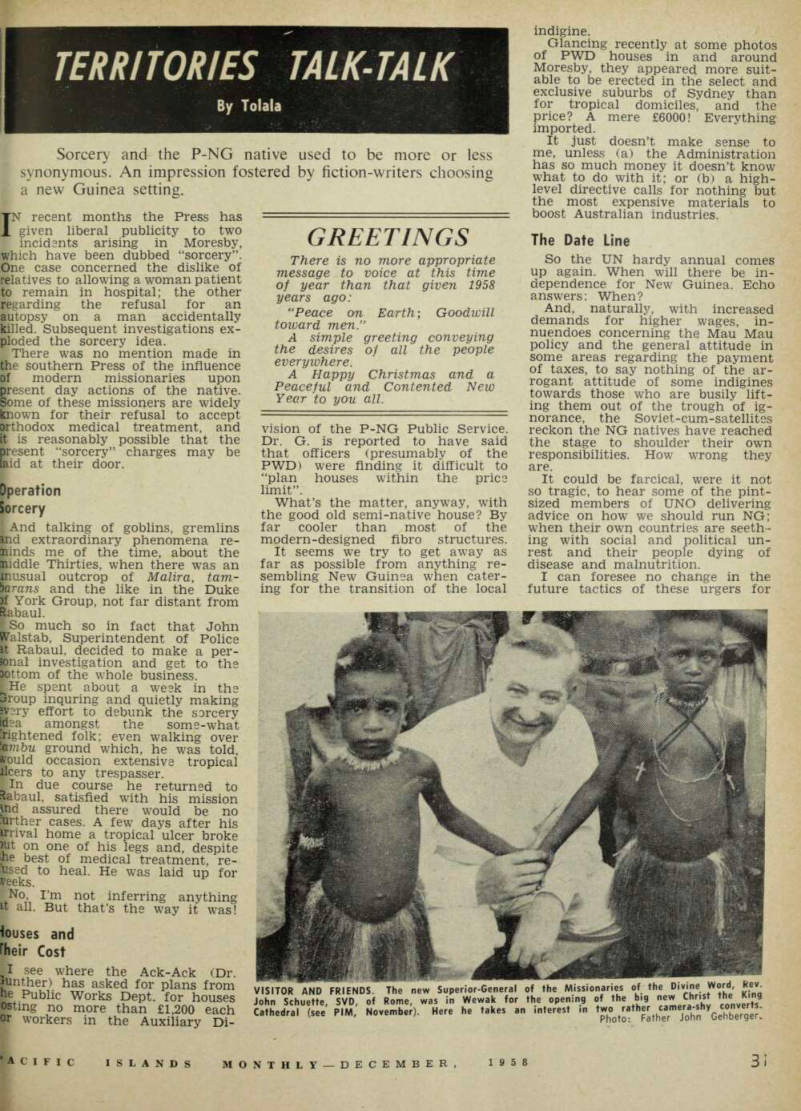
VISITOR AND FRIENDS. The new Superior-General of the Missionaries of the Divine Word, Rev.
John Schuette, SVD, of Rome, was in Wewak for the opening of the big new Christ the King Cathedral (see PIM, November). Hare ha takas an interest in two rather camera-shy converts.
Photo: Father John Gehberger.
NG independence, who hope to whittle away Australia’s prestige and later entice a national New Guinea into their own fold.
And, if oil begins to flow, this will intensify their energies to wards acquisitiveness.
But a hand to our delegate, Mr.
Kelly, for his firm stand and lucid explanations during the debate.
Lop-Sided
Education In an issue following the “Sor cery” reports a P-NG newspaper deals with the matter from an edi torial angle in a most logical and common-sense manner, emphasising the ignorance of Europeans gen erally to the native way of life; pointing out that this ignorance can only be overcome by the Euro pean learning something about the native.
“It should be a great deal easier for Europeans to learn the rudi ments of native thinking than it is for the Hanuabadan to learn about European ways”, the editorial concludes.
But how many Europeans are prepared to do this? A few mis sionaries, intent on fully under standing the native mentality, in order to better equip themselves to evangelise the heathen; here and there an isolated planter or trader as an alternative to working tor toise-shell or “counting his but tons”; and an occasional govern ment official who has the personal urge to continue with practical anthropology after the theory he has assimilated at ASOPA at Mos nan.
If whites would only realise how juickly the P-NG native responds :o any show of sincere interest in heir lores, customs, taboos, lin guistics and the like I feel sure ;here would be a greater tendency m the part of the European to Jducate himself in the native way )f life, and thus gain some know edge of the people amongst whom le is living, as well as creating a greater degree of tolerance and sympathy between the two races.
/lore Experts
“The P-NG Administration may set expert advice on all Territory abour matters”, reads a news )aper heading of early November, ind Mr. H. A. Bland, Secretary of he Dept, of Labour and National Service, is reported as saying that in officer of his department might )e sent along to do the job.
Mr. Bland has been interviewing ‘as many people as possible” to get heir views on “how soon the native )eople will be able to accept re sponsibility and how rapidly they :an be trained”.
This analysis of public opinion las been sparked off apparently by lissatisfaction expressed by native Jublic servants concerning their salaries.
So now P-NG is to have some experts whose knowledge of Aus tralian complex labour conditions will be the yard-stick deciding the requirements of conditions in the Territory.
I can think of no more inappro priate manner of trying to solve the present problem for undoubtedly there is a problem, and a big one at that.
But the stereotyped system of passing the buck whenever a knotty question arises, to a panel of “ex perts” is not going to lead the politicians, or Canberra bureau crats, out of the wood, where they have lost themselves despite the warnings of old-time residents and officials with local knowledge.
A committee of Legislative Councillors, evenly balanced with representatives of all sections would be far more practical, more realistic and give greater satisfac tion to all those who are involved.
Territory problems should be solved by Territorians themselves, not by imported unimaginative de partmental officials who live and
have their being within the con fines of sub-sections and para graphs of this and that Act.
What's in A Name?
One naturally assumes that the names given to their drilling sites by the APC have local geographi cal significance.
No doubt it’s merely coincidental that the now famous (and, we hope, to become more famous) Puri well only requires its name duplicated to become the well-known Papuan word for “sorcery”.
While the Kuru hole reminds one of the mis-named “Laughing Death” disease which is playing havoc with the Fore people in the Eastern Highlands.
Perhaps philologists could work out an answer. Let’s hope it’s a portent for good.
Discipline on the
High Seas
The article “Undisciplined Native Crews” ( PIM, Nov. p. 71) shows
a truly sad state of affairs, but a danger which has given master of Islands shipping headaches for many a year—even in pre-War days. An old mangrove skipper once remarked when the vagaries of boats crews were being discussed: “I sign on all my crew on the ship’s articles, then they have to do what I say—or else”.
And his schooner was a pleasure to see and a joy on which to travel.
The crew took a pride in their work, their appearance and were as happy as Larry.
I don’t know how it is now, but presumably Ship’s Articles are as sacrosanct as ever; although one can see the day when the Articles may be policed by a member of the Auxiliary Division.
Safety at sea is something we shouldn’t footle about with.
The Legco
Farce
PIM publisher Robson’s concise summing-up of the atmosphere of the P-NG Legco (PIM, Nov. p. 83) once again puts the remote control machine on the spot, and his final remark on the members “For all the help they are in administration, however, they might as well stay at home”, puts the position in a nut shell.
The same nutshell it has been in ever since the Gilbertian assembly
has been set up, whether in Papua or TNG.
It is not a chamber of legisla tion; merely a Chamber of Ven tilation in which the People’s Rep resentatives have an opportunity of hurling a few legitimate brick bats at the complacent heads of the Administration, who agilely dodge behind the wall of indif ference erected at Canberra.
The placid disregard of proce dure in disallowing the prescribed time for the consideration of bills by unofficial members is such a long-established custom in Terri torial Councils that it has now been accepted as a modus operandi.
Well do I remember one instance in the old TNG Legco when the Shipping Bill was introduced in the Thirties. It was un fait accompli before it ever reached the Chamber. It was a bill with far reaching effects, but was merely referred to as “a machinery measure”, that delightful camou flage that covers up a multitude of legislature.
One of these days the Unofficial Members may be able to think up some tactic which may out-Darwin their NT opposites.
It would seem that direct action is about the only successful method of solving problems these days.
Sticky Fingers
Registrar of Co-operatives, G.
Morris continues to pull no punches when reporting on native co operatives, and it would seem that the gentle art of tickling the till still prevails, though the members do not attach the same stigma to embezzlement as do most Euro peans, according to Mr. Morris, who reported in November that some “£20,000 worth of goods had been stolen, embezzled or taken unlawfully on credit”.
That, apparently, is the true co operative spirit!
And to think that in our own civilisation some hundred and fifty years ago penal servitude was doled out if one stole a loaf of bread . . . Yes; Time marches on.
PACIFIC MERMAID: And of course mermaids have tails. It's Lorraine Baldock, of Port Moresby—in the prize-winning costume she wore at a children's Fancy Dress Ball at Boroko in November. —Papuan Prints.