Pacific Shipping And Cruising Yachts
pp. 107-115 · Read in the full issue
The Commission of Inquiry into the loss, last July, of the BSIP Government vessel Melanesian, with 64 lives, ended on October 3. (See PIM October, p. 143). The Commissioners’ report, which was presented to the Government, may not be made public, but the Government issued a statement and may issue another later.
DURING the inquiry 34 witnesses gave evidence, 302 pieces of wreckage were examined and 20 exhibits were tendered.
According to the Government statement, the Commissioners con sidered that no evidence was forth coming to show that at the time the Melanesian was missing, July 10-18, that weather conditions were abnormal.
Not a great deal of cargo was carried on the fateful trip and there was no evidence to show that the cargo was stowed in an unsatisfactory manner. It was not considered by the Commissioners that the two 400-gallon water tanks an the after part of the forward hatch would affect the vessel’s stability.
The life-saving equipment was not considered by them to be sufficient, for the following reasons: I (a) The motor life boat, registered and classed as such, was used as a work boat; I (b) Total life-saving equipment capable of keeping persons out of the water was two boats capable of holding a total of 37 persons. The two life rafts, although capable of supporting 22 persons in the water, could not keep more than 3 people each out of the sea. The Commissioners considered it essential that sufficient equipment to keep all people out of the seas in these waters should be pro vided. \ number of witnesses were heard n regard to the ship’s seaworthi less, but no evidence was given to >how that the vessel was unsea vorthy at the time of her last myage. Although no evidence was jiven to show what caused the loss ;he following theories were dis- Jounted by the Commissioners: L(a) The ship was sunk by sub marine ; (b) The ship was sunk by mine; f (c) The ship was sunk by another ship; (d) The ship was sunk by an ex plosion.
Although the last contact was m July 10 and radio contact should lave been made daily, the Com nissioners could not understand vhy no action was taken until July L 3 to search for the ship.
The only direct quotation from the Commissioner’s Report to Gov ernment is the last paragraph, and is here reproduced in full: “If the ship sank suddenly, that would account for the fact that the life raft tanks had been subjected to pressure, that the life boat tanks had been subjected to pressure, that the cork in one of the life buoys had been compressed into a solid mass, and that only one body was picked up. It would also account for the fact that out of all the wreckage found so far, only one piece has come from below decks.
We consider that the facts could fit a sudden sinking of the ship due to her filling up with water, but we must reiterate that there is, in fact, no direct evidence to show what caused her to fill up with water.”
The Commission gave several recommendations outside its terms of reference, including suggestions that increased listening watches for ships should be kept; and that pro vision should be made for a fast vessel for rescue work.
The BSIP Government stated sub sequently that a 24-hour listening watch in the Honiara wireless station will be brought into opera tion in the near future.
• Operation “Flyingfish”:
Perhaps history was made off Raro tonga in October. As NZGS Maui Pomare lay loading at the anchor age, Captain J. Hare was engaged in a most unusual occupation— supervising a pilots’ examination.
This was not an examination in pilotage for the port of Avarua, but a theory examination for a com mercial air pilot’s license, and the sitter was Radio Officer/Purser Ken Windsor, who served with the RNZAF during the war.
Mr. Windsor is planning to quit the sea and try his luck in the seat of a top-dressing aircraft.
Each time that his ship has re turned to Auckland this year he has been building up his flying hours.
The date of the theory examination did not coincide with the ship’s stay in port—so arrangements were made for Captain Hare to take charge of proceedings during the October voyage. Further news in December, when results of the operation should be known!
• Case Of The Well-Stowed
STOWAWAYS: Mr. Dick Brown’s Rarotonga-based ships can be counted on to provide regular news of a calamitous or amusing nature.
A September special sitting of the Cook Islands High Court dealt with 16 persons charged with stowing away in the 128-ton DB ketch Taveuni. The charge was laid by Captain Archie Pickering, of Suva, master of the vessel, who gave evidence that he was quite unaware of the presence of the uninvited guests in his 83i-ft by 22-ft vessel when he departed Atiu for Aitutaki and Rarotonga. It was only when the ship was well to sea that the stowaways, who outnumbered his crew, appeared on deck and tend ered their £3/10/- fare money.
Taveuni is not at present licensed to carry any deck passengers—at least not unless the Administration wants her to carry some of its own.
She does have a license for 15 cabin passengers.
Judge Kay, in finding the group all guilty and fining them £5 each, pointed out that they had en dangered the safety of the ship and its legitimate passengers and crew.
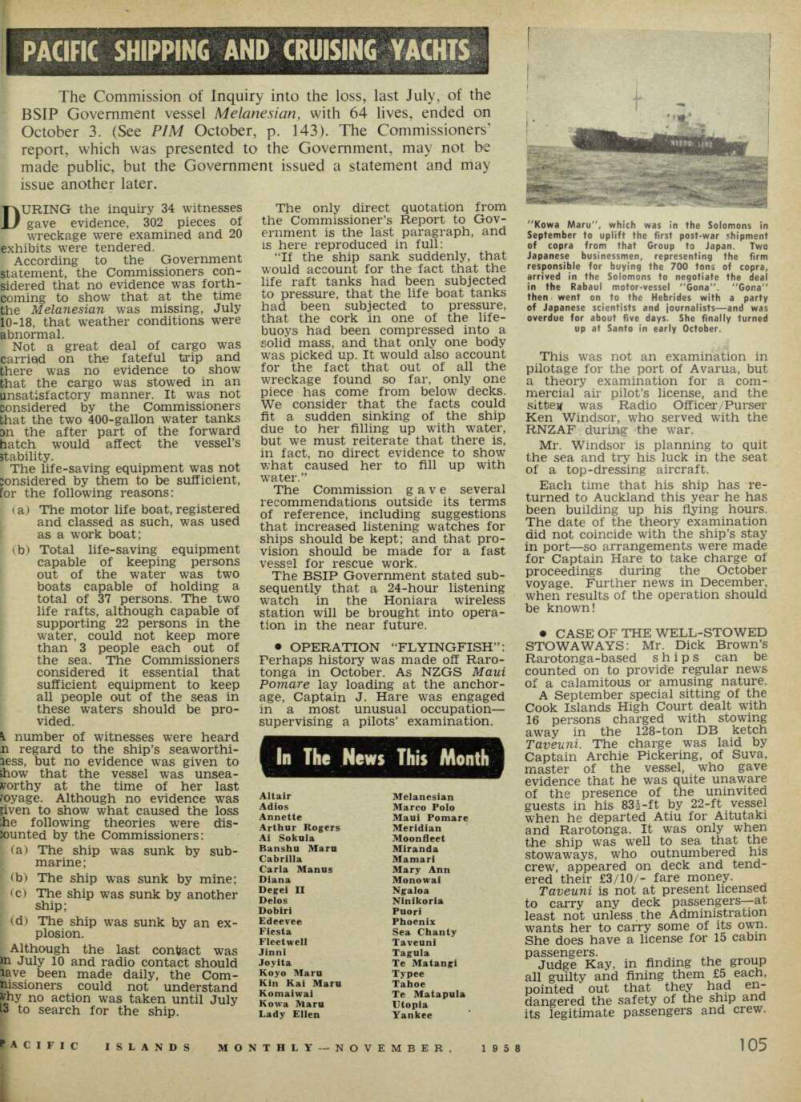
"Kowa Maru", which was in the Solomons in September to uplift the first post-war shipment of copra from that Group to Japan. Two Japanese businessmen, representing the firm responsible for buying the 700 tons of copra, arrived in the Solomons to negotiate the deal in the Rabaul motor-vessel "Gona". "Gona" then went on to the Hebrides with a party of Japanese scientists and journalists—and was overdue for about five days. She finally turned up at Santo in early October.
“We don’t want any Joyita in these ! islands,” the judge declared,
• To All Whom These Pre
Sents Shall Come. . . Greet
ings to Jenefer Natasha Dianne, newest member of the crew of the trading ketch Arthur Rogers, born to Tom and Diana Hepworth, at Auckland, on October 6.
This young lady was not sup posed to have been born in New Zealand at all, but Act of God and stress of weather decreed it so.
In June, bound back for her New Hebrides-Solomons trading ground I after refitting in Auckland, Arthur Rogers received a beating up just north of New Zealand and was ’ forced back for repairs. These were completed and the ketch cleared again on September 6—when the performance was repeated. The tiller . was broken and the deck accom modation flooded, so the Brixham ran back to Whangaroa—and from there Diana ran back to Auckland.
The ketch was to sail again early November with the three Hep worths, :the crew of four Islanders, and an English couple arriving by air to :take a share in the trading
I operations.
• Bomb Season Closed: With
'the completion of the 1958 nuclear bomb tests in the Mahshall Islands, 'the upper air meteorological station > established by the Americans at Betio, Tarawa, has been dismantled.
The station was established during the earlier tests and was rehabil itated last January in readiness for the 1958 tests, and restaffed. In August, a US Navy landing craft arrived from Eniwetok, the station was dismantled and the equipment . and staff removed. With its closing, [Tarawa has lost its temporary air mail link with the outside world.
• Hongkong Deliveries:
Hong Kong & Whampoa Dock Co.
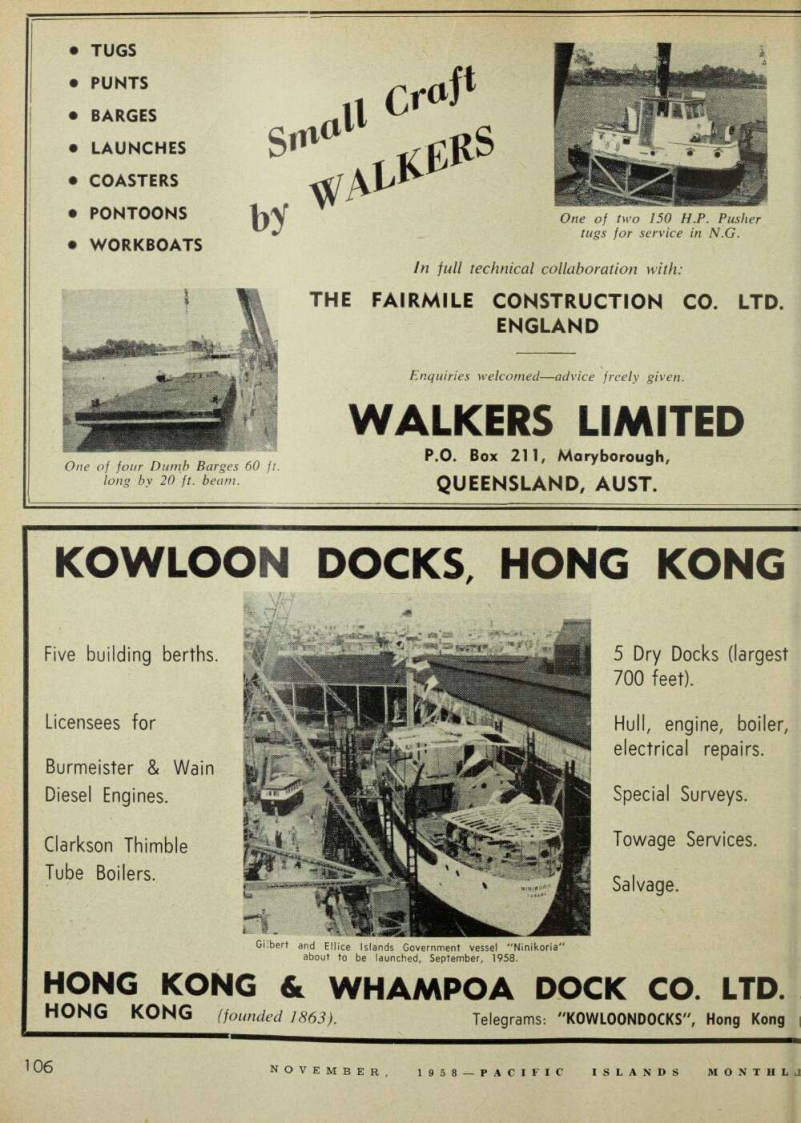
Ltd. expected to hand over the new GEIC Government vessel Ninikoria —sister ship of the ill-fated BSIP Government vessel Melanesian —in mid-October.
Ninikoria was launched on Sep tember 3 by Mrs. Bernacchi, mother of the Resident Commissioner of the Gilbert and Ellice Colony.
Captain MacAdie left Tarawa as a passenger in Te Matapula on Sep tember 11, by way of Ocean Island, to take delivery. His crew travelled via Suva per Ai Sokula later. From Fiji they flew to Hongkong Meanwhile Captain G. W. Duns ford. South Pacific representative for Pacific Islands Shipbuilding Co.
Ltd., reported that the Philippines tug Cabnlla, with three big steel barges for the Auckland Harbour Board and the Fiji Government’s new Degei II at the rear of the tow ■ was meeting fresh head seas north of New Guinea but progressing slowly towards the New Hebrides \ jyhere Degei II would drop the tow ime and proceed under her own . power to Suva.
The convoys touched Rabaul, for bunkers, on October 22. • DE G E I’S COST STILL SECRET: The Degei II has a crew and a master, Captain M. A. Verrall, aboard.
Williams and Gosling Ltd., Suva, have been appointed agents in Fiji by the builders and will attend to the matter of repatriating the crew to Hongkong.
Williams and Gosling will also officially hand the new ship over to the Fiji Government when she arrives.
The Government has yet to make an “official statement” on the cost.
After the fuss that attended the announcement of the cost of Singa
pore-built Ra Marama the Govern ment can’t be blamed for being a bit coy.
The Degei II will replace the de partment’s present ship Degei, which is used mainly for Govern ment cargoes, lighthouse and beacon servicing and other odd jobs. The old ship will be offered for tender overseas.
• Dobiri’S Delivery By
STAGES: When Captain Hugh Williams took his newly purchased ex-APC vessel Dobiri, 135 tons gross, out of Port Moresby on September 2, it was his intention to make a 3,000-mile non-stop run to Raro tonga base.
However, plans were altered. A call was made at Vila in mid-Sep-
smber and the vessel, with her as- Drted crew of Australians, New ealanders and one American—six 11 told arrived at Suva on tetober 3.
There she is to undergo some bructural alterations and to be etch rigged with sail to assist her lotor —if she is not sold first. Cap lin Williams indicated in Suva hat he was ready to listen to offers, Meanwhile it may be assumed tiat no one is protesting against tiis interruption to the 3,000-mile lug against fresh Trades in a ship le size of Dobiri.
• Fish For The Fishing:
•nee again Fiji was given a prac ical demonstration of the wealth lat lies in surrounding waters when le Japanese tuna fleet mother-ship ' oyo Maru, 7,400 tons, put in to uva early October to transfer 870 )ns of fish to the supply vessel 'anshu Maru for shipment to apan.
Koyo Maru and her forty 100-150- )n fishing vessels expect to reap ,500 tons of assorted fish from ’aters in the Fiji-Tonga area dur ig the current cruise. Judging by leir radio signals in the 2 mc/s and, some of the vessels were well )uth towards New Zealand in •ctober. Jap fishing vessels, “just ff the coast”, were producing the sual headlines in Australian news apers in October, too.
• Cement And Monkeys,
LSO; Suva had a surfeit of Jap nese shipping within three or four ays in early October. As well as ie two fishing boats, Kin Kai Maru, arrying cement, also arrived.
The Koyo Maru is expected to re irn to Suva towards the end of •ctober to pick up a Japanese sea ian who was admitted to the olonial War Memorial Hospital, uva, with a fractured leg.
Kin Kai Maru arrived with a irgo of cement and steel pipes *om Japan and rice from Thailand, he will be back as she is doing
four charter voyages (this is her second) from Japan, Bangkok, Suva, Apia, Nukualofa, Suva and return to Japan.
Fiji seems to have found a ready supply of cheap cement available in Japan and several ships have arrived from Japan this year with it. The Nadi Airport reconstruction
project is being carried out with cement from Japan.
Captain Marubayashi and his crew, had Fijian wharf workers in fits of laughter with their little Siamese monkeys. According to Cap tain Marubayashi, the pets are available in Bangkok for as little as £1 Fijian each.
Under Fiji’s laws, even murder would not be frowned on so severely as bringing one of these little "pets” into the Colony. They are absolutely tabu.
• Trying Again: The 70-Ton
twin screw motor vessel Joyita, liv ing down her unhappy past, re entered the Fiji inter-island service under the ownership of Mr. David Simpson, Snr., and under the com mand of Captain Laetia Sivo, on October 6. The vessel has been issued with a Fiji Marine Board sur vey certificate following extensive repairs occasioned by her stranding on Horseshoe Reef on January 8, 1957.
• Slipway For Pago Pago;
There was a time when a large number of Islands vessels used to head for Auckland, Sydney, and other southern ports for refit dur ing the hurricane season. The main
The "Joyita", a vessel with a past, now back in service again. See story this page.
"Carla Manus", 66-ft. schooner-rigged auxiliary owned by Mr. Jack Thurston of New Guinea, which arrived in Sydney on October 21 from Rabaul via Samarai and North Queensland ports. (See October PIM, page 115).
reason for their doing so was absence of large enough slipways and suitable engineering facilities locally, but all this is gradually changing—to the detriment of some southern shipyards.
In post-war years good slipways lave been estabilshed in New Guinea, at Noumea, Papeete, Suva, and other places, and now Pago Pago will soon have one in use.
We are not sure whether this has aeen financed by the Government, ay the tuna fishery interests, or by ather private enterprise. Certainly t will probably be most used by ;he Japanese tuna fishing vessels vhich are based there on short-term arrangements.
This marine railway will have a .40-ft cradle and a lifting capacity )f 450 tons, so will be capable of iealing with any vessel based in lither Eastern or Western Samoa paters. The slipway is located icross the harbour from the town md near the fish cannery.
• Another Cruise: The Uss
Company’s 11,037-ton flag-ship \lonowai, normally on the trans rasman passenger run, which made he first post-war Union Company sland Cruise last year—when she iras heavily booked out —is to repeat he performance next Winter. She j scheduled to clear Auckland on 'une 30 for calls at Nukualofa, Pago ‘ago, Apia, Suva and Great Barrier sland (near Auckland), arriving iack at Auckland on July 15.
• Thanks To Uncle Sam:
Though the American taxpayer ours out a flood of financial assist nee to countries around the world, here is often little thanks for it 11 and always someone to point ut how it’s all a matter of self nterest.
The people of Pukapuka, who now iave a fine new reef passage, thanks o the visit of the American solar clipse expedition in September - )ctober, are certain to take a kinder iew. There is no anchorage for a hip off this atoll; the reef falls heer at its outer edge, and it ex ends far out from the beach and 5 practically dry at low tide.
So cargo handling here has always •een tough, with a long carry across he shallows. The Americans ex acted to have to blast a passage o get their equipment ashore — •ut this was not necessary; their mphibious vehicles managed it.
However, the reef passage was •lasted regardless, for the benefit ‘f the population. Some 66 tons f TNT was employed and the •assage, located about 250 yards outh of the former landing point, •as a minimum depth of 4J ft and \ width of 30 ft throughout its 500 ards width. A sort of surge pond •as been blasted half-way along, 'Hd the channel changes direction this point, the idea being to dis ipate the swell coming in from he open sea. Some blasting has also
been done between shore-reef and village, inside the lagoon.
• Change Of Scenery: The
23-ton, 53-ft Lao Heni, twin-screw wooden motor vessel of the Seventh Day Adventist Mission, which has been stationed in Tonga waters for some years, was transferred to the Mission’s Fiji circuit in September and the 10-year-old vessel will be stationed in Suva In future. The Tongan crew has been replaced by Fijians.
• Ironmongery From The
SKY; What with first-stage rockets, half-burnt sputniks, and other
similar objects falling round about to add to the perils on the high seas, we’re apt to forget that meteorites and other objects have been plummetting into these same seas since time began—or at least since the earth became the earth.
Last year a Scripps Institution of Oceanography vessel, out on an IGY cruise, scraped up some of this ironmongery from outer space, and other similar earth-formed'materials from the bottom of the Pacific. The report of what they found has got the American metal merchants thinking.
A rich store of these metallic
stones or nodules was located just east of the Tuamotus, some 500 lb weight of stuff being brought up from 600 fathoms in a single haul.
Analysis showed the nodules to con tain 25 per cent, manganese, 15 per cent, iron, and quantities of other valuable metals, and it was esti mated that material valued at half a million pounds per square mile is down there for the getting.
The only catch is that 600 fathoms is outside the scope of existing dredging equipment—except the ex pensive gear installed in scientific research vessls.
• Fiji Ships Laid Up For
WANT OF CARGOES: The former W. R. Carpenter and Co. (Fiji) Ltd., now Morris Hedstrom Ltd.,
motor ship Ai Sokula and another Carpenter vessel, the Komaiwai, are both laid up in Suva because of the falling off in trade around the Group.
Ai Sokula was promptly put into “moth balls” after she returned from a trip to the Gilbert and Ellice Islands, late in September.
No indication has been given by the companies concerned when the ships are expected to resume trad ing.
• Tenders For “Pompom”:
Tenders have at last been called — in London only, apparently—for the building of the replacement for the New Zealand Island Territories De partment’s refrigerated passenger and cargo vessel Maui Pomare.
According to the London nouncement, tenders must be in December 31. The ship is to hav speed of 12-14 knots, a gross tonn of about 2,750, and a ca capacity of 60,000-70,000 cubic J and accommodation for 40 passe ers. The London consultants, J. H. Biles & Co., are apparel handling the tenders.
A good many people believe t this ship will not be built, or at It not in the near future. Finan belt-tightening in New Zealand, i the availability of an increas number of small refrigerated f] vessels in the trans-Pacific tn have considerably altered the sit tion since the ship was first moo three years ago. Now there is t that Maui Pomare number i will be okayed by the survey auth ities for another ten years, by moting her to non-passenger ve; status.
• Showing How In Nj
GUINEA: Since echo-sounders w fitted to the New Guinea Fishe: vessel Tagula, there has been m fish available in Lae and F Moresby—something like 11,000 lie a six weeks’ period.
Tagula belongs to the Fishei Division of the Department of Af culture, Stock and Fisheries, wh uses it as a research vessel—mai for the instruction of native operative fisheries which the Adra istration has endeavoured to est lish along the Papuan coast.
The echo-sounding equipment ;
permitted the tracking of shoal f mostly of the mackerel variety.
• Tahiti Contacts: Shipp
contacts with Papeete are steao
ncreasing. Immediately after the var the only passenger connections tfere provided by Messageries Mari nes from Europe and Australia, a >'ery limited Union Co. service from ■Jew Zealand and Canada, and Pacific Islands Transport Line’s fhor 7, and an occasional Matson freighter with limited passenger jccommodation from the US. Then lame the new MM passenger liners, Miaw Savill’s Southern Cross, the aew Matson liners, and Thorshall md Thorsisle replacing Thor I.
Next to appear in the big-liner aass was Rotterdam Lloyd’s 12,342- :on Sihajak, which has made one )r two calls each year recently on ier west-bound run to Wellington ind Sydney—her schedule was for 'hree calls this year. Now the Nederland Line of Holland is enter ng this service in the reverse direc -ion with sailings by the 19,781-ton Johan van Oldenbarnevelt from
Wellington for Papeete next May, August and November.
Added to this is increasing in terest by the Italian Sitmar Line which made trial runs via Suva and Papeete last year. The Line is drop ping Suva but will make East-bound calls at Papeete from Sydney and Auckland next February and De cember with its Panama-registered, 12,150-ton Castel Felice and its 11,833-ton Fair sea respectively.
A regular West-bound passenger connection from the US East Coast to Australia has also been provided for several years past by the United States Line’s Pioneer ships. All in all, Papeete is now better served by passenger liners than any other South Pacific Islands port.