The Months New Reading
pp. 94-105 · Read in the full issue

With Judy Tudor
The thin trickle of books of a couple of months ago has turned into the expected flood in anticipation of Christmas— which will be, alas, as you read this, not much more than a month away.
IN the books now coming from the publishers there is something to tickle the taste of all readers; entertainment and instruction for all levels of brows and for all ages, adult, teenager and tot.
Those who traditionally Give Books for Christmas should have no difficulty—and even a selection of the attractive paper back editions now offering is not to be scorned.
They Took Their Holidays
in the Gilberts
r:ERE must be few people on earth who, when contemplating the annual holiday, have seriously considered the Gilbert Islands. Firstly, they are one of the few remaining places on earth that are off the commercial air routes, and the alternative ways of getting there are sufficiently rigorous to dampen the enthusiasm of any but the most persistent seekers after new places and new experiences.
But about four years ago, Nancy Phelan and Helen Shiels decided to take their holidays in that string of tiny atolls flung across the equator just west of the 180th meridian, and which, in their time have been called many uncompli mentary things including the Lousy Islands by the then editor of PIM who visited them, strictly in the course of duty, in 1941.
On the face of it, Mrs. Phelan and Miss Shiels should have known better. Pacific islands were not un known to either of them—both were then on the staff of the South Pacific Commission—and when one has much to do with Pacific islands they usually are regarded as strictly business, and one takes one’s pleasures elsewhere.
But their incurable romanticism about Pacific islands has resulted in one of the best travel books of the year, Atoll Holiday, from the talented pen and expertly wielded camera of Nancy Phelan.
Mrs. Phelan was Visual Aids Officer in the SPC, so perhaps it should be no surprise that she knows what to do with a camera' but this particular Visual Aids Officer’s gifts extend also to the art of writing, with humour, whimsy and real insight.
Even case-hardened characters
who have been too long in the islands will feel the charm of this book—although they are unlikely to share the passion for such things as lying on the beach till the small hours drinking in the moonlight.
European residents of the islands do lie on the beach in the darkness, from time to time, of course. But it is seldom for the purpose of imbibing moon glow.
This type of eccentricity will have to be accounted for by the Irish ancestry of the two women in question—which, as everyone knows, endows with a double-dose of sentiment and a sense of the fey
that places like the Gilberts brinj on in exaggerated form.
The old hand is advised to ski] these passages, if he cannot tolerat them, and read on, for there i much in this book that will interes him.
The Phelan-Shiels pair proceedei from Melbourne to Ocean Island oi one of the British Phosphate Com missioners’ vessels, and this hai considerable bearing on subsequen events.
On board was a child wh, developed spots which the docta diagnosed as hives, and the mothei bluntly, as chicken-pox. The mothe knew best and a couple of week later, when Phelan-Shiels had pm ceeded from Ocean Island t; Tarawa by local smallship, right i: the middle of a dance arranged fa a party of visiting Americans, Hele:i came out in spots.
Both disappeared from the ball t consider the matter . . . “and h due course we heard that our dis appearance had been given thr most sinister interpretation, am that all the American officers whi
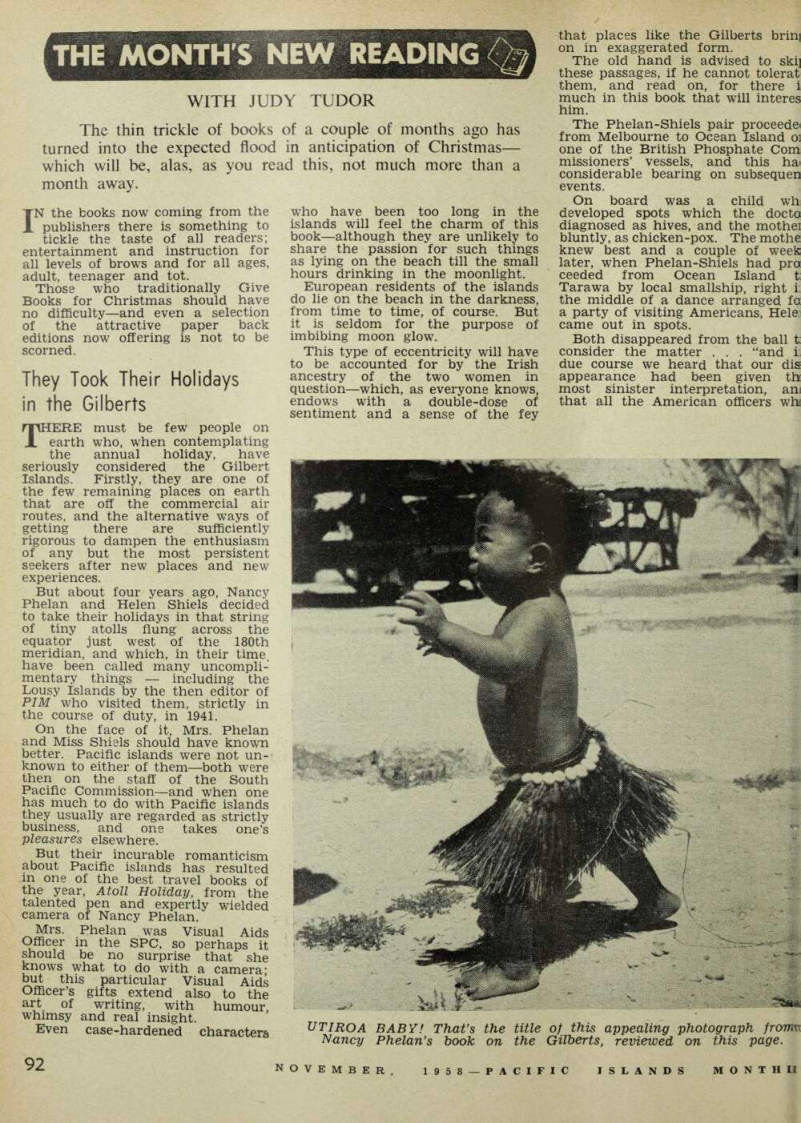
UTIROA BABY! That’s the title of this appealing photograph from Nancy Phelan’s book on the Gilberts, reviewed on this page.
failed to return home to their hosts that night were laid to our credit”.
For the time being, however, they were more worried about the possibility of decimating the Gilbertese, Pacific Islanders, they knew, being susceptible to such childish diseases.
But in choosing chicken-pox they chose well —this disease, it appears, being endemic there, while such things as measles and influenza have the usual lethal effect.
Nonetheless, Helen must be quarantined, which was done at the hospital two hours away by launch —taken thither, across the lagoon in the heat of blazing mid-after tioon, in a state of discomfort and misery calculated to curb the illusions of any but these incurable romantics.
Nothing can dampen the enthusiasm of these two —not spots, nor sagging beds, nor bucketing about in smallships, nor primitive houses, nor latrines seven minutes walk from home, nor crazy cooks.
And although such wholesale use ff rosy spectacles might be regarded as misplaced by some, it is sufficiently well done to recapture, for most of us, that belief in the romance and the glamor of the South Seas that we once had. \ (ATOLL HOLIDAY. Published by Angus and Robertson, Ltd. Australian price, 17/6.)
Full Entertainment
Value
r>R the vast number of people who like reading books for relaxation, entertainment and perhaps escapism, three novels this month fill this middle-brow need admirably. [ All are the products of good craftsmanship; all tell a story, and all the authors are obviously more concerned with doing just that, than in using their novels as a medium for the self-expression of :heir own tortured souls.
Two of the writers are women. 3ne of the stories is of late, 18th Century England; the other two are contemporary—one set in Cyprus and the other Italy.
Here they are;
Dne
IITITH the Cyprus “Emergency” f ? now a couple of years old we may expect an increasing lumber of books about it. John Appleby’s The Bad Summer is the second that has come this way with a Cyprus background (Night on the Bare Mountain, was the other, re
viewed some months ago).
Appleby spent two years in Cyprus as news editor of the Cyprus Broadcasting Service and bis story has a ring of authenticity about it—possibly because he does bot attempt to “take sides”.
In a situation of the Cyprus variety there can be few clear-cut
blacks and whites, and Appleby sensibly paints in his background, creates his very human characters against it, and allows them to get on with their story. The reader J? 1S °^ n concl u uslons
finaVii 5m they euphemis-
f very nature of things, for the British Army, Cyprus is pretty much of an Eveless Eden, and for StoVhaTto^be'taDO^d 651 ln thiS % h link in this story, but once in Cyprus, Paula Vincent turns out to be quite a girl.
The reason that she went there, was that her brother Captain Douglas Vincent, who has a talent for getting himself into trouble, has stumbled into what threatens to be
his last predicament by allowing himself to be kidnapped in Nicosia and being held as a hostage for the reprieve of a Cypriot terrorist.
The characterisation in this novel is excellent, and in this setting of inflamed passions and sudden death, with the stage set and the dramatis personae all in position, the story moves swiftly to its climax.
' (THE BAD SUMMER. Published by Hodden and Stoughten. Australian price, 17/-.)
Two
ONE Australian product most easily exported is a successful novelist, and teenage prodigy, Catherine Gaskin who published
her first novel at 17, and achieved best-seller class with Sara Dane about four years ago, has followed that primrose path.
She is now married to a television consultant and lives in New York but her latest novel, Blake’s Reach, is set in the marsh country of Kent, at the end of the 18th century—a time of flux and uncertainty in the affairs of men, when just across the Channel in France, the Revolu tion was (as our writer puts it) [carried on in bloody haste and passion in the strange, unfamiliar names of Liberty and Equality”. [ Jane Howard has her own problems of both, symbolised for her by her struggle to have Blake’s Reach, the old manor house over looking Romney Marsh, from which her mother, Anne, had fled, dis inherited, for the softer, London beds of the nobility. ; This was the era when the pro fession of mistress, if not exactly respectable, was at least a well brganised one, but by the time that Jane, who had been left to the care of an inn keeper’s wife, Joined her mother in London, Anne was almost at the end of her short life, and certainly at the end of her resources.
With Anne’s death, Jane sur reptitiously sold everything portable within the London house, and with William, her small half-brother, Patrick, the versatile man-servant, and the carriage and matched pair of greys generously donated by Lord O’Neill, flitted from the dunning tradesmen for the prospective sanctuary of Blake’s Reach.
There she found her grandfather lately dead, and the crumbling ruins of the old house and estate, which he had systematically drunk into the ground, willed in spite to Cousin Charles who had chosen to live with relatives in France, and pow was awaiting the pleasure of the Revolutionaries in a French prison. . How Jane sets about rehabilitat ing the old Manor, and the few lands that remained to it, and
what she uses for money, are the crux of the story—reminiscent, in some respects to early Daphne du Maurier, but without that author’s sombre atmosphere of gloom.
Miss Gaskin is a writer with an obvious predeliction for strong willed women and thus makes Jane a red-haired, warm blooded female but with the almost masculine capacity of keeping the pleasures of the flesh in a compartment separate from material aspirations.
Blake’s Reach may not achieve the 1,000,000 copies reached by Sara Dane, but it will not do anything to damage the reputation of this versatile writer. (BLAKE’S REACH. Published by William Collins, Ltd. Australian price, 18/9.)
Three
HELEN MacINNES, the author of the last of the three novels, North From Rome, is also a New American. Born in Glasgow, she married an Oxford Don who in 1937 went to Colombia University, New York, to lecture. They have lived there ever since, with travel in Europe as circumstances per mitted. The Maclnnes’ novels, therefore, have a cosmopolitan flavour, usually being set in a European background, with a colour-wash of Americanism. This has been particularly so in the last two books, Pray for a Brave Heart and the current one, which have been considerably involved with a theme of international communism, preoccupation with which ap parently extends to New Americans as well as to old ones.
As the title suggests, the story is based on Rome and a wild adven ture to the mountain towns beyond the city. It covers the discovery that the young American play wright and Eleanor who works in the American Embassy, still are in love, although she suffers a tempor ary aberration with an Italian nobleman who turns out to be a bad lot. But before this can happen, a lot of water runs down the Tiber and the reader sees a lot of Italy.
Those inveterate diggers after the “real” Italy (or the “real” France or the real anything else) should be warned that most of Helen Maclnnes’ Italy is the real tourist Italy. And as few visitors are likely to see anything else, for the purpose of this novel, that suffices. (NORTH PROM ROME. Pubished by William. Collins. Australian price, 18/9.)
Tales of the South
Pacific—Clune Style
rpHE writing technique of author X Frank Clune is something calculated to make all other word-smiths froth at the mouth, or fall flat on their faces in amaze
ment—depending on the character of the individual.
What the technique is we can only guess—but the guess is that it is pretty mechanical and time tried. Such as gathering together every technical manual, mainten ance guide, time-cable, tourist pamphlet, history, fable, govern ment report and photograph remotely connected with the area of the current Clune visitation, slinging them into a sausage machine and publishing what comes out at the delivery end.
Latest offering from the Clune mechanical brain is Tale of Tahiti —which is the result, as he naively remarks in the foreword, of having visited New Zealand in 1956 (see Roaming Round New Zealand —or don’t, just as you like) and having found, accidentally that Tasman Empire Airways Ltd, have a service through Polynesia.
After this shattering discovery Clune packed his bags—or his ports, as he probably calls them —and set off along this halcyon way to report on Polynesia for the folks back home.
In spite of the title, only about one-quarter of the book concerns Tahiti. The rest of the narrative is taken up with the Clune version of everything, past, present and future, animal, vegetable, mineral, between Mechanic’s Bay, Auckland, and Western Samoa.
There are the vital statistics of the TEAL Solent in which he travelled; Clune on Polynesian migration; the story of Kingsford Smith and Ulm in the pioneering flight of the Southern Cross —recalled to the fertile Clune memory at sight of Albert Park, Suva.
The history of Fiji and its Racial Problem naturally follow, and then we are away for Western Samoa where, in Apia, he really strikes pay dirt. There is the whole Bully Hayes saga to be re-told, Clune fashion; and, of course, a disserta tion on Robert Louis Stevenson with whom Frank is on intimate terms —he calls him Lou.
The 1889 hurricane is dredged up and then off for Aitutaki and Papeete where, as well as potted history and geography of the
French possession, opportunity is
taken to give the Clune version of the Bounty mutiny and the after math on Pitcairn. .
There are only 200 pages in this book, but the customer may rest assured that there is absolutely no aspect of life in the South Pacific in the last 1,000 years from Gauguin as an artist, to what you get for morning tea in a TEAL Solent—that does not get at least a mention. . , But as with most Mechanical Brains, a couple of crossed wires can give the most extraordinary results. We were interested to read on page 24—and we’ll bet the people of Fiji will be even more interested —that, by a special dispensation, “the importation of Fijian sugar,
[bananas and pineapples into Aus tralia is allowed, though they are grown by coloured labour in com petition with Queensland produc iion by white labour”.
Who ever told you that, Frank, was just a sadist at heart. ; (TALE OF TAHITI. Published by Angus and Robertson, Ltd. Australian price, !5 -.)
Mum Plays Poker,
Drinks Beer
rHE cute sayings of tots are not everyone’s dish —and the dish of yours truly less than most.
But preconceived ideas are a good ;hing—at times —if only that they ire occasionally the prelude to airprises (pleasant).
Kids Say the Darndest Things vas received with something less han wild enthusiasm: It would, of :ourse, be terrible. That was the )relude. The pay-off was an wening’s entertainment punctuated >y sufficient sniggers to put the eeth of the rest of the family on sdge.
Mr. Art Linkletter (the fellow vho wrote it) doesn’t know it, but t takes something to make this >ook reviewer laugh out loud at omething in a book, and to this ixtent he can take a bow.
There are about 250 pages in his ipus and they are, of course, not all unny: Some of his brats are just irhat you would expect and need a ood swift kick where they sit. ilso, it’s American, and some of it tiisses us by a mile —such as American children who from about years of age, seem to be far aore interested in Marilyn Monroe ,nd their mothers’ pregnancies than imilar children in our own com aunities.
Mr. Linkletter, it appears, runs . TV session in which he interviews hildren in the 4-11 age group. ?he kids are either picked out by (is talent scouts from schools or Sunday schools, or recommended y teachers and parents. He takes hem on, four at a session.
To be chosen for Mr. Linkletter’s how is regarded as quite an honour -but must be somewhat of a nixed blessing. The child world is ompounded of half fact, half antasy and when normal family
lappenings are interpreted against
his background and spilled out rom a six year old in an intimate interview, the results are likely o be devastating for those most losely concerned. /The interviews cover most aspects f child life. What animal would 'ou like to be? (“I’d like to be -n octopus so I could grab all the >ad boys and girls in my room and Dank them with my testicles.”) Joes dad help with the house work? |My dad won’t dust. But he cleans Us own teeth.”) How would I
know your mother if I met her? (“My mother has black suede shoes and clean pants.”) What does your mother do? (“She’s a Sunday school teacher.”) What does she do for fun? (“She plays poker and drinks beer.”) Naturally some of the facts of life (American) as interpreted by five and six year olds come in for a lot of attention. So do juvenile versions of how mum met dad.
One of the best in this category came from a youngster who re marked that they had a new Daddy round the house. When asked if he knew how mother had met him, he came up with the following: “It all happened one morning when the door-bell rang while Mummy was taking her bath. My little sister went to the door and
there was a strange man standing there. He said he’d like to see my mother. So sister let him.”
(Kids Say The Darndest Things.
Published by The World’s Work. Aus tralian price, 20/-.)
Basinful of the
Inscrutable East
AUSTRALIAN book reviewers have welcomed A Handful of Pennies as a literary event of magnitude; but most have added the rider that it will likely be above the heads of the common herd.
They could be right on the first score; but they certainly are right on the second.
The author, Hal Porter, is an Australian poet “of some note”.
This is his first novel, and in it he
has employed the techniques of contemporary verse-making. The result may prove that he is a genius and please the palate of the members of the Professional Book Reviewers’ Union, but it is more than likely to irritate the paying customers —that common herd they affect to despise.
Poet Porter has a large vocabulary, and he is as spend thrift with his words as a drunken sailor is alleged to be with his money. And, frequently, with as little apparent sense—but if bamboozlement is the hall mark of merit, then he scores full marks.
The title has, of course, no apparent connection with the story which is a sordid one of Occupation life in Japan.
The central figure is Paula, an Australian schoolteacher, who some what reverses the order of things by seducing a Japanese youth; subsidiary characters are a homo sexual Army padre, a callow Army captain who has a tender affair with a local prostitute, and sundry Orientals who behave in incrutable Oriental ways—like being possessed by foxes and contemplating suicide with ecstasy. [There have been many novels WTitten about the Occupation— Hungerford’s Sowers of the Wind, and Michener’s Sayonara, being two of them. They were stories; Handful of Pennies is abstract art s—without the pretty colours. \ (HANDFUL OF PENNIES. Published by [Angus and Robertson, Ltd. Australian trice, 17/6.)
Looking into Other
People's Houses
IN their struggle to pay off the death duties, the nobility of Britain have found that there are not many who will not pay a couple of bob to see into other people’s houses. Sometimes the cost comes a little higher—when you can buy a coke or a cup of tea behind the potted begonias at the bottom of the garden.
Apparently with the same thought in mind, the Heritage Books have added another to their range— English Country Houses in Colour. The homeward-wending Colonial can now see what is offer ing in the way of sightseeing; and even the plain stay-at-home will derive pleasure from the beautiful photographs and the history of the houses.
In some of the samples, the Englishman’s home literally is a castle, and in period they range from 1300 AD to quite modern ex amples of 19th Century architec ture.
L No one should be fooled with the title, “Country Houses”; each is about the size and proportions of Hampton Court, which also is in cluded.
I Some are now maintained by the
Ministry of Works; others are still inhabited. All are historic and noted for their architecture, the the beauty of their settings or for the distinction of their interiors.
All must have been sheer hell to live in before the invention of steam heating.
Also in this series, recently pub lished, is Wales in Colour. It covers the history of the Principality and has 24 full-page pictures, in full colour, of this beautiful section of the British Isles.
(English Country Houses In
Colour And Wales In Colour. Pub
lished by Angus and Robertson, Ltd.
Australian price, 24/-.)
These Came As
Collections
r:E anti-climactic ending to the modern short story is probably a natural development or re action from the trick ending to every story of the O. Henry era.
The modern short story (apart from when it appears in the popular magazines, and particularly when it is the variety that is published in “Collections”) can be regarded as artistic self-expression rather than the desire to create pleasure for the reader.
Two collections —one by Rhys Davies called The Darling of her Heart, and the other by Sean O’Faolain—come strictly within this category. Because of their ancestry, Welsh and Irish, and because each writes about his own territory, and because there is much of the pixilated about both of them, both collections have much in common.
They are interesting studies, but most of the art will be lost on the general reader who prefers an ending with all strings tied off.
(The Darling Of Her Heart. Pub
lished by Heinemann. Australian price,
18/9. The Stories Of Sean
O’FAOLAIN. Published by Rupert Hart- Davis. Australian price, 26/-.)
Juvenile Department
r:E fabulous adventures of Lee-O and his crew on the schooner Pegasus (Peggy for short) as told in Monsters and Marlinspikes, by Hugh Popham, will do very well for the under-tens, who like stories to be two sizes larger than life.
The extraordinary adventures of
Captain Binnacle, Mr. Piston, his
engineer, Mr. Spokeshave, his
carpenter, and Ben the Bosun, who was eight feet tall, are all created for the sweeping imaginations of childhood. (Published by Rupert Hart-Davis, Ltd.
Australian price, 17/-.)
What's New in Paper Jackets
NEVER underestimate the appeal of the paper jacket edition. One Sydney wholesaler informs us that when “The Naked and the Dead” appeared in the bound edition, they sold 36 copies to retailers in eight months. When it ap peared in a paper edition recently they sold 22,000 copies of it in six months.
“White Coolies”, the experiences of an Australian Army nursing sister as a POW in Japanese hands, originally published by Angus and Robertson a few years ago, and now issued in a paper jacket edition, has already passed those fantastic figures.
Offerings this month in this cheap edition field include the following half dozen —all Fontanas, from Wm. Collins (Overseas), Ltd.: YOU CAN’T HIT A WOMAN, by Peter Cheyney. This is a “collection” too—but any resemblance to the other literary col lections mentioned elsewhere in these re views is pure co-incidence. Crime-master Cheyney roves far and wide in this lot, with 24 experiences that cover the globe just about as widely as John Foster Dulles.
I AM FIFTEEN AND I DO NOT WANT TO DIE, by Christine Arnothy. In the
final days of the German defeat by the Russians in Budapest in 1945, Christine and her parents, with a group of other people, lived a terrifying existence in a cellar. By the light of a candle she wrote this diary, which, in 1954, first appeared in a French version.
When the Russians finally entered the city, a wave of atrocities followed and many Hungarians perished. Christine and her parents made a desperate escape over the Austrian border.
RIDE THE MAN DOWN, by Luke Short.
Strictly for those who like Westerns. A saga about a guy called Will Ballard, who “gave everything to save the range and the girl he loved”. (We seem to have heard that plot before, somewhere).
More Deaths Than One. By Rex
Stout. Nero Wolfe as a buster-upper of crime needs no introduction to readers of thrillers and this time he and offsider Archie Goodwin, take on the strange doings of a lady broadcaster, a racetrack tout and a mathematical wizard who are ; all connected with a murder that baffles the entire New York police force.
DUNKERLEY’S, by Howard Spring, is the second of the novels he has written around the imaginary newspaper kingdom founded by Daniel Dunkerley. This section of the Dunkerley saga takes place after the establishment has expanded from Man chester to London. It again concerns Dan Dunkerley, job printer turned newspaper baron, but only in the minor key. Chief characters are the second generation.
Spring draws his background from his long years on the “Manchester Guardian”, although any resemblance between Dan and the founders of that august journal are, doubtless, just accidental.
THE WHITE CROW, by Philip Mac donald. This thriller was first published in 1928—which is a good indication of the failure of present day writers of crime stories to cope with the extra ordinary demand for this type of fiction.
Because it was written in 1928 does not mean that it is not a good Whodunnit, of course, although the passage of 30 years dates even crime detection.