Fiji Talanoa
pp. 51-53 · Read in the full issue
Vakatawa Talks
Of This And That
The result of the Suva municipal election is being in terpreted as an interesting example of something that must always be taken into account by any student of Fiji politics— the solidarity of the Gujerati vote.
THE local prophets turned out to be wrong in their election fore casts. For the vacant Indian seat, they predicted a close contest between Mr. Ben Jannif, owner of Caine’s photographic studios in Suva and a man with a long record of public service; and Mr. R. L.
Regan, one of the city’s younger lawyers.
But it was a political newcomer, Mr. Arjun Jiva, who topped the poll. He is a motor mechanic who described himself in a Fiji Times interview after the poll, as a “poor man”.
He said that he would try to bring the rates down, or if he could not do this, he would have wages raised. Whose wages he did not specify.
Mr. Jiva is a Gujerati.
The Gujeratis, who come from Bombay, have the reputation, among Indians and non-Indians alike, of being hard, mercenary traders. As a group they are little liked by the Fiji-born Indians. They have never become fully assimilated into the Fiji community and there is not much evidence that they are ever likely to.
Their first loyalty and their main interests lie in India.
With some notable exceptions, they are not liberal spenders and money made in Fiji goes in large quantities to India.
In the Suva elections, voters rode enthusiastically to the polling booth in taxis provided by Messrs. Jannif and Regan. Inside the booth, how ever, 302 of them voted for Mr.
Jivan, who had no car service. The unsuccessful candidates were not pleased.
The political pundits claim that the 302, or the great majority of them, were Gujeratis, rallying to the support of one of their own number.
The ballot maintains its secrets and no one will ever know if the pundits were correct. But they could be.
Mr. Bhindi’s
Lost Cause
At Lautoka, Mr. Gordon John son, manager of the Lautoka Hotel, unseated Mr. Allan Harvie and Mr.
B. D. Lakshman, former school teacher, former official of the Kisan Sangh (canefarmers’ union), former
member of Legislative Council, former president of the Inter national Airport Workers’ Union and of the Fiji Industrial Congress, re placed the former mayor, Mr. Choy Gopal, who did not seek re-election as a councillor.
Mr. P. K. Bhindi, who retired from the Suva City Council, will be a loss to the Council. He was one of its hardest workers and estab lished a record of never missing a meeting during his six years of office.
He assiduously studied reports and presented his views with honesty and courage.
But that, apparently, is not the way to gain favour with the electors whom he sought to serve.
When he refused to push per sonal cases, which he believed were wrong in principle, he became un popular with many of his former supporters who let it be known that they would have no more of him as their civic representative.
So Suva has lost a good councillor and an experienced and knowledge able administrator. It is to be hoped that Mr. Bhindi will one day return to office, for he has proved
himself an honest and able man, of high principle.
Crossed Fingers
For Saweni
Fiji fingers remain crossed about the Saweni beach hotel project, but confidence grows that this scheme at least will not fizzle out as others have done.
The Northern Club at Lautoka leased part of the beach and accepted responsibility for keeping it clean and tidy. Some of the members grumbled every now and then about the cost (which included £lO a year for the lease) and the trouble, but the wheel of fortune has brought ample reward.
The Canadian investors who want to build the hotel have offered 20,000 dollars for the lease, and have undertaken to provide free parking space nearby and to allow club
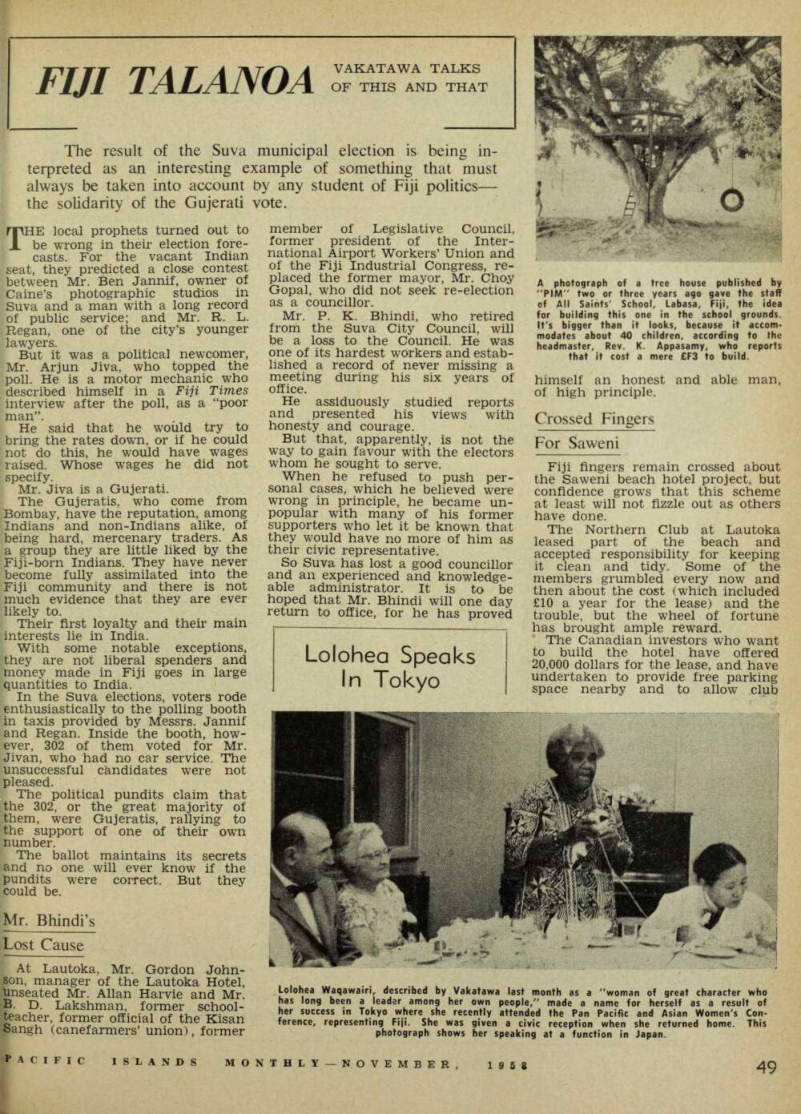
A photograph of a tree house published by "RIM" two or three years ago gave the staff of All Saints' School, Labasa, Fiji, the idea for building this one in the school grounds.
It's bigger than it looks, because it accom modates about 40 children, according to the headmaster. Rev. K. Appasamy, who reports that it cost a mere £F3 to build.
members and their families free use of the beach at all times for swim ming and aquatic sports.
The Fijian owners of the land, which is leased through the Native Land Trust Board, are looking forward to a considerably higher rental than they have had in the past.
The High
Cost of Luxury
As Fiji’s hotels move towards the luxury that American tourists are said to demand, so do prices rise.
At Suva’s new Club Hotel, to be opened shortly, the tariff will range from £4 a day (for bed and break fast) for a single room, to £l2 for a suite.
All rooms are air-conditioned. All have private bathrooms and most of them have individual balconies from which to watch the passing scene.
There was none of this splendour in the well-remembered Club Hotel of pre-war days, when Bill Hayward charged £lO a month for full board.
Then whisky was ten bob a bottle and you could have your month’s laundry done for 12/6, with deduc tions for shirts that were lost or damaged in the washing process.
Colonial Office
Can’t be Bustled
At long last, the Colonial Office in London has stirred slightly and has made the first appointments to the highly important commission to look into the question of Fiji’s population and resources.
Sir Alan Burns, a former Gov ernor of British Honduras and the Gold Coast and then a United Nations Trusteeship Council mem ber, is to be chairman. With him will be Professor Peacock, Professor of Economics at Glasgow University.
The Colonial Office is still getting round to appointing a third mem ber, and the whole Commission, which is to study Fiji’s most urgent problems, will make its way to the Colony some time next year. Just when, nobody knows.
If a note of impatient asperity sometimes creeps into Fiji comments on the Colonial Office and its little ways, there is reason.
Those Good
Old Days
There isn’t much point in sighing for these good old days. Yet this column notes that it has been taken to task by a PIM correspondent who Says that things would be much better in the copra industry in Fiji if only the clock could be put back to the time when German firms competed against each other to buy copra in Levuka.
This column comments mildly that this was half a century ago, and there have been many ups and downs in the copra industry since then, the downs reaching their lowest point when there was nobody to compete, as is the case now, against the Unilever combine.
The price of any primary product depends on the demand for it, and the price is, in general, what the buyer is willing to pay.
Fiji growers are entirely free to sell to any buyer they like. But as the crushing of copra in Fiji gives prices £3 higher than could other wise be obtained, and at the same time avoids the costs and risks which are unavoidable when copra is stored and shipped as copra, there seems to be a lot to be said for the idea that the Fiji planter is more fortunate than his counter part elsewhere in the Pacific.
He’s Retiring, but He'll be Back Suva’s harbour master, Captain E. W. (Ted) Harness, is on leave before retirement. He intends to come back to Fiji to join the band of pilots who conduct overseas cargo vessels round Fiji’s ports.
There are few men with a better knowledge of Fiji waters—or, for that matter, of the waters of the South Pacific, Ted was in the Gilberts when the Japanese descended on Tarawa.
They destroyed his vessel, the Nimanoa, and all other craft in the vicinity and then left temporarily, feeling sure that they had cut off all lines of escape.
But they had not reckoned with the resourcefulness of Harness and
his men, who patched up an old Burns Philp launch and found a diesel engine for her. A lifeboat from the Donerail was also made serviceable, and all who wanted to leave Tarawa set out for Fiji. When they reached Nonouti they were met by the Degei which, with Captain Jack Webster in command, had come from Fiji to see what -was happening.
Both Harness and Webster later helped to pilot the ships carrying the invading US Marines in t e Tarawa lagoon.
They’re Brewing
in Suva
The first beer has been produced at the new Suva brewery. It is not yet on sale, and won’t be until early December.
Stocks are being built up by suc cessive brews and draught beer will be in hotels and clubs for Christmas.
Refrigerating and dispensing equip ment has been installed in prepara tion.
There will be no bottled beer until January. This policy has been adopted by Carlton Breweries (Fiji) Ltd. to enable merchants to order bottles (or cans) for the anticipated Christmas trade well in advance.
The story of the battle of the can c in Papua-New Guinea (October PIM) interests consumers in Fiji.
Cans have so many advantages that they are becoming increasingly popular here, but it remains to be seen whether they will be able to compete with local bottled beer.
Much depends on the price of the local product—and the price has not yet been announced.