Replaces A
p. 49 · Read in the full issue
A New Church Replaces A Shed Of Scrap
One of the largest churches ever attempted in Papua-New Guinea was dedicated at Wewak on Sun day, October 26, in the presence of high civil and ecclesiastical dig nataries from all parts of the Terri tory.
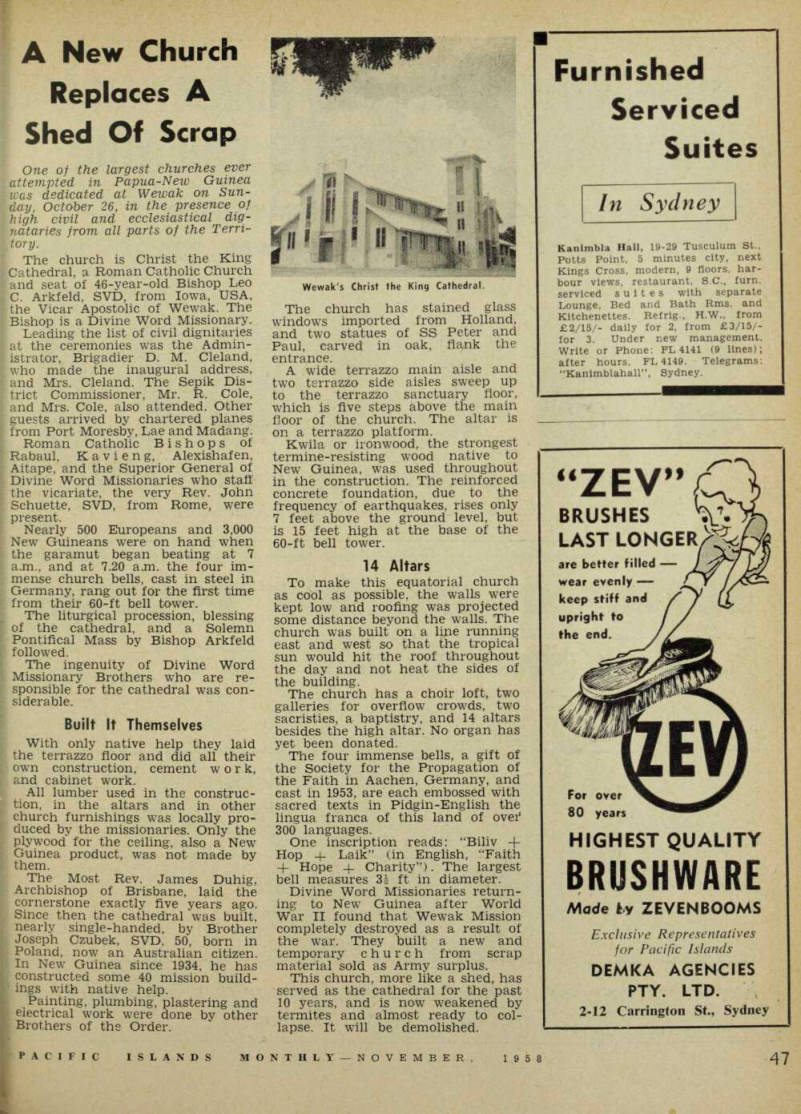
The church is Christ the King Cathedral, a Roman Catholic Church and seat of 46-year-old Bishop Leo C. Arkfeld, SVD, from lowa, USA, the Vicar Apostolic of Wewak. The Bishop is a Divine Word Missionary.
Leading the list of civil dignitaries at the ceremonies was the Admin istrator, Brigadier D. M. Cleland, who made the inaugural address, and Mrs. Cleland. The Sepik Dis trict Commissioner, Mr. R. Cole, and Mrs. Cole, also attended. Other guests arrived by chartered planes from Port Moresby, Lae and Madang.
Roman Catholic Bishops of Rabaul, Kavi e n g, Alexishafen, Aitape, and the Superior General of Divine Word Missionaries who staff the vicariate, the very Rev. John Schuette, SVD, from Rome, were present.
Nearly 500 Europeans and 3,000 New Guineans were on hand when the garamut began beating at 7 a.m., and at 7.20 a.m. the four im mense church bells, cast in steel in Germany, rang out for the first time from their 60-ft bell tower.
The liturgical procession, blessing of the cathedral, and a Solemn Pontifical Mass by Bishop Arkfeld followed.
The ingenuity of Divine Word Missionary Brothers who are re sponsible for the cathedral was con siderable.
Built It Themselves
With only native help they laid the terrazzo floor and did all their own construction, cement work, and cabinet work.
All lumber used in the construc tion, in the altars and in other church furnishings was locally pro duced by the missionaries. Only the plywood for the ceiling, also a New Guinea product, was not made by them.
The Most Rev. James Duhig, Archbishop of Brisbane, Ifiid the cornerstone exactly five years ago.
Since then the cathedral was built, nearly single-handed, by Brother Joseph Czubek, SVD, 50, born in Poland, now an Australian citizen.
In New Guinea since 1934, he has constructed some 40 mission build ings with native help.
Painting, plumbing, plastering and electrical work were done by other Brothers of the Order.
The church has stained glass windows imported from Holland, and two statues of SS Peter and Paul, carved in oak, flank the entrance.
A wide terrazzo main aisle and two terrazzo side aisles sweep up to the terrazzo sanctuary floor, which is five steps above the main floor of the church. The altar is on a terrazzo platform.
Kwila or ironwood, the strongest termine-resisting wood native to New Guinea, was used throughout in the construction. The reinforced concrete foundation, due to the frequency of earthquakes, rises only 7 feet above the ground level, but is 15 feet high at the base of the 60-ft bell tower.
14 Altars
To make this equatorial church as cool as possible, the walls were kept low and roofing was projected some distance beyond the walls. The church was built on a line running east and west so that the tropical sun would hit the roof throughout the day and not heat the sides of the building.
The church has a choir loft, two galleries for overflow crowds, two sacristies, a baptistry, and 14 altars besides the high altar. No organ has yet been donated.
The four immense bells, a gift of the Society for the Propagation of the Faith in Aachen, Germany, and cast in 1953, are each embossed with sacred texts in Pidgin-English the lingua franca of this land of over 1 300 languages.
One inscription reads: “Biliv + Hop + Laik” (in English, ‘‘Faith + Hope + Charity”). The largest bell measures ft in diameter.
Divine Word Missionaries return ing to New Guinea after World War II found that Wewak Mission completely destroyed as a result of the war. They built a new and temporary church from scrap material sold as Army surplus.
This church, more like a shed, has served as the cathedral for the past 10 years, and is now weakened by termites and almost ready to col lapse. It will be demolished.
Wewak's Christ the King Cathedral.