Territories Talk-Talk
pp. 35-41 · Read in the full issue
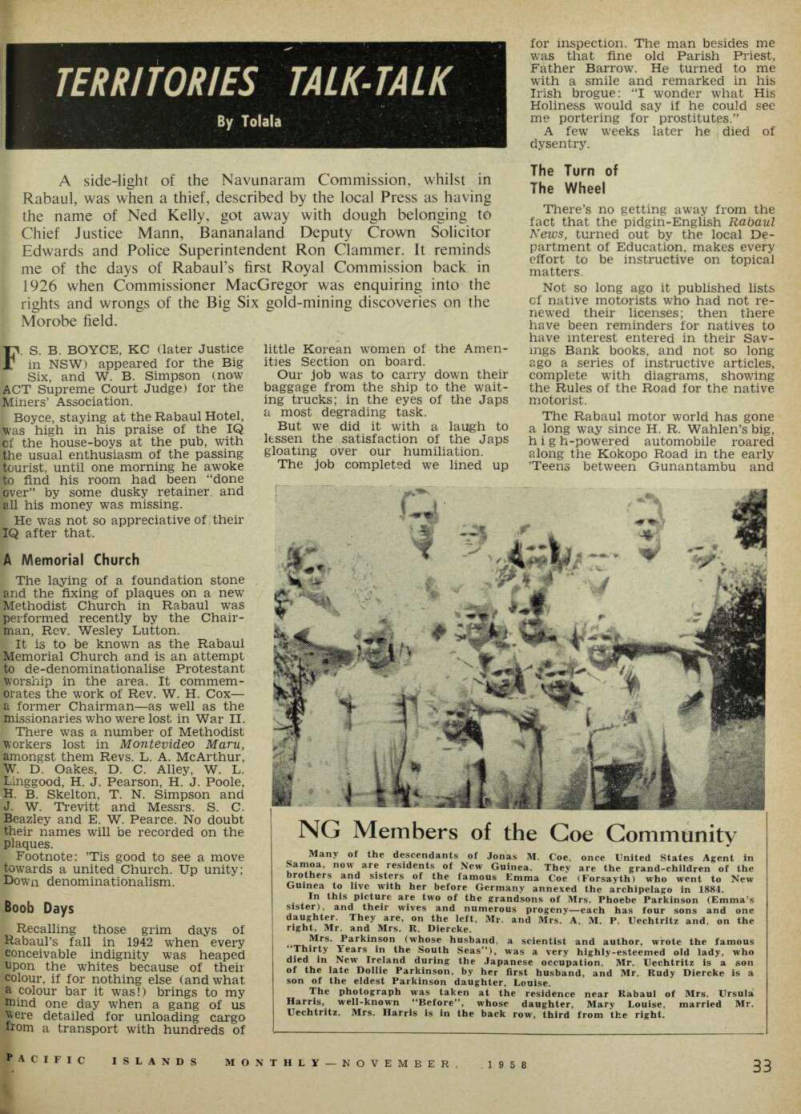

By Tolala
A side-light of the Navunaram Commission, whilst in Rabaul, was when a thief, described by the local Press as having the name of Ned Kelly, got away with dough belonging to Chief Justice Mann, Bananaland Deputy Crown Solicitor Edwards and Police Superintendent Ron Clammer. It reminds me of the days of Rabaul’s first Royal Commission back in 1926 when Commissioner MacGregor was enquiring into the rights and wrongs of the Big Six gold-mining discoveries on the Morobe field.
F. S. B. BOYCE, KC (later Justice in NSW) appeared for the Big Six, and W. B. Simpson (now ACT Supreme Court Judge) for the Miners’ Association, i Boyce, staying at the Rabaul Hotel, was high in his praise of the IQ ■cf the house-boys at the pub, with the usual enthusiasm of the passing tourist, until one morning he awoke to find his room had been “done over” by some dusky retainer and all his money was missing.
He was not so appreciative of their IQ after that.
A Memorial Church
The laying of a foundation stone and the fixing of plaques on a new Methodist Church in Rabaul was performed recently by the Chair man, Rev. Wesley Button.
It is to be known as the Rabaul Memorial Church and is an attempt to de-denominationalise Protestant worship in the area. It commem orates the work of Rev, W. H. Cox — a former Chairman —as well as the missionaries who were lost in War 11.
There was a number of Methodist workers lost in Montevideo Maru, amongst them Revs. L. A. McArthur, W. D. Oakes, D. C. Alley. W. L.
Linggood, H. J. Pearson, H. J. Poole, H. B. Skelton, T. N. Simpson and J. W. Trevitt and Messrs. S. C.
Beazley and E. W. Pearce. No doubt their names will be recorded on the plaques.
Footnote: ’Tis good to see a move towards a united Church. Up unity; Down denominationalism.
Boob Days
- Recalling those grim days of Kabaul’s fall in 1942 when every conceivable indignity was heaped upon the whites because of their colour, if for nothing else (and what a colour bar it was!) brings to my mind one day when a gang of us J'Cre detailed for unloading cargo from a transport with hundreds of
little Korean women of the Amenities Section on board.
Our job was to carry down their baggage from the ship to the waiting trucks; in the eyes of the Japs a most degrading task.
But we did it with a laugh to lessen the satisfaction of the Japs gloating over our humiliation.
The job completed we lined up
for Inspection. The man besides me was that fine old Parish Priest, Father Barrow. He turned to me with a smile and remarked in his Irish brogue: “I wonder what His Holiness would say if he could see me portering for prostitutes.”
A few weeks later he died of dysentry.
The Turn of
The Wheel
There’s no getting away from the fact that the pidgin-English Rabaul News, turned out by the local De partment of Education, makes every effort to be instructive on topical matters.
Not so long ago it published lists of native motorists who had not re newed their licenses; then there have been reminders for natives to have interest entered in their Sav ings Bank books, and not so long ago a series of instructive articles, complete with diagrams, showing the Rules of the Road for the native motorist.
The Rabaul motor world has gone a long way since H. R. Wahlen’s big, hi g h-powered automobile roared along the Kokopo Road in the early ’Teens between Gunantambu and
; Rabaul each mornuing, and fright ened natives ran into the bush to escape from the “steamer belong bl War I Top Brass brought a few cars along with them and the big Cadillac, with Administrator Sam Pethebridge in the back and chauffeur Jim Bell at the wheel, was a regular sight speeding up Tunnel Hill and through the Tunnel to the North Coast.
Of brass-bound T-model Fords there were a few.
Major Newport (Diddyman) had one which lasted well into the ’Thirties. Its number plate, I re member, was No. 1.
Another well-known Ford of the ’Twenties was No. 22 with young Bert Perriman behind the wheel driving with irrepressible abandon.
It was always a popular conveyance for “a blow to Kokopo” at night as any of the old-timers will re call.
There were no taxis then; Tex Roberts started the first taxi ser vice. And then Time marched on and in the late ’Thirties the num ber plate TNG 1,000 appeared on a late-model owned by Bert Gaskin.
Yes, the wheels of the auto mobiles have turned since then.
Our Northern Defences In August last, RSL State Pre sidents journeyed to P-NG to at tend the first RSL executive meet ing there. Said President Sir George Holland; “In the interests of Aus tralia, New Guinea should be guarded to the utmost.”
In mid-October the GOC Northern Command (Major-General T. J.
Daly) said the future patrols of the PIR would spread further afield throughout P-NG and would “shortly be supplied with a 62-ft. patrol vessel form Brisbane to act as an island waterways transport.”
It would have a mounting for twin Vickers machine-guns; would be stationed at Moresby until a crew had been trained, then move to the northern coast of New Guinea, near the Dutch border. It would be stationed at Wewak, where an army base would be prepared.
Well, that’s consoling, anyway.
Australians should be able to sleep better now.
Or perhaps we are depending on guided missiles from Maralinga when the cold war becomes hot and some of our northern neighbours repudiate past statements with the same alacrity they have Shown in repudiating other responsibilities. . Are we too dumb, or just apathetic in interpreting the writing on the wall?
Beating the Drum
Keith McCarthy’s doodling which Produced that delightful cartoon of the Salvo’s man beating the £20,000 drum before the envious Father
(Oct. PIM, p. 141) at least shows that all officials have not lost their sense of humour.
More of it in the make-up of the Bumbles of Bureaucracy would be welcome by the Little People of the World.
But reverting to the good works of the Salvation Army—which no body will deny—if they make as good a job of the Koki centre as they have already shown in the many theatres of war, then there should be no complaint.
Dating from about 1908 the Salvo had a gentleman’s agreement to refrain for fifty years from estab lishing their work in Papua. And now it seems their arrival is oppor tune, despite the colossal denom inational competitiveness within the Territories.
The needs of the civilised people have now become the needs of the near-primitives. The wandering, un attached native, who has but re cently been created, must be looked after; and-who better than the Salvo to do that job?
A factor that could have tipped the official scale towards that £20,000 is the Minister’s experience as a youth.
His father was an ardent Sal vationist.
Confusion of Vowels
The Mann Commission enquiring into the Navunaram incident has brought many things to light. One matter on which, incidentally, I have seen no comment, is the varied spelling of the name of the village where all the trouble started.
At first it was spelt “Navuneram”; later in some newspapers it became Navunaram.
A pity there is not some co ordination in matters of this kind.
There must be an official spelling (which, let us hope, is the accepted local native spelling) and where variance occurs in print an official statement should be made.
If the name is a composite one including vuna (“the place of”) then there can be no argument.
A study of Tolai place-names re veals that some confusion does exist in the use of “w” and “v”.
This is due to an attempt made by the German government about 1911 when it decreed that the use of “w” in place-names should be changed to “v”. It was not rigidly enforced, hence the lack of co-ord ination.
Retrogression
Dudley Jones, MLC, brought be fore the Legco, at the last meet ing, the indifferent ’phone service in the Gazelle Peninsula area as compared with 40 years ago; point ing out that a good rural ’phone service was operating in the Kokopo district in the German days.
DJ had something there. In the
early ’Twenties Rabaul could call up almost any Kokopo plantation, extending down as far as Tamalili, from which point an incoming steamer could be sighted well down the St. George’s Channel. It was the usual custom in those days, before the general use of radio, for Rabaul subscribers to ring Tamalili regarding shipping movements.
In the other direction the ’phone service touched Toma (the oldtime German sanatorium) and ineluded Varzin and Gire Gire plantations. Vunavutung was the limit of the North Coast line.
An occasional hom-bom would temporarily disrupt the service but Ted Hawnt and his native linesmen
would soon remedy that and sub scribers dipped their lids to Ted for maintaining an efficient service with a couple of “Malays” and a gang of “boys”.
"A Little Wisdom . .
If opinions expressed in “Letters to the Editor” in the South Pacific Post are a true indication of the present mental attitude of the P-NG native, then it is evident that our western culture (Australian variety) is being rapidly absorbed by the in digene capable of recording his ideas in black and white.
At least one assumes these letters are the genuine expression of native
' opinion and not the work of their hand guided by a European brain.
Such topics as Communism, Mau Mau, equal pay, employment of apprentices and advantages of education present provocative problems to some of the corre spondents.
One can only anticipate that if, at this early stage of transition, there are so many curly questions, it appears that in future years the number of Conciliation and Arbitra tion Commissioners in the Terriory will be legion; and, with the latest ultimatum issued by the members of the auxiliary division of the Public Service, it seems that the job of PS Commissioner will be no smecure.
“A little wisdom is a dangerous thing/’ has oft been quoted. But in P-NG it can become an embarrass ment to a paternal Administration.
An Old Racket Two Sydney businessmen dis covered that money rolls received from a bank, supposedly containing sixpences, were merely conduit pip ing wrapped in paper and cut to the length of 40 sixpences.
A very similar stunt was put over in Rabaul back in the ’3o’s when a bird of passage deposited a number of “fuses”, each ostensibly £5 of shillings, with a Chinese hotel keeper, and drew against the “fuses” for his spending money.
After several days of high living he suddenly departed.
The publican took the “fuses” to the bank when it was discovered they consisted of galvanised piping, cut to lengths and weighing the same as the ordinary roll of £5 of silver.
Following this fraudulent practice holes were punched in the bank’s paper wrappings which enabled a clear view of the milled edges.
A Political Palliative Considerable disappointment has been expressed amongst European ex-servicemen over the long-awaited Rural Credit Scheme, promised by the government and for which re cently only four blocks were made available in the Warangoi Valley of NB, according to reports in The Rabaul Times (3/10/58).
Diggers, who are usually fairly long in the tooth and hep to all the usual political gerrymandering, should have realised that the much publicised grants were merely a kite flying manoeuvre as a sweetening for the coming elections.
In fact some of the government’s developmental schemes for the NT and P-NG have such fantastic con ditions attached to them that allow only Big Money—repeat Big—to acquire an interest in them.
The development of P-NG is too internationally complicated for a c’ear issue to be defined favouring
European ex-servicemen. I may be wrong, but I would not put the blame cn the shoulders of Paul Hasluck for this involved situation.
P-NG is a major hot potato these days, and we shouldn’t forget it. . ‘ .
Bits and Pieces The man more responsible than any other for gumming up Rabaul as a capital site passed away at the end of September—'Walter ‘ George Woolnough—noted Australian geologist who, with Dr. Stehn (Dutch geologist from Java) made a survey of Rabaul following the 1937 eruption. The latter favoured the retention of Rabaul as a capital site (with reservations) but Dr. W. did not agree. . . Passionfruit growers are
complaining of the assistance given to growers in P-NG. Seems the de mand in NSW is on the decline. . .
Sixty-five per cent, of parcels from Australia received COD by P-NQ natives have to be returned as the consignees thought they didn’t have to pay, or had already spent their {™£ey. Dept. of Education might Pupils and save a lot of trouble, Over y °“’J Sd i|; ors of p idgmp;apers.
A on J Oi• Jan Saave one t]me u M ° at Ra . bau j- fr °™ gh 1 ? ea JE v t . er , hls FRCS> tells of doing his Diploma course ln Tropical Medicine at the Liyer- P°°l (England) School of Tropical Medicine at the invitation of Prof, G. E. Maegraith.