A Scot Named
p. 33 · Read in the full issue
Important Elections In The Cooks A Scot Named Viri Vokotini
Rarotonga businessman Mr.
William Watson, a Scot whose
.accent has been unimpaired by
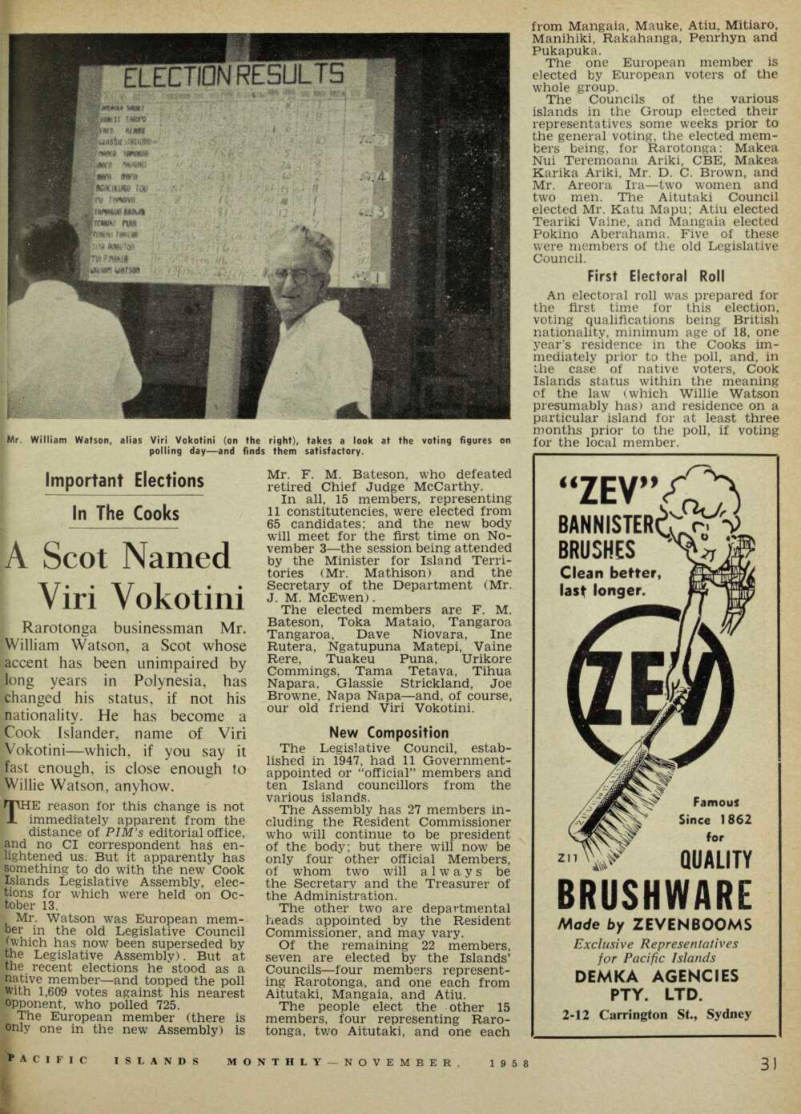
long years in Polynesia, has changed his status, if not his nationality. He has become a Cook Islander, name of Viri Vokotini—which, if you say it fast enough, is close enough to Willie Watson, anyhow.
THE reason for this change is not immediately apparent from the distance of PlM’s editorial office, and no Cl correspondent has en lightened us. But it apparently has something to do with the new Cook Islands Legislative Assembly, elec tions for which were held on Oc tober 13.
Mr. Watson was European mem ber in the old Legislative Council (which has now been superseded by the Legislative Assembly). But at the recent elections he stood as a native member —and tonped the poll with 1,609 votes against his nearest opponent, who polled 725.
The European member (there is only one in the new Assembly) is
Mr. F. M. Bateson, who defeated retired Chief Judge McCarthy.
In all, 15 members, representing 11 constitutencies, were elected from 65 candidates: and the new body will meet for the first time on No vember 3 —the session being attended by the Minister for Island Terri tories (Mr. Mathison) and the Secretary of the Department (Mr.
J. M. McEwen).
The elected members are F. M.
Bateson, Toka Mataio, Tangaroa Tangaroa, Dave Niovara, Ine Rutera, Ngatupuna Matepi, Vaine Rere, Tuakeu Puna, Urikore Commings, Tama Tetava, Tihua Napara, Glassie Strickland, Joe Browne, Napa Napa—and, of course, our old friend Viri Vokotini.
New Composition
The Legislative Council, estab lished in 1947, had 11 Government appointed or “official” members and ten Island councillors from the various islands.
The Assembly has 27 members in cluding the Resident Commissioner who will continue to be president of the body; but there will now be only four other official Members, of whom two will always be the Secretary and the Treasurer of the Administration.
The other two are departmental heads appointed by the Resident Commissioner, and may vary.
Of the remaining 22 members, seven are elected by the Islands’
Councils—four members represent ing Rarotonga, and one each from Aitutaki, Mangaia, and Atiu.
The people elect the other 15 members, four representing Raro tonga, two Aitutaki, and one each
from Mangala, Mauke, Atiu, Mitiaro, Manihiki, Rakahanga, Penrhyn and Pukapuka.
The one European member is elected by European voters of the whole group.
The Councils of the various islands in the Group elected their representatives some weeks prior to the general voting, the elected mem bers being, for Rarotonga: Makea Nui Teremoana Ariki, CBE, Makea Karika Ariki, Mr. D. C. Brown, and Mr. Areora Ira—two women and two men. The Aitutaki Council elected Mr. Katu Mapu; Atiu elected Teariki Vaine, and Mangaia elected Pokino Aberahama. Five of these were members of the old Legislative Council.
First Electoral Roll
An electoral roll was prepared for the first time for this election, voting qualifications being British nationality, minimum age of 18, one year’s residence in the Cooks im mediately prior to the poll, and, in the case of native voters, Cook Islands status within the meaning of the law (which Willie Watson presumably has) and residence on a particular island for at least three months prior to the poll, if voting for the local member.
Mr. William Watson, alias Viri Vokotini (on the right), takes a look at the voting figures on polling day—and finds them satisfactory.