Pacific Report
pp. 119-148 · Read in the full issue
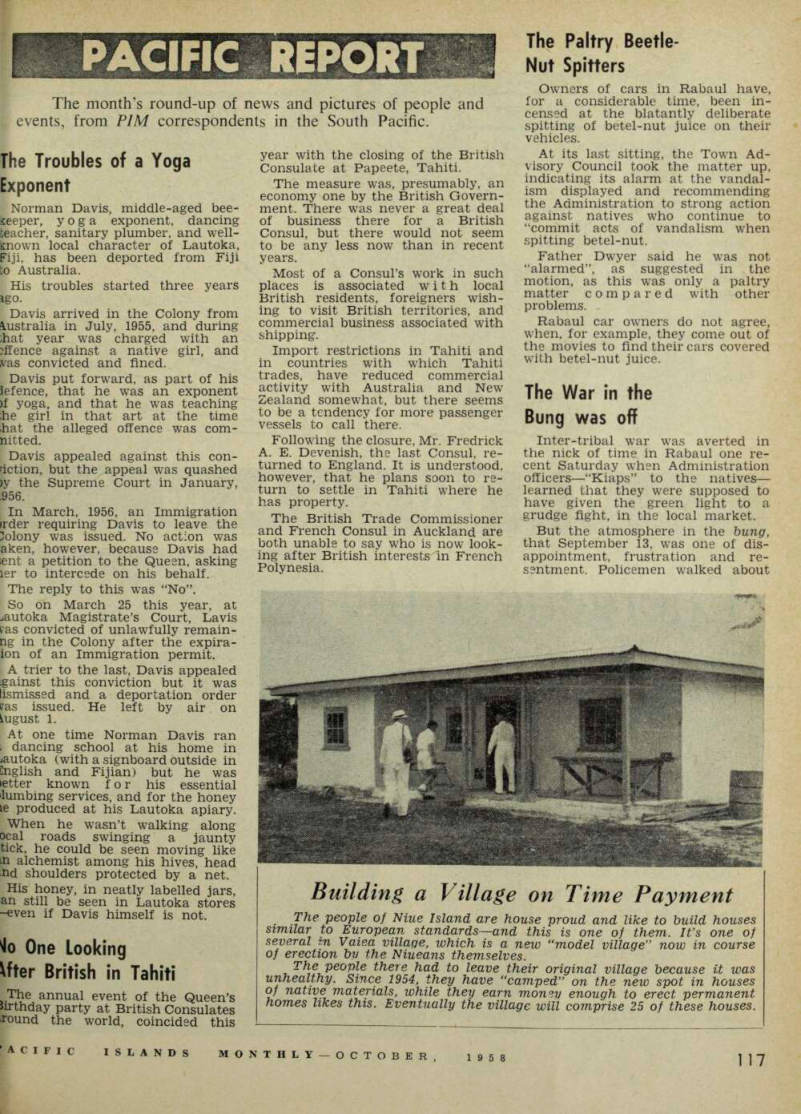
The month’s round-up of news and pictures of people and events, from PIM correspondents in the South Pacific.
The Troubles of a Yoga
Exponent
Norman Davis, middle-aged bee keeper, yoga exponent, dancing teacher, sanitary plumber, and well known local character of Lautoka, Fiji, has been deported from Fiji to Australia.
His troubles started three years ago.
Davis arrived in the Colony from \ustralia in July, 1955, and during ;hat year was charged with an offence against a native girl, and vas convicted and fined.
Davis put forward, as part of his iefence, that he was an exponent )f yoga, and that he was teaching he girl in that art at the time hat the alleged offence was com nitted.
Davis appealed against this con viction, but the appeal was quashed >y the Supreme Court in January, .956.
In March, 1956, an Immigration irder requiring Davis to leave the Colony was issued. No action was aken, however, because Davis had lent a petition to the Queen, asking ler to intercede on his behalf.
The reply to this was “No”.
So on March 25 this year, at jautoka Magistrate’s Court, Lavis ivas convicted of unlawfully remain ng in the Colony after the expira ion of an Immigration permit.
A trier to the last, Davis appealed igainst this conviction but it was lismissed and a deportation order ms issued. He left by air on lugust 1.
At one time Norman Davis ran i dancing school at his home in iautoka (with a signboard outside in English and Fijian) but he was letter known for his essential lambing services, and for the honey le produced at his Lautoka apiary.
When he wasn’t walking along ocal roads swinging a jaunty tick, he could be seen moving like m alchemist among his hives, head nd shoulders protected by a net.
His honey, in neatly labelled jars, an still be seen in Lautoka stores -even if Davis himself is not.
One Looking
Liter British in Tahiti
The annual event of the Queen’s Jirthday party at British Consulates ■round the world, coincided this
year with the closing of the British Consulate at Papeete, Tahiti.
The measure was, presumably, an economy one by the British Govern ment. There was never a great deal of business there for a British Consul, but there would not seem to be any less now than in recent years.
Most of a Consul’s work in such places is associated with local British residents, foreigners wish ing to visit British territories, and commercial business associated with shipping.
Import restrictions in Tahiti and in countries with which Tahiti trades, have reduced commercial activity with Australia and New Zealand somewhat, but there seems to be a tendency for more passenger vessels to call there.
Following the closure, Mr. Fredrick A. E. Devenish, the last Consul, re turned to England. It is understood, however, that he plans soon to re turn to settle in Tahiti where he has property.
The British Trade Commissioner and French Consul in Auckland are both unable to say who is now look ing after British interests In French Polynesia.
The Paltry Beetle-
Nut Spitfers
Owners of cars in Rabaul have, for a considerable time, been in censed at the blatantly deliberate spitting of betel-nut juice on their vehicles.
At its last sitting, the Town Ad visory Council took the matter up, indicating its alarm at the vandal ism displayed and recommending the Administration to strong action against natives who continue to “commit acts of vandalism when spitting betel-nut.
Father Dwyer said he was not “alarmed”, as suggested in the motion, as this was only a paltry matter compared with other problems.
Rabaul car owners do not agree, when, for example, they come out of the movies to find their cars covered with betel-nut juice.
The War in the
Bung was off
Inter-tribal war was averted in the nick of time in Rabaul one re cent Saturday when Administration officers—“Kiaps” to the natives— learned that they were supposed to have given the green light to a grudge fight, in the local market.
But the atmosphere in the bung, that September 13, was one of dis appointment, frustration and re sentment. Policemen walked about
carrying batons, and trading pro ceeded very, very quietly. The fun ,was obviously over, before it had begun.
During the week, word had circu lated that the Kiaps had told groups of feuding Tolais and New Guinea Mainlanders that they could fight out their differences at the market the following Saturday.
Feeling ran high, anticipation mounted, house staffs exhorted puzzled employers to do their marketing early to avoid trouble.
Employers questioned astounded Kiaps and just as suddenly it was all off.
Must be one of these language difficulties of which we hear so much!
Fhe Big Nadi Project
Really Starts Moving
Arrival of large quantities of material and equipment from the JK for Nadi airport’s £F3 million reconstruction scheme, made Lau »ka port a busy place in August md September.
Onlookers prowled around monster fellow and orange-painted earth noving equipment—with a critical lye on possible future bargains when lirport work is completed.
The NZ Star arrived mid-August vith tip trucks, mobile dumpers and oad rollers which went under their iwn power by road from Lautoka o Nadi.
An 18-ton shovel base and 13-ton crapers were transported by barge rom Lautoka to the newly erected etty at Newtown, Nadi airport, :lose to the scene of operations.
A huge area has been excavated it the southern end of the north outh runway revealing an un lulating sea of clay. In the pessimi stic way of most casual observers, ocal people, one eye on the clouds md the other on this mass of uture mud, predicted a sticky end or the machines now working flat >ut to beat seasonal rains due in November.
Remainder of cargo on board the VZ Star was building equipment ncluding pre-fabricated quarters, mlk store and office.
Several of the pre-fabricated lomes were soon up and occupied.
'Jo doubt to allow cross-ventilation, ‘oofs of the rather fragile-looking itructures are open under the eaves, Jiving the illusion that they were >ut on as an afterthought. This •rovided another source of optimistic Jessimism among local residents— vould they stay on in a blow?
Excavators, jeeps, steel mesh and urther building materials arrived >n the Medic in mid-August and •teel mesh also arrived on the ort Lyttleton in early September.
And Shoho Maru, from Japan, carried 3,000 tons of cement, and
Treameadow, in early October, of loaded stone crushing material.
Nadi’s big airport scheme, i make room for the jet age, ws really getting under way.
Plan for Developing
Fiji's Fishing Industry
Proposals for establishing a fisl ing industry in Fiji are made in report of a committee set up la year by the Fiji Government fo lowing a survey carried out by Sout Pacific Commission fisheries offic Mr. H. van Pel.
The report recommends that fisheries officer be appointed to ao vise on and supervise the develoj ment of sea and inland fisheries, also thinks that the netting of fis in an area around Suva should I prohibited for at least five years b( cause of the depleted state spawning beds and fish life gene; ally.
Other suggestions include ei couragement of longline methods fishing, the establishment of a fi:. cannery, and the provision, wh Government assistance, of refriJ eration facilities for bulk storage fish.
South Pacific Commission
Meets in Noumea
Proposals for setting up schoo to train Pacific islanders in boas building and literature products were being considered at tz eighteenth session of the Sout Pacific Commission, which openr at its headquarters in Noumea i September 26. The meeting wi expected to last about eighths days.
Also being studied was Con mission progress made in the pa year in a number of fields, notall fisheries, plant introduction, conti: of plant and animal pests an diseases (especially the rhinocen; beetle), health education of tf public, nutrition and diet, mosquitti borne diseases and islands o operatives.
As usual, plans will also approved for the Commission’s wo for 1959.
Representatives attended 11 meeting from the six membi nations of the Commission, Ail tralia, France, the Netherlands, Nt Zealand, the United Kingdom, ac the US. Chairman is the Sene Commissioner for the Unitri Kingdom, Sir John Gutch.
Where Fiji Gets Its
Motor Cars
Statistics issued in Suva in Sec tember showed that Fiji has total of 7,154 licensed vehicles.
They comprise 2,732 cars, 2,;,S
commercial vehicles (ranging from heavy trucks to light vans), 745 tractors, 684 taxis, 378 buses, and 289 motor cycles, scooters and powered cycles. There are also 18 ambulances, 15 fire engines—and 12 steam rollers.
The statistics are for 1957. They show that there were six times more British makes of vehicles in use than all other makes combined — 5,053 against 822.
Morris led with 664. Then came Ford with 598, Vauxhall with 505, Standard with 392, Austin with 364, Hillman with 267 and Holden with 114.
The statistics show that in new sales, Holden led with 98. Three makes tied for second place, each with exactly the same number of sales, 78. They were Ford, Morris and Vauxhall. Austin’s new sales were 51, and Standard 29.
In the commercial class, Bedford were far in the lead. There were 1,197 of them —nearly 1,000 more than any other make of commercial vehicle.
Work Starts on Big
Moresby Pipe Factory
Work vn construction of a new pipe factory in Port Moresby for the Monier Pipe Coy. of Australia began in September.
Hornibrook Constructions Ltd. secured the contract.
Target date for completion of the new factory is December 1, and production of pipes, building blocks and other precast concrete products is due to begin immediately after wards.
The first stage of erecting and equipping the factory and office will eost about £50,000. Work on the second stage will bring the total to £75,000.
Concrete Industries (New Guinea)
Ltd. has been formed to handle the Port Moresby business, and directors are: Mr. W. V. Armstrong, chairman of directors of Concrete Industries (Australia) Ltd.; Mr. K. B. C.
Milburn, managing director of Concrete Industries (Australia) Ltd.; Messrs. John H. Hohnen, MLC, J. Irwin Cromie and Barry Combe (local directors).
Fiji Bought More Than
It Sold in AuniKt
y State of Fiji’s economics is indicated by the fact that August saw the highest monthly total of
imports ever recorded in Fiji. They were valued at £2,189,000. That was almost £1 million more than the total imports in August last year. But exports dropped.
From Britain came goods worth £973,000 and from Australia goods worth £573,000. More came in from Indonesia—£lB2,ooo—than from New Zealand—£9o,ooo.
Main items were machinery and transport equipment totalling food 00 £°4bo o^o terials £482 ’ 000 and Exports totalled £1,660,000, which was £ 150 ,000 iess than in August iast year, Principal exports were sugar, £957,000; coconut oil, £274.000; un-
refined gold, £50,000 and manganese ore, £20,000.
The chief buyers of Fiji’s goods were Canada, £594,000; Britain, £496,000; New Zealand, £165,000 and Australia, £60,000.
Fiji Talks of
Tourists and Carvings
The Fiji Visitors’ Bureau, which would be called a tourist bureau anywhere else, embarked on a public “morale boosting” programme in September.
It decided that Fiji’s current re cession was causing too many mouths to droop at the edges, and that what Fiji needed was a few facts and figures to show that things could be worse. It was, in fact, time for “legitimate optimism”, the bureau decided.
With the slogan, “Trust in Fiji’s Future”, newspaper advertisements sponsored by the Bureau, announced that the tourist industry was one industry that was booming. It was a million pound industry in 1957, and figures for 1958 probably would be a million and a quarter.
Compared with 1950, said the Bureau, 31,602 more tourists had visited Fiji last year, spending £600,000 more. than they had in 1950. Almost 6,000 more tourists had •stayed in hotels last year, pushing up hotel revenues by £400,000.
And the tourist boom was con tinuing this year, with 37,000 visitors, spending £428,000 in the Colony, in the first six months of the year.
More than 8,000 tourists had visited Fiji in the month of July. Meanwhile the Bureau is laying plans to encourage even more : tourists along to see the wonders of Fiji. One of the areas slated for a build-up is Ovalau, where the old capital of Fiji, Levuka, is meeting
bad times now that the copra trade has gone ( PIM , page 125).
Live-wire Bureau secretary Peter White, who has an eye for publicity, took a first-hand look at the island recently and came back reporting a first-hand “mystery”*—a mystery no doubt guaranteed to attract a few more free-spending tourists for a close-up look.
Mr. White said he visited the beautiful Lovoni valley while on Ovalau, and was told there by a Fijian of a cave in the surrounding hills which had strange writing in scribed on the walls. ‘‘There may be a mystery here as deep and enigmatic at the idols of Easter Islands,” exclaimed Mr. ■White. “Any information about it
would be most gratefully received.”
No doubt somebody will come up with information of some kind about the Lovoni writings, to the delight of the Bureau. But this kind of thing is not unique in Fiji.
There are petroglyphs in a partly water-filled cave in the small island of Yasawa-i-Lau, one of the Yasawa group, which have never been de ciphered, although many author ities have been consulted. It’s been thought that they might be in some early Chinese script.
There are others behind Daku niba, on Vanua Levu, which were discovered in 1933. Some of the Vanua Levu carvings (reproduced on this page) are five feet long and only a few inches deep.
They were photographed in 1940 by the Fahnestock Expedition, and as a result, identified in America as being almost identical with designs found engraved on stones in India.
Tolai Methodists and Popis
Get Together
Among the razor-backed ridges and deep gullies of the Toma area of the Gazelle Peninsula, New Britain, a brighter note was sounded at the opening recently of the Paparatava Maternity and General Hospital for natives.
Two thousand very proud Tolais lined the hill directly above the hospital to see the blessing and opening by Bishop Scharmach.
This was a perfect example of community effort, providing food for thought in these days when the Administration appears to give so much to the natives who give little in return.
The Roman Catholic Mission agreed to supply the framework and
The mysterious carvings of Vanua Levu. They were discovered in 1933, and this illustration of them may or may not be the right side up! See story this page.
timber, if the natives would do the rest. Due to the rugged contour of the land there was no flat surface for the building, so nothing daunted, a daily average of 80 men turned up for many months and excavated the site with shovels and wheelbarrows.
Methodist and Catholic villages of the area raised £2,900 in cash, in addition to doing the entire job of construction under the eye of Father Murche.
During the opening proceedings, a native speaker provided a great deal of amusement in his eulogy of Father Murche by stating, somewhat am biguously, “We want him to die here”!
Same Music—New House
Eddy Lund, whose Tahitian music has been dispensed for many years past from Quinn’s Tahitian Bar in Papeete, and whose recordings are very well known overseas, has re cently tranferred his band to Bar Lea elsewhere in town.
While others are prepared to pollute the air at times with imported music, Eddy, according to cur report, is sticking strictly to the authentic Polynesian beat, at Bar Lea.
Dil in Bulk
)r by Sausage
Overseas interest in establishing i bulk oil installation at Rarotonga vas revealed by the Resident Com missioner of the Cook Islands, Mr. 3. Nevill, at the August meeting the Island Council.
Mr. Nevill said he had received i letter on the subject from Mr.
W. S. Johnson, managing director )f South Pacific Trading Co. —of vhere, not stated. This company vas seeking to lease an area of •ocky Crown Land on the Avatiu Jide of Nikao, right on the fore ihore.
According to the official report )f the Council meeting, Mr. Nevill [aid that the Union Steam Ship ■'O. would not greet the plan with my enthusiasm, and the Council
should keep in mind that, with decreased cargoes for that company’s vessels—all petroleum products are at present imported in drums—there would be correspondingly fewer outlets for tomato shipments to New Zealand.
The matter is apparently still have' raiseti or httle n meeting debate at the Several local shin owners have been showing interest in the possibility of bringing bulk oil supplies by barge or pontoon from the bulk installation at Papeete recently, and at least one was reported some time ago to be making active inquiries for a suitable towing barge, the plastic or rubber “sausage”-type being under consideration as particularly suitable.
It could be rolled up and shipped back in the towing vessel’s hold. involving towage one way only. a n f ” Ixepori Mlmeu dl « y saving d lOWH histo ric former capital of Fiji, made recommendations about its own future in September, A committee of local planters and businessmen, together with the Commissioner for the district, Mr.
Q Weston, issued a report to the Government on what should be done to prevent Levuka, which has been on the decline for 50 years, from finally falling into the dust see FIM, September).
Levuka’s troubles have recently
Ibeen accelerated because the copra Itrade, the basis of its economy, has virtually by-passed it for Suva —one result, of the ending of the (British MOF contract in January.
Main points of the Committee’s report were that the Government should set up a new copra board (the old one was dissolved earlier this year), appoint a copra grader to Levuka, and pay a subsidy of £2 10 - a ton for copra produced in the Lomaiviti group and pur chased at Levuka.
The subsidy will be a temporary
Jxpedient, until the copra board jegan operating again.
In a rather despairing rider to he recommendations, the committee Jeclared that Levuka would be jome “an abandoned and poverty stricken area unless firm remedial neasures are taken without delay”.
The committee pointed out that n the first six months of 1958, about £125,000 had been lost to Levuka.
Business generally is right down, md has never been worse.
One unhappy result of Levuka’s plight is that with 200 unemployed in a town of 1,500, many people are aeing forced to go to Suva for work —and some of them help to swell he big number of unemployed that ire already in Suva from other Jentres.
By late September, the Govern ment had made no comment on he Levuka committee’s suggestions tor saving their town.
Rarotonga Wharfage
May Go Up
Rarotonga Island Council recently approved a Harbour Improvements Committee recommendation that the present cargo levy of 1/- per ton on imports be raised to 2/6 per ton on both imports and ex ports with a view to building up the harbour improvements fund.
Before the measure can be imple mented it will require legislation in New Zealand.
Makogai May Be
Even Happier
Although the cure for cancer has yet to be found, some other human scourges, killers for as far back as history takes us, look as though they could well receive the coup de grace in the next few years.
Tuberculosis is one of them; malaria another; and now it seems that leprosy might follow suit.
In a recent report on the Leprosy Hospital at Makogai, Fiji, the Inspector General of the South Pacific Health Service, Dr. P. W.
Dill-Russell (who is also Fiji’s Director of Medical Services, of course) suggests that the need for famous Makogai may cease altogether within the next 15 years.
Makogai, which is one of the model leprosariums of the world, was established in 1911 and accepts patients from Samoa, Cook Islands.
Niue, Tonga and the Gilbert and Ellice Islands, as well as Fiji.
At one time—and not so long ago —all a leprosy sufferer could expect was a slow death, in complete segregation from family and friends. But now, with improved methods, the trend is for out
patient treatment and so the need for segregation centres like Makogai has diminished, The miracle worker has been the drug diamino diphenyl sulphone, which was introduced at Makogai in 1948. The figures tell the rest of the success story: In 1948 there were 73 admissions, 52 discharges and 40 deaths; in 1951, 113 admissions, 83 discharges, 24 deaths; in 1957, 49 admissions, 38 discharges and only 8 deaths.
Makogai has always been a pleasant
place, with everything possible done for the comfort, welfare and well being of the patients, from technical schools to movies. But it is still banishment and when the need for it is no more, no one will rejoice nore than the band of Missionary Sisters of the Society of Mary whose ‘devotion to duty, enthusiasm and lever failing cheerfulness have made Makogai the happy place that it is”.
The Problem of
’ublicity
Tourists the world over expect, ind receive, some information about he places they are visiting, and a J -NG correspondent reports that hey complain bitterly about the ack of it in the Territory.
Even people in Australia about to ake up an appointment, say there s nothing available at tourist tureaus or Territory departments, ,nd they have to rely on whatever nformation they can gather from x-residents.
But in some cases, their inform ants are not equipped to advise, be ause they may not have set foot ntside one particular center and
wouldn’t have a clue about condi ions elsewhere.
The correspondent adds: At a scent Madang Town Advisory Jouncil the subject was re-intro hced by Mr. Vicary, who suggested hat the Chamber of Commerce give urther consideration to the pub ishing of a tourist pamphlet.
Mr. Meek, secretary of the Chamber, said that the Chamber had gone into the matter thoroughly and it was found that to publish a journal having 12 photographs and 12 pages of matter would cost about £250 —a price based on 5,000 copies. Therefore the Chamber had not considered it to be an economic proposition.
So the Chamber is now mak ing enquiries into the possibility of producing a documentary film on the Madang district, to be used as advertising.
Longer Range for
Electra Airliners
The range of the new Lockheed propjet Electra airliner, which will be flying for three Australian air lines and TEAL next year, has been increased from 2,750 miles to 3,460 miles by the provision of extra 900gallon fuel tanks in the wings.
This development follows repre sentations by Qantas, which is buy ing four of the Electras for use on its Far East, New Guinea and Pacific Islands routes.
Qantas sought the longer range for its Electras to eliminate re fuelling at intermediate stops on these long inter-island runs.
The extra tanks, which are optional for the 15 world airlines which have already ordered 161 Electras, increase the standard fuel
capacity of the 400 mph 66/99 passenger airliner from 5,506 to 6,406 gallons.
Someone in Tl
Didn't Savvy
A group of 160 shell divers in dentured from Okinawa to Thurs day Island last March, were satis factory as divers but of little use as instructors to the local Torres Strait native divers, according to a Thursday Island report.
It was hoped that these Japanese divers would be able to show the local men how to operate in deeper water than they are at present able to do.
Dutch New Guinea is
"Tax Tormented"
The residents of Australian-con trolled Papua-New Guinea have for some months now been sitting on the edge of their chairs, waiting for what they regard as a catastrophe to strike them in the form of in come tax. The tax is coming all right, although nobody knows just when.
But in September, they got some thing in the way of a cheer-up note, if they wanted to read it that way, in a report from Port Moresby based AAP-Reuter correspondent William Gasson, who flew to Nether
lands New Guinea to compare the Territories.
He wired back the heartening news: “Dutch New Guinea is a tax tormented country compared with Australia’s P-NG.”
He then added: A long list of taxes brings in con siderable revenue for the country, 3ut at the same time it appears to have the effect of frightening off private enterprise and investment n this Territory.
The potential of this country is ar less than across the border. For hat reason alone it would seem hat greater incentives might be jffered to attract capital to the jountry by reduced taxation.
Compared with Australian Terri ;orians, who face with uncertainty ;he possible introduction of income ;ax in the near future, the life of -he Dutch officials here is difficult.
Their list of taxes begins with in some tax, continues with property ;ax, wages tax, company tax, stamp iuty, transfer duties, import duties md ends with a nagging statistical luty that is in the form of a fee evied to meet the costs of statistics.
While income tax is charged on ;he total net income of the people, ;here is provision for promoting
economic activity in the Territory.
This includes an establishment exemption for newly formed busi nesses, an investment reserve allow ing new firms tax-free profits to buy further plant and a free write-off which makes it possible to reduce taxable profit by an arbitary write off on plant.
A company tax of 40 per cent, is levied on the profits of limited liability companies established in the Territory.
The property tax is a minor tax but, like Australian New Guinea, import duties are high. The levying system includes 12 per cent, on ordinary consumer goods and 20 per cent, on luxury consumer goods.
The Dutch have a progressive policy regarding the taxation of Papuans which is vastly different to Australian New Guinea’s £2 a head for natives and Europeans alike.
Here, in almost all types of taxes, the employed Papuan pays his tax pound-for-pound with the European.
Both races are taxed from four to 15 per cent, of their wages.
For years, even before the war, the Dutch had adopted this taxation system for the Papuans. Along the coastal areas of the Territory where the natives have been brought under control a head tax is levied by the Government.
Like the neighbouring territory, the tax varies according to the cir cumstances and development of the tribes. But whereas the maximum tax for Australian natives is £2, Dutch Papuans’ tax can vary from £l/14/- up to £3/6/- for each adult male.
This tax is paid direct to the Government and not to local native government councils, which are still in their infancy in this Territory.
In the towns where the natives have become more sophisticated and earn more money, the tax rises and reaches income tax proportions where the natives are regularly em ployed.
Natives living around the coast near Hollandia pay a head tax of between 16/- and £4/10/- a year.
There appears to be no resentment
n the part of the Papuans paying heir tax. Their attitude, among the ophisticated natives is one of a atural right as an equal with the luropeans.
To ask a well-educated Papuan ative whether he thought he should ay his tax seemed ridiculous when tie Papuan was obviously an equal nd totally accepted by the Euro ean population.
Nor do the village natives cause ny Navuneram-type of complaints tiat recently flared up near Rabaul i Australian New Guinea even lough, on a comparison, the natives ere shoulder a far greater tax urden than their Australian New luinea countrymen.
The success of peaceful tax col jcting which the Dutch have chieved is due mainly to the ducation of the natives towards the easons for the tax.
Government officials say the pur ose is fully explained to the tribes efore the tax is instituted. Also, p hen the natives see that the luropeans are paying in most cases •ore tax than the Papuans, they are uite prepared to share in the cost f running the country.
A Papuan office boy working for le Government pays four per cent, f his annual salary. He might re vive the basic monthly wage of i, 8/-, plus a cost of living allow nce of £6/15/ higher than his r ages—and another £6/15/- for his >ur children. Of his yearly salary of 221/16/- he pays £B/8/-.
The higher the salary, the greater le tax. A Government official might Jceive £175/15/- a month, which icludes salary, cost of living allow nce and children allowance. On lis he is taxed £5O/4/-.
So, too. would a Papuan if he
had reached the stage of develop ment where he could fill such a high position.
Papua's Best Show is
Washed Out
Papua—and perhaps New Guinea, outside Goroka—never saw a finer agricultural and pastoral Show than the exhibition at Sefton Park, Sogeri, on September 15. And it never saw a show more quickly obliterated by rain.
As an example of what can be
produced, in foodptuffs, livestock, and standard tropical crops, on those beautiful, fertile plateaus of the Sogeri Valley, this show will not soon be forgotten. The setting was perfect—innumerable stalls laid out under shade trees on undulating green lawns, beside the swift-flow ing Laloki.
As an example of community co-operation, it earned high praise.
Every resident of Sogeri contributed something, in cash, service or ex hibits. Every trading concern in Moresby made an exhibit of some thing interesting. Every citizen of Moresby and the Central District felt it his duty to attend “our Show”. By lunchtime, about 7,000 Europeans and natives had as sembled there.
The Chimbus of the Highlands gave the exhibition its final picturesque touch.
The sophisticated Papuans came along in plain lap-laps and wide smiles, to enjoy the outing. But the Chimbus donned the magnificent, highly-coloured dresses which have made them famous and, in their scores, stalked with great dignity through the crowds. Even when posing for photographers and scrambling for free “samples” they never lost their poise—they were unchallenged gentlemen of a great occasion.
The grand parade—bulls and pro duce, horses and vehicles and so forth—was the highlight of the day.
And then, down came a typical Sogeri thunderstorm, and the ex hibition, the culmination of weeks of devoted and clever work, simply disappeared under a deluge of cold rain. Thenceforth, the programme was washed out. Everyone went home.
The highway from Sogeri down to
Although the most dignified and decorative spectators at the Sogeri Show, near Port Moresby, in September 15, the Chimbus reacted like anyone else when they sighted “free samples". In this case, they were after ice cream. See story below.
fforesby is a narrow road of terrify ag curves and grades, enough to care any driver in fine weather, ’he rain and the countless cars nd lorries and buses turned the lust into slippery mud, queues formed while in umerable vehicles were hauled out f water-holes and ditches. .For Moresby folk, it was a long, rearisome, bedraggled homecoming, kit no car went over the beckoning •recipices of the Sogeri gorges and -if we count the hours only from aylight until lunchtime —it really fas the best show we ever have Ben in the Pacific Islands —R.
'Aoniu" Now on
tegular Schedule
All ships of the Tongan Govern lent have now been brought under lie control of a Shipping Control Committee, with the Harbour Master, laptain John Sutherland, as Chair lan.
Oversight will be given to the eneral running of the vessels and me tables have been prepared to ave overlapping, and to provide a egular service around the Group.
The Aoniu is scheduled to make lonthly visits to Suva and the cabin assages have already been booked ut to the end of the year.
Her first scheduled voyage out of lUkualofa was on September 27, r ith a return departure from Suva aur days later.
Cook Islands Woman
Found Guilty
Mrs. Veia Love Lowry, daughter of a leading Cook Islands family, and wife of a Mormon missionary formerly of Rarotonga, was sentenced to two years gaol by a Canadian Court in September, when found guilty of the manslaughter of her daughter Blondie Takau Lowry, aged eight years.
The child died from head injuries on April 7.
Mrs. Lowry visited New Zealand last year and took the child back to Canada with her at that time.
Now Tourist Fares
On Coral Route
TEAL announced at the end of September that tourist class fares, applicable for several years past on most overseas airline routes, would also apply on the Coral Route ser vice from Fiji to Tahiti as from October 16.
The tourist fare is 20 per cent, less than first class. The service will undoubtedly be rushed by the many people of the low income group, who, through very restricted facilities for sea travel, are forced to travel by air—especially Cook Islands residents who can often ill afford the heavy cost of the first class fare and are quite prepared to
NATIVE "OBSERVERS" OF COUNCIL. An interesting experiment was carried out by the Papua [?]nd New Guinea Administration when the Legislative Council met in Moresby on September 16.
Six "observers", from different parts of the Territory, were brought in to Moresby, and main lined there for a week, while they attended each meeting of the Council and, under the tutelage [?]f Mr. J. C. Williams, of the Native Affairs Department, listened to the proceedings. They were [?]utiftted by the Administration —even to the extent of shirts and ties—and each got a daily [?]llowance of spending-money. Most of them were Pidgin speakers. As the proceedings conformed [?]trictly with Parliamentary procedure—puzzling enough to ordinary citizens—and were all in [?]nglish, it would be interesting to know the private opinions of the "observers". From left to [?]ight, the names of the observers are; KONDOM AKAU'UNDO, Luluai of Chimbu, Eastern High [?]ands; GEIBOB, of Butibum, Lae, president of the Lae-Wompa Native Local Government Council; [?]AU BAERA, of Tureture Village, Daru, Western Papua, president of the Daru, NLGC; JOHN EHAVA, [?]CM, of Kerema, Golf of Papua District; POKIO, of Poluro, Manus District, Councillor of the [?]alusn NLGC; WINTERFORD UMBUTU, MM, of Kokoda Village, Northern District, vice-president [?]f llimo NLGC.
accept tourist class conditions. (First class single Auckland-Papeete is
£Nzio7/10/-.
A major refit was completed to TEAL’S sole Coral Route Solent fly ing-boat in September and the air craft departed from Auckland on September 30 to resume the Suva- Satapuala-Aitutaki-Papeete service.
A chartered Ansett-ANA Sand ringham flying-boat had been operat ing a shuttle service between Suva and Satapuala (W. Samoa) since early August. Due to the failure of Civil Aviation Bureau radio facil ities at Aitutaki the sector beyond Samoa was closed to flying from August 5 for about six weeks.
The chartered Sandringham made one full flight to Papeete following the reopening, and TEAL’s own Solent was to carry on thereafter.
And New Directorate
For Teal
Two new directors have been appointed to the board of Tasman Empire Airways Ltd. They are Mr.
A M. Finlay, a former Labour MP and a barrister and solicitor of Auckland; and Mr. G. N. Roberts, who until his recent retirement, was general manager of TEAL for 12 years. They replace Mr. N. B.
Spencer and Mr. T. A. Barrow.
The appointment of Mr. Roberts apparently caused some heartburn ing in Labour circles in Auckland where the Labour Representative Committee questioned it on the grounds that he was not sympathetic to the Labour Government.
However, his political sympathies were discounted in favour of the fact that he knows the airline busi ness and this was evidently allowed to carry the day.
New P-NG Laws
On Rape
The P-NG Legislative Council in September abolished the death penalty for rape in P-NG and the cri minal law in line with the laws existing in Queens land and the United Kingdom.
Battle Of Britain Day
At Tarawa
TARAWA, in mid-Pacific, didn't forget to com memorate Battle of Britain Sunday in Septem ber. It wasn't a very big service—but it was a moving one. A Sunderland-load of RNZAF men from the RNZAF base at Laucala Bay, Fiji, flew up to the Gilbert and Ellice Islands for the occasion, and paraded with Gilbert and Ellice Administration officers. Bugler Samasoni Lopati, of the Gilbert and Ellice Constabulary, sounded the Last Post as the flag was lowered.
At right, two of the RNZAF men—Squadron- Leader E. J. E. Tompkins, with Wing-Commander R L. Scott (who conducted the service). Below, Mrs. R. Davies, Mr. P. J. Deix, Mr. R. Davies (ofTicer-in-charge during the absence of the Resident Commissioner) and Mr. R. Turpin, assistant secretary-general of the Gilbert and Ellice Administration.— RNZAF photos.
Previously there were conflicting laws in the Territory.
In Papua, rape of a white woman was a capital offence and of a native woman carried life penalty.
Other amendments to the criminal law included reduction of the sentence of death in Papua, or a life sentence in New Guinea for attempted rape, to 14 years; and reduction of life sentence in Papua, or 14 years’ gaol in New Guinea, for indecent assault on a female, to two years. All amended penalties carry the option or including whip ping in the sentence.
Keeping Things Quiet
On Australian Waterfront
The British Phosphate Commis sioners have evidently decided to go quietly and not attempt to buck the Australian Maritime Unions —as did the Colonial Sugar Refining Co., when it brought out its new vessel Rona with a non-Australian union crew, last year.
Round about 54 Australians went Glasgow-wards, by air, on October 6 —officers, cooks, engineers, AB’s — to bring out the new phosphate carrier Triellis. Conservative cost of the jaunt is estimated to be about £26,000, which is probably cheaper than having a black ban placed upon the vessel—which was what happened to the Rona when she got to Australia.
One of the tourists is Communist secretary of the Victorian branch of the Seamen’s Union, W. Bird.
Triellis, of 12,000 tons, was launched in Glasgow last May, should sail from the UK at the end of October and reach Melbourne by mid-De
cember. She will then go on to the Ocean Island-Melbourne phosphate run.
At the same time that the Triellis crew was preparing to take off, a Select Senate Committee presented its report on indemnity payments to the Australian Parliament. (In demnity payments are those made by ship buyers or their brokers to Australian unions to get them to allow foreign crews to deliver ships).
Between 1955 and 1957, said the report, £47,275 had been paid to maritime unions as indemnity pay ments. In the opinion of the com mittee, extraction of such payments was a breach of the Crimes Act.
It was recommended that the unions involved be prosecuted.
Some months ago the ACTU held an inquiry into indemnity payments but failed to clear the matter up, although ACTU president, A. E.
Monk, went on record as saying they were immoral. When the Senate committee findings were tabled in
Parliament on September 30, the unions concerned said they showed political bias, and that they wouldn’t accept them, anyhow.
In Search of Ape-Men
Eighteen Feet High
A Dutch expedition into the Southern portion of NNG, to in spect the comparatively little known Star Mountains area (near the centre of the island of New Guinea), now looks like getting into the area next April.
The expedition was originally planned to take place at the begin ning of last year, but it was twice postponed because of money troubles.
Private Dutch interests promised a big part of the total amount needed, but the organisers still needed another £A50,000. This now has been found following an agree ment with a French film company who will be allowed to go on the expedition.
The company had already planned to shoot a film in the central high lands of NNG, in any case. Two French film men who will take a leading part—Mr. Pierre Dominique Gaisseau and Mr. Toni Saulnier— have both visited the Australian and Dutch areas of NG.
Mr, Gaisseau gained fame of a sort a few years ago , when he entered a restricted area on the Australian side, near Tari in the Southern Highlands, without a permit.
Entrance of the film company to the Star Mountains expedition has already resulted in a lot of publicity in Europe—of a kind the original promoters probably didn’t expect.
Some of the would-be explorers have been quoted on some of the things they expect to find—such as prehistoric animals and ape-men 18 ft high! This has made good light reading for Territorians on both sides of the border.
Meanwhile an airstrip in Sibil Valley, close to the Star Mountains, has been established, and has already been used by one of the supply aircraft, a Twin Pioneer.
IT'S ON AGAIN. The Tokelaus and the Northern Cooks are the scientific rendezvous for the observation of the eclipse of the sun this October. Best sighting point will be at Suwarrow atoll, where a big Japanese team is busy. Other IGY scientists will make duplicated observa tions at other atolls so that best results will be obtained. On October 21, 1930, the central Pacific observed another eclipse of the sun—but the best viewing point then was at Tonga's Niuafoou, better known as Tin Can Island. An American group, using what was then the largest camera in the world—6s ft. long—had successful viewing in perfect weather. This photograph shows the American camp, and celebrated camera.
Three French Alouette helicopters will also be used on the expedition.
An Alouette holds the world height record for helicopters—2s,ooo ft— and should be able to handle with ease the work in that area, which will average about 10,000 ft.
Fewer Visiting
Norfolk Island
The number of tourists visiting Norfolk Island is on the decline.
The Norfolk Tourist Bureau’s latest set of figures show there were only 632 visitors in 1957, compared with 1,203 the previous year and 634 the year before.
In 1952 there were 1,216 visitors,
in 1953 there were 1,467 and 1954 there were 1,168.
The Bureau, which gets an Administration subsidy, shows a credit balance this year of £79,
Transpac Extends
Its Flights
New Caledonia’s internal air service, Transpac, extended opera tions in September, linking Noumea to Koumac, on the west coast. Its services previously have all been to the Loyalty Islands.
Transpac announced, too, that one week in September it had carried its 20,000 th passenger.
Exhibition for
Rabaul and Honiara
With much of her space devote to an exhibition of Australia primary and processed products, tt big Swedish vessel Delos leave Australia in October for the mai ports in Philippines, Borneo, Chir and Japan.
With her, to explain and demor strate the exhibition, go a roun dozen of Australia’s leading busi nessmen, with numerous assistant It should bring an increase i Australian-Far East trade. It ougt to—the organisation of t hi exhibition and the hire of the shi and maintenance of the personm
is costing Australian taxpayers “packet”.
On its way back, the Delos win call at Rabaul, in New Guinea, am Honiara, in the Solomons; and tH exhibition will be open to all tH residents of those Islands district
The Salvation Army
Steals a March
The Salvation Army, invading tH P-NG missions field, in Port Moresbd £he -Highlands and elsewhere, seeim to have stolen a march on the oldor religious organisations.
It now is completing the erectimj of a welfare centre and transit carar at Koki, near Port Moresby, to tH; cost of which the Administration has contributed at least £20,000.
K °ki is the well-known port <• the coastal (lakatoi) people, arm they increasingly need some supers
vision over their recreational activ ities.
Hundreds of natives, going to or joining from labour contracts, pass ihrough Moresby; and a well-man iged staging camp for their accom nodation has been a real need. That, apparently, was why the Adminis tration subsidised the Salvation \rmy enterprise.
But the older Missions did not Ike it. The Rev. Father Dwyer, in the Legislative Council, in Sep tember, said he understood this Government grant came from some thing called a Welfare Fund.
He directed at the Administration i series of questions, in an effort -o find out whether there actually vas a Welfare Fund from which ;uch subsidies could be paid; why the older Missions had not been nade aware of the existence of ;uch a Fund; and why the newly irrived Salvation Army had been subsidised in this generous fashion 0 provide the service, when the »ther old-established Missions would lave been quite happy to do the Fork, if similarly assisted.
The Administration’s reply was short, and did not convey much. It said that the Government had a substantial Welfare Fund, from vhich grants could be made for lative welfare purposes, and that ;he existence of the Fund had not )een concealed in any way. A grant vas made to the Salvation Army Fhen that body submitted detailed )lans for a much-needed native abour transit or staging camp, and 1 recreational centre for the Koki
lative community.
The Salvation Army’s Koki estab lishment was formally opened on
September 27. It occupies a very suitable site in a native amphitheatre in the hills immediately adjoining Koki village. There are dormitories, kitchens, wash-rooms, storehouses, etc—enough to accommodate 100 travelling natives—and generous recreational facilities for the native people, both local and travelling.
The buildings are arranged around a central garden or lawn, in such a way that all are under constant supervision.
The man immediately in charge of the establishment—he planned
and built it in six months—is Major Keith Baker. He is assisted by his wife, Mrs. Edna Baker, who did Salvation Army work in China for seme years, Tnmmf rm Tavoc 1 u r ,l,M un 1 dAeb Tolais, taxes and native discontent were the chief current conversational topics in Rabaul, NG, in September, only a handful of immediate wit nesses were attending the Com mission of Inquiry’s sittings at Navuneram after the first week, the
‘It’s My Turn to Beat the Drum!”
While Father Dwyer, in the P-NG Legislative Council, was voicing a firm protest against a grant of £20,000 having been made to the newly-arrived Salvation Army from a Welfare Fund about which the old-established Missions knew nothing (but from which they would very much like to have similar grants), the incorrigible Keith McCarthy was "doodling" at this LegCo desk. Then the cunning pencil took shape and purpose and, before the little debate was finished, the above typical McCarthy car toon was in circulation. Actually, it is the property of Father Dwyer, who chuckled glee fully over it; but the PIM man "pinched" it temporarily, for purposes of reproduction.
rest having returned to the usual daily round.
Council taxes are next on the list, and once again, there appears to be some doubt regarding peaceful pay ment, with everyone watching the other fellow.
Topinit, Luluai of Navuneram village, told the Commission that the Navuneram trouble was caused be cause the Administration had not told the natives the use to which the tax money would be put. They thought (said Topinit) that it would mean automatic inclusion in a Council area, and Navunerams iust don’t seem to like Councils.
Later in the month, the New Britain District Commissioner, Mr.
J. R. Foldi, told the inquiry that one of the frightening things about the Navuneram incident was that similar tax trouble could spread unless the Administration was in a good position to hold native con fidence.
ADO Eric Wren, describing the incidents at the day of the shoot ing, said police had fired their rifles at an angle of 45 degrees, and when the cease-fire order was given the natives had pulled back, and their screaming had changed to an angry roar. He said the natives had fought with the police “like demented people ’. iv/r Police Commissioner, Mr. C. Normoyle, said there had been an upsurge of sorcery among some sections of the Tolai people
Hawaiian Tourist
Expert Advises NZ
Mr. James H. Shoemaker, chair man of the Hawaii Visitors’ Bureau and vice-president of the Bank of Hawaii, was visiting New Zealand in September-October at the invita tion of the Reserve Bank of New Zealand, to investigate and advise on aspects of the tourist industry.
Mr. Shoemaker said that the whole Pacific area would soon see a great expansion in tourism, especi ally tourists from the United States, where the trend in travel at present was to head westward.
A Grave-Stone for
Flier Kevin Parer
The memory of a young man, Kevin Parer, well known and re spected in the goldfields community before World War 11, was honoured on September 14, when a little party (Jim and Ray Murtagh, J. Vivian Woods and Fred Mayos) left Lae in Mr. Mayos’ boat.
They proceeded down coast to Salamaua (once a flourishing port, now entirely deserted) and in the old-overgrown cemetery “around the point” they searched for and found the grave of Kevin Parer, and placed thereon a headstone sent to
them by Parer’s brothers.
Kevin Parer ran his own little ai; freighting service; and he was c Salamaua airfield early in 1942 whe it was raided by Jap planes. Kev: got out and ran for a slit trenc; but was cut down and killed I machine-gun lire. He was burit by friends, among whom was Die Tebb (an MM, MC, MID of Wor War 1); and Mr. Tebb supplied da which helped the party to locate tl 16-years-old grave.
Racehorses and Puppy-dogs
For Papeete
The Matson freighter Alamet was turned into a modern Noah Ark before she left Brisbane mid-September with a mixed bag Australian animals for Tahiti.
Amongst the animals, who w change their nationality, are : cows, three offspring, and one bu from Victoria; nine pups from NSV and 10 racehorses from NSW an Queensland. To feed them, Alameo was equipped with 250 bags of coi centrated American cattlefood well as lucerne and hay.
Mr. Harrison Bourke of thi Comptoir du Pacifique Sud, Papeet went to Australia to arrange buj ing and shipment of all the animae which was the first which Matso Lines has carried to Tahiti.
He Wasn't Really
Incorrigible
The outstanding social event of September in Papua and New Guinea was the marriage, in Port Moresby on September 18, of Mrs.
Joan Lock and Mr. Monty Stobo, senior Inspector in the Territory for Messrs. Burns Philp (NG) Ltd.
Mr. Stobo had been a bachelor ,n the Islands for so long that le was accepted as incorrigible.
But, a few months ago, Mrs. Lock same along on a Bulolo cruise.
She is the attractive daughter of Mr. and Mrs. J. M. Clift, once veil-known planters in the Solomons, and now living in Queensland.
Mr. Clift is ticketed “valuable” it BP headquarters; and Mr. Stobo vas one of the NG executives who jot a private request to assist the 31ift daughter in every way jossible. That was the end of his jachelorhood.
The wedding took place at the louse of Mr. and Mrs. Bernard Hyan (BP Port Moresby manager), tnd a large section of the PM immunity was nresent. Also there vere Mr. and Mrs. J. M. Clift.
Next day, Mr. and Mrs. Stobo flew ;o Madang, where he is acting as nanager while Mr. Pym is on eave. Thence they go, on a similar nission, to Samarai.
Samoa's Public Servants
\re Happy Again
Public servants in Western Samoa vill not, after all, have to suffer 1 10 per cent, cut in salaries from January 1, 1959. The Government las reconsidered the matter and vill make economies in other direc :ions instead.
The cuts were announced some jime ago and raised a storm of pro test from the local PS Association
which held a special protest meet ing in August.
It can be said that their protests bore fruit—but only to a degree be cause they are going to have it taken off them in another way.
Scales of increment—which are now said to have been of too generous a nature, anyway—are to be lopped.
On the long term the Government is going to be better off; but in the short term, which is right now, the W. Samoa public servants are again happy.
Melanesian's Fate Likely
To Remain a Mystery
The Commission of Inquiry, set up to deliberate on the disappear ance of the Solomon Islands vessel Melanesian last July, has been un able to say what caused the disaster,
and the fate of the vessel and the 62 people who sailed on her is likely to remain a mystery.
When this issue went to press, a full report of the finding of the Commission was not available, but the Commissioners had stated at the end of the inquiry, which be gan late September and lasted about two weeks, that there was nothing to show that the sinking of the vessel was due to a submarine, mine or explosion.
They recommended the establish ment of a better system of radio contact between local shipping and shore stations; and the provision of a fast rescue vessel.
The Commissioners were: M. J.
C. Saunders, Senior magistrate of Fiji, chairman; Captain E. W. Har ness, Suva Harbour Master; and M. E. Palmer, planter of the Russell Islands, BSIP.
The Inquiry considered hundreds of exhibits—most of them flotsam taken from the sea in the area where Melanesian disappeared; and witnesses, European and natives, gave evidence.
A European plantation manager, Mr. J. L. Smith, told the Commis sioners that he had seen what he believed was a submarine off Kaukau Bay, Guadalcanal, on July 14; and some Malaita natives des cribed some explosions they had heard two days after Melanesian was reported missing. Neither this, nor any other evidence, was held to have thrown any real light on what had happened. (Melanesian with over 60 people on board, including seven Euro peans, was on a routine voyage to Sikaiana on July 10. She re ported at 9 a.m. on that date that she was 25 miles off her destina tion, Nothing more was heard of her. When she still had not re ported, on July 12, to her next
Mr. and Mrs. Monty Stobo, after their marriage in Port Moresby, with the bride's mother, Mrs. J. M. Clift. See story below.— Papuan Prints.
>ort of call on Malaita, a general ilarm was raised. In the next week ivery ship in the area, and air :raft from New Guinea, were di verted to search for her. Pieces I broken timber, damaged life •uoy and raft, and finally the autilated body of one of the native rew were picked up west of where he was last reported. None of these ave any clue as to what had hap ened to the vessel. Melanesian was rell-found, built in Hongkong and nly two years old. A few months revious to her disappearance she ad been surveyed and pronounced II at Lloyds.)
lorfolk Is. Thinks
kboot its New Council
The proposed new Norfolk Island ouncil —which is to supersede the
old Advisory Council and is de signed to give the Island a larger measure of self-government—is still in the discussion stage.
The Administration itself, through its news-sheet is trying its best to stimulate interest by describing what is in store, as a sort of serial running through several issues. For the average Islander, of course, the crux of the matter is how much more this increased amount of self-government is going to cost.
It is proposed that the Council will have eight members including the President and Deputy President.
It will be a paid legislature, too —but before anyone runs away with the idea of taking up NI politics as a career, it should be explained that although the president may get up to £l5O per annum, the Councillors may not get more than £1 per month.
Elections will be held every two years but only four councillors will retire at a time—which should at least allow the old hands to pass on their knowledge to newcomers.
To be eligible for election, can didates must have resided on the Island for six months and be eligible as voters. President and Deputy President will be elected by the Councillors within two weeks of an election.
Voters must be 21, British and have resided on the island for six months.
It is proposed that the Council will have control of all roads and road work, drainage, tree-planting; operate electricity supply and water supply; conduct stevedoring and lighterage operations; conduct public baths, bathing sheds and recreational facilities; conduct wholesale and retail liquor stores, and provide for payment of old age and invalid pensions.
To pay for all the above—which, in total, is a tall order, in any lan guage— it is proposed that the council will raise revenue from business undertakings, land rates, licence fees etc.
Japanese Buy
BSIP Copra
The arrival in Honiara, BSIP, on September 11. of the 5,000 ton Japanese Merchant Vessel Kowa Maru of the Nitto Line created much interest.
The vessel was the first Japanese commercial ship to call since war days and the cargo was the first copra sold to interests outside the United Kingdom.
Plying regularly between New
Zealand and Tokyo, the Kowa Maru called to pick up a cargo of 700 tons of copra sold to the Japanese importing and exporting firm of Dai Ichi Bussan Kaisha.
Mr. D. S. Corner, secretary manager of the BSI Copra Board, has also announced that, following a recent visit to the Protectorate of two Japanese copra buyers, a further 1,000 tons of copra has been sold forward to the Dai Ichi Bussan Kaisha, for delivery mid-November.
The buyers arrived in Honiara on a vessel chartered in Rabaul (MV Gona ), and were amongst a party of six Japanese.
Two of them were journalists and two University professors, specialists in marine biology. After the two
copra buyers were dropped off in Honiara, the rest of the party car ried on, in Gona, to the New Hebrides.
Brinaina the Word—
3
Three lanqiiaqes
3 3 Mr. B. D. Lakshman, an Indian gentleman connected with the Fiji trade union movement, gave a widely-advertised speech to the sugar workers at Churchill Park, Lautoka, in September. But he turned out to be singing the same old tune, one that went to the strain of the “Rich Get Richer and the Poor Get Poorer”, He delivered the whole of it—l 3
foolscap pages of close type-script with a certain amount of compet tion from a Fijian religious servl in a nearby church and a wrestlii bout (“Gorgeous George” v “El phant Boy”) on the other side the park.
He ploughed solidly through version in English, despite hoc from the CSR train on its w; through the town and wild chee from the wrestling arena.
Then he followed up by playii over loud speakers, a 20-minu Fijian translation which had be* previously tape-recorded. Then ; nally came a recorded full Hir translation also over loudspeakei But by this time, the audien of 150 to 200 had thinned out coi siderably—driven home by the no: and the mosquitoes.
Mr. Lakshman noted on cop; of his speech he later distribut in Suva that the audience was 1,2< But he probably confused Gorged George’s meeting with his own.