Pacific Shipping And Cruising Yachts
pp. 103-117 · Read in the full issue
A footnote to the August PIM story of the French Father Rougier’s acquisition and operation of the Fanning, Washington, and Christmas Island plantations in the first quarter of this century, is provided by Captain Fred K. Klebingat, of San Pedro, USA.
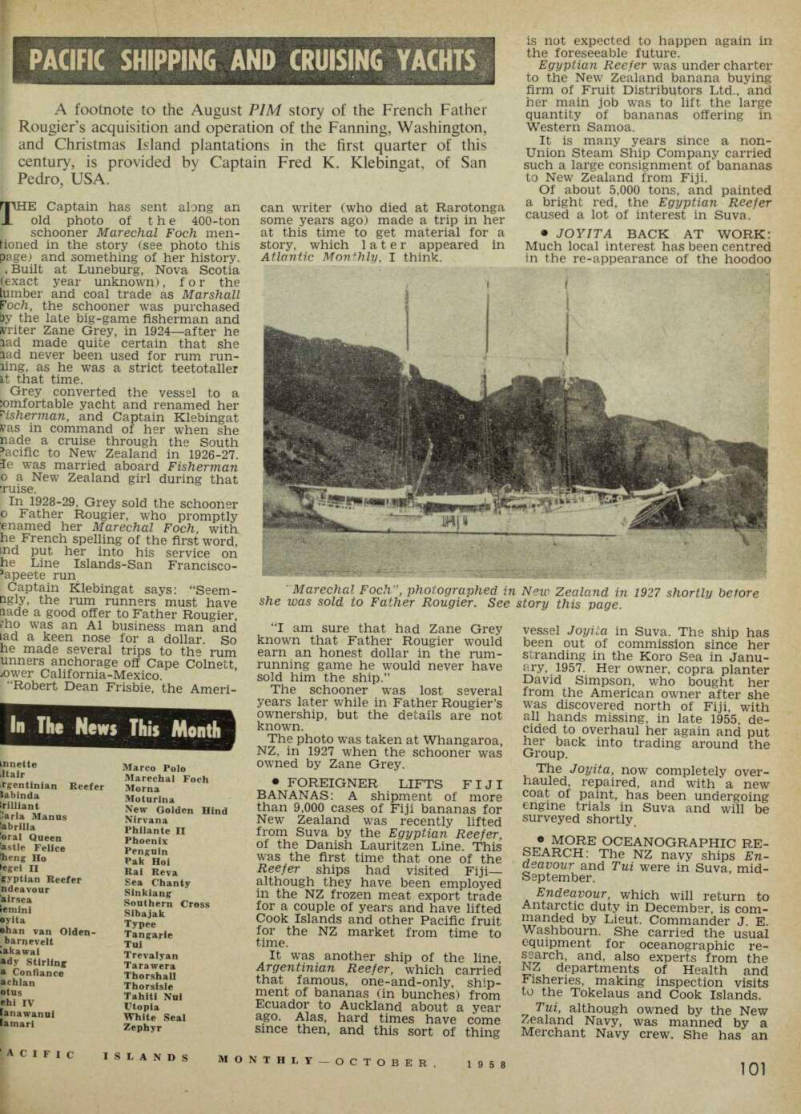
THE Captain has sent along an old photo of the 400-ton schooner Marechal Foch men tioned in the story (see photo this page) and something of her history. . Built at Luneburg, Nova Scotia (exact year unknown), for the lumber and coal trade as Marshall Foch, the schooner was purchased by the late big-game fisherman and vriter Zane Grey, in 1924 —after he lad made quite certain that she lad never been used for rum run ling, as he was a strict teetotaller it that time.
Grey converted the vessel to a ;omfortable yacht and renamed her fisherman, and Captain Klebingat vas in command of her when she nade a cruise through the South Pacific to New Zealand in 1926-27.
Ie was married aboard Fisherman o a New Zealand girl during that iruise.
In 1928-29, Grey sold the schooner o Father Rougier, who promptly enamed her Marechal Foch, with he French spelling of the first word, md put her into his service on he Line Islands-San Francisco
*apeete run.
Captain Klebingat says: “Seem ly, the rum runners must have trade a good offer to Father Rougier, /ho was an A 1 business man and lad a keen nose for a dollar. So he made several trips to the rum unners anchorage off Cape Colnett, jower California-Mexico.
“Robert Dean Frisbie, the Ameri
can writer (who died at Rarotonga some years ago) made a trip in her at this time to get material for a story, which later appeared in Atlantic Monthly, I think.
is not expected to happen again in the foreseeable future.
Egyptian Reefer was under charter to the New Zealand banana buying firm of Fruit Distributors Ltd., and her main job was to lift the large quantity of bananas offering in Western Samoa, It is many years since a non union Steam Ship Company carried such a large consignment of bananas to New Zealand from Fiji.
Of about 5,000 tons, and painted a bright red, the Egyptian Reefer caused a lot of interest in Suva.
• Joyita Back At Work:
Much local interest has been centred in the re-appearance of the hoodoo
“I am sure that had Zane Grey known that Father Rougier would earn an honest dollar in the rum running game he would never have sold him the ship.”
The schooner was lost several years later while in Father Rougier's ownership, but the details are not known.
The photo was taken at Whangaroa, NZ, in 1927 when the schooner was owned by Zane Grey.
• Foreigner Lifts Fiji
BANANAS: A shipment of more than 9,000 cases of Fiji bananas for New Zealand was recently lifted from Suva by the Egyptian Reefer, of the Danish Lauritzen Line. This was the first time that one of the Reefer ships had visited Fiji— although they have been employed in the NZ frozen meat export trade for a couple of years and have lifted Cook Islands and other Pacific fruit for the NZ market from time to time.
It was another ship of the line, Argentinian Reefer, which carried that famous, one-and-only, ship ment of bananas (in bunches) from Ecuador to Auckland about a year ago. Alas, hard times have come since then, and this sort of thing
vessel Joyita in Suva. The ship has been out of commission since her stranding in the Koro Sea in Janu ary, 1957. Her owner, copra planter David Simpson, who bought her from the American owner after she was discovered north of Fiji, with all hands missing, in late 1955, de cided to overhaul her again and put her back into trading around the Group.
The Joyita, now completely over hauled, repaired, and with a new coat of paint, has been undergoing engine trials in Suva and will be
surveyed shortly.
• More Oceanographic Re
SEARCH: The NZ navy ships En deavour and Tui were in Suva, mid- September.
Endeavour, which will return to Antarctic duty in December, is com manded by Lieut. Commander J. E.
Washbourn. She carried the usual equipment for oceanographic re search, and, also experts from the NZ departments of Health and Fisheries, making inspection visits to the Tokelaus and Cook Islands.
Tui, although owned by the New Zealand Navy, was manned by a Merchant Navy crew. She has an
"Marechal Foch”, photographed in New Zealand in 1927 shortly before she was sold to Father Rougier. See story this page.
xtensive oceanographic programme head.
In charge of the scientific party hoard the Tui is Mr. Jack Brodie, hief of the Oceanograph Research station at Wellington. The party’s esearch will include more investi ;ations of the Tonga Deep, which, Jr. Brodie says is, in the deepest lart, about 5,800 fathoms or nearly II miles deep. The floor of the Deep s mostly volcanic rock.
He explained that Fiji was on he edge of what was known as the riji Basin, which was about two tiiles deep and extended to within hout 500 miles of New Zealand.
• Right On The Job; Moana
laoi, the Gilbert and Ellice Whole ale Society’s new motor vessel irrived at Betio, Tarawa, on August after a 19-day direct passage rom Hongkong. Her first working r oyage was to Ocean Island on August 12, and she later called at >uva.
Captain E, V. Ward, former master >f the John Williams VI, says she s a good sea boat. On the delivery [oyage from Hongkong she dodged ive typhoons and in the rough
weather encountered, behaved very well.
She returned to Tarawa with gen eral cargo from Suva.
• Another Near-Victim For
MOTURIKI: A British freighter on her way from Suva to the Fiji coastal port of Ellington to load bulk sugar for the United Kingdom, came near to disaster when her engines failed off the Moturiki Reef near the island of Ovalau on Sep tember 5.
The freighter, the Trevalyan, drifted dangerously close to the reef then, by a strange piece of luck, her anchor was dropped and it caught on a coral outcrop. The sea in the area is extremely deep and normally a ship’s anchor would not reach bottom. The pilot, Captain Mac donald, of Suva, took a chance and the anchor held the ship about half a mile off the reef.
The engineers finally repaired the engines and the Trevalyan got under way about four hours later.
• Sinkiang Returns To
REGULAR RUN: The New Guinea- Australian Line motor-vessel
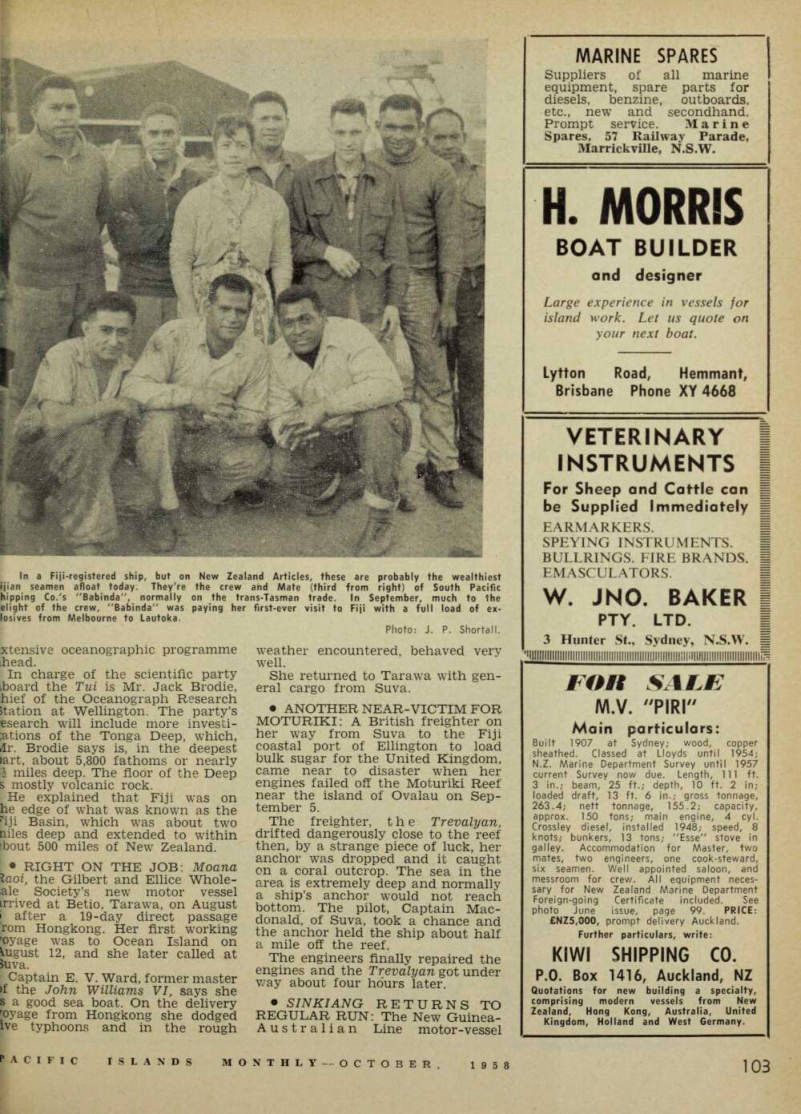
In a Fiji-registered ship, but on New Zealand Articles, these are probably the wealthiest Fijian seamen afloat today. They're the crew and Mate (third from right) of South Pacific hipping Co.'s "Babinda", normally on the trans-Tasman trade. In September, much to the [?]elight of the crew, ''Babinda'' was paying her first-ever visit to Fiji with a full load of ex plosives from Melbourne to Lautoka.
Photo: J. P. Shortall.
Sinkiang, which has been missing from the SW Pacific scene since she went recruiting for the British Phosphate Commissioners in June, swill complete her charter work with a back load of phosphate from Ocean Island to Melbourne, on October 10.
She is due to sail from Melbourne, resuming her Papua-New Guinea run, on October 20.
The Pak Hoi, which replaced her, will run a quick service from Mel bourne and Sydney to Port Moresby and Lae and return.
This means that the NG-A Line will have four ships on the Aus- Iralia-SW Pacific service—but, it is understood, it will be only for the time being.
• Hazard To Navigation:
Shipping in New Guinea on Sep tember 8, was warned to keep clear of an area 65 miles east of Madang, •where there was some sort of underwater disturbance —thought to Tee a submarine earthquake—in pro gress.
The Lae ketch Morna, owned by Mr. B. Bragg, which was on the spot when the disturbance occurred, re ported that it was tossed about and that the compass spun crazily.
• Weather Broadcasts: As
another hurricane season approaches south of the Line we summarise for the benefit of yachtsmen and others the voice broadcasts of weather information available according to our best information.
For New Guinea-N o r t h e r n Solomons waters: Port Moresby broadcast stations 9/PA/VLT6 on 1250/6130 kc’s, week-days 0225/ 0855/1230/2200 GMT; Saturdays 0225/0855/2155 MGT; Sundays 0855
Gmt.
For Solomons and nearby waters: Honiara Radio VQJ2, 5826 kc/s, week-days 0400/2300 GMT; Saurdays 2300 GMT; and from broadcast stations VQO/VQG2 on 1030/5960 kc/s, 0745 GMT except Sundays.
For New Hebrides waters: Vila Radio YJX2, 6900 kc/s, at 2115 GMT daily in French then in English.
For New Caledonia waters: Noumea broadcast station, 3355/ 6035 kc/s, 0000/0115/0155/0830 GMT, in French only.
For Fiji Waters: Nadi Aeradio, 7530 kc/s, 0915 GMT daily. Suva Post Office VRO4, 4445 kc/s, 0230 2130 GMT. Suva broadcast stations
Vrh/Vrh2 Vrh4, 930/840/3980 And
Lautoka VRH3, 890 kc/s (840 kc/s not always in link), week-days 0030 0130/0655/0907 1845 GMT; Sundays
0005/0655/0900/2007 Gmt.
For Samoan waters: Apia broad cast station 2AP, 1420 kc/s, 0600 GMT except Sundays.
For French Polynesian waters: Papeete Meteo FJD27, 7500 kc/s, 0025 1825 GMT daily; Mahina Radio PJA, 8776 kc/s, 0610 GMT: Papeete broadcast station, 6135 kc/s, 0515 2205 GMT except Sundays.
I. Most of the above stations give
hurricane bulletins every GMT hour or half-hour when a storm threatens their particular area. In addition, weather information is available on request on the small ships voice frequencies from other coast stations Rarotonga, Niue, Pago Pago, Nukualofa, Tarawa, Ocean, etc., and probably in Eng lish on request from Papeete and Noumea.
Some of these stations maintain a 2182 kc/s watch, either full or part-time. Others do not, and yachtsmen should obtain details of the frequency situation for any par ticular area from their nearest coast station, before sailing or before losing contact.
® The Typhoon Girls Of
’5B: The South West Pacific is for tunate indeed, as compared with the North West Pacific, in the matter of hurricanes —or typhoons, which are the same thing under a different name.
While the South Pacific probably averages less than half-a-dozen per season, most of them with central winds below 100 knots, which ad mittedly is plenty, that typhoon playground west of the Marianas was experiencing its 23rd of the 1958 season in mid-September, and many of them had had central winds of 130 knots or a lot more.
At least two—Grace and Helen— possibly contributed towards main taining relative peace in the Formosa Straits as they threatened that
area in their movement north and west from the Guam spawning ground.
Helen, which formed 500 miles north of Biak Island on September 9, struck the Tokyo area on Sep tember 18, causing damage and loss of life. Two days later Ida was torn west of Guam, and June—or ■“5823 June”, according to the Jap anese recognition system—came to life west of Midway, and no doubt there would be others before the season was over, officially in October . The Japanese typhoon identifica tion system could well be adopted in South Pacific radio reports, as it not only simplifies reference to any particular past hurricane, but also immediately indicates the number of hurricanes that have taken place in the current year—sB23 in the above instance meaning the 23rd "blow of 1958.
However, in the South Pacific the season laps two separate iyears. • TRICKY TOWAGE: Typhoon 'Grace, mentioned above, was the •cause of the 232-ton Manila registered ocean tug Cahrilla put ting back to Hongkong early Sep tember.
With a tow which consisted of three big steel hopper barges for the Auckland Harbour Board, and the Fiji Government’s new Hong- Icong-built light-house tender and general purpose vessel Degei 11, on the tail end, Cahrilla had cleared Hongkong September 1.
When the danger passed she mailed again September 5, and when this appears her charges should be delivered, if the tricky tow through typhoon waters has gone well.
Captain G. W. Dunsford, Islands representative of the builders of the Degei and the three barges said on September 25, that the tow was then passing through the Sulu Sea. It would then pass north of New Guinea and when in the New Hebrides area, Degei, with a skeleton crew, would be dropped from the tow and proceed to Suva under her /own power.
Captain Dunsford said that he had been advised that the new Western Pacific High Commission vessel Coral Queen, which is being built by the same Hongkong yard as Degei, was expected to clear there on delivery voyage about mid- October.
• She Was British: France’S
largest naval unit in the South Pacific, the “escorteur” La Con fiance, which called at Suva late September on a routine cruise from her Noumea base, once flew the White Ensign.
A river-type frigate of 1,450 tons displacement, this 20-knot vessel was launched in August, . 1942, as
HMS Mayola. She was transferred to France in 1943-44 with others of her class and renamed Tonkinois, receiving her present name in 1953.
We have no details of her war history. Of 306-ft overall, this lattice-masted craft has a peace time complement of 123 men,
• In Fruit Trade: The Union
Steamship Co.’s first Hongkong built vessel, the 2,120-ton refrigerated fruit carrier Tarawera, entered the NZ-Islands banana trade in Sep tember, replacing Navua, 1,952 tons, which was equipped with a blower system but was not refrigerated. ftavua reverts to the coastal trade at present. (Over)
Yacht "Brilliant's” crew. From left, Les Nibbs, Helen Swift, and owner-skipper Mac forster. See story page 113.
Photo; J. P. Shortall.
Tarawera, 290 ft by 46 ft, has a refrigerated space of 93,381 cm ft and two deep-freeze chambers of 3,831 cu. ft for the carriage of food stuffs from NZ to the Islands. There is also 144 tons of unrefrigerated space. She has five hatches Although still painted black on her first sailing, it is assumed that will be painted white in line with the usual Union Co. procedure with its Islands fruit carriers. The white colour reflects the tropic sun shine and keeps the holds several degrees cooler than dark painted hulls.
The second USS Co. vessel of her name, Tarawera, follows in the foot steps of a vessel which served in the islands and trans-Tasman trade from 1882 to 1927, and was then stripped to serve a Norwegian whal as a store hulk at a base at Paterson Inlet, Stewart Island Her remams may still be there, r, J -he_ new ship is commanded bv F. W. Bales, formerly in hte delfverV 6111 t 0 HOngkong t 0
F?M-7Xt Hifting The Shoals:
RNZN survey ship Lachlan, en- ? ge f ln the unending task of re- Jhartmg growing coral reefs and navigational dangers re ported by long-dead mariners of an age when equipment for precise navigation and depth sounding did not exist, made a useful contribu- : ion to marine navigation on her ecent Islands cruise. s h°al, shown on existing rharts a bout nndwiiy between Wail gilala Light, Fiji, and Niuafou
(Tin Can) Island, just south of the main Suva-Apia shipping route, was proved to be one and the same as the Penguin Shoal a little to the north-east, which was also shown to be mis-charted.
The latter shoal was discovered by HMS Penguin in searching for the Zephyr Shoal in 1895.
The present Penguin Shoal will be deleted from charts and the shoal
now accurately fixed by Lachlan may eventually become Zephyr Shoal, as being the one apparently reported by the schooner Zephyr in 1875.
Upcoming also, as a result of the latest Lachlan cruise will be a corrected chart of Nukualofa Har bour and approaches.
• Ticket Required: Under A
recent Tongan law any uncertificated person taking command of a local small craft of a size required to be registered with the authorities, is liable to a fine of £2O or 6 months gaol. The certificated Master of a local craft of over 5 tons is liable to a similar penalty if he puts to sea with officers not possessed of the necessary local certificates.
• Engine Troubles: Hms
Viti, largest unit of the Fiji RNVR, a 14-years-old wooden 72-ft SDML on loan from Royal NZ Navy, was bound for Auckland for refit late August when a breakdown to an auxiliary motor caused her to put back to Suva from a point 100 miles south of Kadavu. She was under escort, and manned by a crew from HMNZS Lachlan.
With docking facilities available in Suva for a small wooden craft of this typev the only apparent reason for her having to refit in Auckland is that the navy prefers to do its own work, and has no facilities for doing it in Fiji.
• New Matson Office: Mat
son Lines, previously served only through Agencies in Auckland, opened a smart new office of their own in Queen Street, right next to the new Qantas office in Sep tember. In charge is Mr. Matt Lurie, who has served Matson in most of its way-ports in recent years. He is
The crew of "Marco Polo” at Rarotonga at end of August. Left to right: Kevin Machin, Quentin McLea and Axel Pedersen, owner-skipper .
See page 115.
Photo: G. Russell.
from the US but his staff of ten are all local recruits.
• Skis May Join Marus:
According to a mid- September Moscow announcement, Russian [fishing vessels will soon commence fishing operations in the South Pacific.
The announcement was made following the visit of a senior official of the State Planning Commission to Japan, where the fishing industry had been studied.
The official did not say what the Russian vessels would be fishing for, but as with pre-war Japanese fish ing vessels, it may not always be for fish. • IT’S AN ILL WIND: The US labour unions controlling the per sonnel in West Coast-registered vessels announced in mid-September that an “agreement” has been negotiated whereby the shipowners frill pay double rates to all aboard vhile the ships are in the Formosa irea and each man will be covered )y a $lO,OOO life insurance policy.
If a ship is actually attacked, Plough not necessarily damaged, ;ach man will, on each occasion, receive a bonus of $l5O, and, in addition, if a ship is lying in any larbour when an attack is made on my part of that harbour, each man Pill pocket another $lOO.
This should make bombing raids
ilmost pleasant.
• Geic Appointments:
\ccording to a GEIC Government mnouncement from Tarawa in August, Captain G. Douglas—the nan who spotted the missing Joyita ■-has been appointed Harbour waster, Betio. Mr . D. Cooper is appointed Assistant Port Officer, 3etio, Mr. Tekaai Bakenebo Assist ant Port Officer, Bairiki; Mr. ferrier is appointed Harbour Master, Jcean Island, and Captain Town is tppointed Assistant Port Officer ihere.
o THE RAFTERS: Under com mand of Commandant Douzet du Vigier, and with Honorary Admiral Durand de Saint-Front aboard, rep resenting the Governor of French Polynesia, and Mr. Garcia Palacios, Consul for Chile, representing the country from where the voyage had commenced, the Papeete-b as e d patrol vessel Lotus arrived at Raka hanga, Cooks Islands, on September 5 to take aboard the four crew members of the raft Tahiti Nui II and the body of Captain Eric de Bisschop, killed when pinned be tween -raft and reef in landing.
Lotus was escorted to her Papeete berth on return by canoes draped in black. Amongst those present to pay their last respect to de Bisschop
was Bengt Danielsson, a member of the Kon Tiki raft expedition. Fol lowing a service in the Catholic cathedral de Bisschop’s body was interred at Paurani cemetery.
On a happier note came word from Maui, Hawaiian Island, on September 28, that another raft Lehi IV, had completed a 69-day voyage from California with four men and a dog aboard. Heading this group was Mormon elder De Vere Baker, who has made three earlier abortive attempts.
For Elder Baker this was a shake down cruise leading to a later at tempt to prove a passage in the Book of Mormon wherein it is re corded that a navigator named Lehi made a 344-day drift voyage from the Persian Gulf to Guatemala in 600 BC, complete with wife and family—according to Mr. Baker.
This should be a somewhat tougher cruise than the one just completed.
Meanwhile, so far as we know, the seven seas are again completely clear of all raft drifters for the time being.
• Cheng Ho Refitting; The
former luxury yacht-junk Cheng Ho, with which the late Captain Eric de Bisschop, of the ill-fated Tahiti Nui II expedition was once associated, as mentioned in the re port of his death at Rakahanga last month, is again entering service.
According to a Papeete report the junk, laid up for a long period in Papeete, has lately undergone a very extensive refit and is now con sidered one of the best vessels trad ing out of Papeete on the local inter-island service. Although she seemed dilapidated several years ago as she lay idle at moorings in the harbour, this was said to be
Union Steam Ship Company’s new Hongkong-built refrigerated fruit freighter “Tarawera”. See story page 107.
nainly superficial. The hull is of Inest selected teak and as sound as , bell.
• Stc Vessel For Sale:
Iteamships Trading Company’s
(ooden motor-vessel Moturma was
ffered for sale in Port Moresby in ite September. This 80 ft, 112 gross
Dns ship is comparatively young,
he was built only in 1947 —by
Tichard Bros. Pty. Ltd., of Sydney.
News of Cruising Yachts
• OCEAN RACE: Royal Akarana Yacht lub, sponsors of the Trans-Tasman and uckland-Fiji ocean races, was expecting ► reach a decision in October as to hether an event would be organised ext autumn-winter, either from Auckland t Brisbane or from Auckland to Suva, n Auckland-Suva race was shelved this sar due to lack of finance and time on le part of interested yachtsmen. • BRILLIANT, of Tasmania, departed ackland September 23 for Nukualofa, ith one new crew member, Mr. Peter ixmore of Auckland. Others aboard the indsome, well-equipped 42-ft. schooner: tipper Mac Forster, Les Nibbs, and Helen vift. Plans call for a quick loop through inga, Fiji, and New Caledonia and out the area before the hurricane season. • LADY STIRLING, 48-ft. Auckland hooner, Islands cruising in the less tpular Western Pacific since June, 1956, rived back home September 21. With mer Stan Worthington was his wife, 10ar-old son Mervyn, Mr. C. Ebbett, and from Rabaul—Messrs. J. Chorns, P. eating, and J. Holtge. The yacht had en in New Guinea waters for some time ter earlier cruising Fiji, the New ebrides and the Solomons. • MANAWANUI, 55-ft. x 12Vz-ft. x sVz >» Auckland ketch, was expected to sail r Nukualofa, Rarotonga, Papeete, Hono lu and the US West Coast late Septem r. Owner Athol Rusden, already well lown as former owner of such craft as
Iilante 11, New Golden Hind. Etc.,
ans to exchange the vessel there for a rger craft suitable for operating com ercial Islands cruises. With him on the esent cruise are Mr. and Mrs. I. John n, Mr, B. R. Neill, and Mr. A. S. Foster, husky craft, MANAWANUI carries 1,100 • ft. canvas and a 150 hp Cummins esel. • TYPEE, with Bob Grant of the ill ted VE TEGA and his wife (nee Marie Avert) of a few days, and Mr. K.
Mildon, cleared Auckland August 31 flying the American flag, bound for the Caribbean via Papeete, Honolulu and the US W T est Coast. Since VE TEGA was lost by fire and explosion in the New Hebrides last year, Bob has been undergoing extensive treatment for burns in Auckland. Miss Calvert was a nurse at the hospital.
Grant purchased the 36-ft. TYPEE in Auckland some months ago following pay out of insurance on VE TEGA. • WHITE SEAL, 37-ft. ketch of Durban, with owners Gerry and Marie Trobridge, and K. Ardill of Australia aboard, reached Suva from Apia September 2. This steel yacht started to move again in April, 1957, after a period in the US Great Lakes and has been edging south and west since then. Only a short stay was planned at Suva. • TANGARIE of Sydney, Tahiti-type ketch, with W. Gill and B. Bowden aboard sailed for Eastern ports via the Barrier Reef and New Guinea on July 13. • SEA CHANTY, 36-ft. Vancouver ketch, with Roy Kempel, has been cruising French Polynesia waters recently, having been in Papeete for the July celebrations. • GEMINI and her owners. Jack and Leah Wheeler returned to Honolulu late August after spending 14 months on Palmyra Island on I.G.Y. business.
Their crew now consists of Sharon and Linda Wheeler, ages three years and nine months respectively. The Wheelers have moored the ketch at the Ala Wai yacht harbour and are now taking a vacation on the US mainland.
• ANNETTE should be round about Western Samoa at present. Last advice from Doc and Dottie Tanner was that after visiting the Windward Isles their next port of call would be Apia. • NIRVANA, the 64 ft. Australian cutter, which arrived in Honolulu July 31, en route from Sydney to England, de parted there late August for San Francisco. Aboard were owner Dr, Keith Laws and a crew of five. • RAI REVA, the 36 ft. schooner which arrived in Honolulu from New Guinea last May also departed in late August. Des tination was Vancouver, BC. Owner skipper Douglas Robinson. • ALTAIR which has been in Papeete for the last two years was expected in Honolulu end of September. The 48 ft. ketch, owned by Slim Lambert, is skip pered on this voyage by Bill Weir.
• Fuss About The Phoenix: Dr.
Earle L. Reynolds who was charged in July with violating the Atomic Energy Commission ruling forbidding the entry of US citizens into the atomic area in the north Pacific, was convicted in Honolulu recently. It is understood that he will carry the fight into a higher court. In Honolulu recently a printed statement was issued by Mrs. Reynolds who also appealed for contributions to fight the case.
In her statement Mrs. Reynolds said (in part): “On the morning of July 1, 1958, the American yacht PHOENIX, en route to Japan, was intercepted on the high seas, 65 miles inside the Pacific nuclear testing zone. On board were the skipper, Dr.
New Vessels
Leave Hongkong
At left, the tug Cabrilla leav ing Hongkong with Auckland Harbour Board hopper-barges and Fiji Government’s MV Degei II in tow. Once clear of the harbour the separate craft were towed in a much more open formation.
Photo below shows the Degei II about to leave the harbour.
Earle L. Reynolds; his wife, Barbara; their ion, Ted (19); their daughter, Jessica (14); and a Japanese yachtsman from Hiro ;hima, Niichi (Nick) Mikami. These five lad lived together aboard the PHOENIX for four years, in the course of a 50,000 mile voyage around the world.
“It was on the final stage of this voyage ;hat the PHOENIX was seized and the ikipper arrested. The yacht was ordered ,o heave to, was boarded by two armed nen of the US Coast Guard, and was breed to sail to Kwajalein, US Navy post n the Marshall Islands, 300 miles to the outh. A Navy destroyer accompanied the lailing boat for the entire three-day trip ind relayed orders by semaphore to the ;uards stationed aboard.
“After being held in Kwajalein until fuly 7, Dr. Reynolds, with his wife and laughter, were flown by MATS to Hono ulu, where he was formally charged “The PHOENIX, en route to Hiroshima, ailed deliberately into the nuclear testing one: (1) As a moral protest against the testing of nuclear weapons. In this action, she followed the lead of the men of the yacht GOLDEN RULE, who were gaoled in Honolulu for their announced intention of entering the zone.
“(2) As a defence of the traditional American concept of the freedom of the seas.
“(3) To challenge the legality of the AEC ruling forbidding the entry of American citizens into a 390,000 square mile area of open ocean.
“We have a number of reasons for be leving that our protest offers the most ramatic and forceful means yet avail ble for calling public attention to the ■responsible and illegal actions of the tomic Energy Commission.”
Everyone who has met the Reynolds in iieir years of cruising, holds them in ffectionate regard—although, of course, ot everyone will agree that they took the Ight action in this case.
LATER: On September 26, in Honolulu, eynolds was sentenced to six months »01. This savage sentence will horrify II the friends the Reynolds family made, ight across the Pacific. • UTOPIA, the luxury pleasure yacht, rrived at Honiara on August 28, from iji, New Hebrides, Russell Islands and anikoro. Captain Fred Peterson and a rew of seven spent four days in Honiara efore proceeding to the Western Solomons l early September. The yacht was at tadang, NG, in late September, having •me “crew adjustments”. One member f the old crew had left in Gizo, and two i Madang, including W. B. McMillan, eplacements included an American college Irl (who apparently flew out to join the 6ssel).
Intention is to complete a world trip ia New Guinea, Philippines, Singapore, idia, South Africa before returning home > Sturgeon Bay. USA. • MAMARI, 28-ft. Auckland built ketch rrived Rarotonga August 3 from Auck md in the course of a South Pacific ruise and departed August 11 in oisterous tradewind weather for lone Uwarrow Atoll. Aboard with skipper ames Oliphant are Colin Sherry and ieorg Pedersen (Dane). They plan to Isit Apia and Suva on the return voyage > Auckland. She carried the most im ressive display of bagawrinkle seen at arotonga for many a year. • KAKAWAI, 39-ft. Dunedin built cutter sached Rarotonga August 1 and departed ngust 5 homeward bound on the last •g of an extensive South Seas cruise that ommenced from Dunedin in March and mbraced the Societies. Tuamotus and Marquesas. She is a modified Colin Archer ppe designed by A. W. Burns of Welling >n and built by the joint owners, Les
McLeod and Les Taylor, of Milton, Otago.
New Zealanders Henry Hamilton and Evin Curtis went along with them. KAKAWAI reached Gisbourne August 24. • MARCO POLO, the 28-ft. Auckland built ketch-rigged short-end keeler that completed a westbound world circuit last year skippered by owner-builder Tony Armit, reached Rarotonga August 15 east bound from Auckland following 26 days of perverse weather. New skipper-owner is Axel Pedersen, a Dane, and with him are Kevin Machin, of Mackay, Queensland, and Quentin MoLea, Aucklander. She sailed August 27 for Tahiti, Honolulu. San Francisco, then via Panama towards Axel’s home in Skive, Jutland, Denmark. • CARLA MANUS, 66 ft. schooner owned by New Guinea’s most consistent small ship addict of the last 30 years, Mr. Jack Thurston, was on her way to Sydney from Rabaul via Samara! in late September.
She expected to make Cairns by October
7 and Sydney towards the end of the month.
On board, as well as owner-skipper, are- Pat Surawsky, of Burns Philp, Rabaul, who is going on leave; Philip James, also permanent crew members Victor Guiffre; of Rabaul. headed for pleasure and busi ness in Sydney; and Kina. Manus Islander, who has w'orked for Jack Thurs ton for 35 years and is as well known in the Territory as his boss.
The schooner has good accommodation for six, a large saloon, a two-way radio with a range of 500 miles, and a fuel capacity sufficient for 2,000 miles. The auxiliary engine is a six-cylinder Gardner.
CARLA MANUS was formerly Che AMOHINE, registered in Sydney. She was bought by Mr. Thurston before the war.
One of the working passengers. Philip James, was the author of the article in August PIM about the wrecks on Roncador Reef, BSIP. He still hopes to get back there to have a better look around.