To Give Plenty Of Room For Argument
pp. 65-66 · Read in the full issue
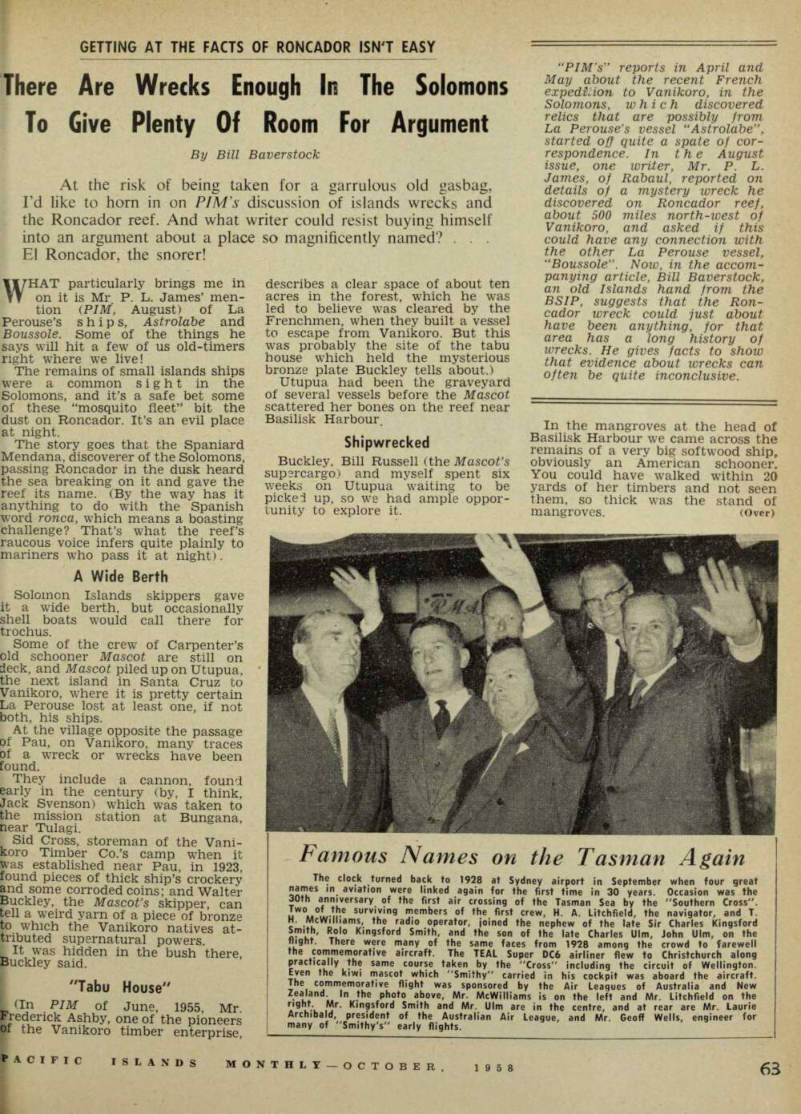
GETTING AT THE FACTS OF RONCADOR ISN'T EASY
There Are Wrecks Enough In The Solomons To Give Plenty Of Room For Argument
By Bill Baverstock
At the risk of being taken for a garrulous old gasbag, I’d like to horn in on PI M's discussion of islands wrecks and the Roncador reef. And what writer could resist buying himself into an argument about a place so magnificently named? . . .
El Roncador, the snorer!
WHAT particularly brings me in on it is Mr. P. L. James’ men tion ( PIM, August) of La Perouse’s ships, Astrolabe and Boussole. Some of the things he says will hit a few of us old-timers right where we live!
The remains of small islands ships were a common sight in the Solomons, and it’s a safe bet some of these “mosquito fleet” bit the dust on Roncador. It’s an evil place at night.
The story goes that the Spaniard Mendana, discoverer of the Solomons, passing Roncador in the dusk heard the sea breaking on it and gave the reef its name. (By the way has it anything to do with the Spanish word ronca, which means a boasting challenge? That’s what the reef’s raucous voice infers quite plainly to mariners who pass it at night).
A Wide Berth Solomon Islands skippers gave it a wide berth, but occasionally shell boats would call there for trochus.
Some of the crew of Carpenter’s old schooner Mascot are still on deck, and Mascot piled up on Utupua, the next island in Santa Cruz to Vanikoro, where it is pretty certain La Perouse lost at least one, if not both, his ships.
At the village opposite the passage of Pau, on Vanikoro, many traces of a wreck or wrecks have been found.
They include a cannon, found early in the century (by, I think.
Jack Syenson) which was taken to the mission station at Bungana, near Tulagi.
Sid Cross, storeman of the Vani koro Timber Co.’s camp when it was established near Pau, in 1923, found pieces of thick ship’s crockery and some corroded coins; and Walter Buckley, the Mascot’s skipper, can tell a weird yarn of a piece of bronze to which the Vanikoro natives at tributed supernatural powers.
It was hidden in the bush there,
Buckley said.
"Tabu House" ■ (In PIM of June, 1955, Mr Frederick Ashby, one of the pioneers of the Vanikoro timber enterprise,
describes a clear space of about ten acres in the forest, which he was led to believe was cleared by the Frenchmen, when they built a vessel to escape from Vanikoro. But this was probably the site of the tabu house which held the mysterious bronze plate Buckley tells about.) Utupua had been the graveyard of several vessels before the Mascot scattered her bones on the reef near Basilisk Harbour.
Shipwrecked
Buckley, Bill Russell (the Mascot’s supercargo) and myself spent six weeks on Utupua waiting to be picked up, so we had ample oppor tunity to explore it.
“PlM’s” reports in April and May about the recent French expedition to Vanikoro, in the Solomons, which discovered relics that are possibly from La Perouse’s vessel “Astrolabe” , started off quite a spate of cor respondence. In the August issue, one writer, Mr. P. L.
James, of Rabaul, reported on details of a mystery wreck he discovered on Roncador reef, about 500 miles north-west of Vanikoro, and asked if this could have any connection with the other La Perouse vessel, “Boussole”. Now, in the accom panying article, Bill Baverstock, an old Islands hand from the BSIP, suggests that the Ron cador wreck could just about have been anything, for that area has a long history of wrecks. He gives facts to show that evidence about wrecks can often be quite inconclusive.
In the mangroves at the head of Basilisk Harbour we came across the remains of a very big softwood ship, obviously an American schooner.
You could have walked within 20 yards of her timbers and not seen them, so thick was the stand of mangroves. (Over)
Previous to finding the wreck we had seen Utupuans with large iron rods laboriously sharpened to a point at one end—obviously the fasten ings of the American ship.
Graciosa Bay, at “Big” Santa Cruz, had some traces of old wrecks, according to Jack Mathews, who ran Lever’s trading post there for about 14 years. He spent this time alone, except for his Malaita boys and had several lively brushes with the natives.
I saw his abandoned house in 1923 when we called there for fire wood and water in the Mascot just before she sailed for Utupua, where she was wrecked. There were some ugly Snider bullet holes in its roof,
but these could have been made after Jack left.
Goodenough Monument
Graciosa Bay is the site of the Admiralty monument to Commodore Goodenough, who was killed there by natives in 1875. It’s a lonely stone obelisk, the same as the one erected at Kurnell, Sydney, to mark Cap tain Cook’s landing in Australia.
Fishing on the reef near the camp of the Mascot’s castaways, I found two very corroded cartridge cases embedded in the coral. I brought them back to Sydney and in the PIM office years later, met Nicholas Hagen, who told a lurid story about
an attack the natives had made 01 a boat he’d sent ashore there ii the very early years of this centurj I asked Hagen to describe tin spot and he gave a perfect won picture of the site of our camp You’ve guessed it—those were hi empty cartridge cases!
Many Wrecks
Among other Solomon Island; wrecks worth recalling is that of thi Houtou, the New Zealand scow whicl the Vanikoro Timber men used t« take their building material, saw mill gear and stores to their camp On return to Tulagi to load anothe; cargo Houtou mysteriously caugh fire, and burned to the water’s edg» in front of Tom Elkington’s Tulag hotel. The Mascot had the carg» that Houtou intended to take t« Vanikoro when she, too, piled up a.
Utupua.
The wreck of another ship tha. burned out was in Faisi—a weiro spectacle as her pumps on thei: long iron pipes stuck out of tht. water like macabre beacons in tin anchorage.
The big US barque Montauk waj wrecked in Manning Strait in 192 G and strewed the ocean with he* deckboard of fine Pacific cedai boards. Lots of natives and somj white inhabitants used this fm building material, and I remembee a house built of it, occupied by s man named, I think, Kant, in thj Marovo Lagoon.
Fascinating History
fv, ol « ella Lavella , the masthead oc the fine cutter yacht Dalveen stuck out of the water off the jetty neai a Plantation run by a man namei?
MacEacharn. She had sailed from Hongkong, where she had been thr pride of the pleasure fleet, ana mysenously founded while at anchoK is nothing more fascinatf mg than overhauling an old wrecc and speculating on the evidence ae to ner nationality, size and rig i:i !!!L re ics anc * fittings you comn tll/I OSS, Mr P L- James, whose accoum re fi cs he found on Roncador wi.l a™™? oub i- start man y argument!J among ship:-wise readers, seems tf w 1 * when he suspects thee SSSS, be t rom Boussole. It is mos< pots ely S^e he carrying trr „ * woul( ? hhe to see the bronze goose neck he found. This, I woullj say, was not from Boussole. Mosc ller ay lateen mizzemr put the spanker was just cominn use then and she could haw on i 6 J. though if she did hei boom would almost certainly haw had wooden jaws.
Anyway, Mr. James’ story war ?^. uc h enjoyed and most of us enwi nim his fascinating researches oo the reel of evil reputation.