There's An Awful Lot To See
pp. 55-63 · Read in the full issue

In The South Pacific!
The Indian firewalkers of Fiji are a point of tourist interest that one day could be worth a lot of money to the Colony. Where else but in Fiji can you see the real Pacific—palms, coral reefs, balmy breezes, plus the Mysteries of the East —the fascinating, fantastic, fabulous Hindu firewalkers?
HONOLULU or even Florida would really turn on a promotion scheme if they had them, and the fact that the firewalking is a religious ceremony would add to the promoters’ enthusiasm, not detract from it.
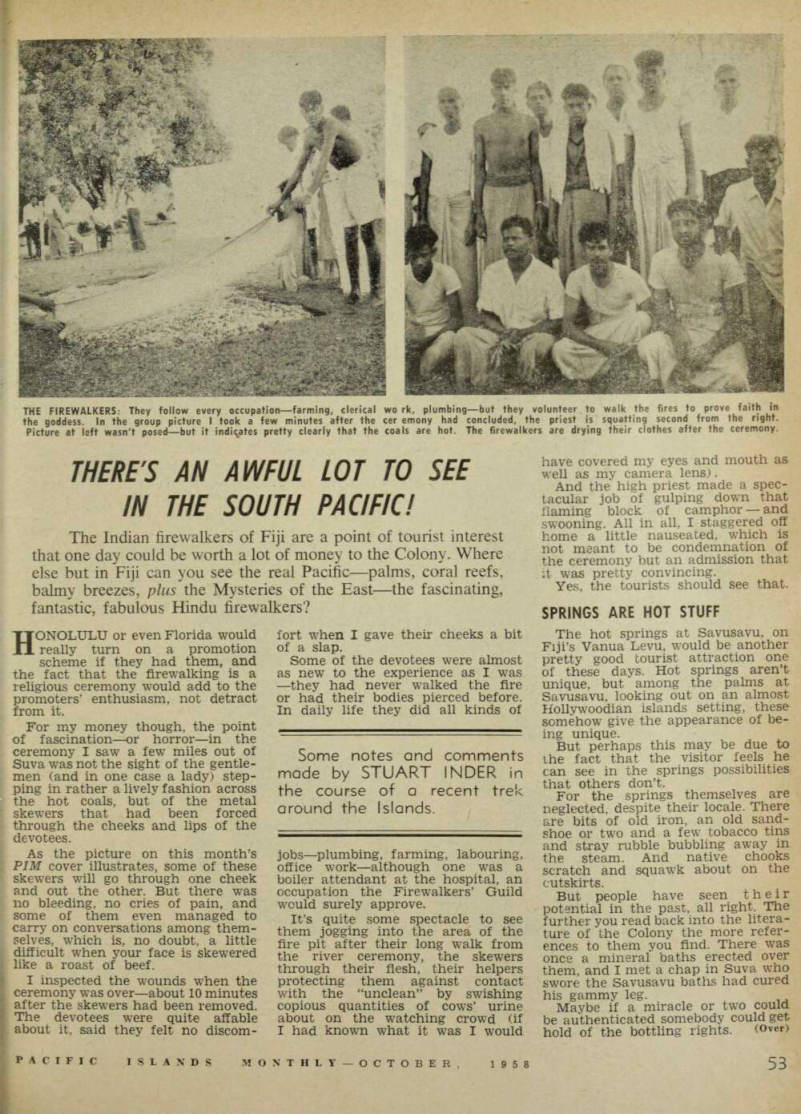
For my money though, the point of fascination —or horror —in the ceremony I saw a few miles out of Suva was not the sight of the gentle men (and in one case a lady) step ping in rather a lively fashion across the hot coals, but of the metal skewers that had been forced through the cheeks and lips of the devotees.
As the picture on this month’s PIM cover illustrates, some of these skewers will go through one cheek and out the other. But there was no bleeding, no cries of pain, and some of them even managed to carry on conversations among them selves, which is, no doubt, a little difficult when your face is skewered like a roast of beef.
I inspected the wounds when the ceremony was over—about 10 minutes after the skewers had been removed.
The devotees were quite affable about it, said they felt no discom
fort when I gave their cheeks a bit of a slap.
Some of the devotees were almost as new to the experience as I was —they had never walked the fire or had their bodies pierced before.
In daily life they did all kinds of
jobs—plumbing, farming, labouring, office work —although one was a boiler attendant at the hospital, an occupation the Firewalkers’ Guild would surely approve.
It’s quite some spectacle to see them jogging into the area of the fire pit after their long walk from the river ceremony, the skewers through their flesh, their helpers protecting them against contact with the “unclean” by swishing copious quantities of cows’ urine about on the watching crowd (if I had known what it was I would
have covered my eyes and mouth as well as my camera lens).
And the high priest made a spec tacular job of gulping down that flaming block of camphor and swooning. All in all, I staggered off home a little nauseated, which Is not meant to be condemnation of the ceremony but an admission that it was pretty convincing.
Yes, the tourists should see that.
Springs Are Hot Stuff
The hot springs at Savusavu, on Fiji’s Vanua Levu, would be another pretty good tourist attraction one of these days. Hot springs aren’t unique, but among the palms at Savusavu, looking out on an almost Hollywoodian islands setting, these somehow give the appearance of be ing unique.
But perhaps this may be due to ihe fact that the visitor feels he can see in the springs possibilities that others don’t.
For the springs themselves are neglected, despite their locale. There are bits of old iron, an old sand shoe or two and a few tobacco tins and stray rubble bubbling away in the steam. And native chooks scratch and squawk about on the outskirts.
But people have seen their potential in the past, all right. The further you read back into the litera ture of the Colony the more refer ences to them you find. There was once a mineral baths erected over them, and I met a chap in Suva who swore the Savusavu baths had cured his gammy leg.
Maybe if a miracle or two could be authenticated somebody could get hold of the bottling rights. (Over)
THE FIREWALKERS: They follow every occupation—farming, clerical work, plumbing—but they volunteer to walk the fires to prove faith in the goddess. In the group picture I took a few minutes after the ceremony had concluded, the priest is squatting second from the right.
Picture at left wasn't posed—but it indicates pretty clearly that the coals are hot. The firewalkers are drying their clothes after the ceremony.
Neglected Islands
But while on this subject of Fiji tourism, the whole problem of tourist traffic for Vanua Levu and Lomai viti would be the better for a little thought soon. This is the Fiji the tourists should see, but few of them do, because the well known tourist trails don’t go in that direction.
People have long been saying they .should —Sir Ronald Garvey was the latest during his farewell visit—but nobody ever does anything about it.
In the outer (and prettier) islands people will tell you that the big tourist interests on Viti Levu have the game sewn up so the money is kept on that island. I made some inquiries about that interesting opinion in Suva, but I don’t think it’s quite correct . . . which is too bad, because I get as much thrill as the next chap in thinking the worst of people with more money than I’ve got.
The fact is that the big tourist ■connections would be willing enough to find some way of getting more tourists to the outer islands if they thought there was a real interest in them. Naturally, they want to keep every tourist in the country as long as possible.
However, I’m convinced that at least some of the tourist people have failed to appreciate just how much interest there is in islands of the Group not included in the present stock runs. I met many tourists who were decidedly annoyed at learning, as they went the rounds, of many attractive spots on Vanua Levu they had not seen, and would not now see, because of the itinerary mapped out for them.
It’s time for the tourist net to be cast wider.
A Pub For Tonga
Tungi, Crown Prince and Prime Minister of Tonga, pointed out a piece of land looking out across Nukualofa’s not-so-terribly-interest ing waterfront and said, “We think that’s where the new tourist hotel should go”.
Tonga’s tourist hotel is in the planning stage yet, and may not get any further unless the Kingdom finds somebody to help put it on a practical basis. It wrote away to Mr. Rehnborg, the American hotel man who is interested in several Pacific spots, and suggested a 50- 50 proposition to him, but there had been no answer when I was speak ing to Tungi.
The present plan is for a 48-room hotel, which sounds a bit big for Tonga, and in fact, the critics are apt to laugh at the suggestion of any hotel at all being able to work in Tonga. But they could well be confounded.
Tonga is still pretty well cut off from the vulgar tourists, but the tiny Kingdom, the only one in the
Pacific, is first-class tourist bait, and transport problems have a habit of getting solved in special circum stances.
If it comes to it, there is probably no reason why Tonga couldn’t make a go of a small Gov ernment-owned hotel, like the one I stayed at once in Hollandia, Dutch NG.
It depends on how badly Tonga itself really thinks it needs a pub, and how much it is prepared to spend on one (it seems to be spend ing money on lots of things lately).
I have always believed that Tonga didn’t want tourists, and I said as much to Tungi. “No, that’s not right,” he said firmly. “We would welcome them. There’s no sugges tion we don’t want them.”
Somebody told me later that the Prime Minister’s view on this matter was not necessarily the view of the Queen, and that in fact my in formant would wager the new Aoniu that it wasn’t.
But the new Aoniu wasn’t his to bet with, so I didn’t take it up.
Beautiful Aoniu
The new copra ship Aoniu is Tungi’s new love, and probably will be until the new seagoing tug, Hifofua, arrives later this year.
Aoniu had been flying the Tongan flag only two days when I was in Nukualofa, and he insisted I go down and have a look at her.
We drove to the wharf, but the ship was in the stream. Secretary to the Government, Mr. R. Sanders, and I got into a skiff with an out board attached, and waited —and waited —while the fellow in charge of the outboard tried to make it do its stuff.
Finally, Sanders picked up a couple of oars and announced, “As soon as we get these into the water that motor will burst into life.”
He was wrong, as a matter of fact.
We shortly took our coats off to the job, while Tungi, who had been watching from ashore, drove off, presumably grinning.
When we finally boarded the Aoniu, I decided the Prime Minister
has reason to be proud of his new ship. As her new skipper, Kiwi Tom Neill, said, “She will still be worth good money when they’re finished with her because she’s built properly, with the best of everything.”
That includes a solid marble front to the washstand in the Queen’s stateroom.
Pago's Troubles
I wonder how many South Pacific towns ever trouble to stand off and see themselves as others see them?
I think if Pago Pago, in American Samoa, took the trouble it would get a shock.
Far from being the Islands para dise that bsdlyhoo has made it Pago is a most dejected looking town to the casual visitor. You can see all there is to see of the town proper in a few minutes —the usual stores, and native market, the wharves and a few dilapidated shanty “bars” that would be condemned under building regulations anywhere else.
It has lost the character it must once have had, and which Apia has still got. The Samoans in Pago have a dejected air about them —like their housing.
This is not to criticise all of Eastern Samoa—for Pago is not all of it—or even to criticise the present Administration. \ Pago has had its troubles, as most local people are aware. Its main one seems to have been that it was ruled too long by the American Navy, and no navy, American or otherwise, is -designed to operate as a civil ad ministration, whatever airs and graces it might claim for itself.
Another trouble is that East Samoa is a long way from the American mainland and from the Department of Interior, which controls it now, and it doesn’t always get the help, pr the money, it needs. It has noth ing in the way of natural resources, or even defence potential now, to ensure that its problems are kept before the eyes of Congress.
But perhaps the most important burden East Samoa carries is that the East Samoan has one ambition
—to get home to the States to work.
East Samoa has produced as many intelligent and advanced people in proportion as any other territory, but it can’t get them to stay in Samoa, There are other territories with this problem, of course. Niue, not many miles to the south, is one of them, with its people going off to New Zealand.
But those left on happy, hard working Niue don’t appear to mind nearly so much. There seems to be more to stay home for—more that is distinctively home.
But I got the impression that East Samoa has been attached to the US for rations and quarters for so long that it has now lost interest in trying to be itself. It has no identity of its own any more.
Niue Oldtimers
Hurtling down one of the Niue roads one day in Resident Com missioner O. Dare’s distinctive hmousine, I noticed an elderly native step quickly off the road and into the scrub, apparently bent on n3t being seen. But looking out the raar window a few moments later I saw him step back on the road
and raise his hat in the direction of the passing car.
A very odd thing, I said to Mr.
Dare.
“Not here it isn’t,” he said. “He’s one of the old school —a real gentleman. He and his contem poraries wouldn’t consider it good manners to be seen in these cir cumstances in their working clothes.
Sc they step into the scrub and there is no embarrassment.”
Figures Versus Facts
Niue’s hospital, like just about everything else on Niue as far as I could see, is getting better all the time. Built on a picturesque spot on a cliff overlooking the sea, it is constantly being extended. And there are more plans yet, so eventu ally it may be as impressive as the one in another unlikely spot, at Vavau, Tonga.
Niue’s latest hospital ward hadn’t long been there when I arrived.
Apparently the MO, Dr. Simpson, had got seven new TB patients and wanted another ward to put them in. The Works Department picked up a small unwanted, unlined, building from another part of the island, moved it lock, stock and
That's Nukualofa in the background, and the Secretary to the Government of Tonga, Mr. R.
Sanders, after some hard rowing, in the fore ground!
Nice Island —it was cnce called Savage Island—has no harbour, and cargo must be landed by lighter. Here, a big new truck makes an odd picture as it sails for the shore.
When I followed it a half-hour later, I found it loaded with cargo, straining up the hill from the landing stage. And it worked very hard for the rest of 'boat day!"
barrel to the site, put down a con crete floor, lined the building, gave it a new lick of paint—and Bob’s your uncle.
From go to woe (to coin a phrase) was only a few days which is a real lesson in how to cut red tape.
And talking of TB, Dr. Simpson took the opportunity to straighten out the record on Niue’s TB in cidence. The last NZ annual report on Niue gave the number of TB patients on the register at Niue as 148—and this was interpreted by some commentators, including one in PIM, as a poor show.
But the register is not a record of active TB cases, says the doctor.
The latest figure on the Niue register is 131. but there are only 50 cases on the island that need regular attention, and only 26 of these need to be in hospital—and all are.
So the situation isn’t serious, not by a long shot.
What’s more, it’s rare for chil dren to have TB—and almost half of Niue’s population is comprised of children.
Vailima Again
In the latter part of his life at Vailima, Robert Louis Stevenson got plenty of visitors—friends, admirers, and tourists interested in seeing the famous writer at work in his not so-remote Islands home.
It’s a bit that way again in Apia these days, but it’s not a Scot but an Australian with an Irish name who holds court. John O’Grady, author of the best seller They’re a Weird Mob, has, on ship and plane days,, a stream of visitors in and out of his house opposite the hospital, in the general direction of Vailima.
I haven’t any doubt that they all get the same warm welcome from the O’Gradys as I got. Without intending it, I even found myself sitting down to lunch off a huge steak—presented Australian fashion, with plenty of bread and reach for the butter yourself. But that’s the kind of home the O’Gradys run wide open and natural, like them selves and like the happy characters in his book, which is autobiographical in parts.
The real sequel to They’re a Weird Mob won’t be written until next year, when O’Grady takes Nino Culotta and his Australian bride home to Italy, travelling aboard a freighter. O’Grady will leave Samoa to make that trip first, and collect the colour on the way (“You know, odd characters, queers and all that mob”, grins O’Grady).
Meanwhile, he’s enjoyed Samoa and the Sarpoans. He has a lot of good words to say for them, and one of his ambitions is to go to work again in Samoa after the NZ Trust Territory has been granted in
dependence, so he can compare the changes.
Footnote : With all those visitors, you’d think the author would be having a gleeful time signing auto graph copies. But you couldn’t buy a copy for love or money when I was in Apia. One shop had long since sold out—the other had banned it. Too many “bloodys”, apparently.
Friendly Mathesons
American Patricia Ledyard is another author under another name, in another place. That is the name she used in writing Friendly Island, a book on Tonga that has not had the publicity of They’re a Weird Mob, yet a book which everybody seems to have read at
sometime, which says much for its readability.
She went to Vavau, 10 years ago, where she still is, and married Dr.
F. Matheson, now medical adviser to the Tongan Government. The friendly Mathesons are happy with their lot, and it’s a special pleasure to hear the doctor’s balanced —and droll —commentary on matters of Tongan interest.
Mrs. Matheson has two more books on the slips, but they’ll take biographical Friendly Island.
What a spectacular harbour approach has Vavau. Unspoiled with buildings, it is probably in the same state that young Mariner saw it when he described his famous Mariner’s Cave. The town itself, though, must have the only picture theatre in the Pacific that
•equires patrons to clamber down in iron ladder to the cheap seats.
You’d need to be fit.
Ihades Of Bully
Apia planter Rudolph Berking, s one of those solid German iharacters of the “Karkar” Schmidt chool.
Mr. Berking, now 86, has been n Samoa for the last 58 years, but wo world wars—in which he lost iverything merely because he lappened to be a German—have lot extinguished his love of the slands, or of hard work. He was »nce the Collector of Customs.
He is only now beginning to get iroperly on his feet since the last Par. Besides copra, ooffee is lelping him—good Liberian coffee Phich sells in West Samoa for 6/i pound. Mr. Berking has 60 acres rearing, and 20 more coming on.
He harvested five tons in 1956, 0 tons last year and hopes to get ibout 12 tons next year. It grows it 1,000 to 1,500 ft, and he has sold ome of it in NZ this year at £5OO 1 ton, Mr. Berking is a man who ought 0 Put some of his experiences lown on paper. Some more details, or instance, surrounding that netal-bound chest he has in his louse.
It belonged to “Bully” Hayes and Pas on the Lotus when “Bully” was Jlled, and it came off with Charles Jetzler, the chief mate. Netzler Pas once Mr. Berking’s father-in
law. He was the father of his first wife.
Unexpected Places
I haven’t stayed at the Goroka Hotel, in the NG Highlands, since the widely esteemed Mrs. Ellen Pitt ran it with the stout support of her first lieutenant, Miss Doreen McGhie. Then you drank your beer from Stuart crystal goblets, which nobody ever broke, no doubt for fear of what Doreen would say.
When Mrs. Pitt died, Doreen carried on gamely for awhile, but then it got too much and she dis appeared from New Guinea, and out of the ken of the many people who would like to have known what happened to her. It turns out that, deeply upset over the death of the woman she was so fond of, Doreen went around the world, and saw many things.
Now she is ready to settle down.
I found her by accident in the office of Fiji’s fine Korolevu Beach Hotel. She is quieter than I remembered her, but she still thinks a lot of New Guinea as she works m surroundings that have nothing in common with Goroka.
Unexpected People
At Labasa, Fiji, an elderly, pioneer lady challenged me: “You’re not from Labasa, are you?” “No—from Suva,” I said. “I knew it,” she said.
“You can tell a Labasa man. They look better!”
Dr. and Mrs. Mathison, on a hill overlooking an arm of the picturesque Vavau Harbour, Tonga. There was an idea afoot once for erecting a hotel on the top of the flat hill in the background, but it didn't come to anything.