Pacific Report
pp. 123-156 · Read in the full issue

The month s round-up or news and pictures of people and events, from PIM correspondents in the South Pacific.
Bee-Pees Build
Bigger and Brighter Stores
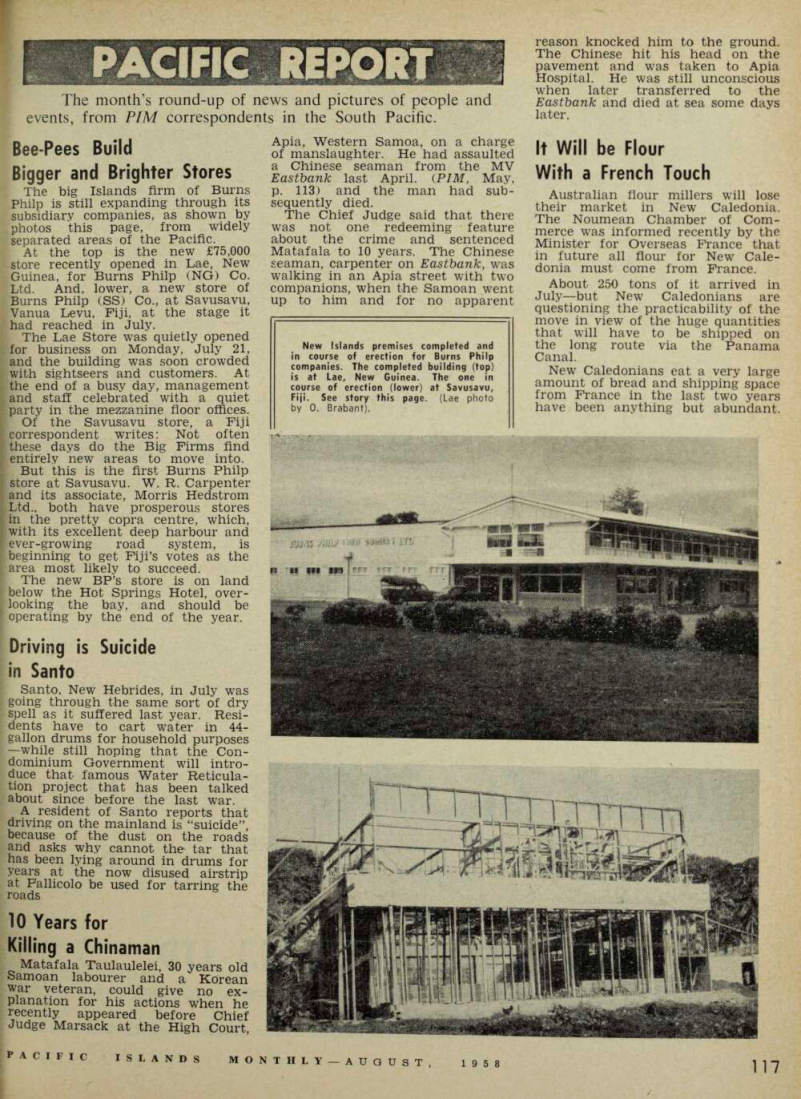
The big Islands firm of Burns Philp is still expanding through its subsidiary companies, as shown by photos this page, from widely separated areas of the Pacific.
At the top is the new £75,000 store recently opened in Lae, New Guinea, for Burns Philp (NG) Co.
Ltd. And, lower, a new store of Burns Philp (SS) Co., at Savusavu, Vanua Levu, Fiji, at the stage it had reached in July.
The Lae Store was quietly opened for business on Monday, July 21, and the building was soon crowded with sightseers and customers. At the end of a busy day, management and staff celebrated with a quiet party in the mezzanine floor offices.
Of the Savusavu store, a Fiji correspondent writes: Not often these days do the Big Firms find entirely new areas to move into.
But this is the first Burns Philp store at Savusavu. W. R. Carpenter and its associate, Morris Hedstrom Ltd., both have prosperous stores in the pretty copra centre, which, with its excellent deep harbour and ever-growing road system, is beginning to get Fiji’s votes as the area most likely to succeed.
The new BP’s store is on land below the Hot Springs Hotel, over looking the bay, and should be operating by the end of the year.
Driving is Suicide
in Santo
Santo, New Hebrides, in July was going through the same sort of dry spell as it suffered last year. Resi dents have to cart water in 44gallon drums for household purposes —while still hoping that the Con dominium Government will intro duce that famous Water Reticula tion project that has been talked about since before the last war.
A resident of Santo reports that driving on the mainland is “suicide”, because of the dust on the roads and asks why cannot the tar that has been lying around in drums for years at the now disused airstrip at Pallicolo be used for tarring the roads
10 Years for
Killing a Chinaman
Matafala Taulaulelei, 30 years old Samoan labourer and a Korean war veteran, could give no ex planation for his actions when he recently appeared before Chief Judge Marsack at the High Court,
Apia, Western Samoa, on a charge of manslaughter. He had assaulted a Chinese seaman from the MV Eastbank last April. {PIM, May, p. 113) and the man had subsequently died.
The Chief Judge said that there was not one redeeming feature iT m . e se^ e . nced Matafala to 10 years. The Chinese seaman, carpenter on Eastbank, was walking in an Apia street with two companions, when the Samoan went up to him and for no apparent
reason knocked him to the ground.
The Chinese hit his head on the pavement and was taken to Apia Hospital. He was still unconscious when later transferred to the Eastbank and died at sea some days later.
It Will be Flour
With a French Touch
Australian flour millers will lose their market in New Caledonia.
The Noumean Chamber of Com merce was informed recently by the Minister for Overseas France that in future all flour for New Cale donia must come from France.
About 250 tons of it arrived in July—but New Caledonians are questioning the practicability of the move in view of the huge quantities that will have to be shipped on the long route via the Panama Canal.
New Caledonians eat a very large amount of bread and shipping space from France in the last two years have been anything but abundant.
New Islands premises completed and in course of erection for Burns Philp companies. The completed building (top) is at Lae, New Guinea. The one in course of erection (lower) at Savusavu, Fiji. See story this page. (Lae photo by 0. Brabant).
Three Months' Notice
For Public Servants
The reserved judgment given re cently in Western Samoa against ex-Government radiographer R. S.
Thomas, seems to mean that people going to work in that Territory for the Government, do so at their own risk.
Mr. Thomas claimed £3,045 Stg. damages. The advertisment induced him to go to Western Samoa said a “term of three years”, but he was, in fact, dismissed after 18 months, the reason given being that the Government was in financial
; difficulties.
In judgment, the Chief Judge said that the W. Samoan Public Service Commission had no power to stipulate a term in a contract of employment, and that under the regulations that governed the Public Service, the services of any Public Servant, permanent, temporary or probationary, could be terminated at will, or upon three months notice, depending on the status in the PS of the person concerned.
It was the Judge’s opinion that the plaintiff would have a good case against a private employer, but with the Government, special prerogatives of the Crown and public interest were involved. Judge Marsack reached his conclusions “with regret”.
What all this appears to mean is that a contract of employment with the Western Samoa Government is not worth the paper it is written on. Whatever might have been the exigencies of the termination of Mr. Thomas’ employment, the end result is not likely to make it easier for the Government to recruit personnel overseas.
Refresher Courses
At Suva CAAS
. The World Health Organisation is to sponsor two one-month
refresher courses in TB for medical officers from 11 Pacific territories.
The two courses, each for 10 trainees, are to be held at the Central Medical School, Tamavua, Fiji, during next January and February.
There will be three officers attending from each of Fiji, Papua and New Guinea, two from each of Cook Is., American Samoa and Western Samoa, and one from each of BSIF, GEIC, Noumea, New Hebrides, Niue and Tonga.
NNG Prepares for
Jet Age
One of the airstrips at Biak, Netherlands New Guinea (staging point on KLM’s services from Australia to the Far East and Europe) is being put in order to take jet airliners—which will be making their debut in the South Pacific next year.
This was announced some time ago, but was repeated in July, after a local stir was caused in Australian New Guinea when it was suggested that the airstrip was being readied for Sabre-jet fighter aircraft. The fighter jets will be able to use the airstrip, of course, but that is not why it is being reconstructed.
Fiji's Sundrenched
Taxpayers
Fiji copra producers, if not others in the £5,000-a-year bracket, were probably tickled to death with the opening sentence in the PRO news letter of July 23. It said: “How would you like to live in a sun drenched tropical island—and have an income of more than £5,000 a year?”
We can remember Fiji when it was far from sun-drenched: when huge lumps of water fell continuously from the sky; and hurricanes whipped down from around Rotuma and blew the coconuts flat. But
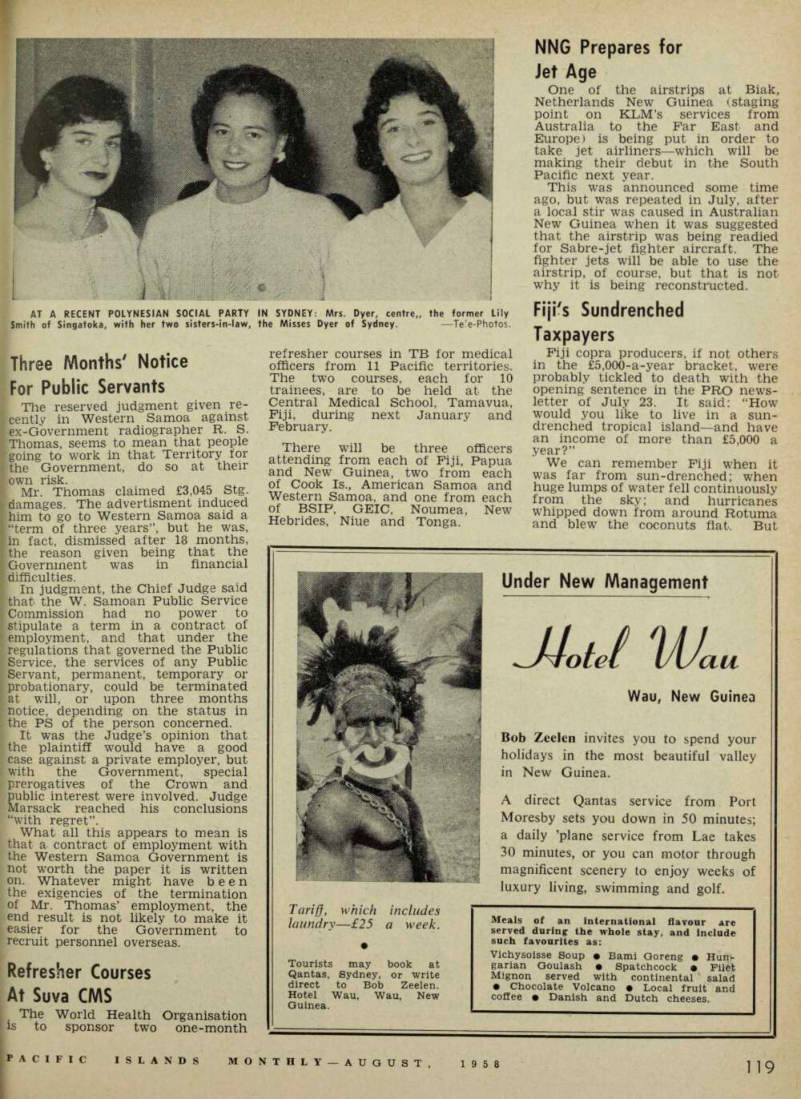
AT A RECENT POLYNESIAN SOCIAL PARTY IN SYDNEY: Mrs. Dyer, centre,, the former Lily Smith of Singatoka, with her two sisters-in-law, the Misses Dyer of Sydney. —Tele-Photos.
perhaps the Inland Revenue Department, which brought all this on, was not including copra pro ducers in its report when it said that 33 individuals in the Colony received £220,000 between them.
This amounts to £6,600 each—but between them they paid £68,000 in income tax, which is over £2,000 each.
Other interesting items in the report were that, in all, Fiji tax payers contributed £1,473,000 to the Inland Revenue Dept.; and that 979 tax defaulters owed the Dept, a total of £40,000.
But maybe the most interesting observation of all was the threat
that “if the difficulties of collecting tax continue and increase, it is pro posed to seek the introduction of spme simpler form of tax collec tion”.
The simplest way of doing that, of course, is to cut the whole thing right out.
Tahitians Advised
to Quit N. Caledonia
Nineteen Tahitian families left Noumea, by Messageries Maritimes liner for Papeete at mid-July, following the New Caledonian labour inspector’s warning that u!, would be little work available shortly for Tahitians and Wallis : Islanders.
There are about 2,000 of these people in New Caledonia, some with families, and many of them are already without work. These are living with their more fortunate compatriots, but in New Caledonia, where the cost of living is very high, even traditional Polynesian hospitality could not cope with that situation indefinitely.
The position for the Wallis Islanders is particularly serious.
Their home islands are dependant only on copra for a cash income— and, of course, that is bringing in decreasing returns these days. The native diet is fish, taro, yams and manioc. After living in Noumea for a while, few Wallisians seem to wish to return to it.
Cook Islands
On Film
Three members of the NZ National Film Unit arrived recently at Rarotonga on the Maui Pomare.
They are Messrs. Bouie, Oakley, and Pomfrey-Brown, and their mission is to produce a 35-mm. colour film for world distribution.
This, it is hoped will show progress in the Cooks.
The party were to travel through the Southern group on board the Maui Pomare, and then spend a full month in Rarotonga. »*, The cameramen will likely be in the Northern groups later in the year. (ov er)
NZ is Out After
Fiji's Trade
Having been sent to explore trade possibilities in Fiji—and carrying many boxes of samples, eagerly supplied by NZ manufacturers— Mr. K. W, Davies (a district officer of the NZ Department of Industries and Commerce) returned to Auck land late in July “convinced that
any manufacturer that caters for the Fiji market will sell goods there”.
“I received the greatest courtesy and consideration in Fiji,” he said, “and I am convinced that this gracious, friendly Colony would indeed welcome greater attention from New Zealand.”
Actually, it would be a good thing if NZ gave Australian traders a little sharper competition. The present situation is cockeyed.
Australia buys little from Fiji; but sells Fiji each year goods worth many millions of pounds. New Zealand buys Fiji bananas running into a very large sum per annum, and sells little to the Colony.
It is vital to Fiji’s economic set
up that Fiji expand the overseas market for her products. A bit of pressure on Australia might accom plish something. Why should Sydney and Melbourne be com pelled to eat the miserable things distributed as “NSW coastal bananas” (retail price 3d each) when Sydney and Melbourne would be very happy to receive the ex cellent bananas grown in Fiji?
Past, Present, Future of
Fiji's Native Policy
With the Fiji administrative .machinery approaching a funda mental change, there should be special interest in a paper which will be presented in Adelaide this month, at the meeting of the Aus tralian and NZ Association for the Advancement of Science.
The paper is “Sir Arthur Gordon’s Native Policy in Fiji”, and the writer is Dr. O. W. Parnaby, of Auckland University, who has devoted con siderable research to the subject.
This policy represented the intro duction of indirect rule of an indigenous people through native councils: and when Gordon became Fiji’s first Governor in 1875, he initiated this plan and put it into operation. Twenty years later, it was adopted and established by Lugard in West Africa, and in other African possessions; but, according to Dr. Parnaby, the full credit should go to Gordon.
It is to be hoped that Dr.
Parnaby will examine the effect of this native policy now against the background of developments never foreseen in 1875—namely, the
establishment of the sugar industry in Fiji, the introduction of a numerically larger Asian population, and the arrival of Fiji at the point where a considerable measure of self-government becomes vital to its economic and social welfare.
Night Landings to
Continue at Nadi, Fiji
The tempo of operations at Nadi Airport, Fiji—where £3,000,000 (NZ currency) is to be spent in two years, to bring the airport to a standard where it can accommodate new jet planes—has speeded up.
There were about 50 New Zealanders, plus large numbers of Fijian and Indian workers, at work there in August. Much of the
heavy equipment for the airport reconstruction, and the materials needed, were arriving in Nadi Bay by ships, and a new jetty, and quarters for native labourers, have been completed.
Most of the survey work has been done, and earth-works on a big scale were in progress in mid- August.
It was feared, at first, that night landing of planes would have to cease at Nadi for a while, owing to the extensive nature of the recon struction; but it was reported at the end of July that the problem had been overcome by placing lights about one mile out to sea, to guide aircraft safely onto No. 2 runway.
Work on the main runway should be completed by February, 1959.
Valuable S. Pacific
Records in N. Zealand
Much South Pacific history is contained in the famous Turnbull Library, of Wellington, NZ, the library of the Polynesian Society of NZ, and the library of Auckland University.
Some members of the Polynesian Society apparently are anxious about the future of their library.
Others would like to see all the books and records brought together in one institution, like the Turnbull Library. The Department of Internal Affairs now is prepared to take over the Society’s library, and house it in the Turnbull Library— an idea which seems to have much merit —but a section of members is unfavourable.
The Society’s library is now valuable and unique. It has been accumulating since 1892. A good deal of the material, of course, is duplicated in the Turnbull Library.
Modern 'Phones to
Cost £20,000
Coming into line with most of the South Pacific towns (which, in the past five years, have discarded
This big vile of scrap was loaded into the Panamanian vessel “Amonea” at Honiara, BSIP, recently—but the whole lot did not weigh very much.
It was aluminium scrap, mostly wings and body sections from planes that were written-off in the fighting in the Solomons in 1942-44.
their inefficient and maddeni manual telephone systems), Weste Samoa is about to instal automa telephones in Apia.
But it is having some difficu in providing for payment—a mati of £20.000 (NZ).
The former Legislative Asseml made the decision and gave t order. The new Assembly a favours the modern system; but t new Assembly has very little mon for capital works of any kind, at first considered cancellation the order; but finally decided to on with it, and try and raise special loan of £20,000.
Shrinking Demand for
Low-Grade Copra
The world demand for coconut « is as large as ever, and it grov; as world population grows. B< that does not apply to all grad! of coconut oil.
The Fiji Department of Agn culture has issued a warning, in booklet for coconut planters TH only certain market, it says,’ is fr good quality oils. There is growin uncertainty about the poor grades . oil and copra.
The £A10,000,000 Yate sam in New Caledoni[?] has been undergoing its first tests. The water level late in July was at rhe 20 matres mar[?] (ultimate height 75 metres-about 230 feet and the test was regarded as satisfactory. Th[?] first casualty has beenthe beautiful Yate rive[?] falls, shown here. They are five miles bac[?] from the sam, but have already disappeared as the river backs up. Work in the dam [?] actually some months behind schedule due t[?] the flooding of the dam site a few monthe ago Because of this delay, filling the dam ha[?] commenced in what is normally New Caledonia's dry season. Delay to the dam will in turn cause delay in getting the new smelters in Noumea into full production.
Photo: F. E. Dunn
“Synthetic detergents are rapidly superseding many of the soaps that formerly were prepared from vege table oils,” says the writer. “The markets for low-grade vegetable oils customarily used for soap-making are shrinking.”
The copra producer, for his own sake as well as for the protection of the industry, must strive con stantly for higher quality.
No Bikinis for Suva's
"Miss Hibiscus"
This year, Fiji’s Hibiscus Festival (begun as a small one-day event three years ago) will last from September 27 to October 4, and is now a major tourist attraction.
Events will include a searchlight tattoo, procession of decorated floats, swimming carnival, sailing regatta and an agricultural show.
Highlight of the week is the choosing of “Miss Hibiscus”. This competition is open to girls of all races. Unlike similar events else where, the girls do not parade in bathing costumes. They wear summer frocks or evening dress.
Head of Clan Once
Lived on Misima
Chieftain Thomas McNeill, of •Isle of Barra, in the Outer Hebrides, head of the Clan McNeill, is back f in Australia, rallying an estimated 400 Australian McNeills, to join the
known 500 in Scotland. He is 79, and a hearty type who wears the kilt and the bonnet.
In Brisbane, there was a happy meeting between Chieftain McNeill and Mr. George Munt, of Misima.
Mr. Munt knew “Tom Neill” well when, away back between the Wars, he was the engine-driver of the little train which ran, on Misima Island (Eastern Papua), between the wharf and the goldmines.
CUo 0n \ n Maui jnecp in mcw
fiiiinAa Hinhhnfk
uumea mgrildnus
Despite handicaps imposed by the steep tropical sun, plus others peculiar to New Guinea, the directors of the Nondugl Trust,
established by Sir Edward Hallstrom in the New Guinea Highlands, still have faith in their sheep-breeding project, Of the 100 breeding-ewes donated this year by Sir Edward, 96 (from Kimo Station, Gundagai, NSW) arrived at Nondugl in good con dition, in May, after a ship-journey to Madang, a plane-journey to Minj, and a 16 miles walk from Minj to Nondugl.
Most of the new-comers dropped lambs in good condition, and these have been added to the lambs from the flock already there.
Cattle increasingly are doing well in the Highlands, and in Papua and New Guinea generally; but most observers still regard sheep-farming there as in an experimental stage.
lae's Pet Show
Dogs in Lae, NG, have been hav ing a “tough trot” lately.
They have been chased by native police, rounded up if found on the streets after hours, put into gaol and, if not claimed within a certain period, just exterminated.
But they came into their own on July 12, when the Lae Hockey Asso ciation held a Gala Children’s Carnival in the European School playground, and invited all the dogs and pets along.
There were prizes for the largest pet, smallest pet, nicest dog,
cutest pup, best kept cat, prettiest kitten, and the most original pet.
And out they came, the greatest collection of washed, polished and deloused dogs Lae has ever seen assembled. There even was among them a couple which had done a “stretch” but lost their hang dog look and wagged their tails with the best of them.
The “Mlost Original Pet” section brought to light some rarities, amongst which was Jennifer Ashton’s prize
winning Tiger Cat; tortoises, Cus Cus, and a very hungry-looking puk puk brought along by lan Hendrick. lan assured us that the small croc, was well fed on fish heads; but the look in the small creature’s eye did not augur well for small fingers placed too close to it.
Passage Blasters at
Work Again
Work of blasting a passage through the reef into the lagoon at Atafu, in the Tokelaus, will begin at the end of August. It may be
finished by December. Atafu will be the second of three Tokelau atolls to be; so treated.
The blasting of the first, at Nukunono, was finished a few months ago, although work is still going on to build cut-off walls each side of the new passage, to control the speed of the water through the channel.
Work on the third atoll passage, at Pakaofa, will start next year.
The job due to begin this month at Atafu will result in a passage 45 ft wide and 500 ft long. Like the others, it will enable the local surfboats to go out to meet the
schooners at low tide —instead of only at high tide as at present.
NZ Works Ministry man in charge of the three operations, Mr. Alan Prichard, estimates that schooners will be able to save three to three and a half days of loading time in working the three atolls when work is completed—and make a saving of £l5O a day. However, savings will not begin until the cost of the passage blasting pays for itself — which should be in about three years.
Prichard was in Apia in July, re covering from a leg infection picked up in the Tokelaus, but expected to be back in the group by mid-August.
This is lan Hendrick and his ferocious pet. During the visit to Lae of the French Frigate "Francis Gamier", the puk-puk was shown to some of the French sailors. They were so intrigued with the little fellow that lan presented it to them.
How Fiji was Freed
From Fly Nuisance
Fiji is relatively free from flies, although 30 years ago they were a nuisance and a menace to health.
How they were cleared is told in an article in the South Pacific Commission’s Quarterly Bulletin by the man responsible, Mr. Hubert W. H. Simmonds, formerly a Government entomologist in Fiji.
He writes: “Early accounts bear witness to the appalling abundance of houseflies in certain of the Pacific Islands. They were accom panied by a general incidence of typhoid and severe epidemic out breaks of various types of dysentery.
There was also much eye disease among the Fijians, often leading to blindness. Many wound infections must have been due to these pests”.
In 1911 the housefly was a prevalent and dangerous pest and Fiji was anything but a healthy place in which to reside. Towards the end of 1927 flies were in such numbers in Suva that he decided to explore the possibility of introducing parasites or predators which might exercise some measure of control over them.
After a series of experiments Mr.
Simmonds found just the insect re quired—a beetle which could con sume from ten to twenty full-grown fly maggots in 24 hours.
Strong colonies of these beetles were introduced into Fiji. Six months later they were well estab lished. The beetle is now widely spread throughout the Colony, and there has been a very marked re duction in the fly pest.
The Director of Medical Services, Dr. P. W. Dill-Russell, in a fore word to the article, describes it as worthy of world-wide attention. He says the pioneer work of Mr.
Simmonds deserves the widest recognition and comments: “The menace of the housefly to health cannot be over-emphasised. Public health workers have spent much time and effort in attempting to devise means whereby this pest can be eliminated”.
Aircraft—They Come
in All Kinds at Lae
Lae airstrip, New Guinea, sees them all—from old faithful (DC3) to pre-war Junkers; a range of single-engined Curtis-Robins, Stin son - L-s’s, Tiger Moths, Proctors, Austers, Norseman, to the latest Otters; Cessnas, Lockheed-Hudsons, See Bee, Super Convair, and the Skymaster. And on July 10, the latest visitor flew in and was made welcome.
This aircraft, a twin-engined Dove, was on a 12,000-mile delivery flight from England to Australia, for the Australian Flying Doctor Service.
The aircraft had flown from London via France, Syria, and through India, Siam and Singapore.
De Havilland’s Australian sales manager, Mr. Rollo Kingsford- Smith, piloted the plane, and was accompanied by Mrs. De Havilland and a QEA Super-Constellation captain, Capt. “Buddy” Myers and
Mrs. Meyers. Captain Meyers took a busman’s holiday on the trip when he acted as the plane’s radio operator.
After leaving Lae, the plane flew direct to Cairns. (Over)
Mrs. Cleland, wife of the Administrator of Papua-New Guinea, Brigadier D. M. Cleland, among the tea-cups at the Red Cross Kiosk, in Taurama Road, Port Moresby. Mrs. Cleland opened the Kiosk, which is an adjunct to the new hospital. —Papuan Prints Photo.
Nadi's Control Tower
Sound-proof, Air conditioned
Work started in August on the new control tower for Nadi airport, —part of the new reconstruction programme that will bring the Fiji airport to modern jet standards.
The new £34,000 tower has been designed in the Government Architect’s office, NZ Ministry of Works. Architect in charge is Mr.
W. F. Ponder, who is well known in the islands for his work on many NZ Government projects undertaken in the Pacific over the last 10 years.
The tower is air-conditioned and has a double glass shell designed to keep temperatures constant, and also to keep out noise of jet engines.
The outside glass skin is of a special heat-resistant glass, and the inside one is armoured.
A stream of air passes continu ously between the two glass shells to prevent condensation. Special research was undertaken to design the glass cab so that it produced the least number of reflections —a problem which exists in some cabs with sloping glass windows similar to the one at Nadi.
The cab is of structural steel on a reinforced concrete base, and there are living quarters for the operators. The estimate does not include cost of technical equipment, including radio aids. The new tower is being built adjacent to the Nadi Club.
Pharmacists of Fiji Unite
The chemists of Fiji, seeking a voice in affairs which concern them, got together at the Lautoka ond of Viti Levu, in December, 1957, under the leadership of William Charles Branchett, Ph.C, MPS, and formed a professional body. They called it the Fiji Pharmaceutical Associa tion.
At the end of April, a general meeting of all pharmacists in Fiji was held in Suva and at this meet ing the name of the new society was brought into line with overseas practice and changed to Pharma ceutical Society of Fiji.
At this meeting, also, the whole council stood down and new elections were held. Office bearers for the next year are: President, W. C. Branchett; vice-president, Mr.
B. Southwick; secretary-treasurer, Mrs. Stone; committee, Mr. G.
Mouat, Miss Mary Maslet and Mr.
Hari Prasad.
The Director of Medical Services m Fiji was elected to Honorary
Membership.
One of the chief aims of the new Association is to suppress mal practice and to encourage a high standard of professional ethics.
The report is that members are supporting the organisation with much enthusiasm.
fhanrip fnr
v-iidiiyc iui DJir
Trade Cnrnoratinn
„ V ' olr H or « lTlon Mr. R. J. Lotze resigned from the position of Manager of the British Solomon Islands Trading Corporation in June.
Present indications are that a new manager will not be appointed
for some little time and meanwhile the affairs of the Corporation are being handled by a Management Board, consisting of three Govern ment officials and a Honiara house wife.
Mr. Lotze took over the manage ment in 1951, when the three tumble-down war-time relics, used as offices and store, were known as the Government Trade Scheme.
In 1956 saw the separation and setting up of the BSIP Ports Authority, and in 1957 the acquisi tion of Mr. K. H. Dalrymple-Hay’s Mendana Avenue store.
Following this purchase the sea front premises were soon vacated and Mr. Hay’s store utilised as the main store and the then recently completed Blair Buildings used for offices.
French Ships and
Planes Visit Around
A French Lancaster aircraft landed in Honiara, BSIP on July 22 in the course of survey work.
The plane, one of three used by the French in air-sea rescue work in the Pacific, was studying local conditions between Noumea, Solomons and New Hebrides.
The 2,000-ton French naval vessel Francis Gamier also arrived at Point
How Nadi airport’s new control tower will look. See story at left
Cruz on August 1. Formerly the Italian Eritrea, Francis Gamier, with Rear-Admiral Toulouse Lautrec, Commander of French Naval Forces in the Pacific, on board, was mak ing an informal 36-hour visit to Honiara.
Football and tennis matches were arranged between the ship’s crew and local teams and a display of ■native dancing was given in the
West Solomons Producers
Get Together
An Association, known as the Primary Producers’ and Trade Asso ciation, with headquarters in Gizo, has been formed in the Western Solomons.
Its function is to express the needs and opinion of the Western Dis tricts of the BSIP Government. It is hoped that the Association will be a forerunner to a Chamber of Commerce.
Members are Messrs. J. H. Page, V. E. Forbes, N. Scott-Elliott, R.
Yates, G. Forrester, R. G. Hodge, A. E. Palmer, A. T. Hughes and K T. Wong. Mr. C. F. Meaker is
Honorary Secretary.
Angle Parking and
Progress for Wewak
Progress brings its own problems, and when small towns have parking problems it’s a sure sign they are expanding.
Wewak, New Guinea, is the latest of the fast growing centres in the rerritory to try out angle parking to offset traffic congestion.
I At a meeting of the Town Advisory Council in July, it was
moved by Mr. Hirst, seconded by Mr. Seto, that: “The Council recommends that angle parking be tried in the shopping area for a period of one month, and the old compound site be prepared to cater for any over flow that may occur in busy shop ping periods.”
Now They Have a
Garden Society
Enthusiastic garden lovers turned up in force at the inaugural meet ing of the New Guinea Horticultural Society, which was held at the Public School, Lae, on July 15.
Specially invited to assist in forming the Society was Mrs. D.
M. Cleland, wife of the Admini strator, who offered valuable advice and suggestions. Nominations were called and office bearers appointed. (Mr. K. White is president).
Visitors from Wau were particu larly interested, and it was suggested that a sub-branch be formed there and at other centres.
Mrs. Cleland informed the meeting that it was the aim, at a later date, and after various sub-branches had been formed, to form the societies into the Association of P-NG.
Mrs. Cleland told the meeting of the activities of the Port Moresby Society and pointed out the benefits to be derived from such Societies.
All were agreed that anything that Port Moresby could do, Lae could do better.
Tapu is Now
Removed from Aoniu
True to Tongan tradition (for good luck) Queen Salote was the first woman to board" the Kingdom’s smart new 500-ton copra ship, Aoniu, and the tapu is thus now removed ( PIM, March, p. 107).
It happened at Nukualofa at 10.30 a.m. on July 21, when the Aoniu arrived from the Dutch builders with a Dutch crew, via Panama and Pago Pago. If any woman had been aboard her until then, the Kingdom of Tonga had never heard about it.
Prince Tungi was on the bridge during the final run from Pago, where he arranged to have the ship repainted white and grey after her long voyage. He made a speech on the wharf at Nukualofa to a great throng which included the Queen and women of high rank.
The Prime Minister presented the
Here are five of the six speakers who addressed the Sri Vivekananda Old Students' Association of Fiji, in the Suva Town Hall on June 21. They are, seated from left to right, J. Denniels, A. D. Patel, Commissioner K. D. Bhasin, Swami Rudrananda, and R. B. Ramroop (Mr. C. S.
Brocket not shown). Swami Vivekananda was an Indian religious leader of the latter half of the 19th century, and June 21 is the anniversary of his birth. The speakers each dealt with some aspect of Vivekananda's life and work amongst the poor of India. He is credited, not only with spiritual leadership, but with moulding the minds of those who founded the modern national movement in India. — S. M. Mudaliar.
Queen with a key to the Royal su aboard the Aoniu, with the prom that it would “always be at her d posal whenever she wished travel”.
As the Dutch flag was lowered the strains of the Dutch Natioi Anthem, the Royal Standard v hoisted and Queen Salote stepp aboard.
Inaugural celebrations—includi a harbour cruise, a feast, danci (there was a new stick dance pi sented), and a cocktail party—to up Nukualofa’s next 12 hours.
The Aoniu went to Suva a f
days later to drop the Dutch cr©‘ off for their return to Holland The new skipper, New Zealand] Thomas Neill, has a three-year cot tract, seven officers, ten men, au room for eight saloon passenger and 400 tons of copra.
Queen Salote’s suite, below tld bridge, is additional to the salcw accommodation. She has her o \r lounge and a well-furnished stati room with a double bunk.
Attached are separate toil* arrangements, including a mar U backed wash stand. Walls of tJd lounge and stateroom are covern in a leather-type plastic materia contrasting with the natural woo»c of the furniture.
Chairs are upholstered in plastif There is a thick pile carpet. A dunn waiter connects the lounge with tit j galley below.
And Another Glamour Shipj
For Tonga in August
new Hifofua, £T125,00 worth of ocean-going tug, was drfc to be launched in Holland in lae the same shipyard thid • Ton S a ’ s newly-a cqu i r e 9 luxurious copra ship Aoniu. The o'o
wooden Hifofua will be offered for sale.
The new steel one will be used as a general runabout (there are even some hopes in Tonga that she may be called upon to salvage a ship in distress occasionally— somebody else’s ship, of course).
She may, too, be used in conjunc tion with four new steel barges ordered from Britain at the cost of about £5,000 each (two of which were in service in July, and the others were expected any day).
Tonga has some plans to develop Eua Island, near Nukualofa, for timber and bananas, and the barges would be involved in that, according to the latest plans, anyhow. They would also be used to speed up the discharge of cargo at Nukualofa, un loading on to the wharf and into barges at the same time.
Mixture As Before
In Norfolk Is.
The four sitting members of the Norfolk Island Advisory Council— Messrs. W. T. McCoy, L. D.
Holloway, W. M. Randall and N.
C. Christian—romped home at the elections on July 23. Local residents evidently believe that experience is better than new blood at this stage of NI affairs, when the Island has been promised more self determination.
The four other candidates who offered themselves for election for the four wards were: H. L.
Christian, G. G. F. Quintal, W. W.
Sanders, and F. J. Needham.
RSL Will Discuss
Loan Scheme
More than 200 ex-servicemen living in Papua-New Guinea hope v-o benefit from the settlers’ loans scheme to be introduced in the Territory, the State Secretary of the Returned Servicemen’s League m the Territory, Mr. J. V. Knight, said at end of July.
The Commonwealth Government recently announced a scheme whereby ex-servicemen if selected could borrow amounts up to £25,000 to settle land. [During a visit in August of the national executive of the RSL this scheme will be discussed at a rural conference.
A party of nine officials of the «jbL are due to arrive in Port Moresby from Australia by air on
August 24.
Investment Opportunities
in New Guinea
Sydney Sun, of July 3, published J? article by a leading stockbroker, who had made an extensive tour „ Pa Pua and New Guinea and was Profoundly impressed” by what he oaw.
He found much evidence of sound economic development, and was struck by the wealth-producing industries which were opening up.
He quoted the values of copra and cocoa production; the evidence of prosperity; the new loan scheme for servicemen-planters; and said: “This ... to show the potential wealth of the Territory, especially when it is considered that the out put of cocoa alone will be about 7,000 tons by 1960.
“With cocoa and copra prices maintaining a reasonable level, the years ahead could mean consider able prosperity . . . Investors should now seriously consider directing some of their funds in this direction.”
COMMENT; Investors, before they go much further, should also “seriously consider” these facts, which the stockbroker’s survey ignored: • Fifty per cent. of the “prosperity” which the casual visitor notes in New Guinea is provided by Australia’s free gift to the Territory each year of about £9 millions, o The present Australian Govern ment’s consistent policy is one of discouragement of the individual European settler, on the ground that there is little suitable land available, surplus to the future estimated needs of the natives. • Because of the official attitude towards European planting enter
prise, there has been comparatively little new planting of coconuts since the war—probably not enough to maintain present copra production. • The recent decision to make special loans available to ex servicemen comes ten years too late —most of the first-class men who were clamouring for land and financial help after the war have been discouraged by official in difference, and gone elsewhere. • Because of lack of land, any worthwhile agricultural development by individual enterprise will be carried out by natives (mostly in co-operation)—and there is little field for investment there.
Samoa's Flag
of Freedom
When West Samoans heard that
NZ Prime Minister Nash had offered $lOO,OOO of Colombo Plan aid to Thailand, they were incensed.
That is, according to Mr. Kinsella, MP, a member of the Opposition.
But it is old stuff politically.
When Mr. Kinsella’s party was in office in NZ (until six months ago), people in NZ’s Pacific dependencies were always resentful when that Government contributed to the Colombo Plan Aid. Whatever New Zealand is able to do for Asia is only a drop in the bucket, but so far no Australasian Government, whatever its political colour, has been game enough to refuse 'to play.
About the same time as Samoans were allegedly feeling resentful about the Thailand hand-out, they had been given a NZ grant of £Bl,OOO. But Mr. Kinsella did not
mention that.
Mr. Kinsella was a member of t NZ Parliamentary delegation whi recently visited Western Samoa f the opening of the Legislati Assembly. He had other things say about the Territory, particular about its rising nationalism. 1 said that one speaker had allud to “the flag of freedom (Samoa : flying alongside that of -Ne Zealand”, and hoped that it wou not be long before the New Zealai flag disappeared altogether.
Such remarks, make in Samo; and translated into English, have; big chance of being misinterprets But if it was what the speak said, it is hard to see why Samoa, should be resentful and “fe ignored”, as Mr. Kinsella put if NZ does buy Thailand a SIOO,C irrigation scheme.
The Farther They
Fall the Safer
The vast ocean deeps of the won has intrigued oceanographers fl years—-but the interest seemed have little but academic value uni the atomic age. They now w come in handy as dumping groun for radioactive waste from atom reactors—including the one at Luc Heights near Sydney.
A great deal of the oceanograpx undertaken during the IGY h concerned these huge trenchr miles deep, in the sea floor. Au trahan, New Zealand and Russii expeditions have undertaken r search in the South Pacific; aj the Americans and Japanese—ai the Russians—in the North Pacif The best known deep in ti South Pacific is the Tongan Trenr which runs beside the Tong* Group and extends towards NT Zealand At places it has a deo of about seven miles—and accordii to the Russian researchers, it mi be even more.
Us i- the place to dump uu wanted radioactive waste which ca remam dangerous for 50,m f,™ ed ,i n I ? eavy lead containers as den?h! d it from .u shlps lnto toe, ’fk 18 thou ght that it w contaminate edible fish or earned on ocean currents. th ? re hasn’t been muj problem involved in dumping rad f be^L W S t 6 in the S°u P th § Pacili But U thP t i l6r ui was none to dum has hPPn P c° blen l will arise and t 5“ b< !!£ suggested that before e countries bordering tt tifp^pcf Bo ? together and agree how b6St places for dumping it, as from Co thi y a? ?£AF plane flew o aid h Queensland cosc thp two * e ad containers g hnL at Q °T- waste from the U n? m */r ex P losions that took place - Saii^ 0n l ebe i 1 P Island s (West Am wu a hout two years ago. has been nurturing tIJ waste in the interim w oc stated, but a number of peo][o
'were not best pleased that it should now be thrown into the sea off
Queensland.
Achievements and Research
of Late Harold Gatty
I Little-known episodes in the life of the late Harold Gatty (head of Fiji Airways, since sold to Qantas) were described by Captain Brett Hilder in Sydney on July 24, in a memorial address, before the Aus tralian Institute of Navigation. The Institute thus paid tribute to a very famous navigator.
Mr. Gatty died in Fiji on August 30, 1957, at the age of 54, after a notable career as a navigator, air man and director of airways. In tracing his history, Captain Hilder brought out some aspects of his Character and achievements not generally known.
Mr. Gatty’s mother and married sister (Mrs. Martin), who are
residents of Sydney, were at the lecture.
Mr. Gatty was an outstanding ex ample of the small-town boy who made good. He went to school at Campbelltown, in Tasmania; and there won a bursary which took him eventually to the Australian Naval College. He left there just before the completion of his 4-years term, apparently because his heart condi tion was not good. Undismayed, he personally got himself taken into the Patrick Steamship Line (then a rather small show) as a cadet officer, and so got his second mate’s ticket.
He served briefly on Union Co. trans-Pacific ships, and it was the influence of his first wife which in duced him to seek a toe-hold in United States navigation and aviation.
There are remarkable stories of how he invented a new driftrecorder for air navigation, and of how his brilliant work as a navigator saved the lives of his associate and himself when they tried —and failed—to make the first trans-North Pacific air crossing from Japan to USA.
It was supposed to be an all- American attempt; but USA officialdom faded out hurriedly when it was discovered that Gatty was an Australian and his partner a Canadian.
Gatty remained an Australian, to the end, although his three sons (by his first marriage) are—and always have been—United States citizens.
But Gatty did not like Australians
much. After Wiley Post and he made the first circumnavigation of the Northern Hemisphere, and he was world-famous, he teamed up with Douglas (famous plane manufac turer); and tried very hard to in duce the Australian Government to allow Douglas to establish a plane making factory in Australia. The Lyons Government turned him down —& bad decision for Australia, as well as for Gatty—and Gatty never forgot or forgave.
In World War 11, Gatty went to General MacArthur’s headquarters as Group-Captain, to be liaison officer for Australian air trans portation. But—strong-willed and contemptuous of red-tape and frip pery—he fought frequently with
much of the top brass in RAAF and RAF; and the job ended half-way through the war. Gatty did not for get that experience either.
His surveys of Pacific equatorial islands, his share in the challenges made by USA to British ownership of certain atolls, his introduction of Pan American Airways to New Zea land, his abortive tuna-fishing enterprise in Fiji waters, his organ isation of Fiji Airways, his collec tion of data to show how natural signs (wind drift, migrations of birds, study of rocks and sand and trees) may aid the science of navi gation—all these things were dis cussed in detail by Captain Hilder.
Captain Hilder’s research well earned the cordial vote of thanks he received.
Lingual Experts' Blind
Work in N. Guinea
I Operating from a base camp in Aiyura, in the Eastern Highlands of New Guinea, some 30 men and women of an institution called “the Melbourne Summer School of Linguists” are residing briefly, in pairs, in the Highlands native villages, in an attempt to record the various dialects in phonetics, and then to reduce the phonetics to a simple alphabet.
Mr. R. G. Brown, representing the Institute, told a Reuter reporter in Moresby that they planned thus to translate the New Testament for the use of the natives —and each translation represented years of work.— Reuter.
COMMENT: This news announce ment emphasises the fact that the P-NG Administration still has no defined policy on the adoption of a common language, or languages, m Papua and New Guinea, through which essential instruction may be given the U million natives in its care.
The number of separate languages in Papua and New Guinea repre sents sheer Babel —it is variously estimated that there are from 300 to 700 of them. The big task of educating these natives, and train ing them for a place in a Westernised world, cannot even be planned until some decision has been reached concerning the number of languages to be estab lished in written form, and what languages. And what place is Pidgin to have in this plan?
Progress towards self-government and an independent national exis tence was made in Fiji, Samoa and other large Territories after one of the several languages or dialects had been reduced to writing,, and the natives thus were given educa tion and training. This work, almost invariably, was done in the Islands by the early missionaries.
Because of primitive conditions and multiplicity of languages, it is a far more difficult task in Papua and New Guinea.
Well-meaning people like this School of Linguists should not be allowed to undertake their kind of activity in New Guinea until their
work can be co-ordinated with an Administration plan. So far, there is no plan.
United Arab Republic
Is In it Now
Two United Nations Trusteeship missions will visit the Pacific next year—one of the missions making a special visit to Western Samoa, and the other visiting the rest of the Trust Territories, including New Guinea and Nauru.
Members of the mission to visit Samoa will be chosen by France, Britain. India and the United Arab Republic.
What the United Arab Republic knows about the problems of administration in South Pacific Islands should be considerable, we imagine.
The mission to visit New Guinea and other Trust Territories have members chosen by Burma, Italy, Belgium and China—which makes an even more interesting combina tion.
Worthy Successors
of Famed NGVR
Life in the tropics has so many compensations in the social round and sporting activities that few people admit to being bored. One sometimes is hard-pressed to spare even one evening for personal chores and an early night.
The conduct of a group of young men in New Guinea who willingly give up their time to becoming good soldiers, and to encouraging others to join their ranks, is therefore the more praiseworthy.
Following in the footsteps of the NGVR, who won such fame in World War 11, these young men of the PNGVR, are equipping themselves for future leadership by giving their time and study to the arts of war.
Recently, on a bivouac into the Atzera Ranges, near Lae, NG — made for the purpose of learning about the country and how to use carrier-lines and locate native foods
Four members of the Ncbbs family of Norfolk Island (left to right): Geraldine. Kathleen, Albert and Iris, with another Norfolk Islander, Mrs.
Mavis Davis —formerly Miss Blucher. They met at a Polynesian Society party in Sydney.—A Tele-Photo.
—the patrol uncovered a number survey pegs believed to have be laid by Australian troops during t war.
During the trip they also foul that the maps which they we using needed revision. On o: calculation, taken from the mai they ended up at a sheer precipi< over which they had to transpc themselves and their equipment, the situation had arisen in actu warfare they would have had litl hope of survival.
Officer-in-charge of the PNGV in Lae, NG, is Lieutenant B Harvey-Hall, whose family lived the Territory pre-war.
To advertise their being, and a drive for new recruits, the PNG\
held a barbecue on June 21, au invited Lae citizens to their hea* quarters. A bullock was donate ind the trimmings were provided members and their wives * have been the kaL A , rmy men pronounce t was n ever like thii ,_ half a dozen recruits lined u Which proves the old adage thd it pays to advertise”.—Pß.
Otter Overshoots
At Tapini
fvw lB of four Otter airers' ri;®!’ 6 recently introduced 4. P *lP ua " New Guinea servfi\ overshot the Tapini airstrip fi?sP a J n early August and wvd slightly damaged. ? s ° L ne of the most difficuc “"tow in the Territory—one ei:s ni?i? nea f fo °t of a mountae, nd other has a 180 sneer drop into a gorge. To male it more difficult, the whole strd
runs steeply uphill.
It has been jokingly said by pilots that when coming in to land, you aim about three feet below the lip of the gorge, depending on an up draft to lift you onto the beginning of the strip.
Three people were on the air craft —which was on Administration charter work —Pilot Ken Montagu, ABC Regional journalist Geoffrey Luck, and Assistant District Officer Ken Chester.
New Guinea Women
Carry on Good Work
The two women’s organisations in Australia which do much good work for ex-New Guinea women, the New Guinea Women’s Club of Sydney, and the New Guinea Women’s Association in Melbourne, both recently held their annual meetings and both reported a year of satisfactory work. i The Sydney Club re-elected its office bearers in a body—Mrs. N. H.
Foxcroft, its president, for the 12th consecutive year. The other office
bearers are: Vice-president, Mrs. J.
Edwards: hon. sec., Mrs. June Johnson: treasurer, Mrs. I. Carr; Committee, Mesdames J. Whiteman, N. Laws, Les Clark, C. Bennie and J Green.
In Melbourne, Mrs. L. Pratt as president, and Mrs. J. Hayne, hon. sec. succeeded Mrs. Lorna McGuigan and Miss V. Youlden.
Both the Melbourne and Sydney groups have been working for the memorial to the men who lost their lives in New Guinea during the war, and during this year, the book-case, "9 house the Book of Remembrance (m which the names of these men are inscribed) was constructed and went forward to Rabaul where it is now installed in the New Britain women’s Club.
The case is a very fine piece of Workmanship executed in Melbourne of,bronze and plate glass and with a Suitably inscribed plaque. It had been intended to have the case 3nade in Rabaul, of local wood, but this proved impossible.
T i / * r
Ineyre not Lrazy
i -i.
—Just Kesenttui
Bleaching the hair with peroxide or lime is an indication of the Papua-New Guinea native’s awareness that he is different from white men.
This extraordinary statement is by a leading Melbourne phychiatrist, Dr. A. Sinclair, who was hired last year by Territory Minister Hasluck to inquire into P-NG native mentalhealth.
NG natives have always bleached their hair—with lime, before peroxide was introduced—and the basic reason is that it killed off the lice.
To assist him in his job, Dr.
Sinclair had some impressive talent— Professor D. W. McElwain, Pro fessor of Psychology at Queensland University, and Colonel E. F.
Campbell, Director of Psychology at Army headquarters, The result of their long and ponderous deliberations seems to be that the P-NG Administration is going to provide better native mental hospitals in Port Moresby, and not before time.
Here are some of the conclusions of the report: • Even the most enlightened Europeans had a basic prejudice against natives, despite their at tempts to disguise it. • There was a great deal of re-
by the native towards the white man—caused largely by the ..obvious disparity in the possession of material goods and the inability of the natives properly to envisage the future. • A few Europeans who have themselves that the native people feel a glad need for the presence of Europeans are fool si n g themselves. (“Overcome by evangelical zeal”, was the way the |doctor put it). • Natives—especially those living outside much contact with Euro peans—had a high suicide rate. • There was little real crime as lEuropeans understand it; cases of rape or attempted rape may have been caused by European women who were unaware that their be haviour or dress was provocative.
I Some of which is interesting but little of which is not already so well Iknown that it requires a eminent phychiatrist and a brace of pro cessors to state the case. The crux of the whole survey is that the facilities for treatment of mental patients in Port Moresby are “highly {unsuitable”. Most people who know ’it are agreed about that, anyway.
He Hatched
Cassowary Eggs!
i; Papuan old-timer Sydney Chance gets this one through to Mr. Ripley, per medium of Sydney Bulletin : - A Sussex (England) lady bar tender made local history by hatch ing out a hen’s egg which she Icarried, wrapped in cotton wool, her bosom for 21 days.
I That’s nothing. I had a friend in New Guinea who hatched out several |casowary eggs. He was that fine old gentleman, Walter Goodfellow who, with Shaw-Mayer, used to come to us every few years bird-collecting for the London Zoo.
I Once he found a nice, warm clutch of large green eggs and phinking that they might be those of the purple-necked double-wattled variety of cassowary (which they were desperately in need of) he called for extra blankets and snuggled up in bed and fed by his
native servants, he stayed put for four days until the chicks emerged, It was in the wilds of Dutch New Guinea, and, believe it or not, he got a pair of the resultant young cassowaries back to London.
Fire Destroys
BSIP "Island"
Sulufou, one of the native-built artificial islands off the coast of Malaita, Solomon Islands, comprising about 60 native houses and a Melanesian Mission Church, was completely destroyed by fire on July e.
The people managed to jump into the sea and only ten were seriously burnt. One small child has since died, in hospital.
With a strong wind blowing there was no time to rescue any possessions and the islanders lost everything, including food, knives, axes and canoes.
Rebuilding of the village is being carried out by 170 natives and much assistance has been given by Gov ernment and Melanesian Mission.
N. Cal. Tourists Unlucky
With Drinks, Westerlies
The Oronsay arrived in Noumea with some 1,200 tourists aboard on July 3, but weather conditions were not of the best, a squally Westerly lowering the temperature and rais ing a nasty sea in the usual mill pond harbour.
As ships of this size must stand right out —some two miles —some discomfort was experienced by passengers coming ashore.
A ball with native dancing was held on the Thursday night, with the tourists drinking fruit juice!
The closing of the bars edict had not then been waived even for the tourists.
The ship left next day at 2 p.m.
On the same day the Monowai, with some 350 tourists aboard arrived and berthed at the wharf. This is the first time that New Caledonia has received the visit of a New Zealand tourist ship. These people had better luck, as the bars opened up that very afternoon.
The Monowai left next day at noon. Luckily, the squally Westerly had dropped, otherwise the Monowai
IT’S WET ON THE OLD SEA WALL: A recent long spell of westerly winds in Fiji brought a heavy ground swell, known locally as a Loka.
The effect in Suva is shown by this photograph of the swells breaking over the sea-wall at Nasese.
Photo: Rob Wright of Fiji PRO.
might have suffered the fate of the Duntroon a few weeks previously.
She was in Noumea on a cruise, but the Westerly held her fast against the wharf for two extra days and it was only with the falling of the wind that the ship was able to slip off.
Noumea badly needs a powerful tug to help ships when a Westerly is blowing.
No More Rolling
for Himalaya
The P & O liner Himalaya, which is currently making its second voyage across the Pacific, has been fitted with stabilisers which cost £150,000 Stg.
Himalaya was the only new P & O vessel which did not have stabilis ers fitted when she was under con struction—and a lot of people who travelled on her were far from happy.
However, the 18 degree roll which a sea-way used to produce in her, has now been reduced to about two degrees.
W. Samoan Trade
is Still Healthy
The Apia Chamber of Commerce has just published its annual report on trade and business conditions in the Territory for the year 1957 W (r lc k contains some interesting observations and statistics of gen eral interest.
This was not considered a good year from the business viewpoint was sli ghtly better than 1956 and showed an improvement in trade on that year. The busi ness community was affected by un certainty, due to the confused posi tion of the Government’s finances, the steady decline in the Govern rrumt’s general reserves and a deficit budget due mainly to the non-r eceip t of an anticipated Western Samoa Trust Estates Cor poration grant of £8125,000.
In spite of the deficiencies in Administration, however, the economic position of the Territory can be considered quite sound, as it has no national debt, and although general reserves have been depleted to a dangerously low level, the ex port trade is buoyant and the country is able to maintain a good and healthy living standard for its
fast-growing population.
V 0^ hle weather conditions in 1957 did much to stimulate the growth of the three main agri copra^ 1 exports ’ cocoa - bananas and The deterioration in Govrnment finances was mainly due to over expenditure on unproductive social g?v '"thp ° Ut sufflc lent IhoSgh given to the economic develonment enlareed^nhhv 7 and - to a greatly enlarged public service. This Ip4 dema°nd nt gr W i th e demand for services, an ever-in creasing population to servl m“e
capital assets to maintain, and in sufficient funds to cope with thes problems. Wholesale dismissals o local and seconded officials were tH result of this wrong policy.
AAoresby Ladies
Farewell IVlrs. Groves
Over 50 Port Moresby women re cently gathered at the home < Mrs. R. Willock, to say farewell t Mrs. W. C. Groves, who will short;) be leaving Papua-New Guinee (Mr. W. C. Groves, Director ♦ Education, retires this month).
Mrs. Groves was the organise? and founder of the,Country Womens Assn, in Port Moresby; was founds) tion president (for two years), am was again president for 1957-55 having resigned at the annua general meeting in June, 1958, whea Mrs. Mona Anthony (well-know* pre-war Rabaulite whose husbam is Assistant Secretary for Lands s Moresby) was elected.
During Mrs. Groves’ associcatim with CWA in the Territory, sM; represented the Territory at as annual conference of CWA of Ausi traha at Melbourne; she saw thl; launching of the special fund foi the erection of a CWA hostes building for visiting women frorc out-stations which, at a cost o over £12,000, is now under erectioDj Port Moresby, buc which will not be completed ii tune for Mrs. Groves to participate m the official opening later thrl year. &
No other organisation of women in the Territory has brought together so solidly such a repre sentative and large number of 'European women in a determined and successful attempt to do some thing of a practical nature for themselves by their own individual and group efforts.
Much of the responsibility for all of these things has rested upon Mrs.
Groves and her active leadership or membership of the Port Moresby Branch Committee. ■ She is an old Territorian, having gone first to the Territory in 1921.
She married in Rabaul in 1925. when she was a teacher at the Administration school at Malaguna.
At that time Mr. Groves was in charge of the school.
W. Samoan Copra
Exports Fall
The recent Apia Chamber of Commerce report points out the serious drop in Western Samoan copra production which in the current year 1958, probably will amount to about half of normal (14,325 tons in 1957).
The lower prices ruling, adverse weather conditions and the effect of unpopular grading regulations, coupled with better opportunities for banana exports are the underlying reasons for this deterioration of Samoa”s main industry.
Some production bonus from the Copra Stabilisation fund is suggested in the report, in order to stimulate copra cutting.
Though the export quantities and values for cocoa in 1957 show no increases, better world market prices in 1957 and 1958 will probably result m record figures being reached in 1958, as favourable weather con ditions and elimination of pests and weeds, should result in a large increase in production and exports.
The most pleasant and satis factory feature in 1957 and particu larly in 1958 was the large increase in banana exports to New Zealand, stimulated by the availability of sufficient shipping to lift the fruit, t The only limitation to Samoan
banana exports is, of course, the capacity of New Zealand consumers to absorb largely increased offerings of Samoan bananas, while also continuing to import bananas from Fiji and Tonga.
For the second half of 1958 New Zealand has already been compelled to reduce the quotas for Samoa from the record monthly shipments in May and June, 1958.
Exports of rubber and coffee and other commodities have so far played no important part in Samoan trade.
The Chamber of Commerce’s report strongly recommends support by the Government of the tourist industry, which in the future should and could favourably affect the economy of the Territory.
Waria Syndicate
Consults Barwick
The well-known Australian con stitutional lawyer, Sir Garfield Barwick, QC, MP, has agreed to supply the Waria Syndicate with
an opinion on its claim upon the Australian Commonwealth Govern ment for compensation in respect of mining and other rights in New Guinea.
The Syndicate (of which Mr. H.
R. Wahlen, of Hamburg, Germany, is still the active head) claims that the grant which was given to it in 1914 by the German Imperial Government over a large area, southwards of the Morobe district of New Guinea, was not wiped out by the developments which followed World War I.
The Syndicate’s rights now apparently are owned by a group of Germans, Swedes and Americans, and they appear confident that their claims can be sustained. Last year they sought the services of eminent Australian counsel, so that they might be guided regarding future procedure.
If it should prove that in the opinion of eminent counsel the Syndicate really has a legal claim, the case could become one of some international importance, involving a very large sum of money.
Tomato Control Board
For Rarotonga
At a special meeting of the Rarotonga Island Council on July 16, the Rarotonga Tomato Export Control Board Ordinance was passed.
The Tomato Control Board will guarantee the freight of tomato shipments when required, and will determine the amount to be shipped on any particular vessel. The board will also set the maximum quantity of tomatoes allowed to be exported.
Head of the Board, Mr. M. Baker, Director of Agriculture, will be as sisted by eight other members.
The districts of Avarua, Takitumu and Arorangi will provide two members each, and two more will represent the Chamber of Com merce.
A three-man Executive Committee composed of the Director of Agri culture, a representative of the tomato growers, and a member of the Chamber of Commerce, may act in matters of urgency, particu larly in regard to shipping arrange ments.
The Board may raise funds by levies not exceeding 3d per box on exported tomatoes. Funds thus raised may be used for payments of salaries, commissions, travelling and other allowances of the Board members or their agents.
The fund will also be used for meeting freight guarantees, ad ditional freight charges caused through bad weather, etc., and payment of persons employed to estimate the size of tomato crops and space allocations.
The new Ordinance will be in force for a trial period of a year.
Copra Producers
in the Milk Business
A new cheap synthetic form of milk—which does no damage to human arteries as butterfat is sup posed to do—is causing British dairy farmers a lot of anguish.
It is ordinary milk, from which the butter fat has been extracted and to which has been added cheap vegetable oils such as ground-nut oil and coconut oil.
Heart specialists are prescribing it, hospitals are using it and so are restaurants, expresso and milk bars.
It tastes like creamy cows milk with a slight “custard flavour”.
In spite of all the fiddling about —such as extracting this and adding that —the finished product sells in England for 3d per pint, against real milk at Bd.
All this might worry the dairy farmers—but it should be good news for Pacific copra producers.
Noumea Enjoyed
Six O'clock Closing
New Caledonia, in July, was en joying an experience never befort known—6 o’clock closing of all bars Following the arrival of the com mission, delegated by the Frencl Overseas Ministry to find some wa; out of New Caledonia’s politica deadlock, a general relaxation o security measures was made.
The law forbidding carrying o firearms and any sort of weapon was withdrawn, the road blocks oi the principal roads into Noumea n longer exist, and of course the bar were opened.
However, they must close at p.m.; instead of as usual, aboui 11 p.m., and it was made cleaj that any sort of trouble occurrim in any bar will automatically resul in the reclosing of all of them.
Round and About in
A 1922 Rolls
Carol and Ted Hollingsworth American educators stationed ii Pago Pago, Eastern Samoa, haw just completed a 2,700 miles tou through New Zealand in a 19Z Rolls Royce.
The Hollingsworth, who arrives in Samoa from the United State in January, combined some sight
seeing with professional visits to various New Zealand educational institutions, and discussed the problems of Pacific Islands educa tion with Dr, C. E. Beeby and his staff at the Department of Educa lion in Wellington.
I Their entire tour was made in a [vintage 1922 Rolls Royce Silver phost Alpine Tourer, formerly owned by the Lord Mayor of London. The 36-year-old-car per formed “faultlessly”, over some very rough country. It had a canvas hood and side curtains which, the Hollingsworths’ said, provided them with generous quantities of the fbracing” winter air. i The return voyage to Samoa allowed them to visit schools in Nukualofa and Vava’u and at Niue Island. Mr. Hollingsworth is Super intendent of Primary and Inter mediate Schools, and Mrs. Hollings worth is Supervisor of the Teacher training College and Demonstration School in E. Samoa.
Co-op. Experts
Met in Moresby
[ Following a technical meeting on co-operatives sponsored by the South Pacific Commission, which ended on August 2, in Port Moresby, several recommendations will go forward in a report to the Commission.
Dr. R. Seddon, Executive Officer for Social Development, said that the main recommendations would include views on: • The place and practical value of co-operatives in Territorial de velopment. • Relations between the Govern ment and co-operative societies. • Education and training of co operative staffs. . • Capital formation and the way m which the Administration can be assisted in the field of co-operatives.
Dr. Seddon said that the dis cussions which had been attended by representatives of Islands throughout the South Pacific, had brought to light other subjects for further discussion.
These included capital acquisition and formation throughout the
South Pacific, and the necessity for closer consideration of credit and marketing.
Dr. Seddon said two other Terri tories—Guam and the New Hebrides —had also shown a keen interest in the formation of co-operatives.
Specially Arranged
for the IGY
A brilliant display of the Aurora Australis, or Southern Lights, was observed in Apia, Western Samoa, for a period of six minutes at 11.50 p.m. on August 1.
The sighting of the Lights so far north is most unusual—but just what the scientists were hoping for dur ing the International Geophysical Year.
The Aurora, during its Samoan “season” culminated in a display of purple and pink rays, a crimson arc, and bands of red light in the sky.
(This is exceedingly interesting.
At approximately the same time, Fiji observers saw what they claimed was the new-type atomic missile fired into space by the Americans near Johnson Island —the explosion that caused such a fuss in Hawaii. The phenonenom—or the missile—was seen in isolated spots in Fiji, including Savusavu, and at Kabara (Lau Group). The descrip tions from Samoa and from Fiji, of what observers saw, are almost identical).
Noumea Has
Opium Smugglers
Three members of the crew of the motor vessel Caledonian were arrested in Noumea in August when they were attempting to deliver a package of opium, valued at £AI3O, to a Vietnamese. They had smuggled the drug ashore under their clothes.
They said that they had bought it from a Turkish sailor in Marsailles.
Lung-Cancer Among
NG's Universal Smokers
The first six months of an ex tensive survey of the incidence of cancer amongst Papua-New Guinea natives has been completed— although it is expected that it will take two years before a true pic ture can be formed. Of the 116 cases reported in the last six months, 25 per cent, were skin, mouth and throat cancers and incidence of lung cancer appeared to be low.
The figures on lung cancer should
The Lord Mayor's “Rolls” —and touring party in NZ.
be interesting. Tobacco smoking universal and begins with tiny tc But the native smoke is brus, tobacco leaf, held over a fl crumbled and rolled up in anotl leaf —or, when it is obtainable, ir piece of newspaper.
Compromise
Offered in N. Cal.
The French Commission Conciliation, sent to New Caledoi from France after the June troub has now moved on to Tahiti. 1 two commissioners were a forn Governor General, M. Angamnu and an inspector of the Ministry Overseas France, M. Carle.
The Commissioners worked out compromise, which was accepted the Lenormand party and some the opposition, but was rejected the Vigilance Committee whi ordered its members in the I sembly Territoriale to resign. Tin had been no official resignations to August 7.
The Commissioners’ comprom requirements included the folio ing: Minority party members to represented in Assembly coi missions; Two portfolios to be offered the minority group—those of Mir and Finances; Revision of the Assembll financial programme.
Native Children's
Art Exhibition in Moresby
Native school children gave thj fourth colourful display of art Port Moresby in early August, The children, whose ages are fro seven and upwards have given fl range to their artistic inclinatic and produced imaginative paintin that compare favourably with Air tralian school art—but with Papua-New Guinea flavour.
The exhibition was arranged the Education Department. The 8 work consists of poster coloul pastels, pictures of torn papc mosaic scratchograms and sair paper lithograms.
One practical child has made ti earth in her painting from crushn coral stuck to paper with bro'n house-paint. She has leaves f palm tree fronds and used cocom fibre to represent coconut pai trunk. * Other children have been ee couraged to paint with nati; materials and used coconut fab:c instead of paper. For the last foe years native schools have competf *° r a shield presented by the formr Bigh Commissioner for India Australia, General K. M. KariapH< ■However, this was always won older pupils.
What was needed was a tropic ior which younger children coiu compete.