Pacific Shipping And Cruising Yachts
pp. 107-121 · Read in the full issue
•Another Marine
MYSTERY: The shipping sensation of the month was, of course, the inexplicable disappearance of the flag-ship of the Solomon Islands Government's interisland fleet, the 241 gross tons, steel, not-yet-two years-old Melanesian.
Certain aspects of the disaster are dealt with elsewhere in this issue, and a result of any formal marine inquiry has not been received, but the known facts are these: Melanesian was on a routine copra-buying trip to the atoll of Sikaiana, which lies about 110 miles due east of Malaita. At 9 a.m., on Thursday, July 10, she reported her position as 25 west of the atoll, and heading in that direction. She was not heard from again.
Sikaiana has no radio transmitter, and when Melanesian did not report further, it was thought at first that her radio had broken down. No alarm was felt until the 12th, when on the evening of that day, she did not report at her next port, on Malaita.
On the following day, local ships were sent to search the area; and because of Sikaiana’s lack of radio, a vessel had to be despatched there to find out whether she had ever reached the atoll or not.
It was subsequently found that she had never arrived there — although her last reported position was only 25 miles off. Sikaiana, a group of four islets that make up a true coral atoll, has no good anchorage and no passage into the lagoon. It is a fact that ships trying to locate the atoll have, at times, returned to base without making a landfall.
When the vessel was not located by early attempts from the sea, the weekly Qantas DC3 was diverted to search for the vessel on the 15th; and the following day another DC3
, , „ . arrived from N £ w Guinea, and together they combed the with out result. Thirteen local vesesls, at one time or another, joined in the search. ..
Search efforts were fruitless until early on July 20 the Ambon, local vessel owned by R. C. Symes Pty.
Ltd., picked up a raft from Melanesian. This was the first real wreckage, as only odd bits had been found before. It was located off Manowai Harbour, on the weather coast of Malaita.
The chartered plane, which that day had commenced to search north of Malaita and east to Sikaiana, was diverted to the area and in the early afternoon sighted the remains of afternoon sighted the remans of a Torrens were immediately diverted
the same navigational limitations — it is safe enough, unless you happen to drop your anchor on a mine now submerged; or pick one up in a trawling net.
There is no way of telling whether the ]\i e i anes i an did, i n fact, drop anc h or The weather when she was rst p oS t ec j missing was unfavour able, and, as has already been pointed out, the low islets of sikaiana are difficult to find, Another theory is that she was involved in sudden submarine volcanic activity and was over whelmed. But, although sudden eruptions from the sea bed are not unknown in that area, it is believed that there would have been some indication if this had happened— patches of floating ash, or pumice, Whatever happened to the sturdy little vessel was sudden and corn plete, without time to send distress messages. It is likely, now, to remain forever one of the unsolved mysteries of the sea.
to the scene and the remains were taken on Cape Torrens. • THEORIES; Various theories as to what could have happened to this well-found ship have been advanced, the most favoured being that she had struck an old Second World War mine—even though, according to the marine experts, the chances of her doing this were “fairly remote”.
According to Admiralty notes to mariners, there is an area, east of Malaita, which because of wartime mine laying, is “safe for surface navigation but not for anchoring”, There are also areas around Papua- New Guinea that, so far as old mines are concerned, come under
At the time she was lost, there were 45 people known to be on board.
The Master, Captain J. Davies; a European supercargo, four adult European passengers and one child; 16 Melanesian crew members and 22 Melanesian passengers. There may have been more Melanesian passengers as these people travel casually from port to port without headquarters being informed of the number.
Melanesian was built in Hong kong by the Whampoa Dock Co.
Ltd., in 1956 and joined the Govern ment fleet in the Solomons at the end of that year.
She was the best equipped small vessel trading in those areas with cabin accommodation for 12 people,
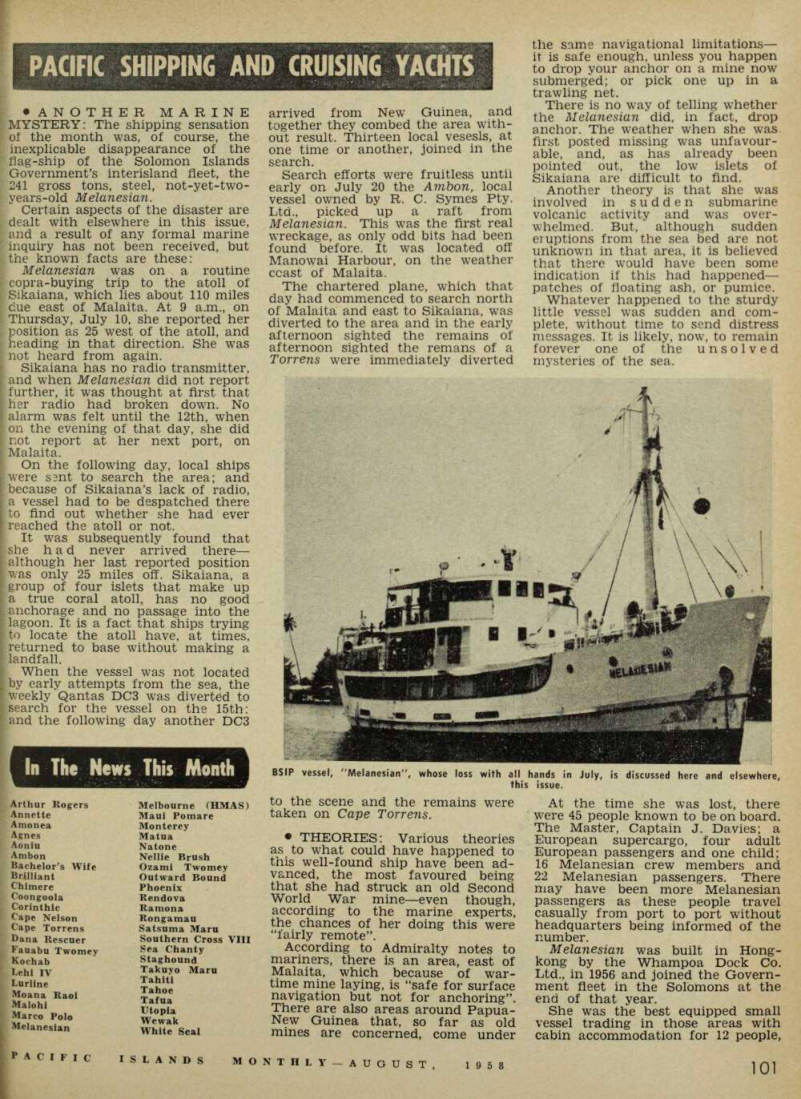
BSIP vessel, "Melanesian", whose loss with all hands in July, is discussed here and elsewhere, this issue.
modern navigational aids and safety 'equipment. A survey had been carried out only this April and she was classed A 1 at Lloyds. She might have been regarded as the Islands vessel least likely to come to a bad end.
• Shaw Savill Flag On
HENDERSON ISLAND; Officers on the Corinthic were amazed to see their house flag flying on un inhabited Henderson Island as the ship neared Pitcairn Is., recently.
However, the Pitcairn Islanders said they had hoisted the flag dur ing their last timber-gathering trek, as an appreciative gesture as it was Shaw Savill’s centenary year.
Conjectures that skeletons found on Henderson Island might be from the Joyita were described as “stupid” by experienced Fiji residents, who pointed out that Henderson is 3,000 miles from where the Joyita was
found, against winds and currents.
Pathological examination of hair from a skull indicated that the remains were more likely European than Polynesian. The skeletons, found in a cave, were of two men, a woman and a child.
• Air Display Thrills
SAMOANS: While in Samoan waters recently the Australian Carrier Melbourne was invited to call at Apia, but had to refuse because of
y nr,
*J}™edJSf Spl d tn
Pv! a ni °S t 0
thrill thousands of Samoans.
• New Sea Routes To Asia:
Two minesweepers and two frigates of the RAN are engaged in a hydrographic survey to find at least four
new safe lanes in the treacherous Sahul Bank, between Darwin and Timor. The additional lanes, neces sary because of the greatly in creased traffic between Australia and the Far East, will provide shorter routes to Djakarta, Singa on^’M^nul^ 15, H ° ngk ° ng ' Ja P an ’ ana Mamia *
A Save By Cape Nelson
co-operation between Rarotongan authorities, local shipping concerns and the owners and, particularly, the master of the British freighter Cape Nelson, saved Rarotongan growers a loss of hundreds of pounds on their tomato crop recently.
The fruit, to have been shipped to New Zealand in the African Reefer, would have rotted unpicked when
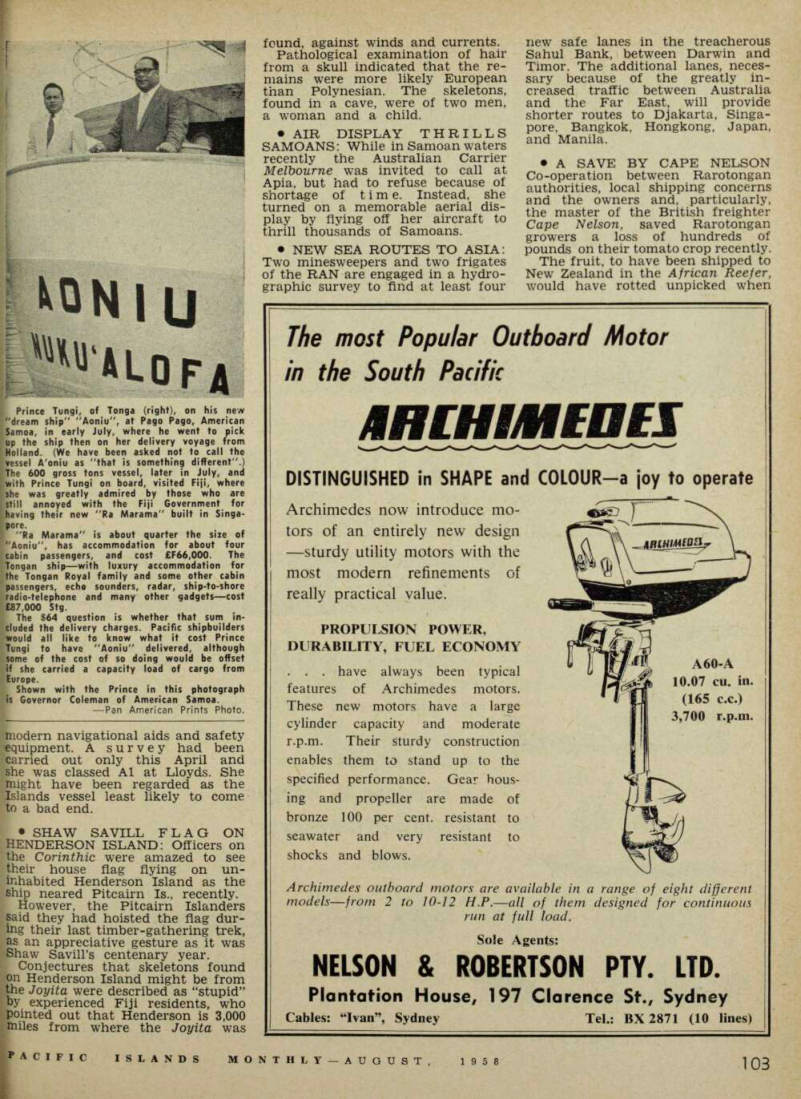
Prince Tungi, of Tonga (right), on his new “dream ship” "Aoniu", at Pago Pago, American Samoa, in early July, where he went to pick up the ship then on her delivery voyage from Holland. (We have been asked not to call the vessel A'oniu as "that is something different”.) The 600 gross tons vessel, later in July, and with Prince Tungi on board, visited Fiji, where she was greatly admired by those who are still annoyed with the Fiji Government for having their new ”Ra Marama” built in Singa pore. ”Ra Marama” is about quarter the size of “Aoniu”, has accommodation for about four cabin passengers, and cost £F66,000. The Tongan ship—with luxury accommodation for the Tongan Royal family and some other cabin passengers, echo sounders, radar, ship-to-shore radio-telephone and many other gadgets—cost £87,000 Stg.
The 564 question is whether that sum in cluded the delivery charges. Pacific shipbuilders would all like to know what it cost Prince Tungi to have "Aoniu" delivered, although some of the cost of so doing would be offset if she carried a capacity load of cargo from Europe.
Shown with the Prince in this photograph is Governor Coleman of American Samoa. —Pan American Prints Photo.
..this vessel was unable to call, but strenuous efforts were made to locate alternative transport, and as soon as there was a possibility of the Cape Nelson being able to call, Rarotongans were told to get pick ing. Local vessels were dispatched to pick up the shipments from various islands.
On arriving in Auckland on July 12, the bearded master of the Cape Nelson said that the vessel had re ceived a radio call when four or five days from Rarotonga while on
passage from Hamburg to Auckland with 9,350 tons of potash.
Captain A. C. Jones, a bit of a farmer himself, had been anxious to collect the tomatoes, and he eventually obtained permission from the owners to divert his ship.
On the run to Auckland, four storms and attendant heavy seas were encountered, and all hands and the cook were on deck chasing tomatoes.
Many cases were moved from the hatch covers up to the bridge deck.
• Maui Pomare In The Red;
The New Zealand Department of Island Territories announced in its annual report that the Government
vessel Maui Pomare had a working loss of £79,750 for the financial year ended March 31.
It cost £120,726 to give the 32year-old ship a major overhaul and (the same old story) tenders are “soon” to be called for a new 40passenger vessel.
Plans and specifications have been drawn up—for the rest, we’ll believe it when we see it.
• Summer Cruise Can
CELLED; The Matson liner Lurline’s South Seas and Orient cruise, planned next summer, has been can celled, and this will mean a loss of several thousands of dollars to NZ and ports of call in the Islands.
"Coongoola", N. W. Thomas' 73-ft. auxiliary, lying at Wellington before crossing to Sydney in July.
Canadian schooner "Tahoe" at Auckland.
Photos: J. N. Duder.
"Fauabu Twomey", soon after she arrived in Honiara, from NZ (see page 107).
I Factors entering into the can cellation were the increased travel potential for Hawaii in 1959, and the pact that bookings received so far [for the intended cruise had not [been up to expectations.
• Passenger Signs On As
; OFFICER: The death occurred at sea of the first mate of the Monterey, Mr. Otis Yarrington, of San Mateo, Cal., during a recent Pacific passage of this Matson ship, and a passenger on the liner was asked to stand .watches in his stead.
He was Mr. L. Veronimo, of San Francisco, who was travelling on holiday to Tahiti. Mr. Veronimo, who holds a mate’s ticket, was e signed on for the round voyage. : • NZ STRIKE TIES UP ISLANDS’
SHIPS: The Union Steamship Co.’s Matua sailed from Auckland for the Islands on July 4, leaving be hind 200 tons of cargo, mostly food stuffs.
Matua was only one of more than 20 coasters and freighters affected to a greater or lesser degree by the recent wharf strike resulting from the loading dispute between CSR’s Chelsea Sugar Refinery and the Watersiders’ Union.
Ironically, the only work on the wharves on the 4th was the un loading of sugar lighters by CSR It was reported that 67,000 cases of bananas were spoiling in Tofua as she lay waiting to be unloaded, but wharflabourers said that the I fruit was in satisfactory condition iwhen it was eventually taken off.
Tofua was two days late leaving Auckland.
® Long, Long Trail Ends:
There must have been cries of “Well, I never”, and “What, so soon”, when the first of the New Zealand Leper Trust Board’s auxiliaries, Fauabu Twomey, arrived at Honiara, BSIP, after over a year of delays and frustrations. (See PIM, June, July).
Under the command of Mark Anthony, an Auckland yachtsman, the ketch-rigged launch took 10 days 8 hours to cover just under 2,000 miles. Crew for the trip consisted of McKenzie Smith, Bob Hammond (engineer) and Christopher Brown.
The cause of the electrolysis that was mainly responsible for the de
lay in delivering was first thought to be the result of an escape of acids in the harbour, but this was kept on the secret list for fear of disturbing local boat-owners.
However, the New Zealand DSIR came to the conclusion that an electric welder with faulty earthing that was used in the vessel and also nearby was the cause of the corrosion.
Replacements of the affected parts were made, and some months later, when the ship was slipped for painting, no further corrosion was apparent.
• Second Ketch Launched:
The 55-foot ketch Ozami Twomey, second of the NZ Leper Trust’s gift
Co-owners Fred Sheppard (left) and Reg Blake on "Tahoe". Fred has left the yacht in Auckland to return to Canada.
Photo: J. N. Duder.
launches for the Solomons, was launched at the Auckland yard of her builders, C. Bailey and Son, on July 24.
Sister L. Jones, for many years a missionary in the Solomons, named the 40-tons vessel by cracking a coconut across her bows, and the dedication ceremony was conducted by the Rev. Dr. D. O. Williams, president of the Auckland Methodist conference.
The ketch was to sail on July 30, although this would appear to leave all too short a time to prepare the vessel for the 2,000-mile stretch to the Solomons.
• Arthur Rogers Turns
BACK: While on her way back to home waters around the Hebrides- Solomons, the ketch Arthur Rogers encountered very heavy weather 160 miles NNW of NZ’s North Cape, and returned to Whangaroa, North Auckland, after the development of a small but persistant leak.
This storm was reported as hav ing "tossed the liner Wanganella like a cork”, and officers of HMNZS Royalist, on her way home to Auckland from the Far East, described it as "the worst in years”.
• Radio-Active Japs: Rabaul,
NG, has had all sorts of Japanese
in its time; in July it got another variety for a visit. What made these different was that they were allegedly radio-active.
Two Japanese ships, Takuyo Maru and Satsuma Maru, which had been engaged in oceanographic work, put into Rabaul on July 19. Their masters alleged that while they had been going about their business in the North Pacific, they had come in contact with radio-active cloud blown from the American atomic testing area round Eniwetok.
At one stage, geiger counters (which are part of the normal equipment of the ships) showed a count of 70 —when the permissable maximum is 60.
The Japs immediately went into decontamination drill—and headed for Rabaul. Why Rabaul was not stated, although it is well known that that place has a fatal fascina tion for Japanese.
At Rabaul, the local medical officer placed the ships out of bounds, and blood-tested the crews.
And the best geiger-counter score that could be got was 29.
It gave Rabaul something to talk about; Australian newspapers some thing to write about; and also caused a flutter in American dovecots.
After the Japs had been in Rabaul about a week, an American team arrived by air from the Carolines.
Leader of the team, Colonel R. M.
Lechausse refused to comment on the visit before he left, except to say that there was no danger, from the ships and no radio-active sick ness amongst the sailors.
The two ships have now left Rabaul.
The Japanese training ship Ginga Maru, which called into Auckland,
BELOW: "Kochab" and "Malohi" tied up in Noumea at the finish of the Sydney-Noumea Yacht Race. AT LEFT: Neville McEnnelly, Captain of "Malohi", which won the race; and Dr. J. Franklen Evans, of "Kochab". See page 113.
NZ, about the same time as the other ships reached Rabaul, also was supposed to have been contam inated by the same nuclear tests.
This vessel carries 100 Merchant Navy cadets and later went on to Sydney.
• New Wholesale Society
VESSEL: The GEIC Wholesale Society’s new vessel Moana Raoi was to have arrived in the colony early in August.
Her crew left Tarawa early in June for Hongkong via Fiji, where they were to take delivery of the ship— yet another example of the keen competition from that part of the world to be faced in the ship building business. (See June PIM, p. 99).
• Don’T Wave From The
MAST: Parades, flag ceremonies, sports meetings were the order of Queen’s Birthday Week-end in the Solomons —but it was not all merry making for the Chinese owner of
the 45-ft a.v. Rendova, which went on a reef near Barakoma with a crowd of merrymakers returning home from the celebrations.
The vessel was travelling close inshore in rough seas when the passengers decided to climb the masts and the bridge to wave to their friends. A big sea hit the vessel and she capsized on the reef.
Crew and passengers swam ashore safely and the Rendova was later hauled off by Melanesian —the last rescue chore performed by that ill fated vessel. • NEARLY THERE: Trials of Southern Cross VIII, built for the Melanesian Mission by Ballina Slip way and Engineering Company, will have her trials at Ballina in early
August. She will go to Sydney shortly afterwards, and be dedicated at Bennalong Point, on August 23. by Bishop Kerle, Coadjutor Bishop of Sydney. (It was intended, before his recent illness, that Archbishop Mowll would perform the ceremony).
Captain G. E. Langley will be the delivery skipper: Mr. Geoffrey Kuper, who arrived in Sydney from the BSIP in July, will sail as Mate, and take over as Master once the vessel reaches the Solomons. An Islands crew will be flown to Sydney shortly to man her on the voyage from Sydney. • PERSONAL: Mr. Bjarne Halvorsen, of the well-known Berry’s Bay, Sydney, shipbuilding firm, left for two weeks business trip to
TOP: Auckland ketch "Marco Polo", now under new ownership, which left NZ recently for Denmark via Polynesia.— Photo: J. N. Duder.
LOWER: Doc and Dottie Tanners' "Annette ", recently in Papeete (see page 113).
Papua-New Guinea, on August 4. He will visit Port Moresby, Samarai and Lae, and maybe Rabaul.
I Captain T. H. Neill, of Hamilton, [New Zealand, has been appointed Waster of the Tongan Copra Board’s new Aonui. He began his sea career as a cadet on the barque Pamir, and was later second officer on the Wanganella. He sailed an auxiliary stays ’1 schooner, the Caroline, to Tonga in 1950, and his latest com mand was the John Manners freighter Tees Breeze.
O Rendezvous; The Lst
Wewak, well-known deliverer of cattle to Papua and New Guinea ports, was doing the job a different way in July. She was engaged to pick up two mobs of breeder heifers in the Endeavour River, North Queensland, and take them to Cape Flattery, 35 miles north of Cook town, where they were to be trans ferred to Natone.
Natone would then take them the rest of the way to Port Moresby for delivery to the Fairfax Cattle
Company.
This job was scheduled for last March, but bad weather in Queens land prevented it.
The 200 tons, wooden Natone was formerly Wyatt Earp, used for a few seasons by Australia’s Antarctic ex peditions.
News of Cruising Yachts
• Sydney-Noumea Yacht Race: The
two yachts to finish in the race (see June and July PIM for earlier details) crossed the finishing line—the lighthouse on the reef about six miles from Noumea—late on July 7. First across was MALOHI, the NSW sloop. The UK yawl KOCHAB made Jts landfall too far south and had to beat oack to the lighthouse. Skipper of MALOHI, Neville McEnnally, said that it was a “wonderful trip”. Two cyclones (with the crew lashed to their posts to he prevented from being washed overboard hy 30-ft, waves) and a dead calm in the
middle of one that becalmed them for half a day. During their stay in Noumea, the crews of both yachts were given much hospitality. MALOHI got back to Sydney on July 29. • ANNETTE—whose owners Doc and Dottie Tanner—write us a long letter from Papeete, should now be around the French Oceania group before heading for Suwarrow (where they plan to spend at least a week “living off the land”), the Samoas, Suva and Sydney. In Sydney they’ll both take a job, to recoup the family finances. New Zealand will see them in 1959 or 1960. This is the second time round for these enthusiasts—they lost BACHELOR’S WIFE on Lord Howe Island in 1950. They send greetings from Ted Grant—he and Mrs. Grant now have a baby daughter—and news of SEA CHANTY (from Vancouver); TAHITI (of Hawaii); CHIMERE (France); and WHITE SEAL (Durban, S.A.) all of which were in Papeete at the same time. • MARCO POLO, first NZ yacht to sail round the world left Auckland again on July 13, this time headed for Denmark
via Rarotonga, Hawaii and Panama. Pre sent owner, Axel Petersen, who has been eight years on a working holiday in NZ, and latterly on the Auckland bridge, was accompanied by an Aucklander Mr. Q. F.
McClean of the Union Co., who cancelled a liner passage to Britain to sail on the 32 ft. red-sailed, blue-hulled ketch. • NELLIE BRUSH, 37 ft. Los Angeles ketch owned by Ernest Nelson, left San Diego during June for Costa Rica, the Galapagos, and the South Pacific. With Nelson sailed, 6 ft. 4 in. Don Stewart and 6 ft. 5 in. Don Friedman. • BRILLIANT, 42-footer from Tasmania, berthed at Tauranga, NZ. late in June on her way to Auckland and then the Islands.
Aboard are skipper M. Forster and a crew of three. • LEHI IV, 28 ft. by 18 ft. raft was towed about 150 miles out to sea from San Pedro, Cal., on July 13, in a renewed attempt to drift on ocean currents to the Hawaiian Islands. If the adventure is successful, skipper Devere Baker hopes to have the raft shipped to the Persian Gulf, from where he plans to float across the Indian and Pacific Oceans, in an attemot to prove his theory that early inhabitants of the western hemisphere drifted on currents across the Pacific from Asia. • TAHOE, of Vancouver, arrived in Auckland on July 9 after a vigorous pas sage from Rarotonga via the Kermadecs.
The 37 ft. schooner, with skipper Reg Blake, Fred Sheppard and four Raro tongans aboard, ran into head winds when three weeks out, and 5 in. of play de veloped in the rudder. The yacht was then headed for Raoul Is., where a pleasant week was spent repairing the rudder and enjoying the hospitality of the nine New Zealanders stationed on the island. After leaving Raoul with a capacity load of wild oranges, TAHOE ran into a 40-knot gale with heavy seas. Two jibs and the main sail were blown out and the dinghy and some bow scrollwork washed away (see photograph).
Sheppard is to leave the schooner in Auckland to return to Vancouver, and Reg Blake is looking for five young fellows with sufficient money to pay off Fred’s part-ownership and refit the yacht.
Further plans indicate a sojourn in Auckland, and then to Sydney at the end of the year. Reg then hopes to take 6-12 months to cruise back (via the Islands) to the West Coast, where the ship will be sold, crew members receiving proportional shares of the proceeds. • AGNES —where is she? The 138-year-
The American schooner “Utopia" (see PIM July) left Suva for the New Hebrides, on July 16, to continue her world cruise. Four men were recruited in Suva for crew. Shown here (left to right) Edward Whippy, Joe Pachernegg, Fred Peterson (Captain), Douglas Book, W. B. Mc- Millan, lan Davidson, photographed before the schooner sailed. —Photo: Stinsons.
The Panamanian vessel “Amonea" alongside the new wharf at Point Cruz, Honiara, BSIP (see page 117, July). The wharf was unfinished at this stage.
Jld West Country ketch with skipper Uistair Barr and his mixed crew of about was reported as being in Papeete in rAnm? ry (P ™ April) * but Reg Blake of . E f ays that as far as h e kn <>ws no ressel of the name was in Tahiti from December to March, and there has been io news of her from anywhere since then. • COONGOOLA, 73 ft. x 17 ft. x 7 ft etch-rigged auxiliary of Wellington] lea red that port for Sydney on July 12.
'kipper N. w. Thomas may be re aembered by Islanders as owner and mate f the schooner HUIA when she was lost n Koma Kame Reef. He also cruised to and the Islands some years back * ILEX, former Auckland A-class keeler.
"d may revisit Polynesia next year. ■OONGOOLA, built in Brisbane, has one r orld-voyage to her credit already, under er original owner, a Mr. Griffiths. • ALSO IN THE MAILBAG this month as a note from Phillip L. Schroder, now a^ k J n , Ca,lforni a after a voyage to Tahiti L b?«L k - He was a member of the crew f STAGHOUND (PIM, January, 1958) but * e . a *®t of other projected Pacific Pulses, this one fell apart once it reached apeete. After three attempts to get back ome on other yachts, whose plans fell ‘rough, he finally made it with owner tipper Bob Insinger, in RAMONA. They n Papeete on May 20 and arrived San ‘ego on June 29—with the aid of the
motor for a considerable part of the way.
It was ironic, comments Schroder, that after waiting six months in Papeete, three days after he left, the ketch TAHITI, on which he had done a lot of Pacific sailing, turned up there. • OUTWARD BOUND: The Caldwell family, in their new ketch OUTWARD BOUND, moved round to Broken Bay from Sydney in late July. Here they will paint the vessel and make ready for their forth roun(i-the-world voyage (see July PIM, p. 41). Also leaving Sydney end of July were Mr. and Mrs. Derek Horne, plus pedigreed Siamese cat, Hina, bound USA * la * s:ands the 73-ft. ketch LADY
Ml Llaln.
• RONGAMAU, Roy Lidgards 50-ft.
auxiliary ketch, returned to Auckland at the end of June after two months holiday cruise in Fijian waters. • PHOENIX, together with owner Earl Reynolds and family, was picked up by officials from a Coast Guard cutter when 65 miles inside the Eniwetok nuclear test area at the beginning of July. The 50-ft. ketch was escorted to Kwajalein, from where Reynolds was to have been flown to Honolulu. (Reynolds, who is anti-atomic test, in June set a course from Honolulu to Japan that would take him through the test zone). • DANA RESCUER, 19 ft. Danish fibre glass life-boat on a world voyage under lone-hander Capt. Walter Vestborg (Dec., April., PIM) was reported in trouble oft the Mexican west coast late in June.
Captain Vestborg was rescued by the Danish vessel "Johannes Maersic” but whether complete with life-boat or not, is not known. • MERIDIAN, the 44 ft. cutter (PIM has mistakenly referred to it recently as a ketch), with American couple Richard and Abbie Stafford aboard, the where abouts of which and whom somebody was seeking in June PIM, was sighted by a roving PIM man at Vavau, Tonga, at the end of July.
She had been there a week after a run from Apia, and the Staffords were waiting for a favourable wind to take their craft to Suva, where they arrived in early August. The MERIDIAN is going into dry dock there for two months while the Staffords make a tour of Fiji.
The hard-working, but happy-go-lucky couple left Panama in 1956 and expect eventually to take in NZ and the Great Barrier Reef. "But we aren’t in any great hurry," said Richard. • AT VAVAU IN LATE JULY, at the same time as the MERIDIAN, giving the attractive harbour a crowded look, was the 48 ft. ketch WINDSONG, which left Melbourne about May with a crew of Aus tralians bent of a 12-months Pacific cruise.
Owner-skipper is Jack Walker, with Geoff Soames, Tom Jones, Max Stolkes (all from Victoria) and Basil Chipmonk, from Tas mania.
They had seen Lord Howe and Nuku alofa, and were off to Suva and a yacht ing tour of the Fijis at the same time as the Staffords. Then they will head for the Cooks.
TOP: The radio-active Japs, "Takuyo Maru" and "Satsuma Maru", at Rabaul wharf, in July (see story). photo: C. H. Meen.
AT LEFT: Mr. David Sharp's crocodile-hunting small ship which went up on the reef at Pt.
Cruz, Honiara, BSIP, during the June cyclonic storm.