Weary Survivors
pp. 67-69 · Read in the full issue
Bena Bena Incident
Six Parties Of
to Kainantu, not Roy MacGregor. We were joined there on June 10 by Dave Laws and (the fourth) party which had landed at Sio, and crossed the Finisterres before coming to the Ramu country.
They were guided in by Greg Neilson.
We first saw Sgt. MacGregor on June 27 at Bena Bena ( over five months after we set out from Rabaul), when he arrived from Madang with Bill Luff and others (the fifth party).
We then received advice from Jerry Pentland that he was authorised to fly out only Americans and that we were to walk to Wau.
700 Miles on Foot
Our party of “weary survivors” will always be grateful to Roy MacGregor for his guidance on the second-last, and quite unnecessary stage of our very long journey— totalling over 700 miles on foot (most of it without proper food), and 500 miles by sea in canoes and small craft. We arrived at Wau in mid-July, six months after leaving Rabaul.
The sixth party consisted of 2/22 Battalion personnel, Sgts. Beenie, Vine and Flucker, who were origin ally members of my party of escapees from New Britain (see page 83, Hell and High Fever, by David Selby).
They were detached to assist Lincoln Bell in his AIB activities on
• In gathering together the com ments that have been made follow ing a review of the Australian war history, “The Japanese Thrust”, in January, “PIM” seems to be in pro cess of compiling a war history of its own. At all events, a history of the Bena Bena Incident.
This month, B. G. Dawson (Lieut.- Col. R of O), now Australian Gov ernment Trade Commissioner for Auckland, NZ, writes in reply to what Mr. Roy MacGregor, of Madang, NG, said in July (p. 37). Although they disagree on some points, what each has to say is interesting, in deed, because it throws light on what a lot of people are now pre pared to forget—what war meant to New Guinea.
Few people paid a higher sacrifice for official blundering and un preparedness than did the pre-war residents of New Guinea or the lone 2/22 Battalion, AIF, which was sent to Rabaul for garrison duty. Of the eight people mentioned by Mr.
Dawson, in his letter, five of them were subsequently tortured or killed (or both) by the Japs.
Recently a scroll containing the names of over 400 New Guinea civilians who died during the Pacific war was enshrined in Westminster Abbey. (See elsewhere).
Mr. Dawson writes as follows: I SHOULD like to observe that Mr.
Roy MacGregor himself is under a misapprehension. The volume of the War History, The Japanese Thrust, deals with “Ordeal on New Britain”, and mentions the ultimate fate of survivors from Rabaul only.
The story of the NGVR in New Guinea is the subject of another chapter in a later volume.
He has recorded three parties of soldiers. There were in fact, SIX.
Our party originally consisted of ten members of the 2/22 Battalion, AIF, when it was formed at Wide Bay, New Britain, after the massacre of Tol. One man died of malaria, one “went bush”, and three were later left with Lincoln Bell at Vitu.
Five of us reached Bena Bena.
The facts given below are ex tracted from our diary of the trip.
Our party, the third, arrived in New Guinea, at Bogadjim, South of Madang on May 16, 1942, by which time we had been almost four months “living on the country” in New Britain.
We did NOT meet Roy MacGregor at Bogadjim, as he claims, but met instead the Rev. Harry Dott, of the American Lutheran Mission, and Lieut, (later Captain), Reg Boyan, of Angau.
It was Reg Boyan who took us
New Britain, and did not arrive in New Guinea until much later. They crossed New Guinea on foot from Bogadjim, via the Ramu and Kain antu, then down the Vailala River
to Kerema, arriving in Port Moresby
267 days after leaving Rabaul.
According to War History
The story of my party of soldiers
from 2/22 Battalion, AIF, appears on
page 673 of The Japanese Thrust, and for the benefit of those who do not have access to the book, it reads as follows: Another group of nine led by Lieutenant Dawson, having learnt from Lieutenant Figgis of McCarthy’s scheme on the north coast, followed the route taken by Colonel Carr, but arrived too late to be evacuated in the “Lakatoi”.
They were led by friendly natives to Mavelo Plantation, and thence by canoe reached Valoka Mission at Cape Hoskins.
At the end of March, Dawson at Garua, following the route of earlier escapers, met Lincoln Bell, who had remained in New Britain after McCarthy’s departure, and through him sent a message to Port Moresby, giving the names of his men.
On May 14, after periods spent at Iboki and in the Vitu Group, the party was picked un at Bali Harbour by Lieutenant Harris in the schooner “Umboi”.
On the 16th, they reached Bogadjim and met Lieutenant Boyan of Angau. He led them to Kainantu in the Upper Ramu.
They were joined by several other Aus tralians and learnt that they must go to Bena Bena for evacuation.
At Bena Bena the weary Australians were told that only Americans (survivors
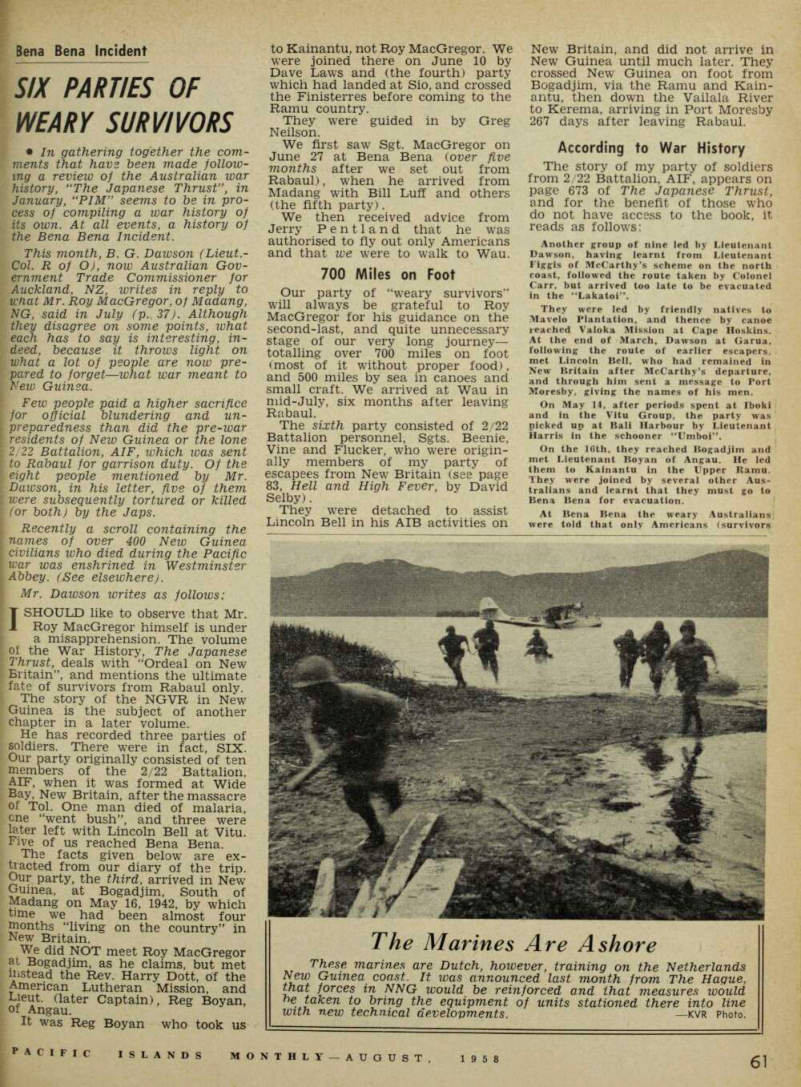
The Marines Are Ashore
These marines are Dutch, however, training on the Netherlands New Guinea coast. It was announced last month from The Hague, that forces in NNG would he reinforced and that measures would he taken to bring the equipment of units stationed there into line with new technical developments. —kvr Photo.
of a Mitchell bomber which had made a forced landing in the area), were to be flown out; they must walk by way of Wau to the south coast, where they would be picked up by small ships.
They reached Wau on foot on July 15 and were ordered to walk thence over the Ekuti Range to Bulldog and down the Lakekamu River to the south coast of New Guinea.
Dawson protested and eventually all except Dawson himself were evacuated from Wau by air. Dawson’s odyssey had not ended.
He remained with the 2/sth Independent Company until the end of September, when, suffering from dysentery, he walked over the Ekuti Range along a track which climbed to about 8,500 feet through moss forests until at length he reached the mouth of the Lakekamu; there he was picked up by a small vessel and taken to Port Moresby. (In 1945, he was back on New Britain as a battalion com mander).
EDITOR’S NOTE: Evidently a higher estimate was held of the value of these relatively fit American aircrew than of the weary survivors from New Britain.
Four aircraft—two Boston A-24’s, a DH -86, and a Spartan Moth—were lost attempting to rescue the Americans from Bena Bena.
Weary Survivors Walk
It was this “Editor’s Note” which led to the panel in PIM January issue, and prompted me to write that our information from Jerry Pentland led us to believe that Mr.
G. W, L. Townsend had issued the order to evacuate American air crew, but to make the “weary sur vivors” of New Britain walk.
At Wau, we were ordered to walk to Port Moresby—a total of 250 air miles from Bena Bena, probably nearly 400 miles by surface track.
At that point, on behalf of the soldiers of my party, I “jacked up” and, with the support of the medical officer of the NGVR, managed to get the troops evacuated by air from Wau.
The Medical Officer’s opinion was that the men were quite unfit to walk further and that exposure to reinfection with malaria, along the Lakekamu River, would probably mean blackwater fever and cerebral malaria.
He was not prepared to accept re sponsibility for allowing them to continue the walk, as ordered.
Eight who Helped
Lest Roy MacGregor should con sider us lacking in appreciation of his great help to us over the second last stage of our journey, I should like to record the list of those who, before we met him, helped my party m our escape from New Britain: The , Rev. Fr. Franke, of Talasea who gave us (on March 24) our first groper meal for two months, and our first quinine supply. At iriat point, our health was ex tremely had. We were all suffering from malaria, which, through lack of quinine, had gone un treated (and of which one of us had already died); and starvation, i was suffering also from what later proved to he amoebic
dysentery. Fr. Franke was confined in the ship’s brig of a Japanese destroyer, for three days, being “persuaded” to disclose our whereabouts. He did not tell.
Lieut. Lincoln Bell, RANVR (later killed at Saidor), with whom we stayed for some weeks, in the Vitu group.
Bert Olander, manager of Numundo plantation, Talasea district, (killed by the Japanese), who gave us a pinnace and radio transmitter.
Capt. “Blue” Harris (executed by the Japanese at Hollandia), who took us in the “Umboi” from Vitu to Bogadjim, South of Madang.
Capt. Reg Boy an, who, with great cneerfulness, led us to Kainantu.
I he Rev. Rod Fowler, Seventh Day
Adventist Mission, Kainantu, who nursed us back to partial health, Bill Brechin, of Aiyura Government Agricultural Station, who gave his life organising the air evacuation (of the Americans), from Bena Bena, and finally, Roy MacGregor, NGVR, who guided us over the second-last stage of our journey, i.e., from Bena Bena to Wau. * * * But I would still like to know who was responsible for issuing the order requiring sick men, who had already endured so much, to walk from Bena Bena to Port Moresby! If it was not Mr. Townsend, well then, who was it?