Why Samoans Want Democracy
pp. 43-45 · Read in the full issue


High Chief Explains "Matai" to Trusteeship Council
Why Samoans Want Democracy With A Difference
From a Staff Correspondent, recently in Samoa With self-Government for Western Samoa scheduled for 1960, there is still a difference in opinion within the Territory concerning the type of new Government: Government under the present matai family system, or Government through universal suffrage.
THERE are arguments for both — and arguments, too, for a middle course which would give Government by matai (the elected heads of family groups) to begin with, followed fairly soon by the popular vote.
But the latest shots in the dis cussion were fired in July by High Chief Tamasese, at the United Nations Trusteeship Council meet ing which discussed Western Samoa.
Tamasese is one of the three Fautua —the others being High Chiefs Malietoa and Mataafa—and the three of them attended the recent Trusteeship Council meeting to ex plain the matai system.
Tamasese presented the Council with a printed statement explain ing and supporting this system for self-governing Samoa.
The Samoa Bulletin (which is a leading advocate of the popular vote) was quick to report that Tamasese’s document could not be classed as “official”, and commented that Tamasese was just talking a lot of theory, anyway; that in practice, the matai system didn’t work like that.
“Fact shows that many matai do not rise to office by constant ser vice to the aiga, but because they have become wealthy or achieved positions of stature in Apia,” said the Bulletin. “There are part-Euro pean and Samoan matai living in Apia whose visits to the seat of the aiga are made only on extraordinary occasions.”
NZ Supports System
But, in any case, High Chief Tamasese’s statement set out very clearly the main points of the matai system, and indicated just as clearly (“official” document or not) why the New Zealand Government gives its support to the matai system, and thinks it is the one for an in dependent Samoa.
“The matai system,” said the state ment, “has developed and flourished m Samoa for over a thousand years. It is just as natural for the average Samoan to look to his matai for leadership and guidance m all the major affairs of life as it
is for the European or American to expect the press and radio or tele vision to tell him what goes on. It is something that is an essential part of life.” It continued: Such being the case it is surely not un natural that the Samoan people, when confronted with the difficult and un accustomed task of devising a system of independent government, should not wish to abandon thoughtlessly the system which has stood them in good stead through so many vicissitudes, right up to the present day.
Surely, what all peoples the world over are looking for is security—freedom from fear and from want, without undue anxiety for the future. This it can con fidently be asserted the Samoan social system does provide.
Every member of the clan has a right to be provided for out of the goods of the clan. The only condition is that he fulfil his part of the contract by rendering service to the family and to its head, the matai.
Those who contribute according to their ability receive according to their need.
In a Samoan family, no one is idle. Each group has its appointed tasks. Even young children and the old and infirm make some contribution.
Those who are employed outside the family, e.g.. in government or business, contribute a part of their earnings.
This contribution may be compared to
the tax systems of other countries, and it provides security for the wage-earner. In time of sickness or loss of employment through dismissal the Samoan worker simply retires to his family and takes bis rightful place there.
For this reason you will not find in Samoa, as in most countries, homes for the aged and infirm, or for orphans. The word "orphan” does not even exist in the Samoan language.
Nor does the Samoan Government im pose taxes for the support of the un employed since the need does not arise.
Individualism Has No Appeal
The statement said the impact of
European ways had already changed
Samoa, and other changes would come.
Nevertheless, “those who know and understand Samoa best are convinced that the great majority of her people will hold fast to the broad general principles of the Samoan way of life.”
It added: The rugged individualism of Europe and America makes no great appeal to the Samoan. Sometimes it shocks and disgusts him. The basic realities of social life in Samoa are the family and the village com munity. Beyond that there is the district made uj of a number of villages, and now becoming more prominent is the realisa tion of nationhood.
True Representatives
The statement insisted that the matais were true representatives of
the people, even though a legis
lature was composed of matais, elected by matais. It said: We have avoided the use of that so much abused word "democratic”, since it has come to mean as many different things as there are countries represented in the United Nations.
The matais who sit in the Samoan Legislature must certainly be regarded as the true representatives of the peoole.
Remember that every matai is freely elected and chosen by all the members of the clan. (Over>
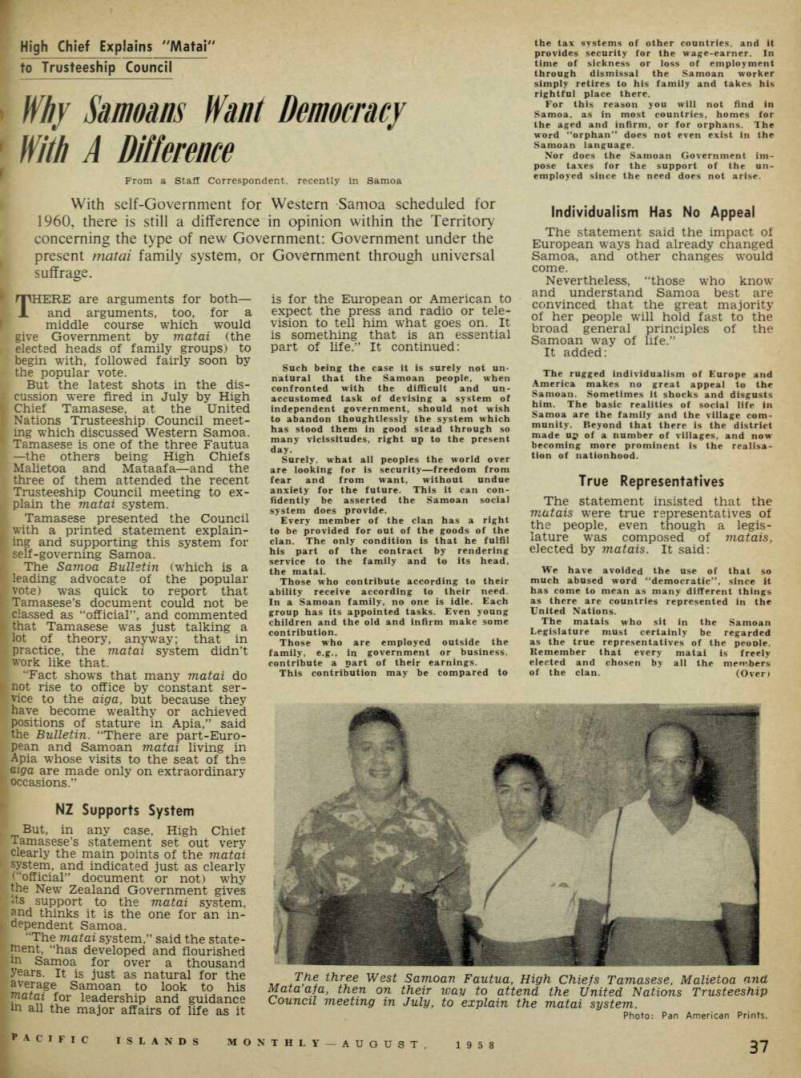
The three West Samoan Fautua, High Chiefs Tamasese, Malietoa and Mata’afa, then on their way to attend the United Nations Trusteeship Council meeting in July, to explain the matai system.
Photo: Pan American Prints.
When a matai goes to the council of the district to choose one of its number to become the member for that district (in the Legislative Assembly) the family not only feel that their matai votes on their behalf, but they also feel that they also vote through him.
In other words they feel that they have expressed their will and choice through their matai. Thus all the people in a district feel that they have played their part in the election of the member and look upon him as their representative.
Can this system be regarded as neces sarily inferior to the operation of the Party System in so many countries, where the ordinary voter is offered a choice be tween two candidates who have been selected by a party machine in which he has no voice and who propose policies about which he is never consulted and of which he may entirely disapprove?
In Samoa the matais are constantly meeting and discussing public affairs with the members of the clan and with their brother matais in village and district councils and other gatherings. This gives adequate opportunity for forming an active and effective public opinion.
In a small country like Samoa the mem ber for the district is known personally by everyone in the district, a thing im possible in other countries.
No one would have the slightest hesita tion about approaching the member about some problem, or have the slightest diffi culty in meeting him.
The Samoan matai does not lord it over the members of the clan.
As head he is given honour and dignity, but he is also the servant of all. The family or clan is the superior entity to which all owe allegiance.
About this the Samoans have a quasi religious feeling. To them the family is sacred and the demands of family loyalty a most sacred obligation.
Not Frustrated
Mr. Tamasese’s statement sought to answer criticism that young,
educated Samoans were being
thwarted and frustrated by the matai system, their initiative stifled and their voice unheeded by the matais.
“In the first place,” the state ment said, “it must be pointed out that more and more of these young,
educated Samoans are becoming
matais ”
It continued: More of them would be elected to the office if more of them realised that a European style education is not the sole qualification for that office.
It is also necessary to have a thorough knowledge of all that pertains to the language, customs, and traditions of Samoa in general and of one’s own clan in particular.
Some prefer not to accept the onerous outies and responsibilities of the matai.
That is their privilege.
But they should not complain when called upon to render service, for by doing so they retain the right to call upon the matai and the family in time of need.
Some of the young people forget that " they were living overseas they would °e taxed heavily for the security they so easily enjoy at home.
Young people in every country are ant jo be impatient with their elders. Revolu tionary change often appeals to the young, inose more enlightened realise that social systems change slowly and that true pro gress is a painful and slow process of trial and error.
We assert with complete confidence that any young, educated Samoan who will take the trouble to study the language, particularly the beautiful ceremonial
language of the orator, together with the customs and traditions of his people, will find that he will draw closer to them, so that his European education will help and not hinder both him and them.
Right of Free Choice
The statement to UN concluded on this note: “We will say only that the Samoan people ask no more and no less than the natural God-given right of people everywhere, to choose freely for themselves a system of society and government that is not imposed on them by a group of foreigners, however well-intentioned, for that would be oppression and tyranny, but one which accords with
their own ancient and hallowed traditions, for in these is enshrined all that is most noble and most honourable in the spirit of their race.”
High Chief Tamasese’s statement, and others that were made to the Trusteeship Council, are hardly the last word on the matter, however.
The Council, at its session, appointed a drafting committee for a visiting UNO mission to visit Samoa next year. It will, in the manner of all UN visiting com mittees, no doubt poke around a lot and draw various conclusions—some of them undoubtedly incorrect—on the value of the matai system in Samoa.