No More Capital For Papuan
p. 41 · Read in the full issue
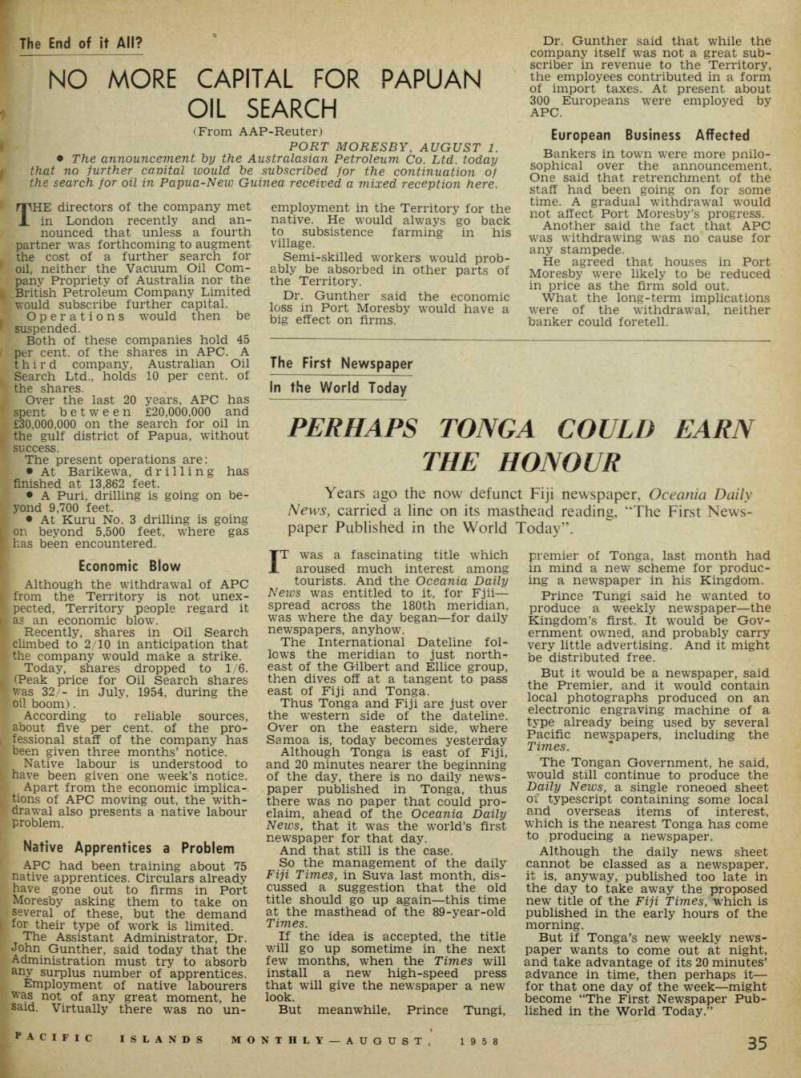
The End of it All?
Oil Search
(From AAP-Reuter)
Port Moresby, August 1.
• The announcement hy the Australasian Petroleum Co. Ltd. today that no further capital would he subscribed for the continuation of the search for oil in Papua-New Guinea received a mixed reception here.
THE directors of the company met in London recently and an nounced that unless a fourth partner was forthcoming to augment the cost of a further search for oil, neither the Vacuum Oil Com pany Propriety of Australia nor the British Petroleum Company Limited would subscribe further capital.
Operations would then be suspended.
Both of these companies hold 45 per cent, of the shares in APC. A third company, Australian Oil Search Ltd., holds 10 per cent, of the shares.
Over the last 20 years, APC has spent between £20,000,000 and £30,000,000 on the search for oil in the gulf district of Papua, without success.
The present operations are: • At Barikewa, drilling has finished at 13,862 feet. • A Puri, drilling is going on be yond 9,700 feet. • At Kuru No. 3 drilling is going on beyond 5,500 feet, where gas has been encountered.
Economic Blow
Although the withdrawal of APC from the Territory is not unex pected, Territory people regard it as an economic blow.
Recently, shares in Oil Search climbed to 2/10 in anticipation that the company would make a strike.
Today, shares dropped to 1/6. (Peak price for Oil Search shares was 32 - in July, 1954, during the oil boom).
According to reliable sources, about five per cent, of the pro fessional staff of the company has been given three months’ notice.
Native labour is understood to have been given one week’s notice.
Apart from the economic implica tions of APC moving out, the with drawal also presents a native labour Problem.
Native Apprentices a Problem
APC had been training about 75 native apprentices. Circulars already have gone out to firms in Port Moresby asking them to take on several of these, but the demand for their type of work is limited.
The Assistant Administrator, Dr.
John Gunther, said today that the Administration must try to absorb any surplus number of apprentices.
Employment of native labourers was not of any great moment, he said. Virtually there was no un
employment in the Territory for the native. He would always go back to subsistence farming in his vmage. oWn l h i ' sk K le l W ri or ' kerS fi, would P rob : f. be absorbed in other parts of tne -territory.
Dr. Gunther said the economic loss in Port Moresby would have a big effect on firms.
Dr. Gunther said that while the company itself was not a great sub scriber in revenue to the Territory, the employees contributed in a form of import taxes. At present about 300 Europeans were employed by
Apc.
European Business Affected
Bankers in town were more pnilo sophical over the announcement.
One said that retrenchment of the staff had been going on for some time. A gradual withdrawal would not affect Port Moresby’s progress.
Another said the fact that APC was withdrawing was no cause for any stampede.
He agreed that houses in Port Moresby were likely to be reduced in price as the firm sold out.
What the long-term implications were of the withdrawal, neither banker could foretell.