Tropical Home in an Igloo
pp. 21-22 · Read in the full issue
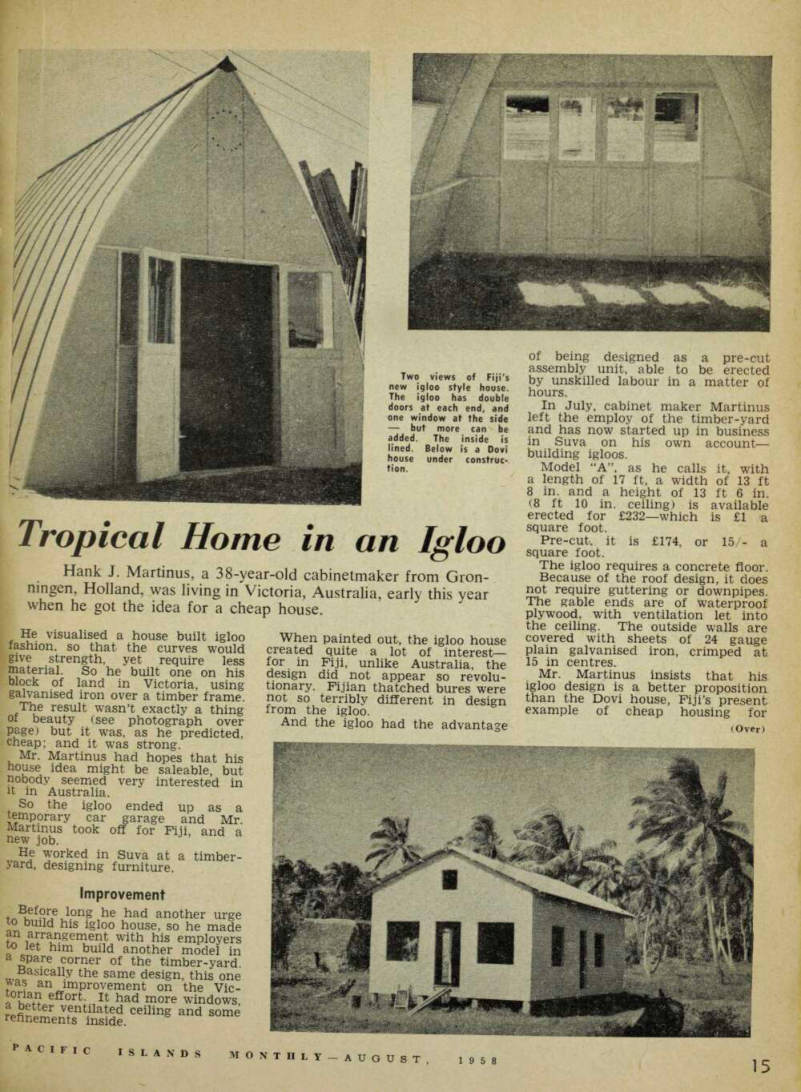
Hank J. Martinus, a 38-year-old cabinetmaker from Gron ningen, Holland, was living in Victoria, Australia, early this year when he got the idea for a cheap house.
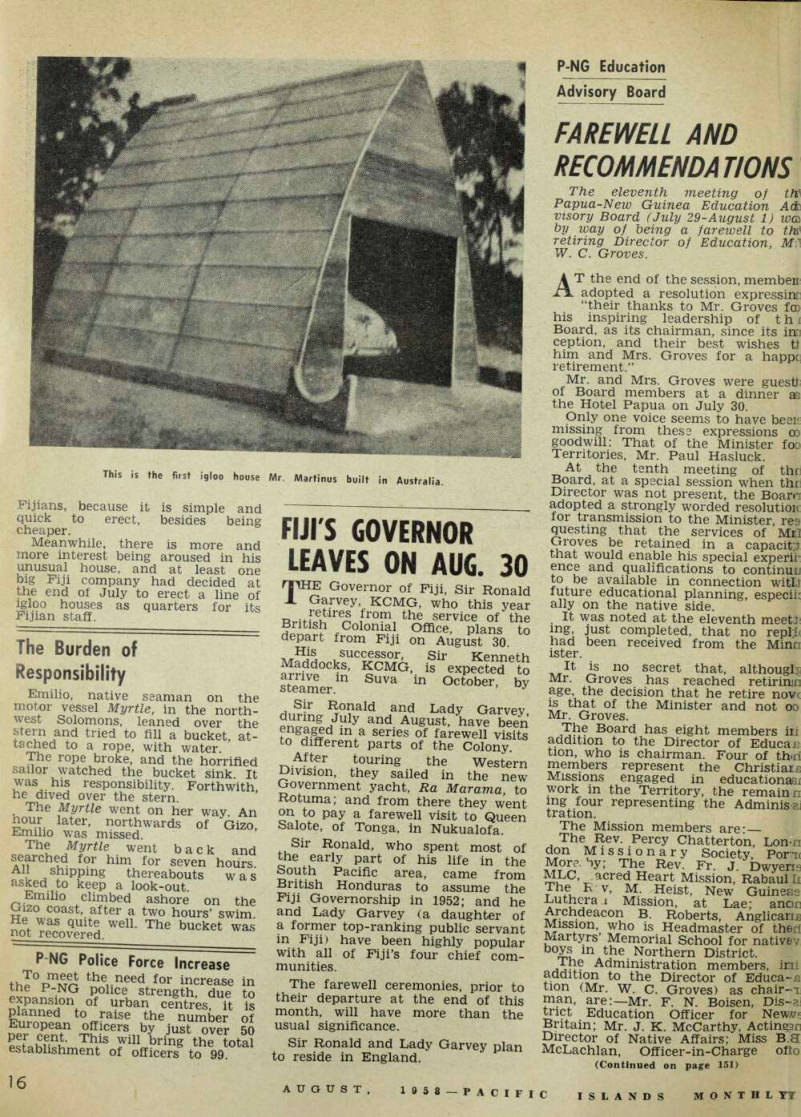
He visualised a house built igloo fashion, so that the curves would give strength, yet require less material. So he built one on his block of land in Victoria, using galvanised iron over a timber frame.
The result wasn’t exactly a thing of beauty (see photograph over page) but it was, as he predicted, cheap; and it was strong.
Mr. Martinus had hopes that his house idea might be saleable, but nobody seemed very interested in it m Australia.
So the igloo ended up as a temporary car garage and Mr.
Martinus took off for Fiji, and a new job.
He worked in Suva at a timber yard, designing furniture.
Improvement
+«^ ef R I l e , long he had another urge to build his igloo house, so he made f* 1 , a *; rai }gement with his employers to let him build another model in a spare corner of the timber-yard.
Basicaily the same design, this one wL an i m p rovemen t on the Vic had more wind ows, r\ae n rS, CemnB S ° me
When painted out, the igloo house created quite a lot of interest— for in Fiji, unlike Australia, the design did not appear so revolu tionary. Fijian thatched bures were not so terribly different in design from the igloo.
And the igloo had the advantage
of being designed as a pre-cut assembly unit, able to be erected by unskilled labour in a matter of hours.
In July, cabinet maker Martinus left the employ of the timber-yard and has now started up in business in Suva on his own account — building igloos.
Model “A”, as he calls it, with a length of 17 ft, a width of 13 ft 8 in. and a height of 13 ft 6 in. (8 ft 10 in. ceiling) is available erected for £232—which is £1 a square foot.
Pre-cut. it is £174, or 15/- a square foot.
The igloo requires a concrete floor.
Because of the roof design, it does not require guttering or downpipes.
The gable ends are of waterproof plywood, with ventilation let into the ceiling. The outside walls are covered with sheets of 24 gauge plain galvanised iron, crimped at 15 in centres.
Mr. Martinus insists that his igloo design is a better proposition than the Dovi house, Fiji’s present example of cheap housing for (Over)
Two views of Fiji's new igloo style house.
The igloo has double doors at each end, and one window at the side but more can be added. The inside is lined. Below is a Dovi house under construc tion.
Fijians, because it is simple and quick to erect, besides being cheaper.
Meanwhile, there is more and more interest being aroused in his unusual house, and at least one big Fiji company had decided at the end of July to erect a line of igloo houses as quarters for its Fijian staff.
This is the first igloo house Mr. Martinos built in Australia.