But Prickly Problem
p. 20 · Read in the full issue
All Quiet in French Islands
Is Due Soon
ALL was quiet in New Caledonia at the end of July, following the political pro-Gaullist flare up on June 18-21.
After a similar political revolt in French Oceania on April 29-30 (the direct result of new legislation in troduced by the Leftist Assembly) there was quiet. No demonstration, there, followed the political change in Paris.
Firm action in each case by the Territories’ Governors —and especi ally the prompt decisions of M.
Aime Grimald, in Noumea —stopped all disorderly developments, by both Right and Left parties.
For a little while, in late June and early July, the situation in New Caledonia was ugly; but both sides ouietened down, and neither side challenged the Governor’s right— which was firmly supported by Paris —to take complete responsibility for administration, pending clarification of the constitutional position.
By mid-July, it was clear that the constitutional changes, brought about in the French Oversea Terri tories in recent years by the Fourth Republic, were under review by General de Gaulle, along with the Constitution of Metropolitan France herself.
It was those constitutional changes in New Caledonia and French Oceania which brought about the election of an Assembly under a common roll, and the establishment in power of local governments of a definitely Leftist character. This, in turn, led to the Rightest revolts in Tahiti (in April) and New Caledonia (in June).
In each case the Governor, pend ing constitutional review, has taken full administrative responsibility.
Choice for Territories
It was officially announced in Paris on July 20 that, after the referendum had been taken in France, next October, on the new Constitution to be submitted then by General de Gaulle, the various overseas Territories of France will we allowed to choose the form of future government they prefer, namely— • The Territory to become an in-
BSIP Trial Timber Shipments
Encouraging interest, has been taken in the timber sarhples sent to Japan by the Forest Department of the British Solomon Islands Protectorate. An Australian firm is also showing interest in two kinds of Solomons timber.
The trial samples will be followed by small trial shipments of logs.
tegral part of France, with a status similar to that held by Corsica or Martinique; or • The Territory to become one of a Federation of French States, each having control over its internal affairs, but leaving control of national defence, diplomacy, economic policy, justice and higher education to Metropolitan France; or • The Territory to retain its pre sent status.
No other details were given.
The method under which each Territory will make its choice was not indicated. This is a matter of considerable importance.
There is likely to be a sharp dif ference of opinion in the French Pacific Territories concerning each Territory’s future status. How is a decision to be reached?
The Leftists, who elected the pre sent Assemblies (now more or less moribund) under a common roll will naturally wish to retain the one man-one-vote system in deciding the Territory’s future status; and that decision naturally would then be in favour of the continuance of the common roll.
Against Common Roll
But the Rightists certainly will object to the further use of the common roll. After the recent series of Assembly incidents, they will de mand at least some form of differ entiation between the votes of the literate and the illiterate classes.
There is room here for very wide differences of opinion, and a pos
sibility of civil disorder, regarding the one-man-one-vote system.
It comes down to the fundamental question —likely to be of importance in due time in every South Pacific Territory— of what should be the qualifications of a voter. Is the at tainment of an adult age, by a per son of any race, sufficient? If it is not, what should be the measuring stick—education, or public service or ownership of property, or what- And are there to be degrees recog nised in these several qualifications; Tahiti Has Rightist Local Govt.
News is slow in coming out o: Tahiti. However, we now have s fairly comprehensive account o: political events there in recen months.
After the election on a common roll of a Territorial Assembly foi French Oceania, the state of parties was (early in 1958) Union Tahitienne Democratic (led by M. Alfred Poroi) .. T RDPT (one faction of 10 led by Pouvanaa a Oopa, and one faction of seven led by J. B.
Ceran-Jerusalemy) T A local Administration then wai. formed by the RDPT (Rassemble: me n t Democratique Populatiom Tahiti) with M. Ceran-Jerusalem:, (who, in private life, is a linotypi operator in the Government Print: ing Office) as President and M a Oopa as Premier.
The new Government excitec public opinion by (a) introducing i new income tax and (b) suggestinu that French Oceania might breaL away from France and form a sepc arate republic.
On April 29 anl 30 (sse PIM o; May, p. 14), the citizens of Tahitr revolted against the Government and the Governor assumed adminr istrative control, pending a r© arrangement.
The new taxation law was r© scinded and a new local Rightis Administration, headed by MM Alfred Poroi and R. Bambridge, tooc over.
All has been peaceful, since. Then was no public reaction in Frenco Oceania to the arrival in power ii Metropolitan France of General EZ Gaulle, as there was in Ne £ Caledonia.
Reporting to Paris
A the end of July, the Governo; of j. •’ench Oceania (M. Camili Baill>, and the RDPT leader, M Ceran T erusalemy, proceeded by ae to Paris (via Fiji and Noumea) t report in person on political an, economic affairs.
Pending the submission to tM people of France by referendum, i October, of the new Constitution prepared by General de Gaulle, tK < respective Governors of N©i Caledonia and French Oceania as accepting a large measure of n sponsibility for the administrate of the two Territories.
(See also article, page 150.)
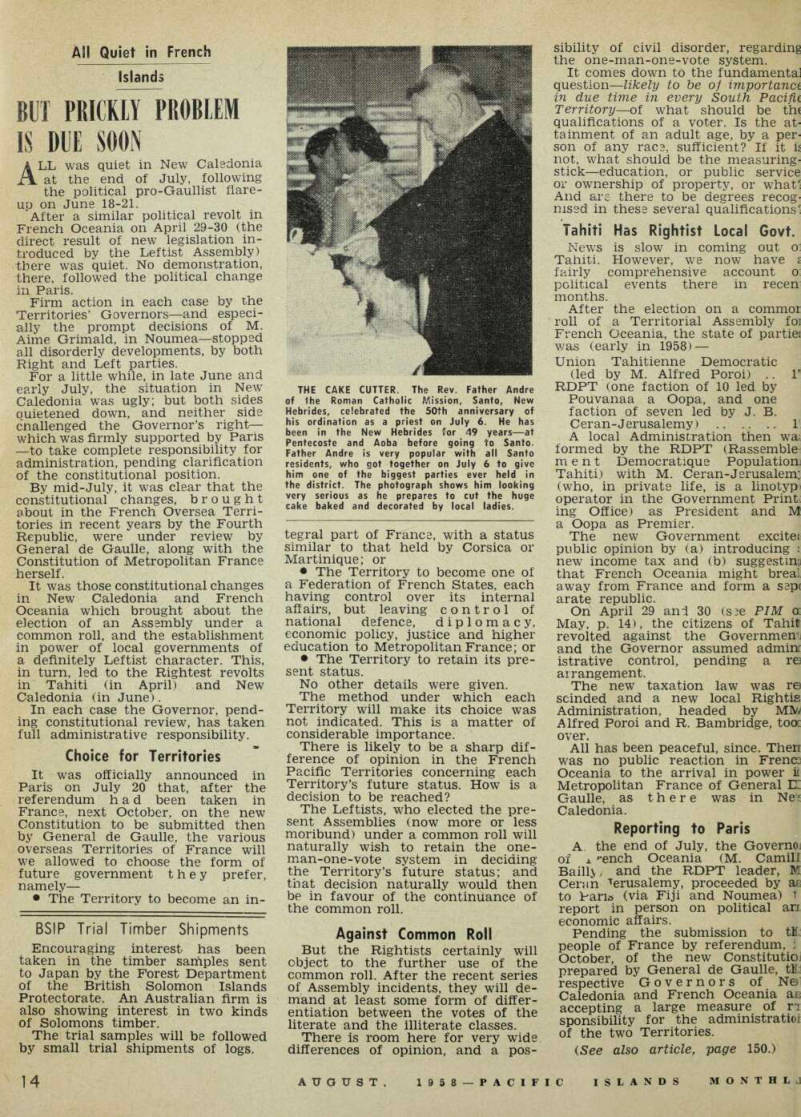
THE CAKE CUTTER. The Rev. Father Andre of the Roman Catholic Mission, Santo, New Hebrides, celebrated the 50th anniversary of his ordination as a priest on July 6. He has been in the New Hebrides for 49 years—at Pentecoste and Aoba before going to Santo.
Father Andre is very popular with all Santo residents, who got together on July 6 to give him one of the biggest parties ever held in the district. The photograph shows him looking very serious as he prepares to cut the huge cake baked and decorated by local ladies.