Papua Owes A Lasting Debt To Polynesia
pp. 90-106 · Read in the full issue
Continually we are reminded that 50, 70 or 100 years ago, the Pacific was more one-world than it is today
• The role that the London Missionary Society played in the pacification of Papua and other parts of the Pacific is not given sufficient recognition, says TOAGUBA. And even less recognition is given to the native Polynesian missionaries who laboured in alien lands to make them safer for white men.
WITHOUT the pioneering work
of such men as James Chalmers, C. W. Abel, James Gilmour, John Kemp-Welch, W. G.
Lawes and others equally well known, the difficulties of pacifying the Papuan natives would have been far more difficult than it was.
Through these pioneers of Christian religion and education, magistrates, patrol officers, miners, traders and others were able to take advantage of the spade work already done.
Following these stalwarts were the Rev’ds B. T. Butcher, E. Pryce- Jones, Cabel Beharrel (who later went to Niue), W. N. Lawrence, C.
F. Rich and E. Baxter Riley.
However, none, or few, of their achievements could have been realised without the help of the native Pacific Islanders, who having been converted themselves, wished to convert others.
The first missionaries had reached Tahiti in the year 1797, so that by 1870, some of the converts were willing to help in civilising the untouched Papuans.
When the suggestion was made known to the Niue natives they greeted the news with great joy and the volunteers were far in excess of the numbers required.
As, however, the natives of the Loyalty Islands (of the New Cale donian group) had been asked first, it was from Lifu that the first eight native missionaries went to New Guinea, When the first meeting was called on that Island practically every able bodied man and woman volunteered.
The eight chosen left for their new work, and as soon as the news reached the native preachers of such places as Samoa, Rarotonga and Niue, they all offered their services. The Niueans were so anxious to be in the forefront of this movement that they had a ketch built, called it the Niue and presented it to the Society.
This boat was still doing good service in Papua in 1914.
The great difficulty of doing a job of mission work in New Guinea was the lack of suitable land on which to establish stations. The
mainland was unhealthy, and the natives wild and hostile to .ill aliens, irrespective of colour.
The First Step
The Lifueans sailed from their home on April 30, 1871, in charges of two veteran European Misn sionaries, the Rev, S. MacFarlane and the Rev. Mr. Murray. Their vessel was the Surprise, and after| a most strenuous voyage, she reached Darnley Island in the Torres Strait on July 1. Darnley Island is almost due south of Goaribari Island, Papua, and dis-j tant hardly more than 100 sei miles, but although the progress of the missionary work was good beyond all expectations, Goaribari Island was still heathen, 30 years later, in 1901. I mention this be-i cause in that year, the Rev. Jamesl Chalmers (Tamate) was, with the young recruit, Tomkins, killed and eaten there by the natives of Dopima village.
It was decided to make Darnley Island the first settlement and
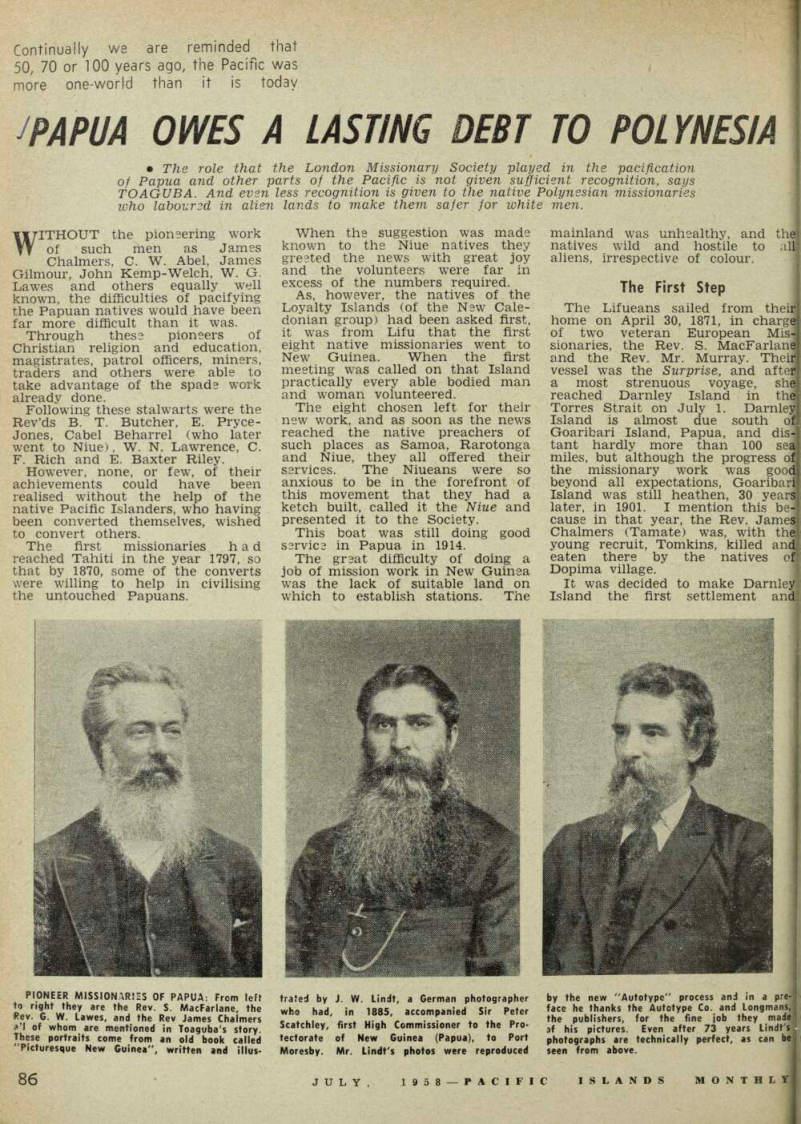
Pioneer Missionaries Of Papua; From Left
to right they are the Rev. S. MacFarlane, the Rev. G. W. Lawes, and the Rev James Chalmers all of whom are mentioned in Toaguba's story.
These portraits come from an old book called "Picturesque New Guinea", written and illus-
trated by J. W. Lindt, a German photographer who had, in 1885, accompanied Sir Peter Scatchley, first High Commissioner to the Pro tectorate of New Guinea (Papua), to Port Moresby. Mr. Lindt's photos were reproduced
by the new "Autotype” process and in a pre face he thanks the Autotype Co. and Longmans, the publishers, for the fine job they made af his pictures. Even after 73 years Lindt's photographs are technically perfect, as can be seen from above.
it teachers with their wives and dren were landed on the beach itart their task. tie workers radiated from the headquarters and worked on nearby islands of Dauan and ai, all arrangements being con ed in a most satisfactory mer. it they were still not established any island or part of New aea, and both Mr, MacFarlane Mr. Murray were anxious to nd their sphere of operations, le services of evangalists from oa, Rarotonga and Niue were >ted and the success attained these Polynesians was really tanding.
Malaria and Arrows iese Polynesians were left *ely on their own, but practically ised the whole of the coast of la from the Dutch boundary to Cape. icy suffered many casualties, * actual losses in the early ss of their pioneering work ? 122. Some died of malaria, ; from dysentry; others were med, poisoned by the arrows of iendly tribes; killed by the ? natives with stone clubs, irs died from natural causes, nothing held them back. the year 1894, 23 years after first landing, there were still seven European LMS mis iries in the Papuan field, whilst 5 were 106 native ordained ionaries, 35 native preachers, church members, 27 Sunday Dls. 105 day schools, with 6,890 lars. e acceptance of Christianity by Samoans and other Pacific
Islands peoples, enabled the Mission to extend its pacifying influence in a most successful manner with out the necessity of calling on too many Europeans.
Tribute must be paid, of course, t 9 the men who taught the mis sionaries, who, so it was thought, being almost akin to the natives of the districts, could go out to teach the three “r’s” as well as the rudiments of Christianity.
W. G. Lawes was one of the first
pioneers of the LMS in the SW Pacific, and with MacFarlane and Chalmers established the Mission in New Guinea.
This was after a strenuous period of hard work during which time Lawes had been able to translate the Bible into the Motuan and Niuean dialects.
Lawes also founded the LMS College at Vatorata, in behind Kapa Kapa, near Port Moresby.
This college later came under the control of the Rev. R. Lewis Turner who, like Lawes, was most successful in his teaching of English and the full understanding of the Scriptures.
Tamate Murdered James Chalmers has become a legendary figure in Papua. His attitude towards all natives was one of exceeding kindness and under standing. The success which at tended all his efforts was remark able, but he was over-venturesome, and this in the end proved his undoing.
He refused to believe that he could not go on to the Island of Goaribari without meeting anything but kindness from the natives, but as we now know he and his com panion, a new-chum named Tomkins, were clubbed to death at Dopima.
Robin, the native skipper of the Niue, had pleaded with Chalmers to wait a few days before venturing on to the Island, because the Goaribarians were making very “big feast” and would not tolerate any stranger in their midst at that time.
(Continued on page 102)
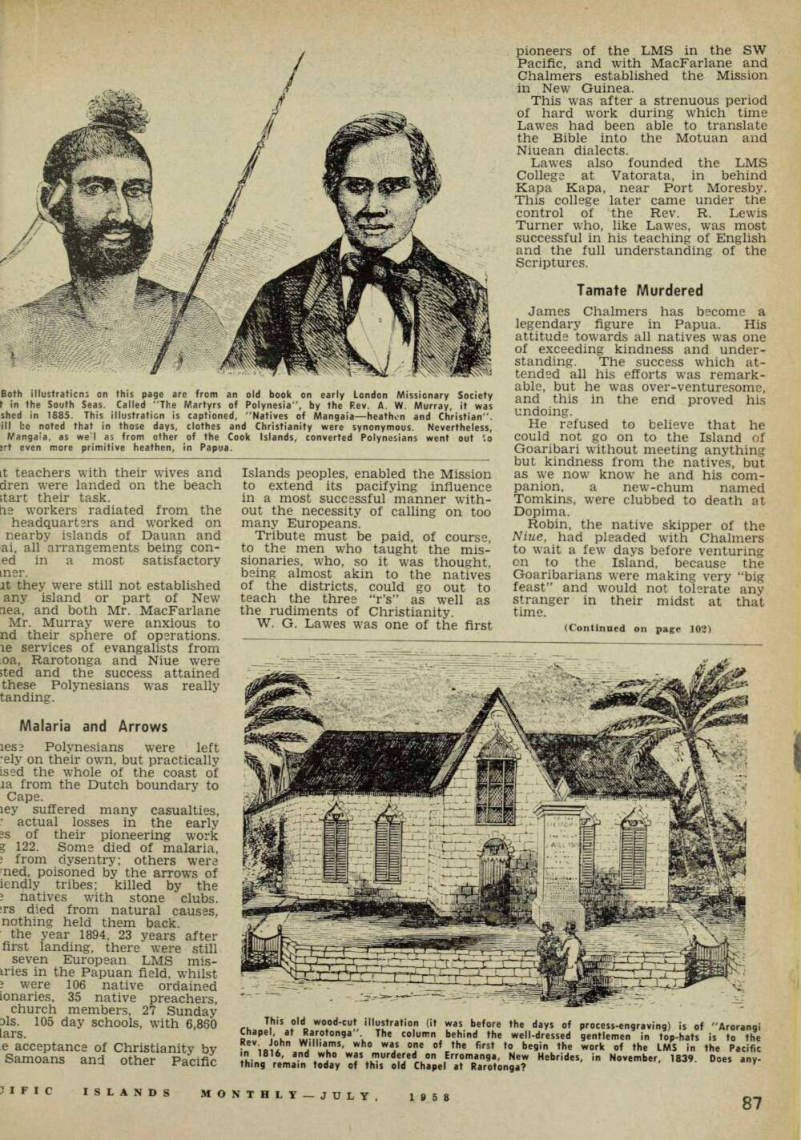
Both illustrations on this page are from an old book on early London Missionary Society t in the South Seas. Called "The Martyrs of Polynesia", by the Rev. A. W. Murray, it was shed in 1885. This illustration is captioned, "Natives of Mangaia—heathen and Christian", ill be noted that in those days, clothes and Christianity were synonymous. Nevertheless, Mangaia, as well as from other of the Cook Islands, converted Polynesians went out lo ert even more primitive heathen, in Papua.
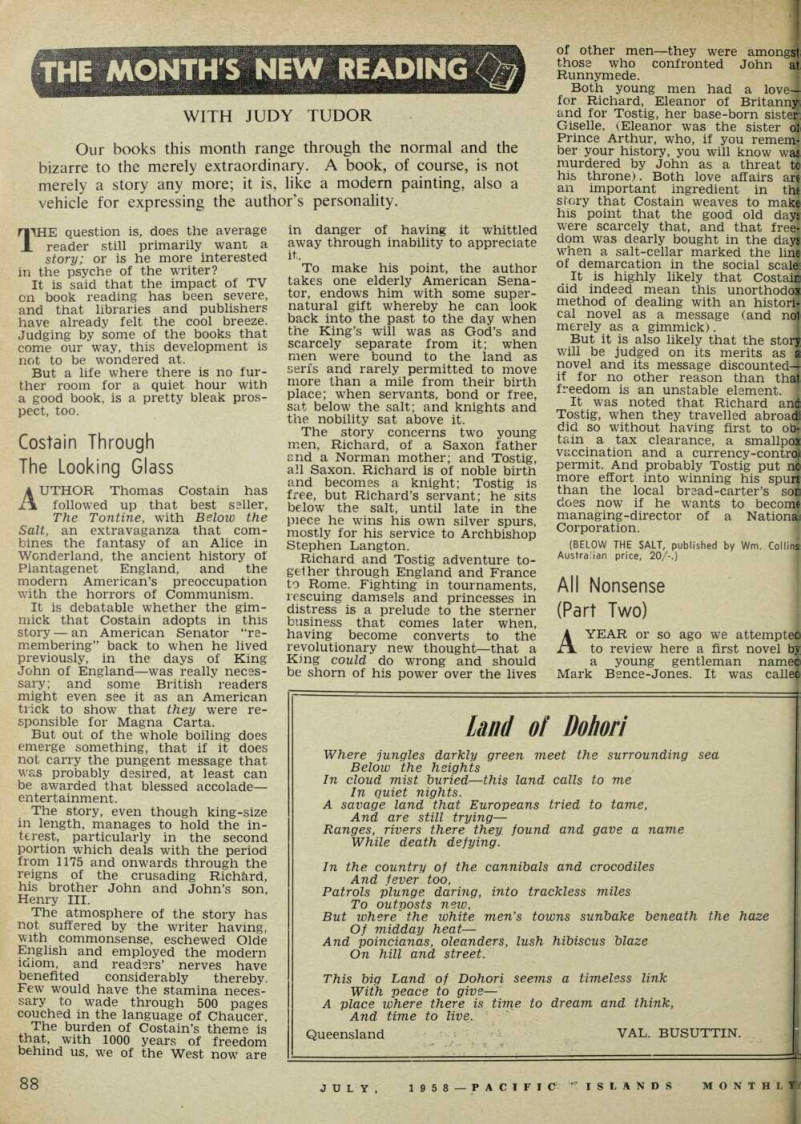
This old wood-cut illustration (it was before the days of process-engraving) is of "Arorangi Chapel, at Rarotonga". The column behind the well-dressed gentlemen in fop-hats is to the Rev. john Williams, who was on e of th e first to begin the work of the LMS in the Pacific in 1816, and who was murdered on Erromanga, New Hebrides, in November, 1839. Does any thing remain today of this old Chapel at Rarotonga?
(Continued from page 87) Chalmers took no heed but ; soon as he and Tomkins were cle;; of the Niue, Robin took what wr left of his crew and heaved up tf anchor, so that, if Tamate sense danger and turned back, with tH sails ready, they could sail out I sea without delay.
With the anchor almost on dec Robin watched the progress of tH two men, and saw that, as soon ; Tomkins landed, he was clubber and that Tamate being so clom behind him, was unable to retrea and suffered the same fate.
This put much fear into tH skipper, and not having anythin with which to beat off am mauraders, he had the sails un furled and with a good SE winu he managed to get well away befoi the dug-out canoes could get any where near him He sailed into Daru, and mad his report to the Govemmen Official who was there at the tirm There was much violent dis cussion about this awful crime, air the then officers of the Territory Government, raw and not under standing the native psychology made a mess of their efforts tf bring the culprits to Moresby; c to bring about a proper understand ing of the crime by the natives o the Island.
Early Europeans
Other outstanding early mis sionaries included the Rev. C. 1 Rich, of Fife Bay, who with Mrr Rich, did splendid work in the are? from Samarai to the west of hi station: and the Rev. C. W. Abe? of Kwato, where the men wen taught boatbuilding, carpentry wort and all trades which fitted them foe the average job to be done in NG Most of the other white miss sionaries were to a certain extent successful, but could not be caller outstanding. Some of them werr quite satisfield to carry on wherr their former incumbent had lef i off; whilst others just did thd routine job and called it a day. j They did very little real pioneer;' ing, or breaking new ground.
It is to the native pastors ant' those men and women from Samoa.
Rarotonga, Niue, etc., that the Mission owes much of its reale success; without the help of these the difficulties of the LMS woulc have been insurmountable.
The RM’s and Patrol Officers oi the early years of this century could not have landed at many of the places on the coast unless the area had already been “scouted?! by the Polynesian missionary, who could at all times tell the Patrol Officer how to get to his destination! and what sort of reception he was likely to receive when he got there. 5 ?