DO YOU Remember?
p. 89 · Read in the full issue
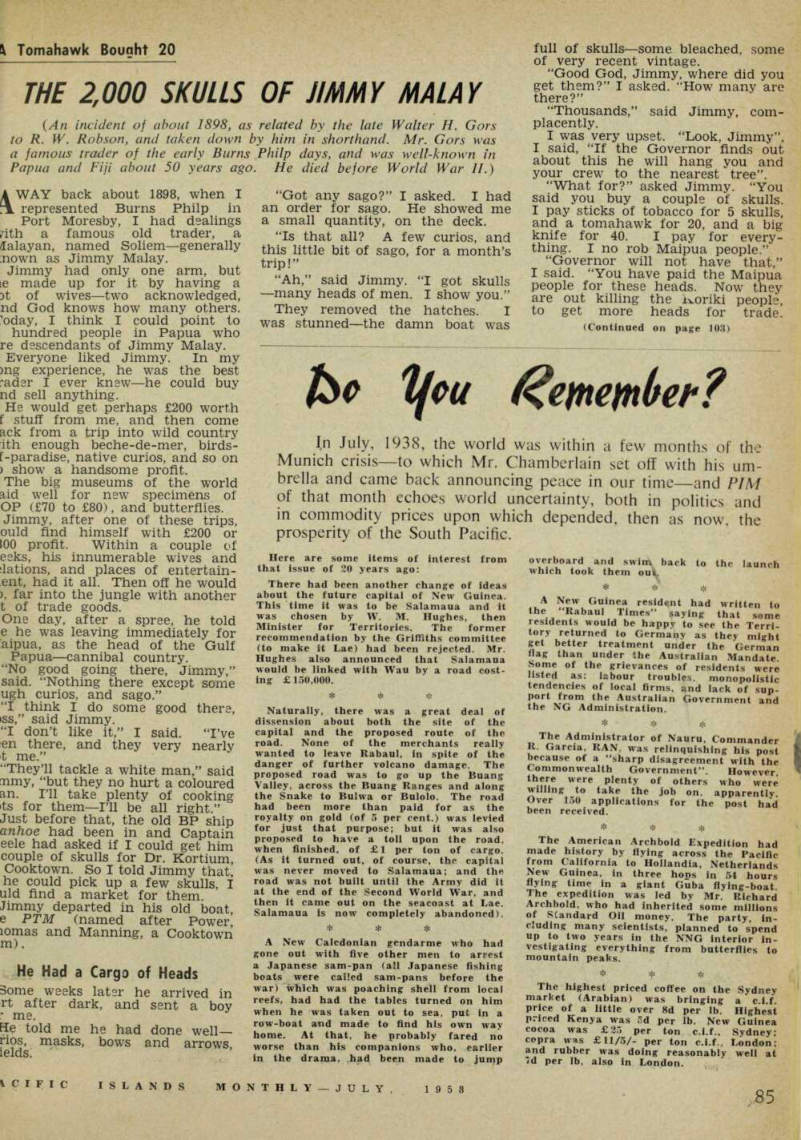
In July, 1938, the world was within a few months of the Munich crisis—to which Mr. Chamberlain set off with his um brella and came back announcing peace in our time—and PIM of that month echoes world uncertainty, both in politics and in commodity prices upon which depended, then as now. the prosperity of the South Pacific.
Here are some items of interest from that issue of 20 years ago: There had been another change of ideas about the future capital of New Guinea.
This time it was to be Salamaua and it was chosen by W. M. Hughes, then Minister for Territories. The former recommendation by the Griffiths committee (to make it Lae) had been rejected. Mr.
Hughes also announced that Salamaua would be linked with Wau by a road costing £150,000. * * * Naturally, there was a great deal of dissension about both the site of the capital and the proposed route of the road. None of the merchants really wanted to leave Rabaul, in spite of the danger of further volcano damage. The proposed road was to go up the Buang Valley, across the Buang Ranges and along the Snake to Bulwa or Bulolo. The road had been more than paid for as the royalty on gold (of 5 per cent.) was levied for just that purpose; but it was also proposed to have a toll upon the road. when finished, of £1 per ton of cargo. (As it turned out, of course, the capital was never moved to Salamaua: and the road was not built until the Army did it at the end of the Second World War, and then it came out on the seacoast at Lae.
Salamaua is now completely abandoned). * * * A New Caledonian gendarme who had sone ont with five other men to arrest a Japanese sam-pan (all Japanese fishing boats were called sam-pans before the war) which was poaching shell from local reefs, had had the tables turned on him when he was taken out to sea, put in a row-boat and made to find his own way home. At that, he probably fared no worse than his companions who earlier in the drama, had been made to jump
overboard and swim back to the launch which took them out. * * * * .. , th ? t a , res , dent . had written to N" 1 ® 8 that some ! ? "/!!!“. be happy to see the Terri h(( . ® Germany as they might b *“* r ‘"• tn, * nt A under „ th * German c„£,„ “ d r . * he Australian Mandate, w® 1 "* °* the . {["evances of residents were 1 st^ d l 2 bour troubles, monopolistic tendencies of local firms, and lack of sup- P« rt fr om the Australian Government and * be Administration. * * * T h( . .w, . ’
R RAN was because of a “sham p hinf his post Commonwealth rovcmmp'r' 11 the
theTe ffienS of ‘ ‘ ”owever
willine to take thp inh h * S Wh ° W * C , re Ovei 150 an D L tn/ tJ appar t en u t,y : be en received P ° St had * * * The American Archbold Expedition had made history by flying across the Pacific from California to Hollandia Netherlands New Guinea, in three hons in 54 hours flying time in a giant Cuba flvine-boat The expedition was led by Mr Richard Archbold, who had inherited some millions of Standard Oil money. The party, in eluding many scientists, planned to spend
Xt'S friT“houVSr ‘V
mountain peaks m b "“" flles •» * * The highest priced coffee on the Sydney market (Arabian) was bringing a c.i.f. price of a little over 8d per lb. Highest J™ 6 / £*” ya £ £f S J?. lb ; , ? CW ‘ nea con?a was £ll~>s/ n... i it' T Syd " ey: and rubser was ' 7d per lb, also in London.