Fiji Talanoa
pp. 63-67 · Read in the full issue
Vakatawa Talks
Of This And That
It is hard for non-Fijians, unless they have lived among Fijians for a long time, to appreciate the depth of feeling which stirred the Fijian people when Ratu Sir Lala Sukuna died.
HE was the man above all others to whom Fijians of all pro vinces looked for guidance and leadership. They had immense pride in his achievements.
He had his critics among them, ff course. No leader in history has oeen accepted as faultless. But underneath there was a feeling hat came close to reverence.
A lot of overseas newspapers and aroadcasting stations wrongly de scribed him as the “paramount ihief” of Fiji. Even the London limes erred.
The paramount chief is the Ainivalu (“Root of War”), of Bau. fhis title, originally assumed by rakobau when conquest gave him jaramountcy throughout most of he Fijian islands, is now held by as great-grandson, Ratu George )akobau.
It is not hereditary, but is con erred, usually on a member of the 2akobau family, by the chiefs of Jau.
Confusion often occurs in the linds of non-Fijians about the po rtion of the traditional chiefs and he administrative leaders ap iointed by the Government or the bjian Administration.
Roko Tui, for instance, is a hiefly title which has come down rom pre-cession days, but now it leans the administrative head of province. It sometimes happens bat the traditional high chief of bat province is also appointed 'oko Tui, but nowadays this does ot often happen.
The Roko Tui is frequently a fan who was not born in the rovince, and he need not even be I chiefly rank.
On Fijian ceremonial occasions, le traditional high chiefs are ac :rded special honours, and they ave certain rights in custom, but ley quite possibly have no official osition in the government of the rovince.
Even the name Council of Chiefs nowadays misleading. Commoners ho have been made Roko Tuis are utomaticallv members of the ouncil of Chiefs, and other corn oners may be elected as members 7 the various Provincial Councils.
The general position is a bit like lat of the Duke of Norfolk in re tionship- to a British Cabinet Minister.
When there is a coronation the uke comes into his own. He has
hereditary rights and duties, but these have nothing to do with the day-to-day government of Great Britain.
The cabinet minister, on the other hand, has administrative authority and helps to form government policy, but he need not be of noble birth.
The Fijian equivalent of a Duke of Norfolk who became Prime Minister would be, roughly, a Vuni valu of Bau who was appointed Secretary for Fijian Affairs.
The Banana
Boosters
The high-powered delegation which went from Fiji to try to in duce New Zealand to buy more bananas came back with a lot of sympathy for the New Zealand Government’s economic and politi cal problems, but with very little comfort for Fiji’s banana growers.
The New Zealand Government
undertook to accept this year’s out put from Fiji, but would make no promises for the future.
Apparently, their main concern is what the Russians or the Guate malans or the Poles may say in the United Nations if any cut is made in imports from a Trust Territory, so they have to accept all of Western Samoa’s production.
Then they promised to try to fit bananas from Fiji and Tonga into whatever was left of the market.
This was all very well, but the announcement of the Samoa First policy coincided with a sudden spurt in Samoan production of bananas, as has been reported in PIM recently. (See elsewhere this issue).
Samoan exports in May were over 100,000 cases. If this rate continues —and the question from Fiji’s point of view is how big that “if” is—New Zealand can look to Western Samoa alone for over a million cases a year.
Then there was another shock.
The delegation from Fiji was told that New Zealand could not ab sorb more than a million cases, or at the most a million and a quarter, per year.
So where does that leave Fiji?
The prospect is not the sort of tning that would encourage any normal business enterprise to launch out on new capital invest ment in the banana industry.
But the Fijian provincial autho rities, encouraged by years of ex hortation by New Zealand Fruit
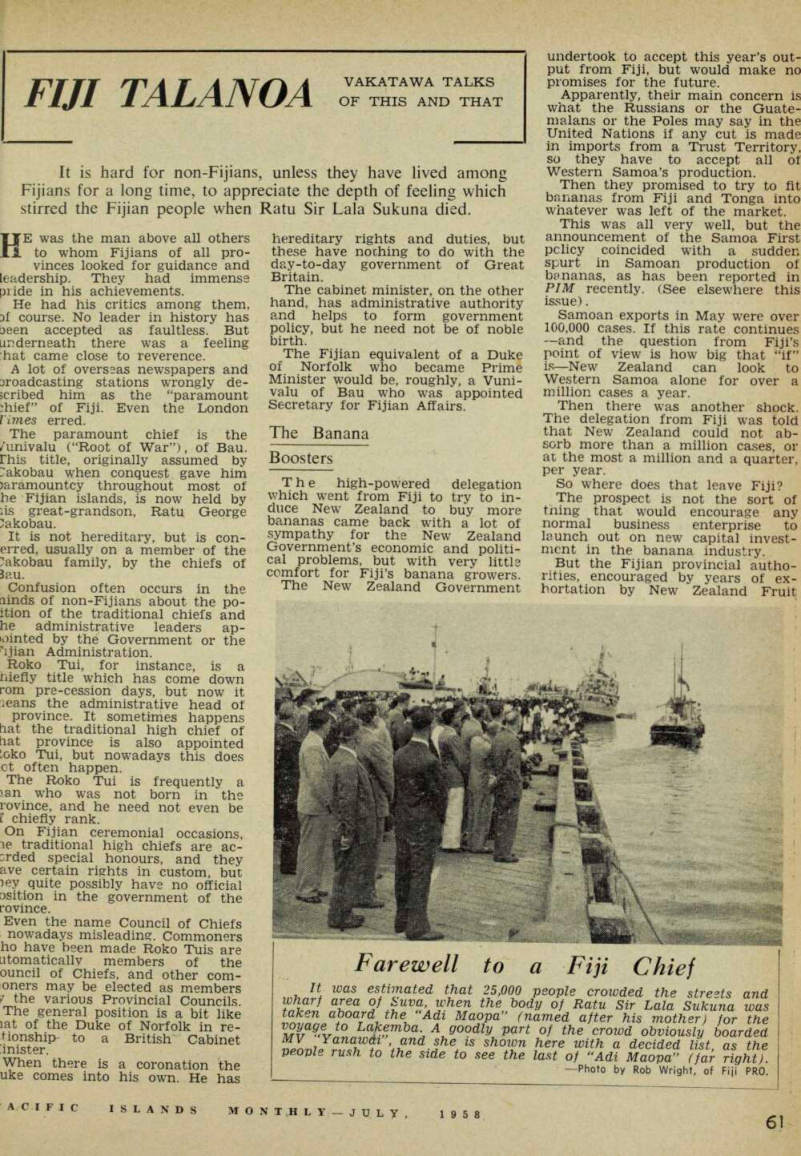
Farewell to a Fiji Chief
It was estimated that 25,000 people crowded the streets and wharf area of Suva, when the body of Ratu Sir Lala Sukuna was taken aboard the Adi Maopa (named after his mother) for the voyage to Lakemba. A goodly part of the crowd obviously boarded MV "Yanawan", and she is shown here with a decided list, as the people rush to the side to see the last of “Adi Maopa” (far right). —Photo by Rob Wright, of Fiji PRO.
Distributors Ltd., (the monopoly buyers of bananas for the New Zealand market) to grow more and still more bananas, have been doing [ust that.
Plantations, and very good plan ;ations, established by Cakaudrove Fijians near Savusavu under the mergetic leadership of Ratu Penaia janilau are just coming into pre diction.
There are other new plantations m Ovalau and other Lomaiviti slands.
So long as New Zealand remains he only market for Fiji bananas he prospect for the growers seems retty grim. It is almost exclusively Fijian industry, and in some reas provides the only source of icome for villagers.
Fiji bananas are kept out of Aus :alia by government action, in ured by pressure from Australian rowers.
Fiji can hardly be blamed for uking a little cynically at the >stly enthusiasm of Australia and ew Zealand for the Colombo Plan boost the economy of Asian itions.
A little thought for Pacific untries whose loyal friendship is been abundantly proved in peace id war would be helpful.
mericans
ack in Suva
The United States Government ■s acknowledged reality and is to jpen the American consulate in Lva.
There was a consulate there for my years, but in a post-war jnomy drive it was closed, to ther with the one in Tahiti, and consulate business for the tropi -1 South Pacific was concentrated Noumea. rhe main reason for this was un itedly the decision at that time set up the headquarters of the iu t h Pacific Commission at umea, but the consulate arrange mt has become more and more workable. s eople from Tahiti, both Samoas, : Cooks, Tonga and Fiji wanting do business with the consulate ve had to write to Noumea and :n sometimes wait weeks for a ily because of poor communica- Some have made the costly rney to Noumea via Sydney to to speed things up.
Occasional trips by the Consul Fiji and the eastern islands have ped, but the main result has n to emphasise the absurdity of mg to conduct Fiji and Poly la operations from Noumea, ncidentally, when the consulate ; moved from Suva, the US Gov ment did not break all terri al ties with Fiji.
It owned a commanding house site at Tamavua. It had been used during the war by an anti-aircraft battery.
A couple of years ago, the Ameri can Government decided to sell the site, but nothing final was done.
Now the site will probably be used for a new home for future consuls.
Suva Has
the Lot
Suva’s advantages are obvious. It is a port of call for the main trans pacific shipping lines, a junction for cable and radio services, base
for the Coral Route flying boat service to Polynesia, and on the same island as Nadi international airport, where all north - south trans-Pacific airliners call.
The Americans were unwise when they moved the consulate to Noumea. It has been clear from the start that the South Pacific Commission headquarters should never have gone there, either.
The mistake has cost the Com mission dear, in money, efficiency and effectiveness.
Perhaps the United States Gov ernment’s realistic decision about its consulate will induce the Com mission governments to follow suit.
High Cost of
Government Yachting
The waterfront at Suva, always aitical of those set in authority, lad a field day when the vessel R,a Marama arrived from Singa >ore.
When she was first ordered she tas described in official handouts ,s the Governor’s Yacht. Then as nurmurs began to be heard about he expenditure of a rumoured F 66.000 from public funds on such project, the handouts turned her ito an administrative and naval raining vessel, or, at the worst, the ew Government yacht.
When she arrived, it soon became lear to those who went aboard lat the designers at least had had 0 doubt about her purpose.
In what would be described, in a rivate yacht, as the owner’s state )om, her accommodation could istly be described as luxurious.
Further aft, two small cabins mtain four austerity bunks, and lat completes the passenger ac >mmodation. She can carry no trgo.
At a time when financial belts •e being tightened severely in gov nment and commercial enter •ises and in private households, te spending of £F66,000 to carry jo people round Fiji in luxury has casioned some sharp comment.
It is the sharper because those 10 know cannot understand why, len Fiji builds wooden ships of gh standard, an order for such a ssel should have had to go to ngapore, especially when delivery volved sending a special crew all e way from Fiji.
Just to aggravate the situation, so happened that at the time 1 Marama arrived, the American ch Kuru was in Fiji waters. She truly luxurious, and fitted with ch things as air-conditioning and scial refrigeration. *The owners let it be known that sy would consider offers to buy c yacht, and the price, so it is sorted, was well under half the >t of the Ra Marama.
xylene Age—
ashbasins for All rhe appearance of terylene on 5 Fiji tailoring scene in the past ir or two has transformed men’s thing habits. [There was a time when the only rect wear was white drill, rrousers were 6/- a pair and a lor-made coat cost 12/-. A shirt 4/- completed the outfit.
Newcomers bought six pairs of users and two coats and with ndry at 10/- a month, they were .1 and economically catered for, torially. ’he only snag about this whole
sale initial equipment was that all your clothes wore out at the same time.
Bank clerks serving three years in Fiji found that their white trousers just lasted the distance.
For the final month or two there were frayed cuffs and patches round pockets and seats, but there was usually still enough shaped material left to make a parting present to the houseboy before going aboard the ship.
After the white drill period came the time when Palm Beach was the thing, at least for superior occa sions.
Now the story is terylene.
Two pairs of shorts, a couple of terylene shirts and a terylene suit
for formal wear can produce a well dressed man, but not for the few shillings of the white drill days.
Such an outfit costs about £4O, but the convenience is great.
After wearing one pair of shorts you wash them in a hand basin, hang them up, and in a few hours, while you wear the second pair, the first pair is dry, and perfectly ci eased without the need for iron ing.
Shirts, too, need no ironing, and dry a few hours after being washed.
Even suits, if linings, pockets, padding etc., are made of terylene too, can be washed with soap and water. No ironing, no dry-cleaning, no trouble. (No houseboy? — Ed. PIM).