Sharp Challenge To Anthropologists
pp. 55-61 · Read in the full issue


way With the Theory of Gradualness, He Says
By Eric Feldt, well-known former officer of the New Guinea administration
• What has been the value of the anthropologist in the establishment of European administration in Northern Australia and the Islands?
Why is the anthropologist—usually a highly-trained man with a University degree—not always treated with the respect that is accorded other professional men, like doctors, or navigators, or pharmacists? These are some of the questions the author attempts to answer here.
lAYBE, laymen, in their con tacts with anthropologists, got wrong impressions. Some — rhaps only a few —anthropoloits who did field work in New linea were noted for their trnedness rather than their manliness. [t appears that, sometimes, to in the confidence of their native sts, they lived as did the natives md so they presented themselves Europeans dressed in a laplap, shaven —perhaps not dirtier than j natives, but looking dirtier be ise of their white skins.
With these initial impressions, a )d many laymen, observing an 'opological activities, came to the iclusion that the writers gener y were on the side of any tives who were against Euro ins.
Anyone acquainted with the work le by Professor Elkin on behalf Australian aborigines must be wed by his sincerity and devo n to their welfare; but it is abtful if Professor Elkin can say ;h certainty that his —or any asures that can be devised —will sure that the aborigines will de op and take their place in the dern world. las he the confidence that a ;tor has, when he says that a iken leg will heal in a certain le? One gets the impression that only hopes that the measures he locates will be effective.
A Little Each Way Conversely, when Nauru (for ex ple) is discussed, the anthropo ist points out that the rents and r alties paid to the native uruans have made them favoured rds, parasitic upon the phos ate industry, with the loss of ir manliness and independence, t what an outcry there would ve been if the Mandatory vers had simply told the Nau ms to sink or swim by their own r ices!
"he anthropologists cannot have aoth ways. n their writings on the sad re ts of the visits of the early alers, traders and beachcombers the Pacific, they always stress great harm that was done to ;ive peoples by the trade in arms
and liquor.
This was undeniably so. But some books suggest that the natives had
these goods forced on them. It is obvious that the natives wanted to drink the rum and fire the muskets at their enemies. Very rarely is it mentioned, for instance, that a Fijian Chief, listening to the sales talk of an arms salesman, asked him to demonstrate by shooting one of his subjects.
Where culture is described, such items as the launching of war canoes over bound captives, the killing of parents by their sons, or the more revolting parts of head hunting on the Sepik in recent years, are played down.
Europeans who have known savages feel that there is a lack of judicial detachment in such de scriptions. (Over)
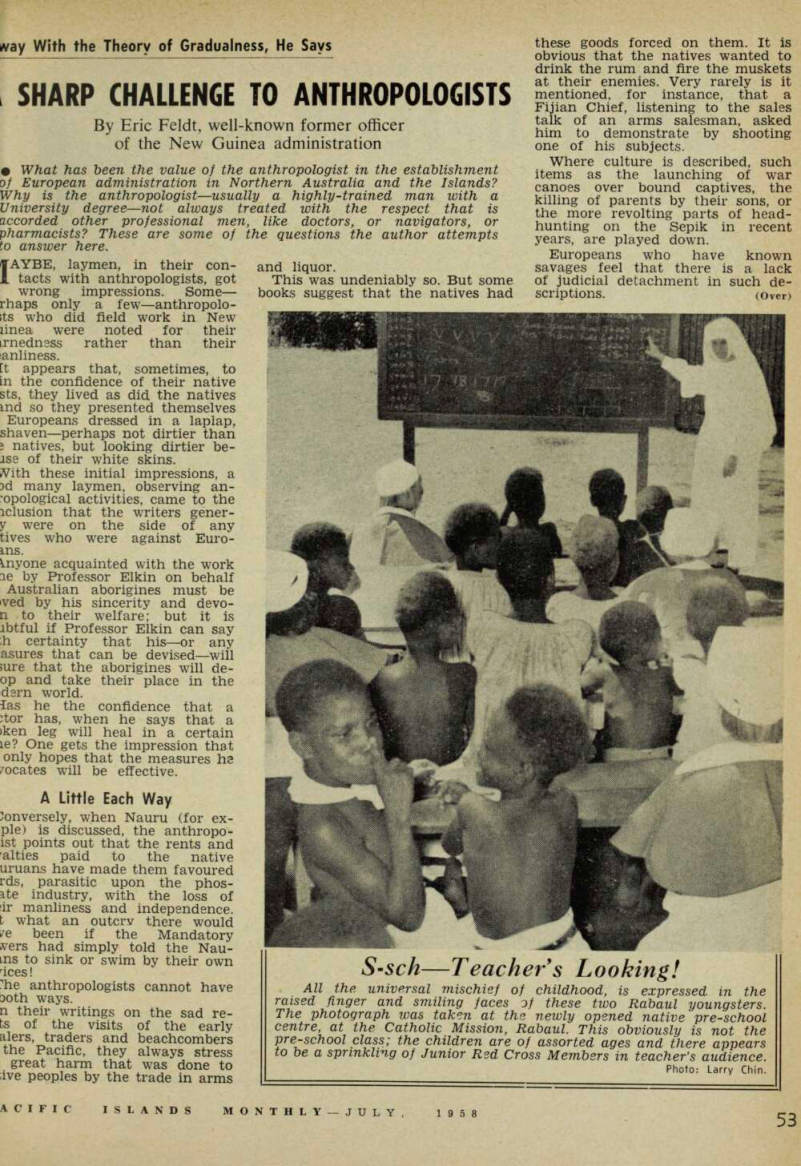
S-sch—Teacher s Looking!
All the universal mischief of childhood, is expressed in the raised finger and smiling faces of these two Rahaul youngsters.
The photograph was taken at the newly opened native pre-school centre, at the Catholic Mission, Rahaul. This obviously is not the pre-school class; the children are of assorted ages and there appears to he a sprinkling of Junior Red Cross Members in teacher’s audience.
Photo: Larry Chin.
One-Sided Viewpoint on Labour , It is on the subject of employ nent of native labour that the ayman, particularly the employer, daims that there is one-sided :reatment.
One instance: Most anthropolo gists treat with derision the claim >f the Queensland Government, ifty or more years ago, that the :anaka labour on the canefields vas content to stay there. As a mall boy on my father’s canefarm n North Queensland, I saw the Lismay of the kanakas when they ound they had to return to their slands homes.
As this is not in accord with the xpectations of the anthropologist, le sticks to his doctrinaire opinion nd fails to accept the facts.
In New Guinea, there has been he outcry that the non-return of tative labourers has disrupted illage life, and the employer has een blamed for this.
Of the many anthropologists who isited New Guinea and investi ated native villages, none seems :> have visited a labour line and nquired why natives went to work nd why they stayed there. Anyone f experience in New Guinea could ill them the answers.
Natives, even though they could ibsist and earn money in their illages, went to work to get away ■om the utter boredom of village fe and to see a bit of the world, hey stayed at work because they referred it to returning home.
The employer is naturally re mtful when, having obeyed the lw and a bit over, he is accused f “exploiting” the native when he as been giving him a better living lan he would have had in his llage.
Factors that are Ignored Administrative officers, from ex srience, feel that the anthropolo st does not state the full case hen he conveys the impression lat native communities lived by istoms which had, in effect, the •rce of law. Little, if any, mention made of the machinery of en ircement.
In written law there are always msiderable differences in interpre tion; and there must be more here customs are known by word mouth only. Experience shows tat the “big man” of a village, icked by a powerful family, finds any exceptions in his favour hich the common man can not.
Something similar might even ippen in Sydney!) In discussions on the effects of cruiting, a factor rarely men oned, is the excess number of ales over females in the New uinea native population. This ids to the marriage of immature males to much older males. If is continues, it will have a dele rious effect on the population.
There is a tenable argument that the removal of surplus males by re cruiting, provided this surplus is not exceeded, would be beneficial.
Yet I have never seen this facet of the problem discussed by any anthropologist.
With the inherent weakness of most sociological studies—where individuals are submerged in the consideration of larger entities — anthropological writings do not mention the very friendly personal relationship that exists between in dividual Europeans and natives.
There are men who have had the same “boys” working for them for many years—people who under stand each other and consider each other, though they both observe the “caste” distinctions between them.
In most cases it appears that the native does not want it otherwise.
These thousands of cases must have a definite effect on the rela tionship between natives and Euro peans generally.
It may be that “caste” distinc tions between European and native are over-emphasised. In the early days of the Pacific, chiefs were treated with deference by visiting ships; castaway sailors and runa way convicts were suppliants, and could assert no claims to su periority. In general, the native must have been treated as a social equal. And a fat lot of good it did him!
Cephalic Index versus Experience
To the layman who has lived in, say, New Guinea, the anthropolo gist sometimes seems to go a long way round to get to his destina tion.
He may know the cephalic index, physical measurements, blood grouping, sib, clan and social organ isation of a native people: but if given all the available informa tion about, say, five natives, it is doubtful if he could identify them.
But, an experienced European could say at a glance: “That’s a Buka: that’s a Manus; that’s a Tolai; that’s a Sepik; that’s a Markham.”
Nor does the anthropologist seem to take account of the dour self sufficiency of the Buka, the sensi tive pride of the Manus, the money hunger of the Tolai, the dependa bility of the Wewak, the tenacity of the Sepik, or the courage—with a dislike of hard work—of the Laewomba—all factors of more im portance than the shape of the head when dealing with those people.
Finally, the layman feels, when reading anthropological works, that the native is never to blame for anything.
It is never said that the natives had a chance and missed it through their own laziness and fecklessness.
It is always someone else’s fault.
It is stressed that the natives had shown their fitness to survive in their own environment. But Dar
winian fitness surely must include ability to adapt oneself to a change in environment. It can be done.
There were natives of some Paci fic Islands who found themselves :ar behind the West in technology.
But they sprang off their tails and ;aught up in fifty years; and in an >ther forty years they made us ipring off ours. The Japanese.
There is substance in the lay nan’s charge that the anthropolo ;ist is one-sided in stating a case. s erhaps he should be—perhaps that s his role. But while he states only me side of a case, his opinions will le received with doubt and his ad ice with reserve.
Perhaps he has to overstate his ase to get it heard. Perhaps I am verstating this one.
That Cry of "Detribalisation"
In the eyes of the anthropologist, tie Administrations, Missions and mployers have committed the grave rime of detribalisation of the atives.
It is pointed out that, before the dvent of the whites, the native ad a social structure and a way f life adapted to his environment, hich ensured his survival. (To hich the ordinary man replies that ) did sparrows, mountain sheep ad any other gregarious fauna.) The anthropologist says the lange of environment, caused by le advent of the whites, has riven the native from his way of fe, to his detriment. (It surely did i the past, replies the ordinary an, but that is water under the ’idge. For the last fifty years, acific Islands populations have sen increasing.) So now, they say, to preserve the itive, any influence towards de ibalisation must be resisted.
But this is a modern world. Any here else, such attachment to the ist would be called romanticism, ae native’s only chance of sur val is to adapt himself to the esent, which means detribalisa m.
In Fiji, it looks as if the Fijians 11 have to do some smart work in at direction if they are to survive :ainst the Indians.
Furthermore, it is impossible to event natives adopting anything Dm Western ways which the itive considers of benefit to him [f.
It was tried, in a minor way, at mch Island.
Tench was closed to recruiting. ) patrols or missions visited it. was left alone and isolated for number of years.
Then a patrol was sent to see w they were faring. It was met the beach by natives who lined l , who burst into song—just recog sable as the National Anthem— -1 by a native Mission teacher, rhe natives themselves had gone t to have a look at the world.
When they found there was a rule against signing them on for labour, the answer was easy—they said they came from places other than Tench. Did they want to go on living in accordance with their own viable way of life? Not (Pyg malion) likely!
Perhaps the idea of maintaining an anthropological zoo is no longer entertained. But it is not long since it was seriously advocated. But there is still opposition to detribal isation, though this is accepted if done gradually. In this connection, gradually seems to mean as slowly as possible.
Between wars, Papua was held in comparative virtue for its grad ualness, while the neighbouring
Mandated Territory was blamet for allowing too rapid commercial isation. In fact, conditions in botl Territories were little different.
In both there was no market overall loss of population, thougl an odd tribe or so (e.g., the Nini gos) disappeared. There seemed U be a slight fall-off in numbers ir the first generation after contac with whites, then a recovery in th< next generation.
Papua and New Guinea wen probably the only two Pacific area: in which there was no great drof in the native population after con tact with Europeans—but did wt get any praise for it!
The policy of gradualness had its effect on the Europeans, as well at
the natives in Papua, leading to a loss of initiative which was near stagnation.
Hubert Murray's Blue!
So, in 1923, in Papua Today, Sir Hubert Murray reported that all the natives in Papua were being brought under control and that there were but few who were not under Administration influence.
Exploration by unpopular private enterprise, from the despised Man dated Territory, caused a major re vision in this estimate seven years later.
It is interesting to reflect what a howl of derision there would have been in the Press if General Wis dom had made a “blue” comparable to Sir Hubert’s. As it was. Sir Hubert Murray’s error in judg ment was passed over in discreet and tactful silence.
More than anthropological opinion was responsible for this. Sir Hubert Murray had a good Press, which is one of the facts of modern life, and is a curry of very mixed ingredients. (Even journals, including Pacific Islands Monthly, which did not judge a Territory solely by its policy of native welfare and criti cised the Mandated Territory for lot assisting development suffi ciently, were kindly disposed to wards Papua, where much less was lone in that respect, in accordance vith its policy of gradualness.) Is this policy of gradualness to ce adhered to? Does it mean we ire to go as slowly as we can? Have ve time? Has anthropology any >ther contribution to make to ad ninistration?
What Anthropology Could Do
We should set out what we are rying to achieve in Papua-New juinea. Australia is paying for it, n the main, and Australia frankly vants a strategic return for its noney; but not at the cost of in ustice and oppression.
The natives want to survive and •rosper in the modern world, what ver doctrinaire romanticists say o the contrary. The Missions want o teach religion. Capital wants a leld for investment, with stable
conditions, so that it can get a re turn on its money.
And the ordinary Australian, liv ing in the Territory, wants to go on much as he is, but not to be penalised if he is successful.
The common objective which should meet all requirements is the development of the indigen ous population into a people able to stand on its own feet in the modern world, with cultural, commercial and religious ties with Australia, with English as its common language.
This is not an impossibility, as the good personal relationship be tween natives and Australians shows.
Caste distinctions will disappear when the cultural differences have gone. There will be room for Aus tralian capital, technical knowledge and integrity for as long as any one can foresee.
Then the problem becomes, not how slowly wfe can modernise the native but how quickly, without damage to him. The special know ledge of the anthropologist should be turned in this direction. We want him to tell us what to do now, not what should not have been done in Nuka-Hiva in 1858.
It is suggested that the proper sphere for field work now is not among the primitives, but in the progressive communities which are trying to modernise themselves, using present-day methods of agri culture and marketing, with a money economy.
For instance, some natives are now making real money. Should they make wills; or, if they die intestate, should their assets be distributed by the old bow-and arrow custom, even when the as sets include a modern sawmill?
Should there be regulation of the employment of one native by an other?
In this, there is no room for the congenital pessimist, such as the one who told me years ago that medical treatment of natives was bad, as it destroyed their natural resistance to disease.
And a final word of advice to anyone who undertakes this assign ment is that he should wash, shave and keep his pants on in public.