& New Guinea
p. 36 · Read in the full issue
Now Available
Handbook of Papua & New Guinea
2nd Edition The Handbook of Papua and New Guinea, 2nd Edition was published last month and is now on sale throughout the Pacific Islands and Australia. Price is 10 - (posted: 1/extra within British Empire; Foreign, 1/9) or $1.50 U.S. (includ
ing postage).
Comprising 288 pages, with a special map of the two Territories, it contains all details of the administrative and com mercial organisation in both Papua and New Guinea, plus a complete list of all European residents.
There is a description of each of the 15 Districts, with some local maps; a list of all Departmental officers, showing correct names, titles and positions; lists of all trading firms in each District; details of all communications—such as airfields, radiophone networks, timetables; lists of fees and taxes; the Customs tariff.
The structure of the Administration is described, with an outline of the activities and responsibilities of each Department.
A section is devoted to the Statistics of the combined Territory.
There are particulars of commerce and industry, and of the Missions.
This is a Handbook which any person dealing in any way with Papua and New Guinea must have on his desk.
Copies may be obtained at most bookstores in Australia; at all stores in Papua and New Guinea and from the publishers
Pacific Publications Pty. Ltd.,
Technipress House, 29 Alberta
Street, (PO Box 3408), Sydney. pLJ O ”* Papua-New Guinea agents: Pacific Publications (NG), Ltd.. Theatre Block, Fourth St., Lae, NG.
In Melbourne: Pacific Publications Pty.
Ltd., Newspaper House, 247 Collins St.
Since the one-time conservative Royal Empire Society has become the Royal Commonwealth Society one cannot help but wonder where the definitions of Empire stop and Commonwealth start.
Rather strangely, perhaps, the word “Commonwealth” to me con jures up days of Cromwellian austerity when Britain’s monarch had his head lopped off. But then that was some 300 years ago.
So far as Fm concerned, the word “Empire” will still retain its original meaning, whether our Asian neighbours like it or not.
With No Ties Attached Many eyes from all global points are watching with interest the P-NG experiment with regard to merging of social interests. Many theories have been advanced from those with practical experience.
In recent issues of South Pacific Post, D. M. Fienberg, a one-time Officer of the District Services who became an official on Australia’s UNO staff, has written some in teresting articles dealing with current political and social matters existing between the European and P-NG indigenes.
An outstanding feature is that his ideas conform in many ways to the Rules laid down by the High lands Committee some months ago, and of which lan Downs was one of the prime movers.
According to this policy there must be inalienable co-operation between the Europeans and natives m order to carry on. That may be possible for the Europeans, but will the native, with his new gained knowledge, be prepared for such a partnership?
Modern history records that, once one-time “underprivileged” races have attained their independence
they want no inter-racial partm ship.
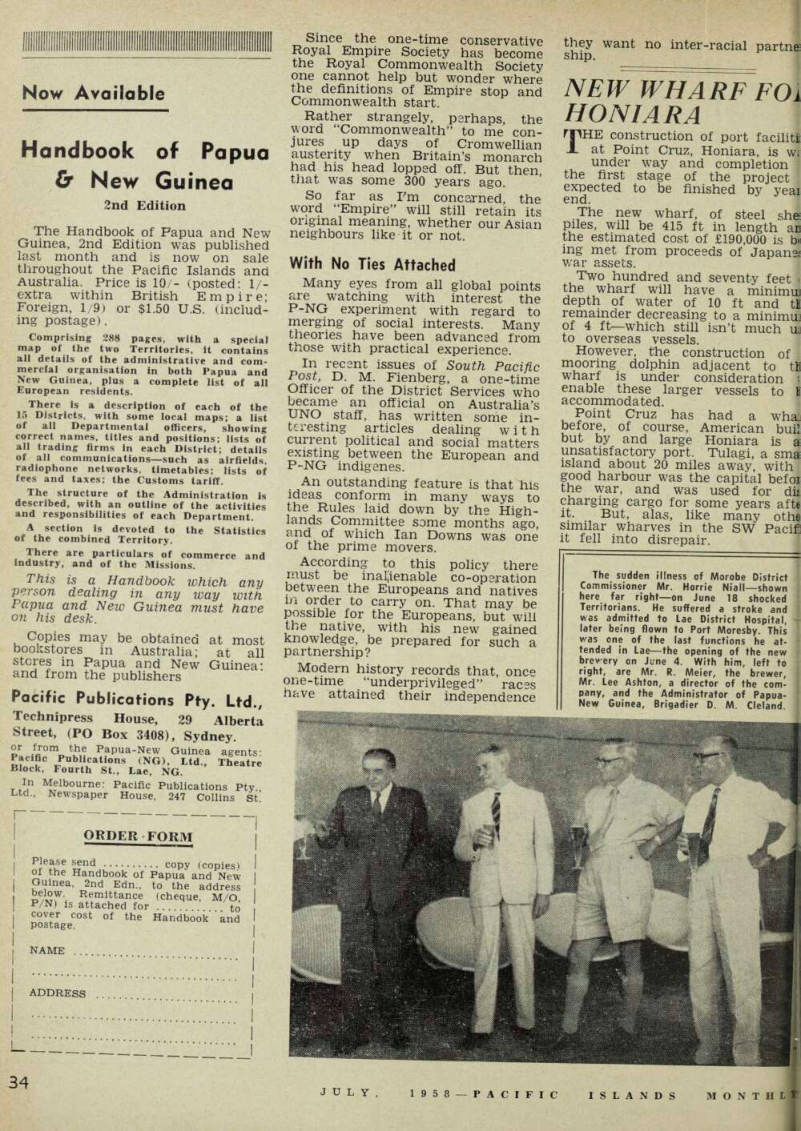
The sudden illness of Morobe District Commissioner Mr. Horrie Niall—shown here far right-on June 18 shocked Territorians. He suffered a stroke and was admitted to Lae District Hospital, later being flown to Port Moresby. This was one of the last functions he at tended in Lae—the opening of the new brewery on June 4. With him, left to right, are Mr. R. Meier, the brewer, Mr. Lee Ashton, a director of the com pany, and the Administrator of Papua- New Guinea, Brigadier D. M. Cleland.