Territories Talk-Talk
pp. 31-35 · Read in the full issue
By Tolala
e a Look, Jimmy!
was indeed a happy thought of the South Pacific Post, of Port Moresby, to put a pen back he hand of Jimmy James and rd him space to air his thoughts, lough always in the public eye e the war, by various utter ;s and actions, and an honest ;avour to keep the Legco on an i keel, we have missed many ds pungent comments from the Drial chair of the now defunct nan Courier. personally appreciated his re aces to the uphill task we had, ediately after the war, of at jting to re-establish the Press loresby, Lae and Rabaul. member of the staff of the obe News (mentioned in June ), Syd. Richardson, who also ed with ANGAU, has made good ress along the Inky Way since Lae days. ; started in 1946 by acquiring the m Post, since then he has d the Camden News, Campbell i-Ingleburn News and the jrthur Advertiser to his news r interests.
ling
itelists
e natural enemy of philatelists, fakers, have been on the go recent months, and faked ese stamps have alerted de /es in three countries, e story includes a reference to rged 2d issue of the Harbour je, printed and circulated in ey, which was “the only at it they recall to forge postage ps in Australia,” of which reminds me of the when some pretty hefty ries were made of the old lan New Guinea stamps sur ged GRI when Australia )ied the colony in T 4. ese forgeries appeared on the on market in the ’2o’s (if I re ber rightly) and the faking in connection with the sur ;e—not the actual stamp, e original overprinting was at the Government Printing ? in Rabaul and as a result of r careless feeding at times by iressman there were numerous ilarities in registration. Some icse “errors” became valuable a collector’s viewpoint and explained the reason why a in Garrison NCO approached of the local printers with a
proposition to overprint a number of old German “ship” stamps with the valuable “errors.”
It was turned down. Some time later however, the forgeries were discovered in London. I don’t recall new whether they ever caught up with the bloke or not.
It seems, however, that it’s only a matter of time when postage stamps, wonderful revenue-pro ducers that they are, will be ruined by this pernicious (to me) system of bulk-postage-stamping which shows only uninteresting mechanical markings on the envelope.
Only recently I received one such from Aden, so it is not only the big cities which adopt the mechanical gadgets.
Where Warriors
Rest Brigadier Brown, General Secre tary of Imperial War Graves Com mission, makes another visit to war cemeteries this month in P-NG, where over 8,000 Aussies sleep in
warriors’ resting places at Moresby, Lae and Bitapaka.
These are hallowed areas and de serving of careful upkeep which, I understand, they generally receive, and doubtless are well maintained when the Brigadier arrives.
Were I the Brig. I would be in clined to keep my itinerary on the secret list and pop in unexpectedly to see that these sacred acres are well maintained at all times. It is the least we can do for those who gave all for our present way of life. (The cemeteries are kept beautifully, at all times —not just when the Brigadier calls — Ed. PIM ).
Not far from Bitapaka cemetery is the oldest site in the Territory chosen as a war memorial centre, and its selection is somewhat unique.
In 1934, a move was made in Rabaul to form an automobile club, with the result that a car picnic was organised by local motoring enthusiasts and Tom Ellis (then chief clerk of the Lands Dept.) who, incidentally, didn’t own a car, suggested that the venue of the picnic should be in the vicinity of where the first Australian soldiers fell in the First War.
This was on the Kabakaul-Bita paka road where Australian troops first met the enemy and the casualties included Captain Pockley (who should have received a decora tion for his action in giving his medical brassard to a wounded German being sent back for treat ment. It was a brave act.) (to p. 32)
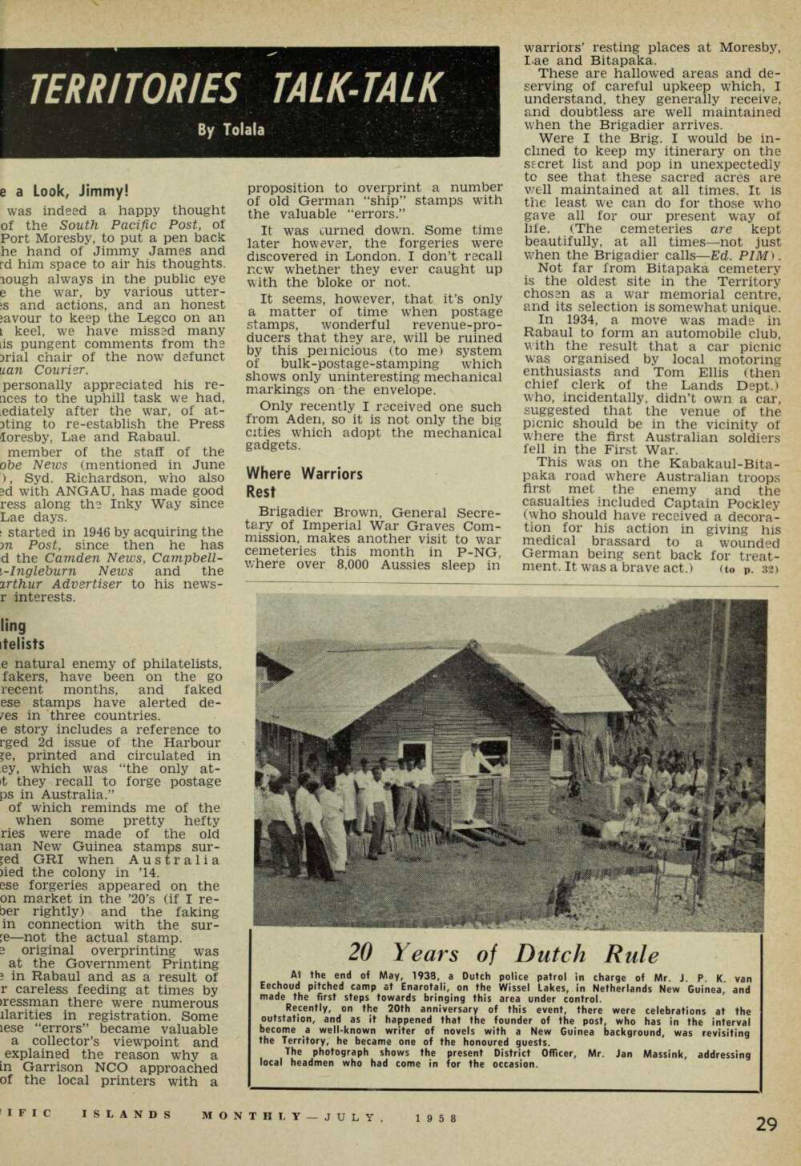
20 Years of Dutch Rule
At the end of May, 1938, a Dutch police patrol in charge of Mr. J. P. K. van Eechoud pitched camp at Enarotali, on the Wissel Lakes, in Netherlands New Guinea, and made the first steps towards bringing this area under control.
Recently, on the 20th anniversary of this event, there were celebrations at the outstation, and as it happened that the founder of the post, who has in the interval become a well-known writer of novels with a New Guinea background, was revisiting the Territory, he became one of the honoured guests.
The photograph shows the present District Officer, Mr. Jan Massink, addressing local headmen who had come in for the occasion.
Though the number of cars was limited, some thirty owners turned up and an association was formed nd was known as the Automobile Club of New Guinea, with Dr. N, B.
Watch as president.
Well do I remember the start of the field day from Tex Roberts’ garage in Casuarina Avenue, and Mrs. Rhpda Coote cut the ribbon.
It was a great picnic, held near Kabakaul, and as a result of public interest in the site having been awakened, it was decided that a memorial should be erected in “this vicinity”.
Tom Griffiths, the then Admin istrator, gave his approval and Bill McGowan, of the Public Works De partment, designed the memorial and the last public appearance made by Tom Griffiths before hand ing over to Brigadier McNicoll was
his attendance at the unveiling ceremony.
There are few remaining of those who took a principal part in that ceremony: Tom Griffiths, “Nobby”
Clark, Tom Brennan, Tom Ellis, Bill McGowan, Jock Bennie and Phil Coote. They have all gone to their long rest.
Another Automobile
Club—Why Not?
All that is left of the Automobile Club (insofar as I know) is an occasional Club badge (also designed by McGowan) and a long-for gotten bank credit of some £3O.
Someone with automobile club aspirations in Rabaul might now re suscitate this old-time organisation, adopt the old badge (which was cast by Amor, of Sydney) and col lect the £3O as a starting fund.
Coffee Units
For Sale
Goroka Coffee (Holdings) Lto was not original in its idea of offen mg units in a plantation insteau of the usual shares. Rugen Harbout Coffee Estates, tried out thf same scheme for a property dowr m Bougainville, but it did not prow the success anticipated, nor did ir resemble the money-making unfj re-afforestation schemes in NZ a about that time.
So far as I can recall, Rugen wa* the only unit-selling company ii the TNG. It folded up just 20 year ago.
The name was a bit confusing Rugen Harbour is situated on thu SE New Britain coast; the pro< perty was located inland fronr Raua Bay in Bougainville. Reason i When the company was first formeo it was intended that the Ruger Harbour area should be developed but a change of venue switched ii to Bougainville.
To Drink or not to Drink . . .
That is the question insofar as. the indigenous population of P-NG is concerned. This local Territorial! problem has received some ventila-, tion in recent weeks as a result ol< the metho-ising of the Malagunase on the outskirts of Rabaul. (Poor old Malagunans seem destined to be a focal point in the more un savoury affairs of New Britain. It: was here the strikers foregathered in 1929 when there was a general walk-out of Rabaul labour.) Father Dwyer produced some statistics that, although described as startling by some people, were accepted more or less laconically by more experienced residents who have been able to foresee coming events.
Ever since the Bill to legalist native drinking was introduced im 1953 there has been controversy and of all the pros and cons which: have been tossed about in the P-NG Legco, I still like best the remark! of Mrs. Doris Booth who, whem amendments were brought forward) in March, 1955, described thes absence of booze in Manila (PIM where she attended a South Easi Asian Conference and concluded!
“Let us give to the native peopled what is good in our way of life, now those things which will help to def stroy them.”
But those words were spoken oveiji three years ago, don’t forget, and in P-NG, where Speed governs|2 Change, official opinion tends nowf —more than ever—to favour disf criminate native drinking.
The metho sprees outside Rabaul ! will probably be used as arguments;?, in favour of permits being granted!! to privileged parties and thati. doubtless, will be the ultimate de- cision of the Administration which! i
erto has always adopted a rnal interest in the natives er its trusteeship, y own opinion is that the iting of any permits would be [stake before three or four years’ ijustments during the transition Dd have by no means been con ed. There are very few natives en amongst the sophisticates— can safely be given their heads the matter of independence, e of them have become ment intoxicated with the superficial vledge we have given them; let tot add physical intoxication by ding them to obtain grog, it, when the time does arrive, i selected men may be granted lits to drink, let’s consider ing available a good wholesome r with a low alcoholic content, i two breweries in the Terri this should now be possible.
‘ Guys
»w and then, as I browse ugh news items dealing with snt-day P-NG affairs I have impression that the Territory— all modern countries —is iring its quota of “wise guys.” course, the trouble with this of homo sapiens is that he is ;ssed of that “little knowledge” h is said to be a dangerous y, added to which he invariably a chip on his shoulder, the days of long ago, when I running a labour line, planting outs which are now over forty > old, I remember only too well one or two wise guys in the ex boats-crews who had filed overseas; one-time boss demoted for some misde lour, and now and then a lad had worked in Samoa or Fiji. often I noticed that these tisfied sophisticates constituted little cell of discontent in the of plantation life, variably they attracted other ontents within their influence, e wise-guys must have room in h to develop their somewhat -eyed ego. I singled them out some “specialist” job in order ay up to their ego. And it paid ends. think the Administration d be well advised to follow this m in dealing with present-day isticates (whether capable or who return from scholastic es overseas. Satisfaction breeds ty; dissatisfaction breeds dis on and, which is worse, creates e ground in which to sow > of subversion.
to Drinking
see where Keith McCarthy s the metho ball back into the >erra court, pooh-poohing the that natives picked up the : from the Japs during the pation, or even before, from on fishermen.
I agree with him. During my 3h years in the boob at Rabaul I don’t remember a single case of metho drinking by the Jap troops, not even in 1944, when their grog ran short. When saki and beer supplies diminished, the Japs turned to local plonk, made from pawpaws, rice, bananas and coconut toddy. I heard of specially favoured natives being given saki by the Jap services— usually the Army, seldom the Navy, but there was a fair amount of liquor pilfered by the more dar ing indigenes.
It is pretty obvious that metho drinking was introduced by a poor type of white in most cases, and this was rife (sad to relate) when our troops were in Rabaul before the Japs landed.
In passing, it is interesting to note that in TNG during the 1937- 38 period there were 129 natives convicted of possessing or drinking liquor, and no Europeans or Asiatics convicted of supplying it. The amount of metho imported into the country for that same period was valued at £572.
Even Canberra must face up to the fact that metho-drinking is a typical Australian aberration.
Empire or
Commonwealth?
In June PIM (p. 119) we read of the “Burns Philp empire. . . .”
Does this, in fact, refer to the BP common wealth or just its “vulgar riches”? (Over)