Heinrich Rudolph Wahlen
pp. 85-101 · Read in the full issue
Once a King on Maron
Heinrich Rudolph Wahlen Expects to Live To be One Hundred
There was a bright and happy celebration in Hamburg on June 5. The name of ,( New Guinea " was prominent. Relations and old friends haa assembled in Bebelallee, in the residential quarter, to acclaim the 85th birthday of the guest of honour.
JHE guest of honour was Hein rich Rudolph Wahlen, a pic turesque figure in German New nnea from 1895 until 1914. ‘I feel as fit as a man of thirty”, ote the veteran, to the PIM, on ly 5. “I am sure I will retain my alth until I am 100. I hope to i Australia once more. I send my jetings to Sunny Australia.” tfr. Wahlen was born in Hanover, s trained in a Hamburg mer mt firm which traded with the meroons, and arrived in New [inea in 1895, as a 22-years-old mber of the staff of Hernsheim Co,, of Matupi, in New Britain ten Neu Pommern). From 1896 til 1902 he was sub-manager.
The North-Western Islands n 1900, Mr. Wahlen travelled in Australian steamer, with his leral manager, to the North stern Islands —a series of small 11 archipelagoes, lying generally stwards of the Admiralty Islands anus), north of the New Guinea inland, and populated mainly a Micronesian type of natives, •nsheims had a series of trading tions there. bung Wahlen was impressed by at he saw—he said he would 1 to get possession of these nds. Hernsheims were agreeable i introduced him to the German onial Office. The latter said he Id have about 100 islands, on dition that he planted them i coconuts. he then German Governor famous Dr. Hahl—suggested b Wahlen purchase the islands the Government. This was done o easy task. The Government a sold the islands to Mr. Wahlen
—and at the same time transferred to him a monopoly fishing licence over the area, with a tenure of 30 years.
That was how Heinrich Rudolph Wahlen entered into his kingdom.
He settled on Maron, in the Hermit Group, at the end of 1902, and built for himself a residence, “Wahlen burg", which became famous.
He got on well with the natives, end they helped him in his task of planting the numerous islands with coconuts. These islanders were
light in colour, amiable and in telligent. Wahlen brought in the darker, stronger natives from New Britain and Buka to do the heavy work.
He planted hundreds of thousands of palms and established many plantations.
He maintained a large staff of servants at Wahlenburg—a propor tion of them being young women famous for their good looks—and he lived like a prince of the blood royal.
The fishing licence did not seem valuable—the reefs had been fished bare by the Hernsheim people— and there was nothing left but masses of trochus shell.
Button Fortune But Wahlen’s luck was in.
Button manufacturers had de veloped machines for cutting but tons out of trochus, and soon Wahlen was shipping the shell in quantity to Europe and Japan. He organised both supply and distribu tion, and made a big fortune. He ploughed back much of his large trochus profits, to develop his coco nut plantations.
In 1910, Mi*. Wahlen bought the well-known old firm of E. E. For sayth and Co. This had been es tablished many years before by Mrs. Emma E. Forsayth better known as “Queen Emma". She had been joined in the business by her soil, Jonas M. Coe Forsayth, who was a successful manager. She was now Mrs. Paul Kolbe, and spent most of her time abroad. She was a sufferer from diabetes. Mr. J. C.
M. Forsayth wished to retire to Australia.
Mr. Wahlen went to Germany,
(Continued on page 95)
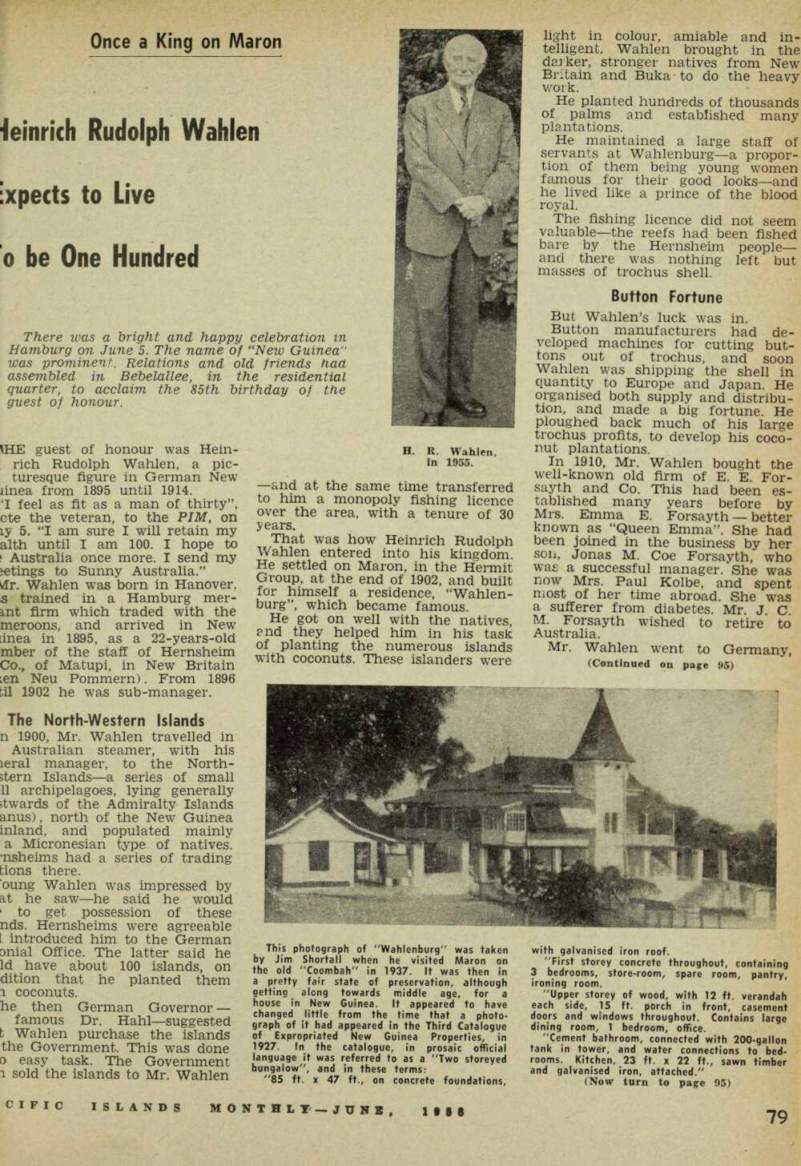
H. R. Wahlen, In 1955.
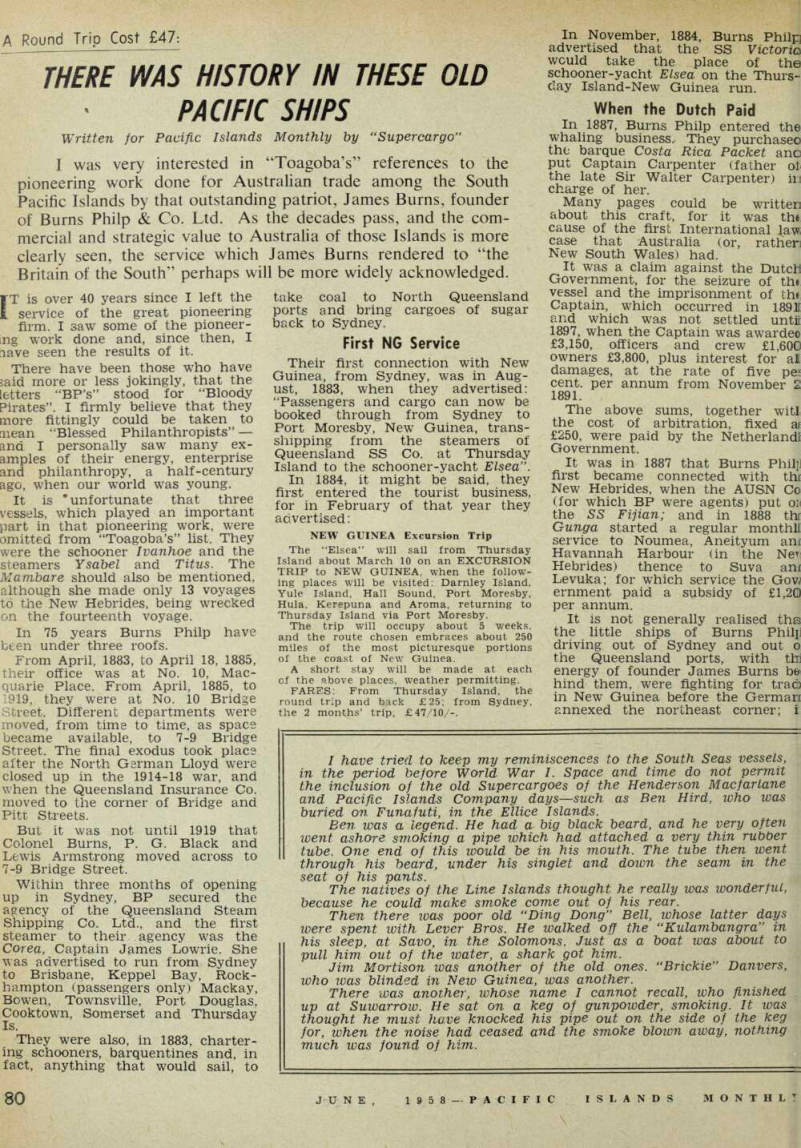
This photograph of "Wahlenburg" was taken by Jim Shortall when he visited Maron on the old "Coombah" in 1937. It was then in a pretty fair state of preservation, although getting along towards middle age, for a house in New Guinea. It appeared to have changed little from the time that a photo graph of it had appeared in the Third Catalogue of Expropriated New Guinea Properties, in 1927. In the catalogue, in prosaic official language it was referred to as a "Two storeyed bungalow", and in these terms: "85 ft. x 47 ft., on concrete foundations,
with galvanised iron roof.
"First storey concrete throughout, containing 3 bedrooms, store-room, spare room, pantry, ironing room.
"Upper storey of wood, with 12 ft. verandah each side, 15 ft. porch in front, casement doors and windows throughout. Contains large dining room, 1 bedroom, office.
"Cement bathroom, connected with 200-gallon tank in tower, and water connections to bed rooms. Kitchen, 23 ft. x 22 ft., sawn timber and galvanised iron, attached." (Now turn to page 95)
the group while Kathleen developed the plantation and brought up their three children. (Mrs. Bignell later shifted her interests to Rabaul, was interned by the Japs during the war, and died in Spring wood, NSW. a few years ago).
During the war Charlie became a Coastwatcher on Ysabel, taking into the hills with a radio, but was later ordered to abandon the island. He took his “Valere” out of hiding, was given 30evacuees to take down to the New Hebrides. They succeeded in avoiding the Japanese patrols, and finally arrived at Vila. Here he was given command of the BP schooner “Resolution”, and sent on various supply trips around the islands as far as Vanikoro. Later, in the American Transportation Service, he was sent to Oro Bay to take charge of the vessel “General MacArthur”, then to a sub-chaser, a 112-foot Fairmile, in the Philippines. At war’s-end he was at Manila.
With all his BSIP assets gone without compensation, he went to New Guinea for the Shipping Board, in 1951. and became master of the “Kokoda”. He has stayed with the ship ever since, though she now belongs to Burns Philp, mostly trading around the coast of Papua, although she is currently under charter for a mineral survey In the Solomons.