50 Years and Still
pp. 84-101 · Read in the full issue
at Sea
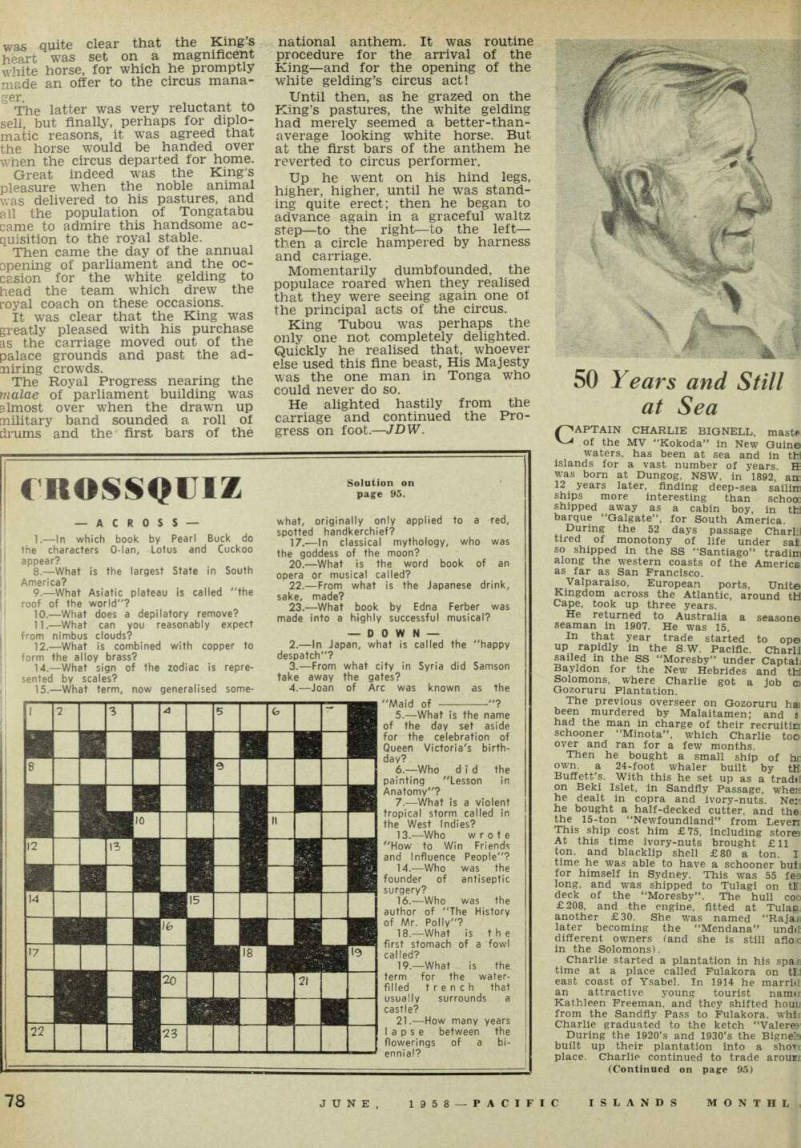
Captain Charlie Bignell, Maste
of the MV "Kokoda” in New Guine waters, has been at sea and in thi islands for a vast number of years. H : was born at Dungog, NSW, in 1892, arr 12 years later, finding deep-sea sailirr ships more interesting than schooc shipped away as a cabin boy, in thi barque “Galgate”, for South America.
During the 52 days passage CharliJ tired of monotony of life under saii so shipped in the SS "Santiago” tradim along the western coasts of the America as far as San Francisco.
Valparaiso, European ports, Unit© Kingdom across the Atlantic, around tU Cape, took up three years.
He returned to Australia a season© seaman in 1907. He was 15.
In that year trade started to op© up rapidly in the S.W. Pacific. CharlJ sailed in the SS "Moresby” under Captal.
Bayldon for the New Hebrides and thi Solomons, where Charlie got a job co Gozoruru Plantation.
The previous overseer on Gozoruru hs been murdered by Malaitamen; and s had the man in charge of their recruitin schooner "Minota”, which Charlie too over and ran for a few months.
Then he bought a small ship of hr own, a 24-foot whaler built by tM Buffett’s. With this he set up as a trad*] on Beki Islet, in Sandfly Passage, wheis he dealt in copra and ivory-nuts. Ne:: he bought a half-decked cutter, and the the 15-ton “Newfoundland” from Leven This ship cost him £75, Including stores At this time ivory-nuts brought £ll ton. and blacklip shell £BO a ton. I time he was able to have a schooner buij for himself in Sydney. This was 55 fee long, and was shipped to Tulagi on tK: deck of the "Moresby”. The hull coo £2OB, and the engine, fitted at Tulag, another £3O. She was named "Rajar= later becoming the "Mendana” undd different owners (and she is still aflo.c in the Solomons).
Charlie started a plantation in his spars time at a place called Fulakora on tld east coast of Ysabel. In 1914 he marrid an attractive young tourist namir Kathleen Freeman, and they shifted houu from the Sandfly Pass to Fulakora. whir Charlie graduated to the ketch “Valeree During the 1920’s and 1930’s the Blgne’a built up their plantation into a shore place. Charlie continued to trade arouEi
(Continued on page 95)
nged the finance, completed purchase, formed a new com r, Hamburgische Suedsee AG, personally took over the general stion at Rabaul, while his ler became general manager of Wahlen organisation in the hwestern Islands, with head ters at Maron. out this time, HRW joined various plantation-owners, who ed finance, to form a number nail plantation companies.
The Waria Syndicate out 1909, Mr. Wahlen ap plied the Imperial German rnment for a mineral rights ission over a large area in the a district (southwest German Guinea, adjoining the Papua ir). He got the concession in just before World War I. had smelled the gold. It was irered just after World War I, the 5,000 square miles con to him lay just southeast of o goldfield. ly in 1913, in London, Mr. en married a Swedish woman vas a member of a well-known y which was associated with iVahlen in the Waria Syndi- Their son was born in De ;r 1913, at Gunantambu, once famous residence of “Queen i”, at Kokopo, New Guinea, : Mr. and Mrs. Wahlen then residing.
Wahlens were back in Ger when World War I broke rhat war swept away all of Wahlen fortune represented in itions. ;r the war, all German-owned :ty in New Guinea was “ex ated”. It was seized by the ilian Government and sold;
the amounts so produced were credited to the German Govern ment, which had been debited with a huge sum as “war damage com pensation”; and the German Gov ernment was left with the task of compensating its own nationals who thus had been deprived of their properties.
Three claims from German New Guinea companies were recognised by the German Government, namely: - Deutschmarks The Wahlen Group .. 45,000,000 German New Guinea Company 42,000,000 Hernsheim & Co. 13,000,000 But the German Government could pay only a small part of the 100,000,000 Marks thus recognised.
An amount was paid over to the Melanesian Company, registered in London. Mr. Wahlen assumed the general managership, and the Co. purchased a number of the former German plantations from the Aus tralian-New Guinea Expropriation Board, in 1926-27.
Mr. Wahlen went out from Europe to Australia in 1929, to make an inspection, but the Australian Government would not allow him to visit New Guinea—General E. A.
Wisdom, then Administrator in New Guinea, said he was afraid Wahlen would have a bad influence on the natives, whom he knew so well.
He returned to Europe, and the Melanesian Company lost both plantations and investments.
Mr. Wahlen and his Swedish as sociates claim that the Waria Syn dicate concession, given to them by the German Government before World War I, was neither liquidated nor expropriated.
The argument between them and the Australian Government has
been going on for 35 years. If Mr.
Wahlen lives to be 100—as every one hopes—it probably will con tinue for another couple of decades.
Mrs. Wahlen died in 1953. They had three sons and two daughters.
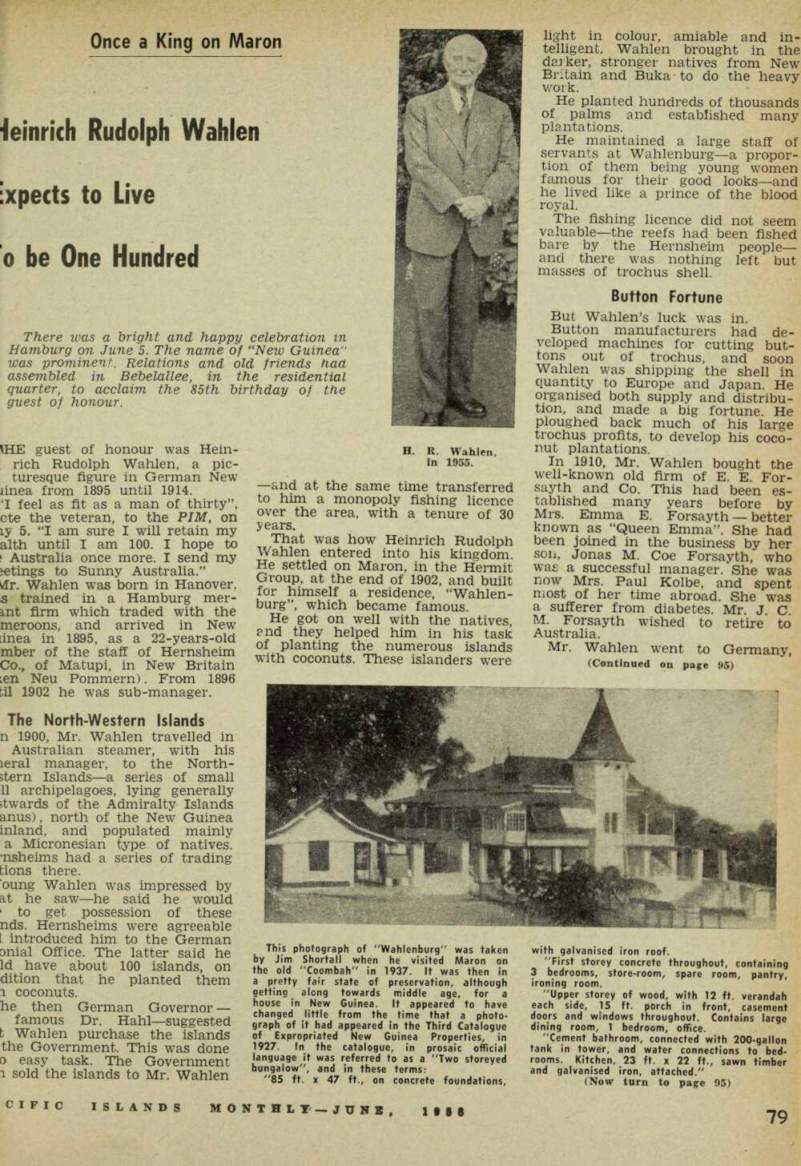
Their eldest son, born in New Guinea, became an air pilot, and was killed in World War II. Their second son became a submarine commander, and also was lost in World War II. Mr. Wahlen was called up for service in the German Army in both World Wars.
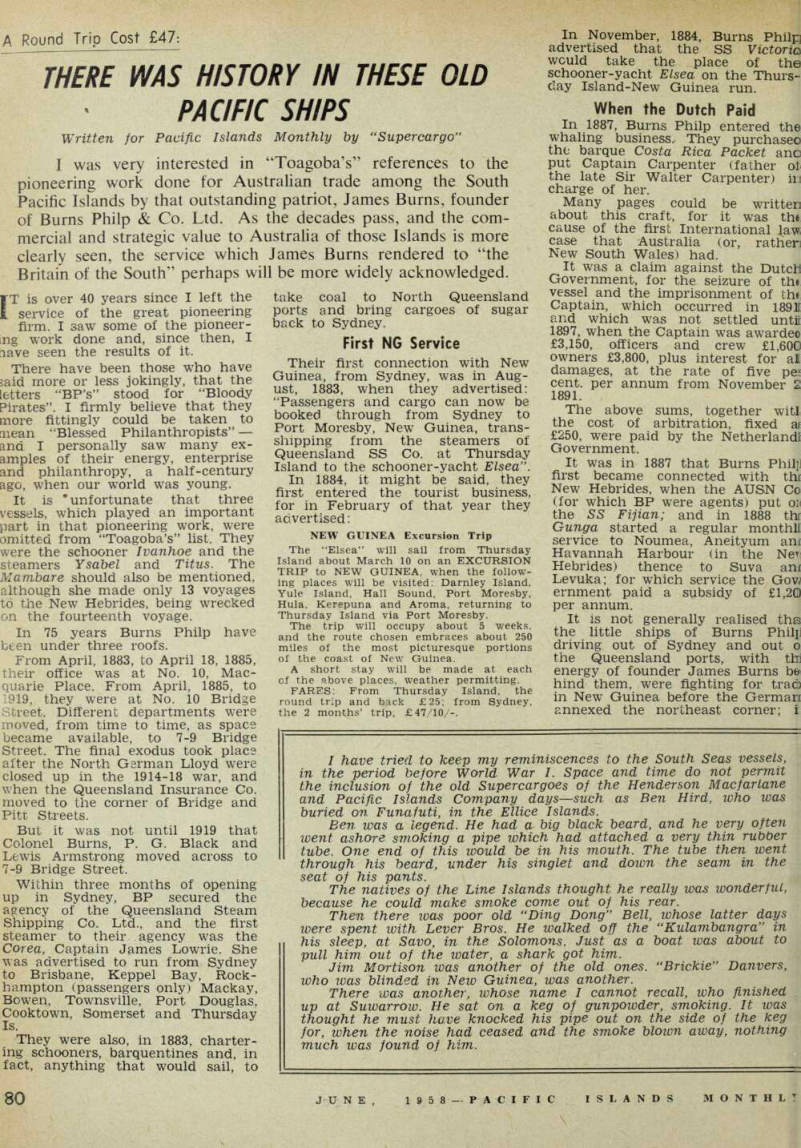
In 1952 "Wahlenbburg" looked like this.
Mr. Hal Evans, who took the photograph, wrote at the time: "The house is still standing and is occupied by the present owner of Maron, Mr. G. Kuster. It is now, however, in quite decayed condition. The timber has dry rot and the house appears to have been badly knocked about during World War II and neglected over the same period.. but at a distance it still looks imposing". The most noticeable difference between this and the photograph in the old 1927 catalogue (which was taken from the same position) is that the balconies and their railings had, by 1952, disappeared.