Territories Talk-Talk
pp. 31-151 · Read in the full issue

By Tolala
led: e Winds overseas correspondent has en to me asking for a copy hat tropical tome by Robson Tudor, "Where the Trade Is Blow”, now out of print, yone in the house with a spare P If so drop me a line (c/- Box 3408, Sydney), mentioning irice desired. irs Are he Ball last it would seem the RSL NG is to have one of its long ing requests granted by the al government—a scheme for ing the land settlement of rvicemen. And about time, >se who may benefit will be to send up a little prayer of ;s for the pertinacity of lents Whittaker and Bunting, lave so doggedly persevered in eague’s fight for this right.
RSL in the P-NG has always a force to be considered and h the League in TNG, fol > War I, did not obtain a ic Land Settlement Scheme, is instrumental in securing ential treatment when the board properties were put up ;nder, and afterwards, when crashed, succeeded in ing a moratorium which the economic life of most of gger planters. i these advantages the names 11 Grose, Jack Mullaly and y” Clark will always be ited.
ling of
5L establishment of the TNG i of the League goes back to tter part of 1920, and well remember the inaugural g, held in a small building mgo Avenue, Rabaul (where the Agnes Wisdom Library msed).
Jolley, Business Manager of :proboard was chairman and Saunders was Secretary, if the audience—who became tion members to a man— Ixproboard employees, for the was composed of 99 per cent, s. e are few of that gathering >w— very few. In fact I can e sure of one—Jack Gilmore,
who now rusticates amid the scenic beauties of Madang.
The biggest chip on our shoulders at that first meeting was the fact the government would not permit the wives of married employees to join them in the Territory, despite ample accommodation. Many of us had spent little time with our families in Australia after returning from France.
The Chairman of the Board was responsible for this segregation policy; strongly-worded protests, however, from the meeting, coupled with some judicious publicity touched the heart of Billy Hughes, the then Prime Minister, and the ban was lifted.
Let’s hope the League’s latest victory in securing the Land Scheme works out to everyone’s satisfaction.
Well, let’s hope it works.
Cynic that I am, I fear delays and more delays, with the possibility of the Scheme becoming an ac complished fact—too late.
Incidentally, one assumes that those eligible to participate will be non-native ex-servicemen. In these days 91 desegregation enthusiasm definitions often become confused (This is one of the matters that
“have to he defined”, But it seems Native ex-servicemen are to he in on it, too. — “PIM” Editor ).
Postal Amenities
Suburban residents at Lae, I see, are anxious to have their mail delivered to their homes, and natives trained as “posties”.
And why not? The excuse, no doubt, will be high wages of the postal employees.
Into the limbo have gone those days of “marks” and a couple sticks of tobacco. But the delivery of mail in the old days used to be looked upon as something almost sacrosanct—and the more isolated the addressee the more meticulously was that obligation carried out.
Well do I recall the many occasions when, living 10 to 30 miles from the district office, a day after the arrival of the mail at the station there would appear at the foot of my verandah steps, a police boy with a couple of carriers with mailbags on their shoulders.
A short note from the government official invariably told me the p.b. had a job of work in a neighbouring village and the carriers were en listed for the job. “Give them a feed and a smoke and send them back”.
That was friendly service and no doubt still operates in some of the more isolated areas. Strange how the more civilised people get the less friendly they become!
In those days, no planter’s home was complete without three or four mail-bags put to good use as
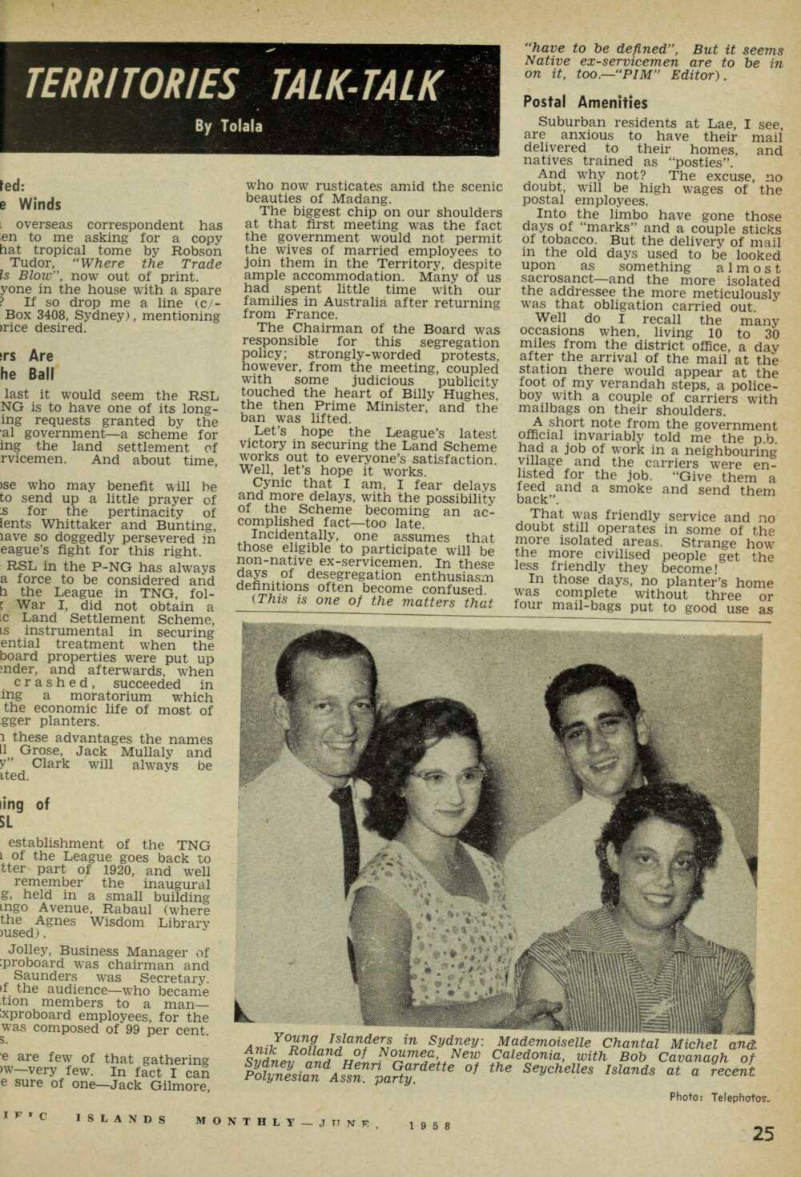
Young Islanders in Sydney: Mademoiselle Chantal Michel and Anik Rolland of Noumea, New Caledonia, with Bob Cavanagh of Sydney and Henri Gardette of the Seychelles Islands at a recent Polynesian Assn. party.
Photo: Telephotos.
linen containers, or weather coverings for suit cases or when travelling, time when I was travelling lanter’s launch, with a Police ntendent as passenger, one native crew, sitting for’ard, ted glued to his position while isengers disembarking had to ver him. t’s a bit hot, isn’t it?” I :ed to the planter after we aded. ‘Why didn’t you make y get up?” owner took me back to the and pointed out where the d been sitting—on a stout f canvas nailed down to the d been a mail-bag, with the ettering “NSW” still plainly ing in the direction of the officer, my friend remarked: bit queer about mail-bags”, le time the GPO people from
Sydney sent out a memo requesting the return of all mail-bags, hinting that there might be trouble if His Majesty’s property was found in unauthorised places.
They made a big haul. I forget how many thousands.
Does This
ajj I In? uu u r* I noticed in a recent issue of the South Pacific Post that a government member of the TAG in PM alleged that Treasurer Reeve “had £300,000 which he didn’t know what to do with”, On the same page Director of Posts and Telelgraphs Carter complained he “could not get enough money to give Boroko an adequate telephone service”. No provision had been made in the estimates, Sounds a bit cock-eyed to me; or is it just the usual brush-off by bureaucratic euphemisms?
Follow the
i-, • • , D . , Louisiana Purchase In the “good old days" ot colonialism—back in 1803—the USA bought Louisiana from the French for a mere £5.5M; and then later, in 1867, purchased Alaska from Russia and thus solved some rather
*“an old
Sr tL rote D u r tr h ent k y ew su «i Australia 6 mainder of "toe Js& B from Its present owner—the Netherlands— ofndlndonesfa6!! mVenting the ° lalmS Such a transfer would naturally
be frowned upon by the Asian- Afro block in UNO, although there are certain features worth con sidering.
Expansion of territorial rights. however, went out with the creation of the League of Nations, and it is doubtful if a transfer to Australia would be acceptable, notwith standing the fact that “Indonesia” is scratching the bottom of the pan for finance.
With this thought in mind it occurs to me that DNG, which is probably the most primitive country in the world and least developed, would be a most suitable area to bo. declared a “Sanctuary for Primitive People”, allowing only health organisations to operate under a benevolent supervision, which in no way would interfere with existing native customs and traditions for a long range period, The idea is born of an old German scheme which, years ago, isolated Tench Island (off the New Ireland coast) and its people in order that they might continue life along their own primitive lines SvUlsatlon' terference from modern Fnr vpL thp and then a? 6 missionarv hip L i t SSe? and th?“ whl 9? latlor i St d h whole ldea went theo d ry qU mig£t Teamed 6 out”to
s «rts b fSdi d J
end decade's”?,? be he ftS™" in which a thniX UV «L« w
tatemation® WiSns! ° Ur
(Continued on page Hsi
i Experts—
i Talk iat a happy hunting ground is j for experts. One is forever ng of medical experts soaring ) the big open spaces to study or That in P-NG; or perhaps nguistics, sociology, economics friculture. e other day, over the ABC irk came the revealing infor >n that a CSIRO expert was naking a survey in the Terri of rice potentialities, with a of ascertaining whether rice be grown in sufficient quanti -0 warrant imports from out ources being curtailed. 5 “Rice” file in the Depart of Agriculture must indeed be one. iy back in 1933 or ’34 I sent ■y to the PIM on rice-growing e Rabaul area, with a photo ng Colin Marr standing in a >hing field of the cereal, s well-known that the Japs, t their occupation, grew large ities of rice around Rabaul cut off from their own home es. What does this present expect to add to the know already obtained? It has been 1 that P-NG can grow rice— ot as cheaply as it can be ted from Australia. iy of the opinions expressed by of these experts of the 1950’s been on record for over half :ury.
/ay of
lide Rule
t with physicists tossing ;es into space; scientific sur emphasising the growth of .orld’s population to over ng proportions: and the e rise in ocean tides over the 1 surface due to the melting ! Arctic regions, it is quite t that the more we know ourselves, and the more we i out to look into the future, ss happy we become, i the placid NG indigene is mg to wonder just what he’s to get out of the higher ion planned for him by a lent Administration. ; . a rather pathetic plea from ive correspondent in the Pacific Post (14 '5/58): T hy is nothing told us about that we can do after school ? mnt you to prove that school e best way to improve our s and to find proper work in a bank or being an entice trainer or science e T- If . you cannot prove it nil back to our villages and he young men not to school Knot right for educated to be without suitable work
and money.
How many more enlightened natives are going to ask the same questions as the years go by? And who can, or will, give them a satisfying reply?
Teachers on Tour The P-NG Education Department arranged for about ten native teachers to make a tour of Queens land last month, visiting schools, farms and factories “to give them wider understanding of Australian life, industry and education”.
Later ten native women teachers will make the tour. Doubtless such a trip will add considerably io their general knowledge, broaden their vision and give them a certain prestige amongst their pupils.
A tour I would like to see, maybe escorted by J. K. McCarthy or one of his ilk, would be a collection of the Territory’s “cargo cult” leaders, allowing them to have a first-hand insight as to how and where “cargo” comes from. Showing them from Whoa to Go how things are made, by whom and how exported.