The Editarr' Maillag
p. 29 · Read in the full issue
Edited
jrspout
your blcckmaker have a day Dr hasn’t he come in touch subtle tones before, demands Vright—in respect of a picture water-spout on page 107 of PlM —which was attributed to is Fiji PRO photographer, says that some of his friends he faked it, and he obviously Is the publication of it in this as an unfriendly act. waterspout was real enough, ► was Rob’s photo; the fiddling one by one of PlM’s editors emale partner) with more en sm than skill. se subtle tones Rob speaks were at fault; at the hands photo-engraver they would ost 25 per cent, of definition; ;r 25 per cent, would have n the printing with the result lere would have been nothing at all except black sky. So pressed for time, the editor stion borrowed a pot of white id a paint brush and before >uld say waterspout, there it ►rtunately in this event, the laker went to a great deal üble to get all the subtle and the printer also put his )ot forward, with the results lined of by Mr. Wright. tow, those who still do not can visit PIM offices and see ginal photo, with the offend hite ink now carefully re with a wet finger. This will that there was a water and that it was that shape. ; meantime, the editor re )le is sticking to editing and photo-retouching to those ave graduated BSc in this
rating Those
officers
lan McDonald, of Port y, takes PIM up on a couple ements made in April issue ;he command, past and pre f the Pacific Islands Regi r Don Barrett, who has been known planter and citizen in since the war, and whom i usurping the place of the nt’s 2IC, Major Mackie, is urg to do anything of the 'Jajor Mackie will remain vhile Don will be a Liaison —a sort of go-between for ian officers and Papua-New
Guinea troops—the point at which, most people in the Territory agree, the PIR troubles started a few months ago.
Mr. McDonald reminds us, too, that Colonel H. T. Allan was not the war-time commander of the Pacific Islands Regiment. Major Bill Watson commanded the Papuan Infantry Battalion (a fore runner of the PIR) which first went into action when the Japs landed at Buna. Colonel (later Brigadier) Bill Edwards was the first Regimen tal Commander of the Pacific Islands Regiment—he relinquished command about the end of Septem ber, 1945, and it was then that Colonel Allan took over. (Don Barret arrived in New Guinea and in the PIR about the same time.) (This is quite true, of course. In the November, 1945, PIM ice re ported: “An interesting appoint ment was made in September when Colonel H. T. Allan, OBE, who was in Australia awaiting discharge after five years distinguished service (in Tobruk, Middle East and New Guinea ) was suddenly given com mand of the Pacific Islands Regi ment consisting of three battalions of Papua and New Guinea natives. . . . The battalion was formed in the last two years.” There had been some PIR trouble just previously and the PIM editorially thought Col. Allan might straighten it all ouc.)
Memories of
Abemama Royalty
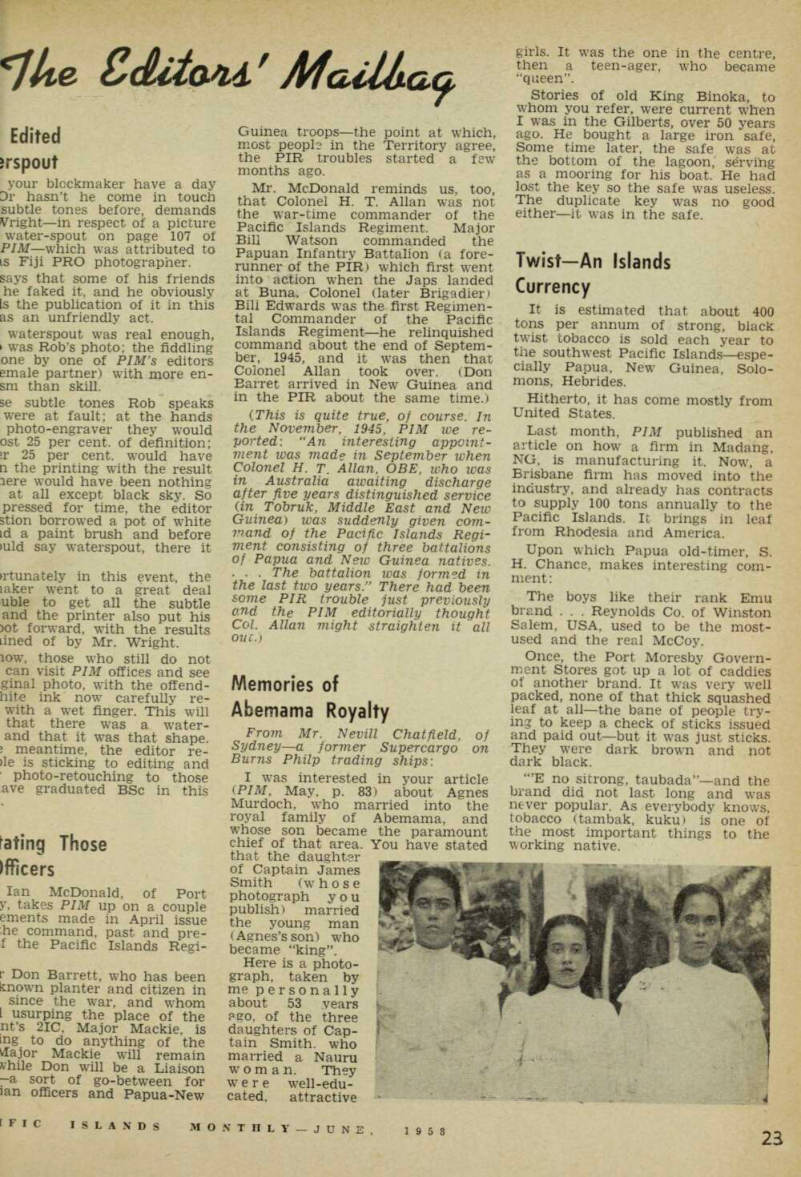
From Mr. Nevill Chatfield, of Sydney—a former Supercargo on Burns Philp trading ships: I was interested in your article (PIM, May. p. 83) about Agnes Murdoch, who married into the royal family of Abemama, and whose son became the paramount chief of that area. You have stated
that the daughter of Captain James Smith (whose photograph you publish) married the young man (Agnes’s son) who became “king”.
Here is a photo graph, taken by me personally about 53 years ego, of the three daughters of Cap tain Smith, who married a Nauru woman. They were well-edu cated, attractive
girls. It was the one in the centre, then a teen-ager, who became “queen”.
Stories of old King Binoka, to whom you refer, were current when I was in the Gilberts, over 50 years ago. He bought a large iron safe, Some time later, the safe was at the bottom of the lagoon, serving as a mooring for his boat. He had lost the key so the safe was useless.
The duplicate key was no good either—it was in the safe.
Twist—An Islands
Currency
It is estimated that about 400 tons per annum of strong, black twist tobacco is sold each year to the southwest Pacific Islands—espe cially Papua, New Guinea, Solo mons, Hebrides.
Hitherto, it has come mostly from United States.
Last month, PIM published an article on how a firm in Madang, NG, is manufacturing it. Now, a Brisbane firm has moved into the industry, and already has contracts to supply 100 tons annually to the Pacific Islands. It brings in leaf from Rhodesia and America.
Upon which Papua old-timer, S, H. Chance, makes interesting com ment : The boys like their rank Emu brand . . . Reynolds Co. of Winston Salem, USA, used to be the most used and the real McCoy.
Once, the Port Moresby Govern ment Stores got up a lot of caddies of another brand. It was very well packed, none of that thick squashed leaf at all —the bane of people try ing to keep a check of sticks issued and paid out—but it was just sticks.
They were dark brown and not dark black.
“’E no sitrong, taubada”—and the brand did not last long and was never popular. As everybody knows, tobacco (tambak, kuku) is one of the most important things to the working native.