Sydney-Rrisrane Journey
pp. 89-115 · Read in the full issue
The Old Bus is Earthbound
Southern Cross Makes Its Last
By K.N.
Pacific Islanders, particularly those living in Fiji and Hawaii, who recollect the excitement and speculation in con nection with the first Trans-Pacific air flight made by the late Sir Charles Kingsford Smith, in 1928, will be interested to learn that his historic aircraft, the monoplane, “Southern Cross”, is being prepared for public exhibition “in perpetuity” at his birth place, Brisbane, Queensland.
THE Old Bus is to be placed in a T-shaped, specially built glass walled memorial hangar, costing £35.000, established at the Eagle Farm Airport. There it will be held as a lasting memorial to Australia’s, and to one of the world’s, greatest airmen.
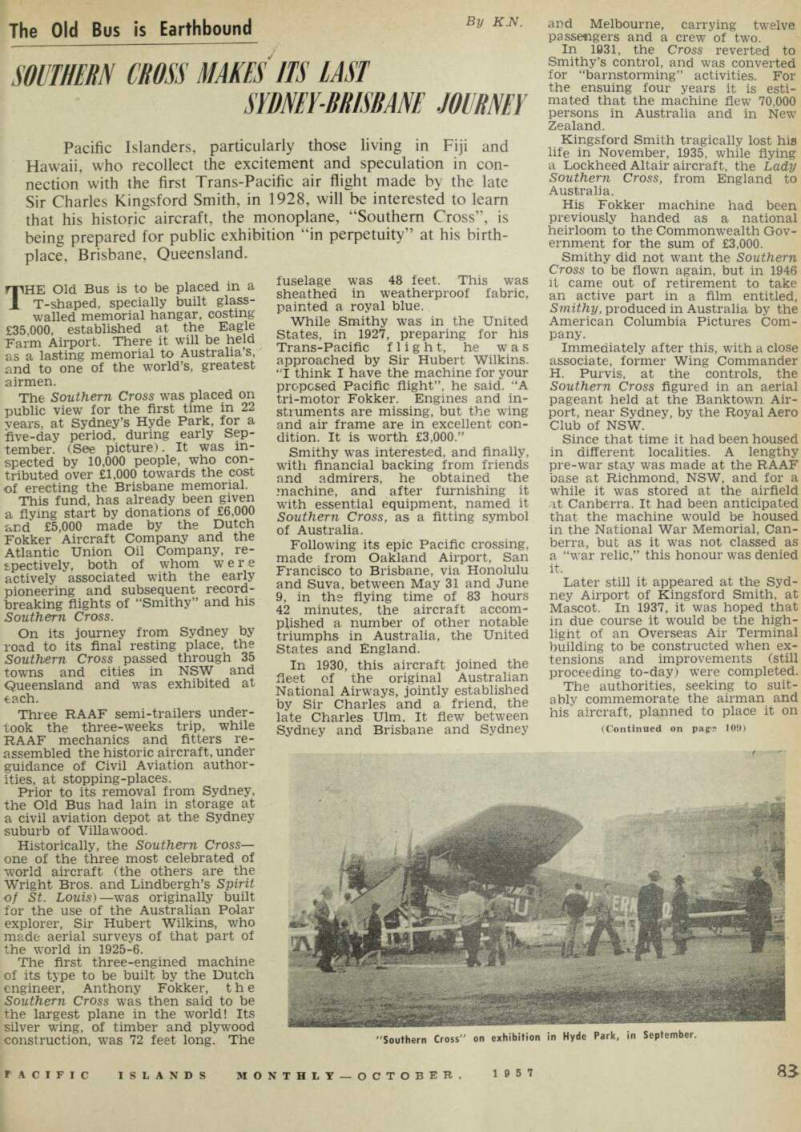
The Southern Cross was placed on public view for the first time in 22 vears, at Sydney’s Hyde Park, for a five-day period, during early Sep tember. (See picture). It was in spected by 10,000 people, who con tributed over £l,OOO towards the cost of erecting the Brisbane memorial.
This fund, has already been given a flying start by donations of £6,000 ard £5,000 made by the Dutch Fokker Aircraft Company and the Atlantic Union Oil Company, re spectively, both of whom were actively associated with the early pioneering and subsequent record breaking flights of “Smithy” and his Southern Cross.
On its journey from Sydney by road to its final resting place, the Southern Cross passed through 35 towns and cities in NSW and Queensland and was exhibited at each.
Three RAAF semi-trailers under took the three-weeks trip, while RAAF mechanics and fitters re assembled the historic aircraft, under guidance of Civil Aviation author ities, at stopping-places.
Prior to its removal from Sydney, the Old Bus had lain in storage at a civil aviation depot at the Sydney suburb of Villawood.
Historically, the Southern Cross — one of the three most celebrated of world aircraft (the others are the Wright Bros, and Lindbergh’s Spirit of St. Louis ) —was originally built for the use of the Australian Polar explorer, Sir Hubert Wilkins, who made aerial surveys of that part of the world in 1925-6.
The first three-engined machine of its type to be built by the Dutch engineer, Anthony Fokker, the Southern Cross was then said to be the largest plane in the world! Its silver wing, of timber and plywood construction, was 72 feet long. The
fuselage was 48 feet. This was sheathed in weatherproof fabric, painted a royal blue.
While Smithy was in the United States, in 1927, preparing for his Trans-Pacific flight, he was approached by Sir Hubert Wilkins.
“I think I have the machine for your proposed Pacific flight”, he said. “A tri-motor Fokker. Engines and in struments are missing, but the wing and air frame are in excellent con dition. It is worth £3,000.”
Smithy was interested, and finally, with financial backing from friends and admirers, he obtained the machine, and after furnishing it with essential equipment, named it Southern Cross, as a fitting symbol of Australia.
Following its epic Pacific crossing, made from Oakland Airport, San Francisco to Brisbane, via Honolulu and Suva, between May 31 and June 9, in the flying time of 83 hours 42 minutes, the aircraft accom plished a number of other notable triumphs in Australia, the United States and England.
In 1930, this aircraft joined the fleet of the original Australian National Airways, jointly established by Sir Charles and a friend, the late Charles Ulm. It flew between Sydney and Brisbane and Sydney
and Melbourne, carrying twelve passengers and a crew of two.
In 1931, the Cross reverted to Smithy’s control, and was converted for “barnstorming” activities. For the ensuing four years it is esti mated that the machine flew 70.000 persons in Australia and in New Zealand.
Kingsford Smith tragically lost his life in November, 1935, while flying a Lockheed Altair aircraft, the Lady Southern Cross, from England to Australia.
His Fokker machine had been previously handed as a national heirloom to the Commonwealth Gov ernment for the sum of £3,000.
Smithy did not want the Southern Cross to be flown again, but in 1946 it came out of retirement to take an active part in a film entitled, Smithy, produced in Australia by the American Columbia Pictures Com pany.
Immediately after this, with a close associate, former Wing Commander H. Purvis, at the controls, the Southern Cross figured in an aerial pageant held at the Banktown Air port, near Sydney, by the Royal Aero Club of NSW.
Since that time it had been housed in different localities. A lengthy pre-war stay was made at the RAAF base at Richmond, NSW, and for a while it was stored at the airfield at Canberra. It had been anticipated that the machine would be housed in the National War Memorial, Can berra, but as it was not classed as a “war relic,” this honour was denied It.
Later still it appeared at the Syd ney Airport of Kingsford Smith, at Mascot. In 1937, it was hoped that in due course it would be the high light of an Overseas Air Terminal building to be constructed when ex tensions and improvements (still proceeding to-day) were completed.
The authorities, seeking to suit ably commemorate the airman and his aircraft, planned to place it on
(Continued on pag?e 109)
“Southern Cross" on exhibition in Hyde Park, in September.
ew, suspended from the ceiling of ,e building, at an angle of 45 igrees, so that people could walk ) and inspect it at close quarters, lis anticipation was never realised, ir intervening, and eventually ter an unfortunate career in noble obscurity, it was “banished” the Villawood depot.
Recently it was renovated, to be me the property of the Kingsford nith Committee in Queensland.
Often called “The Drake of the r,” Charles Kingsford Smith was rn in Brisbane in 1897. At one ne he held 11 world records in iation. In 1917, in the Royal Fly % Corps, he won the MC.
As well as being the conquerer of e Pacific, “Smithy” was the first girdle the globe at the Equator d the first to cross the Tasman a.
For this last feat he was awarded e Gold Medal of Honour, while in e same year he was made an morary Air Commodore in the He was knighted in 1932, for his •vices to civil aviation.
Vlr. R. Gillespie, managing •ector of Robert Gillespie Pty., d„ paid a two weeks’ business lit to Fiji in October.