Tropicalities
pp. 87-88 · Read in the full issue
Magazine Section
The Best Car In Tonga
\\TE had gone ashore from the if round-trip Matua, at Nuku alofa, last year, and a business acquaintance was showing us the sights.
There, being filled with petrol from a curb-side pump, under a tongue-twister sign that read, “Fakatu’utamaki —Tapu Ifi Tapaka” (“Danger—No Smoking”), stood the biggest and shiniest car we’d ever se en—a 1956 Ford Ranchwagon: bright gleaming duco, eye-dazzling chrome, and six fathoms wide (it seemed).
“That’s better than anything we’ve seen in Suva”, I said. “Who owns it?”
“Well, it’s just come for the Marist sisters”, my friend replied. “Come on, we’ll talk with the driver.”
But before we could cross the road, a neat Marist Mission Sister in white tropical habit, opened the car door, slid behind the wheel and piloted the Ranchwagon with loving care up the street.
We wandered off, on our way to rubber-neck at the Royal Palace, but not before my companion had pro mised to drop me a line later on about the car.
I was back in Suva for a time, then on to Sydney; and I’d for gotten all about the car. Then, last month, practically a whole year after out Matua round-trip, I re ceived a letter from my Nukualofa friend. “By the way”, he wrote, “I got the story about that car that took your eye.”
Back in 1950, an ex-Boston school teacher, Sister Mary Susanna, went to Tonga from USA. Her friends in Massachusetts conceived the plan to send her a gift—a jeep; but be fore the plan had been long under way, the Sister became ill and was flown to New Zealand, as a stretcher case. She died early in 1951.
The Boston people were shocked by her death, but eventually decided that they would press on to raise an even larger sum and send a vehicle down to Tonga to serve all the Sisters. “That was how the Ranchwagon came to Nukualofa, after many delays, just before you were here,” said my Tonga corre spondent.
“It still is as smart as paint and its 287 number-plate is a familiar sight on the metalled roads of Tongatabu. But not all our roads are sealed and when the Sisters’
Ford comes back from an errand to one of the outback Mission stations, via the earthen by-roads, then you’ll see a dozen young Tongan helpers proudly polishing up the Ranch wagon, under the watchful eye of Mr. Small, the local engineer, or of one of the Sisters, to make it still the ‘Best Car in Tonga.’ ” — Dee.
A Dog Named “Willie”
A DOG named “Willie,” a Heinz Terrier (he was registered thus on his papers), means so much to his mistress, Miss Peggy Johnson, formerly of Samarai, Papua, that she is taking him with her to a new job in Central America.
Miss Jackson brought Willie frorr Australia and when he has com pleted his present journey he wil be a much travelled dog and wil have cost her a pretty penny.
Willie is at present travelling ir luxury on the Norwegian vesse Thoi'sisle, via ports to San Francisc( at a charge of a dollar a day, plu: a fee of £lO to a crew member t( valet him. Before settling down t( the present journey, Willie was flowi to Port Moresby and thence to Lae where he boarded Thorsisle.
He will spend six months ii quarantine at San Francisco at 5 cost of three dollars a day, afte: which time he flies on to Centra America.
Dog Knocks-Out Man
WE heard another story recent!, of man’s devotion to dog, whicl didn’t have such a happy end ing.
It appears that the doglover’s do; had puppies. Most of the litter founi homes but three remained unwantec Not having the heart to destro them himself, the dog lover callei in a friend from the Health De partment, who brought with him bottle of chloroform.
The friend, too, was kind-heartec but had imbibed a little before com mitting the deed.
Eventually he staggered off wit; the pups and the chloroform, but be Ing a little unsteady spilt th chlorform on himself and passe out.
However, during the process, som was administered to the pups an they died .—P.R.
How The Kundu Got Its Skii
Our old friend Sanasi says tha he once sold this snake-yarn t an American adventure magazin and got $3O for it. We can believ it. It has all the ingredients re quired for American 'publication: hit of sex added to the broth of th unusual. But we don't mind givin it the “PIM” 15/- treatment (plu
extra for illustration). It makes an entertaining addition to our collec tion of snake data, anyhow.
The natives of the Upper Gama River in the Delta Division of Western Papua are a very primitive lot and have very little surplus produce or goods to trade with.
However, they do a fine export trade in snake skins which they ex change for the coastal natives’ salt and steel goods. As everybody knows,
snake (or lizard) skins are used as the tympanum stretched across and firmly cemented on to the one end of the native “gaba” or tom-tom. (Kundu, on the New Guinea side).
There are very few lizards or snakes in and around the muddy and water-logged
villages of the coastal strip.
How the Gama natives catch the fresh water snakes must be one of the quaintest methods in the world.
Unlike all the sea snakes, the Gama fresh water snakes are non-venom dus, with no teeth and only a gummy mouth. This is how the catching is done: A line of mature girls kneels in the swamp water of such a depth that their breasts are about one foot below the surface. The snakes, at tracted by the protuberances, attach themselves to them; the girls then seize and detach the reptiles and :hrow them to the waiting men on :,he bank. They are then expertly skinned and smoke cured.
Removing the skins does not kill ;he snakes, and minus skins they are thrown back into the swamp, and, •o I was informed by the skinners, :hey live on to eventually grow a lew skin.
In my several excursions into this 3ama and similar regions I must ;ay I have never seen a dead snake, rhe natives always had scores of ikins to barter and the rate of ex hange was one skin one safety razor jlade.
Thinking that a tanner friend of nine would be interested I took a iozen of these Gama snake skins to Vustralia but they were too thin to io anything with.
Iindu Fire Walkers In Suva
Festival
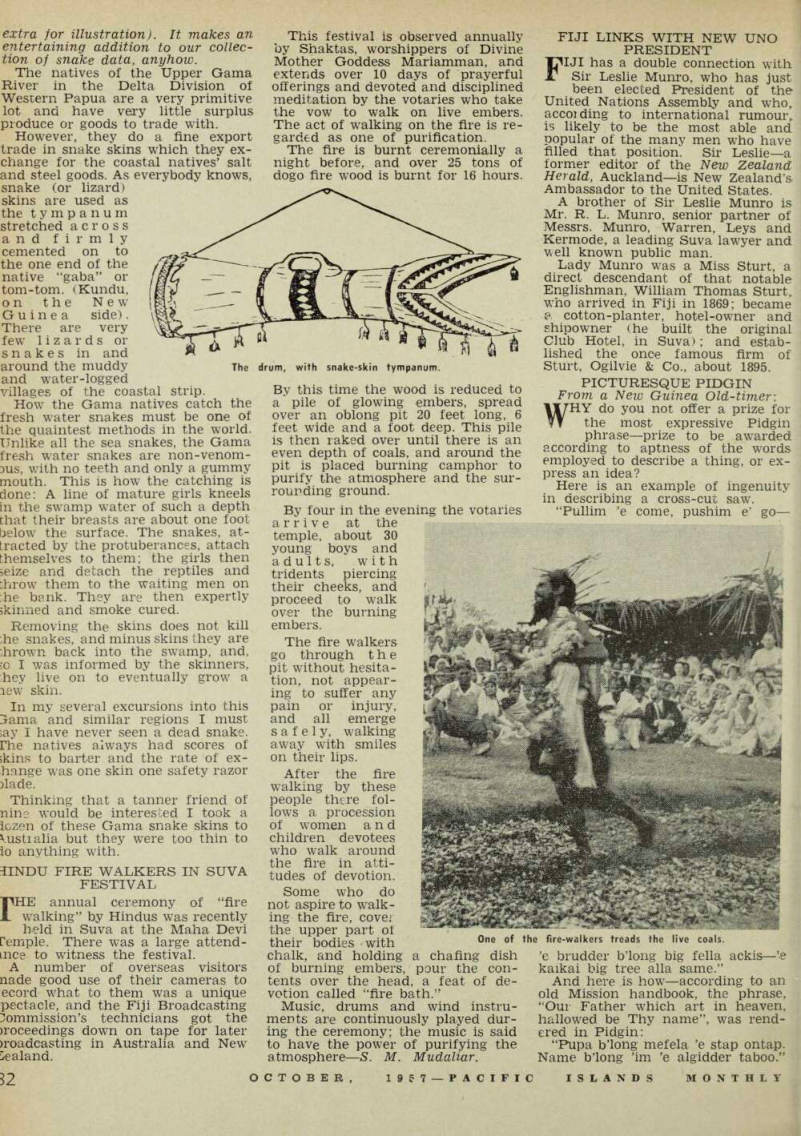
rHE annual ceremony of “fire walking” by Hindus was recently held in Suva at the Maha Devi Demple. There was a large attend mce to witness the festival.
A number of overseas visitors nade good use of their cameras to ecord what to them was a unique pectacle, and the Fiji Broadcasting Commission’s technicians got the )roceedings down on tape for later >roadcasting in Australia and New tealand.
This festival is observed annually by Shaktas, worshippers of Divine Mother Goddess Mariamman, and extends over 10 days of prayerful offerings and devoted and disciplined meditation by the votaries who take the vow to walk on live embers.
The act of walking on the fire is regarded as one of purification.
The fire is burnt ceremonially a night before, and over 25 tons of dogo fire wood is burnt for 16 hours.
By this time the wood is reduced to a pile of glowing embers, spread over an oblong pit 20 feet long, 6 feet wide and a foot deep. This pile is then raked over until there is an even depth of coals, and around the pit is placed burning camphor to purify the atmosphere and the sur rounding ground.
By four in the evening the votaries
arrive at the temple, about 30 young boys and adults, with tridents piercing their cheeks, and proceed to walk over the burning embers.
The fire walkers go through the pit without hesita tion, not appear ing to suffer any pain or injury, and all emerge safely, walking away with smiles on their lips.
After the fire w r alking by these people there fol lows a procession of women and children devotees who walk around the fire in atti tudes of devotion.
Some who do not aspire to walk ing the fire, cover the upper part oi their bodies with
chalk, and holding a chafing dish of burning embers, pour the con tents over the head, a feat of de votion called “fire bath.”
Music, drums and wind instru ments are continuously played dur ing the ceremony; the music is said to have the power of purifying the
atmosphere
S. M. Mudaliar.
Fiji Links With New Uno
President
FIJI has a double connection with Sir Leslie Munro, who has just been elected President of the United Nations Assembly and who, according to international rumour, is likely to be the most able and popular of the many men who have filled that position. Sir Leslie —a former editor of the New Zealand Herald, Auckland—is New Zealand’s Ambassador to the United States.
A brother of Sir Leslie Munro is Mr. R. L. Munro, senior partner of Messrs. Munro, Warren, Leys and Kermode, a leading Suva lawyer and well known public man.
Lady Munro was a Miss Sturt, a direct descendant of that notable Englishman, William Thomas Sturt, who arrived in Fiji in 1869; became a cotton-planter, hotel-owner and shipowner (he built the original Club Hotel, in Suva); and estab lished the once famous firm of Sturt, Ogilvie & Co., about 1895.
Picturesque Pidgin
From a New Guinea Old-timer : WHY do you not offer a prize for the most expressive Pidgin phrase—prize to be awarded according to aptness of the words employed to describe a thing, or ex press an idea?
Here is an example of ingenuity in describing a cross-cut saw.
“Pullim ’e come, pushim e’ go—
’e brudder b’long big fella ackis —’e kaikai big tree alia same.”
And here is how—according to an old Mission handbook, the phrase, "Our Father which art in heaven, hallowed be Thy name”, was rend ered in Pidgin: “Pupa b’long mefela ’e stap ontap.
Name b’long ’im ’e algidder taboo.”
The drum, with snake-skin tympanum.
One of the fire-walkers treads the live coals.