Ata (Pylstaart)
p. 88 · Read in the full issue
Was Well Known to Whalers
THERE is a fascination about those isolated islands scattered across the Pacific, which, though dots on a map, and now abandoned, were at one time large enough for little communities to live out their lives.
One such is Ata, Tonga’s southern most island —shown on older charts as Pylstaart’s Island—a fragment of whose history Mrs. Catharine E.
Cowie toldrin PIM last February.
Though Ata lies only 90 miles west-south-west of Tongatapu and is close to the shipping route from New Zealand to Nukualofa, ex traordinarily little of its history is to be found in any reference book.
There is an interesting reference to this island in a book just published and reviewed in the June PIM The Whaling Journal of Captain W. B. Rhodes, 1836-1838, which is worth quoting. It clearly shows that, in its heyday, Ata was far from unknown to the whaling masters.
Here is the extract from Captain Rhodes’s log: MONDAY. December sth (1836) p.m. Steady breeze, ship stand ing towards the island. At 4.30 returned on board. P’Astarts Isle is in Lat. 22.23 S., Long. 175.49 W. It is very high, but of small extent, being only about 3 to 4 miles in cir cumference.
The landing is both difficult and dangerous even in fine weather, and can only be accomplished in the native canoes. The settlement is on a small flat on the summit of the island, and it is difficult to climb up to it, the mountain being nearly
perpendicular. . . . .
We found the natives very friendly and obliging, and procured some pumpkins, sweet potatoes, etc., in exchange for clothing and calico.
There is 75 souls on the isle, but principally consisting of children.
They are a colony from Tongataboo and have not been more than 20 years on the isle. Cocoa-nut trees and most tropical plants are culti vated. They live entirely on fruits and vegetables, and are an interest ing and industrious people.
What few young girls there are, are very good looking. They are not to be procured except by those masters who have often visited the island. Indeed there are only two that have been allowed; and they are considered as wives and kept taboo’d. , , Captain Brin was the person who first succeeded, and has to pay pretty handsomely to support his lady She is a fine girl and a daughter to the Chief. One white man has resided on the island five years and is married to a young native girl.
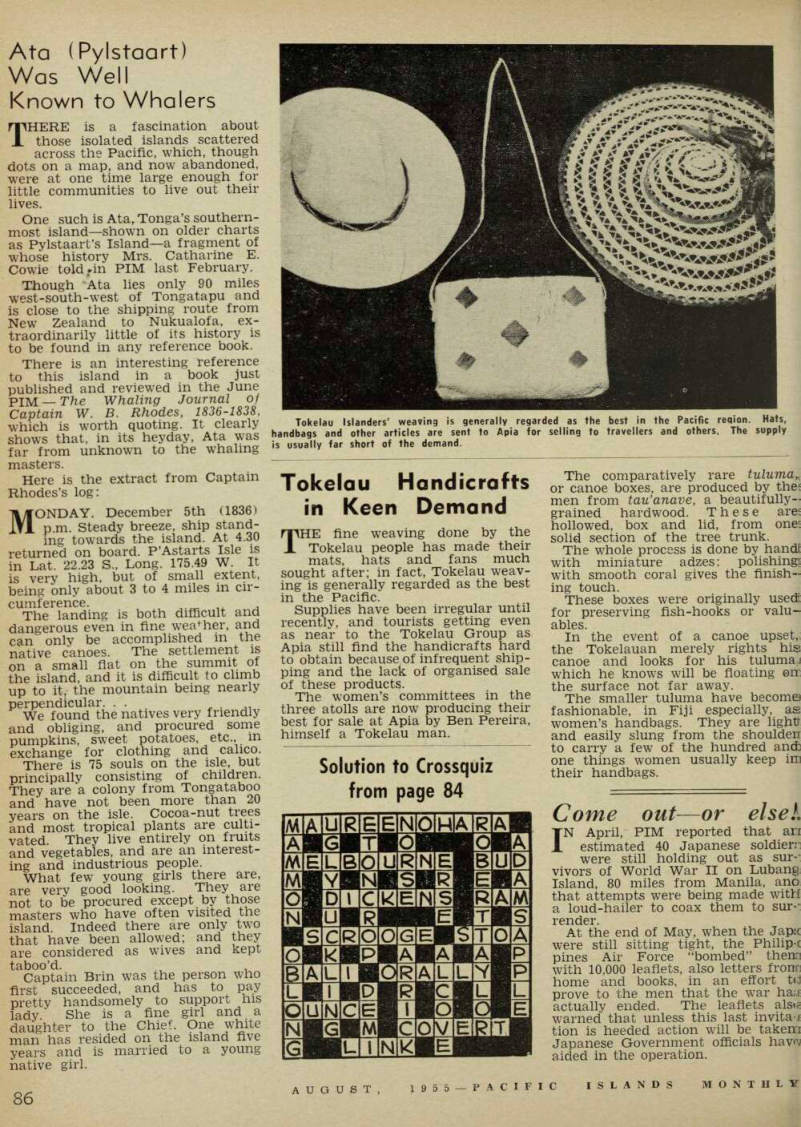
Tokelau Islanders' weaving is generally regarded as the best in the Pacific region. Hats, handbags and other articles are sent to Apia for selling to travellers and others. The supply is usually far short of the demand.