Penrhyn Was a Port of Call
p. 87 · Read in the full issue
Off The Shipping Lanes
By R-01
THE engine-room telegraph had rung “Stand By” and then “Stop Engine .” The light easterly breeze caused the ship to drift slowly to leeward, whilst waiting for the local pilot to board ship and take her through the narrow entrance to the Penrhyn Lagoon.
This passage is known as the “Taruia Passage.” and is on the Western side of the atoll. The depth of water in the passage seemed barely enough to float the ship, but the absence of muddy river waters in this region gives a stranger to these parts the false impression that the reef bottom is far too close for comfort. The kea water is crystal clear and the ebbing tide through the passage seems to give movement to the coral rocks that are the worry of every skipper who visits the place.
The ato’i is somewhat off the usual shipping lane, low lying, visible from a ship’s deck in clear weather for about twelve or thirteen miles. It is known locally as “Tongareva,” and is made up of numerous small coco nut islets surrounding a beautiful lagoon, which is a delightful picture when the sun is high overhead, showing up the small coral patches in blues and greens.
Our deck passengers were full of ex citement at seeing their home island so soon—the ship having made a good run up from Rarotonga, 750 miles to the south. All had been busy rolling their sleeping mats and dressing in all the finery they had purchased in Raro’ especially for the occasion—and, of .course, trying to get a glimpse of things dear to them as the ship coasted along the reef, close in near the village of Omoka.
On shore there was also great activity, due to the early arrival of the ship. A group of young boys and girls could be seen on the beach trying to keep pace with the ship, waving and shouting greetings.
From the lagoon side of the small islet that has the village of Omoka on it, it was possible to see the Resident Agent’s small auxiliary cutter steaming out to meet the ship, with the local pilot. Quite a number of people availed them selves of this opportunity to be the the first to greet their friends or relatives as the case may be.
The pilot aboard, we got under way again and stood in towards the passage. Our Captain had been here before and knew the pilot—an old sea-dog himself in his younger days, but now a “skin” diver for pearl-shell. Local rumour has it
that he has reached the 20 fathoms mark in some of his diving efforts — and the envy of some of the younger fellows on the atoll. His handling of the ship and his know ledge of the reef and the numerous coral patches, down to the anchor age off the village, were remarkable The vessel was brought to anchor in about five fathoms of water, roughly a cable’s length from the rock wall that surrounds the local trading store on the lagoon side of the land. Many other islanders came out to the ship in canoes and
pearling cutters—no doubt a colourful reunion. The flower garlands worn by the villagers were a very pretty picture. Eventually visitors and passengers mads their way to shore and all was peaceful on board.
Usually the smaller trad ing vessels plying between the North and South Cook Islands lie practically alongside this rock wall to work cargo for this port, the mooring of the vessel being quite an education.
Assisted by a couple of local divers—of w T hom there are many experfs to choose from —the vessel is brought in fairly close to two small convenient coral heads that
have worn a stout chain of office for the past forty years, according to the locals. The divers go down to secure the bow and stern lines of the vessel. The last few feet be tween ship and shore is bridged by a gang plank. This is the commence ment of chaos, as each person hav ing cargo to ship or receive does his best to have his little lot at tended to first, the poor super cargo having a busy time among the excited shippers, passengers, and visitors, all mixed up together on deck. The excitement is easy to understand, as local ships are not frequent callers at Penrhyn, and stores are quite often at vanishing point. pur cargo was put ashore in the ship’s work boat, a much slower way than the gang-plank method, but the decks were not so crowded.
Our second officer, an old hand in the lore of the sea, gained some little fame as a healer of the sick, mainly due to his effort aboard ship on the run up from Raro’, in full view of the deck passengers, when he attended to the odd cut or bruise amongst the sailors. No sooner had we cleared the cargo we had brought than he was ca’led a r hore to a young boy who had a fish-bone
lodged in his throat. The bone was stubborn and was still there four days later when we left the lagoon.
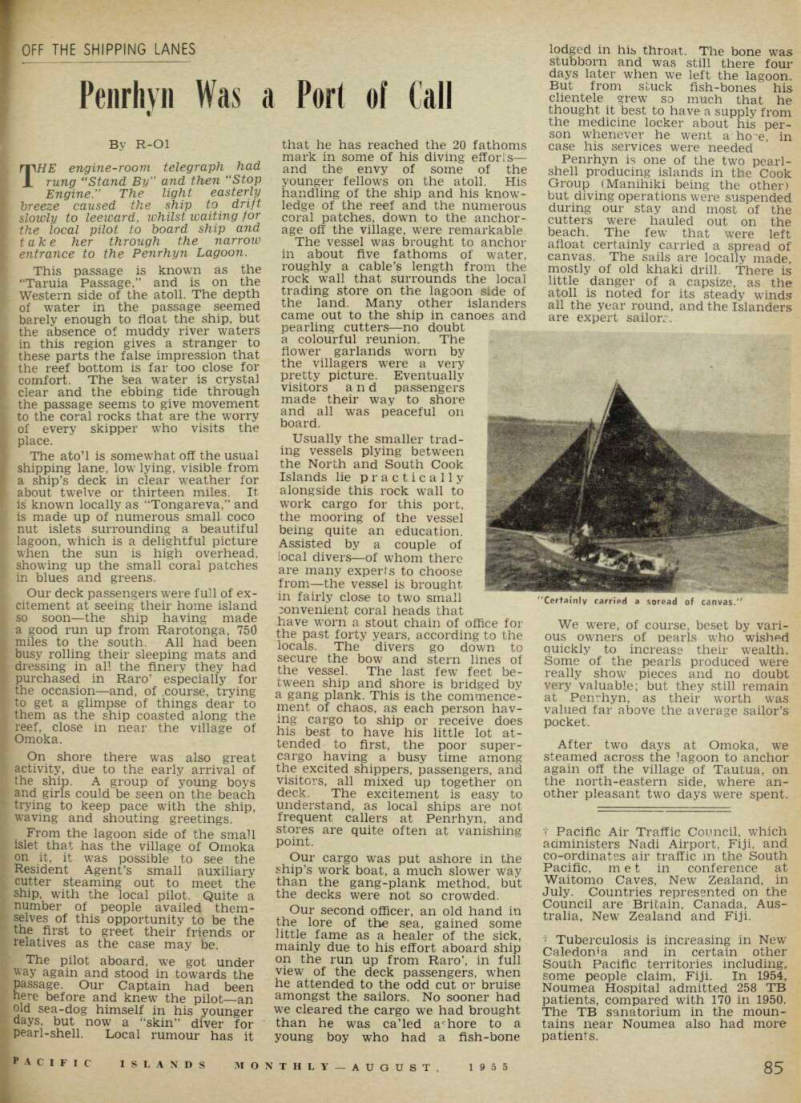
But from stuck fish-bones his clientele grew so much that he thought it best to have a supply from the medicine locker about his per son whenever he went a ho e, in case his services were needed Penrhyn is one of the two pearl shell producing islands in the Cook Group (Manihiki being the other) but diving operations were suspended during our stay and most of the cutters were hauled out on the beach. The few that were left afloat certainly carried a spread of canvas. The sails are locally made, mostly of old khaki drill. There is little danger of a capsize, as the atoll is noted for its steady winds all the year round, and the Islanders are expert sailor:.
We were, of course, beset by vari ous owners of pearls who wished quickly to increase their wealth.
Some of the pearls produced were really show pieces and no doubt very valuable; but they still remain at Penrhyn, as their worth was valued far above the average sailor’s pocket.
After two days at Omoka, we steamed across the l agoon to anchor again off the village of Tautua, on the north-eastern side, where an other pleasant two days were spent. v Pacific Air Traffic Council, which administers Nadi Airport, Fiji, and co-ordinates air traffic in the South Pacific, met in conference at Waitomo Caves, New Zealand, in July. Countries represented on the Council are Britain, Canada, Aus tralia, New Zealand and Fiji. t Tuberculosis is increasing in New Caledonia and in certain other South Pacific territories including, some people claim, Fiji. In 1954, Noumea Hospital admitted 258 TB patients, compared with 170 in 1950.
The TB sanatorium in the moun tains near Noumea also had more patients.
"Certainly carried a soread of canvas."