Many came to this.. .
pp. 17-154 · Read in the full issue
nded on good Yankee dollars, I, to a lesser extent, to good Aus lian and New Zealand pounds, .nd, wherever the Americans it they fell in love and some es married. And as a con aence, in the United States, now ttered over the 48 States of the ion are young women, war brides the early post-war period, from and Australia, the Samoas and v Zealand—tens of thousands of m in the aggregate, forging, with ir husbands and their children, rig links between the South Seas [ the United States.
Escape from
Japs
s the Japs moved with speed th and east, it was inevitable t many Pacific Islands dwellers I ke one morning to find them es behind the Jap advance. The 'tion was usually immediate: to ipe. The following is just one i story out of hundreds. It was oared from official reports and orts from the men concerned, all which came to us in the early years but which we were unable ise then, for security reasons. 5 now presented, it forms part i book manuscript of a collec of Pacific war escape stories :h we hope some day to publish ts entirety. This is the first time escape from the Gilberts in early has seen print. ‘ART from Roman Catholic missionaries, of whom there were between 30 and 40 in the
whole Gilbert Islands, there were only about 20 Europeans left in the Group at December 7, 1941—the women and children having been taken south in a ship only a few days earlier.
Most of those Europeans were on Tarawa, which was the pre-war administrative centre of the Gilberts.
The administrative officer, Mr. A. C.
Bevington, was, however, on the ad ministrative patrol vessel Kiakia when they heard of the Japanese raid on Tarawa on December 10.
Thinking that the atoll had been permanently occupied, the Kiakia therefore turned southwards and later reached Suva.
Besides F. L. G. Holland and R. C.
Morgan, stationed on Bairiki, there were on Betio Islet, Dr. D. R. Steen son, Chief Govt. Medical Officer, Dr. L. Isaac, his assistant: Mr. A. C.
English, postmaster and Customs Officer; Mr. George Jenner, manager of the local branch of Burns Philp (SS) Ltd.; his assistant, Mr. Clark; Captain T. C. Doughty, of Burns Philps’ auxiliary schooner Helena; and Captain I. R. Handley, retired master-mariner. Later they were joined (December 9) bv the officers of the RCS Nimanoa— Captain E. W.
Harness: Chief-Officer Harold Stead; Messrs. Sinclair and Hunt, engineers; and on January 17 by the survivors of the Panamanian Donerail. (■Donerail had been sunk near Hawaii by a Japanese submarine two days after the attack on Pearl Harbour. The sub had shelled the ship as passengers and crew were manning life-boats swung out from
their davits. Twenty-four people out of the 42 on board had been killed and the survivors had taken to a large steel life-boat which normally would have accommodated 50. The boat had been badly holed by shell-splinters and sank to the gunwales, being kept afloat by its air tanks. The occupants Anally succeeded in plugging most of the holes with pieces of clothing. In the next 38 days, before they reached Tarawa, they lived on salt water-soaked ships’ biscuits, flying fish, vitamin tablets and a case of milk. They continually fought off attacks by shark s—particularly during the first days when the boat was partially filled with water, and of the 24 who began the voyage only eight reached Tarawa alive. Of the survivors five were Danish, one Norwegian and one Australian— Murray Chambers).
When Betio was awakened by the approach of two Jap destroyers in the early hours of December 10, 1941, Dr. Steenson sent a message to Mr.
English, as Customs Officer, and the local manager of Burns Philp, to destroy all oil stocks, as previously arranged. Mr. English who normally was a quiet retiring type of man, and perhaps might have merited be ing described as timid, showed up extraordinarily well in this crisis. He not only frightened away the Jap anese by brandishing his axe and a torch when destroying the Gov ernment oil stocks, but later he re fused to hand over the key of the Government safe to a Japanese soldier who demanded it at the point of a bayonet. When he got
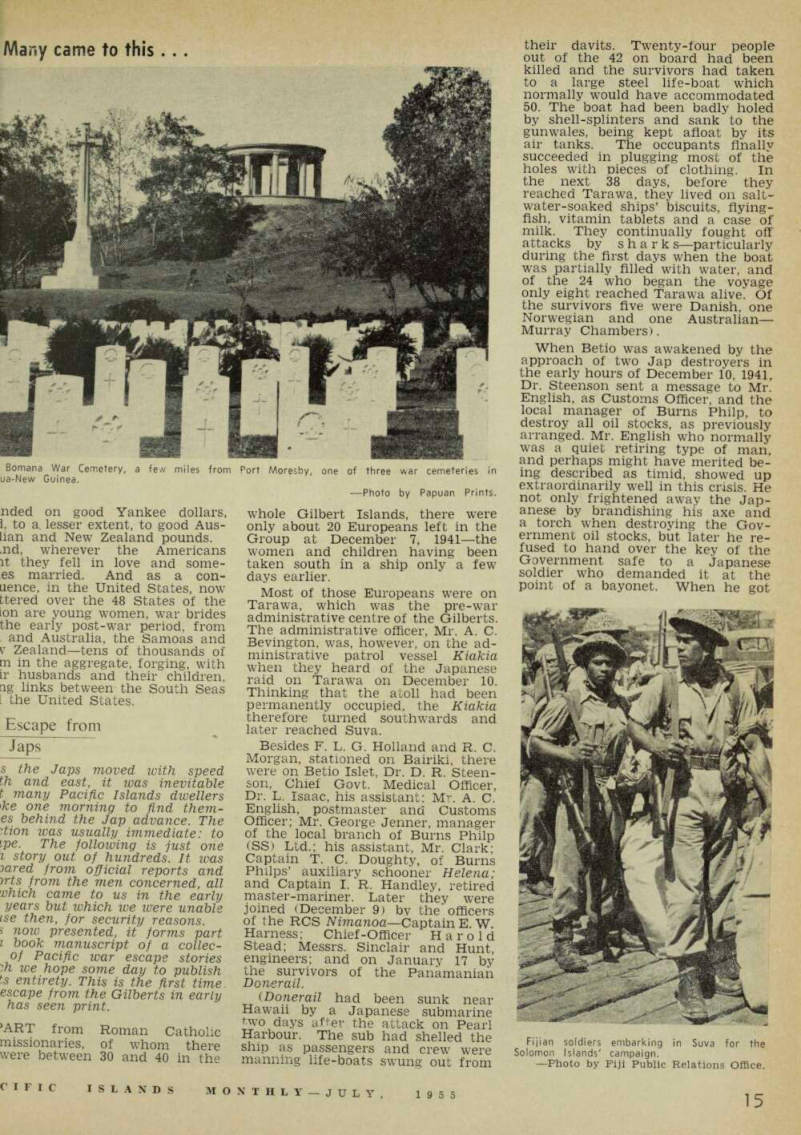
Bomana War Cemetery, a few miles from Port Moresby, one of three war cemeteries in ua-New Guinea.
Photo by Papuan Prints.
Fijian soldiers embarking in Suva for the Solomon Islands' campaign.
Photo by Fiji Public Relations Office.
nowhere with Mr. English the Jap attempted to break the safe open with an axe but succeeded only in breaking off the handles. Later, after English had been tied up, the key was obtained but by that time the safe had been so knocked about that it could not be opened with a key. After the Japs had departed, the handles of the safe were re fitted by an engineer off the Nimanoa and it then opened easily.
In this way £l,OOO of the Colony’s money was saved from the enemy.
When the Japanese marines landed on the beach apparently the first European house that they reached was that of Captain Handley, where a great commotion immedi ately began—the Japs smashing things and the old Captain cursing them roundly. From Handley they went smartly across to Jenner’s bungalow where they baled up the BP manager, Clark, and a Euro nesian foreman. From Jenner they demanded the keys of BP’s store — their intelligence system was apparently pretty good: they knew what they wanted and that Jenner could lead them to it. The keys were produced: the party proceeded to the store, which was unlocked. What the Japs saw inside made them very content. Jenner and party were taken along to join the rest of the European population then being herded together at the adminis trative offices.
The Japs then turned their at tentions to Nimanoa and Burns Philp’s auxiliary schooner Helena.
Nimanoa had arrived at Tarawa on the afternoon of December 9.
An air-raid had been reported from Ocean Island that same afternoon and Nimanoa’s master, Captain E. W. Harness, was doubtful if he should stay in Tarawa. However, it was expected that if leaving the atoll were considered a matter of
extreme urgency by Authority, radio instructions would come from Ocean Island. Captain Harness therefore prepared to stay the night ashore with Dr. Steenson. Chief-Officer Harold Stead, the second engineer and several of the native crew stayed on board and commenced to take on oil and water in preparation for an early get-away.
The first intimation Captain Stead had that the Japs had landed was when Sinclair, the Nimanoa’s engineer, came on board with a message from Captain Harness that Stead was to bend on a white flag in case the ship was shelled from the sea. Stead destroyed the ship’s codes and made his own prepara tion for dealing with the Japs: he knocked the pin out of the shackle in the starboard chain, all ready for slipping at a second’s notice.
Some time before 5 am two native wireless telegraphists came on board and attempted to get into com munication with Ocean Island— they had been chased out of the station ashore by the Japs. But be fore they could establish contact, the Japanese had brought their machine-guns down to the jetty and opened fire on both Nimanoa and Helena.
There was now nothing much left for Stead to do but slip the cable although the tide was not quite right for so doing. Daylight was coming fast, and at 6 o’clock he took out the pin of the shackle and let the cable go. Nimanoa drifted slowly before a northerly wind and, at high water, went firmly or to the reef near the Government wharf. Stead remained with his ship until a boarding-party arrived about 9.30 am and took him ashore to the line-up.
To an inquiry from the Japanese Naval Officer as to who had slipped
the anchor chain, he laconically ve c . plied, “I did.”
His action prevented Nimanon falling into enemy hands. Captaiii Harness was ordered to get thf Nimanoa off the reef but when r was shown that this was clearlj impossible, a demolition charge \va£ placed in her. She was blown up and her wreckage burned for some hours.
While Stead was s 1 i p p i n; Nimanoa’s cable and drifting to thf reef, Captain Doughty was lying lov on the Helena. But finally he deE cided that he would have to g* ashore and find out what was hape pening, so rowed himself there in i dinghy and was promptly made prisoner by the Japs.
After interrogation he, with youm Narruhn, the engineer, were takei; back to the Helena and forced td start up the engine and go outsidi the entrance to pilot one of the Jap destroyers into the lagoon. Once inr side, the destroyer’s officers cam ashore, seized every available boas and began to transport BL merchandise to the Helena.
The dozen Europeans of the isle and a number of Euronesians re5 mained under guard near thr Customs House throughout most cd the day. One or two otherwise grim incidents had their brighter side« When the belligerent Captaii Handley arrived at the line-up, aft© an earlier dust-up with the firs flush of Japs at his own bungalow he was sweating in a pair of handt cuffs. The Japs had found thr handcuffs when looting his hous and had promptly applied them tJ their still demonstrative owner. HE remained for some time in them until, in fact, other Europeans sue cessfully pleaded with the Japanese to release the old man.
By the time the destroyer ha|i come inside the lagoon the invaden
(Continued on page 145)
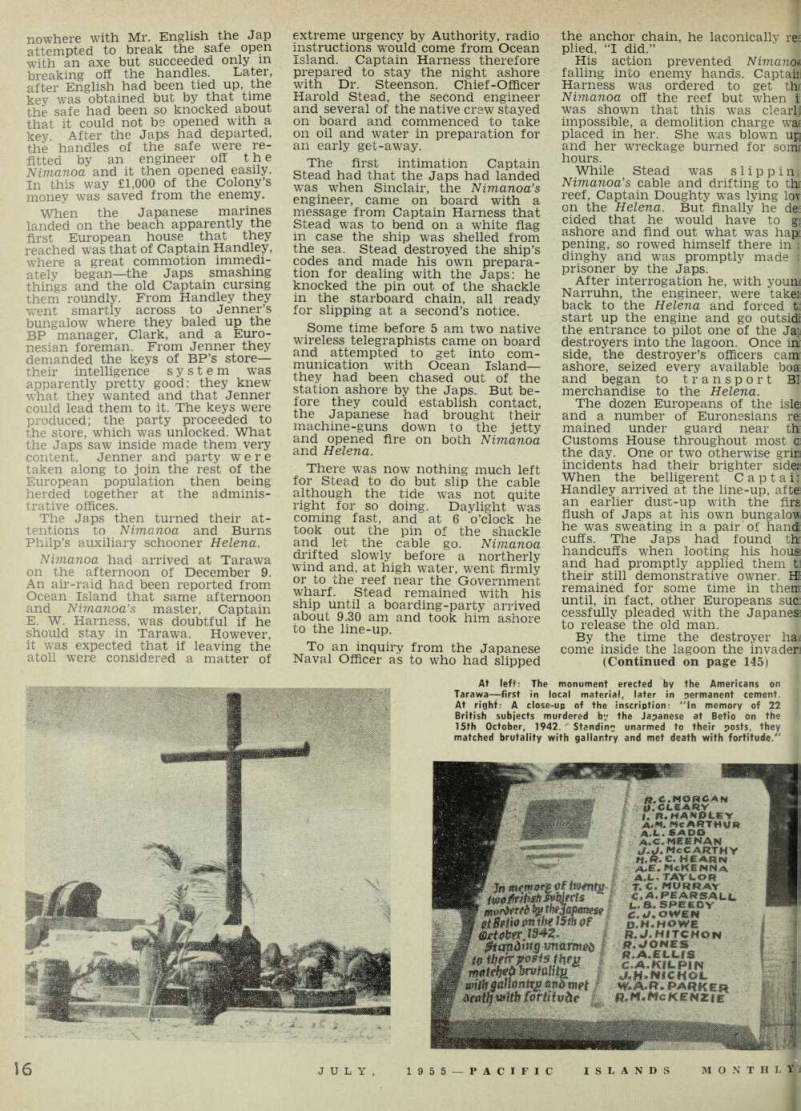
At left: The monument erected by the Americans on Tarawa —first in local material, later in permanent cement.
At right: A close-up of the inscription: "In memory of 22 British subjects murdered by the Japanese at Betio on the 15th October, 1942. Standing unarmed to their posts, they matched brutality with gallantry and met death with fortitude."
id found that Dr. Steenson was e senior official in the little ttlement. He was forthwith taken l board for interrogation. He was i the grill for some hours and en, to his own surprise, was per itted to return to the beach, row g himself the six miles there. He d one quaint experience. A bitter nd was blowing when he reached e destroyer, and to curb his ivers the Japs handed him three •ge Union Jacks in which to drape nself. He was still wearing this newhat original costume —to the lazement of his friends —when he Tie ashore. So much for the Japs' eged lack of humour.
Late in the afternoon, the gstioning, looting and boat ashing complete, the Japanese ik their departure, taking with un the Helena and her native w and as many stores as they ild put into her. They towed her Butaritari behind a destroyer, at >ut 15 knots, and it was learned sr that that junketing had almost led the bows out of her.
ACK on Tarawa the Europeans began to take stock. The Japs were gone, for the moment at st. They were alive, and free, if ng confined to Tarawa could be led freedom. At first glance re seemed little chance of escape boat—the Japs had made a tty thorough job of putting these of action. liey settled down into an uneasy et, broken on December 25 when y were visited briefly by another lanese warship, and on January by a large sea-plane, which ;hted on the harbour and dis ged another party of officials. ) came ashore for a couple of irs to look the Tarawa com uity over. The only noteworthy dent of this visit seems to have ;en out of the Japs’ desire to 1 a refrigerator for their Com idant. They looked over all those liable and then settled for that Dr. Steenson’s bungalow. They :ied it painstakingly over the t to the jetty only to find that would not go into their little ber dinghy. It was earmarked collection at some future date, y now’ six weeks had passed e the Japs’ first visitation—but without a certain amount of iveness on the part of some of Europeans. It was inconceiv ■ that they would allow them the of Tarawa indefinitely and that Japs would not, in time, come some decision as to their fate. seemed imperative to the iier souls that they should :e good the breathing space wed them and try to escape, s resolve w T as strengthened by discovery, after the first visit the Japs, that one of Burns ip’s launches was not irretriev
ably damaged and the further dis covery of a new’ diesel engine in Burns Philp’s store.
But there were others who, over cautious, were prepared to wait in the hope that the initiative would be taken out of their hands and that Authority—now a somewhat nebulous affair in far, far, off Suva— would send a ship or a plane to the rescue.
Nine days after the first Jap visit, Captain Stead, Nimanoa’s Chief Officer, who had already shown hiwself a man of decisive action,
was hard at work on the least damaged launch, installing, with the help of the ships’ engineers, the new’ diesel engine. A certain amount of understandable agitation was felt by the amateur boat-builders when the Japs paid their second visit on Christmas Day, but the boat escaped their attention and a few days later was pronounced ready for sea.
The small community met to gether to discuss the venture but now the majority of them were struck by the immensity of the task —the large expanse of unconcealing ocean, the frequency of Jap air re connaissance, the great distance be tween them and safety in Suva.
One by one they backed out, leav
ig Stead baffled, fuming with ustration. Captain Harness said lat he was of the opinion that the unch, towing a life-boat, could not ;t through the Jap reconnaissance; i proposed to put off the venture itil the next full moon to give the ip vigilance a chance to slacken.
“I will go in a sailing boat if meone will volunteer to come th me!” said Stead.
There was no response.
Another month went by and all is made ready again. Another nference was called. Still the me reluctance to take to the sea. iptain Harness said that he still nsidered the reconnaissance too )se and that he would not take e responsibility of trying to get e launch and life-boat of evacuees rough to safety. He resigned the idership. Dr. Steenson and Hunt, 'ond engineer of the Nimanoa, re sed to go without Captain Harness t Stead took on the job of leader ip. rhat night, however, as they ided the last of the stores into 0 launch, Sinclair, chief-engineer the Nimanoa, suddenly pulled out. ft thus without an engineer, Stead d to abandon the trip—in the inch, anyway.
Ne can imagine with what baffled ?e Stead called off his cherished ape plan for the second time, reiterated what he had said after 1 first failure—that he would go
alone if he must. This brought one response.
A young Chinese-Gilbertese, Yee- On, who had been a sailor in the Nimanoa for a month or so but who was then acting as a house-boy, approached Stead. “I will go with you,” he said, “even if you go in a canoe.”
After the reluctance of the Euro peans this was encouragement in deed, and Stead therefore began to look for a suitable boat without loss of time.
Two German-Marshallese, Fritz and Henry Reiher, had repaired a sailing boat for their own use in the lagoon, and, to use his own words, Stead “fixed his eye upon it.”
None of those who properly could be said to constitute Authority upon the atoll were encouraging, either when Stead showed signs of want ing to commandeer this boat, or in suggesting other boats. The little community, out on the end of a limb, ripe fruit for Jap plucking, were strangely bound by Govern mental red tape as to what could, or could not be done. There was even some argument as to what the Government, now almost ungetatable in Suva, would pay for.
Captain Harness wished to keep the Nimanoa’s life-boat to tow be hind the launch when he considered it safe for a large party to go, so Stead did not ask for that; but when Murray Chambers, one of the survivors from the torpedoed Donnerail, signified that he was
willing to leave with him, the two men approached Henry Reiher and told him that they were forced to take the boat that he and his brother had repaired but that they would pay £lO for it. Both the Reihers refused to take anything for the boat; on the contrary, they were co-operative and wished the voyagers luck.
THE morning of February 9 was spent loading stores and making ready for sea and when all was complete, Mr. Jenner appeared and announced that he, too, would go along. The members of the party, now four in number, left the jetty at 2.30 pm. As they sailed down the lagoon a Japanese plane passed overhead but took little notice of them.
The boat was double-ended, rather narrow of beam and carvel built.
She was 24-ft long and carried a mainsail and staysail. In moderate winds and smooth water she sailed well but she was so low amidships
that she was not safe to sail in a strong breeze or a sea way.
Stead had been told by the Islanders that she wanted plenty of live ballast —at least ten men. How ever, not having the ten men, Stead loaded her with 600 pounds of iron ballast, plus the stores and water tie carried, and as an extra pre caution, he lashed four empty 44gallon drums in her in case she filled.
Stead’s idea was to get to Nonouti, in the Southern Gilberts, by way of Maiana and Abemama. That was the first objective—Nonouti; but if necessary he was prepared to go on still further —somewhere, so long as It offered reasonable means of escape from the Japanese.
A two hours’ sail took the small party to Bairiki, where F. L. G.
Holland and R. G. Morgan made them welcome and provided them with an excellent dinner before they went on their way again.
By 10.30 pm, Stead calculated that there was sufficient water in the passage between Betio and Bairiki to let them through to the open sea. To make matters more dif ficult it was a period of neap tides but after a few minor bumps and shipping a few gallons of water they got through and were on their way in deep water. The Government
station at Maiana was reached at 9.30 am next day.
Here they were made welcome and here also they found another boat, smaller than their Tarawa boat but more seaworthy. Here, also they
were held up for almost ten days by bad weather, during which they painted their new boat, transferred sails, stores ballast and the oil! drums and waited, as patiently as possible, for the weather to moderate
fficiently for them to leave the foon.
A.t 6.45, on February 20, they tally made the choppy sea and ?an the long beat round the north Lnt of Maiana until they could set “ small boat on her course for emama. By mid-morning on the lowing day they had sighted emama and a little after noon had reached the government ,tion. rhey were again welcomed by the tive officials and by two of the w Zealand soldiers who had taken coast-watching posts on the ill (and who subsequently were rdered by the Japanese). laptain Stead records that he did ; have a pair of parallel rulers i that a Private Howe made him eally fine pair. lere at Abemama, Jenner and aimers left the party, having de a deal with a Euronesian to e them to Nonouti in a cutter er extensive repairs had been de. Both had had enough of in boats and anything with a k looked good to them, itead, however, elected to carry and get to Nonouti as soon as sible and Yee-On carried on with i. The weather again held them for a few days but on February it had moderated sufficiently to fe. But once outside they found t the wind had again freshened i that there was a heavy sea run g. Soon the second reef had to taken in the sails and the boat lively, shipping much water, for whole of the passage. Yee-On sea-sick, but always willing to his share. fter 16 hours at the tiller, Cap i Stead was in over the passage into the quiet waters of Nonouti >on, and journey’s end was in it. t Nonouti, the RSC Degei, er the command of Captain I. Webster, was expected within veek. In the early hours of •ch 9, Captain Stead went out neet her. After three months alarms, doubts and excursions, tain Webster, he said, looked a figure of a man to him, the ei “as substantial as a battle * * * EANTME, back on Tarawa, all hope of relief by plane had gone. There was now only two rnatives, escape by the route ady taken by Stead and his y, to connect up with the relief i which they now knew could i them off from the still com itively safe Southern Gilberts; n indefinite stay on Tarawa, n February 27, two days after id had already arrived at outi, they left Tarawa in the ich which towed two life-boats party of 24 in all. Apart from missionaries and the New Zea i coast-watchers, there were l left in the northern Gilberts five Europeans—R. G. Morgan, L. Sadd, A. M. McArthur, B.
Cleary and J. R. Handley. Their fate, together with that of the 17 New has been recorded in PIM.
The launch with its two life boats in tow and with the inevitable delays caused by the chancy weather of those latitudes, plus one alarm when a Japanese plane passed overhead, reached Nonouti on March 9 by way of Maiana and Kuria.
They made rendezvous with Webster outside the reef as he was steaming north to search for them.
They transferred immediately, join ing Stead and the three original members of his party and 11 sur vivors of the USS Prusa, who had, in late January, 1942, been cast up on Nikunau, in the Southern
Gilberts, after being at sea in an open boat for 31 days.
The party of 40 landed at Suva on March 18, 1942.
But Many Did Not Escape
MANY, of course, did not escape.
And concerning these, the most disgraceful episode was the sacrificing of about 300 men civilians at Rabaul (all women and children had been evacuated from the Terri tory in December, 1941).
The defence of Rabaul was in the hands of the 2 22nd Battalion, AIF, which had been garrisoned there for a couple of years before the Jap anese invasion of January, 1942.
There was also some attempt at
defence instruction. But the inese invasion was well organ and overwhelming and the ic defence put up by the Rabaul of the New Guinea Volunteer ;s, the 2/22nd, and the men of RAAF in their half-dozen out ed Wirraway planes, lasted a ter of hours, and then the al order was, “Every man for (elf.” the weeks following January 942, hundreds of soldiers were ded up by the Japs (hundreds thers were helped to escape by Coast Watchers) and so were t 300 Rabaul civilians. These ners were eventually shipped r to Japan in the Montevideo i, which was bombed about , 1942, near the Philippines. All oard were lost. news was received of these all through the war, but their ; and relatives assumed or ly, perhaps, hoped—that they still alive somewhere, probably ipan. our issue of September, 1945 — first after the Japanese sur ?r—we described how the De nent of Territories had set up •ge Prisoners’ Welfare Section ydney to deal with and take of released civilian internees.
But “unhappily, there is little for the Section to do. . . There is one explanation of circumstances for which relatives of missing men must be prepared. It definitely is a pos sibility that the great majority of the civilians were placed aboard a ship in Rabaul about June, 1942, and that that ship was lost. .
In August, the New Guinea organisations which had flourished in Sydney during the War had held a celebration in the Paddington Town Hall. By September hope was beginning to fade for the civilian internees. By October, almost 200 New Guinea women knew that after waiting for 3i years for their men, for three years they had been widows.
The men who were lost were the cream of the old New Guinea population. Heads of Government departments, leading public servants, planters, merchants —the great majority of them veterans of the First World War —had gone.
The tragedy was, of course, that they should have been alive.
In early January, 1942, there arrived in Rabaul the motor-vessel Herstein, to load copra. By this time those in authority could already see the writing on the wall and the Government Secretary, Mr.
H. H. Page, who was acting Admin istrator at the time, radioed Can berra on at least two occasions ask ing permission for the Herstein to be utilised to carry the civilian
population away to safety in Ausl tralia. Permission was refused. I During the invasion of Rabaul, on January 23, Herstein was bombed by the Japs, set on fire and subsel quently sank. A picture of her pro! peller salvaged from Rabaul harbour in 1954, appeared on a PIM cover last year.
No one will ever know why the| civilians of Rabaul were denied help; or why their lives and the Herstein were wantonly thrown! away. Canberra and the guilty men who are responsible have main] tained a stubborn silence for 13 years.